
Araceae · Reproductive Biology
THE ARISAEMA
INFLORESCENCE
The one flower on earth that takes its pollinators prisoner — and never opens the door
Opening
The Only Flower That Never Opens the Door
A great many flowers cheat their pollinators. A much smaller number imprison them. Exactly one genus keeps them. In Arum, in Dracunculus, in Sauromatum and Helicodiceros, the trap is a night’s detention: the fly is held, loaded with pollen, and released through the entrance it came in by. In female Arisaema there is no release. The fungus gnat that falls into the tube pollinates the flower, exhausts itself against a wall it cannot climb, and dies there.
Take it to the plant
Not here for the botany, and just want seed? The printable field card is the working half of this page on one sheet — how to sex a plant in one glance off the hole at the base of the spathe, the three-week season, the corm rule that decides which sex you get next year, and the cross step by step — with a second side carrying the corrections that matter at the bench, including why a spathe you cannot smell is not finished, why dead gnats in a female tube are the system working, and why the one manipulation ever tested says never to tidy the appendix.
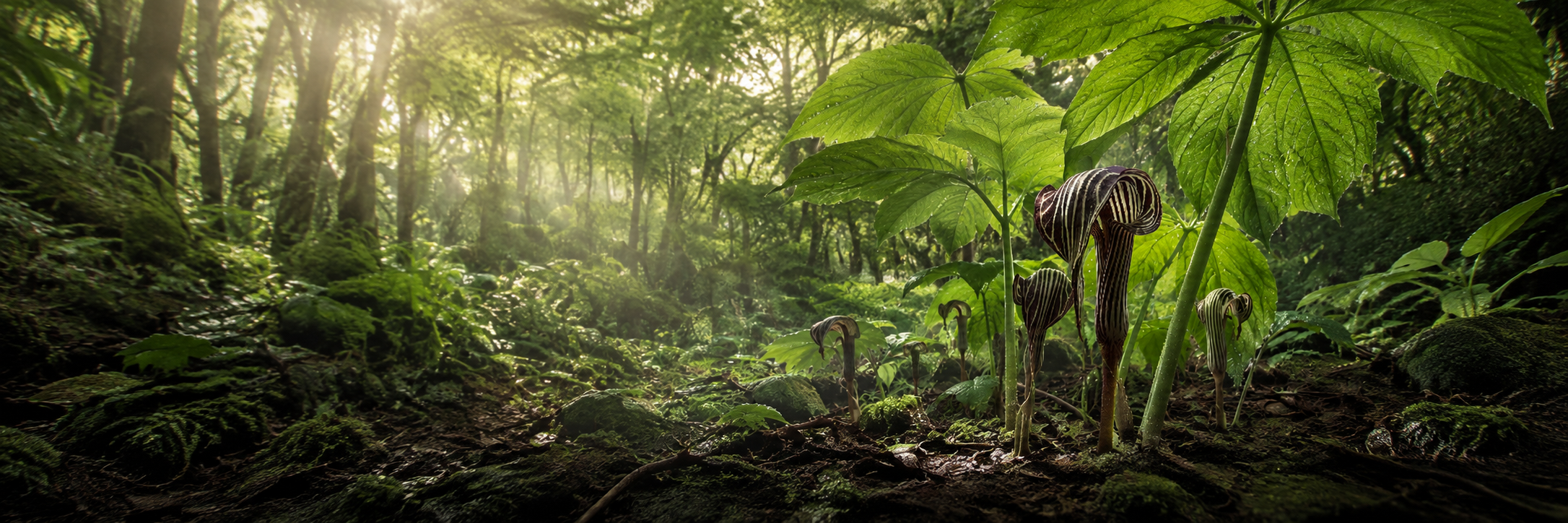
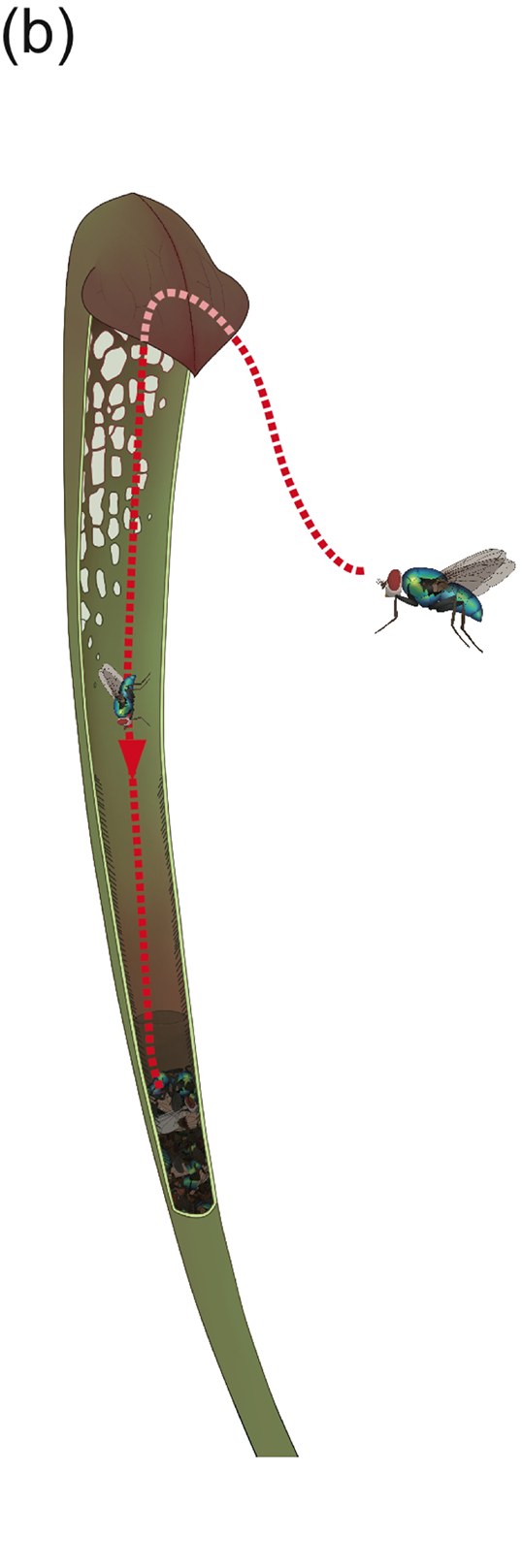
The plant most English speakers know it by is jack-in-the-pulpit — Arisaema triphyllum, a perfectly ordinary-looking woodland herb of eastern North America. The hood over the spadix reads as shelter. It is not shelter. It is the lid of a pitfall, and the resemblance to a carnivorous pitcher plant is close enough that the same review paper draws Arisaema and Sarracenia side by side and calls it convergence — two lineages arriving at the same trap for opposite reasons. The pitcher plant catches insects to eat them. Arisaema catches them to move pollen.
What this page is really about
Not the killing, which is easy to sensationalise, but the engineering underneath it — and the fact that the engineering explains the killing. The trap has no moving parts at all. Nothing opens, nothing closes, nothing relaxes on a schedule. That single constraint accounts for the escape hatch in male inflorescences, for the choice of victim, and for why the females cannot let anyone out even if it would pay them to.
How much this rests on, said plainly
The genus has 224 accepted species. Detailed pollinator data exist for fourteen of the fifty-three species native to Japan, for nine species sampled across Nepal in the survey that established the mechanism, for one species in Quebec watched through a whole season, and for four Chinese species in work published in 2025. Everything else — including the entire African group of eight species, stranded on mountains in Ethiopia, Uganda and Tanzania — has never been watched at all.
That is thin coverage for a genus this size. It is also, for a trap this strange, remarkably good: Arisaema has been under continuous investigation since the 1920s, and the last four years have produced more new mechanism than the preceding eighty.
One habit this page keeps
Where a number comes from a single plant, a single season or a single garden, the page says so in the sentence that carries it. This matters more here than on most of these pages, because the foundational survey is largely built on plants cultivated in European botanical gardens, visited by European fungus gnats standing in for species none of the authors could watch at home. That is a real result — the plants lure a substitute cast perfectly well — but it is not the same as a wild population, and the page keeps the two apart.
Part I
The Trap, in the Order a Gnat Meets It
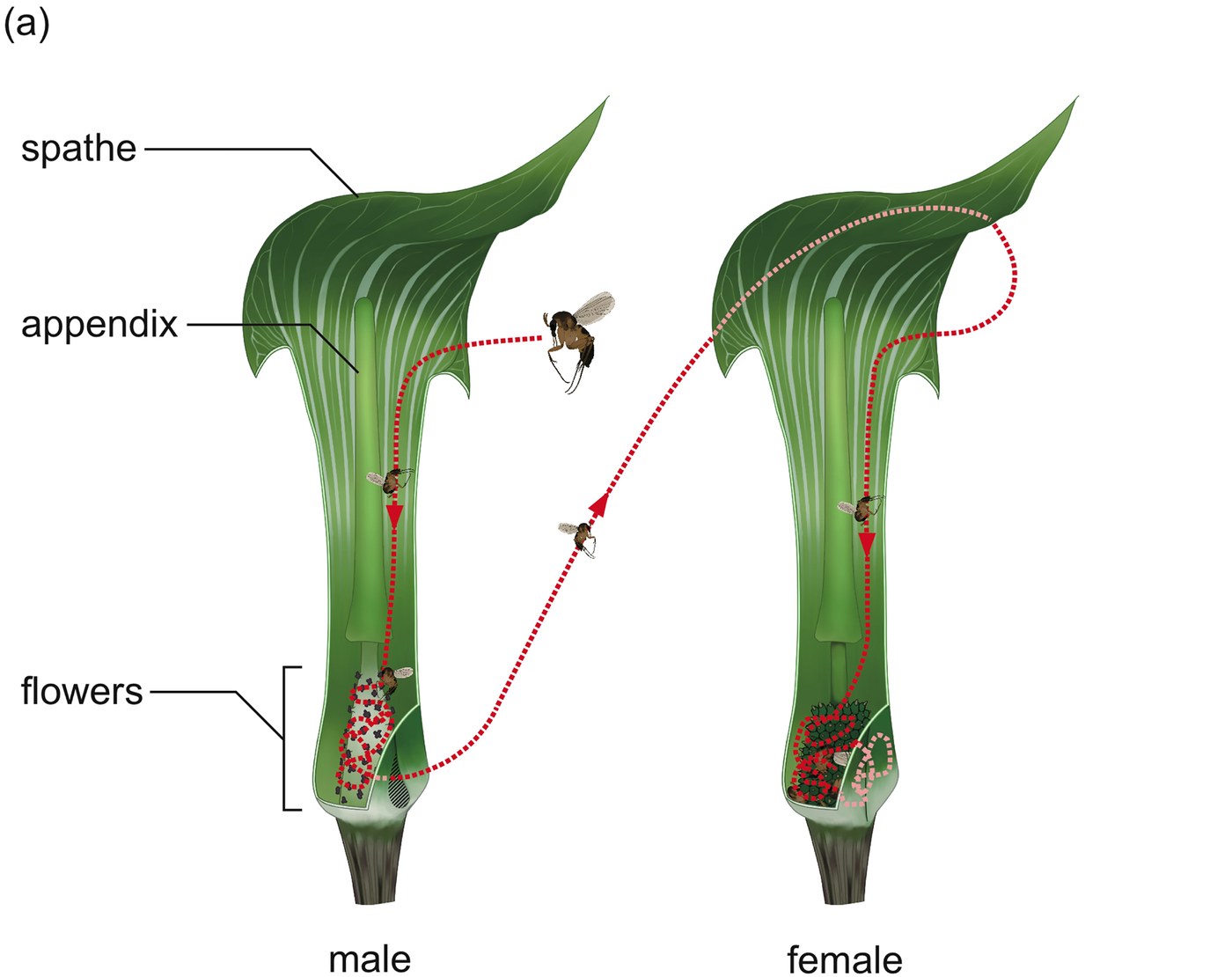
The inflorescence is a vertical tube with a hood bent over its mouth. Inside the tube stands the spadix, carrying flowers at the bottom and, above them, a sterile column called the appendix that carries no flowers and does nothing but smell. Everything that happens to a fungus gnat happens in that tube, and it happens in one direction.
The parts, from the top down
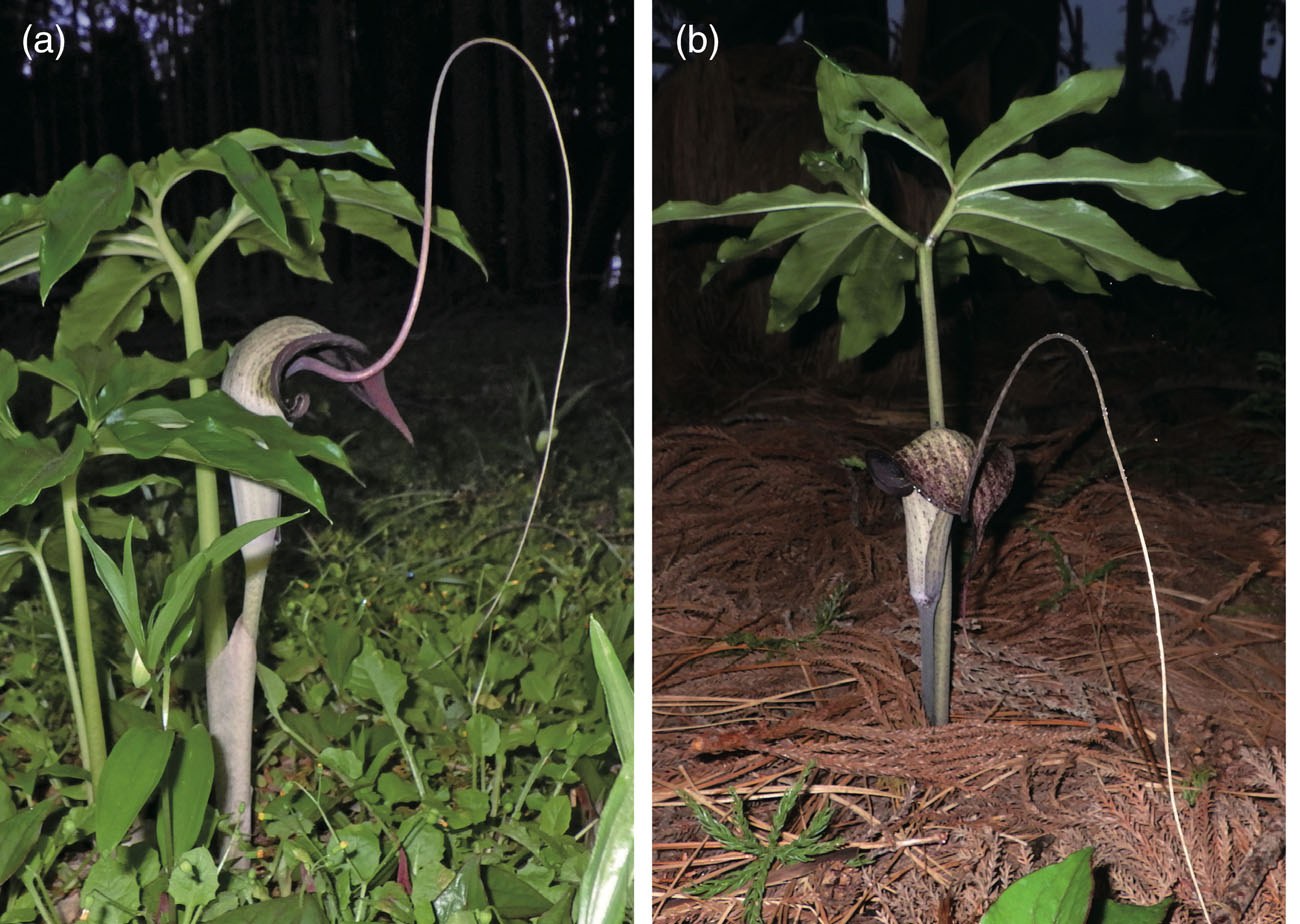
The hood arches over the entrance. It keeps rain out of the chamber — the same job the lid of a pitcher plant does, for the same physical reason: wet pollen is wasted pollen. In many species it tapers into a thread that hangs down toward the ground.
The appendix is the scent organ. It is the part that does the advertising, and in most species it is not even visible from outside; the smell reaches the gnat, the shape does not. Its base is often abruptly swollen or flared out like a small umbrella, and that flare matters later — where it is present, a gnat that falls past it cannot climb back up.
The tube is the prison. Its inner wall, and the surface of the spadix inside it, are coated with a microscopic wax bloom. This is the single most important structure on the page, and Part II is about nothing else.
The flowers sit at the bottom, below the appendix. In most of the genus an individual plant carries either male flowers or female flowers, never both — and which one it carries this year is not fixed. That is Part V.
The window. The lowest zone of the tube is a band of translucent tissue that lets light in from outside. In a male inflorescence it illuminates the place where the pollen has collected and where the exit is. In a female inflorescence it illuminates nothing but a dead end.
The sequence, as recorded
Gnats approach in an erratic, jerky flight, mostly in the evening. They try to land on the outside of the hood, on the tube wall, on the rim. On the waxed surfaces they cannot hold, and slide. If that happens outside, they take off and try again. If it happens over the mouth, they fall in. They were never once observed to walk in deliberately — the entry to the trap is an accident, every time.
One thing the trap is not
There is no floral chamber here. In Arum, in Alocasia, in Xanthosoma, the spathe pinches shut above the flowers to seal a closed room. Arisaema has no such constriction: the tube is open all the way up to the mouth. The gnat is not sealed in. It is simply somewhere it cannot climb out of — which, for an insect of this size, is the same thing.
A reward that is not supposed to be there
The genus is described everywhere as rewardless, and mostly it is. But Arisaema consanguineum exudes small drops of real nectar on the inner face of the flanges at the spathe mouth, and gnats were watched drinking them. Arisaema ciliatum, observed the same way in a different garden, has no nectaries at all. Whatever the deception is, it is not uniform across the genus, and a page that says all of these plants offer nothing is overstating a real and specific observation.
Part II
A Wall of Loose Wax, and the Trap It Forced Into Existence
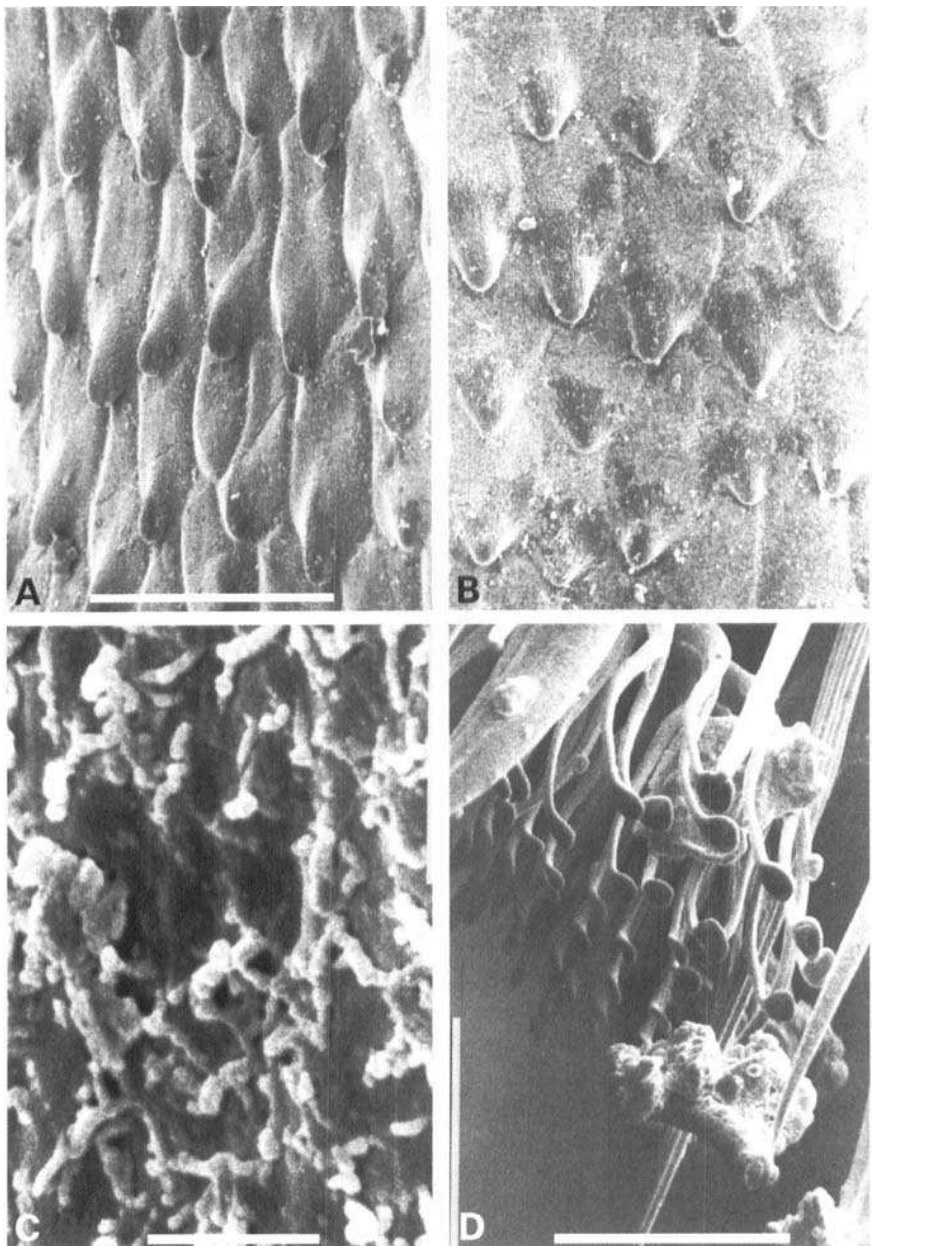
The inside of the tube is not slippery the way glass is slippery. It is covered in minute wax rods that are designed to come off. When a fungus gnat sets a foot on that wall, the wax detaches, packs into the fine spoon-shaped bristles of its adhesive foot pads, and puts them out of action. The insect is not sliding on the plant. It is sliding on a layer of the plant that has transferred onto its feet.
Scanning electron micrographs of the tube wall show the rodlets standing on the epidermis; micrographs of a mycetophilid’s foot, recovered from a spathe, show its bristles clumped and fouled with the same particles. In some species the wax is reinforced by zones of overlapping downward-pointing papillae, which make the surface not just frictionless but directional.
The trap chooses its victim mechanically
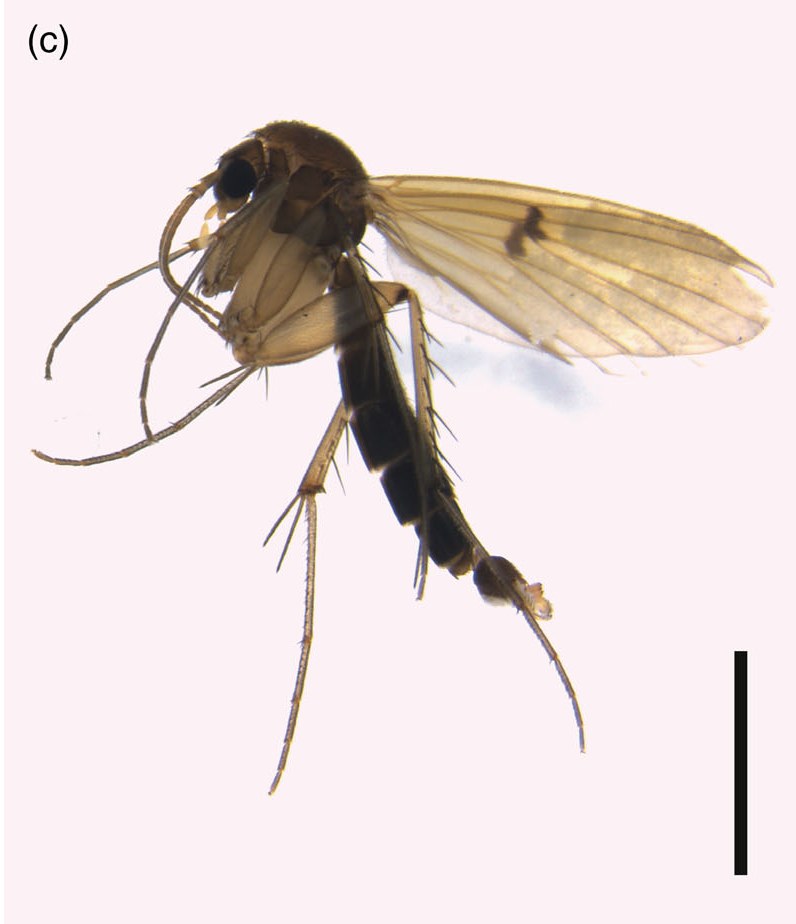
This surface does not stop everything. Under test, ordinary short-horned flies, ants and earwigs could all hold on to it. What it defeats specifically are the long-horned midges and gnats — the Nematocera — whose foot pads carry relatively few adhesive bristles and are therefore easy to clog. The plant filters its pollinators before scent preference enters into it at all: a beetle that lands on the rim simply walks away, and a fungus gnat that lands on the rim falls in.
Why this one fact explains the rest of the page
Compare the trap next door. Arum maculatum holds its flies overnight behind a palisade of sterile bristles, and in the morning those bristles wither. The prison unlocks itself on a schedule, and the flies walk out the way they came in. The whole design depends on a moving part.
A wax bloom has no moving part. It cannot wither, retract, or be stood down at dawn. Once the wall is waxed it stays waxed for the entire anthesis — which in this genus runs for weeks, not a night. So a plant built this way has exactly two options: keep its pollinator forever, or grow a second opening somewhere else.
The argument, stated the way its authors stated it
The unchangeability of the gliding surface necessitated the invention of a secondary basal exit. The escape hatch in male inflorescences is not an act of mercy and not a clever refinement. It is the workaround a plant needs when it has built a prison it cannot unlock.
Which leaves the females. A female inflorescence has no pollen to give away and no reason to spend tissue on a door. It keeps the wall and skips the workaround — and the gnat inside it dies of a design decision made somewhere upstream, about wax.
Part III
The Door Is Not Opened. It Is Grown.
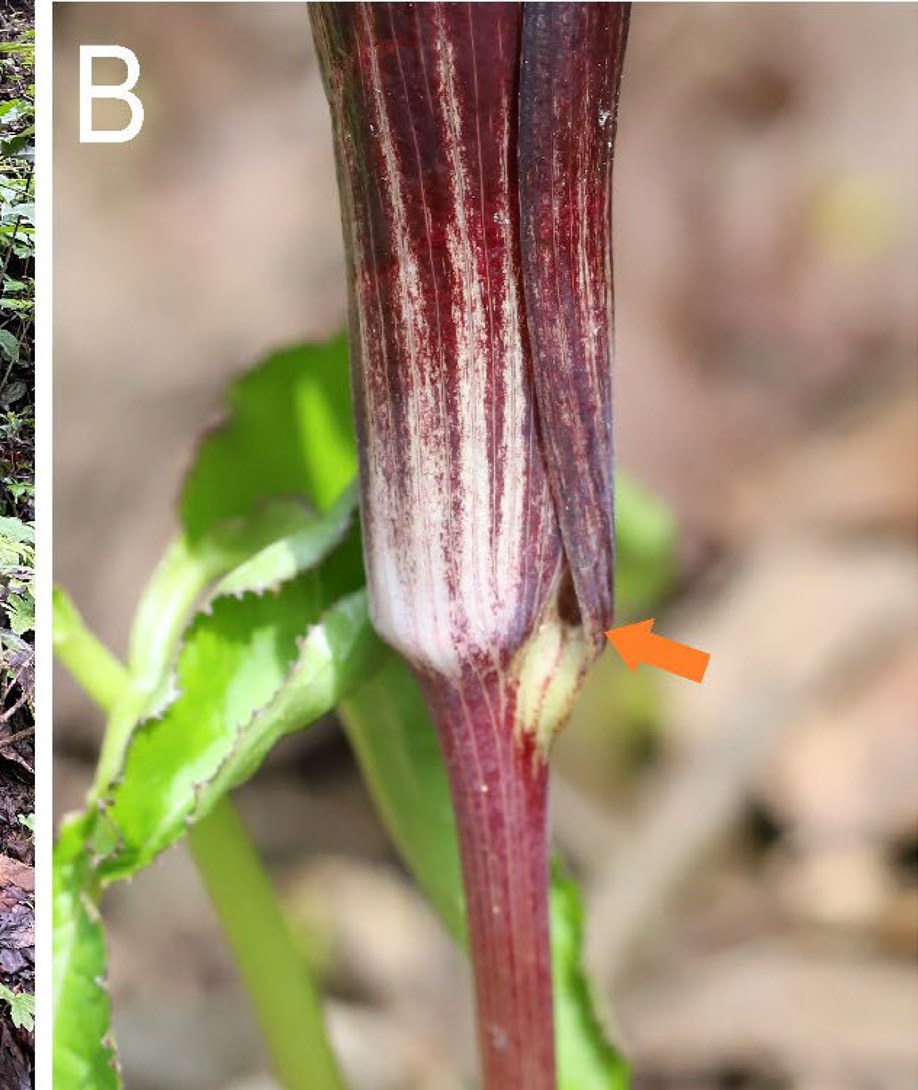
At the very bottom of a male inflorescence, where the two edges of the rolled spathe overlap, there is a hole about one to two millimetres across. It is not a valve and not a slit that parts. The inner edge of the spathe simply thickens and bulges inward as the inflorescence matures, leaving a small round gap that was never there before and will never close again.
The first person to describe it was Edward Barnes, working on the Nilgiri Hills of southern India, who wrote that at the bottom of the tube “where the edges overlap, the two edges arch away from one another, so as to form a small roundish orifice about 1–2 mm” — and noted, in the same breath, that female spathes have nothing of the kind. In the female the outer edge is thickened instead, and presses down harder on the inner one.
Seventy years later that observation was checked across the genus. The hole was confirmed by direct examination in ten species, and read off published photographs in fourteen more — something on the order of two dozen species spread across six sections of the genus. Given how uniformly the spathe is built, the one-way system is safe to call a general feature.
Why the gnat finds it
Just above the hole, the spadix carries no flowers. That bare zone leaves an open ring of space between the column and the wall, wide enough for a gnat to circle in — and it is exactly where the shed pollen has piled up. The insect wades through the pollen while looking for a way out, and the way out is in the floor of the pollen heap. The plant does not guide the gnat to the pollen; it puts the only door underneath it.
Three species that break the rule, and what they prove
Arisaema tortuosum is the important one. It is monoecious — male and female flowers on the same spadix — and it is protogynous, so its female phase runs first. In cultivated plants the exit stayed shut for the whole of the female phase and began to gape only when pollen release started. The door is not on a timer counting days from opening. It is tied to maleness.
Arisaema fargesii breaks it the other way: in two cultivated specimens, some female spathes had a distinct basal exit as well. Two plants is two plants, and the page says so — but it is a reminder that the lethal female is a strong tendency and not a law of nature.
Arisaema flavum cannot form a door at all. Its spathe is fused for more than half its length from the start, sealing the chamber shut. It is also the smallest inflorescence in the genus, the chamber barely ten millimetres across, with an appendix reduced to a stub. It appears to be self-fertile and to pollinate itself: an isolated plant, raised from a single introduced corm in a European garden, set fruit with no pollinator available. It is also the most widespread species in the genus, running from western China to Yemen and climbing to well over four thousand metres.
The pattern worth noticing
The species that gave up the trap is the species that gave up needing anybody. Arisaema flavum is a pioneer of dry open ground at high altitude — the habitat where fungus gnats are least likely to be. It kept the shape of the inflorescence and threw away the mechanism, which is what a lineage does when the machine stops paying.
Part IV
The Trap Does Not Run Warm
Heat is the signature trick of this family. Arum maculatum drives its appendix more than fifteen degrees above the air. Amorphophallus, Philodendron, Symplocarpus and Dracunculus all burn stored carbon to volatilise their scent, and the skunk cabbage holds its temperature through snow. Arisaema does none of this. It runs the family’s most extreme trap completely cold.
The measurement has been made once, on Arisaema triphyllum, in a maple wood on Montreal Island over three weeks of May. Six plants — three male, three female — carried a probe pushed three millimetres into the appendix and a second probe in the leaf stalk as a non-heating control, logged every ten minutes against ambient air.
The result
No significant temperature increase, in either sex, at any point in the flowering period. At night the ambient air was consistently warmer than the appendix — the plant was losing heat, not making it. In three of the six plants a daytime difference from air did reach significance, but it was between 0.25 and 0.57 degrees, and when the appendix was compared against the plant's own leaf stalk rather than against the air, the difference vanished entirely.
That last comparison is what settles it. An appendix that is no warmer than the petiole beside it is not generating heat; it is simply a piece of plant sitting in the same weather. And the experiment had already removed the obvious confound: every inflorescence was kept under cardboard for the whole three weeks so that sunlight could not warm it. The fractions of a degree that survived are the residue of a shaded plant equilibrating, not a furnace.
What the plant uses instead
The authors’ reading is that Arisaema never needed to pay for heat, because the sun does the job well enough. Warmed passively through the day, the appendix releases its scent; the gnats it wants are active in the same hours; and the whole system works without the mitochondrial machinery that costs Arum so much.
How far this can be pushed
One species, six plants, one population, one season. That is the entire thermogenesis literature for a genus of 224 species, and it comes from the coldest corner of the range. The Himalayan species that flower near the snowline, and the tropical Asian ones, have never been measured. The honest statement is that Arisaema triphyllum does not heat, and that no evidence of heating exists anywhere in the genus — not that it has been ruled out everywhere.
Why it matters
Heat, in aroids, is usually read as the engine of deception: warm the tissue, throw the scent, pull the insect in from a distance. This genus demonstrates that the engine is optional. The trap that catches more thoroughly than any other in the family — the only one that never lets go — is powered by nothing but wax, geometry and a smell most humans cannot detect.
Part V
The Plant Decides Its Sex Every Year
A small Arisaema is male. A large one is female. The plant is not born one or the other: it reads its own corm each spring and produces whichever inflorescence it can currently afford — and if the corm is set back, it goes the other way again. Fruit is expensive; pollen is cheap. The plant sells whichever it can pay for.
The technical word is paradioecious: a population that looks dioecious at any one moment, because each plant is carrying one sex, but in which individuals move between sexes over their lives. Some plants, Arisaema triphyllum among them, can also produce a mixed inflorescence carrying both.
The experiment, from 1922
John Schaffner did not merely observe the correlation between size and sex — he broke it on purpose. He lifted plants, cut away most of their roots, and replanted them, so that a large plant faced the coming season with a crippled supply line.
What happened
Pure female plants came back male. Mixed plants came back male. Plants that were already male stayed male. And in a later season, plants whose corms had recovered reverted to female — the switch runs in both directions, and it tracks the plant's resources rather than its age. Schaffner concluded that the sexual state was under direct environmental control, and that the sex ratios he saw across different habitats were not a difference in death rate between the sexes but the same mechanism reading different soils.
That is a striking piece of work for 1922, and it still stands as the experimental core of the story. Everything since — the size thresholds worked out in Japanese populations, the demographic studies in North American woods — has refined the relationship rather than replaced it.
What it does to the trap
Sex change is what makes the lethal female possible. Because a plant is male while it is small and female only once it is large, a population always contains both, and every gnat that escapes a male inflorescence has somewhere to carry the pollen to. It also means the killing is not evenly distributed: the plants doing it are the big, established, well-fed ones, and a gnat's chance of dying rises with the quality of the flower it chose.
A number worth correcting
Jack-in-the-pulpit is widely said to live a hundred years. The claim circulates in review literature without a citation attached, and no census supporting it exists. What the demographic census of the species actually reports — in its own words — is a “long (15–25 yr) life”, typical of most forest herbs. That is a long life for a woodland herb and quite long enough to matter — a plant that changes sex with its resources gets a couple of dozen attempts at getting it right. It is not a century.
Part VI
What Actually Brings Them In — and the Mushroom Story That Fell Apart
For a century the answer looked obvious. The pollinators are fungus gnats; fungus gnats lay their eggs in mushrooms; therefore the flower must be pretending to be a mushroom. It is a clean argument, it is still in most books, and for nearly all of the genus it now appears to be wrong.
The objection is embarrassingly simple. Plants that genuinely mimic fungi advertise with a well-known class of eight-carbon volatiles — the compounds responsible for the smell of a mushroom, which human noses detect easily. Most Arisaema inflorescences smell of almost nothing to a human being. Whatever they are broadcasting, it is not the mushroom signal.
The exception that proves it
Arisaema sikokianum really is a mushroom mimic, and it makes the contrast sharp. Its appendix is snow-white and swollen into a blunt cap that looks like a fruiting body; it smells distinctly fungal even to a person; and the insects it traps closely match the assemblage that gathers on the bracket fungus Ganoderma applanatum. When a species in this genus does mimic a mushroom, it is not subtle about it. The others are not doing the same thing quietly — they are doing something else.
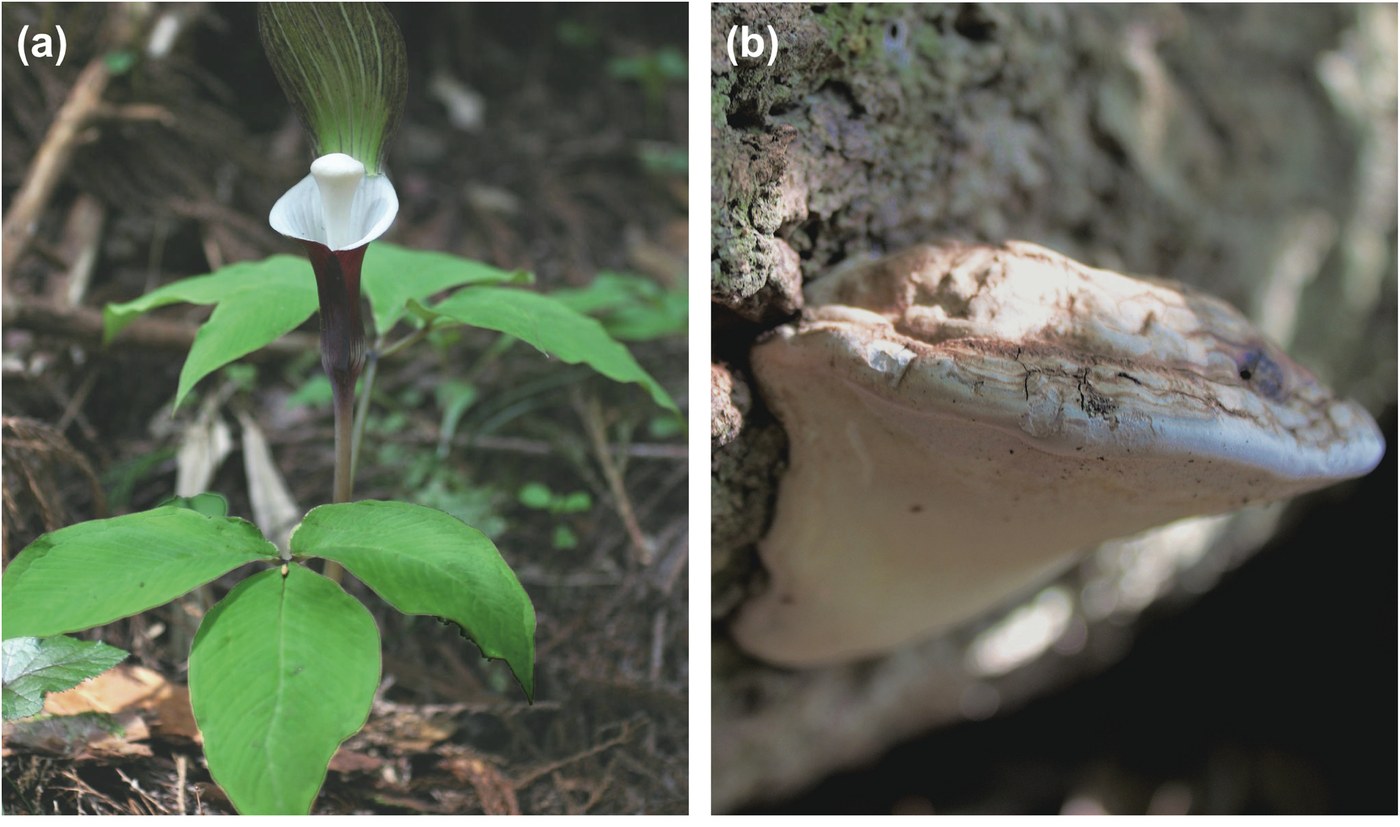
The clue in the sex ratio
The something else announced itself in the catch. Two closely related species growing side by side in Japan, Arisaema angustatum and Arisaema peninsulae, each trap a different and almost completely separate set of fungus gnats. And in both, the trapped gnats were overwhelmingly male — fifty-seven of fifty-eight in one, all thirty-eight in the other. The obvious innocent explanation — that males simply emerge earlier in the season — was checked: the same gnat comes out of the surrounding mushrooms at roughly one male to one female while the plant is in flower. And when the researchers cut the appendix off, whole or in part, the visits that stopped were the principal pollinator’s and nobody else’s, in both species: whatever each plant is saying, it says it from the appendix, and it is addressed to one species of male gnat.
A brood-site mimic should catch females, because females are the ones hunting for somewhere to lay. A signal that pulls in males and almost nothing else looks like a sex pheromone. That is the hypothesis the field has been working under since: not brood-site deception but sexual deception — the strategy of the Ophrys orchids, arrived at independently in an aroid.
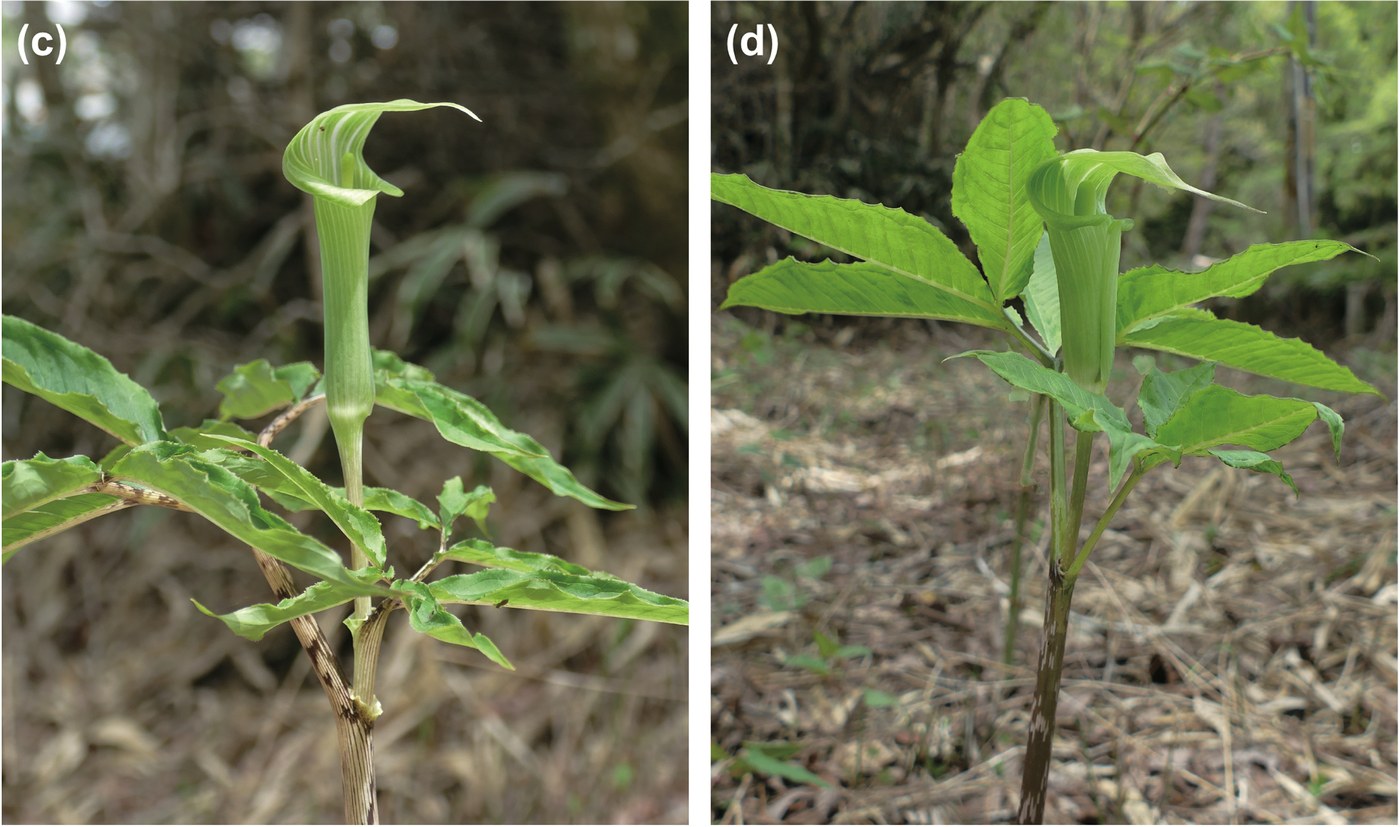
2025: somebody finally watched
The trouble with all of this was that nobody had ever observed the behaviour. Visits are so rare in the wild that the entire literature was built from counting corpses. Then a population of Arisaema serratum in an Okayama experimental plot turned out to be visited constantly, and was filmed for two seasons.
The first ethogram in the genus
2,459 visits by male Cordyla sixi in 64 hours of observation. The gnats walk along the appendix with their genitalia extended, fan their wings, and fly in zig-zags at a fixed distance from the inflorescence — all behaviours recorded from fungus gnats on sexually deceptive orchids. What was never recorded, in two years, was an attempt to actually mate with the plant.
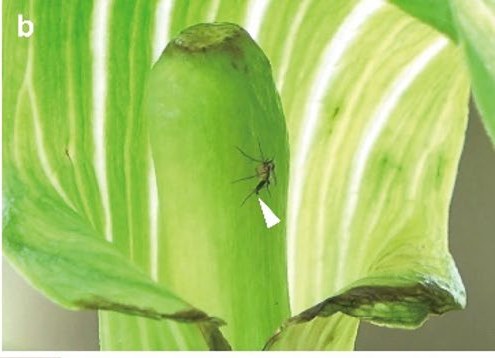
And a twist: they arrive in crowds
The observation that complicates the sexual-deception reading is social. Nearly half of all scored visits — 825 out of 1,760 — had more than one male on the inflorescence at once, and as many as six were recorded together. Gnats stayed longer when others were present, and a second gnat already in place shortened the wait for the next one to arrive.
That is not what a female-mimicking decoy produces; a fake female should be a prize one male monopolises. It is what a lek looks like — males gathering, signalling, and drawing in more males. So the current proposal is that the flower may be copying an aggregation pheromone rather than a sex pheromone: not here is a mate, but here is where everyone is. The genital extension and wing-fanning would then be the gnats’ own signalling, dispersing their pheromone from a stage the plant built.
What is still missing
Nobody has analysed the floral scent of any Japanese Arisaema, and nobody knows whether Cordyla sixi produces an aggregation pheromone at all — let alone whether the plant’s chemistry resembles it. Both halves of the hypothesis are untested. The behaviour is now documented; the chemistry that would explain it does not yet exist.
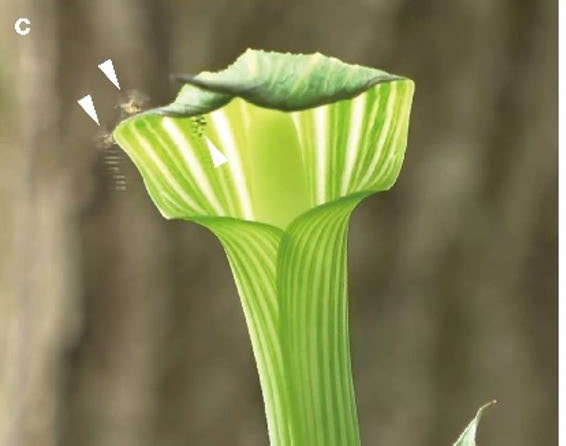
One thing they are not doing: learning
A lethal trap ought to select hard for avoidance, and visits do fall off late in the season. But the decline tracked the inflorescences visibly wilting, and it coincided with a neighbouring plant coming into flower and drawing the crowd away. More tellingly, individual visits got longer as the season went on — the opposite of what a gnat learning to be careful would do. There is still no evidence that fungus gnats learn to avoid Arisaema.
Part VII
Some of Them Get Out Alive
Everything above this point was settled science in 2023. Then, in the space of eighteen months, three studies found fungus gnats breeding inside the lethal trap — and, in one species, routinely walking out of it. The genus is not the uniform executioner it was described as. It runs a spectrum.
2024: the trap is a nursery
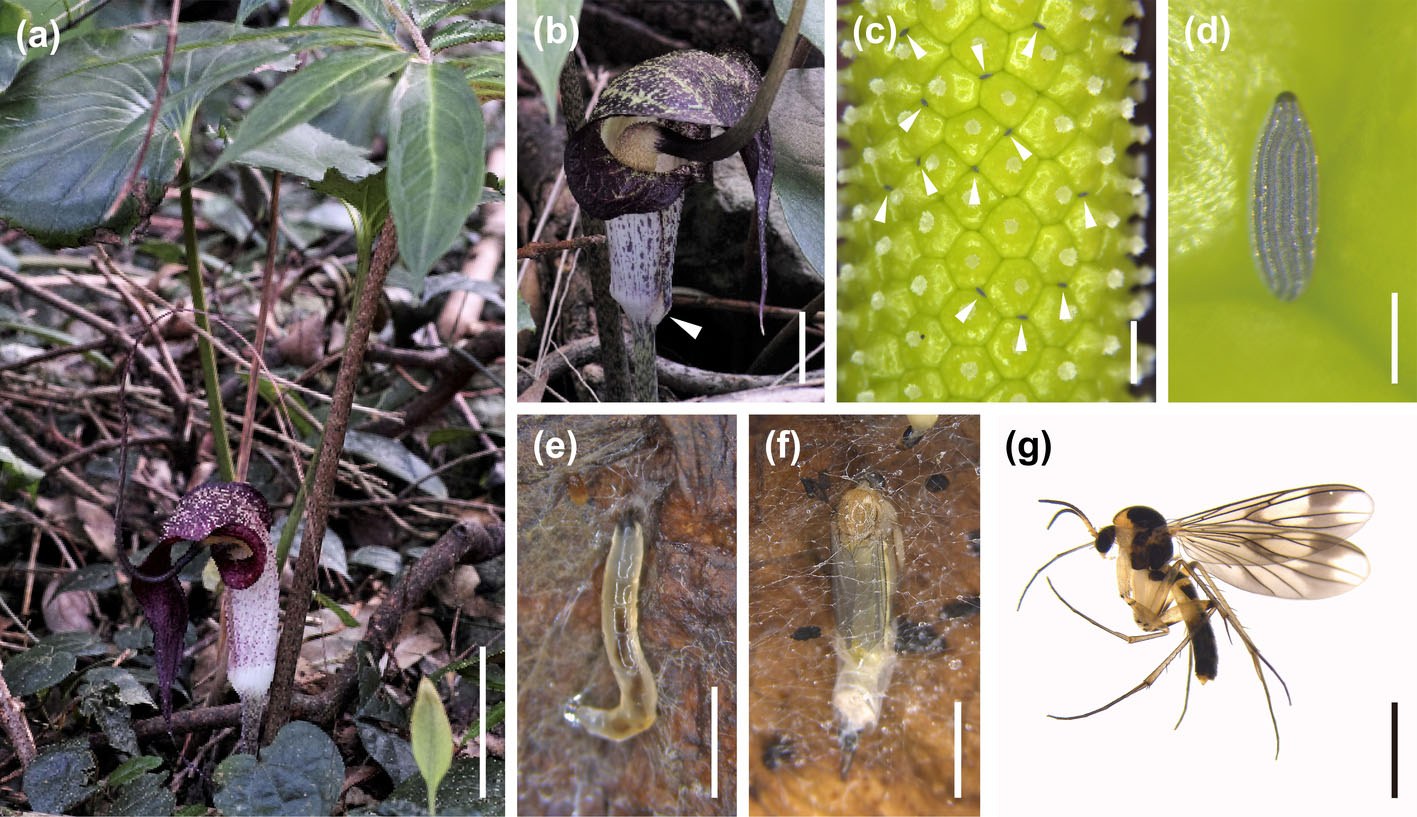
Working on Arisaema thunbergii on Yakushima, a team collected spathes with the insect corpses still inside, then did something nobody had thought to do: they incubated the dead inflorescences and waited to see what came out.
What came out
Sixty-nine adult Leia ishitanii — one of the plant’s main pollinators — emerged from at least fifteen inflorescences over four weeks, with as many as twenty-three from a single one. The larvae had been eating the decaying spadix and the mould growing on it, without touching the ovules, and had spun their cocoons on the rotting spathe. The trap that killed the parents raised the children.
And there was a stranger detail. Forty-four of those offspring came from five inflorescences that contained no adult corpses of their own species at all. Something had laid eggs in those spathes and then left. Since the inflorescences in question had been sealed to imitate a female, that is indirect evidence that some females lay and then climb out through the top.
2024 again: and in the sister species, nearly all of them do
Arisaema urashima was the obvious next test, because it lacks the abrupt swelling at the base of the appendix that stops gnats climbing. Here the escape was not an inference.
Watched directly, in a cage
Individuals of Sciophila yokoyamai placed at the bottom of female spathes climbed the appendix or the wall and escaped through the mouth. Every single one got out within a day; two were clear of the flower inside a minute. Seventy-three adults later emerged from more than twenty-two field-collected inflorescences — and, tellingly, not one of those inflorescences held a corpse of the same species. Meanwhile Mycetophila, the species doing most of the actual pollinating, stayed in and died.
The methodological sting
This is the part with consequences beyond one genus. For a hundred years, the pollinators of Arisaema have been identified by collecting the bodies out of the spathe. It is a sensible method for a plant nobody can watch. But it has a blind spot so obvious in hindsight that it is painful: a pollinator that escapes leaves no corpse, and therefore does not appear on the list. Sciophila yokoyamai was invisible for a century because it was good at getting out.
How much this actually changes
Less than a headline would suggest. In Arisaema thunbergii, the gnat that breeds in the trap is also the one most often found dead in it — many females still die inside, and being trapped costs them every future clutch they might have laid. This is not a partnership between equals. The fair description is a continuum: outright deception in most of the genus, an uncomfortable middle in Arisaema thunbergii, and something approaching a genuine brood-site mutualism between Arisaema urashima and Sciophila yokoyamai.
2025: and in China, a grimmer version
The habit is not confined to two Japanese species. Work published in 2025 reports fungus gnats breeding inside the traps of four Chinese species — Arisaema erubescens, Arisaema lobatum, Arisaema bockii and Arisaema wattii — and adds a detail that closes the loop unpleasantly: the larvae feed on the corpses of the trapped adults.
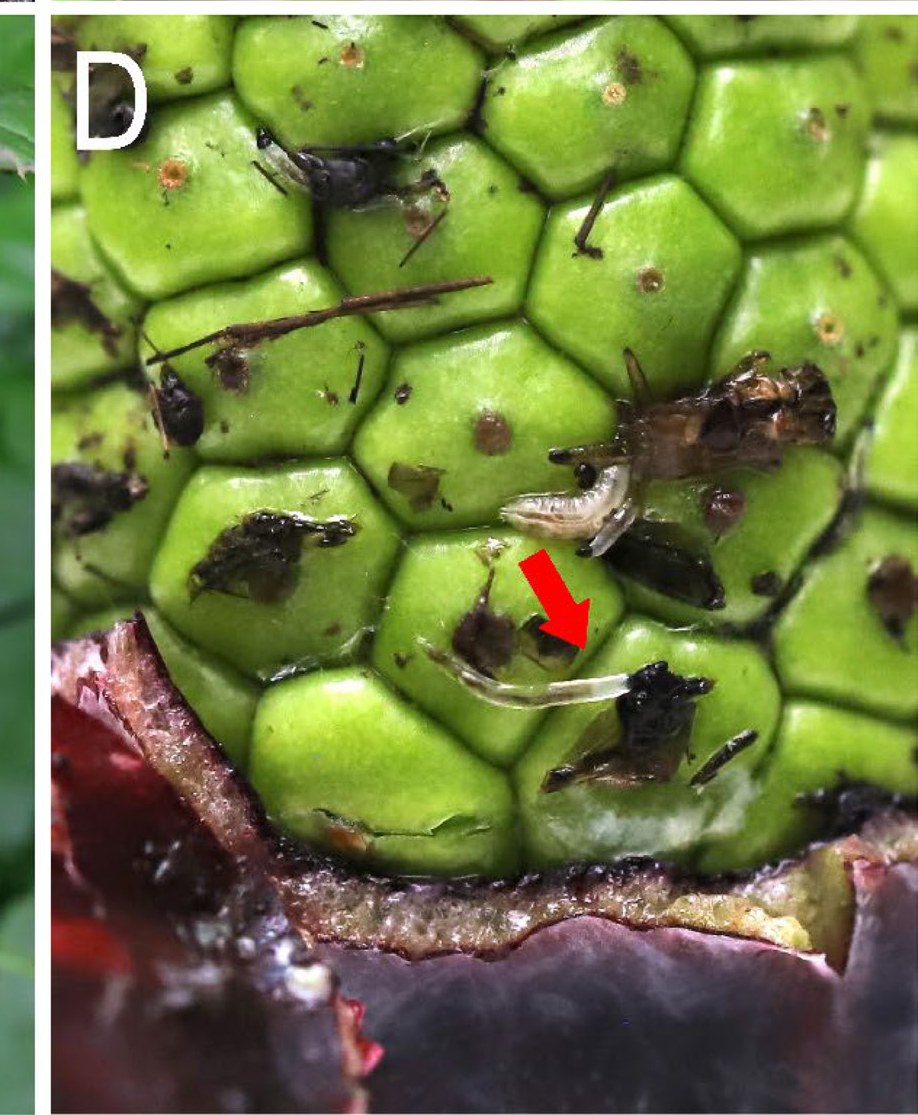
If that holds, the female inflorescence is not merely a nursery that happens to kill. The killing is what stocks the larder. The dead pollinators become the food supply for the next generation of pollinators, and the plant gets its pollen moved either way.
Part VIII
How Rarely Anyone Comes At All
The trap is spectacular. The traffic through it is almost nothing. In the only study to count properly, a season of jack-in-the-pulpit produced 133 insects from 6,983 inspections of inflorescences — and that is the number the whole reproductive strategy has to work with.
Nearly seven thousand checks were made across 159 plants in a Montreal wood over three weeks, each inflorescence opened and searched several times a day. The yield averages out to well under one insect per flower per day across a flowering period that runs the better part of a month.
Which is why the flowers last so long
Arisaema triphyllum holds its inflorescence open for about twenty days — nineteen and a half on average in both sexes, and up to twenty-six. Set that against the rest of the temperate aroids: Arum, Dracunculus, Helicodiceros and Peltandra are finished in two to five days. Within the whole subfamily only Arisarum and Ambrosina keep comparable hours.
The reading offered is that the long flowering period evolved secondarily, as insurance: at high latitude, under weather that can shut down insect activity for days at a stretch, a flower that stays open for three weeks will eventually catch a warm afternoon. The stigmas seem to stay receptive for something like thirteen to sixteen days, though that was judged by eye from the way the stigma surface changed, not measured.
The timing that does hold
Two thirds of everything caught — 67 per cent — arrived during the days when pollen was actually being released, and traffic collapsed the day after it finished: 8.6 insects a day during pollen release, 3.4 a day afterwards. The first insects of the season appeared on the same day the plants first smelled of anything. Whatever the scent is doing, it is doing it on schedule.
The Quebec visitors are not the Japanese visitors
Fungus gnats dominate the genus, but the second most abundant family in this Canadian population was the gall midges (Cecidomyiidae) — which barely register in the Japanese studies. A thrips named after the plant, Heterothrips arisaema, turns up in the spathes as well. The cast is regional, and a page that names one set of flies as the pollinators of Arisaema is describing one continent.
The species that would not cooperate — until it did
In the botanical gardens of Berlin-Dahlem, during the fieldwork behind the foundational survey, one species failed completely. Arisaema serratum attracted nothing at all, produced no smell the observers could detect, and did so while Arisaema amurense flowering a few metres away filled with gnats overnight. The authors put it down to some physiological deficiency in those particular plants and moved on.
Twenty-five years later
Arisaema serratum is now the best-observed pollination system in the genus — the species behind the 2,459 recorded visits and the first ethogram anyone has managed. The plant written off as the genus’s failure turned out to be the one that would let researchers watch.
The two results are not necessarily in conflict, and the page does not claim the earlier observers were mistaken. Different continents, different plants, a quarter-century apart — and the 2025 team are careful to say that their own population is unusually attractive, far more so than Arisaema serratum in the wild. What can be said is that nobody has run the experiment that would explain either extreme, and that a genus whose visits are this rare will look like it has no pollinators at all if you watch the wrong plant in the wrong year.
Part IX
What Nobody Knows Yet
This genus has been studied for a century and the central question is still open. Not how the trap works — that is now understood in detail — but why the females kill at all, when killing costs the plant its own pollen carriers.
Why kill the pollinator?
Two explanations are on the table, and they are not mutually exclusive.
The first is straightforward: with no way out, the gnat spends longer scrambling around the stigmas, so more pollen ends up where it is wanted. Retention as a mechanism for thoroughness.
The second is less comfortable: a dead gnat cannot go on to pollinate a rival female. On this reading the killing is not about the plant’s own seed set at all, but about denying a competitor.
The one test that has been run did not support the first
A field experiment on Arisaema triphyllum cut a hole of one to two millimetres — the male dimension — into the base of female spathes, against two controls: the same cut plugged with cotton, and plants left untouched. Fruit set did not differ between any of the three. It is a single study, in one place, in one year, with few plants and wildly variable fruit set — the experimenter says as much — and the benefit might well appear where pollinators are denser or in a better season. But the intuitive explanation currently has an experiment against it and none for it.
Is the wild seed set healthy or catastrophic?
In New York State, Arisaema triphyllum populations were found setting so little seed — 60 to 80 per cent of females with no seed at all in any given year, and an average of about seven seeds per female per year, against hand-pollinated plants producing more than ten times as much — that the researcher wondered aloud whether the whole pollination system might now be maladaptive: a machine that worked better in the evolutionary past than it does today. The counter-argument is that gnat numbers depend on how good the previous autumn’s mushroom crop was, so bad years are simply normal and good years make up for them. Both positions are defensible. Neither has been tested across enough seasons to settle it.
The list of things not yet measured
The scent has never been analysed for any Japanese species. The sexual-deception and aggregation-pheromone hypotheses both stand or fall on floral chemistry, and that chemistry does not exist. The only volatile data in the literature are a general statement that Arisaema scents contain short-chain aldehydes and alcohols, not tied to particular species.
Nobody knows whether the pollinator produces the pheromone the plant is supposed to be copying. The insect side of the deception has simply not been studied.
Heat has been measured in one species. Six plants, one Quebec population, one May. The Himalayan species flowering near the snowline and the tropical Asian ones are untested.
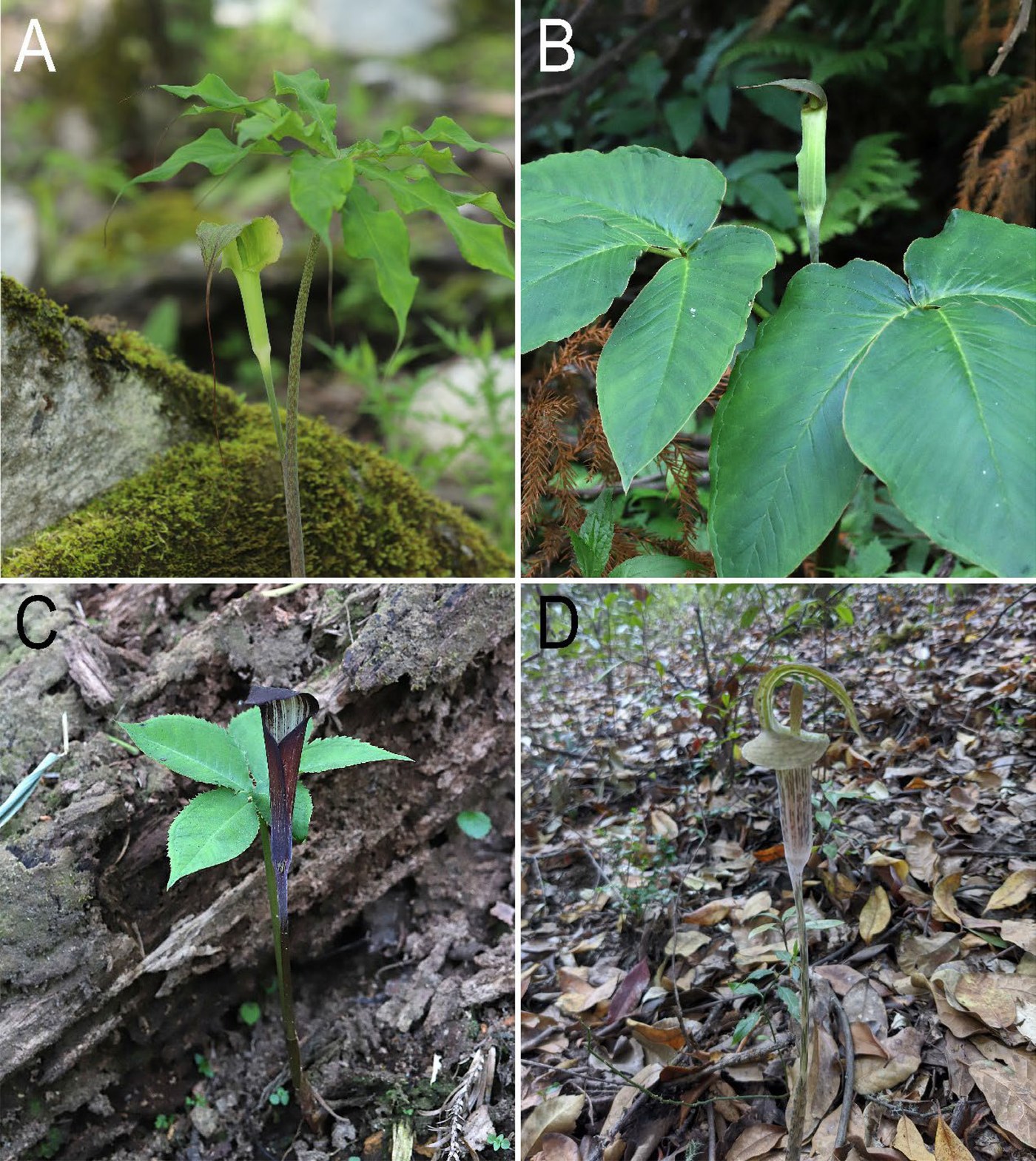
The African species have never been watched. Eight species survive on East African mountains — in Ethiopia, Uganda, Tanzania, the Ruwenzori — thousands of kilometres from the rest of the genus, and not one observation of their pollination exists. The same is true of most of the Himalayan species beyond a list of what was found inside them.
Nobody knows how far the nursery habit reaches. It has been predicted for the species that lack the swollen appendix base, and it has now turned up in four Chinese species as well. Whether it is a rare exception or a widespread and simply unlooked-for feature of the genus is exactly the sort of question that was settled wrongly for a century because everyone was counting corpses.
The methodological lesson, which travels
Every pollinator list for this genus was assembled from insects found dead inside the flower — and that method is blind, by construction, to any pollinator competent enough to leave. One species went unnoticed for a hundred years on exactly that account. It is worth asking, of any trap flower anywhere, who the sampling method cannot see.
Sources
Sources, and What Kind of Evidence Each One Is
One foundational survey, six modern field studies, a review, a demographic census, a thesis experiment, an experiment from 1922 and a colonial-era description: the whole working literature of the family’s strangest trap, each entry graded by the weight it will bear.
- Vogel, S. & Martens, J. (2000). A survey of the function of the lethal kettle traps of Arisaema (Araceae), with records of pollinating fungus gnats from Nepal. Botanical Journal of the Linnean Society 133: 61–100. The foundation, and Parts I, II and III entire: the wax gliding surface and the clogged mycetophilid foot pads, the mechanical filter that lets ants and short-horned flies walk away, the basal exit recorded across two dozen species and six sections, the three exceptions (fargesii, flavum, tortuosum), the nectaries of Arisaema consanguineum, and the argument that an unswitchable wax wall is what forced the second door into existence. Also the comparisons to Arisarum, Pinellia and Zomicarpa. Grade: multi-season field collections across nine species in Nepal, plus direct observation and SEM on cultivated plants in European gardens; the pollination sequence itself is watched, not experimental. Note: the archive’s copy carries a heavy scanning watermark that corrupts binomials and digits, so no number is taken from it that has not been read off the page images.
- Barriault, I., Gibernau, M. & Barabé, D. (2009). Flowering period, thermogenesis, and pattern of visiting insects in Arisaema triphyllum (Araceae) in Quebec. Botany 87: 324–329. Part IV entire and Part VIII entire: the only measurement of spadix temperature ever made in this genus, and the source of the negative result the page is built around. Also the twenty-day flowering period, the 133-insects-in-6,983-surveys visitation rate, the 67 per cent pollen-release peak, the gall midges, and the ozone-or-mushrooms scent. Grade: measured, instrumented, with the right control — appendix against petiole, not merely against air, and every inflorescence shaded to remove sunlight. n=6 plants for temperature, 159 for visitation.
- Suetsugu, K., Sato, R., Kakishima, S., Okuyama, Y. & Sueyoshi, M. (2021). The sterile appendix of two sympatric Arisaema species lures each specific pollinator into deadly trap flowers. Ecology 102(2): e03242. The male-bias data of Part VI, first-hand: the principal pollinator of Arisaema angustatum (Cordyla murina) was 98.3 per cent male, and both principal pollinators of Arisaema peninsulae were 100 per cent male — against a roughly even sex ratio emerging from the mushrooms nearby. Also the removal experiment showing that each species’ principal pollinator answers its appendix and nothing else’s, and the size arithmetic of the door: gnats about a millimetre wide against an exit of about two. Grade: measured — trapped assemblages plus a two-species appendix-removal experiment. The authors state plainly that these traits are insufficient to confirm sexual deception, and this page keeps their hedge.
- Suetsugu, K. (2022). Arisaema: pollination by lethal attraction. Plants, People, Planet 4: 196–200. The review that reopened the question, and the backbone of Part VI: the case that mushroom mimicry cannot be general because most Arisaema scents are imperceptible to humans while genuine mimics broadcast detectable eight-carbon compounds; the sexual-deception alternative; and the Sarracenia convergence. Grade: review — it argues, it does not measure. The Arisaema sikokianum mimicry evidence reaches this page through it and is not held in the archive; the male-bias counts and the exit-hole manipulation, once in the same position, are now held first-hand — see the entries above and below.
- Suetsugu, K., Nishigaki, H., Fukushima, S., Ishitani, E., Kakishima, S. & Sueyoshi, M. (2022). Thread-like appendix on Arisaema urashima (Araceae) attracts fungus gnat pollinators. Ecology 103: e3782. The only manipulation of a floral organ in this literature. Cutting the thread off the appendix cut Mycetophila visits significantly while leaving other visitors alone, and dropped fruit set from 79 to 42 per cent and seed set from 37 to 11 per cent. Grade: measured field experiment with three treatments and stated sample sizes — small n on the fruit-set arm (five and seven plants), and the page says so wherever it uses those figures.
- Suetsugu, K., Nishigaki, H., Kakishima, S., Sueyoshi, M. & Sugiura, S. (2024). Back from the dead: a fungus gnat pollinator turns Arisaema lethal trap into nursery. Plants, People, Planet 6: 536–543. Half of Part VII: the 69 Leia ishitanii reared out of decaying Arisaema thunbergii inflorescences, the larvae eating spadix and mould without touching the ovules, and the 44 offspring from five spathes containing no adults of their own species. Grade: measured, three field seasons, 106 inflorescences incubated; the escape itself is inferred here, not watched — it is watched in the next entry.
- Suetsugu, K., Nishigaki, H., Sato, R., Kakishima, S., Ishitani, E., Fukushima, S., Sugiura, S. & Sueyoshi, M. (2024). Fungus gnat pollination in Arisaema urashima: the interplay of lethal traps and mutualistic nurseries. Plant Biology 26: 1–8. The rest of Part VII, and the methodological warning the page ends on: Sciophila yokoyamai escaping female spathes under direct observation, 73 adults emerging from more than 22 inflorescences none of which held a conspecific corpse, and the authors’ own conclusion that a century of corpse-based sampling has been systematically blind to pollinators that survive. Grade: measured — 416 inflorescences incubated, plus a filmed cage experiment. The paper carries an internal inconsistency in the cage sample sizes, so this page prints no n for that experiment and reports only the qualitative outcome.
- Nishigaki, H., Matsumoto, T. K., Miyazaki, Y., Hirobe, M., Kakishima, S., Okuyama, Y. & Suetsugu, K. (2025). Ethological evidence for sexually exploitative pollinator attraction by Arisaema serratum (Araceae). Journal of Plant Research. The newest work on the page and the whole back half of Part VI: 2,459 visits by male Cordyla sixi in 64 observation hours, the first ethogram in the genus — genital exposure, wing-fanning, zig-zag flight, and no mating attempt in two years — the co-visitation data that point at an aggregation pheromone rather than a fake female, and the finding that the seasonal decline is senescence rather than learned avoidance. Grade: measured, two seasons, video-recorded, with mixed models; but eight plant-years in total, and the authors themselves caution that the morphology results rest on too few plants.
- Kubo, T., Matsumoto, T. K., Miyazaki, Y. & Yano, O. (2024). Pollinators of Arisaema nambae (Araceae), endemic to Okayama and Hiroshima prefectures, western Japan. Journal of Asia-Pacific Biodiversity 17: 191–195. The independent check on the size filter in Part III: 113 insects from 24 spathes across three populations of an endangered endemic, with fungus gnat body widths measured against the roughly two-millimetre exit, and Arisaema pollen found on gnats taken from female spathes — direct evidence that they arrived from a male one. Grade: measured visitation with morphometrics and pollen loads.
- Schaffner, J. H. (1922). Control of the sexual state in Arisaema triphyllum and Arisaema dracontium. American Journal of Botany 9(2): 72–78. Part V entire, and the oldest experiment on the page: root pruning drove female plants to male, and corms that recovered reverted to female in a later season — sex expression under resource control, reversible in both directions. Grade: manipulative experiment with controls, and it still stands. The archive’s copy is a lossy scan whose figures cannot be read reliably, so this page reports the direction of every result and none of the counts. (The counts have since been read off the page images — of 25 female plants root-pruned, 21 went male — and the direction-only wording above stands by choice, not necessity.)
- Barnes, E. (1935). Some observations on the genus Arisaema on the Nilgiri Hills, South India. Journal of the Bombay Natural History Society 37(3): 630–639. The first description of the one-way door, quoted in Part III: the overlapping spathe edges arching apart into a roundish orifice of one to two millimetres in male inflorescences, and its absence in females, with the outer edge thickened and pressing down instead. Grade: careful field description by a resident botanist; no experiment. Note on the date: this archive filed the paper as 1934, but the offprint carries no date on any page, and the number pencilled on its opening sheet is a collection stamp, not a page number. Vogel & Martens (2000) and Kubo and colleagues (2024) independently cite it as 1935, volume 37, pages 630–639, which fits the paper’s own footnote describing a 1934 publication as already out. That is the citation used here.
- Bierzychudek, P. (1982). The demography of jack-in-the-pulpit, a forest perennial that changes sex. Ecological Monographs 52(4): 335–351. The census behind Part V’s lifespan — “its long (15–25 yr) life is typical of most forest herbs” — and the hard numbers behind how rarely the wild cross happens: 60 to 80 per cent of females set no seed at all, an average of seven seeds per female per year, and hand-pollinated plants outproducing naturally pollinated ones of the same size by more than an order of magnitude. Also the finding that mortality falls sharply once a plant reaches flowering size and then differs neither between sexes nor among sizes. Grade: measured — three years, two populations, size-classified transition matrices. Her own methodological point is that the matrices varied too much between years to quote a single population growth rate, and none is quoted here.
- Pettit, J. L. (2009). Pollinator deception and plant reproductive success in jack-in-the-pulpit. MSc thesis, Indiana State University, Terre Haute. The exit-hole experiment of Part IX, first-hand: a 1–2 mm hole cut into female spathes — against cotton-plugged cuts and unmanipulated plants — produced no detectable difference in fruit set. Grade: manipulative field experiment with the right controls and a small sample — the author says so, and fruit set was strongly bimodal — so it weakens the retention hypothesis without disproving it, which is exactly how Part IX uses it. Also in the thesis: 57 per cent of female plants set fruit, and thrips — found on under a third of plants — judged minor beside the fungus gnats.
- Huang, W. & Yang, C.-F. (2025). Trapped fungus gnats oviposit in the lethal kettle of Arisaema while corpses provide essential food for larval development. Bulletin of the Ecological Society of America 106(3): e70028. The closing paragraph of Part VII — and the weakest citation on this page, deliberately flagged. This is a four-page photo gallery, not a research paper. It documents fungus gnats breeding in the traps of four Chinese species and larvae feeding on trapped adult carcasses, and that is all this page claims from it. Grade: photographic record only. The study it illustrates — Huang, Li, Wang, Yang & Ågren 2025, Scavenging contributes to larval food intake in fungus gnats using the Arisaema kettle trap as a brood site, Ecology — is not held in this archive, and no figure from it appears here.