
Araceae · Reproductive Biology
THE ARUM INFLORESCENCE
The best-studied trap in the family, and the textbooks describe it wrongly
Arum
What Is on This Page
This is the trap everyone has heard of — the spathe that swallows flies overnight and lets them out covered in pollen. It is also the one where the standard explanation was disproved a century ago and nobody updated the books.
Take it to the plant
Not here for the botany, and just want to make a cross? The printable field card is the whole method on one sheet — the one-night clock, what to do on each of the two mornings, how long the pollen lasts and what to check when it fails — with a second side carrying the three corrections that matter most at the bench, including the one that decides whether a single clone is any use to you.
An Arum inflorescence catches small flies, holds them for about a day, dusts them with pollen and releases them. That much is true, and it has been known since the 1870s. Almost everything usually said about how is wrong.
The bristles are not a one-way valve. The insects do not walk in. The dark spathe is not a visual lure. The famous heat does not attract anything. And the plant is not self-incompatible — which, if you grow one clone, is the single most useful sentence on this page.
Where the corrections come from
Not from new work. From Fritz Knoll's 1926 monograph, which ran controlled experiments nobody had run before — glass model inflorescences, a kettle cut off and turned upside down, an ant on oiled glass — and reached conclusions that contradicted the textbook of its own day.
The textbook did not change. The standard British account of Arum maculatum was published in 1949, twenty-three years later, and does not cite Knoll anywhere.
The order, and why
Parts I to III are the machine and its timetable — what the inflorescence is built from, how many species there are and where the genus grows, and the one-night clock the whole system runs on.
Parts IV to VIII are how it actually works — the trap, the smell, the heat, who comes, and the question of whether the insects get anything at all. Part IV is the one to read if you only read one.
Parts IX to XIII are the operation — reading your own plant, keeping pollen, making the cross, what happens to the fruit, and what to check when nothing sets.
Then the sources, with what kind of evidence each one is.
The one thing worth knowing before you start
100 of 100
A hundred bagged Arum inflorescences set no seed at all — twenty each in five populations, across three taxa. That result is usually reported as proof the genus is self-incompatible.
It is not. In the same study, pollen moved by hand from another inflorescence of the same clone gave a full 100% infructescence set, with seeds equal in number and weight to outcrossed ones.
The barrier is timing, not compatibility. Female and male phases do not overlap within one inflorescence — but a plant's inflorescences open days apart, and the stigmas stay receptive for at least a day either side. So one clone can pollinate itself perfectly well, if you carry the pollen. Part XI.
Part I
The Inflorescence, and the Names for Its Parts
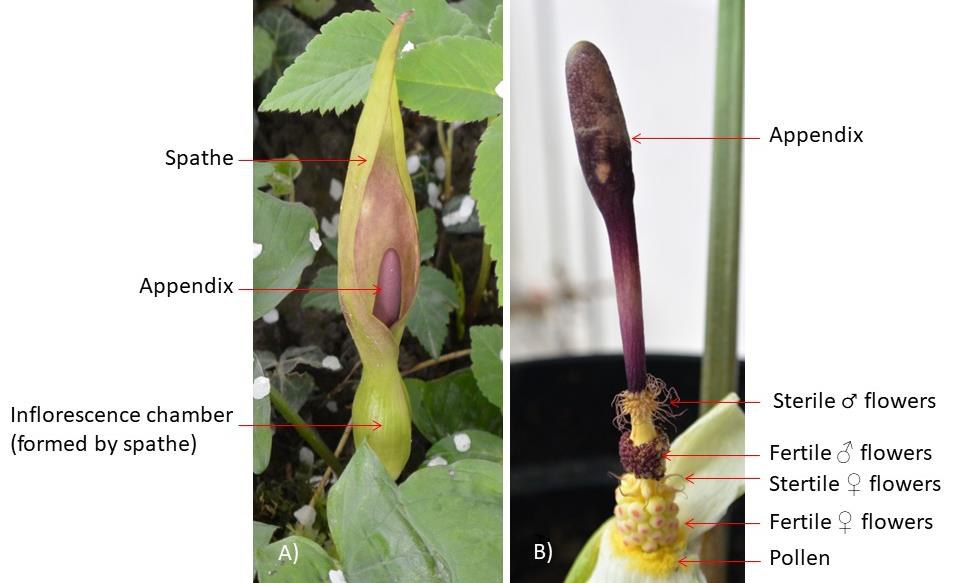
An Arum inflorescence is one chamber with a lid, a heater, and two rings of bristles between them. Get these five names straight and the rest of the page reads itself.
| Part | What it is | What it does |
|---|---|---|
| Spathe limb (the “helm”) | The large hood standing above the chamber | The landing surface insects fall off. Not a signboard — see Part V |
| Floral chamber (the “kettle”) | The closed tube at the base, holding the flowers | Where the insects spend the night |
| Appendix (the “club”) | The sterile spadix tip, projecting from the chamber | The scent organ and the heater. Sterile — it carries no flowers at all |
| Sterile flowers (bristles) | Two rings of stiff filaments, above and below the stamens | A size filter, not a valve. Part IV |
| Fertile zones | Female flowers at the bottom, male above them | Receptive on night one, shedding on night two |
Proportions, in the one species anybody counted properly
Knoll dissected Arum nigrum in the Dalmatian karst and gives numbers that are still the most complete set for any species in the genus: 73–103 female flowers, 171–213 stamens, ovaries about 2 mm long.
One number in that set is not what it looks like
171–213 stamens is not 171–213 male flowers. An Arum male flower is a small group of stamens, not one — on the usual count of two to four per flower, that is at most about fifty male flowers.
The distinction matters wherever this page or any other gives a floral sex ratio, because the two conventions differ by a factor of four.
The bristles, and a name you should not repeat
The two rings of sterile filaments are almost always called staminodes (the upper ring) and pistillodes (the lower) — the implication being that one is a failed stamen and the other a failed ovary. The anatomy does not support the second half of that.
Somebody counted the plumbing
In Arum italicum, the lower bristles receive two or three vascular bundles. A stamen receives one to three. An ovary wall receives eleven or twelve.
“The vascular pattern of bristle-like pistillodes is much closer to that of stamens than to that of pistils.” The authors decline to settle what the organs are, and say so.
Say “sterile flowers” or “bristles”. Nothing on this page depends on which sex they failed to be.
The same study found something worth knowing for its own sake: Arum has no flowers intermediate between male and female, no residual ovary or stigma anywhere on a bristle. In Philodendron, Cercestis and Schismatoglottis such intermediates are common. Here the boundary is clean.
One structure you will not find described anywhere else
The chamber wall is not a solid sheet. Knoll found that its epidermal cells do not meet along their long edges, leaving open intercellular channels — a Lückenepidermis, a gap-epidermis. He measured the aperture area by region and found it largest at the top of the chamber and smallest at the bottom.
He then argued against his own explanation for it. If the gaps were for ventilation, they are in the wrong place: carbon-dioxide-laden air should be leaving at the bottom, and the gaps are at the top. A hundred years later nobody has said what they are for.
Part II
The Genus, and the One Species That Breaks Every Rule
A small genus — a few dozen species, all of them European, Mediterranean or west Asian. Small enough that the count has been revised three times in twenty years, and one species sits outside the genus's entire calendar.
How many species — a moving target, shown moving
| Year | Source | Claimed |
|---|---|---|
| 1989 | Boyce, Kew Bulletin 44(3) | 25 species |
| 1993 | Boyce, The Genus Arum | 25 species |
| 2006 | Boyce, Aroideana 29 | 28 species |
| 2007 | Lobin, Neumann, Bogner & Boyce | 29 species |
These are dated claims, not the current total, which comes from Kew's Plants of the World Online and is the figure the site's own counter uses. The table is here because the direction is the interesting part: in one decade the genus gained three species, lost a subspecies, and had one of its commonest European members renamed.
If you have a plant labelled Arum alpinum
It is Arum cylindraceum. Boyce recollected from the type locality and found the older name “unequivocally identical with the later Arum alpinum”. Arum lucanum goes the same way.
He calls this “perhaps the most unfortunate outcome of these new studies” — which is what a taxonomist says when a long synonymy has just landed on a plant everyone grows.
Two subgenera, split on when they flower
The primary division in Arum is not a floral character at all. It is the calendar. Subgenus Arum flowers at the end of the growing season, in spring or early summer, the spathe pushing out of the sheath of the last leaf. Subgenus Gymnomesium — one species — flowers at the start of the growing season, in autumn.
Arum pictum, and why it deserves its own subgenus
The autumn flowering is only the first of it. Nearly everything about this plant departs from the genus.
Four departures, not one
It flowers in October, when every other Arum is dormant or in leaf.
The inflorescence sits on the ground, the spathe tube partly buried, with no peduncle above soil level in most plants.
The fruit is wrong for the genus. Every other Arum ripens a cluster of pulpy orange-red berries held up on a stout stalk, built for birds. Arum pictum ripens a globular head of drier, silvery-lilac berries, at ground level.
It has only one ring of sterile flowers, above the stamens. The lower ring is simply absent.
Its scent departs too. Where the dung-mimicking species of the genus build their smell out of p-cresol and indole — though not evenly, and Arum italicum emits no detectable indole at all — Arum pictum's single largest volatile is isomyocorene — 43–87% of the blend in every sample from every population — and the chemists who identified it expect it does not smell of dung at all. Part V.
And it is the only species in the genus whose appendix heats twice in one day. Part VII.
The honest state of the pictum question
Nobody knows what the autumn flowering is for. Boyce's own sentence, and it has not been improved on: “Just what advantage this gives Arum pictum over spring-flowering species has still to be discovered.”
Nor is it known what disperses the seed. Ground-level, dry, silvery berries are not a bird package. The suggestion on record is ants — by analogy with Biarum, which has similar berries. It is an analogy, not an observation.
A classification you will see quoted, and should not lean on
Boyce proposed in 1989 that Arum inflorescences come in two kinds: “flag” — scentless and held up on display — and “cryptic” — scented and hidden in the foliage. It is a good idea and it is quoted constantly.
Two species break it in the paper that proposes it. Arum creticum is strongly fragrant and displayed; Arum idaeum is unscented and hidden — and the two share, in Boyce's words, “a remarkably similar inflorescence morphology” despite that. His own 2006 revision then added two more exceptions, Arum longispathum and Arum sintenisii, both displayed and strongly scented.
Four exceptions to a scheme covering eighteen taxa. Treat it as a useful description of some species, not as the shape of the genus.
Part III
The Clock: One Night, and Then It Is Over
The entire reproductive life of an Arum inflorescence is about two days, and the part that matters to you is the first evening. Miss it and there is no second attempt on that spathe.
| When | What the plant is doing | What you do |
|---|---|---|
| Day 1, afternoon into evening | Spathe unrolls. Appendix heats and stinks. Stigmas receptive. Insects arrive and fall in | Pollinate now. This is the whole window |
| Day 1, late evening | Anthers open — sometimes as early as 10 pm. Pollen rains down all night | Nothing. Too late to apply, too early to collect |
| Day 2, morning | Spadix wilts and becomes climbable. Insects leave, loaded | Collect pollen. Flies first, beetles later |
| Day 2 onward | Scent has stopped. Nothing is attracted, though the spathe still looks perfect | Nothing. Move to the next inflorescence |
The spathe lies to you on day two
Knoll's cleanest internal control: on the second day the inflorescence attracts nothing at all, and yet “the appearance of the spathe has not meanwhile changed”.
An open spathe is not evidence of a receptive plant. The scent is the signal and you cannot see it.
How the heat is timed — in the one species instrumented properly
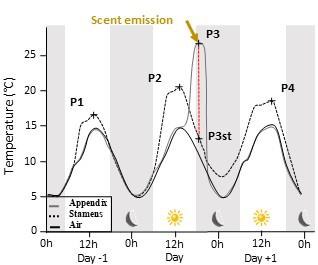
In Arum italicum, thermocouples in six inflorescences found not one heating event but four, and only one of them is the famous one.
| Phase | Organ | When | Peak above air |
|---|---|---|---|
| P.1 | male flowers | day before the spathe opens, 0900–1400 | +7.5 °C at 1100 |
| P.2 | male flowers | opening day, 0900–2200 | +11.1 °C at 1100 |
| P.3 | appendix | 1400–0200, spathe open | +19.3 °C at 2130 |
| P.4 | male flowers | day after pollination, 0900–1500 | +4.6 °C at 1250 |
The appendix is the loudest, not the most useful
The appendix produces the single highest peak — +19.3 °C — and conducts almost none of it into the chamber where the insects are. The chamber sits about 1 °C above air for a continuous day, and its three peaks match the male flowers' heating episodes, not the appendix's.
So the organ everyone measures is doing the advertising, and a different organ is doing whatever the warmth inside is for.
Two things this timetable is not
It is not measured. “About twenty-four hours” has been repeated since Knoll and there is still no mean, no variance and no temperature dependence published for it anywhere. It is a good approximation and it is only an approximation.
And it is not universal. Arum creticum stays fresh for about seven days after the spathe opens; Arum hygrophilum for nine or ten. Both figures rest on a single report each. If you grow either, the one-night rule does not apply to you.
Part IV
The Trap — and Why It Is Not a Fish-Trap
Every account you have read says the downward-pointing bristles let insects in and stop them getting out. Fritz Knoll disproved that in 1926, with four experiments, and the books never caught up.
The received picture is a fish-trap — a Reuse, the funnel-and-spike basket that lets a fish swim in and not back out. The insect walks down the spadix, pushes past the ring of stiff bristles, and is held below them until they wilt.
Not one part of that is what happens.
What Knoll saw, lying on the ground beside the plants
“No insect makes its way on foot through the spathe neck into the kettle; instead all fall, sliding rapidly down the funnel wall, into the cavity of the kettle.”
And in his summary, flatly: it never enters voluntarily. This happens to the quick small flies as much as to the clumsy dung beetles — the flies can be seen beating their wings trying to arrest the fall, and failing.
Experiment 1 — the tilt
Cut the hood off a fully turgid spathe and lay a dung beetle on the inner surface. It walks about freely only while that surface is horizontal. Raise the hood so its back-line rises at about 45° and the beetle can no longer climb it.
The reason is mechanical: the beetle has claws but no working adhesive pads, and the turgid papillose wall is so elastic that a claw cannot pierce it — when the pressure stops, the wall springs straight back. A small fly fails too, for the opposite reason: its claws are far too small for the papillae, and the oil puts its adhesive pads out of action.
Experiment 2 — the oil, and a glass tube
Under the slide zone Knoll found something nobody had looked for: the papillae are coated in droplets of a fatty oil, liquid at ordinary air temperature. He found it by examining dry sections in air rather than under a coverslip in water, and proved it by pressing the droplets onto clean glass.
The control that isolates the oil from everything else
Put an ant in a scrupulously clean glass with vertical walls. It climbs the smooth glass easily on its adhesive pads.
Now smear the upper part of that same wall with a very thin film of olive oil. The same ant can climb only as far as the oil-free glass — and “numerous cleaning movements of the animal betray that it has fouled its adhesive pads.”
Same result with a blowfly. Nothing about the surface has changed except the oil.
He also noticed the film is graded rather than sharp-edged — weaker at the rim of the hood, stronger in the middle — and argued that the gradient is what makes it work: “Were the boundary between walkable and unwalkable surface a sharp one, a fly… would turn back and return to the walkable surface.” Instead its footing degrades by degrees until it is already too late.
Experiment 3 — turn the trap upside down
This is the one that settles it.
The inversion
Knoll cut the club and upper spathe away, cut the chamber free at its base, drew the spadix out downward, plugged the lower opening with cotton wool and stood the resulting tube upright. Insects taken from an intact chamber could climb only as far as the pale, non-papillose part of the wall, then made cleaning movements at the edge of the red zone.
He took them out, turned the chamber through 180° so the original entry hole was at the bottom, re-plugged it, and put the same insects back.
“The same animals which previously could not climb on the red surface are now quite well able to, if often somewhat slowly.”
Same surface. Same oil. Same insects. The only thing that changed was which way the papillae point. They point down, toward the chamber base — and with them pointing up instead, a claw can hook into the grooves between them without injuring a cell.
The trap is not a texture and not a basket. It is a direction. Knoll coined a new word for it: Gleitfallenblume, a slide-trap flower, “to avoid the misleading expression Reuse”.
So what do the bristles do?
They are never bent by an entering insect — Knoll watched for it specifically and records that no bending whatever occurs during the fall. He renamed them Hindernisorgane, obstacle organs.
What they actually do is sort by size. An insect small enough to pass between them drops through into the chamber. One too large stays caught on the upper ring — and since the bristles later become climbable, that animal simply climbs back out. Knoll's own summary: “a sifting of the insects by size does take place, though in quite a different way from what was hitherto believed.”
And the release — also not what you were told
The standard account has the bristles wilting to open the door. Knoll tested the wall itself each morning, with ants, and found it just as impassable on day 2 as on day 1.
The door is the spadix
“But over night the whole spadix from the kettle base up to the club has become walkable.”
The oil-covered epidermis of the bristles and the club stalk wilts: the cells collapse, wrinkle and go soft, and the surface turns visibly matt. Into that wrinkled surface “all insects without exception can hook their claws.” They walk up the spadix and take off from the club stalk.
Where this does and does not hold
Two limits, both worth stating
All of Knoll's work is on Arum nigrum. He treated Arum italicum and Arum maculatum as “the same type developed at two different sizes” and promised a separate publication for them. The experiments were never published for the species everyone cites him for.
And in two Middle Eastern species there is no slide zone at all. Kullenberg examined Arum hygrophilum at every developmental stage and found no slippery epidermis; the moth flies “could always run freely” on the spathe. “All here mentioned insects are able easily to move up and down in the spathe kettle.” In Arum dioscoridis the bristles worked purely as a size filter — only the big Scatophaga flies were ever blocked.
Somebody reached the same conclusion in 2012, from a completely different direction
Everything above rests on one man's experiments, published in German in 1926. That is a thin footing for a claim this large — so it matters that a modern comparative study, scoring inflorescence morphology across the whole family to ask how trapping evolved, describes the Arum mechanism the same way, in passing, without arguing the point.
Independent confirmation, and it is not arguing with anybody
“In the Arum type… traps do not close their constriction. During anthesis, escape is prevented by the presence of downward pointing papillae on the spathe and slippery elongated sterile flowers on the spadix. After anthesis, these parts wither, and the insects can leave the trap through climbing.”
And on what the bristles are for: they “produce oil and are slippery”, and they “act like a sieve that gives access to the spathe chamber only to insects of a certain size.”
That is Knoll's slide surface and Knoll's size filter, restated by authors whose subject was the family's phylogeny, not the argument about what a fish-trap is.
What that paper does not say
It still calls Arum a trap — a perfect one, in its terms. Nothing on this page claims otherwise. What is wrong is the mechanism, not the category: the insects really are caught, really are held overnight, and really do leave covered in pollen. They are simply not held by a valve.
And the Arum type covers four genera — Arum, Biarum, Dracunculus and Helicodiceros. Dracunculus was scored as lacking the elongated sterile flowers altogether, so the sieve is not a property of the group. It is a property of some of its members.
There is one more crack, and it is in Arum maculatum itself. In 1947 Grensted reported Edwards's observation that the flies “can and do come out freely past the filaments when the plant is tapped, so that the trap is not wholly effective”.
Nobody has ever measured an escape rate. For the most famous trap in the family, how many insects it catches of those that approach, how many it holds overnight, and how many die inside are all unknown.
Part V
The Smell, and Which Organ Makes It
The scent is the whole signal — the heat only volatilises it and the colour does nothing. But asking what an Arum smells of is the wrong question until you say which part of it.
Read this before any percentage below
Modern scent work identifies compounds by matching mass spectra to a library and checking retention indices — usually without running an authentic standard. The largest recent Arum study says so in its own methods:
“All names used in our analyses should therefore be considered hypotheses.”
That is not a reason to ignore the numbers. It is a reason to treat a compound name as a good guess rather than a fact — and it is why the next paragraph matters.
What happens when somebody checks properly
In 2023 a team went back to Arum pictum with NMR — structure determination, not library matching. Its five published “major volatiles” were benzyl alcohol, indole, dihydroocimene, ocimene and skatole.
Only two of the five survived. The actual dominant compound is isomyocorene, at 43–87% of the blend in every sample from four populations. “Ocimene” was almost certainly isomyocorene misassigned; “benzyl alcohol” was probably p-cresol; “dihydroocimene” probably β-citronellene.
And the punchline: isomyocorene almost certainly does not smell of dung. It is a plain hydrocarbon monoterpene. The single largest emission of an entire Arum subgenus has no known function.
Two organs, two chemistries, two jobs
| Organ | What it releases | When |
|---|---|---|
| Appendix | Nearly everything — 44 of 59 compounds, and essentially all of the quantity | The evening burst of day 1 |
| Male flower zone | Bicyclogermacrene and one unknown — a real second source | Female phase only. Silent on day 2 |
| Floral chamber | Over 95% bicyclogermacrene, in every species sampled except Arum creticum | Inside, while the insects are held |
| Spathe | Nothing of its own. Not one compound disappeared when it was removed | — |
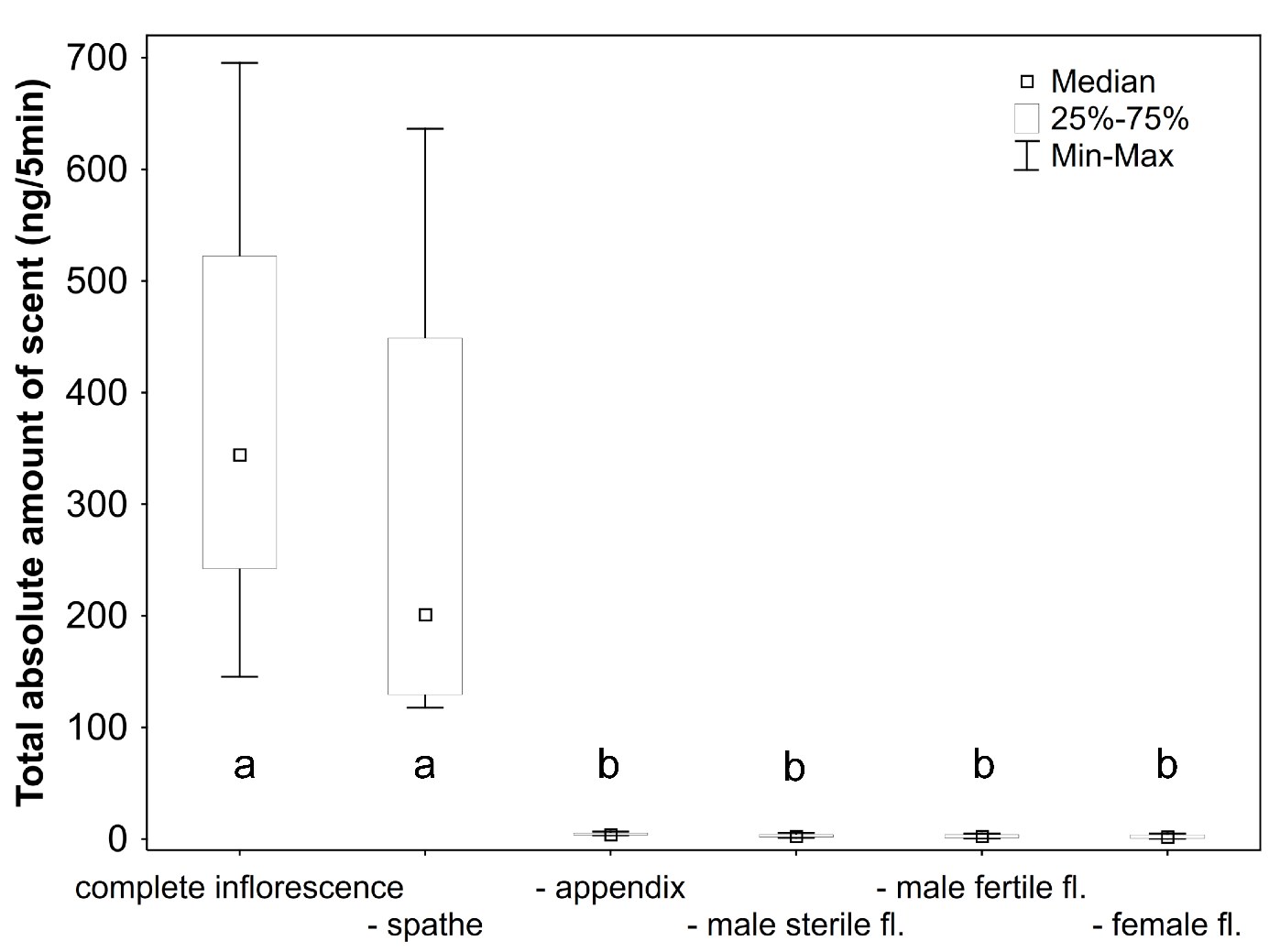
The dissection that produced those rows is worth describing, because it is unusually clean. Four Arum maculatum inflorescences were sampled whole, then with the spathe removed, then with the appendix removed, then zone by zone.
Take the appendix off and the plant goes quiet
Complete inflorescences released 118–695 ng per five minutes. With the appendix cut off: 4–7 ng. Removing further zones changed the amount no further.
Compound richness went the same way — from 32–47 compounds down to 2–8.
So the appendix assumption is right about quantity and wrong about identity. Two findings complicate it. Bicyclogermacrene vanished when the male flower zones were cut away — and was still absent when the male zone was excised with the female zone left in place, so the female flowers are not the source. And indole is not appendix-exclusive: it was still detected when only the bare peduncle remained.
What it smells of, by species
Arum maculatum is built on indole, p-cresol and 2-heptanone — all three present in cow dung, which is where its main pollinator breeds. Arum italicum is a different plant chemically: 1-decene and two dimethyloctadienes, compounds that could not be detected in Arum maculatum at all. The fragrant Arum creticum is over 80% benzyl alcohol. Arum palaestinum is almost entirely ethyl acetate — rotting fruit — and attracts Drosophila.
“Scentless” species are not scentless
Arum rupicola var. rupicola is described in the literature as having no smell. Its appendix released numerous sesquiterpenoids plus trace p-cresol and assorted alcohols, esters and ketones. Arum idaeum, also called scentless, released p-cresol and two p-cresol derivatives.
“Scentless” means “not obvious to a human”, which is a statement about us.
The same species smells different in different countries — and in different years, and next door
Three published profiles of Arum maculatum, from three countries, name three different sets of dominant compounds — England: 2-heptanone, indole, bicyclogermacrene; France: indole, limonene and α-pinene; Austria and Germany: β-citronellene and two dimethyloctenes. Only indole is common to all three.
The obvious reading is that the plant smells different in different places. The best dataset says the year matters more than the country.
One population, two consecutive springs
At a single French site, Arum maculatum's limonene went from 4.3% of the blend to 50.5% in one year, while indole fell from 26.8% to 2.0%. At a second site limonene went 6.9% to 42.0% over the same two springs.
Meanwhile the three French populations did not differ significantly from one another in the first year. Year beat geography, in the same study, on the same plants.
And individual plants vary more than either. Mean dissimilarity between two neighbouring inflorescences is 0.44 in Arum italicum and 0.68 in Arum maculatum — against a published benchmark of about 0.55 for deceptive flowers and 0.28 for rewarding ones. Two plants in the same wood are barely more alike than two species.
A retraction, by the same authors
An earlier paper reported geographic structure in Arum maculatum's odour. Its own authors withdrew that in 2013, reporting “no geographical structure” in the odour of that species across three French populations and calling it “surprisingly in contradiction” with the earlier result.
They also explained why the old finding had been weak: only two populations were sampled for odour in 2008, one of them represented by three individuals.
Is any of it local adaptation? Somebody moved the plants to find out
If a population's scent were tuned to its own local flies, a plant carried elsewhere should do worse than the natives. Two species were dug up on the morning they flowered, driven to another site, and set out among the local plants.
The transplants behaved like their new address, not like their origin
Arum italicum moved from a poor site to a rich one trapped what the natives trapped — and significantly differently from its own home population. Moved the other way, it caught thirty times fewer insects than it had at home, again matching its new neighbours.
Arum maculatum kept its own signature — over 85% moth flies wherever it stood — but its numbers collapsed 25 to 55-fold when moved.
The authors' conclusion: “No pattern of local adaptation was found for these two species.” What varies between populations is which insects are flying there, not what the plant is offering.
Read the design before quoting the result
This was a same-day translocation of already-flowering plants, not a cohort grown at the other site. And “fitness” here means insects trapped — no seed set was measured, and pollen transfer was deliberately prevented. A local-adaptation test on actual seed has still never been done in this genus.
The Arum maculatum arm was also one-directional, because the species does not grow at the receiving site; its two probability values were 0.063 and 0.051, which the authors read as no difference. They are a hair from the opposite reading, on nine and five inflorescences.
Does more scent bring more insects? Yes. Does the recipe matter? Apparently not.
Quantity yes, composition no
Across 95 wild inflorescences in two populations, the more an individual emitted, the more insects it trapped (P = 0.003 and P = 0.03).
But inter-individual variation in relative composition predicted nothing about which insects arrived, in either population.
That result also kills a tidy explanation. Deceptive plants are supposed to stay scent-variable because rare phenotypes do better — pollinators learn to avoid the common signal. In Arum maculatum the signal runs the other way: rarer scent phenotypes attracted fewer insects and were less likely to set fruit. Largely because, at that site, rare phenotypes were mostly just quiet ones.
Part VI
The Heat — Real, Measured, and Not What It Is For
An Arum appendix can run twenty degrees above the air around it. It is one of the most impressive feats of physiology in the plant kingdom, and it does not attract a single insect.
First, that it is real
The measurement goes back further than most people think. Lamarck noticed the heat in 1777; the first thermometer reading was Sennebier's, +8.6 °C on Arum maculatum. By 1851 Garreau had built an apparatus that measured oxygen consumption and heat in the same vessel and reported Arum italicum at +11.5 °C above a 20 °C room while drawing 140 cc of oxygen in that hour — thirty-one times the organ's own volume.
Modern figures are consistent with him. +18.5 °C above air for Arum italicum and +8.6 °C for Arum maculatum, measured side by side in one French population; 10.9 °C for Arum concinnatum in Crete. The appendix behaves like “an almost perfect thermoregulator tending towards a temperature optimum” of about 30 °C.
Which species is “more thermogenic” depends on how you divide
Arum italicum's appendix runs about 6.6 °C hotter than Arum maculatum's. But it is roughly six times the volume.
Per unit of appendix, Arum maculatum produces about four times the heat — 27.4 against 6.1 °C cm−³.
Both statements are true. Neither is quotable without its normalisation.
What it costs
Starch, and all of it in one night. On day 1 the epidermis of the anthers, of both rings of bristles and of the club stalk is packed full of starch; by the morning of day 2 those tissues are starch-free and their cells are dead. Garreau's accounting put roughly 470 cc of a 770 cc daily oxygen budget into the six hours of the paroxysm.
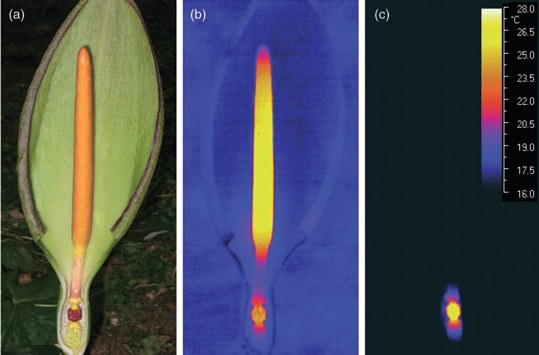
And now the part everybody gets wrong
The obvious story is that the warmth is a reward, or a beacon — that the insects come to a heated shelter. Two independent experiments say they do not.
Knoll's heated model, 13 days
In a Prague botanical garden, on thirteen separate days, Knoll ran a glass model inflorescence containing an electrically heated wire spiral in place of the club, warming the interior 10–20 °C above outside air. Beside it he ran an identical unheated model, and a model baited with rotten blood.
Throughout the whole period only the baited model caught insects. The heated and unheated models caught nothing but the occasional irrelevant leafhopper — and the baited model proved there were plenty of insects available to find the warm shelter, had they wanted one.
His verdict: “it now makes no sense to go on saying that the visitors of Arum inflorescences seek and find a warm shelter in them.”
Seventy years later, independently, someone offered Psychoda phalaenoides glass tubes held 10 °C above ambient. The flies showed heat avoidance in two of four experiments and no significant response in the other two.
The heat volatilises the scent. That is what it is for, so far as anyone has demonstrated — and it is a sufficient job, because the scent is the entire signal.
What that does not settle
Knoll tested attraction from a distance only. Whether warmth matters to an insect already inside the chamber is a different question, and it is open.
A 2026 study found that stamen temperature during the trapping night never fell below air temperature in either common species — running 4.7 °C above air in Arum italicum and 2.6 °C in Arum maculatum — and its authors say the flies “could benefit from the warmer temperature in the inflorescence”, thereby “questioning to what extent this system really is deceptive.”
A hot organ inside a cool room
The most careful measurement in the genus separated air from tissue from wall, with six thermocouples per inflorescence across 24 plants. The result is a gradient that ought to be impossible over the distance.
The stamens run 7–10 °C above ambient while the air at the bottom of the same 7 cm chamber sits within 0.2 °C of ambient. About eight degrees across less than seven centimetres, and up to eleven in three individuals. Only two of sixty-five passively warming species anywhere achieve a comparable gradient.
And it switches off in a heatwave
Held at 5 °C and at 15 °C the gradient holds. At 35 °C it collapses entirely — the whole chamber sits at 31 °C and every position is below ambient.
Psychoda prefers about 10 °C and its upper limit is around 33 °C. A hot enough day removes the cool refuge at the same time as it removes the fly.
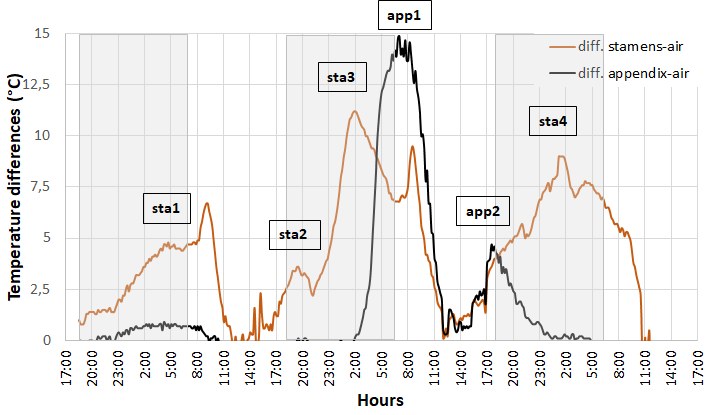
The one species that heats twice
Arum pictum again. Its appendix runs two separate heating episodes in one day — a long morning one peaking 14.6 °C above air between 06:10 and 09:20, and a weaker evening one peaking 6.7 °C above air between 17:00 and 19:30. Insects were attracted at both, in lower numbers at the second. Its stamens run four further heating phases on a schedule of their own.
Part VII
Who Comes — and How Good the Evidence Is
Arum maculatum is pollinated by a moth fly called Psychoda phalaenoides. That sentence is true in England and Germany, false in northern Italy, and unverifiable for most of the genus.
Four rungs, and most claims are on the first
“Pollinator” is used for four quite different levels of evidence. This page keeps them apart, and so should you.
| Rung | What was shown | In Arum |
|---|---|---|
| 1 | An insect was found inside the chamber | Nearly all of it |
| 2 | It was carrying pollen | Several species |
| 3 | It touched a receptive stigma | Two observations in the whole literature |
| 4 | It flew to another inflorescence | Never demonstrated |
The review says this out loud
“Except for four species, namely Arum maculatum, Arum italicum, Arum nigrum and Arum hygrophilum, data on pollination are actually observations or samples of insects captured in the floral chamber, which are not necessarily efficient pollinators.”
Pollinators are recorded for only about half the genus, and for most of those the record is a list of what was in the trap.
How much difference that makes: Arum nigrum attracts 50 insect species, of which perhaps four or five may actually pollinate. Arum creticum was visited by at least 21 species in Crete and only the five bruchid beetles were judged pollinators — while the larger scarabs in the same chambers carried far more pollen and were dismissed because they “remained quiescent at the bottom of the spathes.”
Carrying pollen does not make a pollinator. Behaviour does.
The textbook fly, and where it stops being true
North of the Alps the picture is as advertised. In Germany 94% of insects trapped by Arum maculatum were psychodid moth flies, and 93.5% of those were females of Psychoda phalaenoides. The British record agrees, and adds something odd — they are almost all female.
The females-only result, and the experiment that explains it
Tonnoir's British sample: Psychoda phalaenoides 0 males, 158 females. He suspected parthenogenesis.
Satchell settled it near Leeds. He collected Psychoda phalaenoides from tree trunks beside the same Arum plants at the same time and took both sexes there — and he reared the females taken from spathes, which produced both male and female offspring.
So the flies are not parthenogenetic. The plant is attractive to the female fly only — which fits a plant mimicking a place to lay eggs.
And then you cross the Alps
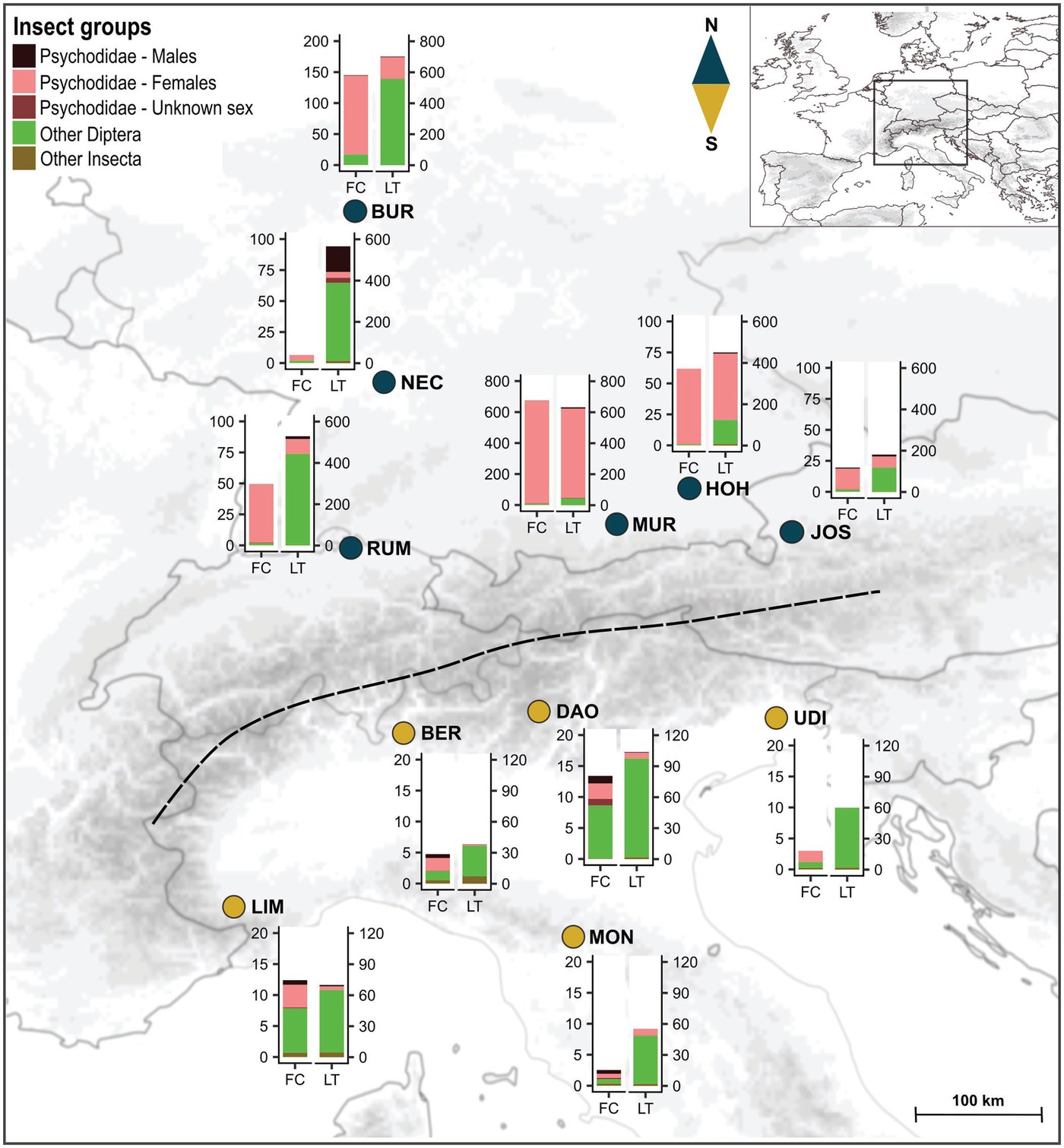
16,296 insects, 11 populations
North of the Alps, plants trapped a median of 16 visitors per chamber, dominated by female Psychoda phalaenoides.
South of the Alps the median was 6 — and the most abundant visitor group was Sphaeroceridae, dung flies previously reported from a single German population. In one Italian population the light traps caught no psychodids at all.
Local insect supply explains part of it and not all of it: northern plants are simply more attractive to female Psychoda phalaenoides than southern plants are.
The genus does this everywhere you look. Arum dioscoridis has four documented regional pollinator faunas that do not overlap — staphylinid beetles in Turkey, sphaerocerid flies in Cyprus, a different beetle-and-fly set in Lebanon where “none of the Lebanese species are the same as those from Turkey or Cyprus”, and another set again in Israel. In Israel Arum hygrophilum attracts only males of Psychoda cinerea — and a plant drawing in only males cannot be mimicking an egg-laying site.
Even at one site it can change between years: an English Arum maculatum population normally worked by Psychoda phalaenoides flowered three weeks late in a bad year and was visited by a completely different fly, with poor fruit set.
What the flies are actually tuned to
Their antennae respond to 78 of Arum maculatum's volatiles — together about 88% of everything the plant emits. Seven compounds triggered a response in every fly species tested, and six of those seven are also active in cow-dung headspace.
But cow dung only accounts for a quarter of it
Just 18 of the 78 active compounds are shared with cow dung. The other sixty are unexplained — which is why the current reading is that the scent imitates several different breeding substrates at once, not one.
And the five compounds everyone cites as the attractants failed to attract anything in field bioassay at natural concentration. A later study got a positive response from a four-compound blend — but only in the dark. Psychoda sigma turns out to be nocturnal with an endogenous clock, so the likeliest explanation is that the older trials did not control for time of day. Nobody has tested that.
More visitors, more fruit — up to a point
Fruit set rose with visitor abundance in both regions. Then it stopped. In northern chambers holding more than 71 insects the relationship vanished entirely. The suggested causes — damage to the stigmatic papillae by fly activity, or pollen-tube crowding — are guesses; neither was measured.
Which sits against an older and much-quoted claim that fruiting “did not appear to be related to the number of insects trapped, as if just one midge carrying pollen was necessary for a full fruit set.” The newer result wins, with the caveat that over most of the range the older study sampled, the curve may already have been flat.
Part VIII
What the Insects Get — An Open Question
Arum is the standard textbook example of a deceptive plant — one that pays its pollinators nothing. That claim rests on a single negative observation, and three separate lines of evidence cut against it.
The deception itself is not in doubt. The scent mimics a breeding substrate — dung, or rotting matter — and the flies that arrive are overwhelmingly females of species that lay eggs in exactly that. The chemistry is a real match: p-cresol is a major volatile of cow dung, and cow dung is where Psychoda phalaenoides breeds.
The load-bearing experiment, and it is a field trial
Cotton wool charged with single compounds over water traps, near a sewage farm, ten traps, 24 hours:
p-cresol caught 452 Psychoda. 2-heptanone caught 76. Indole caught 49. A three-compound mixture caught 785 — more than any single compound or pair.
p-Cresol is by a wide margin the most effective single attractant, and it is the compound that makes the dung.
So what is in dispute?
Whether the flies get nothing in return. The evidence for “nothing” is one observation: that feeding on the stigmatic secretion “was never observed” in Psychoda phalaenoides, and that the fluid is better read as a medium for pollen adhesion and germination.
Three things cut the other way.
| Evidence | What it shows |
|---|---|
| The fluid is sugary | Stigmatic secretion of Arum maculatum measured at a 9–12.5% sucrose equivalent — slightly higher than fluid from cut phloem |
| It measurably helps | In Arum hygrophilum the fluid prolongs Psychoda cinerea survival, and a matching 5% sucrose solution doubled survival over water alone |
| The chamber is warm all night | Stamen temperature never fell below air temperature in either common species through the trapping night |
The newest paper reopens it rather than closing it
Normally this site resolves a conflict by taking the newer source. Here the newest source is the one raising the doubt: the flies “could benefit from the warmer temperature in the inflorescence”, thereby “questioning to what extent this system really is deceptive.”
So the honest position is that the reward question is open, and anything on this site that flatly calls Arum rewardless has gone past the evidence.
The half nobody has measured at all
Every version of the deception argument is stated from the plant's side — what the plant gains without paying. Nobody has measured what the insect loses. Not the eggs it failed to lay while shut in a spathe, not the energy spent, not any effect on its fecundity. The cost half of a cost–benefit claim is simply absent.
A nineteenth-century objection nobody has answered
Kullenberg, working in Lebanon in 1953, made a point that has never been addressed. Ammonia and amines are ubiquitous protein-breakdown products across the plant kingdom — in Rosaceae, Asclepiadaceae, Aristolochiaceae, Rafflesiaceae. Their presence in an Arum is therefore not by itself evidence of adaptation to dung insects. They should “bid us be careful in judging whether the Arum species are to be regarded as adapted for pollination by manure insects.”
He added a sharper version: no experimental study of Arum floral biology has ever been done in an environment free of dung insects — and such an environment might not be one in which Arum grows.
Told as history: the 1929 reading
An early German account asserts a genuine reward outright — a nectar droplet on each stigma, released only once the stigmatic papillae wilt, plus pollen eaten before release.
That reading is superseded and is recorded here because it shows how the question was answered before anyone measured the fluid, and because the wider claim that aroids are nectarless has since failed in at least one other genus.
One thing the trap definitely is not
It is not carnivorous, and the idea was already being knocked down in 1883. Dead flies do accumulate in a crowded chamber, but Knoll's account of why is mechanical: in a chamber packed too densely the more delicate flies are damaged in the crush. He never found beetle corpses in an inflorescence with advanced fruit development.
The one place death looks routine is Arum dioscoridis, where the mass of falling pollen means “the insect visitors easily are drowned, particularly if they are wet or smeared with stigmatic secretion.”
Part IX
Reading Your Own Plant: Go Out at Dusk
There is exactly one window and it is the evening the spathe unrolls. The cue is not that the spathe is open — it is that the appendix is warm and the plant stinks.
Touch it
Put a finger on the appendix in the late afternoon or evening. If it is receptive it will be noticeably, unmistakably warm — not a degree or two, but ten to twenty degrees above the air. You do not need a thermometer and you will not mistake it.
And you will smell it. A strong faecal or urinous stench, strongest in the evening, gone by the next morning.
| What you see or feel | What it means |
|---|---|
| Spathe unrolled, appendix warm, strong smell, late afternoon or evening | Receptive. Pollinate now. This is the only window there is |
| Spathe open, appendix cool, no smell | Yesterday's flower. Female phase is over. Nothing you do will work |
| Pollen visible in the chamber base, next morning | Male phase. Collect — do not apply here |
| Flies moving in the chamber | It worked as designed. Leave them; they will go at dawn carrying pollen |
| Spathe still standing, days later | Means nothing. The spathe outlasts the function |
If you have come from the Anthurium or Alocasia page — reset your clock
Those genera want you out at first light. Arum is a dusk plant, and getting this wrong costs you the whole season on that inflorescence.
There is a mechanism behind it, recently measured: at least one of the pollinating moth flies is nocturnal, with an endogenous clock — nearly 30 times more active in the dark, and the rhythm persists under constant light. A synthetic Arum maculatum blend raised its activity to the level of fresh horse dung — but only during the dark phase. In daylight the same blend did nothing at all.
Which species you have, and why it matters
Two things separate the common European pair at a glance, and they are the two things that change what you should do.
| Arum maculatum | Arum italicum | |
|---|---|---|
| Leaves appear | Late winter or very early spring | Autumn |
| Flowers | Earlier | 2–4 weeks later |
| Spadix length | c. 64 mm | c. 102 mm |
| Female flowers | 25 ± 7 | 61 ± 19 |
| Inflorescences per plant | Usually one | 1.96 on average — 67% make two |
The autumn-leaf test is the reliable one. A plant that puts up leaves in autumn is not Arum maculatum — that character was described as one “which one never encounters in Arum maculatum” and has been used to correct herbarium determinations.
And if your plant flowers in October, at ground level, you have Arum pictum and most of this page's timetable does not apply to you. Part II.
Part X
Pollen, and the Cross: One Clone Is Enough
Bag an Arum and it sets nothing. That is reported everywhere as self-incompatibility, and it is the wrong diagnosis — with a consequence that decides whether a single plant is any use to you.
The experiment that separates timing from compatibility
Bagged and left alone: 100 inflorescences, three taxa, five populations, zero seed. Complete failure of spontaneous selfing.
Bagged, then hand-pollinated with pollen from another inflorescence of the same clone: 100% infructescence set in four of five populations — with fruit number, seed number and seed weight statistically indistinguishable from outcrossed controls.
Self pollen also germinated on the stigma as readily as outcross pollen, at every stigma age tested. There is no prezygotic rejection of self pollen at all.
So the barrier is dichogamy — timing — not incompatibility. Within one inflorescence the female phase closes before the male phase opens, so a spathe cannot pollinate itself. But a plant's inflorescences open days apart, and the stigmas stay receptive across a window at least twenty-four hours wide — 12 hours before anthesis through 12 hours after, with no measurable decline.
What this means if you have one plant
A clone is a perfectly good pollen donor to itself. Collect from an inflorescence in male phase, carry it to a different inflorescence in female phase, and you will get seed — as much of it, and as heavy, as from a cross.
One limit, and it matters: shown for three taxa only: Arum italicum subsp. italicum, subsp. neglectum, and Arum maculatum. Everything said about the rest of the genus rests on a personal communication.
How long the pollen lasts
This is the number that decides your logistics, and chilling roughly doubles it.
| Species and storage | Stays good for | Then |
|---|---|---|
| Arum maculatum, left in the spathe in the field | 2 days | 36% on day 3, zero from day 4 |
| Arum maculatum, dark dry cupboard at 15 °C | 4 days | 51% on day 5, weakly viable to day 7 |
| Arum italicum, dry at room temperature | Under 48 hours | Total loss |
| Arum italicum, refrigerated at 8 °C | 72 hours | Then drops rapidly to zero |
Two cautions on that table
The two species were tested by different methods — Arum italicum in a germination medium, Arum maculatum by actually pollinating with it. The rows are not directly comparable.
And Arum italicum's germination was only 15–32% even at time zero. The authors leave two explanations open: the medium may be wrong for Arum's unusual pollen, or the pollen may genuinely be poor. Do not quote that figure as a property of the species.
Why it dies so fast has a structural answer: Arum pollen is trinucleate and starchless, called “a rare combination in aroids”. Trinucleate pollen is short-lived and hard to germinate artificially, wherever it occurs.
The method
- Work two inflorescences. They can be on the same plant, or on the same clone — see above. What they cannot be is the same spathe.
- Collect on the morning of day 2, when pollen has fallen into the chamber base. Cut a window in the spathe if you need to.
- Store cold if you must store at all. 8–15 °C, dark, dry. Fresh is better; two days is your realistic ceiling.
- Apply in the evening of a receptive inflorescence — warm appendix, strong smell — through a window cut in the chamber wall, onto the stigmas directly.
- Bag it if the parentage matters, and re-bag immediately after. The one study that re-bagged got 80–100% set; a study that does not mention re-bagging got 15%.
- Label it. Fruit takes about three months.
Crossing between species
No interspecific cross has ever been attempted in the breeding literature. The paper most often cited for “isolating mechanisms in Arum” tests nothing of the kind — every experiment in it is within a single taxon.
But the hybrids exist. Natural pentaploid Arum italicum × Arum maculatum hybrids are documented — 2n = 5x = 70, from a hexaploid and a tetraploid parent — in France and in Sussex. Their pollen is about a third sterile. So the barrier between the two species is leaky, and it is ecological rather than genetic: different pollinators, different scent, different flowering dates, and in most places they simply do not grow together.
Within the italicum group, crossing works and the direction matters: the two are interfertile, “particularly with italicum as the female parent.” Attempts to cross that group with Arum maculatum by hand all failed — using a 56-chromosome maculatum, and the experimenter suspected an 84-chromosome race would have worked but never found one.
Part XI
Fruit and Seed, and the Seven-Year Wait
The berries are the easy part. What follows them is the longest wait of any genus on this site — and the seed will not keep for a second season.
What a successful infructescence looks like
A tight cylindrical cluster of berries on a bare stalk, green ripening through orange to red, the leaves long gone by the time they colour. In Arum italicum that is about 43 berries with 2.5 seeds each; in Arum maculatum about 24 berries with one seed in 86% of them. From pollination to ripe berry is about three months.
The one exception, again, is Arum pictum: a globular head of drier, silvery-lilac berries sitting on the ground, with no bird package about it and no known disperser.
There is no such thing as an “Arum fruit set rate”
Published figures for Arum maculatum range from 1% to 86.1% between populations of the same species. For Arum italicum, one French population managed 16.1% while two Spanish ones managed 65% and 74%.
Do not average these and do not expect a number. In the French study, 144 of 260 marked plants set nothing at all.
What eats them before they ripen
In one closely watched population, of 155 Arum italicum inflorescences only 25 matured. 77 aborted on their own — and 34 had the appendix eaten, five the spathe. Every altered inflorescence aborted, including ones that had already set fruit. Roughly three-quarters of the damage was herbivores eating the appendix.
Sowing, and the thing that will catch you out
The seed does not keep
Eighty-four seeds collected in 1947 and sown in 1949 gave not one seedling. Seed from the same source sown the season it was collected germinated at 29%.
Sow the year you harvest. There is no second chance with stored Arum seed.
It also wants cold and dark, and the difference is not marginal.
| Treatment | Germination |
|---|---|
| Room temperature, in daylight | Nil |
| Room temperature, in darkness | 20% |
| Outdoors, frozen through the first winter | 86–92% |
Sow outside and let the winter do its work. The daylight-versus- darkness pair is a single unreplicated comparison, so do not read too much into the exact figures — but the outdoor result is confirmed independently, once at 100% on a small sample.
Then you wait
Seven years, and the first two are invisible
Nothing appears above ground for the first two seasons. In the third, one small ovate leaf. The adult arrow-shaped leaf comes in the fourth season “and generally later”. A seed-grown plant “rarely flowers before the seventh year.”
Meanwhile the seedling is spending its energy going down: contractile roots haul the young tuber from about 2 cm to nearly 7 cm deep in its first autumn. Replant one near the surface and it will pull itself back down within a week.
Which is why division is the sensible route for a grower, and why seed is for making something new. A vegetatively produced plant starts at the right depth with a food store already made, and flowers years earlier.
Part XII
When It Fails — In Order of Likelihood
Five things go wrong, and they are not equally likely. Work down this list in order before concluding anything about your plant.
- You went out in the morning. Commonest cause by a wide margin, especially for growers who came here from the Anthurium or Alocasia pages. Arum is receptive in the late afternoon and evening of the day the spathe unrolls. Check by touch: if the appendix is not warm, you are too late.
- The spathe was open but the plant was finished. The spathe outlives the function and looks unchanged for days afterwards. Knoll showed this in 1926 — on day two the inflorescence attracts nothing while “the appearance of the spathe has not meanwhile changed.” The smell and the warmth are the signal. The open spathe is not.
- The pollen was dead. Two days is the realistic ceiling at room temperature, and Arum italicum is finished in under forty-eight hours. Chill it, or use it the morning you collect it. Part X.
- You only tried once. Each inflorescence gives you one evening. If a cross matters, you need two inflorescences whose timings you have watched — not two plants you hope will oblige.
- It worked and you are early. Three months from pollination to ripe berry, and the leaves die back long before the fruit colours. A bare stalk in midsummer is not a failure.
Two things that are not the problem
Not self-incompatibility. If you have one clone, that is workable — move pollen between two of its inflorescences and you will get a full set of seed. Part X.
Not a shortage of insects, if you are hand-pollinating. One study found fruit set stopped improving above about 71 insects per chamber, and an older one concluded a single pollen-carrying midge was enough for a full set.
And one cause that is real but rarely suspected
Something ate the appendix. In one monitored population 34 of 155 inflorescences lost their appendix to herbivores, and every single one aborted — including those that had already begun setting fruit. If your inflorescence looks chewed at the tip, that is the answer, and there is nothing to be done for it this season.
Sources
Sources, and What Kind of Evidence Each One Is
Fifty papers were read for this page. These are the ones it actually leans on, each with a note on how much weight it will bear.
- Knoll, F. (1926). Insekten und Blumen: experimentelle Arbeiten zur Vertiefung unserer Kenntnisse über die Wechselbeziehungen zwischen Pflanzen und Tieren. Abhandlungen der Zoologisch-Botanischen Gesellschaft in Wien 12. (In German.) The most important source on this page and the best experimental work in it. Everything in Part IV is his: the slide-trap model, the tilt test, the fatty oil, the oiled-glass control, the kettle inversion, the glass model inflorescences, the heated-model trial across thirteen days, and the release-up-the-spadix mechanism. Also Parts I, III, VI, VII and VIII. Grade: controlled field and laboratory experiment, with explicit negative controls — unusually rigorous for 1926 and still not superseded. Note: Scope is Arum nigrum. He treated Arum italicum and Arum maculatum as the same system at a different size and promised a separate publication that this archive does not hold. Note: roughly a third of the scanned pages are unreadable; several counts in it are OCR-corrupt and are not quoted on this page.
- Diaz, A., Ollerton, J., Boyce, P. C. et al. (2006). The effectiveness of some mechanisms of reproductive isolation in Arum maculatum and Arum italicum. The source of Part X's central correction. 100 bagged inflorescences across three taxa and five populations, plus hand-pollination with clone-mate and outcross pollen, plus stigma-age germination trials, plus progeny grown on for three years. Grade: measured, replicated, with n stated throughout — the strongest breeding-system work in the genus. Note: despite its title it contains no interspecific cross at all; every experiment is within a single taxon. Note: its seed-sowing sample size is stated two different ways in the same paper.
- Gibernau, M., Macquart, D. & Przetak, G. (2004). Pollination in the genus Arum — a review. Aroideana 27. The frame for Part VII, and the source of the evidence-ladder caution this page is built around: “except for four species… data on pollination are actually observations or samples of insects captured in the floral chamber, which are not necessarily efficient pollinators.” Also the genus-wide thermogenesis compilation in Part VI and the reward argument in Part VIII. Grade: review — almost everything in it is second-hand and the page cites it as such.
- Laina, D., Dötterl, S., Gfrerer, E. et al. (2022). Local insect availability partly explains geographical differences in floral scent of Arum maculatum. The largest pollinator dataset in the genus: 19,306 insects — 16,296 from 273 floral chambers across 11 populations, plus 3,010 from light traps. Source of the north/south Alpine split in Part VII, the Sphaeroceridae result, the pollen-load comparison and the 71-insect plateau. Grade: measured, large n, with the statistical tests reported. Note: its own key negative result is that pollen loads did not differ significantly between psychodids and non-psychodids, which contradicts the standard justification for calling psychodids the effective pollinators.
- Marotz-Clausen, G., Gibernau, M. & Dötterl, S. (2024). Where are volatiles produced in the highly synorganised inflorescence of Arum maculatum? Part V's organ table. Sequential dissection of four female-stage inflorescences, sampling after each cut. First direct organ-level evidence that the male flower zone is a second scent source, and the demonstration that the spathe contributes nothing exclusive and that indole is not appendix-specific. Grade: measured, n=4 — small, and the bicyclogermacrene effect was clear in only two of the four.
- Marotz-Clausen, G., Jürschik, S., Fuchs, R. et al. (2018). Incomplete synchrony of inflorescence scent and temperature patterns in Arum maculatum. The evening-burst timing in Part III and the scent/heat relationship in Part V. 150 headspace samples across five plants at 30 time points, plus two by proton-transfer-reaction mass spectrometry. Grade: measured. Its headline is a negative: in none of seven individuals did peak scent coincide with peak temperature — three peaked before, two after.
- Gibernau, M., Quilichini, A. et al. (2023). Arum pictum emits isomyocorene. Parts II and V. The only Arum scent study that confirmed its main compound by NMR rather than library matching — and in doing so overturned three of the five previously published “major volatiles” of the species. Also the twice-daily thermogenesis. Grade: measured, n=18 inflorescences across four populations, with structure determination. Note: the paper states its thermogenesis sample as 8 inflorescences in the methods and 10 in a table caption.
- Gibernau, M., Albre, J. et al. (2003). Pollen viability and longevity in two species of Arum. The storage table in Part X — the single most practically useful result on this page. Grade: measured, but Note: the two species were tested by different methods (in vitro for Arum italicum, in vivo for Arum maculatum) and the rows are not directly comparable. The authors themselves leave open whether Arum italicum's low baseline is the pollen or the medium.
- Kite, G. C., Hetterschieid, W. L. A., Lewis, M. J. et al. (1998). Inflorescence odours and pollinators of Arum and Amorphophallus. In: Reproductive Biology (eds Owens & Rudall), 295–315. The per-species scent survey in Part V (11 Arum species) and the p-cresol trapping trial in Part VIII. Grade: measured for the trapping trial; for the scent survey, very small samples — one to nine analyses per species, mostly from single cultivated plants at Kew, with proportions given as bands rather than figures. Note: OCR-degraded; one cell of the trapping table contradicts every other cell and is treated on this page as unresolved.
- Leclerc, C., Gibernau, M., Perdereau, E. & Pincebourde, S. (2025). Subtle ecophysiological divergences in a deceptive strategy to attract the same pollinators in two sympatric Arum. Annals of Botany. Parts VI and IX. The volume-normalised heat comparison, the warm-chamber-all-night result, and the first measurement of a pollinator's daily activity rhythm — Psychoda sigma is nocturnal with an endogenous clock, which is why Part IX sends you out at dusk. Grade: measured. Note: notable for reopening the reward question in print, and for an all-null row: the Arum italicum blend did not differ from solvent, from dung, or from the Arum maculatum blend.
- Leclerc, C., Gibernau, M., Villain, S. & Pincebourde, S. (2026). Trapped in a hot microcosm: how flower microclimate… Phil. Trans. R. Soc. B 381: 20240382. The hot-organ-in-a-cool-room gradient in Part VI, and the heatwave collapse. Six thermocouples per inflorescence across 24 plants, separating air from tissue from wall. Grade: measured, and the best of its kind in the archive. Note: quote the Results (8 °C typical, 11 °C maximum), not the Discussion, which rounds differently. Note: its “thermal plug” idea joins two separate datasets and no fly was ever observed inside a chamber; the authors' own verbs are “is expected to” and “suggests”.
- Gfrerer, E., Laina, D., Dötterl, S. et al. (2022). Antennae of psychodid and sphaerocerid flies respond to floral scents of Arum maculatum. The 78-compound electrophysiology result in Part VII, and the finding that only 18 of those compounds are shared with cow dung. Grade: measured for Psychoda phalaenoides (20 individuals); single for three other species tested on one or two flies each. Note: contains the unpublished field-bioassay failure that this page reports as an open conflict.
- Albre, J., Quilichini, A. & Gibernau, M. (2003). Pollination ecology of Arum italicum (Araceae). The four-phase heat programme in Part III, the pollinator identity in Part VII and the fruit-set data in Part XI. Notable for establishing that Psychoda phalaenoides — Arum maculatum's pollinator — was not among the 405 psychodids identified from Arum italicum. Grade: measured, 174 inflorescences. Companion paper: Albre & Gibernau 2008, on reproductive success and herbivory.
- Barabé, D., Gibernau, M. & Lacroix, C. (2003). Development of the inflorescence of Arum italicum. Part I's anatomy, and the vascular argument against calling the lower bristles pistillodes. 37 SEM-prepared samples across developmental stages. Grade: measured for the development, single for the bundle counts (n=4 staminodes, n=2 pistillodes) — and the authors decline to settle what the organs are.
- Boyce, P. C. (1989). A new classification of the genus Arum. Kew Bulletin 44(3): 383–395. — with Boyce, P. C. (2006). Arum: a decade of change. Aroideana 29: 132–137. Part II's structure, the species-count timeline and the 'flag'/'cryptic' proposal. Grade: taxonomic revision from living material — Boyce studied every species but one alive, which matters because scent, ecology and colour do not survive in a herbarium. Note: The species counts are dated claims, not current totals. Note: the two papers contradict each other on Arum purpureospathum's tuber orientation, and neither mentions the other.
- Bröderbauer, D., Diaz, A. & Weber, A. (2012). Reconstructing the origin and elaboration of insect-trapping inflorescences in the Araceae. American Journal of Botany 99(10): 1666–1679. The independent confirmation in Part IV, and the best single source on this page for how Arum sits in the family. Scores four trapping devices across 114 genera, with scanning electron microscopy on 142 species in 76 genera, then reconstructs where trapping arose: at least ten separate times, in at least twenty-seven genera, from an ancestor that had no trap. Grade: measured for the morphology; inferred for the reconstruction, which is an ancestral-state analysis on somebody else's tree. Its most useful sentence for a reader of this page is a warning: “one should be cautious to deduce the presence of trap pollination from the shape of the inflorescence alone.” Note: it scores the genus, not the species, so a polymorphic genus is a single data point — and it imposed a step matrix on its parsimony run that favours the result it reports, which the authors state plainly.
- Delpino, F. (1874). Ulteriori osservazioni e considerazioni sulla dicogamia nel regno vegetale. (In Italian.) The origin of the trap-flower reading of the genus, and the source of the prison/shelter classification. Grade: single, observational, 1874. Note: two things worth knowing: his description is of Arum italicum — Arum maculatum gets one line, “as the preceding species” — so the whole genus-wide account was built by extrapolation from one species; and his explanation for the deception is that the flies are stupid, which has not aged.
- Sowter, F. A. (1949). Arum maculatum L. Biological Flora of the British Isles, Journal of Ecology 37: 207–219. The British seed and germination data in Part XI, and the female-only pollinator surveys in Part VII. Grade: compilation, with some original counts. Note: It is also this page's main example of the problem it is about: published 23 years after Knoll and citing him nowhere, it carries the refuted fish-trap account. It also miscredits a 1921 study as confirming a claim that study contradicted. Use it for its numbers, not its mechanism.
- Scott, D. H. & Sargant, E. (1898). On the development of Arum maculatum from the seed. Annals of Botany 12. The seven-year schedule and the contractile-root measurement in Part XI. Grade: measured, over four seasons — and the authors flag their own confound, that pot soil is looser than field soil and may exaggerate the pull. Their note that bird dispersal “is much needed” as evidence is still true.
- Kullenberg, B. (1953). Observationer över Arum-arternas pollination. (In Swedish, with an English summary.) Part IV's counter-evidence — the finding that Arum hygrophilum and Arum dioscoridis have no slip surface at any developmental stage and that the bristles work purely as a size filter. Also the only rung-3 observation in the batch: pollen-dusted moth flies found stuck to the stigmas. Grade: single, direct observation. Note: heavily OCR-degraded; pages 7–11 of the scan are unrecoverable. Its objection that ammonia and amines are ubiquitous plant products, and therefore weak evidence of dung adaptation, has never been answered.
- Chartier, M., Pélozuelo, L., Buatois, B., Bessière, J.-M. & Gibernau, M. (2013). Geographical variations of odour and pollinators, and test for local adaptation by reciprocal transplant of two European Arum species. Functional Ecology 27(6): 1367–1381. The reciprocal transplant in Part V, and the source of the French scent profile. Seven wild populations, 2008–2010, six in France and one in Spain; 347 inflorescences scored for insects and 81 for scent, plus two years of transplants between a rich site and a poor one. Grade: measured, and the largest field dataset on this question in the genus. Its result is a negative and a clean one — “No pattern of local adaptation was found for these two species”; what differs between populations is which insects are flying, not what the plant offers. Two limits belong with every quotation from it: the transplant was a same-day move of already-flowering plants rather than a cohort grown in place, and “fitness” means insects trapped — no seed was ever counted. It also retracts part of its own authors' 2011 paper, finding no geographic structure in Arum maculatum odour after all. Note: its Results describe Arum italicum's dominant compounds as “seven… 75%” and then list six totalling 83%, while its Discussion says five — use the individual percentages, not the summary sentence. Read visually from rendered pages on 2026-08-06, because the file has no recoverable text layer.
On the two names you will see for the same fly
Psychoda grisescens appears in more recent papers as Psycha grisescens, following a 1983 split of Psychoda into several genera. This page uses whichever name its source used and does not harmonise them, because harmonising would make it impossible to match a record back to the paper it came from.