
Araceae · Reproduction
WHY SOME CROSSES FAIL
Chromosomes, breeding groups, and the crosses nobody tried
Araceae · Reproduction
What Will Cross with What
The pollination guides on this site tell you how to make a cross. None of them tells you which crosses are worth making. That question runs through chromosome numbers, breeding groups and a great deal of missing data — and the honest answer, for most plants anyone grows, is that nobody has checked.
This page collects what is actually known. It is short on rules and long on scope, because the subject is one where a confident answer is nearly always someone generalising from a handful of plants.
Three things are worth knowing before starting. Chromosome counts exist for about a quarter of the family. No aroid genus has a tested compatibility matrix — not one. And the strongest evidence anyone has is retrospective: records of crosses that worked, which say nothing about the crosses nobody tried.
What is here
Four parts. The third is the practical one.
Part I
The Number, and Where a Grower Meets It
A chromosome count is the least glamorous number in botany and one of the few that can decide, before you start, whether a cross has any chance at all.
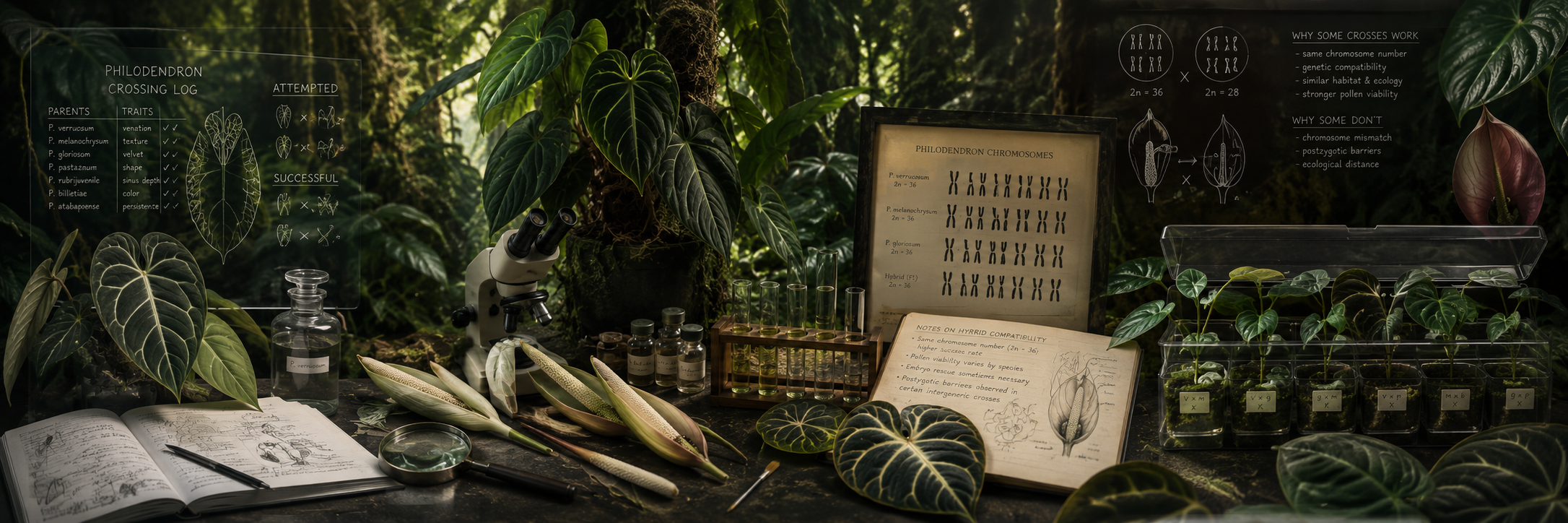
Two notations turn up. 2n is the count in an ordinary cell of the plant. n is the count in a pollen grain or an egg — half of it. A plant written as 2n = 28 makes pollen carrying 14. When two plants with the same number cross, the halves pair cleanly. When they do not, they may still make a seed, and that seed may still grow — but the plant it becomes often cannot make working pollen of its own.
That is the practical shape of it. A mismatch does not usually stop a cross. It stops the generation after.
How much of the family has been counted
The scope of everything on this page
26%
The largest analysis of chromosome evolution in Araceae drew on counts for 26% of the family's roughly 3,300 species. For the other three-quarters, no count exists.
Set against botany at large that is not unusual and is not comforting: counts exist for about 60,000 of the 300,000 or more flowering plant species known.
So the first honest answer to “what is my plant's chromosome number” is usually that nobody has looked. The second is that if a number does exist for the species, it may rest on one plant, counted once, decades ago.
The numbers, for the genera people grow
These are Marchant's own counts, made on living plants at Kew between 1970 and 1973 and read here from the printed tables. Where a genus is uniform he counted several species and got the same answer; where it is not, the spread is the interesting part.
| Genus | 2n | What to notice |
|---|---|---|
| Amorphophallus | 26 in most, including Amorphophallus titanum | Amorphophallus bulbifer is 39, a triploid. Amorphophallus paeoniifolius (counted as Amorphophallus campanulatus) and Amorphophallus maximus sit on a different base at 28. |
| Anthurium | 30, up to c. 124 | Fragments and B chromosomes are common — 30 + 2f, 30 + 5f, c. 60 + 1B. One variety counted 45–47, which is not a stable number. |
| Monstera, Epipremnum, Scindapsus, Rhaphidophora | 60, and up to c. 120 | The whole clade sits high, on one ancient genome duplication. Scindapsus pictus var. argyraeus reaches c. 110 and is sixteen-ploid. |
| Dieffenbachia, Zamioculcas | 34 | On a base of 17, with unusually large chromosomes. The clearest karyotype signal in the family. |
| Aglaonema | 40 | Except Aglaonema treubii at 100. |
| Homalomena | 40 | Same number as Aglaonema and Anchomanes, but small chromosomes where theirs are large. |
| Alocasia, Colocasia | 28 | Matches the modern Alocasia work. Alocasia odora at 56 and Alocasia longiloba at 70 are the exceptions — the second was counted as Alocasia longiloba (published as Alocasia lowii), a name now referred to the cultivar Alocasia longiloba ‘Lowii’. |
| Philodendron | 32 and 42 | Two of his three accessions were named only as “received as” — he did not vouch for the determinations. |
| Zantedeschia | 32 | Three species, all the same. |
| Syngonium | 24, 26, 30 | Three accessions, three numbers. |
| Cryptocoryne | 28 to 42 | Genuinely variable across species. |
| Typhonium | 54 | Previously published for the genus: 52, 26, c. 160, c. 118, 16 and 18. The worst disagreement in the family. |
| Pinellia | 115 in Pinellia ternata | Against previous counts of 116, 128, 129 and 28. |
| Sauromatum | 26 | Five separate accessions from three countries, all 26. This is what a settled count looks like. |
A count is only as good as the plant it came from
When Sheffer and Kamemoto worked through Anthurium they met conflicting numbers for the plant they called Anthurium durandii (published as Anthurium littorale), a name now referred to Anthurium durandii — 2n = 28 against 30. Their conclusion was not that one count was sloppy. It was that two different species had been examined, and that the earlier specimen had been identified from a leaf alone.
Marchant reached the same conclusion from the other direction. An earlier body of work had claimed widespread chromosome variation within species and even within single plants in this family; his counts gave it no support, and resolved several published disagreements as errors instead.
Two independent surveys, the same verdict. Where counts for one species disagree, suspect a mistake before you suspect biology. A chromosome number is a measurement of a particular plant, and it inherits every uncertainty in the name attached to it.
Part II
What the Family's Numbers Actually Did
For eighty-four years botanists worked out a family's “basic number” by taking the highest common factor of the counts they had. For Araceae the answer was seven, or fourteen. Both are wrong — and the botanist who supplied the seven said at the time that it was tentative.
Where the seven came from
Between 1970 and 1973 C. J. Marchant worked through the living collection at Kew and published five papers under the title Chromosome variation in Araceae. He set out to reach every genus in the family, and by the last paper he had karyotypes for just over half of them — 44 genera, about a third of the family, by the first paper, with 54 genera simply not available at Kew to be counted at all.
In that final paper he wrote that, with just over half the genera done, x = 7 was the most common basic number, followed by x = 13. That sentence is the origin of a figure repeated for the next forty years.
What was repeated far less often is what he said around it. His scheme of basic-number relationships was published as a diagram whose dotted lines marked “very uncertain derivations”, and he described the relationships as only tentative. He was blunter still about the underlying problem:
Marchant on his own data, 1973
“On the basis of the kind of karyotypes encountered in those genera contrasted by taxonomists as primitive or derived it is hard to formulate any obvious evolutionary trends. This inadequacy of chromosome information serves only to emphasize our present-day lack of knowledge of chromosomes as evolutionary indicators over a broad spectrum of genera.”
He also said his own survey was “incomplete in terms of coverage of the whole family and in terms of representation within some individual groups.” The number outlived the warning.
He was capable of the same scrutiny on himself. The final paper opens its discussion by correcting his own first one: he had concluded in 1970 that Scindapsus pictus, at 2n = ca. 110, had a base number of x = 10, and called that in print “a poor numerical interpretation of the facts”. On a base of x = 7 the same plant is sixteen-ploid.
One further thing his survey settled. An earlier body of work had claimed widespread chromosome variation within species and even within single plants in this family. Marchant's counts gave it no support, and resolved a number of published disagreements as errors rather than biology. That matters for everything below: where two counts for one species disagree, the usual explanation is a mistake, not variation.
Why the seven did not survive
The method had no way of knowing which species were related to which, or how common each number was. It was arithmetic performed on a list. In 2012 the same question was asked again using a model that treats polyploidy, chromosome fusion and chromosome fission as separate events with their own probabilities, fitted to a phylogenetic tree of 113 of the family's 117 genera.
The ancestral number, re-estimated
n = 16
Maximum likelihood put the ancestral haploid number at n = 16; Bayesian inference at n = 18. The previously accepted basic numbers of 14 and 7 were rejected outright.
The authors' wider conclusion is blunter than the numbers: calculating a basic number by highest common factor is obsolete for any large group, and the arithmetic has a built-in bias toward answers that are too low.
The direction of travel is down
This is the finding that changes how the rest of the page reads. Across the family the model inferred:
| Event | Inferred number | What it means |
|---|---|---|
| Chromosome losses | 98.1 | Fusion. Two chromosomes becoming one. |
| Chromosome gains | 8.4 | Only one gain is inferred with high probability anywhere in the family, on the branch leading to Scaphispatha. |
| Duplications | 14.3 | Whole-genome doubling. |
| Demi-duplications | 14.3 | Doubling of part of the complement. |
Losses outnumber gains by more than eleven to one. The aroid lineage has spent its history shedding chromosomes, not accumulating them — which is exactly the pattern the old highest-common-factor method could not see, because a family that starts high and descends produces a misleadingly small common factor.
Polyploidy is recent, and it is patchy
Twenty-nine polyploidisation events were inferred, and they sit mainly at the tips of the tree — in Gymnostachys, Alloschemone, Urospatha, Anubias, Montrichardia, the Cryptocoryneae, Calla, Filarum and Peltandra. Only three are inferred deep in the tree, and two of those are worth naming because they shaped genera people grow: a genome duplication on the branch leading to the Rhaphidophora clade, taking it from n = 15 to n = 30, and a demi-duplication on the branch leading to the Zantedeschia clade, from n = 14 to n = 21.
The Rhaphidophora event is the reason a whole group of familiar climbers — Rhaphidophora, Epipremnum, Scindapsus, Amydrium, Anadendrum and Monstera — all sit at n = 30 while most of the family sits far below it.
What these numbers are, and are not
Every figure above is inferred, not counted. They are the output of a model fitted to a tree, and the paper reports them with probabilities. They describe ancestral numbers for each genus, and a living species can and does sit somewhere else entirely.
Use them to understand why a genus behaves as it does. Do not use them as the chromosome number of a plant in front of you.
Part III
The Walls That Stop a Cross
Three genera have been looked at hard enough to say something. They were looked at in three completely different ways, and the difference matters more than the similarity.
| Genus | What was actually done | How much weight it carries |
|---|---|---|
| Philodendron | Crosses were attempted — hundreds of them, with millions of seedlings screened, by a commercial hybridiser. | The strongest. A failure here means somebody tried and it did not work. |
| Alocasia | Existing hybrids were fingerprinted and sorted by genetic similarity. | Retrospective. It maps where success has happened. No pair was tested and found incompatible. |
| Anthurium | Chromosomes were counted in 63 species, 38 of them for the first time. | Counts only. No crossing experiment accompanies them. |
Philodendron: the wall somebody walked into
McColley and Miller divided the genus into three groups by breeding behaviour: the arborescent, tree-like plants; the majority of the vines and the true self-headers; and a third set of vine types that had not been crossed with anything, a few of which refused even their own pollen. Plants cross freely within the first two groups. After hundreds of attempts, no successful cross was ever made between them.
They noted in 1965 that the chromosome numbers of their groups were unknown. They are now known to run from 2n = 28 to 40 across the genus, and a 2026 genomic study of cultivars sorts them into five genetic groups, finds that two of those show no notable hybridisation within them while crosses between two others are frequent, and proposes differing chromosome number as the reason.
A breeder's wall and a geneticist's mechanism, sixty-one years apart
The temptation is obvious and should be resisted. A hybridiser found a barrier in the 1960s; a genomic study proposes a mechanism for a barrier in the 2020s. Nobody has tested that they are the same barrier, and the two sets of groups were not defined by the same criteria — one by what would cross, the other by molecular markers.
There is a further limit on the 2026 study worth stating: all 62 accessions in it are cultivated plants from a single research centre. What its groups describe is the breeding history of a nursery population — who crossed with whom indoors — not gene flow in the wild.
Alocasia: three clusters, drawn after the fact
An AFLP study fingerprinted 23 cultivars across 17 species and recovered three clusters. The first holds most of the familiar hybrid parents; the second is a smaller group built around Alocasia odora, Alocasia cucullata and Alocasia portei; the third held a single plant so unlike the others that the authors doubted it belonged to the genus at all — and they were right, since it is now referred to Caladium.
The finding a hybridiser wants is that every documented Alocasia hybrid was developed within a single cluster, and none between them. But it is retrospective. It observed hybrids that already existed rather than testing pairs, so it records where the ground has proved firm and says nothing about where it gives way.
The chromosome numbers sit oddly beside it. Most Alocasia are 2n = 28, but Alocasia odora is 56 and Alocasia longiloba (published as Alocasia lowii) is 70. Two of the genus's most-used parents are therefore not diploid — and Alocasia odora, the tetraploid, is also the species that has been successfully selfed. Whether those two facts are connected is untested and nobody has proposed that they are.
Anthurium: numbers without crosses
Sheffer and Kamemoto counted 63 species, 38 of them for the first time. The most common somatic number is 2n = 30, and the counts range from 20 to 90. Four polyploid series are evident:
| Series | Note |
|---|---|
| 30 – 60 – 90 – ca. 124 | Most species belong to this one. |
| 24 – 30 – 48 – 84 | |
| 28 – 56 | |
| 20 – 40 |
Two further complications turn up. B chromosomes — small extra chromosomes outside the normal complement — appear frequently in section Cardiolonchium, in ones and twos and threes. And aneuploidy, an odd chromosome out, shows in at least two species.
No crossing experiment accompanies any of this. The counts tell a breeder which plants are likely to pair cleanly and which are not. They do not tell anyone what has actually been achieved, because for Anthurium that work has not been published.
The summary, stated at its real weight
No genus in this family has a tested compatibility matrix. One genus has a breeder's record of what failed. One has a map of what succeeded. One has chromosome counts and nothing else. Everything else in Araceae has none of the three.
Which makes the practical advice unglamorous and reliable: check whether the cross you are planning has a precedent, prefer parents that are demonstrably close relatives, and write down what happens either way — because the failures are the half of this subject nobody records.
Part IV
What the Offspring Inherits
A cross that takes is only half an answer. The other half — what the seedlings will look like — has been studied properly in one genus, once.
That study crossed four Alocasia species and four cultivars in 20 combinations and scored the seedlings for leaf characters. It is the first inheritance data the genus has, and its results are unusually clean.
| Character | How it is inherited | What a grower gets |
|---|---|---|
| Lobing at the leaf base | Incomplete dominance | Very shallow × medium gives shallow. Very deep × very deep gives very deep. The progeny land between the parents. |
| Notching of the leaf margin | Incomplete dominance | Absent × absent gives absent; absent × medium gives shallow. |
| Velvety leaf texture | Dominant | Crossed with a non-velvety species, the progeny are velvety. The texture is an air space beneath the surface. |
| Convex surface beside the vein | Dominant over a flat surface |
Every cross matched its expected ratio exactly.
The result that tests the rule
medium
The strongest thing in that paper is not one of its own crosses. It is that the rule retrodicts a hybrid made decades earlier by someone else: Alocasia × chantrieri, from very shallow Alocasia cuprea and very deep Alocasia sanderiana, has medium base lobing.
Incomplete dominance predicts exactly that, and nobody designed the rule to explain it. A rule that accounts for evidence it was not built from is doing real work.
And that is the whole of it
One genus, one paper, twenty crosses, leaf characters only. Nothing equivalent exists for Anthurium, Philodendron, Monstera or anything else in the family. There is no published account of how flower characters, growth habit, thermogenesis or scent are inherited in any aroid.
For Philodendron a 2026 study maps the hybridisation history of a cultivar collection and works on the mechanism behind leaf colour, which is the nearest thing to a second data point. It is not an inheritance study, and this page does not treat it as one.
Araceae · Reproduction
Sources, and What Is Missing
Seven sources hold up this entire page. That is not a reading list — it is the size of the subject.
Peer-reviewed literature
- Cusimano, N., Sousa, A. & Renner, S. S. (2012). Maximum likelihood inference implies a high, not a low, ancestral haploid chromosome number in Araceae, with a critique of the bias introduced by ‘x’. Annals of Botany 109(4): 681–692. doi:10.1093/aob/mcr302 — the backbone of Part II. The rejection of x = 14 and x = 7, the ancestral n = 16 / 18, the 98.1 losses against 8.4 gains, the 29 polyploidisations and where they sit, and the 26% coverage figure that scopes this whole page.
- Sheffer, R. D. & Kamemoto, H. (1976). Chromosome numbers in the genus Anthurium. American Journal of Botany 63(1): 74–81. 63 species counted, 38 for the first time. The 2n = 30 mode, the 20–90 range, the four polyploid series, the B chromosomes in section Cardiolonchium, and the Anthurium littorale discrepancy that turned out to be two different species.
- McColley, R. H. & Miller, H. N. (1965). Philodendron improvement through hybridization. Proceedings of the Florida State Horticultural Society 78: 409–415. The three breeding groups, and the statement that after hundreds of attempts no cross was ever made between the first two. Measurement by the standards of practice — hundreds of crosses, millions of seedlings screened — with no per-cross counts printed.
- Chen, J., Devanand, P. S., Henny, R. J., Norman, D. J. & Chao, C.-C. T. (2004). Interspecific relationships of Alocasia revealed by AFLP analysis. Journal of Horticultural Science & Biotechnology 79(4): 582–586. The three clusters, the finding that every documented hybrid was made within one, and the chromosome numbers relayed from Marchant. Retrospective — no pair was tested.
- Hsieh, C.-W., Kuo, H.-T., Wei, T.-Y. & Yeh, D.-M. (2025). Inheritance of leaf traits and mechanisms of velvety leaf texture and vein coloration in Alocasia. HortScience 60(11): 1968–1974. doi:10.21273/HORTSCI18887-25 — the whole of Part IV. Twenty crosses, incomplete dominance for lobing and notching, dominant velvety texture, and the Alocasia × chantrieri retrodiction.
- Marchant, C. J. (1970–1973). Chromosome variation in Araceae, papers I–V. Kew Bulletin 24(2): 315–322; 25; 26; 26: 395–404; 28(2): 199–210. The family-wide karyotype survey, made on living plants at Kew with vouchers in the Kew Herbarium. Source of Part II's account: the coverage figures, the x = 7 statement and the caveats printed alongside it, the correction of his own 1970 paper over Scindapsus pictus, and the finding that earlier claims of widespread within-species chromosome variation were unsupported. Quotations and counts here were read from the rendered pages, not from extracted text — see the note below.
- Hybridization footprint and the mechanism of leaf colour in cultivated Philodendron (2026). Five genetic groups across 62 accessions, the hybridisation map, and the proposal that differing chromosome number underlies the barriers. All 62 accessions are cultivated plants from one research centre, so its groups describe a nursery's breeding history rather than gene flow in the wild.
A note on how the numbers here were read
Chromosome papers are mostly tables, and tables survive digitisation badly. Reading Marchant's five papers from their extracted text produced numbers that looked plausible and were wrong — Zamioculcas zamiifolia came out as 2n = 24 when the page says 34, and Scindapsus pictus as 56 when the page says ca. 110.
Every count and quotation on this page was read from the rendered page image instead. It is worth saying because the same trap is waiting for anyone who searches a scanned cytology paper for a number and trusts what comes back.
What is missing
The gaps here are larger than the literature, and they are specific enough that a grower with records could close several of them.
1. A crossing experiment. Any crossing experiment. Not one aroid genus has had a systematic set of pairs attempted and the failures published. The Philodendron work comes closest and dates from 1965. Everything else on this page is inference from crosses that happened to succeed.
2. Chromosome numbers for three-quarters of the family. Counts exist for about a quarter of Araceae by species. Marchant reached just over half the genera and named the obstacle plainly: 54 genera were not growing at Kew, so they could not be counted. Fifty years on, most of them still have no karyotype. For most genera the number in circulation rests on one or two plants.
3. Whether the breeding groups and the chromosome groups are the same thing. In Philodendron a breeder's barrier and a geneticist's proposed mechanism point the same way, sixty-one years apart. Nobody has tested that they are the same wall.
4. What ploidy does to a cross in this family. Alocasia odora is tetraploid and is also the species that has been selfed successfully; Alocasia lowii is 2n = 70. Both are used as parents. No study connects ploidy to crossing success in any aroid.
5. Inheritance of anything other than leaf characters. How flower form, growth habit, thermogenesis or scent pass to the next generation is unrecorded across the entire family.
6. The failures. The single most useful thing missing from this subject is the record of crosses people attempted and lost. Every source above is built from successes, which is why every conclusion on this page is weaker than it looks.
If you keep records, they are the missing data
the failures
A cross that did not take is data, and it is the half nobody publishes. Parents, dates, whether it set, whether the seedlings were fertile — that is precisely what would turn this page from a set of inferences into a compatibility matrix. Aroidpedia would like to publish it: get in touch through the contact page.