AMORPHOPHALLUS CARNOSUS
SYNONYMS:
HOMOTYPIC SYNONYMS: N/A
HETEROTYPIC SYNONYMS: N/A
ACCEPTED INFRASPECIFICS: N/A
OTHER: Amorphophallus carnea
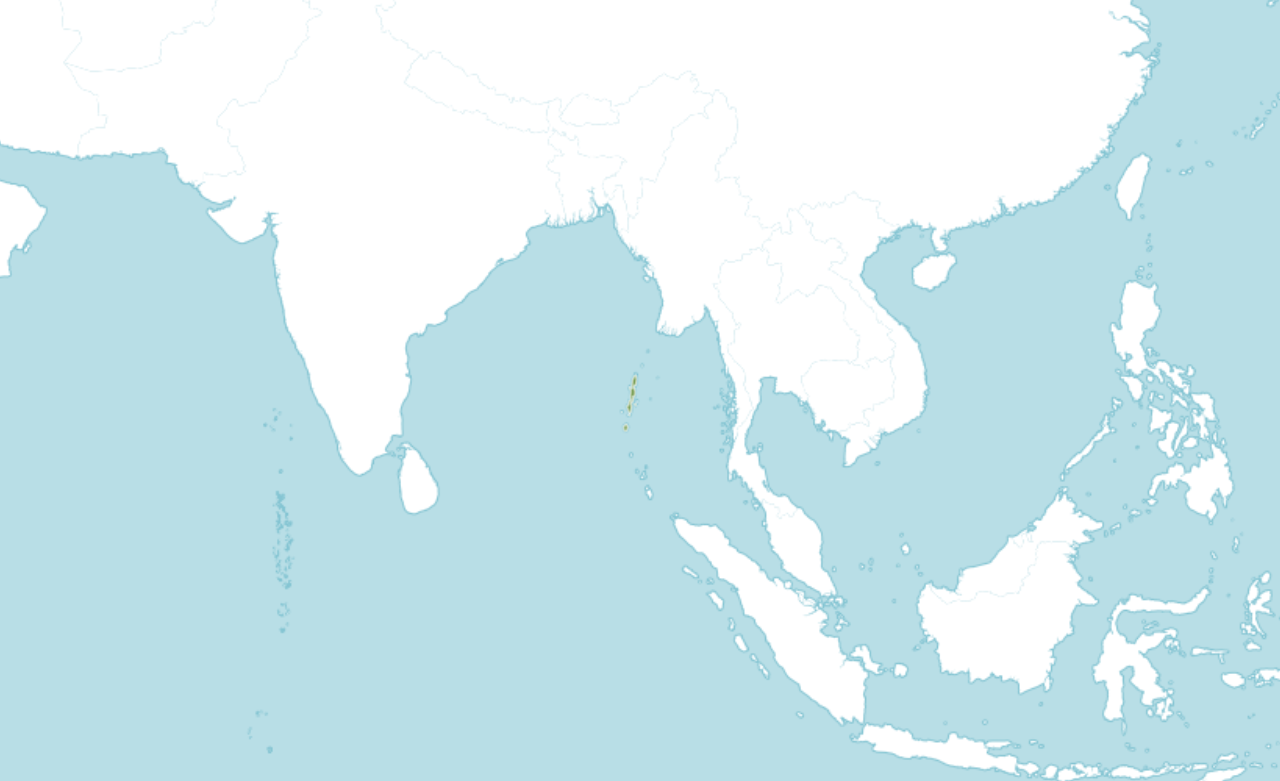
DISTRIBUTION: India | Andaman Islands
CLIMATE: N/A
ECOLOGY: N/A
SPECIES DESCRIPTION:
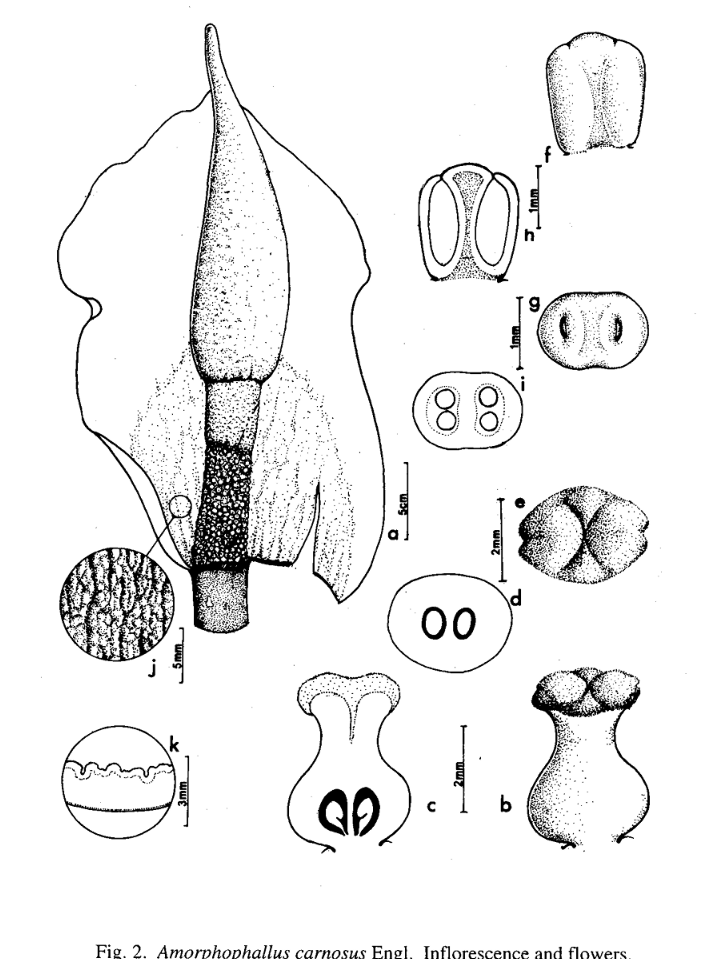
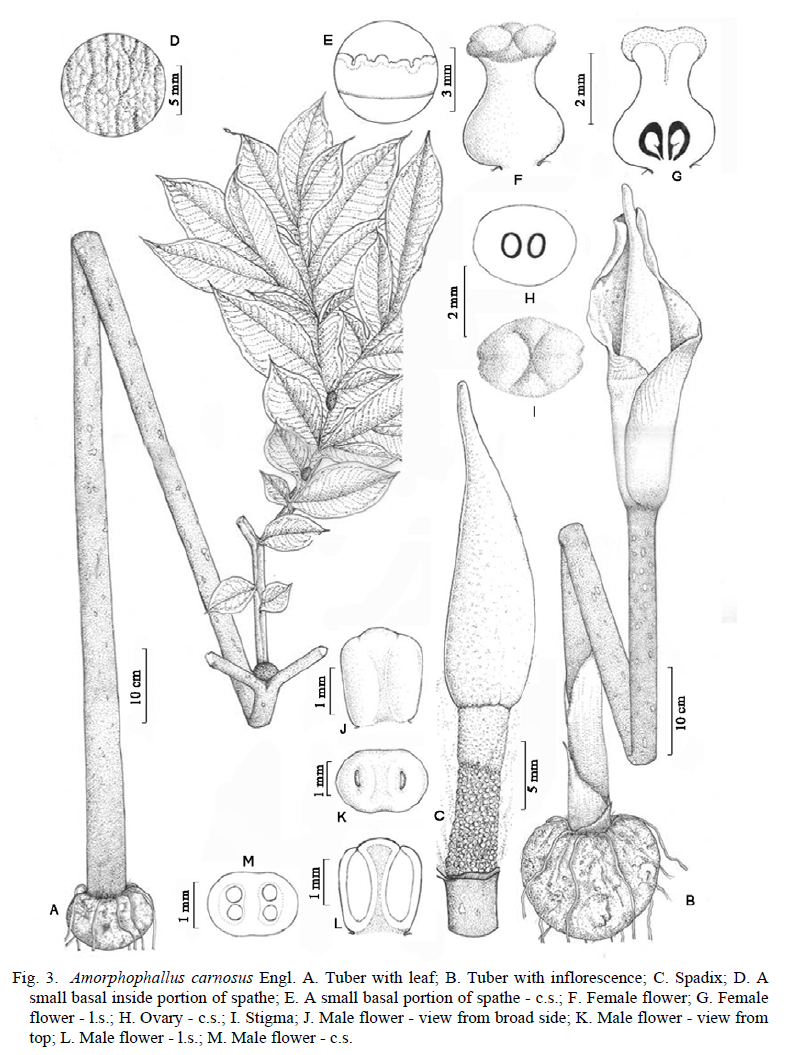
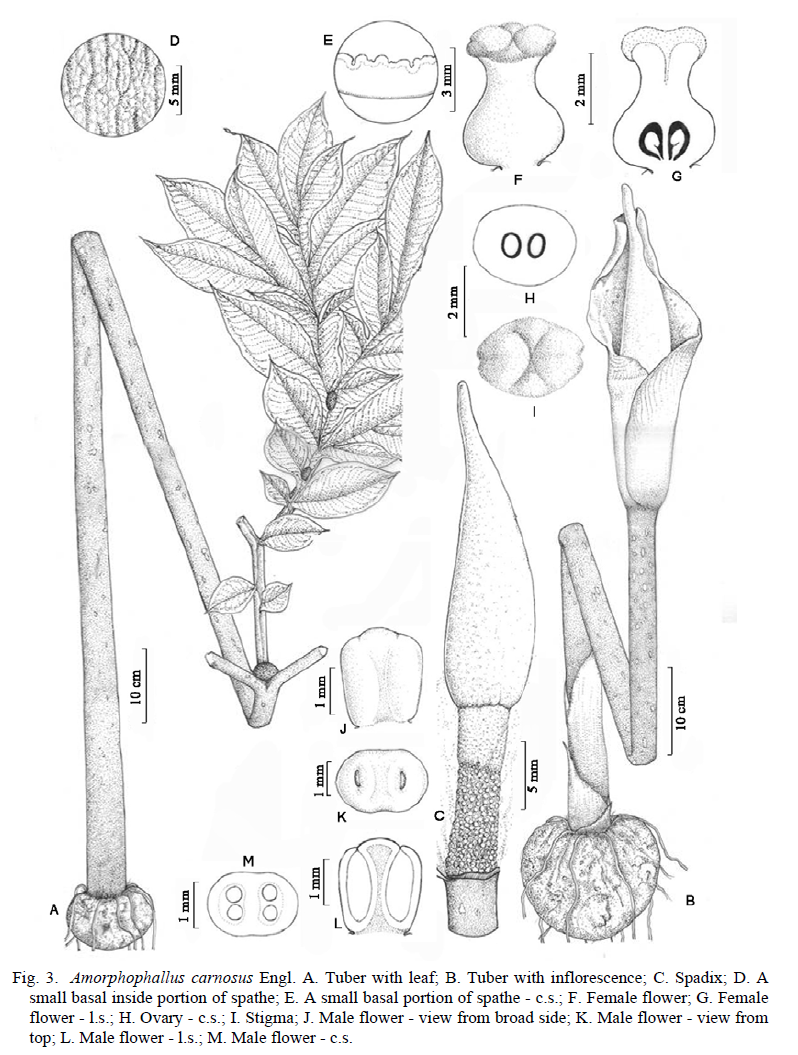
Tubers subglobose, 2.5-7.5 cm in diam. and 2-6 cm thick in vegetative phase, c. 20 cm in diam. and 14 cm thick in reproductive phase. Petiole 70-108 cm long, dark greenish brown with few minute pale green mottling. Leaflets sessile, 5-23 x 2.6-8.0 cm, ovate to elliptic lanceolate, tip long-acuminate, twisted in mature leaflets, margin undulate, green above and paler below; veins depressed above and projected below, secondary laterals close. Bulbils pale greenish, c. 0.5 cm in diam. and 0.1 cm thick.
INFLORESCENCE:
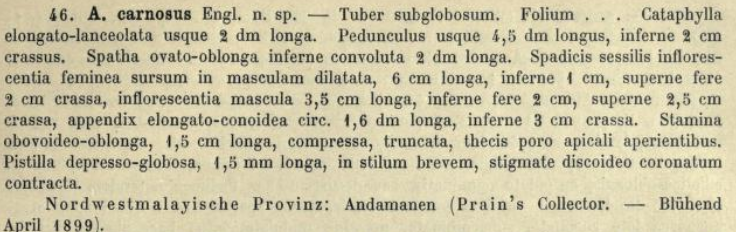
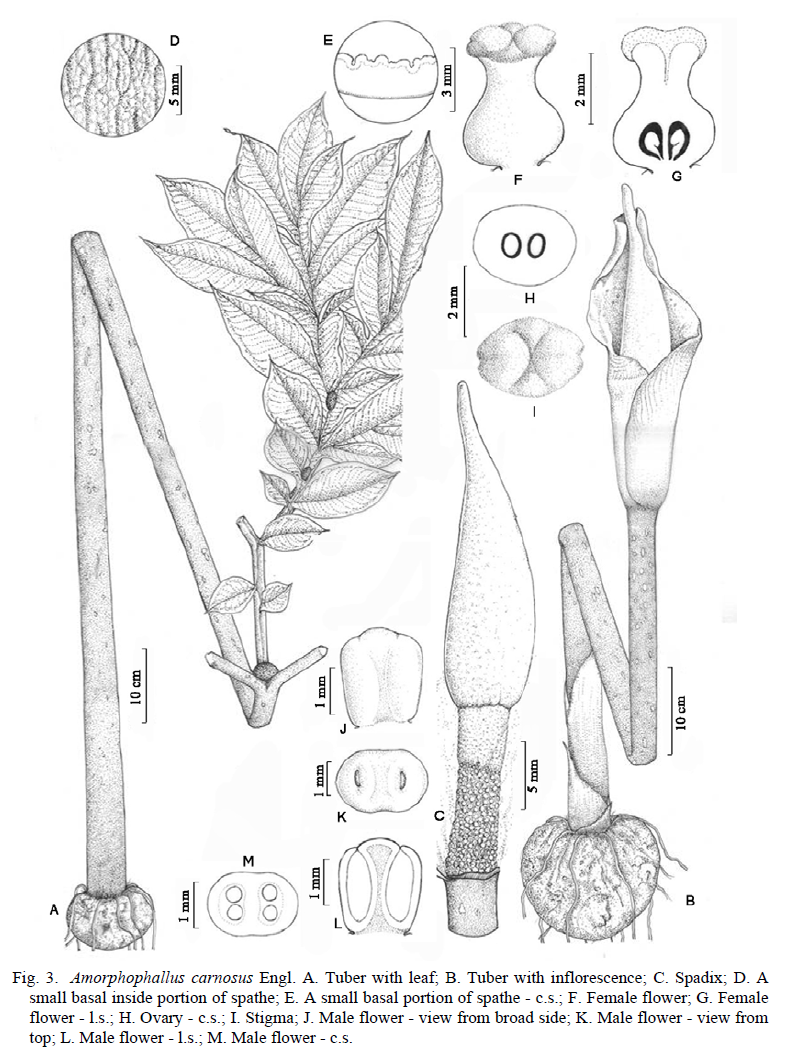
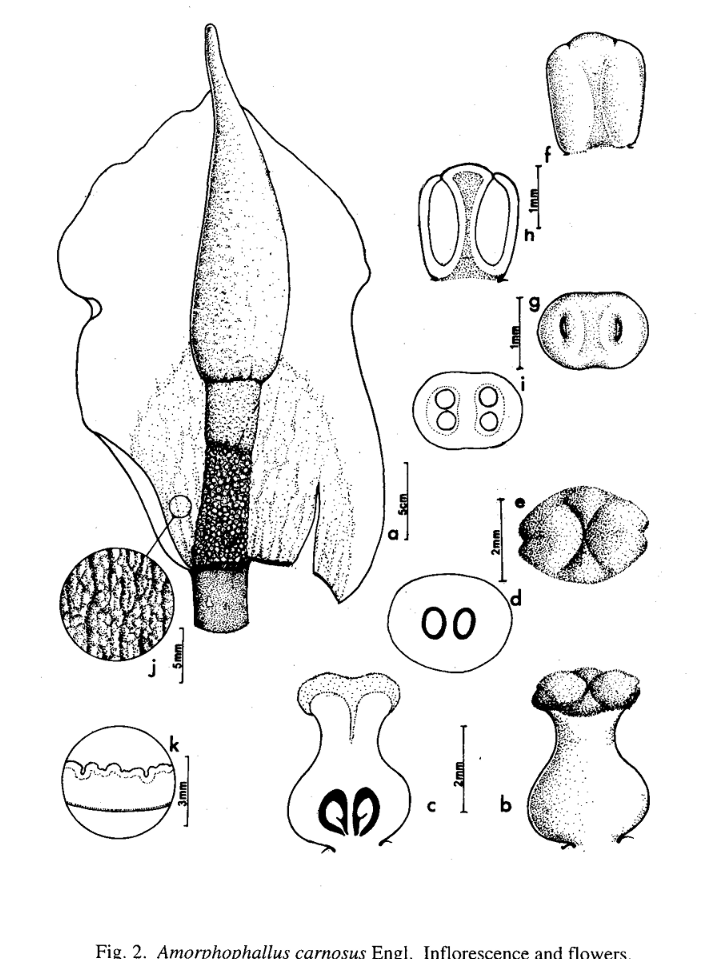
Peduncle c. 68 cm long. Spathe c. 39.5 cm long, ovate-oblong with basal convolute tube and an upper expanded erect limb, pale green outside with few minute white mottling, and dark green minute mottling towards margin, basal portion with dark green dense mottling; spathe-tube c. 15.5 cm long and 7.5 cm in diam., rough within with irregular verrucogranulate protuberances; limb margin undulate, tip obtuse, purplish orange inside, reddish pink above with small ovate yellow mottling, mottling sparse towards margin, closely oriented vertical veins prominent on outer surface of spathe. Spadix slightly longer than spathe, sessile, c. 41 cm long; female zone c. 9 cm long; male zone about half the length of female zone, c. 5.5 cm long; appendix c. 28 cm long. Female flowers dense, sub-spirally arranged, irregular towards base; each flower c. 4 mm high, ovary sub-globose, c. 1.5 mm high, reddish, 2-locular; style very short, c. 1.0 mm long, pale red; stigma inconspicuously 2 or 4-lobed, yellowish. Male flowers dense, sessile, each c. 2 mm high, inconspicuously 2-lobed, yellowish. Spadix-appendix obpyriform with narrowed tip, cream-coloured, slightly rough with minute depressions at base, and smooth towards the top. Fruits ovoid, or ellipsoid, 1.2-1.5 cm long. Seeds 1-2, 0.9-1.1 cm long.
Phenology: Flowering: May-June; Fruiting: September-October.
VARIEGATED FORMS: N/A
ETYMOLOGY: The species epithet share an origin with Amorphophallus carneus, both being derived from the latin carnea/carneus which in the case of Amorphophallus carnosus likely alludes to it being fleshy, thick, succulent (in mass/substance)
NOTES:
Specimens examined: South Andaman: Ograbraj, 9.5.1999, Abdul Jaleel RIA 335 (CALI); Ibid., 9.5.1999, Abdul Jaleel RIA 336 (CALI); Ibid., 31.5.1999, Abdul Jaleel RIA 369 (CALI).
Amorphophallus carnosus, a little known rare and endemic species, has been rediscovered from Andaman after it was first collected by Prain's collector in the year 1899 and no later collections were available from the islands (Srivastava and Rao, 1993). After over 100 years, during May 1999 the species was rediscovered and collected both in flowering and vegetative stages from its type locality – Andaman islands and the rediscovery was reported by Sivadasan and Jaleel (2000a). Amorphophallus carnosus is quite remarkable in having large-sized plants and inflorescence with erect spathe of about 39.5 cm long with prominent pale green colour outside and purplish orange at base, and reddish pink above within. It resembles Amorphophallus oncophyllus, but differs in its large size, erect spathe, male zone about half the length of the female zone and an elongate obpyriform spadix-appendix with narrow tapered tip.
CULTIVARS: N/A
HYBRIDS: N/A