
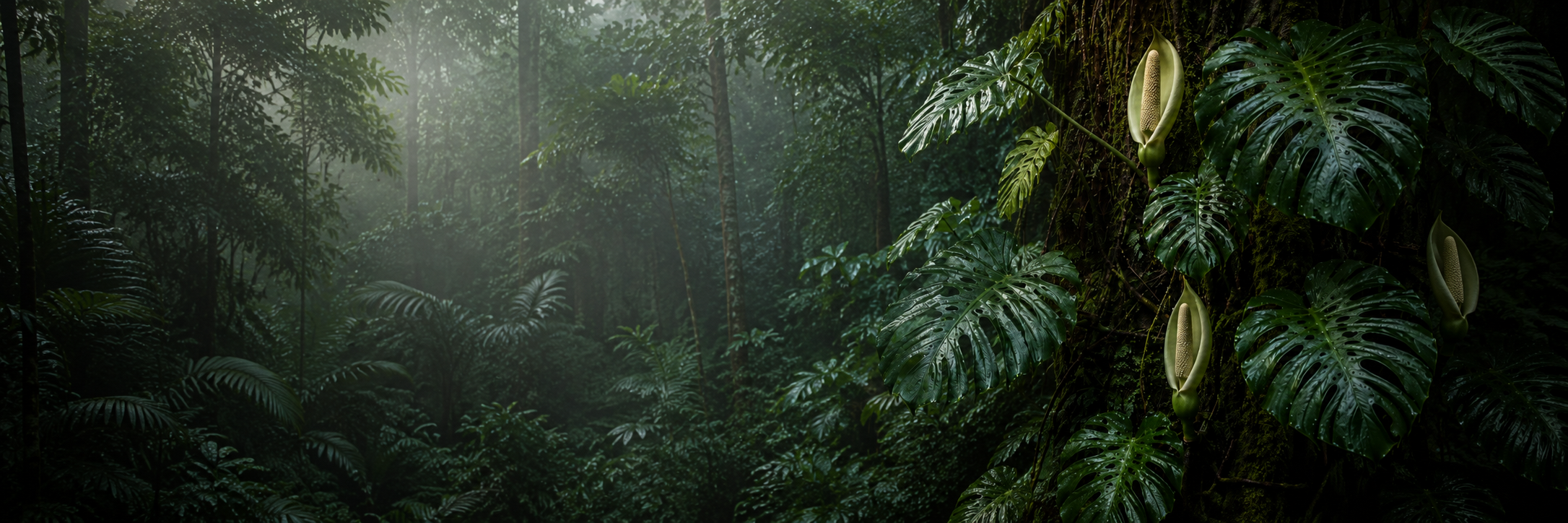
Araceae · Reproductive Biology
THE MONSTERA
INFLORESCENCE
The flowers of an Anthurium, run on the machinery of a beetle aroid
Opening
One Flower, Both Organs
Every other genus on these pages — Arum, Amorphophallus, Alocasia, Philodendron — builds its spadix in zones: female flowers below, male flowers above, and a clock that runs the two against each other. Monstera does not. Every fertile flower on the spadix carries four stamens and an ovary together. There is no female zone, because every flower is the female zone. And yet the system that grew around those flowers is not the open, bee-worked system of its bisexual relatives — it is a floral chamber, gentle heat, and beetles in the dark.
Take it to the plant
Not here for the botany, and just want to make a cross? The printable field card is the whole method on one sheet — how to spot the hidden flowering through the slit in the closed spathe, the days-long clock, the two-day pollen window and the harvest signal — with a second side carrying the three corrections that matter most at the bench, including why bees on an open spathe mean you are already too late.
That is the finding this page is organised around, and it is worth hearing in the words of the people who did the fieldwork. Summing up everything known for the genus, the authors of the most recent field study write that the pollination system of Monstera “quite differs from other bisexual groups which lack a floral chamber and heat production, such as Anthurium … and Spathiphyllum” — and instead “rather resembles the pollination mechanism of the monoecious and neotropical Philodendron”, right down to a parallel they take one step further: the same architecture — chamber, heat, nitidulid beetles — appears again in the neotropical palms, a different family altogether.
What that means for reading this page
The flower says Anthurium; the machinery says Philodendron. Flower sex does not predict pollination system. Protogyny still separates the sexes here — but in time, within each flower, instead of in space along the spadix.
How little this rests on, said plainly
The genus has 71 accepted species. Exactly two of them have had their pollination studied in the wild — Monstera obliqua in French Guiana in 2007 and Monstera lentii in Costa Rica in 2017. Two more, Monstera adansonii and Monstera deliciosa, have had their flowering and heat cycles watched in a greenhouse, with no pollinator present — that study says itself that “field studies are needed to confirm this hypothesis.” Everything else is inference, anatomy, and a 1978 note about bees that turned out to be wrong about the bees.
Against the dozens for Arum
Arum has been watched, probed, heated, cooled and modelled for a century; this genus has two field studies, published ten years apart, which disagree on almost every number they share. That disagreement is not a defect of the page — it is the honest state of knowledge, and the page reports it as such.
Part I
The Flower, and the Names for Its Parts
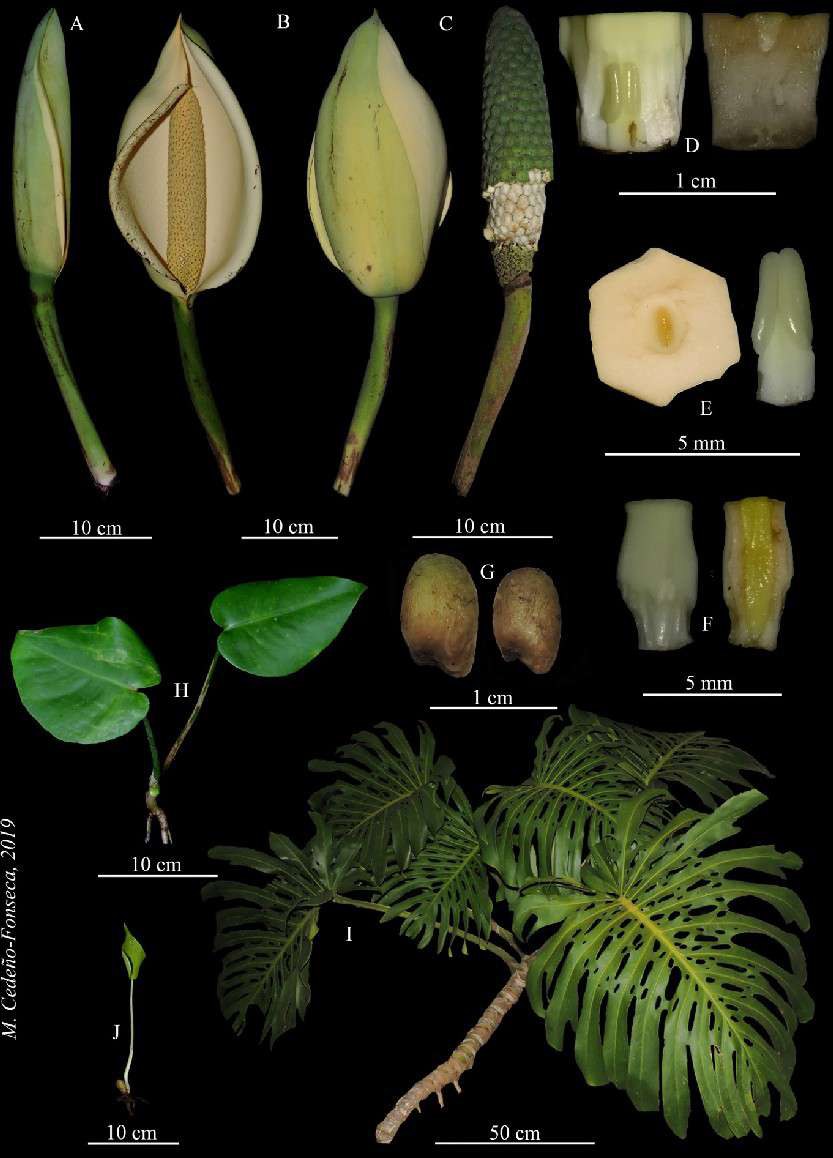
A Monstera spadix is a column of hundreds of identical, naked, two-sex flowers — no petals, no zones, no appendix, no bristles. The whole vocabulary of the trap pages goes; five other names replace it.
| Part | What it is | What it does |
|---|---|---|
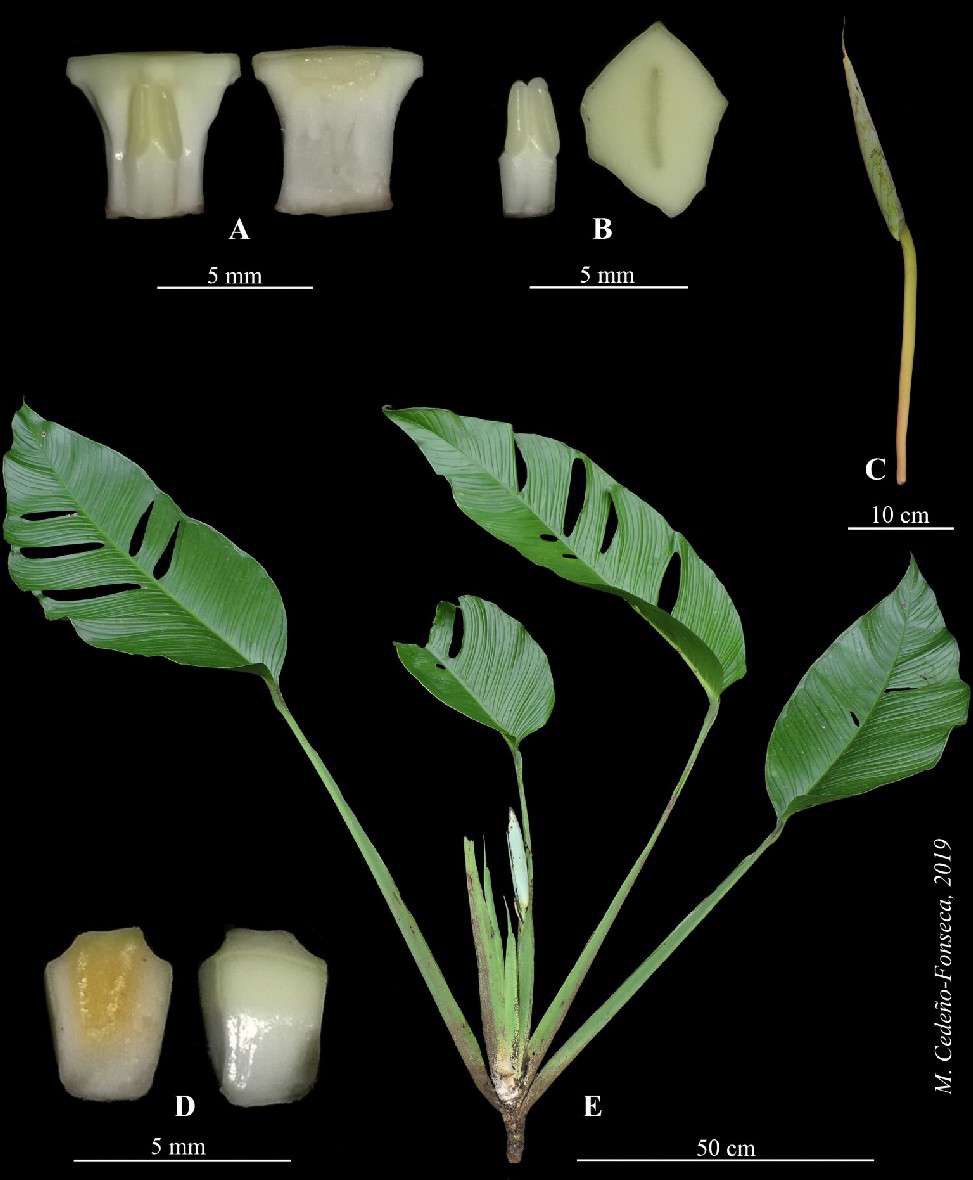
| Fertile flowers | Four stamens around a two-chambered ovary; no perianth at all | Both sexes in every flower — separated in time, not in space |
| Stylar cap | The broad, tough top of each pistil, packed with needle-like trichosclereids | Armour over the developing seeds; sheds in slabs at fruit ripening — Part X |
| Stigmatophore | A small projection carrying the stigma | Holds the stigma above the anthers while they shed — and disappears when a specimen is dried |
| Sterile basal flowers | A ring of flowers at the spadix base with no functioning stamens | Produce a large secretion drop whose job nobody has demonstrated — Part VII |
| Spathe | One boat-shaped bract, white to cream, shed two or three days after opening | Forms the floral chamber — the structure botany missed for a century and a half. Part III |
The clock inside each flower
The flowers are protogynous: stigmas come receptive first, one to two days ahead of the stamens, and maturation runs from the base of the spadix upward. Madison’s 1977 revision states the mechanism plainly — the stigmas’ secretion drops “have ceased by the beginning of [the male phase], and thus self-fertilization is not possible within an inflorescence.” Whether that holds in practice turned out to be more interesting — Part IX.
The counts, in the one species measured
In Monstera adansonii: 4 stamens per flower, an ovary of 2 locules with 2 ovules each, and 57,204 ± 8,289 pollen grains per flower — around three times the pollen of any Philodendron flower measured in the same study, for a pollen-to-ovule ratio of 14,301.
A structure that dries away
The stigmatophore is easy to miss for a reason the 2022 Costa Rica revision states outright: it is “absent (i.e. becoming unobservable) in dry specimens.” A pressed, dried Monstera keeps its leaf shape and loses its floral function — a pattern this page will meet again, at larger scale, with the floral chamber.
Part II
A Genus Being Described Faster Than It Can Be Studied
Monstera holds 71 accepted species — and a quarter of them were described in the last six years. The pollination literature has not begun to catch up with the taxonomy, and the taxonomy itself says it is not finished.
The count, and why every book gives a different one
Madison’s 1977 revision accepted 22 species — and he wrote, with unusual candour, that a taxonomist of different temperament “using the same data and approach, might accept 40 or 45 species where I recognize 22.” The 2022 revision of Costa Rica alone accepts 35 — more than one and a half times Madison’s entire genus, from one country — and notes that South America has never been revised at all. Any species total in a Monstera paper is a snapshot with a date on it.
A 1977 prediction, kept
Madison: further species “are most likely to be found in section Monstera and to come from Costa Rica and Panama, particularly the mountainous regions.” Nearly every description since — ten in the 2022 revision alone — is from exactly there.
What kind of plant this is
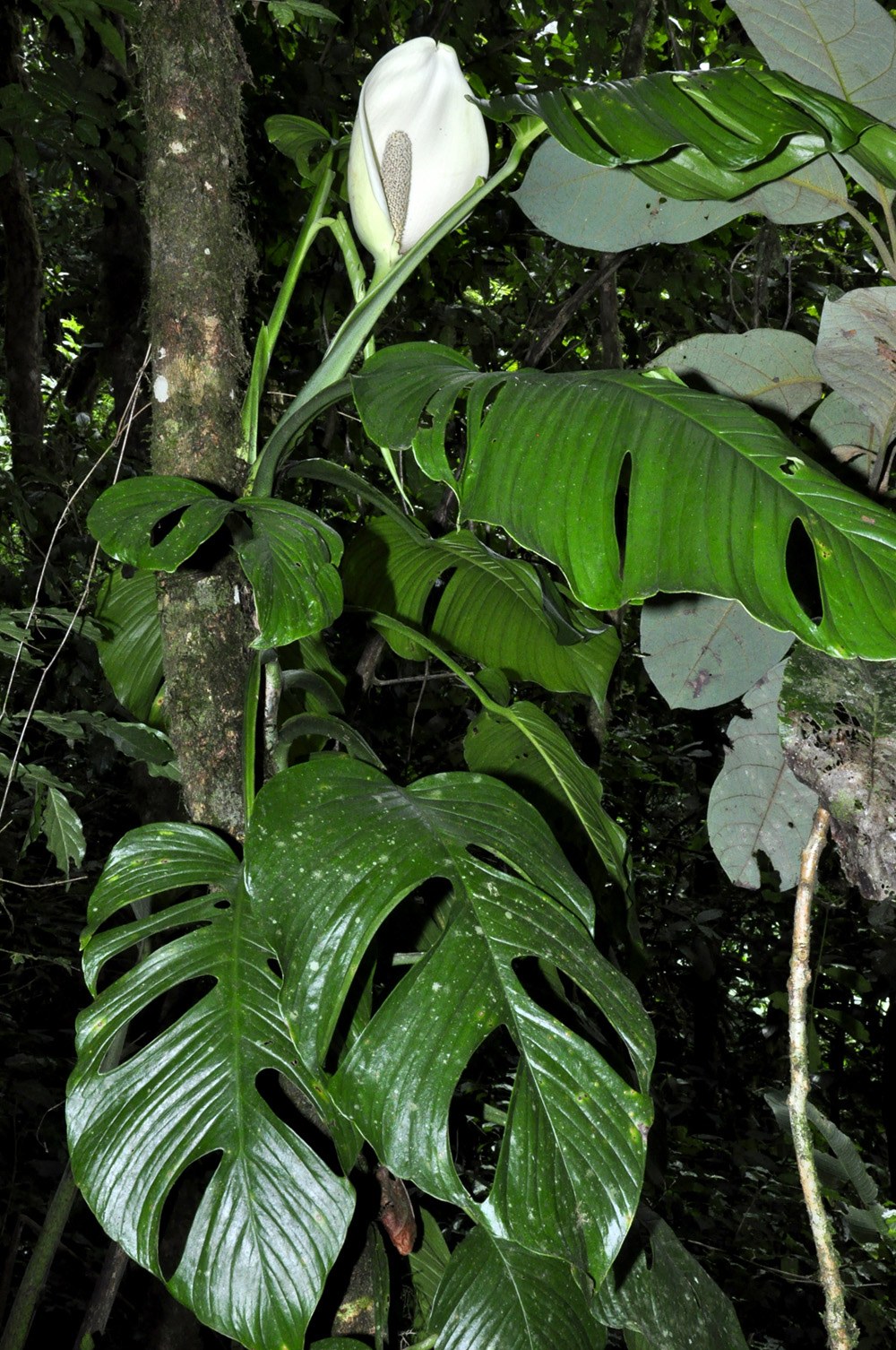
The current term is nomadic vine (the older literature says hemi-epiphyte): the seed germinates on the ground, the seedling creeps until it finds a trunk, climbs, and the oldest stem behind it dies away until the plant’s only link to the soil is its long feeder roots. Flowering happens up the tree — often out of reach, which is not a small fact in the history of this genus’s study.
Why the books stayed wrong so long
Madison put it plainly: the plants are poorly represented in herbaria because the fleshy parts are too big for presses, difficult to dry, and “the plants usually flower out of reach.” The 2022 revision adds that a single specimen can demand 5 sheets, so “botanists avoid collecting it.” What a dried specimen keeps is the leaf; what it loses is the flower’s working parts — the stigmatophore (Part I), the spathe’s living geometry (Part III), every colour and every secretion. A century of herbarium-based description therefore missed the floral chamber entirely — the next part tells that story.
A note the revision makes that botany rarely has to
Demand for these plants now runs a black market serious enough that the 2022 revision deliberately omits the coordinates of its type localities, so the populations cannot be looted. The houseplant on the windowsill and the poaching pressure in the forest are the same phenomenon at two ends.
Part III
The Chamber Botany Missed for 150 Years
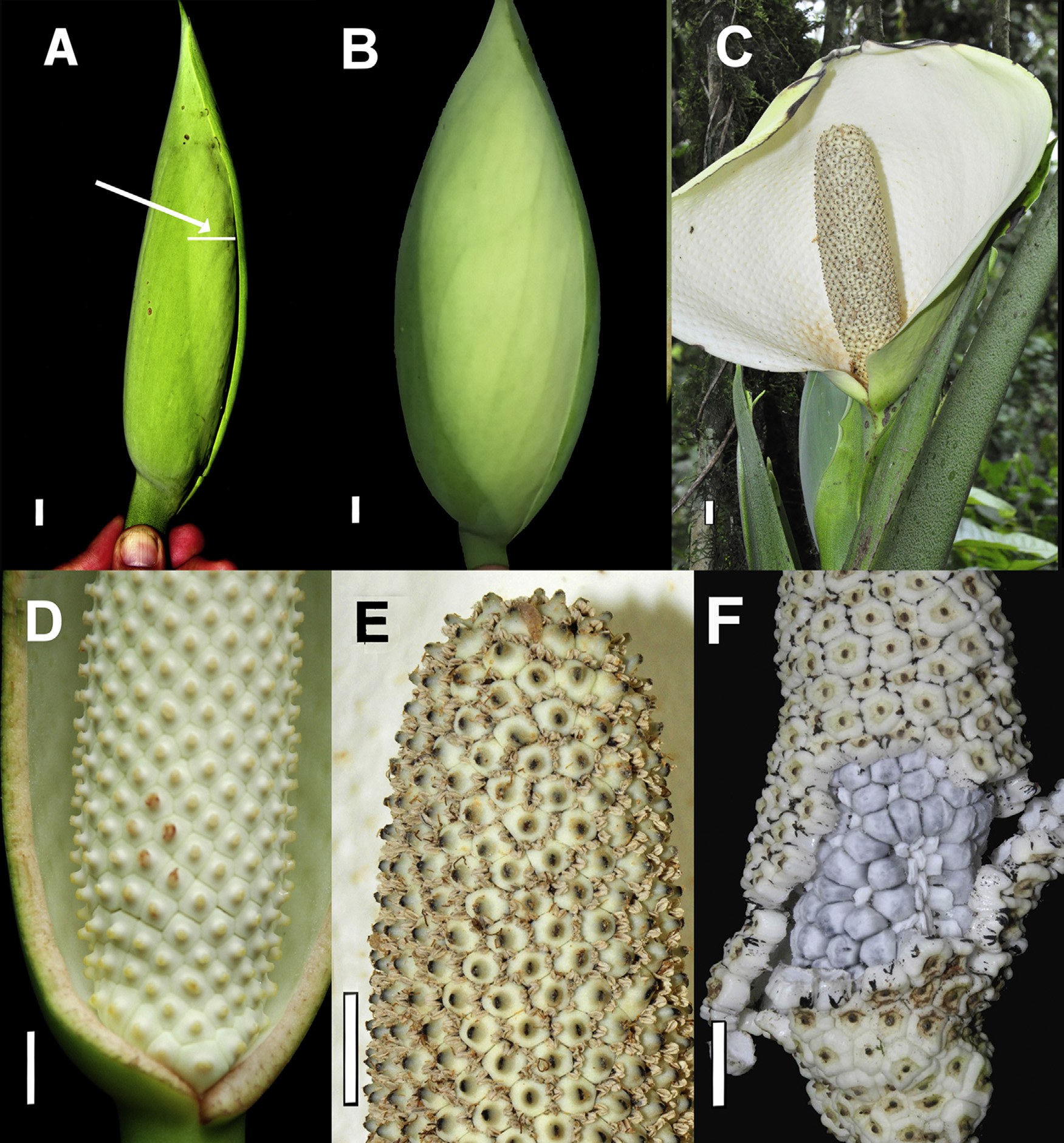
At flowering, the spathe does not open into the wide white blade of the houseplant photographs — not at first. It forms a closed green vault around the spadix, with a slit of an entrance. The first description of that chamber in the scientific literature is from 2007.
How a structure hides in plain sight
The genus was described in 1763. Madison’s 1977 revision calls the spathe “hemispherical to naviculiform … opening widely or only by a narrow slit” — shape, not function; the word chamber appears nowhere in the revision. The reasons are almost embarrassingly ordinary. In a dried specimen the chamber does not exist — the spathe is pressed flat. And in the forest understorey the flowering spathe is green, closed, and easy to walk past; it becomes the conspicuous white cowl of the photographs only when it opens fully — at which point the pollination is already over.
The year before it was described, it was denied
A 2006 paper on pollen-to-ovule ratios states: “in Monstera, the inflorescence has no floral chamber and thus pollinators come and go several times during the pollination cycle.” One year later, the same three authors published the first field study of the genus — and described the chamber, with sixteen beetles shut inside it. Nothing on this page argues the 2006 sentence was careless. It was the honest state of knowledge, written by the people about to overturn it; the chamber was invisible until somebody watched a living inflorescence through its whole cycle.
What the chamber does
Both field studies describe retention. In Monstera obliqua the beetles arrive on days one and two, stay packed in the chamber — sheltering, aggregating, mating — and leave at daybreak on day three, coated in fresh pollen. In Monstera lentii the spathe’s entrance slit closes on the second day of the female phase, holding the insects inside, though an opening sometimes remains near the tip. What the chamber demonstrably offers is shelter, a meeting point, a mating site and warmth.
Two claims this page will not make
That the beetles breed in the inflorescence: larvae were seen at the spadix base of Monstera lentii, but the authors state they “could not investigate the use of [Monstera lentii] inflorescences as brood site” — so the “probably as brood site” of their abstract stays a hypothesis here. That pollen is the reward: also “could not be ascertained” — the beetles’ mandibles “rather suggest a predatory habit.” Neither species offers the protein-rich sterile flowers that pay the beetles in Philodendron.
Trap, or chamber? Depends who you ask, and how
The family-wide comparative study of trap inflorescences scored Monstera “no trap” — enclosing spathe, yes, but none of the four trapping devices its definition requires. The field studies, watching behaviour rather than scoring dried morphology, describe insects that cannot leave for a day or more. Both are right about what they measured; this page says chamber, and “encloses” or “retains” rather than “traps”.
Arrived at from the other side — twice
The 2017 authors read the whole system — chamber, heat, nitidulid beetles — as convergent not with Philodendron but with the neotropical palms, where the same three-part architecture recurs. Their beetle, Cychrocephalus corvinus, belongs to a tribe known mainly as palm pollinators, and this was the first record of its pollination ecology anywhere. The same solution, built independently inside the family by the unisexual Aroideae, and outside it by the palms — with Monstera, bisexual flowers and all, arriving at it a third time.
Part IV
The Clock: Female First, and Female Longer
In every documented bisexual aroid, the female phase is the short one — a few receptive days against weeks of pollen. Except here. Monstera runs its stigmas longer than its stamens, and nobody has explained why.
The review of bisexual-flowered aroids states it as the genus’s standing exception: bisexual aroids have “a female phase shorter than the male phase (at least in documented cases, except in Monstera)”. In Monstera lentii the count was 3 days female against 2 male. For comparison, the Spathiphyllum species of Part VIII run female phases of six to eight days against male phases of eighteen to twenty-four — the proportions inverted.
How long the whole performance takes — two species, two answers
| Monstera obliqua (2007) | Monstera lentii (2017) | |
|---|---|---|
| Whole cycle | 48 hours, spread over 3 days | 8–9 days |
| Pollen release | Around 01:00, night three | Male phase days, after a 3-day female phase |
| Beetles leave | Daybreak, day three | End of male phase |
Same genus, same pollinator family, and a fourfold difference in the clock. Whatever a “typical” Monstera cycle is, two species are not enough to say.
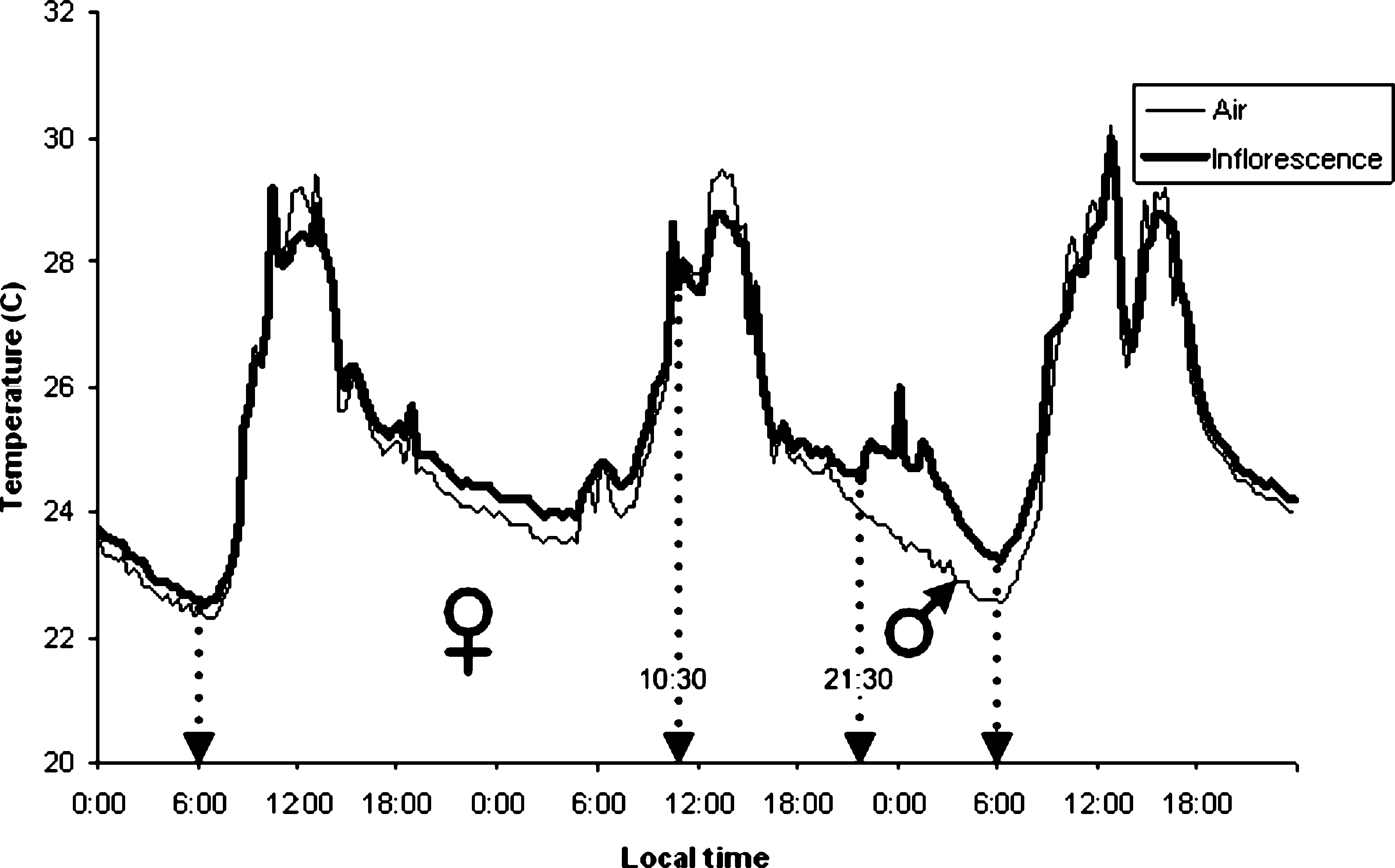
And in the one everybody grows, three studies give three answers
Monstera deliciosa has never had a field pollination study (Part XI), but its flowering clock has been measured three times in cultivation across a century — and the three do not agree.
| Study | Thermogenic cycle | Note |
|---|---|---|
| Leick (measured 1904, synthesis 1915) | 3 consecutive days, second day the strongest | Greenhouse, Greifswald |
| Skubatz et al. 1990 | 2 days | Reported secondhand; the paper is not in this archive |
| Chouteau et al. 2009 | 96 hours over 5 days | Greenhouse, Montreal; identical in Monstera adansonii |
Do not average these
Three eras, three protocols, three answers for one species. The honest statement is that the flowering clock of the most widely grown aroid on Earth is not settled — not that it is “about four days.”
What the phases do agree on
Protogyny is strict in the field studies: receptive stigmas first, pollen after, no overlap within an inflorescence — and in the greenhouse study both species released pollen on the final morning, at the coldest hour of the day, with the spadix warming against the ambient minimum. Pollen release is simultaneous along the whole spadix — the same all-at-once habit as Philodendron, and nothing like the weeks of piecemeal release in the long-cycle bisexual aroids.
Part V
The Heat Is Small, and Everywhere at Once
A Philodendron spadix can run eleven to nineteen degrees above the night air. Monstera runs two to four — and instead of pouring the heat through a sterile appendix, it warms the whole fertile column almost evenly.
The modern numbers, kept apart on purpose
In Monstera obliqua the spadix peaked at 2.0 ± 0.4 °C above air, with the peak coinciding with pollen release around one in the morning. In Monstera lentii the chamber air ran 1.8–4.3 °C above ambient through the female phase — with no distinct peak at pollen release.
Those two measurements cannot be compared, and the authors say so
The 2007 team probed the spadix tissue; the 2017 team measured the air of the chamber. The 2017 paper flags the difference itself. What the two agree on is the part that matters: Monstera heat is small — single digits, not the furnace of the trap genera.
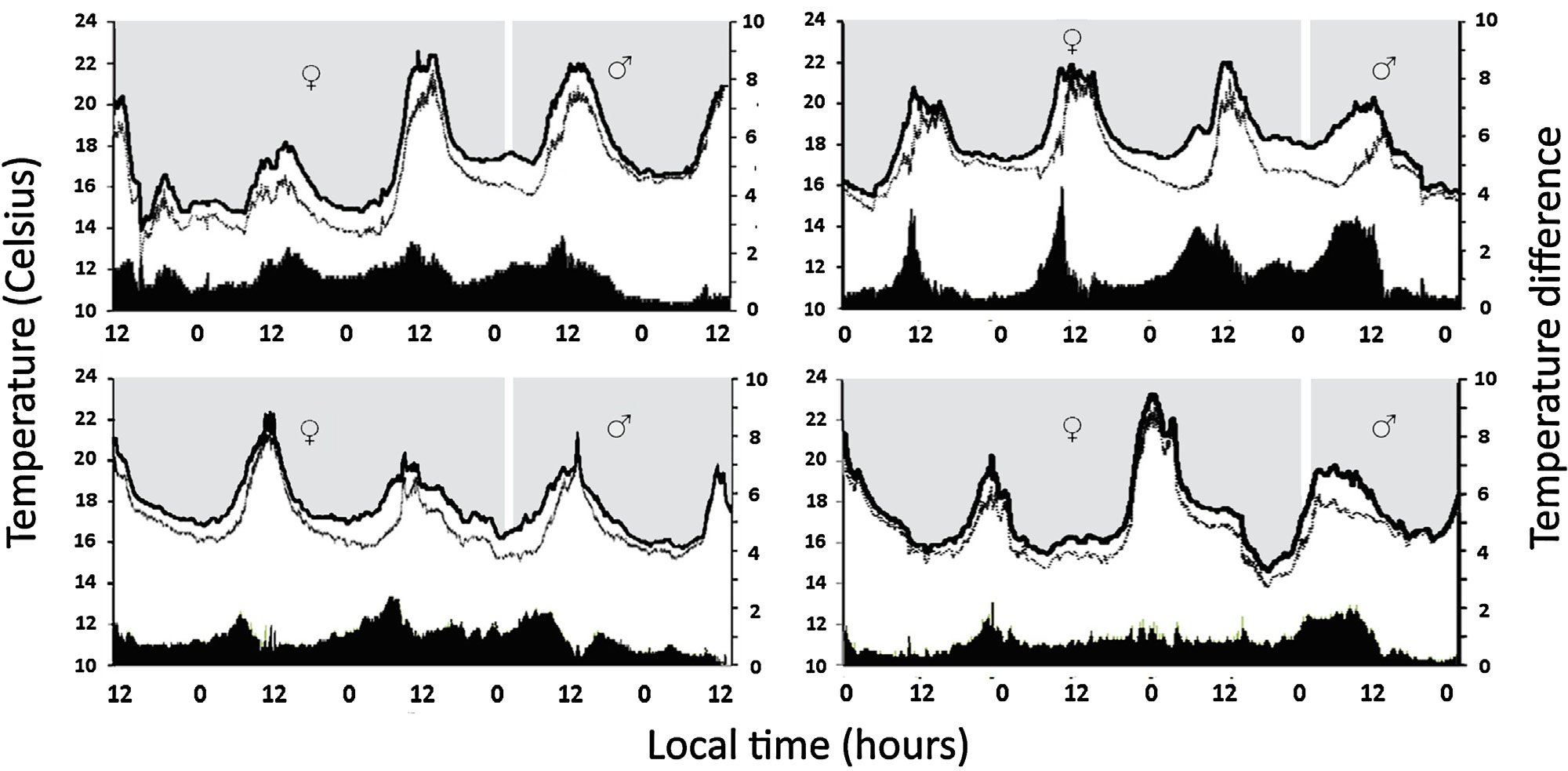
What the heat is not aimed at
The oldest measurements in the genus are also the most spatially complete. Leick, working on Monstera deliciosa in 1904, found the warmth distributed almost equally over the whole spadix — base as warm as tip, no hot organ, no sterile appendix to concentrate it; he called it the most primitive form of thermophore development in the family, and noted it was the exception among every aroid he surveyed. His one cross-checked maximum, at the second day’s pollen release, was +12.9 °C at the spadix tip — far above anything measured since, on different plants with different instruments, a century apart.
Uniform heat is what the architecture predicts. In a zoned aroid there is a male region to warm at shedding, an appendix to volatilise scent from. Here every flower is both sexes; there is nothing to aim the heat at, and the insects — as Leick himself put it — are made to walk everywhere.
What the heat is for — still open
The candidates in print: extending attraction through a long female phase, an energy subsidy that keeps the sheltering beetles active, easing pollen release from the anthers, and warming the beetles for flight. The 2017 authors decline to pick one, and so does this page.
Part VI
The Smell Nobody Has Ever Analysed
Every scent claim in the Monstera literature is a human nose working unaided. No floral scent of any species in the genus has ever been chemically analysed — not once, in 260 years of botany.
The descriptions on record are perceptual and thin: Madison found “no odor … except a faint, sweet smell in a few cases”; the field studies offer “a slight bittersweet fragrance” and “sweet-smelling pollen.” The 2017 study closes by saying the obvious out loud: testing what the scent does “requires quantitative measurement of floral scent chemistry.” It has not happened.
What the gap looks like from next door
For Spathiphyllum — the comparison genus of Part VIII — a 2021 study ran full gas chromatography–mass spectrometry and identified 49 scent compounds in one species and 3 in another, down to their daily emission schedules. For Monstera, the corresponding table is empty. A beetle lured across the understorey at one in the morning is almost certainly following chemistry — and nobody knows which chemistry.
An old observation that still bites
The near-scentlessness is not a modern discovery. In 1915 Leick used exactly this genus to knock down a then-current theory — that aroid heat exists to volatilise scent. Monstera deliciosa, he pointed out, heats strongly and smells of almost nothing; if the heat were a scent-thrower, it would have nothing to throw. A hundred and ten years later the genus is still the odd one out, and still unanalysed.
Part VII
Who Comes: Beetles, and a Thirty-Year Bee Mistake
For thirty years the books said bees. Then somebody finally watched a wild Monstera through a whole flowering, and the pollinators were sap beetles — and the bees were robbing the pollen.
The beetles, two species’ worth
| Monstera obliqua (2007) | Monstera lentii (2017) | |
|---|---|---|
| Pollinator | Colopterus amputatus (Nitidulidae) | Cychrocephalus corvinus (Nitidulidae: Mystropini) |
| Beetles per chamber | 16.1 ± 6.9 (range 3–25) | 97 ± 42, plus 28 ± 24 drosophilid flies |
| Other visitors | None. All 242 recorded visitors were the one beetle species | Flies, and stingless bees at the open male phase |
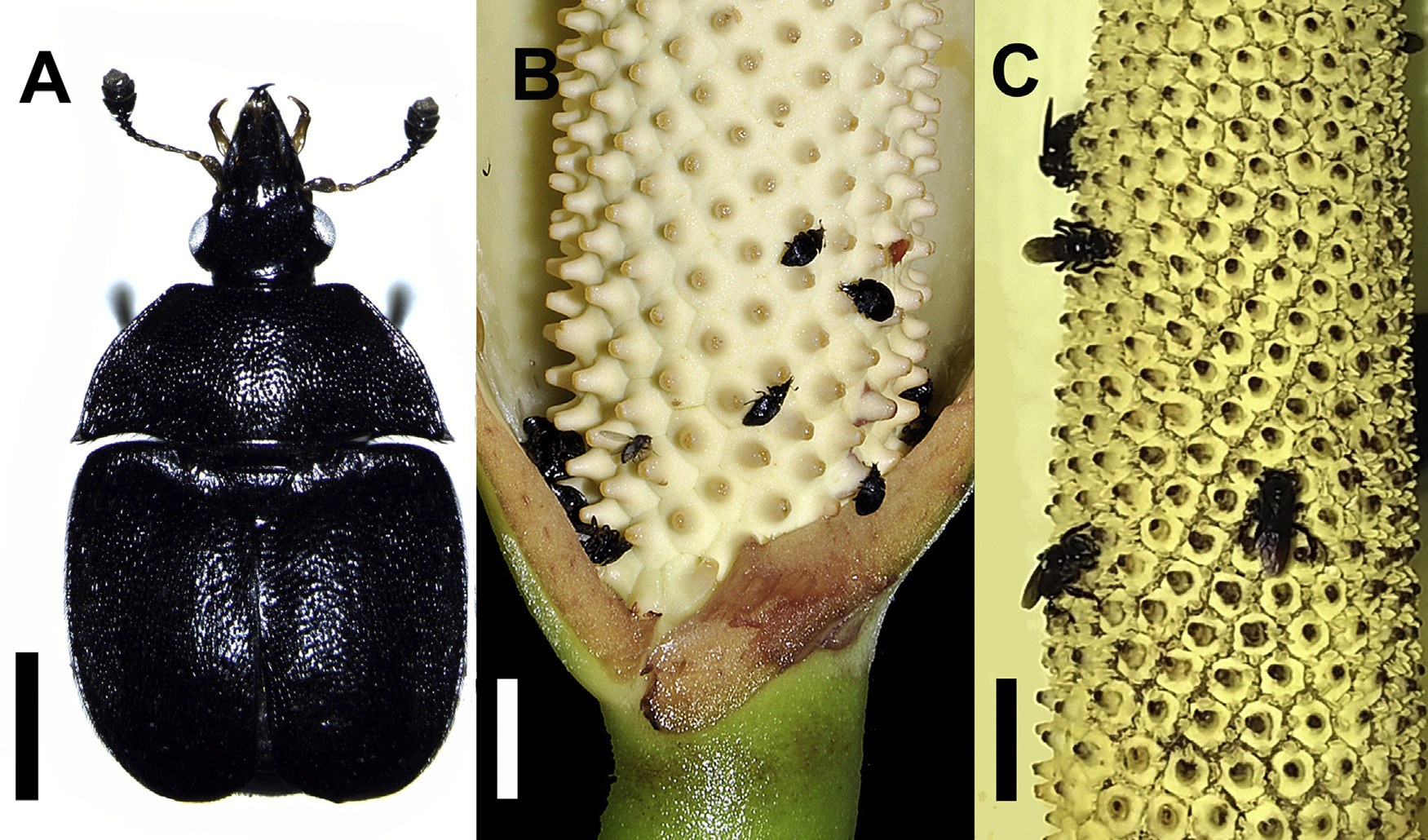
The 2017 beetle deserves its own sentence: Cychrocephalus corvinus belongs to a tribe documented mainly as palm pollinators, it is rarely collected, almost nothing is known of its natural history — and this was the first record of its pollination ecology anywhere. The same survey recovered it from the chambers of Monstera adansonii and Monstera oreophila nearby, and recorded the genus’s first drosophilid flies — entering in the female phase and leaving in the male, a potential second pollinator nobody has yet tested.
Where the bee story actually came from
Trace it back and the root is thinner than anyone quoting it knew. Madison, 1977, watching living plants, listed “several species of beetles, hemiptera, flies, and bees” in a single inflorescence — the beetles were in view from the start — and guessed the bees were the pollinators because they moved the most, citing as support a personal communication from C. H. Dodson: trigonid bees on two species in Ecuador. Unpublished, then; unpublished still. A 1978 note then reported Trigona bees collecting stigmatic secretion and pollen from Monstera deliciosa — visitation, not pollination, and its own wording was later summarised honestly: since bees were the only recorded visitors, “it was therefore supposed that these bees were pollinators.”
How the supposition died
Two field studies later: in Monstera lentii the stingless bees arrived only after the spathe opened wide in the male phase, took pollen, and touched no receptive stigma — “more appropriately regarded as pollen robbers, not pollinators as previously suggested.” The species the bee story was invented for, Monstera deliciosa, has still never been tested — the supposition was not disproved on its own plant; it was replaced by evidence from two others. Part XI keeps that hole on the books.
What the visitors are paid — nobody knows
No nectar — the site’s standing rule holds here, and gets a twist: the 1978 note is a behavioural observation that bees collect the stigmatic secretion and use it, for food and as nest material. A secretion can function as a reward without being nectar. But for the beetles that actually pollinate, no reward has been demonstrated at all — not pollen (Part III), not brood sites (unconfirmed). On present evidence the chamber sells shelter, company and warmth, and the pollination happens on the way out.
Part VIII
The Control Group: What Bisexual Aroids Usually Do
To see how strange Monstera is, look at its nearest well-studied relative. Spathiphyllum — the peace lily’s genus, 76 species, same subfamily, same bisexual protogynous flowers — runs its pollination in broad daylight on an open spadix, and pays in perfume and pollen.
Three ways to work an open spadix
Perfume. The classic account: male euglossine bees land on the exposed spadix and harvest the scent itself, brushing it up with the front tarsi and packing it into their inflated hind legs — the same behaviour they perform at orchids, with the fragrance as the entire reward. The attraction is species-specific enough to act as a reproductive barrier between species, and has been proposed as a driver of the genus’s speciation.
Mistake. The larger correction, from fifteen months on Barro Colorado Island: pollen-collecting stingless bees made 87% of visits to Spathiphyllum friedrichsthalii and set most of the seed. They forage the pollen-rich male-phase spadices, blunder onto female-phase ones — about one female visit per forty male — find nothing, and leave; the pollen on their bodies does the rest. A 2021 Mexican study found the same system in two more species, one of them served almost entirely by a single stingless-bee species — and found the scent chemistry (49 compounds in one species, three in the other) full of known euglossine attractants that barely drew a euglossine. A scent profile does not predict a pollinator.
Nobody. At the far end, a Colombian population of Spathiphyllum grandifolium was caught doing without visitors altogether: anthers opening while the stigmas below were still receptive, shedding clotted pollen that fell onto them by gravity — a bagged inflorescence set every flower. One species sets seed by apomixis; another packs extra embryos into each seed from maternal tissue.
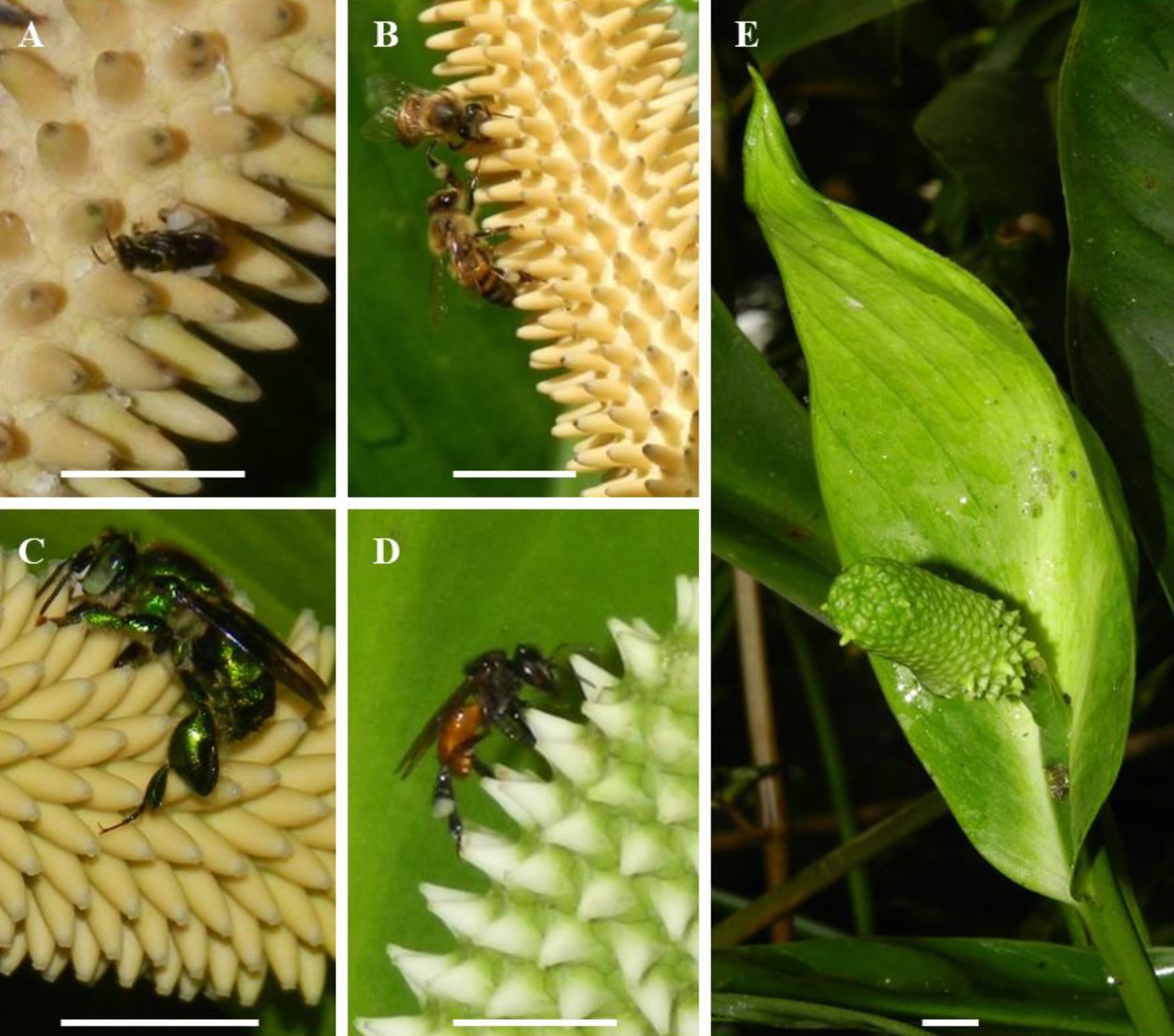
The comparison, in one table
| Spathiphyllum | Monstera | |
|---|---|---|
| Flowers | Bisexual, protogynous | Bisexual, protogynous |
| Spadix at anthesis | Fully exposed; the spathe is a flag | Enclosed in a chamber; the spathe is a vault |
| Heat | None reported in any study | +2–4 °C, whole spadix |
| Working hours | Morning; bees | Night; beetles in the dark |
| Reward | Perfume, or pollen | Undemonstrated; shelter and warmth on present evidence |
| Female vs male phase | Female 3–8 days, male 7–24 — male far longer | Female longer — the family’s one documented inversion |
| Scent chemistry | Measured, to the compound | Never analysed |
Same flowers, opposite machine. And the deepest similarity is the one the table cannot show: in both genera, the breeding system itself varies species by species — Spathiphyllum spans strict outcrossing to autonomous selfing, and Monstera’s two field-tested species landed on opposite answers (Part IX). In this subfamily, neither the pollinator nor the mating system is a property of the genus. It is a property of the species — which is why this page keeps counting how few species have been tested.
Part IX
Self and Cross: Two Species, Opposite Answers
Bag a Monstera obliqua inflorescence and it dies. Bag a Monstera lentii inflorescence and, more often than not, it sets fruit anyway. The only two self-compatibility tests in the genus contradict each other flatly.
| Monstera obliqua (2007) | Monstera lentii (2017) | |
|---|---|---|
| Bagged, no insects | All 15 aborted within a week | 6 of 11 set fruit — mean 10% of flowers (range 1–20%), seeds normal in appearance |
| Verdict | Strict outcrosser | Some capacity to self |
| Open-pollinated fruit set | 84.1% of flowers — where the inflorescence survived at all (Part XI) | 61.4% ± 16.7 of flowers |
| Seeds per berry | 3–4 | One, in 88% of fruits |
Both teams bagged before the spathe opened; both scored fruit. The contradiction is not an artefact to be explained away — it is two species in one genus with different breeding systems, exactly the within-genus spread the Spathiphyllum work found from the other direction. This page presents both and adjudicates neither. No third test exists.
A tension inside the 2017 paper, reported as found
Its abstract calls protogyny “a mechanism likely to prevent self-pollination”; its own exclusion experiment shows most bagged inflorescences setting some fruit. The authors note that incomplete dichogamy and spontaneous selfing “seem plausible” and call for confirmation. That is the paper’s contradiction, and it belongs to the paper — the site reports it.
The pollen’s short life
Monstera adansonii pollen starts at the lowest initial viability of any aroid in the one comparative test — 40–55% — loses half of that in about 30 hours, and is finished within about 60: roughly two and a half days to move between plants. It is also released all at once along the spadix, like a Philodendron and unlike the weeks-long trickle of the long-cycle bisexual aroids — a short-window system on every axis.
For growers who want seed
Everything above translates directly: an isolated plant is its own worst partner. Madison inferred from failed seed set in isolated cultivated plants that the genus is free of agamospermy — no seeds without pollination — and even the self-fruiting Monstera lentii managed only a tenth of its flowers unaided. Two inflorescences with staggered timing, pollen moved within its two-day window, and fresh seed sown promptly — Madison again: seeds lose viability rapidly if they dry, having no endosperm and a soft coat — is the procedure the biology dictates.
Part X
The Fruit: A Spadix You Can Eat, On Its Own Schedule
Monstera deliciosa is the only aroid most people will ever taste. What ripens is not a berry but a monsterocarp — the whole spadix matured into one composite fruit that unwraps itself in plates when, at last, it is ready.
How the fruit is built
After pollination the spathe is shed and the spadix turns green — photosynthetic armour over the developing seeds, each pistil capped by that tough, needle-packed stylar cap from Part I. The berries ripen synchronously, and at maturity the caps detach together, in slabs, exposing the pulp beneath — the 2022 revision treats the colour of that pulp as a taxonomic character (white in most species; orange in Monstera membranacea). Ripening takes 2–15 months depending on the species — a fruit that can spend over a year on the plant.
The eating, on the record
The 2022 revision, not a grower’s forum: the flavour is “a combination of pineapple and guanabana (soursop)”; Costa Rican villages take it in smoothies and desserts; it is occasionally marketed as an exotic fruit in Central America, South America and Europe. The epithet deliciosa is the fruit’s review, published 1849.
The burn in an unripe fruit — the standard story is not settled
Every houseplant article says the same thing: unripe fruit burns because of calcium oxalate. Madison looked at this in 1977 and declined to sign it. The acridity, he wrote, “has been widely attributed to raphides of calcium oxalate, but the stylar portion of the fruit is abundantly supplied with trichosclereids which visibly penetrate the skin when the fruit is handled … it remains unclear whether the reported prickly nature of the unripe fruits is due to raphides or trichosclereids.” Two candidate needles, one chemical and one mechanical, both present — and the discarded caps carry much of either. Nobody has resolved it since. The practical rule is unchanged: wait for the caps to shed on their own.
Who eats it in the forest — a nearly empty ledger
Madison relayed that seeds “are eaten by birds according to observations recorded on herbarium specimens” — and added, honestly, “I have not observed birds at ripe fruits.” The first published records with the animal actually identified came in 2020: a tanager (Habia rubica) striking fruits against a petiole before eating, a Thraupis tanager swallowing berries whole, and Geoffroy’s tamarin (Saguinus geoffroyi) feeding at an infructescence. That — three observations — is approximately the complete scientific literature on Monstera seed dispersal. Nothing is known about how far seeds move, what survives gut passage, or what the two-to-fifteen-month ripening buys the plant.
After the fall
The seed germinates on the forest floor with no dormancy to spare: no endosperm, a soft coat, and rapid death on drying. The famous dark-seeking seedlings — growing toward the darkest sector of the horizon, where a trunk should be — were shown in a 1975 study on a plant whose identity Madison himself called ambiguous (probably Monstera tenuis or Monstera dubia); Madison’s own field observation was that seedlings on slopes grow uphill. Both tricks aim the same place: the base of a tree.
Part XI
What Nobody Knows, Listed Without Cushioning
A page like this usually ends by rounding its gaps into “further study is needed.” The gaps here are too clean for that. Each one is a specific, askable question that no one has asked.
When it fails, it fails wholesale — sometimes
In the French Guiana population of Monstera obliqua, 71% of naturally pollinated inflorescences aborted entirely — twenty of twenty-eight, dead within days, against a fruit set of 84% of flowers on the spadices that took. In Monstera lentii, ten years later, not one inflorescence aborted. Pollinator scarcity, mate scarcity, resource limits — the 2017 authors can only list the candidates. The genus’s failure mode is as unsettled as everything else about it.
The open questions, enumerated
| Gap | State of the evidence |
|---|---|
| Scent chemistry | No species ever analysed — the attractant of a night-flying beetle guild is entirely unidentified |
| Monstera deliciosa in the wild | Never studied. The most widely grown aroid on Earth has no field pollination study — the plant everybody owns is the plant nobody has watched |
| Brood-site use | Larvae seen once, investigation impossible — and it is the hinge of the palm-convergence argument |
| The beetles’ reward | Undemonstrated — shelter and warmth are what the evidence supports |
| Self-compatibility | Tested twice, opposite answers, no third test |
| Seed dispersal | Three identified animals, ever — nothing on distance, gut passage or germination fate |
| The flies | Drosophilids enter with the beetles and leave with the pollen; their role has never been tested |
| 69 of 71 species | No pollination observation of any kind |
The clearest measure of how young this field is
The 2022 revision of the genus in Costa Rica examined 4,114 specimens and was written by the world authorities on Monstera taxonomy. It cites no pollination study — not one. No Chouteau, no Prieto, no chamber, no beetle. The two literatures on this genus do not yet reference each other; they have not needed to, because between them they still cover almost nothing twice.
Two species watched, sixty-nine to go, and the best-known plant in the family still waiting for someone to sit with it overnight. For a genus on ten million windowsills, the wild biology is barely opened.
Sources
Sources, and What Kind of Evidence Each One Is
The Monstera pollination literature is small enough to list nearly whole. These are the papers this page leans on, each with a note on how much weight it will bear.
- Chouteau, M., McClure, M. & Gibernau, M. (2007). Pollination ecology of Monstera obliqua (Araceae) in French Guiana. Journal of Tropical Ecology 23: 607–610. The first field pollination study in the genus and the first description of the floral chamber. The source for the 48-hour cycle, the single-species beetle record (242 of 242 visitors), the 16-beetle chambers, the strict-outcrossing bagging result (15 of 15 aborted), the 71% natural abortion, and the spadix heat peak at pollen release. Grade: measured field study, one population, one flowering season.
- Prieto, D. & Cascante-Marín, A. (2017). Pollination by nitidulid beetles in the hemi-epiphytic aroid Monstera lentii (Araceae: Monsteroideae). Flora 231: 57–64. The page’s thesis sentence is this paper’s closing argument — the comparison with the bisexual genera, with Philodendron, and with the neotropical palms. Also the 8–9-day cycle, the 97-beetle chambers, the drosophilid first record, the pollen-robber verdict on the bees, the partial-selfing bagging result, and the explanation of why the chamber went undescribed. Grade: measured field study, one population; its brood-site and reward statements are explicit non-findings and are treated as such here. Note: its thermogenesis was measured in the chamber air, not the spadix — not comparable with the 2007 figures, as the paper itself says.
- Chouteau, M., Barabé, D. & Gibernau, M. (2009). Flowering and thermogenetic cycles in two species of Monstera. Bulletin de la Société d’Histoire Naturelle de Toulouse 145: 5–10. Greenhouse study of Monstera adansonii and Monstera deliciosa, Montreal Botanical Garden — the 96-hour five-day cycle and the coldest-hour-of-morning pollen release. Grade: measured, under glass, with NO pollinator observed — its own words: “field studies are needed to confirm this hypothesis.” Never cited on this page as a pollination record.
- Chouteau, M., Barabé, D. & Gibernau, M. (2006). Pollen-ovule ratios in some Neotropical Araceae and their putative significance. Plant Systematics and Evolution 257: 147–157. The pollen counts and the pollen-to-ovule ratio of Part I. Grade: measured, n = 10 inflorescences. Also the source of the pre-discovery sentence quoted in Part III — “the inflorescence has no floral chamber” — written by the same group one year before their own field study found it. Cited for both the numbers and the history.
- Barabé, D., Lavallée, K. & Gibernau, M. (2008). Pollen viability and germination in some neotropical aroids. Botany 86: 98–102. The two-and-a-half-day pollen lifespan and the simultaneous-release observation. Grade: measured laboratory germination series, six species compared.
- Madison, M. (1977). A revision of Monstera (Araceae). Contributions from the Gray Herbarium 207: 3–100. The genus’s foundational revision, and a model of saying which of its own claims are observations. Source for: protogyny and the end of the stigmatic drops, the visitor list that already contained the beetles, the 22-species count and the “40 or 45” concession, the Costa Rica–Panama prediction, fruit ripening at 2–15 months, the unresolved raphide-versus-trichosclereid question, and seed perishability. Grade: expert field-and-herbarium observation, largely without counts. Its bee-pollination suggestion rested on a personal communication and is quoted here as exactly that; its bird-dispersal line is herbarium-label hearsay, flagged by Madison himself.
- Ramírez B., W. & Gómez P., L. D. (1978). Production of nectar and gums by flowers of Monstera deliciosa (Araceae) and of some species of Clusia (Guttiferae) collected by New World Trigona bees. Brenesia 14–15: 407–412. The origin of the bee story, and a genuine behavioural observation underneath it: Trigona bees collect the stigmatic secretion for food and nest material. Grade: visitation note; pollination supposed, not shown — and later shown otherwise in two species. Its “nectar” is a misnomer this site does not repeat.
- Cedeño-Fonseca, M., Hay, A. & Blanco, M. A. (2022). A taxonomic revision of Monstera Adans. (Araceae: Monsteroideae) in Costa Rica. Aroideana 45(1). The modern taxonomic ground truth: 35 species in Costa Rica alone, the nomadic-vine habit, the monsterocarp and stylar-cap architecture, the stigmatophore and its disappearance on drying, the fruit’s flavour and market, and the type-locality secrecy. Grade: revision built on 4,114 specimens and five years of fieldwork. Note: it contains no pollination biology at all — a fact Part XI treats as a finding in its own right.
- Cedeño-Fonseca, M. et al. (2020). Notes on frugivory in Monstera and Philodendron (Araceae) from Costa Rica and Panama. Aroideana 43: 212–224. The tanager and tamarin records of Part X — the only published Monstera seed-fate observations with the animal identified. Grade: narrative field observations with photographs; no counts of any kind.
- Leick, E. (1915). Die Erwärmungstypen der Araceen und ihre blütenbiologische Deutung. Berichte der Deutschen Botanischen Gesellschaft 33: 518–536. (In German.) The oldest measurements in the genus (taken 1904, first published in his 1910 Greifswald monograph): the three-day thermogenic cycle of Monstera deliciosa, the whole-spadix uniform warming, and the scent-volatilisation refutation. Grade: pioneering instrumental measurement on cultivated plants. Note: the archive’s copy is a rough scan; this page quotes only the two facts that are cross-corroborated within it — the three consecutive days (spelled out in words) and the +12.9 °C second-day maximum, which appears twice independently. His other maxima are not quoted.
- Díaz Jiménez, P., Hentrich, H., Aguilar-Rodríguez, P. A., Krömer, T., Chartier, M., MacSwiney G., M. C. & Gibernau, M. (2019). A review on the pollination of aroids with bisexual flowers. Annals of the Missouri Botanical Garden 104: 83–104. The family-side frame: bisexual flowers in 31 genera, observations for only a few percent of their species, and the female-phase-shorter rule with its explicit Monstera exception. Grade: synthetic review — cited for its catalogue, not its generalisations.
- Williams, N. H. & Dressler, R. L. (1976). Euglossine pollination of Spathiphyllum (Araceae). Selbyana 1: 349–356. The perfume-bee account of Part VIII: male euglossines harvesting fragrance from the open spadix, orchid-fashion, with species-specific attraction. Grade: multi-locality visitation records with collected vouchers. Note: the archive’s copy is a poor scan; this page carries its species-specificity qualitatively and takes no exact count from it.
- Montalvo, A. M. & Ackerman, J. D. (1986). Relative pollinator effectiveness and evolution of floral traits in Spathiphyllum friedrichsthalii (Araceae). American Journal of Botany 73: 1665–1676. The mistake-pollination system of Part VIII: 87% stingless-bee visitation, the 40-to-1 male-phase preference, and the bagging and hand-pollination arms behind the self-compatible-but-not-selfing verdict. Grade: 15-month field study with experiments and stated sample sizes — the strongest single study cited on this page.
- Díaz Jiménez, P., Hentrich, H., Dötterl, S., Krömer, T., MacSwiney G., M. C. & Aguilar-Rodríguez, P. A. (2021). Reproductive biology of two Spathiphyllum (Araceae) species in Los Tuxtlas, Veracruz, Mexico. Flora 285: 151958. The 49-versus-3-compound scent chemistry of Part VI’s contrast, the single-bee pollination system, and the 100% open-pollinated fruit set. Grade: measured field study with GC-MS scent analysis and exclusion experiments.
- Díaz Jiménez, P., Hentrich, H., Ruiz-Idarraga, J. M., Gibernau, M. & Zuluaga, A. (2019). The exceptional flowering behaviour of Spathiphyllum grandifolium Engl. (Araceae) — an indicator for self-pollination? Ecotropica 21: 201910. The autonomous-selfing end of Part VIII’s spectrum, and the conduit for the Spathiphyllum humboldtii apomixis record (Hentrich et al. 2010, not held in this archive). Grade: short communication — three flowering plants, six days; its own authors call for a proper follow-up, and this page leans on it only for what was directly watched.
- Bröderbauer, D., Diaz, A. & Weber, A. (2012). Reconstructing the origin and elaboration of insect-trapping inflorescences in the Araceae. American Journal of Botany 99: 1666–1679. The family-wide trap survey behind Part III’s “no trap” scoring — and its own caution that spathe shape alone does not make a trap. Grade: comparative morphology and ancestral-state reconstruction, genus-level — it scores morphology, not behaviour, which is exactly the distinction Part III draws.
- Strong, D. R. & Ray, T. S. (1975). Host tree location behavior of a tropical vine (Monstera gigantea) by skototropism. Science 190: 804–806. The dark-seeking seedlings of Part X. Cited through Madison 1977; the paper itself is not in this archive. Madison’s caveat is carried with it: the plant’s identity is ambiguous — probably Monstera tenuis or Monstera dubia.