
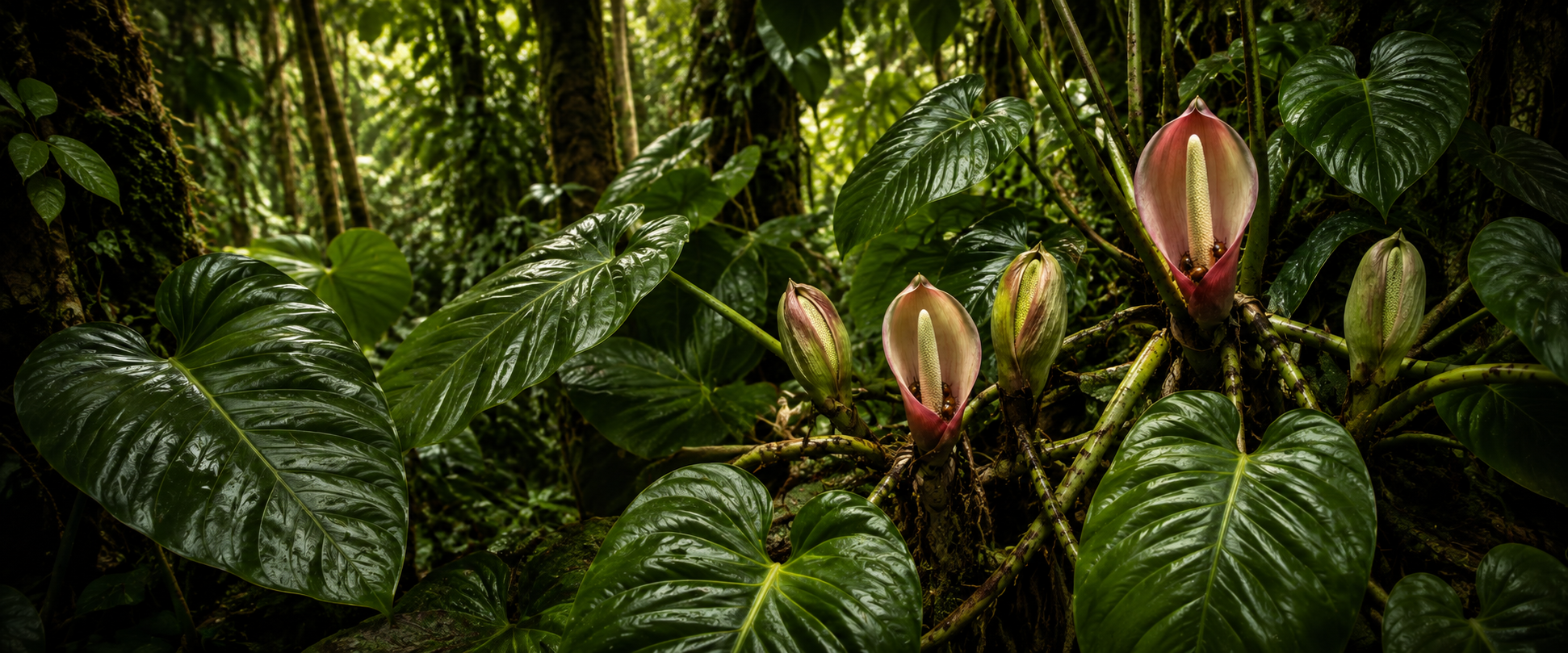
Araceae · Reproductive Biology
THE PHILODENDRON INFLORESCENCE
Food, resin, and a warmth still being argued over
The best-evidenced genus in this family, and the most narrowly sampled. Real exclusion experiments, instrumented thermogenesis, a beetle measured inside a flower — nearly all of it from a handful of people working in one corner of one country, on a few species out of several hundred. Both halves of that are true, and this article tries to hold them together.
For the bench, not the sofa
The whole method in one printable document — the clock, the field signs, the cross, and an honest account of what is known about storing the pollen.
A Philodendron inflorescence is a two-night machine. On the first evening it heats, releases a scent, and opens a chamber to beetles that will stay inside for roughly a day. On the second it coats them in resin, sheds pollen onto them, and squeezes them out past it. The female flowers were receptive on the first night and are finished before the pollen appears, so no inflorescence can pollinate itself in time — which is the fact every practical instruction on this page descends from.
The flower is female one night and male the next. By the time it has pollen, its own eggs are past taking it. To make a cross you need two plants out of step, or pollen you kept.
What follows is arranged so it can be read two ways. The first seven parts are the biology — the zones, the clock, the heat, the chamber, and the long argument about what the beetle is actually being paid. Parts VIII to XII are the method: how to read an inflorescence in front of you, what to do with the pollen, how to make the cross, and what it looks like when it works. Each part is labelled, and skipping is expected.
Caution · two kinds of knowledge, kept apart
This article draws on peer-reviewed pollination ecology and on the working experience of breeders and growers, and it does not pretend they are the same thing. Where a figure comes from an instrumented study it says so; where it comes from someone who has made the cross a hundred times it says that instead.
Neither is treated as the weaker. For several of the questions a grower actually has — whether the pollen will keep, why an inflorescence produced none at all — practice is the only evidence that exists. And where the two disagree, this page names both and lets them disagree rather than quietly picking one.
The reading path
Twelve parts. Botany explains how the system works; Method tells you what to do. If you came to make a cross, Parts VIII to X are the ones you need — and Part IX is the one that will surprise you.
- I Anatomy of the inflorescence Botany
- II The genus, and how little is known Botany
- III The clock Botany
- IV The furnace Botany
- V The chamber Botany
- VI What the beetle gets Botany
- VII Who comes Botany
- VIII Reading yours Method
- IX Pollen, and whether it keeps Method
- X The cross Method
- XI Fruit and seed Method
- XII When it fails Method
- — Sources, and what kind of evidence this is Botany
Part I
Anatomy of the Inflorescence
Three zones stacked bottom to top, and no appendix. The middle zone carries neither pollen nor ovules — and in one species it is half the spadix. Understanding why it is there explains most of what the rest of this page describes.
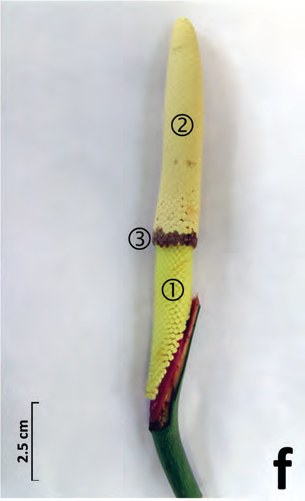
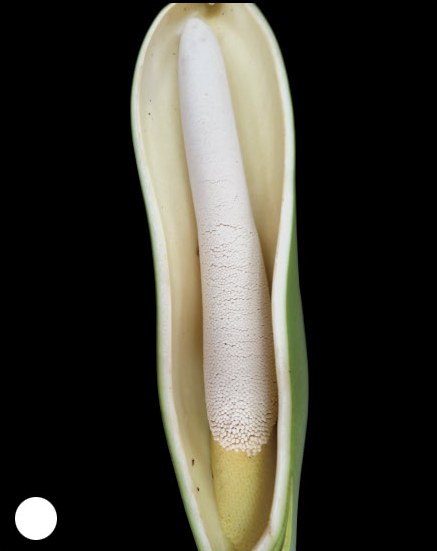
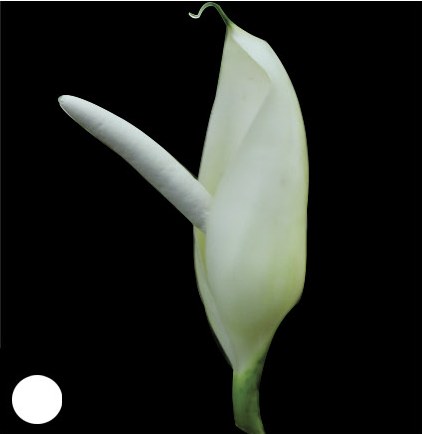
Photographs by A. C. D. Maia and H. Teichert, from Maia, Schlindwein, Navarro & Gibernau (2010), International Journal of Plant Sciences 171(7). Reproduced by permission. Right-hand pair: From Buturi, Temponi & Sakuragui (2016), Rodriguésia 67(3), published under CC BY 4.0.
What looks like a single flower is a spadix — a fleshy column carrying hundreds of tiny naked flowers — sheathed in a single modified leaf called the spathe. The flowers have no petals and no sepals. A pistillate flower is an ovary with a stigma on top; a staminate flower is little more than a group of anthers. They are unisexual, and they are sorted into bands that do not overlap.
The spike is not a flower. It is a pole covered in flowers, sorted into three stripes, and the hood around it is a leaf doing the job petals normally do.
Bottom to top, on the spadix
1 · The pistillate zone. The female flowers, at the very bottom, sealed inside the closed base of the spathe. Each is an ovary topped by a stigma. In Philodendron propinquum — the only species of subgenus Pteromischum ever sectioned — the ovary has three or four locules carrying 50–60 ovules each, above a non-lobed stylar region and a shallow compitum (n = 7). This is the zone a hand-pollination is trying to reach, and it is the one zone in every Philodendron so far instrumented that produces no heat at all.
During the receptive phase the stigmas are wet. In Philodendron solimoesense that secretion is one of two things the beetles are recorded taking — but the paper calls it a stigmatic secretion and never calls it nectar, no gland was described, no sugars were assayed and no volume was measured. In Philodendron propinquum the stigma bears apical unicellular trichomes releasing a polysaccharide exudate. Both are secretions on a stigma. Neither has been shown to be a food.
2 · The sterile staminate zone. A band of staminodes — male flowers reduced to sterile structures — sitting immediately above the ovaries. They shed no pollen, and unlike the fertile males above them — which in Philodendron melinonii extrude resin in droplets around the lower part of their own zone — they produce no resin either. On the surface they do nothing. They are the food.
3 · The fertile staminate zone. The pollen, at the top, released in a single event late on day two — as copious strings in Philodendron melinonii and Philodendron solimoesense, and in long chains in Philodendron adamantinum. In Philodendron propinquum it is released in monads instead. Three species, two presentations: no genus-level statement about how Philodendron pollen arrives is safe.
There is no appendix — and that is the point
In Alocasia and Amorphophallus the top of the spadix is a flowerless column that does the advertising. Philodendron has no such organ. The sterile staminate zone is where the heating happens instead, alongside the fertile males, and the two begin warming together.
Barabé, Gibernau & Forest read Arum and Dracunculus as having transferred that heating function outward into an appendix, which is why those genera show a delay between the male-zone peak and the appendix peak while the two Philodendron peaks overlap. That is an evolutionary reading of their own figure, not an experiment — but the structural difference it is built on is plain enough.
Why a zone that does nothing is the largest part of the spadix
The beetles eat the staminodes. In Philodendron solimoesense the beetles spend the whole of day two inside the chamber, inactive and photophobic, feeding on the sterile male flowers — and how much they eat scales with how many of them arrived (r² = 0.64, n = 29). In heavily visited inflorescences 25–30% of the sterile male flowers were consumed.
The plant appears to be paid for building a bigger one. Across the same population, a longer sterile male zone drew more beetles (r² = 0.15, F = 5.15, P = 0.03, n = 31), while pistillate-zone and fertile-male-zone lengths predicted nothing at all (P = 0.84 and P = 0.96). Read that r² honestly: the zone explains about a seventh of the variation in beetle numbers. It is a real effect and a small one, and it is one species in one region in one month.
Half of a Philodendron solimoesense spadix carries neither pollen nor ovules
≈ 50%
Across 68 inflorescences in four wild populations in French Guiana, spadices ran 22–32 cm (mean 29 cm) and divided roughly 20% pistillate, 50% sterile staminate, 30% fertile staminate. The reward zone is the single largest part of the inflorescence.
What the staminodes are made of has not been settled. The reward package for this genus is usually listed as sterile flowers rich in protein — but that description is asserted in the literature rather than assayed, and no proximate analysis of Philodendron staminode tissue appears anywhere in the sources behind this page. What is documented is starch: in non-thermogenic Philodendron propinquum the sterile units retain abundant starch that is never burned, which its authors propose is functioning as a food reward instead of a fuel.
How much of the spadix each zone takes
Three species have had their zones measured as proportions. They happen to be one species from each of the three subgenera, and they do not agree.
| Species | Subgenus | Pistillate | Sterile staminate | Fertile staminate | Scope of the measurement |
|---|---|---|---|---|---|
| Philodendron melinonii | Philodendron | ~27% | ~14% | ~59% | Wild and transplanted, Petit Saut, French Guiana; n = 13–17. Whole spadix about 25.6 g. |
| Philodendron solimoesense | Meconostigma | ~20% | ~50% | ~30% | Wild, four populations along National Road 1, French Guiana, July; 68 inflorescences. Spadices 22–32 cm. |
| Philodendron propinquum | Pteromischum | 24.2% | 9.3% | 66.5% | Wild, Reserva Biológica do Tinguá, Rio de Janeiro; n = 7 inflorescences from seven individuals. Spadix 5.0–8.1 cm. |
Caution · three rows are not a genus
These are three species measured by three groups with three methods, and they are printed as three rows for that reason. There is no average here to take. A sterile zone that is half the spadix in Philodendron solimoesense is under a tenth of it in Philodendron propinquum, and treating either as the Philodendron figure would be wrong in both directions.
Nor does a percentage give a length. The spadices behind these rows run from about 5 cm to 32 cm, so 9.3% of one and 50% of another are not on the same scale at all.
The sterile zone measured in centimetres
Recorded as absolute lengths, the range across four species is the widest single number on this page: 0.4–0.6 cm in Philodendron quinquenervium, 0.8–1 cm in Philodendron pedatum, 2–3 cm in Philodendron melinonii, and 9–12 cm in Philodendron solimoesense. That is a twenty-fold spread in the organ the beetles come to eat.
The figures come from two field papers that state no sample size for the individual measurements, so read them as descriptions of the plants those authors had in front of them rather than as species ranges. The consequence for the reader is the same either way: a 2–3 cm band and a 12 cm one cannot be doing the same amount of work, and one of them may be too small for an instrument to resolve at all. In Philodendron melinonii the sterile zone showed no significant temperature rise on day two — and the authors themselves raised the possibility that a 2–3 cm zone is simply too small for the method.
Whole-spadix mass runs on the same scale. A Philodendron melinonii spadix of about 25.6 g is roughly a fifth the size of Philodendron selloum at 124 g or Philodendron solimoesense at 98.6 g — though that last figure is cited in its own source as unpublished data, and should be carried with that label attached.
And around all of it, the spathe
The spathe divides into a base, which stays shut, and a limb, which opens. Between them is a constriction — a waist where the spathe pinches in, and the landmark that tells you where the enclosed part ends. The base is not a wrapper. It is a room: in Philodendron melinonii the floral chamber stands about 60 mm high with an 8 mm gap between the spathe wall and the florets while it is open, and that gap is eliminated entirely when the spathe closes on the evening of day two.
The bottom of the hood is a closed chamber with a beetle inside it, roughly the size of a thumb joint. On the second evening the walls come in, the gap disappears, and the beetle is pushed up the spadix and out past the pollen.
Two details of the spathe matter more than they look. The first is that part of the insulation around the chamber is not the spathe at all: a fibrous mass of dried bracts wraps the base of each Philodendron melinonii inflorescence. It had to be removed to fit respirometry hoods, which means the published hooded and un-hooded chamber figures are not measuring the same physical object — a caveat that belongs to every chamber temperature quoted later on this page.
The second is that in several species the spathe, not the spadix, is the resin organ. In Philodendron adamantinum the resin is released from the adaxial — inner — face of the spathe, from large-caliber canals that form an anastomosed network and deflect toward the surface; a second, small-caliber canal system sits nearer the outer face and never releases anything. The resin escapes through openings a little over 100 µm across, formed by rupture of the epidermal cells, and the droplets exceed 1 mm — the openings are described as barely visible to the naked eye while the droplets are obvious in the field. In Philodendron solimoesense the resin likewise comes from the inner spathe, and that species has no resin canals in the spadix. In Philodendron pedatum it is described at the base of the male zone instead.
No sample size is given for that canal anatomy, and no chemistry: there is no gas chromatography on Philodendron resin in this literature, and the authors say so themselves. The secretion is terpenic and lipid-positive by histochemistry. Beyond that, what it is made of is not known.
One subgenus was described for the first time in 2018
Subgenus Pteromischum had no floral description at all
Of the three subgenera, one had never had a flower described. The first floral account of any Pteromischum species is Barbosa and colleagues on Philodendron propinquum, published in 2018 — a genus in cultivation for two centuries, and a third of it structurally unexamined until then.
The rest of that paper’s comparative scoring is second-hand from an unpublished 972-page thesis, and only Philodendron propinquum was newly sectioned. Its own Results and Discussion disagree about whether subgenus Philodendron has a shallow or a deep compitum. That is not a reason to discount the paper; it is a reason to treat every cross-subgeneric character statement in this genus as provisional, which is what Part II is about.
One structure is worth naming before leaving the spathe, because it is easy to mistake for something it is not. Philodendron melinonii bears red-spotted extrafloral nectaries on the spathe, in two bands — at the constriction and near the top, on the side opposite the opening. Extrafloral nectaries are not floral nectar, they sit on the outside of the story rather than inside the chamber, and the visitors they concern are ants. They are covered where they belong, with the ants.
Every number in this block belongs to one species, and in several cases to one population in one month of one year. That is not a caveat attached to the anatomy — it is the shape of the entire literature on this genus, and it is what Part II is for.
Part II
The Genus
This is the best-evidenced genus on Aroidpedia and the most narrowly sampled one. Both are true at the same time, and everything after this block should be read holding the second in mind.
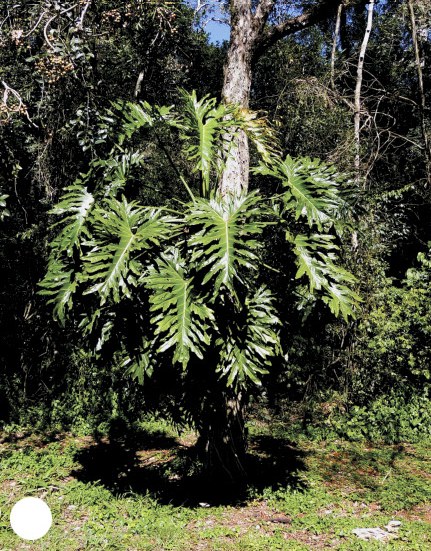
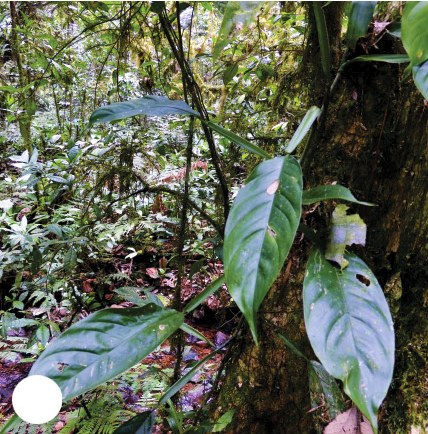
From Buturi, Temponi & Sakuragui (2016), Rodriguésia 67(3), published under CC BY 4.0.
Philodendron is where aroid pollination biology has its firmest ground. Real exclusion experiments — bagged inflorescences that set no seed while their neighbours set full heads. Thermogenesis measured with thermocouples and with respirometry. A pollinating beetle whose own metabolism was put in a respirometry chamber and measured. Very little of that exists for any other genus in this cluster.
And almost all of it was done by a handful of people, in one corner of one country, on a small number of species.
Who did the work
Of the papers on this genus behind this page, roughly fifteen carry Marc Gibernau or Denis Barabé, or both, and most of those report fieldwork in French Guiana — a great deal of it at one site, Petit Saut, and along one road. Roger Seymour joins for the physiology. The genuinely independent material is a short list: a study of Philodendron quinquenervium (published as Philodendron quinquenervium (published as Philodendron acutatum)) in Atlantic Forest in north-eastern Brazil, a scent study of sympatric species in Atlantic Forest in the south-east, and a 1977 palaeobotanical paper on Eocene leaves that has nothing to do with pollination at all.
None of that is a criticism of the work. It is excellent work, and it is precisely why this genus is the best-evidenced one here. But it does bound what the findings are entitled to describe. A grower in Florida or Singapore holding a subgenus Philodendron houseplant is outside the sampled range — not slightly, but entirely.
Nearly everything confidently known about how Philodendron flowers are pollinated was learned from a few species, in one rainforest, by one research group. That knowledge is solid where it was gathered. It has not been shown to travel.
What has actually been counted
Rather than argue about how much of the genus is understood, it is more useful to state what has been measured and how many times.
| What was measured | How many species | Scope, and what the figure will not do |
|---|---|---|
| Floral scent characterised | 13 | A count as of 2023, published against that same paper’s own total of ca. 490 species — about 2.7% of the genus. Numerator and denominator come from one source, so the fraction is internally consistent. It should not be recalculated against any other total. |
| Thermogenesis instrumented | Fewer than 15 | And the well-replicated cases are far fewer than that. Two of the three field papers state a sample size in their methods, then print one curve per species with no means and no variance — those traces are n = 1 however the methods read. |
| Pollinator exclusion actually tested | 4 | Philodendron solimoesense, Philodendron adamantinum and Philodendron fragrantissimum, plus a 23-species bagging survey. The bagged arms are small — four inflorescences in the Philodendron solimoesense experiment. |
| Subgenus Pteromischum, heat | 0 | No species of this subgenus has ever had its temperature measured. The single statement that one of them does not heat rests on an unpublished thesis, not on published thermometry — see below. |
The number this page keeps coming back to
13 species
Thirteen Philodendron have had their floral scent characterised. Against the genus total printed by the same authors in the same year, that is roughly one species in every thirty-seven. Measured instead against the 627 accepted species in the current POWO list, it is one in every forty-eight — the fraction gets smaller whichever total is chosen, which is the only thing about it that is stable. Six of the thirteen are dominated by a single compound, three by a pair, four by a combination of three — though that paper names only five of its own six single-compound species, so even the breakdown is short by one.
One species of Pteromischum, described in 2018
The genus divides into three subgenera. Two of them — Philodendron and Meconostigma — carry every thermogenesis trace, every pollinator observation and every exclusion experiment discussed on this page. The third, Pteromischum, had no floral description of any kind until 2018, when Philodendron propinquum was sectioned for the first time.
That paper reports something consequential: Philodendron propinquum has functional osmophores, retains its starch, and does not heat — from which its authors argue that scent emission in this genus does not require thermogenesis at all. Read carefully, though, because the paper reports no thermometry. The non-thermogenesis is sourced entirely to an unpublished ninety-seven-page thesis in Portuguese. It is the most interesting claim in the subgenus and it rests on a document almost nobody can read.
How many species is a Philodendron?
There is no settled answer, and the disagreement is not between rival camps. It is within a single overlapping group of authors, across roughly two decades.
| Total printed | Where | Status |
|---|---|---|
| ~700 species | Gibernau and colleagues, 1999 | Published in the paper that established the Philodendron solimoesense system. |
| 487 published species | Croat and Ortiz, 2022 | Estimates the genus at 1,500 once undescribed species are counted. |
| ca. 560 published species | Ortiz, Croat and colleagues, 2022 | The same two authors, the same year, and 73 species apart. |
| ~560 described species | Maia and colleagues, preprint after 2022 | Not peer reviewed at the time of writing. |
| ca. 490 species | Gibernau and colleagues, 2023 | The denominator behind the 2.7% scent figure above. |
| 627 accepted species | Plants of the World Online, 2026 | The figure this site uses. Curated, current, and higher than every published total above except the 1999 guess. It counts described species only, which is why it sits so far below the 1,500 Croat and Ortiz reach once undescribed material is included. |
| over 600, given as 621 | da Silva-Luz and colleagues, 2025 | The most recent figure of the set. |
Caution · a single species total for this genus is not available
Any page, label or database entry that gives one clean number for Philodendron has chosen it. The published figures span from 487 to about 700, they come from a small and overlapping set of authors, and none of the papers reconciles itself against the others. Two of them were written by the same pair of authors in the same year and differ by 73 species.
Some of the disagreement is not even taxonomic. One 2018 checklist is cited as the authority for three different totals by three later papers — about 560, 621, and “more than 400”. And a paper giving 457 species in one subgenus, described as about 85% of the whole, implies a genus of roughly 538 — against the 560 printed a few pages earlier in the same paper.
The honest form is to attribute and date. Where this page needs a scale rather than a count, it says that Philodendron is one of the largest genera in the Araceae and moves on — which is the only part of the claim every source agrees on.
It would be easy, and wrong, to read that spread as carelessness. Part of it is real taxonomy doing its job. A genus of several hundred species in tropical America is under continuous revision; species are described, synonymised and transferred every year, and a total published in 1999 was never going to survive intact. And part of the spread is one specific argument, which the next section is about.
Philodendron, or Thaumatophyllum?
In 2018 Sakuragui and colleagues removed subgenus Meconostigma from Philodendron and raised it as the genus Thaumatophyllum. The proposal is accepted by some authors and rejected by others; two published responses in the following two years declined to adopt it.
For this page the question is not academic housekeeping, because of what happens to the evidence. The best-documented plants in the entire Philodendron literature are Meconostigma species — Philodendron solimoesense, which supplies the heat-reward system; Philodendron adamantinum, which supplies the best clock and the best experiment; Philodendron bipinnatifidum. Under the split, a page about Philodendron pollination would be built mostly on plants that are no longer Philodendron.
What this page does, stated once
This page uses Philodendron in the broad sense and names subgenus Meconostigma where the distinction matters. It is not a compromise with popular usage.
In the same year the split was proposed, a study of floral structure treated Philodendron as three subgenera, kept Meconostigma inside it throughout, and did not mention Thaumatophyllum at all — and the senior author of that paper is the senior author of the split itself. A second 2018 paper, on the resin of Philodendron adamantinum, likewise writes of the three subgenera of Philodendron. Whatever the eventual resolution, this is how the specialist literature behind this page was naming these plants while it was being written.
A reader who prefers the split loses nothing: every species named on this page carries its subgenus, so the translation is mechanical.
What “specialist” is allowed to mean
The narrowness of the sampling has one consequence sharp enough to be worth stating on its own. This genus is repeatedly described as having specialist pollinators — one beetle species per plant species. The observations behind those statements are almost always from a single locality in a single season.
When the same plant is watched somewhere else, the beetle changes. Philodendron fragrantissimum in French Guiana is visited by Cyclocephala simulatrix; the same plant species in Panama is visited by a different beetle, Cyclocephala brevis. The relationship is specialised, but “specialist” here means local and seasonal, not exclusive.
Caution · the oldest form of this correction is from 1986
None of this is new. A 1986 review of beetle pollination in the family concluded, against the assumption of the day, that the relationship between these flowers and their dynastine beetles is often not very specific, and proposed that broad, general odour components were doing the attracting — the same argument that circulates today as a recent finding.
That review named one clean exception: a beetle said to visit Philodendron selloum and nothing else, never found approaching any other plant. That claim is now false. The same beetle species was shown in 2014 to be the sole recorded pollinator of Philodendron adamantinum, with a third host reported alongside it. Stated flatly in 1986, still repeated as an assumption in 2014, and falsified by the same 2014 paper — which is roughly how long a specificity claim in this genus survives.
What follows from all of this
None of it argues for reading less confidently. The Philodendron solimoesense exclusion result, the Philodendron melinonii respirometry and the Philodendron adamantinum clock are as good as pollination biology gets in this family, and the rest of this page uses them without apology.
What it argues for is reading every number with its label attached. Throughout the parts that follow, a figure carries the species it was taken from, the place it was taken in, and how many plants it was taken from — because in this genus those three are what bound it. Where a number rests on one inflorescence, or on an unpublished thesis, or on a calculation rather than a measurement, the page says so at the point of use.
The alternative is the thing this block exists to prevent: thirteen species’ worth of scent data, four exclusion experiments and a handful of temperature traces from one rainforest quietly becoming a description of five hundred species.
Part III
The Clock
An inflorescence is female on one evening and male on the next, and the beetle that carries the pollen is shut inside the chamber for the whole interval between. The sequence is the same in every species measured. The hours are not, and a grower who borrows one species’ timetable for another will arrive at the wrong end of the day.
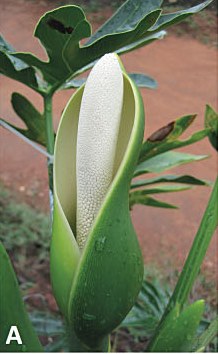
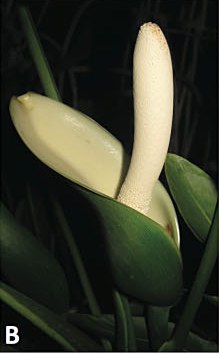
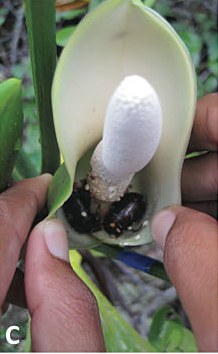
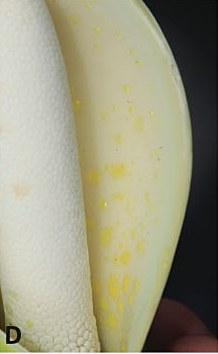
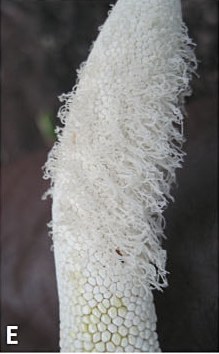
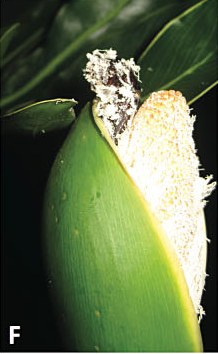
From Pereira, Schlindwein, Antonini, Maia, Dötterl, Martins, Navarro & Oliveira (2014), Biological Journal of the Linnean Society 111. Reproduced by permission. Philodendron adamantinum, Minas Gerais.
Philodendron is protogynous. The stigmas are receptive first, on the evening the spathe opens; the anthers of the same spadix do not shed until the following evening, by which time the stigmas below them have gone over. Anthesis runs about two days in every species instrumented in this literature, and pollination in every Philodendron studied is crepuscular or early-evening and attributed exclusively to cyclocephaline scarab beetles.
The plant is female one evening and male the next. It does not pollinate itself. What it does instead is trap the courier overnight — the beetle arrives while the stigmas are wet, spends a full day locked in, and is released the next dusk covered in that day’s pollen, to fly to a plant that is a night behind.
That much is the genus. The rest of this part is the arithmetic of when, and it is where the genus stops being tidy.
One species has a full timetable
Philodendron melinonii is the only species in this literature logged hour by hour from spathe to pollen. The table below is that record, from four wild inflorescences in French Guiana and two cultivated at the Montreal Botanical Garden, July and August 1999.
| When | What happens |
|---|---|
| Day 1, mid to late morning | The spathe begins to open. |
| Day 1, 16:30–17:00 | Spathe wide open — about two-thirds of its length — with the spadix protruding strongly forward. |
| Day 1, 18:00–18:30 | The spadix begins to warm and the odour begins. The stigmas are moist and, in the authors’ wording, apparently receptive. Receptivity was not tested chemically in this species. |
| Day 1, after 19:30 | The beetles arrive — and only once the inflorescence is already warm and odoriferous, not before. |
| Day 2, morning | The spathe closes partway, upper half only. The beetles stay inside all day, sitting at the base above the female flowers and eating the sterile male flowers. |
| Day 2, afternoon | Reddish resin is secreted by the upper sterile and fertile male flowers, in droplets of one to two millimetres, mostly at the base and middle of the male zone. |
| Day 2, 18:30, dusk | The spathe begins wrapping around the spadix from the base upward. |
| Day 2, about 20:00 | The anthers release pollen. It sticks to the resin already coating the beetles’ cuticles, and the beetles fly out. |
Two things in that sequence are worth separating out, because both are mechanism rather than description.
The first is that the resin is secreted before the pollen is released, by several hours. The beetles are glued before there is anything to glue to them. The same order has since been documented independently in Philodendron adamantinum, where resin appears around 11:00 on day two and pollen not until the afternoon, so it is not a quirk of one field season.
The second is the shape of the exit, and it is the one thing that holds across every species anyone has watched closely.
The invariant
Base to apex
The spathe closes from base to apex and squeezes the beetles upward past a freshly resinous, freshly dehisced male zone. The chamber does not simply reopen and let them go. It constricts from the bottom, and the only way out is up the spadix and across the resin, and then across the pollen that the resin has been waiting for.
This is documented with hours in Philodendron solimoesense, Philodendron squamiferum, Philodendron adamantinum and Philodendron fragrantissimum — four species, four separate studies, four for four. It is the load-bearing mechanism of the genus as the literature has it, and it is not a passive exit.
Caution · the resin does not come from the same organ in every species
The mechanism is four for four; the source is not. Philodendron fragrantissimum secretes at the base of the male zone. Philodendron squamiferum secretes from the spadix along the male zone. Philodendron solimoesense and Philodendron adamantinum both secrete from the inner face of the spathe. Philodendron quinquenervium (published as Philodendron acutatum) secretes from the inner spathe and from both the fertile and sterile staminate zones of the spadix, which breaks the tidy rule that the spathe is the Meconostigma organ and the spadix the rest.
So there is no genus-wide sentence to be had here. If a plant is being watched for resin, watch both the inner spathe and the male zone, and record which one it came from.
What is known, species by species
Six species have published hours. They agree on the order of events and they disagree on almost every clock time in it. The two extremes are worth stating before the table, because they are what the table is for: Philodendron adamantinum opens its spathe at 07:00 and releases pollen at about 15:30 the next day, in daylight, while Philodendron solimoesense releases on the second evening, in the dark.
| Species | Spathe opens | Stigmas receptive | Heat peak — and where the probe was | Pollen released | Whole cycle |
|---|---|---|---|---|---|
| Philodendron melinonii subgenus Philodendron |
Day 1, mid to late morning; fully open by 16:30–17:00 | 18:00–18:30 day 1, moist and “apparently receptive” — not chemically tested | 39.5 ± 0.9 °C at 19:29 ± 0:08, 12.3 ± 1.2 °C above air. Second evening 31.9 ± 0.5 °C, only +5.8 °C, and earlier than night one. Thermistor in the centre of the spadix, fertile male zone; wild and transplanted, n=15 for the maximum | Day 2, about 20:00 — dark | 2 days |
| Philodendron solimoesense subgenus Meconostigma |
Day 1, mid-morning | About 18:00 — reported as “seemed to be”, not tested | 35–38 °C at 19:30–20:00, about +11 °C. Sterile male zone, probe at 5 cm | Day 2, evening — in the dark | 2 days |
| Philodendron adamantinum subgenus Meconostigma |
07:00–09:00 day 1 — the earliest in the genus | About 16:30 day 1, tested with hydrogen peroxide | 42.4 °C at 18:00–19:00, +18.8 °C — the largest elevation in the table. Sterile staminate zone, probe at 0.5 cm | Day 2, about 15:30 — in daylight | 36 h |
| Philodendron quinquenervium subgenus Philodendron |
09:30–10:30 day 1 | Dusk, about 17:30 day 1, tested with hydrogen peroxide | 38.6 and 38.1 °C about 18:30 (+11.6 and +11.9 °C), episode over by about 22:30. Second, weaker episode day 2 with no perceivable odour. Probe about 3 mm into the sterile staminate zone; n=2, one site only | Day 2, 16:15–17:15, abundantly — in daylight | 2 days |
| Philodendron squamiferum subgenus Philodendron |
Day 1, mid to late morning | Not reported | No peak — a plateau from 19:00 to 22:00 at only +3–4 °C above air. Fertile male zone, probe under 5 mm | Day 2, dusk | 2 days |
| Philodendron cipoense | Pistillate flowers receptive from 09:00–12:00 day 1 | About 29 h — from day 1 until 14:00–15:00 the following day, overlapping the male phase | Pistillate stage +10.0–17.0 °C (mean 35.9 ± 1.67 °C, n=5); staminate stage to +10 °C (mean 29.12 ± 3.59 °C, n=5). Probe in the upper staminate zone; depth not stated by the authors | Hour not reported. Resin from about 09:00 on day 2 | Not reported |
The temperature column is not a ranking and must not be read as one. Six probes went into different tissue at different depths — the centre of the spadix in one study, the sterile staminate zone at half a centimetre in another, an unstated depth in a third — and the reference air probe sat 10 cm from the inflorescence in some studies and 50 cm away in others. The 42.4 °C of Philodendron adamantinum and the 39.5 °C of Philodendron melinonii are not two measurements of the same thing. Part IV is where that problem is taken apart properly.
Two further limits on the table. The Philodendron squamiferum and Philodendron solimoesense hours rest on single plotted traces in papers that state a larger sample in their methods and then print no means and no variance; only the Philodendron melinonii and Philodendron quinquenervium rows carry real replication, and the Philodendron quinquenervium temperatures are n=2 from one of its two sites. And Philodendron cipoense is the row that breaks the pattern: its stigmas stay receptive across the male phase, so the clean protogynous gap that the other five species show is not a genus-wide guarantee.
Caution · the two-day cycle is the plant’s, not necessarily the beetle’s
The canonical account — arrive at dusk, be shut in through day two, be expelled the next dusk — is documented with hours in four species. It is not universal. In the Philodendron bipinnatifidum complex, Cyclocephala variolosa was watched entering and leaving inflorescences at any point across two or three nights, moving in both directions — female-stage to male-stage and male-stage back to female-stage, and between inflorescences at the same stage.
Nobody has measured how much pollen moves per switch, and the authors who recorded the behaviour say its effectiveness is unclear. What it means for this part is narrower and firmer: an open chamber on day two is not proof that the visit has ended.
A cultivated plant runs the same cycle two hours late
This is the only wild-versus-cultivated comparison anywhere in the Philodendron pollination literature, and it is one inflorescence against one.
Greenhouse against forest, Philodendron melinonii
Two hours later
The wild plant peaked at 37 °C (+13.5 °C) at 19:30; the greenhouse plant peaked at 35 °C (+10.1 °C) at 21:20. The second evening ran the same offset: 21:00 under glass against about 18:50 in the field. The two-peak pattern survived the move indoors; the hour did not.
Ambient temperature ranges at the two sites were comparable, which is why the authors attribute the offset to photoperiod rather than to warmth. Scope: n=1 wild inflorescence in French Guiana against n=1 cultivated at the Montreal Botanical Garden, thermocouple 5 mm into the fertile male zone in both. One pair is not a rule — but it is the only pair there is, and it points the same way as everything else in this part.
The practical reading is simple enough. Published hours were recorded near the equator, at a day length that a greenhouse in a temperate country does not reproduce. An indoor plant may be expected to run late against the printed timetable, and the amount it runs late is unknown for every species except this one, where it was two hours, once.
What to do with all of this
Use the sequence from the literature and take the hours from the plant in front of you. The order is dependable: spathe opens, spadix warms and the smell starts, stigmas are wet that evening, chamber shuts overnight, resin appears the next day, spathe closes from the base, pollen last. Where in the day each of those falls is a species trait, a latitude trait, and apparently a day-length trait, and no table can be trusted to supply it.
Part VIII turns that sequence into field signs — what a receptive stigma looks like, what resin looks like, and what a spathe that has begun to close is telling you.
Part IV
The Furnace
The spadix burns sugar and fat to make heat, on two successive evenings, and it does it hard enough to run twelve degrees above the air around it. The temperature trace is the cheapest way to watch that happen and the most misleading. The one species measured a second way — by what it exhales rather than by how warm it feels — turns out never to have stopped burning at all.
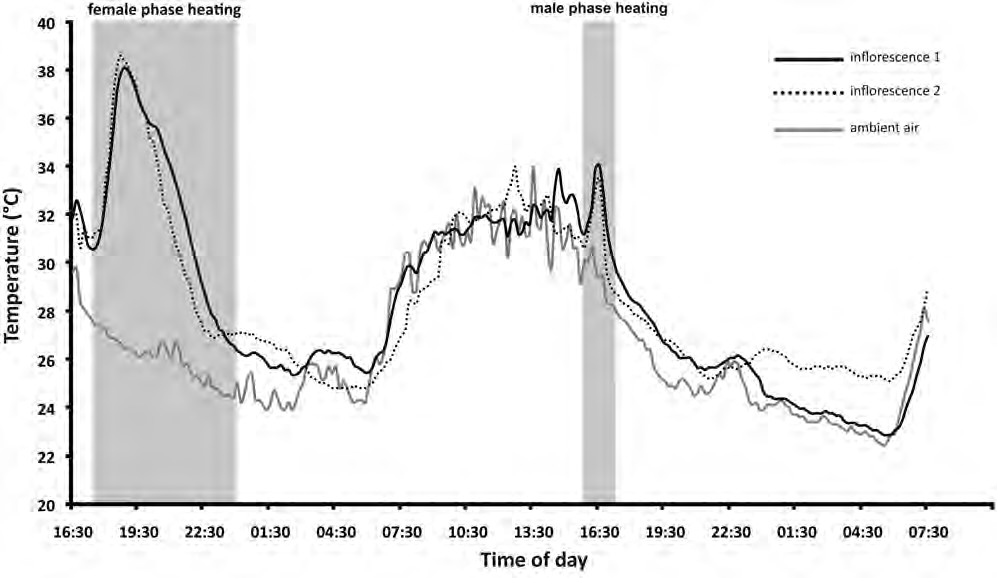
From Maia, Schlindwein, Navarro & Gibernau (2010), International Journal of Plant Sciences 171(7). Reproduced by permission.
Fewer than fifteen Philodendron species have ever had thermogenesis instrumented, and subgenus Pteromischum has never been measured at all. Of those, exactly one — Philodendron melinonii — has been put in a respirometer, given step changes in air temperature in a cabinet, and photographed with an infrared camera. Almost everything precise in this part is that one species, and almost everything about the rest of the genus is a single temperature curve from a single inflorescence.
Caution · the published temperatures are not a comparable series
Three research teams probed three different zones at three different depths, and none of them is measuring the same tissue as the others. One study placed a thermistor in the centre of the spadix in the fertile male zone. Two placed thermocouples 5 mm in. One went about 3 mm into the sterile staminate zone. One states no depth at all.
How much that matters can be read straight off a single species. Probed through the fertile male zone, Philodendron solimoesense peaks at 41 °C. Probed through the sterile male zone of the same species, it peaks at 38.2 °C — and no second peak can be clearly recognised at all. Nothing about the plant changed. The probe moved.
What the thermometers recorded
| Species | Evening 1 | Evening 2 | Where the probe was, and how many plants |
|---|---|---|---|
| Philodendron melinonii | 39.5 ± 0.9 °C, 12.3 ± 1.2 °C above air, at 19:29 ± 0:08; onset 18:36 ± 0:08 | 31.9 ± 0.5 °C, only +5.8 ± 1.0 °C — and significantly earlier than evening 1 (19:05 against 19:29) | Thermistor in the centre of the spadix, fertile male zone. Eight transplanted plus two wild plants; n=15 for the maximum, n=14 for the elevation, n=11 for onset. The only properly replicated series in the genus |
| Philodendron quinquenervium (published as Philodendron acutatum) | 38.4 °C, rising 19:20–20:00; maximum elevation +13.5 °C; falls back to 23–24 °C | 31.8 °C, elevation +9 °C | Thermocouple 5 mm into the fertile male zone. Wild, outside Cayenne. One trace — the methods state two. Part III lists a different pair of figures for this same species, from a Brazilian study that probed the sterile staminate zone about 3 mm in. Two studies, two zones, one plant species |
| Philodendron pedatum | 34.5 °C, rising 20:30–21:30; elevation +12 °C | 33.5 °C, elevation +9 °C — the two evenings are nearly equal in this species | Thermocouple 5 mm into the fertile male zone. Wild but isolated: three climbers on one lakeside rock, several hundred metres from the forest and from any conspecific. n=1 |
| Philodendron solimoesense fertile male zone |
41 °C at 19:40, elevation +16.3 °C. The sterile male zone peaked later and lower, 37.2 °C at 20:30 | Both zones then held 4–7 °C above air right through to the second night | Thermocouples 5 mm into all three zones. One trace of five recorded; the qualitative pattern held across all five, and in two of the five the sterile zone rose as high as the fertile zone at the start of night one |
| Philodendron solimoesense sterile male zone |
38.2 °C, elevation +14 °C | No second peak could be clearly recognised | A different study, same species, probe in the sterile zone. n=1. This row and the one above it are the same plant species measured two ways |
Read the last column before the first three. The two field papers that supply four of these five rows state a larger sample in their methods, then print one curve per species, no means, no variance and no statistics — while using the word “significantly”. Only the Philodendron melinonii row carries real replication. The rest are single traces and should be read as the shape of one plant’s evening, not as a species constant.
The two peaks are not two bouts of burning
This is the most valuable single finding in the Philodendron physiology literature, and it overturns the reading that the temperature traces above invite.
Respirometry, Philodendron melinonii, whole inflorescence
It never switched off
Carbon dioxide production peaked at 1,880 ± 250 nmol per second on evening one — 200 ± 28 nmol per second per gram of floret mass — and at 710 ± 70 nmol per second on evening two. Respiration continued measurably right through the night and the whole of the following day, at a time when the temperature trace had fallen back toward ambient.
Scope: n=10 inflorescences at Petit Saut, French Guiana; the whole inflorescence enclosed in a 330 ml hood and sampled for six minutes in every thirty. Measured, not modelled.
A spadix that has cooled back to air temperature is not a plant that has stopped. It is a small object losing heat as fast as it makes it. The thermometer is reading the balance between production and loss, and it cannot tell a furnace that has gone out from a furnace that is being outrun.
So the two famous peaks record heat retention, not heat production. What actually happens is one long burn with two moments when the plant briefly wins.
Converted to power, the same measurements give a peak output of 0.88 W on evening one and 0.34 W on evening two, and a total across the whole 48 h sequence of 29.6 ± 3.6 kJ, from 62.6 ± 7.6 mmol of carbon dioxide. The carbon dioxide is measured; the wattage and the kilojoules are calculated from it, at an assumed 21 J per millilitre of carbon dioxide. They are arithmetic on a measurement, not a second measurement.
By aroid standards the rate is unremarkable. 200 nmol per second per gram in an intact Philodendron melinonii sits against about 300 for the sterile male florets of Philodendron selloum and up to 820 in some smaller aroids — though the Philodendron selloum figure is itself a conversion, from 360 nmol of oxygen per second per gram at an assumed lipid respiratory ratio, not a directly comparable carbon dioxide reading.
And the second peak may not be a peak
In Philodendron solimoesense the authors say outright that the second peak is an illusion: the difference between spadix and air was compressed during the hottest hours of day two, roughly 13:30–17:00, and re-expanded as the air cooled in the evening, which draws a second hump on the trace without the plant doing anything new.
It does not fully settle the question, and the same traces are why. On night two the sterile male zone turned up at 17:20 and the male zone at 19:00 — an hour and forty minutes apart, which a purely passive ambient effect should not produce. That was n=1, with no manipulation of the ambient, and nothing published resolves it.
Caution · the inflorescence can run cooler than the air
On the afternoon of day two, between about 13:00 and 15:30, all three zones of a Philodendron melinonii spadix read below ambient, the female and sterile zones most strongly. At chamber scale the maximum floral-chamber temperature ran 6.5 °C below the maximum air temperature during the day, while the minimum chamber temperature sat only 1.9 °C above the minimum air temperature at night.
A negative reading is therefore not an instrument fault and not a dead inflorescence. It is a wet organ in a shaded chamber during the hottest part of a tropical afternoon. The zone figures are one trace; the chamber figures are replicated. Part V is where the chamber is taken up properly.
Regulation: the mechanism is there, the performance is not
Thermoregulation — holding a target temperature against a changing ambient, rather than simply running hotter when the air is hotter — is the claim most often made loosely about aroids. In subgenus Philodendron it has actually been tested, against a manipulated ambient, and the answer comes in two halves that point opposite ways.
The mechanism is genuinely present. Cut spadix sections of 20–40 mm, given step changes of cabinet air temperature, responded first in the direction of the change, as any chemistry would, and then reversed — inhibition after a rise, activation after a fall. The transient temperature coefficient was 2.3; the equilibrium coefficient was 0.7, meaning that once the tissue had settled it was producing more heat at the lower temperature. Scope: Philodendron melinonii, cut fertile and sterile male sections, n=4 during the main bout and n=8 afterwards, in a 0.6 L Peltier cabinet, needle thermocouple 15 mm in. It is the only manipulated-ambient experiment in the genus.
The set point matches the ceiling
38.4 °C
Cut tissue reversed its respiratory rise at a mean spadix temperature of 38.4 ± 3.7 °C — statistically indistinguishable from the 39.5 °C the intact plant reaches in the field. A severed piece of spadix in a laboratory cabinet knows where the plant’s own ceiling is.
Scope: n=4, Philodendron melinonii. The confidence interval is wide relative to the mean, which is what four replicates buy.
Then the performance, which is poor. Equilibrium spadix temperature tracked cabinet temperature with a slope of 0.75. A perfect regulator has a slope of zero and an unregulated object has a slope of one, so 0.75 is much nearer no regulation than good regulation, and the authors call it very poor regulation in their own words.
Their own caveat has to travel with that number. It was measured on cut sections with the spathe removed, in a cabinet whose air was replaced roughly every ten seconds — conditions that strip away every insulating structure the intact plant has — and the authors themselves discount the figure for interpreting field behaviour on exactly those grounds.
It is also slow. Reversing the initial chemical response took 20–30 min above 20 °C but more than 2 h below it, and full re-equilibration took 129 ± 34 min after a rise and 258 ± 113 min after a fall, running past 7 h at the coldest temperatures tested. Skunk cabbage, the standard against which floral thermoregulation is measured, overcomes the same chemical effect in 38 min and finishes in 68–88 min. Philodendron melinonii is at the slow end of everything published.
Caution · the field evidence for regulation is weak, and its authors say so
The field regression is T max = 0.33 Ta + 30.5, with n=14, R2 = 0.20 and P = 0.11. The slope is not significantly different from zero — but at that sample size and that fit it is not significantly different from very much else either. The authors’ own wording is somewhat regulated, and that is the honest ceiling on the claim.
Two further limits. No thermoregulated plateau was detectable at all in field Philodendron melinonii, despite cut tissue showing the machinery present throughout the two-day sequence. And the field test of respiration against ambient failed for want of range: air inside the respirometry hoods spanned only 26.4–31.0 °C, so the method destroyed the very spread the hypothesis needed to be tested against.
Placed on the published scale of thermoregulatory precision, where a lower slope is better regulation, Philodendron melinonii’s 0.33 sits mid-way: Philodendron selloum manages 0.145 intact and 0.179 severed, and the thermoregulatory species as a group run 0.09–0.59. Philodendron melinonii begins to fail just below 20 °C, whereas Philodendron selloum holds 39–44 °C down to about 4 °C of air temperature. That comparison is drawn across studies rather than within one, and the Philodendron melinonii ambient range sampled never extended far below 20 °C in the first place, so the point at which it fails is an extrapolation.
Which zone does the work depends on how the question is asked
Both the fertile and the sterile male florets are thermogenic. The female florets showed no thermogenicity by thermocouple or by infrared camera, across n=15 instrumented Philodendron melinonii inflorescences — that part is solid.
Which of the two male zones is hotter is not a fixed fact about the plant. The two begin heating simultaneously; the fertile males reach a slightly higher peak and then decline faster overnight, while sterile-male thermogenesis is, in the authors’ phrase, several hours more protracted. So which zone is warmer depends entirely on when the reading is taken.
The instrument reverses the ranking
Skin against core
At about 19:00 on day one, an infrared image of a Philodendron melinonii spadix shows the surface of the sterile males hotter than the surface of the fertile males — the opposite ranking to what the interior probes give at peak.
Neither instrument is wrong. Infrared reads the outer skin; the thermocouple reads the spadix centre. They are answering two different questions and only one of them — the surface — is the temperature a beetle actually stands on.
Scope: one inflorescence, photographed on one occasion. A single image, and the whole of the reversal rests on it.
The picture is not consistent across the genus either. In Philodendron solimoesense the fertile male zone ran hotter than the sterile male zone across the entire flowering cycle, which is a direct argument against writing off fertile-male heat production — though again from a single trace of five recorded. And there is an unresolved null that the authors flagged themselves: in Philodendron melinonii the sterile male zone showed no significant rise on day two, but that zone is only 2–3 cm long and may simply be too small for the method to resolve. A null that might be an instrument limit is not a finding.
Size buys total energy, and does not buy temperature
The intuition is that a bigger spadix should get hotter, because a larger body loses heat more slowly relative to its volume. Within a species, it does not.
In Philodendron melinonii, thermogenic floret mass did not predict peak day-one carbon dioxide production (R2 = 0.076, P = 0.44) and did not predict maximum temperature elevation (P = 0.60), at n=10. Peak carbon dioxide did not predict elevation either, at n=8 — a sample far too small to read a direction into, so no direction is reported here.
What did scale with mass was the total heat released across the 48 h sequence, at n=10 with R2 = 0.39 and a borderline P = 0.05.
A bigger spadix is a bigger fuel tank, not a bigger flame. It burns more over the two days. It does not burn hotter at the peak.
The physiologist who ran those experiments states the general limit plainly: there is “no physical barrier to small spadices producing large temperature elevations if they have sufficient thermogenic capacity and ambient temperatures are sufficiently low” — and the case in point is a 4.7 g skunk-cabbage spadix reaching an elevation of 33 °C above air at −10 °C. Capacity, not volume, sets the ceiling.
And then the same discussion invokes size in the other direction, to explain why Philodendron melinonii fails below 20 °C — the difficulty of warming a smaller spadix. The paper holds both positions and never reconciles them against its own null. A second group independently attributes the flatter, plateau-shaped trace of subgenus Meconostigma to size, hedged, and proposes the test that settles it and that nobody appears to have run: measure a small-inflorescence Meconostigma such as Philodendron adamantinum or Philodendron brasiliense. If the plateau is a size effect, those should show the two-peak pattern instead.
For scale while that stays open: a Philodendron melinonii spadix weighs about 25.6 g, roughly a fifth of Philodendron selloum at 124 g or Philodendron solimoesense at 98.6 g — and that last figure is cited as unpublished data, not as a published measurement.
One Philodendron smells without burning
The standard explanation for floral heat is that it volatilises the scent — that the furnace exists to launch the smell. Subgenus Pteromischum, described florally for the first time only in 2018, supplies the awkward case.
Caution · a strong claim on a weak source
Philodendron propinquum is reported to be non-thermogenic, and it has functional osmophores and emits odour anyway. If that holds, then heat is not necessary for volatilisation in this genus — which is the strongest circumstantial evidence available against the standard explanation.
But the paper that reports it contains no thermometry at all. The non-thermogenesis is sourced entirely to an unpublished ninety-seven-page thesis in Portuguese. It is one species, one unpublished source, and it is not a test of the hypothesis — it is a case that the hypothesis has to accommodate. Treat it as exactly that much and no more.
Scope for the rest of the description, which is published and sound: Philodendron propinquum, wild, Reserva Biológica do Tinguá, Rio de Janeiro, n=7 inflorescences from seven individuals.
One consequence of that work is firm regardless of the thermometry, and it matters to anyone reading anatomy papers for heat clues. The sterile units of Philodendron propinquum are packed with starch that is never burned — retained, and proposed instead as a food reward for the beetles. Starch is not a thermogenesis marker. Any inference running from stored starch to expected heat is invalid in this genus.
What this part is actually for
The heat is real, it is large, and it is measured — on a handful of species, by two instruments that disagree with each other about which zone is hottest, at depths that are not the same from one paper to the next. Read the temperature numbers on this page as evidence that a furnace is running, not as a scale on which species can be ranked against one another.
What the heat is for is a separate question, and it is not settled by any of the above. Part V is the chamber the heat sits inside, and Part VI is the beetle, where the question of whether that warmth is a reward at all gets the direct answer it deserves.
Part V
The Chamber
A spadix at thirty-nine degrees, and six centimetres below it an air space at twenty-six. The chamber is not the furnace’s room. It is the room underneath.
A Philodendron inflorescence in anthesis is two things at once: a hot organ, and a cool volume of air with insects standing in it. Those two are usually reported as though they were the same measurement, and they are not. The gap between them is large, it has been measured, and it changes what the temperature figures on this page are allowed to mean.
The distance between the two numbers
6 cm
In Philodendron melinonii, the spadix six centimetres above the floral chamber ran at 39.5 °C while the chamber itself held roughly 26 °C. Eleven inflorescences at Petit Saut, French Guiana, thermocouples plus infrared imaging. The chamber value is the temperature of the air, not of any tissue.
| Reading | Value | What it actually is |
|---|---|---|
| Chamber, 24-hour mean | 26.5 ± 0.5 °C | Air inside the floral chamber, probe beside the female florets. Philodendron melinonii, wild, n = 11. |
| Chamber, inflorescences left un-hooded | 25.8 ± 1.2 °C | Same site, same species — but with the insulating bract mass still in place. See the caution below. |
| Chamber excess over outside air, overnight | 2.7 ± 1.4 °C | Across the twelve hours of night, un-hooded. The whole of the buffering, expressed as a difference. |
| Spadix, six centimetres higher | 39.5 °C | Tissue, not air. Thirteen degrees above the chamber it sits over. |
Where the probe was, and where the beetles are
The chamber figure was taken beside the female florets. In Philodendron melinonii the female zone is the one part of the spadix that produces no heat at all — a null established twice over, by fifteen thermocouples and by infrared camera, with both the fertile and the sterile male florets thermogenic and the females flat.
The beetles do not spend the night down there. They climb to the sterile male florets, cling to them, and eat them. No published air temperature exists from that position. The authors say so themselves: the number describes the cool part of a chamber that has a hot organ in it.
The thermometer was at the floor of the room. The animals are up near the ceiling, holding onto the warm part. Both facts are true; only one of them has a number attached.
Caution · part of the insulation is not living tissue, and it was taken off
A fibrous mass of dried bracts wraps the base of each inflorescence and insulates the chamber. It is dead material and it is not doing any physiology — but it is doing a substantial share of the buffering that the chamber figures describe.
It had to be removed to fit the respirometry hoods. So the hooded and un-hooded numbers above are not two readings of one thing. One system has its insulation; the other has had it stripped away. Quote either figure, but say which, and do not split the difference.
The shape of the space
The chamber of Philodendron melinonii is about 60 mm high, with a gap of roughly 8 mm between the spathe and the florets while the inflorescence is open. On the evening of day two, when the spathe closes, that gap is eliminated entirely — the beetles are pressed up the spadix and out.
Which is worth holding onto: the volume being measured is not a fixed room. It is a room that shrinks to nothing on a schedule, and every chamber temperature on this page was recorded while it still existed.
The third genus to show the same thing
This is not a peculiarity of Philodendron. The same arrangement — a strongly heating organ sitting above air that is barely above ambient — has now turned up in three separate genera, measured by three different groups with three different methods.
| Genus | The hot organ | The chamber air |
|---|---|---|
| Philodendron | Spadix at 39.5 °C — Philodendron melinonii, wild, n = 11 | 26.5 ± 0.5 °C, 2.7 °C over outside air across the night |
| Arum | Stamens 7–10 °C above ambient | Within 0.2 °C of ambient — effectively no warming at all |
| Amorphophallus | Appendix about 12 °C above ambient in Amorphophallus titanum | Flat at ambient all night. Data loggers inside three intact inflorescences found no chamber warming. |
The Arum figures are reported at genus level in the source and are given here without a species name for that reason. The Amorphophallus row is the measurement set out in Part IV of that genus’s page.
What the pattern licenses, and what it does not
Three genera, three methods, one result: the heat does not centrally heat the chamber. Whatever these organs are doing, they are not warming the whole space to their own temperature, and any explanation that assumes a uniformly hot interior has to answer three independent measurements.
What the pattern does not settle is whether the modest warmth that does reach the chamber matters to the insect inside it. A difference of two or three degrees can be trivial or decisive depending on the animal and the night. That question has its own evidence, and it is the subject of Part VI.
Part VI
What the Beetle Gets
Food, glue, company and warmth. Three of those have been described and never measured. The fourth has been measured, on fourteen beetles — and what it showed was that the room was warm and the beetle was not.
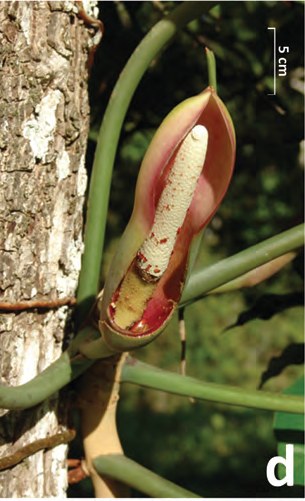
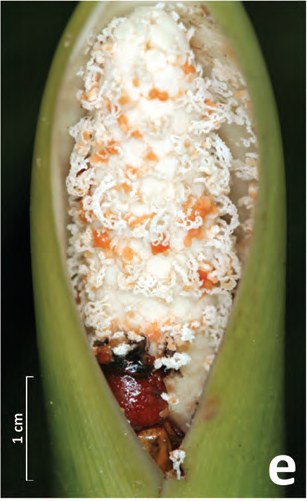
Photographs by A. C. D. Maia and H. Teichert, from Maia, Schlindwein, Navarro & Gibernau (2010), International Journal of Plant Sciences 171(7). Reproduced by permission.
A scarab that enters a Philodendron at dusk stays for roughly twenty-four hours. The standard account of what it receives in return runs: sterile male florets to eat, resin, a chamber to mate in, and heat. That list is worth having, and it is worth knowing that the paper which states it most cleanly contains no protein assay, no resin chemistry and no temperature measurement of any kind. It is a summary of other people’s fieldwork, and the items in it are not equally evidenced.
| The reward | What is claimed | What has been measured |
|---|---|---|
| Sterile male florets | Food, and described in the literature as rich in protein | Beetles were observed eating the tops of the sterile florets. No protein assay appears in any paper in the set — the phrase is unsourced in both papers that carry it. |
| Resin | Glue, to hold pollen onto a smooth beetle | Its release, timing and anatomy are well described. It is explicitly not a reward, its chemistry is unknown, and the adhesion itself has never been tested. |
| A mating chamber | An enclosed space in which the beetles meet, feed and mate | The enclosure is real and timed. Whether endothermy is tied to competition for mates inside it is, in the authors’ own word, unknown — the attempt to measure it failed. |
| Warmth | A heat reward, widely reported as an energy saving of two to five times | Chamber air ran 3.4–5.0 °C above ambient overnight while beetles were active (Philodendron solimoesense, n = 20). The saving itself is calculated, not measured. |
What the beetle’s own temperature says
The decisive measurement is simple and it has been made. Beetles were pulled out of inflorescences and a needle thermocouple was pushed into the metathorax immediately.
The whole of the beetle’s excess over the air around it
0.4 °C
Mean thoracic temperature 27.9 ± 0.3 °C against chamber air of 27.5 ± 0.2 °C. Six male and eight female Cyclocephala colasi (n = 14), taken from two wild Philodendron solimoesense inflorescences at Petit Saut, French Guiana; needle thermocouple into the metathorax on removal. The difference is statistically significant (t = −2.49, P = 0.019) and biologically negligible.
The paper’s own summary sentence: “There was no evidence of endothermy within the inflorescences.”
A second, weaker observation points the same way. Under an infrared camera, with the air at 23 °C and the male florets at 29 °C, beetle thoracic surface temperatures ran 25 °C on the spathe to 28 °C on the spadix — that is, the beetle was cooler than the tissue it was sitting on. That reading is one evening, one inflorescence, one occasion, and the recorder format was incompatible with the analysis software, so the values were estimated visually against the recorded temperature scale. It supports the thermocouple result; it cannot carry weight on its own.
An avoided cost, not a delivered gain
This is the distinction the whole question turns on, and the authors draw it themselves. Activities in the floral chamber, they write, “can occur without the high energy expense of endothermy”; the warm chamber “saves the insects energy by allowing them to be active while reducing the incidence and intensity of energetically expensive bouts of endothermy.”
The plant is not heating the beetle up. The beetle is simply not having to heat itself up. A scarab that wants to be active in cold air has to run its flight muscles as a furnace, which is expensive; inside a warm chamber it can move, feed and mate without switching that furnace on.
The saving is real in kind. It is a bill the beetle avoids, not a payment it receives — and the difference between those two sentences is the difference between the honest version of this story and the one in circulation.
The famous saving, and what kind of number it is
The figure that gets quoted — that a beetle inside spends about a half to a quarter of the energy it would spend outside — comes from a single paper published in 2003. The same group restated it in 2009 as a suggestion, and did not re-derive or re-test it.
Caution · the two-to-five-fold saving is a calculation
It is a ratio between two fitted regressions, one for resting beetles at R² = 0.42 (Q10 = 1.9) and one for active beetles at R² = 0.40, plus a forty-minute averaging convention the authors chose. Neither fit is tight; the authors note considerable variation at the lower ambient temperatures, and concede that their “active” data “included periods in which the beetles were inactive.”
The underlying respirometry is genuine and substantial — 129 hours, 77 single beetles, mean mass 272 ± 12 mg, scored resting or active by intermittent spot observation through a borescope. It was all done in a 10 or 25 ml glass respirometer in a laboratory.
No beetle has ever had its metabolic rate measured inside a flower. What was measured at inflorescences was temperature and nothing else: fourteen thoracic readings, and one evening of infrared imaging.
There is a further problem with moving laboratory beetles into a flower on paper, and it comes from the same study. Of twenty-five beetles tested for endothermy on the evening of capture, fourteen became endothermic and eleven did not. Of six tested after a day in captivity, none did. And any beetle showing nothing within about thirty minutes was removed and replaced, so the protocol pre-selected for responders. If endothermic capacity decays within a day of capture, the population in the respirometer may not be the population in the chamber.
The authors say the test was run in the wrong place
This is the most useful sentence in the literature and it is rarely quoted. The 2009 study concludes that it “focused on the phenomenon in the lowlands of French Guiana, where the rather warm environment” — ambient never fell below 20 °C — “minimised the energy-saving value of floral thermogenesis” in Philodendron solimoesense.
They nominate the comparison that would settle it: Erioscelis emarginata on Philodendron selloum in the Brazilian highlands, where ambient falls as low as 6 °C. That work has never been done. The heat-reward claim, in other words, has only ever been tested in the one place its own authors say it matters least.
It is also worth knowing the claim was contested before 2003 and the paper does not present itself as having closed it: its results are offered as contrasting with earlier suggestions that floral heating is no benefit to pollinators.
What can be said, and defended
How far the chamber holds the beetle above its own flight minimum
~8 °C
A Cyclocephala colasi must be endothermic to fly: thoracic temperature tracks ambient as Tth = 0.58 · Ta + 16.0 (R² = 0.89, fifty beetles flown in a temperature-controlled room). About 20 °C is the practical floor — a judgement, not a measured threshold: beetles were difficult to get airborne near it, and those that flew “seemed to be struggling to remain aloft.”
A chamber at about 28 °C therefore holds its occupants roughly eight degrees clear of that floor. That is a modest claim, it is arithmetic over two measured quantities, and it survives every caveat above.
One further detail, because it is quoted badly. The abstract of the 2009 paper reports that beetles departing inflorescences warmed to about 30 °C before take-off. The Results section records pre-flight warm-up to that temperature in one individual. Anyone quoting the abstract is quoting a single beetle.
The resin, which is not a reward
Resin release begins with the onset of the male phase on day two, some hours before pollen is shed. The chamber then constricts from the base upward and expels the beetles, forcing them up the spadix and across the resin before they reach the pollen. That sequence is the mechanism, and it has been documented independently in more than one species.
What has not been established is almost everything else about it — starting with where it comes from, which is not the same answer twice.
| Species | Organ that produces the resin |
|---|---|
| Philodendron solimoesense | The inner surface of the spathe, upper half — and there are no resin canals in the spadix at all |
| Philodendron adamantinum | The adaxial (inner) face of the spathe, confirmed at canal resolution |
| Philodendron melinonii | The spadix — around the lower part of the fertile male zone |
| Philodendron pedatum | The spadix — base of the male zone |
| Philodendron fragrantissimum | The spadix — base of the male zone |
| Philodendron squamiferum | The spadix, along the male zone, with larger drops toward the base |
| Philodendron quinquenervium (published as Philodendron acutatum) | Both. The inner surface of the spathe and both the fertile and the sterile staminate zones of the spadix |
Caution · there is no genus-wide answer to “where does the resin come from”
A rule of thumb circulates — spathe in subgenus Meconostigma, spadix in subgenus Philodendron — and it is a tendency with a named exception. Philodendron quinquenervium sits in subgenus Philodendron and uses both organs. Name the organ per species, or say nothing.
Three things about the resin that are not known
It is not a reward. The one study to examine the secretion anatomically states flatly that the released resin “is not a floral reward nor is it involved in the attraction of pollinators” — attraction is credited entirely to volatiles from osmophores at the apex of the sterile and fertile staminate flowers. No beetle was observed consuming it. There is no feeding, reward or nutrition claim anywhere in the paper. Scope: Philodendron adamantinum, wild, Parque Estadual do Rio Preto, Minas Gerais, three inflorescences for the structural work, light, scanning and transmission electron microscopy, seasons of 2012–2016.
Its chemistry is unknown. There is no gas chromatography, no compound name, no proportion and no standard anywhere in this literature. The authors state outright that an accurate analysis of the constitution of the secretion was not part of their objective, and they invoke the convention that only a detailed chemical composition licenses calling a substance a resin at all. What can be said is narrow and histochemical: the secretion is terpenic by a NADI reaction confined to the large-caliber canals, and lipid-positive by Sudan red B. Any compound named for Philodendron resin has come from somewhere else.
The gluing has never been tested. The function is inferred from the beetle rather than from the resin: Erioscelis emarginata has a smooth, hairless body with nothing for pollen to grip, so resin “appears to be necessary.” That is the hedge the specialists themselves use, and they close their discussion by proposing the experiment nobody has run — quantify how much pollen adheres to dry beetles against resin-covered ones. A second question, whether the resin reduces pollen viability, is open in the same paragraph.
The honest version
A beetle that enters a Philodendron at dusk gets a night of food, a warm room, company and a coat of glue. Three of those four have been described in careful detail and never measured. The fourth has been measured — on fourteen beetles, with a needle thermocouple — and it showed the beetle sitting at the temperature of the air around it, with its own furnace off.
That is a smaller claim than the one in circulation and a more interesting one. It says the plant is not giving the insect heat so much as removing the reason it would need to make its own. How much that is worth depends on how cold the night gets — and the only place it has been tested is the place its own investigators call the warmest and least revealing.
Part VII
Who Comes
Cyclocephaline scarabs, at dusk, for one night or two. That sentence is true of every Philodendron anyone has watched properly — and it is a smaller claim than it looks, because a great many other insects are also on these inflorescences, in far greater numbers, doing nothing for the plant at all.
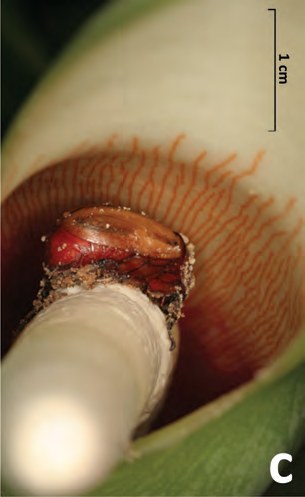
Photographs by A. C. D. Maia and H. Teichert, from Maia, Schlindwein, Navarro & Gibernau (2010), International Journal of Plant Sciences 171(7). Reproduced by permission.
The genus does not run a deception. It smells of ripe fruit, it warms itself at the hour the beetles fly, and it pays: sterile male flowers to eat, a dark chamber to mate in, and a night spent above ambient. Beetles arrive for a reason, and they arrive in company. Sorting the company from the couriers is what this part is for.
Start with how thin the ground is. The modern field literature on this genus is essentially one research group, working mostly in one country, on a handful of species — and the count of species with a demonstrated pollinator is smaller again than the count of species with an insect list.
A paper that contradicts itself, usefully
The 1999 study of Philodendron solimoesense opens by stating that cyclocephaline scarabs pollinate Philodendron, and then, in its own Discussion, takes the statement apart. Pollination is actually known for three species of subgenus Meconostigma. For sixteen species of subgenus Philodendron, beetles have merely been collected from the inflorescences.
Collected-from is not pollination. It is the same gap that makes the family-wide insect tables so hard to use, and here it sits inside a single paper, named by the authors themselves.
What a pollinator claim costs, and what most of them paid
Three things separate a courier from a passenger, and almost nobody does all three. Pollen on the body, checked rather than assumed. Movement between inflorescences at different stages, watched rather than inferred from counts. And fruit, with the plant’s own unaided rate to compare against. Where a study skipped one, the table below says which.
The hedges in the third column are not editorial caution. They are the authors’ own words, and in this literature the hedge is frequently the finding.
| Species | The named beetle | What was actually seen — and what bounds it |
|---|---|---|
| Philodendron solimoesense subg. Meconostigma |
Cyclocephala colasi | The best-sampled case in the genus. All 68 inflorescences that opened were occupied, at 21 ± 12 beetles each, and 899 of the 909 Cyclocephala recorded were this one species. Four inflorescences bagged in organdy dried and set zero seed; all 64 left open developed. Even so the paper will not go further than “the main pollinator seems to be Cyclocephala colasi,” and in the Discussion only that the counts “permit us to suggest that it may be the principal pollinator.” Four wild populations, French Guiana, six days in July 1998. |
| Philodendron adamantinum subg. Meconostigma |
Erioscelis emarginata | Visited exclusively by this beetle during the female phase — no other beetle entered the chamber. Occupancy was 9 of 20 inflorescences, up to four beetles in one. The experimental arms are the strongest in the genus: 24 bagged set zero fruit, 20 hand-crossed with pollen from ≥600 m away set 85%, and 45 left to the beetles set 11%. Campo rupestre, Minas Gerais, two seasons. |
| Philodendron quinquenervium subg. Philodendron |
Cyclocephala celata | The largest sample anywhere in the archive. All 42 day-two inflorescences opened by hand held the beetle, at 14.6 ± 8.0 (maximum 33) at one site and 3.8 ± 2.2 at the other. Natural fruit set was 91.8% across 220 marked inflorescences; 60 bagged gave 1. The authors still write only that the association “suggests a local reproductive dependence.” Pernambuco, 2005 and 2007. |
| Philodendron cipoense subg. Meconostigma |
Cyclocephala variolosa, Erioscelis sp., Cyclocephala atricapilla | Three pollinating beetles, and which three depends on where you stand — see below. Hand crosses set fruit in 6 of 8 inflorescences; natural pollination in 8 of 31. And only 22.8% of pistillate-phase inflorescences held a beetle at all. Endangered, rupicolous, two sites in the Espinhaço range, 920 h of observation. |
| Philodendron fragrantissimum subg. Philodendron |
Cyclocephala simulatrix | The only visitor recorded, at 2.4 ± 1.4 beetles and 73% occupancy. Twelve bagged set zero; 130 open set 55%. French Guiana. |
| Philodendron squamiferum subg. Philodendron |
Cyclocephala simulatrix, occasionally Cyclocephala tylifera | The weakest claim in the set, and the paper says so. “Appears to be pollinated by dynastid beetles”; “our field observations suggest…” No pollen loads examined, no bagging, no fruit set. Twelve beetles in total, from seven inflorescences at one roadside population, July 1999. Read it as a visitor record. |
| Philodendron bipinnatifidum subg. Meconostigma |
Cyclocephala variolosa | The lowest beetle loads in the genus — one or two per inflorescence, at most six — and no fruit-set, bagging or hand-pollination data of any kind. Coastal São Paulo. Note that Cyclocephala variolosa and Cyclocephala cribrata were named together on this plant in 1986, and whether they are one species or two is still unresolved. |
| Eight sympatric species, coastal Atlantic Forest |
Cyclocephala variolosa | Visitation alone. No pollen loads, no exclusion, no bagging, no fruit set — “fruit formation occurred, but was not monitored quantitatively.” The beetle was the unique visitor to six of the eight; for two, no beetles were seen at all. Forty years of observation, and not peer reviewed — a preprint. |
Two species have been properly nailed down. Two more are strong. One is a list of twelve beetles from one roadside. One has no fruit data at all. And the biggest study, in species covered, never checked whether the beetle moved any pollen. That is the whole evidential base for a genus of 627 described species.
The bees that are not pollinators
Stingless bees, Trigona, are conspicuous on these inflorescences. On Philodendron solimoesense they were counted at 4–40 per inflorescence. They have been ruled out twice, in two countries, on two different plants, and the reasoning is worth following because it is the model for how this judgement should be made.
They were never seen to fly from a second-day inflorescence to a first-day one — the movement that transfers pollen. They rarely carried pollen at all. They never entered the spathe, and so never reached the pistillate flowers. And they stop foraging at nightfall, around 18:45 h, while Philodendron solimoesense does not release its pollen until well after dark. What they take is mucilage and spathe resin.
In inland Brazil, on a different plant and in a different decade, Trigona spinipes and Trigona hyalinata behaved identically on Philodendron adamantinum: they came only during pollen presentation, never during the female phase, and never entered the chamber. Two independent observations, the same verdict. A bee on a Philodendron is a bee collecting resin.
The rove beetles, and an honest open question
The most numerous insects in the Philodendron solimoesense study were not the pollinators. Staphylinid rove beetles were recorded at up to 150 in a single inflorescence, and 795 individuals overall — against 909 Cyclocephala from the entire survey. Mirid bugs ran to fifty per inflorescence, ants to thirty, and a weevil, Tyloderma, turned up as well.
Only the Cyclocephala carried pollen. Everything else was pollen-free. That single sentence does most of the work in this part — and it needs its own qualification, because the check was made by eye under a binocular microscope, with no pollen counted on any insect. The authors did not then dismiss the rove beetles. They wrote that “further studies are needed to clarify the status of these staphylinids,” and that is still where the question sits.
Why no page can say “the beetles swarm in”
1 to 200
Beetle loads across the studied species span more than two orders of magnitude. Philodendron solimoesense takes 21 on average and fills every inflorescence it opens. Philodendron bipinnatifidum takes one or two. Philodendron selloum — the upland plant — has been watched taking thirty to fifty arrivals as a matter of course, and once about two hundred.
The swarm is real, and it is one species’ experience. The plants at the bottom of that range are the ones that fail to set fruit.
“Specialist” means local and seasonal, not exclusive
Part II raised this as a consequence of thin sampling. It is worth proving properly, because the word does real damage: two quite different things get called specialisation. A plant can be served by exactly one beetle at one site, in one season and still be served by three others elsewhere; and the beetle that serves it exclusively can be visiting several other plants in several other families. Both halves have now been shown, and the evidence for each comes from a different direction.
From the plant’s side. Philodendron cipoense grows on sunlit quartzite in two reserves about 100 km apart. At Serra do Caraça the visitor list is one beetle, Cyclocephala variolosa, across 178 records. At Serra do Cipó it is three: Erioscelis sp. at 55% of records, Cyclocephala variolosa at 23%, Cyclocephala atricapilla at 21% — plus one male Chalepides dilatatus, the first Chalepides ever recorded from any Philodendron, which the authors decline to promote beyond a visitor. One plant, one range, two answers.
From the beetle’s side. Erioscelis emarginata was known for decades as the sole pollinator of one upland plant, where it is lured by 4-methoxystyrene. It is also the sole pollinator of Philodendron adamantinum, roughly 750 km to the north-east, where the dominant compound is dihydro-β-ionone — and each of those compounds is absent from the other plant’s bouquet. A personal communication in the same paper adds a third host, Philodendron uliginosum. Same beetle, chemically unrelated signals, three plants.
It is not an isolated case. Cyclocephala simulatrix serves both Philodendron squamiferum and Philodendron fragrantissimum in the same corner of French Guiana. Cyclocephala celata, the Philodendron quinquenervium beetle, is separately reported in exclusive association with Caladium bicolor in the same region — a different genus of aroid entirely.
And “specialist” hides a season as well as a place. Blacklight trapping at the Philodendron quinquenervium sites recovered four night-flying Cyclocephala living alongside each other. Cyclocephala celata — the one in every inflorescence — was caught only from April to June, and in significantly lower numbers than two congeners that were abundant every month of the year. The plant’s exclusive partner is the rarest beetle in the trap.
The rule that falls out of all of it
Exclusivity is a property of the plant, not of the beetle. An inflorescence may admit one species; that species is under no corresponding obligation. Cyclocephala celata, Cyclocephala variolosa and Cyclocephala atricapilla are each now documented across several Philodendron and, in two cases, across more than one genus of aroid.
This was settled once already, in 1986
A 2022 preprint reports one beetle serving a whole community of Philodendron as a puzzling result that contradicts the scent-partitioning model. It is not new. In 1986 Gottsberger had already written that “contrary to the prevailing idea… the relationship between flowers and their Dynastinae pollinators is not very specific”, and that “broad and ‘general’ odour components of the flowers might be responsible for this unspecific attraction” — the pre-existing-bias hypothesis, thirty-six years before this literature began citing it to someone else.
He allowed himself exactly one exception: Philodendron selloum, “an example of such a specific relationship, in which one plant species is visited by only one beetle species; the latter never was found to approach any other plant.” That beetle was Erioscelis emarginata.
In 2014 the exception fell. The paper that found Erioscelis emarginata pollinating Philodendron adamantinum — and, by personal communication, a third host — is the same 2014 paper whose own framing still treats the beetle as an upland specialist. The claim was stated in 1986, still carried as background in 2014, and falsified in 2014 by the study that carried it.
Non-specificity is the old position, rediscovered about every fifteen years and reported as news each time. The reason it keeps holding is unglamorous: the beetles a Philodendron gets are the beetles its region has. Gottsberger said that too — the assemblages “seem to reflect the differences in the faunistic spectrum of the geographical regions.”
Caution · light traps do not sample this pollinator
At the Philodendron adamantinum site, three blacklight traps were run over six trap-nights across three months. They caught zero Erioscelis emarginata and zero cyclocephalines of any kind — while the beetle was, at the same time, the exclusive occupant of the inflorescences and present in nearly half of them.
A survey built on light trapping would have concluded the pollinator was not there. Anyone assessing a site, wild or cultivated, has to open inflorescences and look inside; and where light traps do catch these beetles, as at the Philodendron quinquenervium sites, the catch ranks them in the opposite order from the flowers.
The beetle nobody can call in
Cyclocephala variolosa is the sole pollinator recorded on Philodendron bipinnatifidum, the only one at the Serra do Caraça population of Philodendron cipoense, and the unique visitor to six species in one Atlantic Forest community. Its chemical ecology is a blank.
No compound has ever attracted it in the field. One attempt drew a few individuals but the authors withheld the data and called the tests “inconclusive.” A second, on Philodendron cipoense, put it flatly: “despite multiple attempts, field trapping with single compounds failed to attract Cyclocephala variolosa.” The same experiment did draw fifteen Cyclocephala celata — a beetle never recorded in a Philodendron cipoense inflorescence — to (Z)-jasmone, and isojasmol, which is 36% of that plant’s bouquet, was never tested at all. Seventeen beetles came to the whole experiment.
Two independent failures on the most widely shared pollinator in the genus. Whatever brings that beetle to a Philodendron has not been identified.
What this changes for a grower — and what it does not
Nothing about the mechanics of a hand cross, which is why this part sits in the botany track. No beetle is going to visit a plant on a windowsill, and the point of knowing the guest list is diagnostic rather than procedural: it tells you what the inflorescence is advertising for, and therefore which signals are worth reading off it. Part VIII is where that becomes a set of instructions.
One practical carry-over does survive. Beetles arrive at the moment of heating and odour, and they arrive from other inflorescences that are a day ahead. The plant is built for a relay between two individuals a day apart in their cycle, and that — not the beetle — is the part a grower has to reproduce.
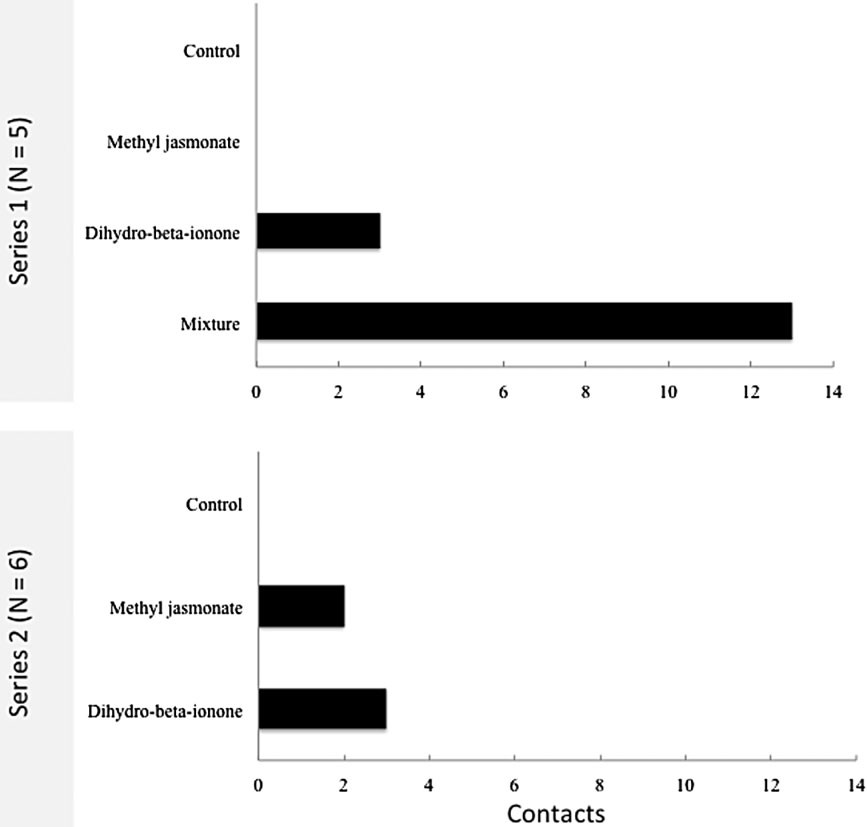
From Pereira, Schlindwein, Antonini, Maia, Dötterl, Martins, Navarro & Oliveira (2014), Biological Journal of the Linnean Society 111. Reproduced by permission.
Part VIII
Reading It
An open Philodendron inflorescence is a clock with its face showing. Six signs, in the order they arrive, none of them requiring a cut, a probe or a thermometer. Part III gives the published hours; this part is how to tell where the plant in front of you already is.
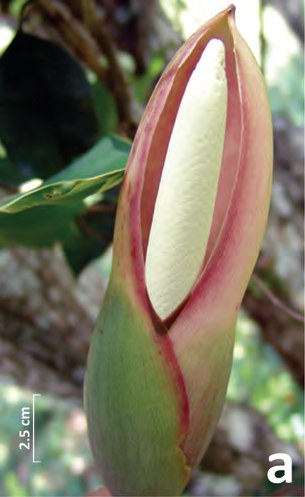
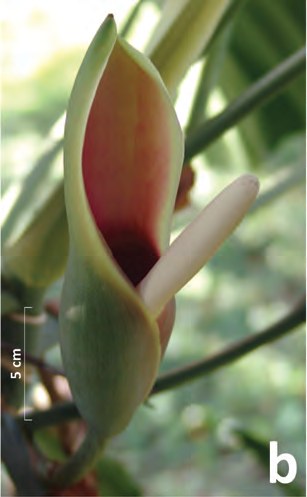
Photographs by A. C. D. Maia and H. Teichert, from Maia, Schlindwein, Navarro & Gibernau (2010), International Journal of Plant Sciences 171(7). Reproduced by permission.
If you read one line of this part, read this one
Resin, no pollen: tonight
The sticky droplets appear hours before the anthers open. An inflorescence carrying fresh resin and no loose pollen has not released yet and will release today. It is the only advance warning this genus gives, and it converts a missed opportunity into a planned evening.
Documented twice, independently. On Philodendron melinonii resin is secreted on the afternoon of day two and pollen falls around 20:00 h. On Philodendron adamantinum, where the resin has been followed to its source under a microscope, release “begins with the onset of the male phase… some hours before pollen is shed.”
Everything else hangs on one structural fact, established in Part III: the inflorescence is female on the first evening and male on the second, and the beetles are shut in between. Which half you are looking at determines what the inflorescence is good for, and the six signs below tell you which half it is.
One habit matters more than any of them. Look in the morning. Spathes open between roughly 07:00 h and midday depending on species, and a plant checked only after work can pass its entire receptive evening unseen.
-
1 · Has the spathe opened — and when did it start
Write down the date and hour the moment you see a gap. Everything after this is measured from that timestamp, and on your own plant it is worth more than any published figure, because the published hours were recorded near the equator at a day length a greenhouse does not reproduce.
Expect it early. Philodendron adamantinum begins at 07:00–09:00 h and Philodendron quinquenervium (published as Philodendron acutatum) at 09:30–10:30 h. An inflorescence that looks newly open at six in the evening has probably been open since breakfast.
-
2 · How far open, and at what angle
Not a yes-or-no. The spathe keeps opening all day, and the reading that matters is the angle between spathe and spadix. On Philodendron melinonii the spathe stands open over about two thirds of its length by 16:30–17:00 h, the spadix protruding strongly forward. On Philodendron solimoesense the white spadix curves roughly 45° clear of the spathe through the afternoon. On Philodendron adamantinum the two reach about 80° at 18:30 h — the same half hour the odour comes up and the beetles arrive.
When the spadix has thrown itself clear of the spathe, the heating hour is close. Be back at the plant at dusk.
-
3 · Are the stigmas wet
Look straight down into the chamber, at the ring of ovaries at the base. On Philodendron solimoesense the stigmas are dry while the spathe stands wide open through the afternoon and moist by 18:00 h. The change is the signal. One look tells you much less than two looks four hours apart.
Be honest about what the test is worth. Receptivity has been determined instrumentally, by hydrogen peroxide, in exactly two species — Philodendron adamantinum at about 16:30 h and Philodendron quinquenervium at about 17:30 h. Everywhere else the wording in the literature is “moist and apparently receptive” or “seemed to be receptive.” Wet stigmas are a very good bet. They are not a measurement.
-
4 · Is the spadix warm to the back of a hand
Back of the hand, not fingertips — more sensitive, and it keeps resin off anything you are about to use. Heating begins in the late afternoon of day one and peaks within a couple of hours. On a strongly thermogenic plant there is nothing subtle about it: Philodendron adamantinum peaks at 42.4 °C, about 18.8 °C above the air around it, and Philodendron solimoesense is still at 33 °C ninety minutes after its peak — it cools slowly, so a late check still catches it.
Warm confirms. Cool confirms nothing. See the caution below before treating this as a gate.
-
5 · Has resin appeared — and from which organ
Day two. Viscous droplets, yellow through orange to red depending on the species, often over 1 mm across and unmistakable once you know where to look. Where to look is species-specific and there is no genus-wide answer. Check the inner face of the spathe and the male zone of the spadix, and note which one produced. The table below has every species anyone has watched.
Resin means the male phase has begun and the pollen has not fallen yet. This is the step that buys you the evening.
-
6 · Has the spathe begun to close from the base
The last sign and the most decisive. The spathe constricts from the base upward, wrapping the spadix as it climbs — in every species followed to the end. On Philodendron solimoesense the whole wrap takes about 60 min, and the anthers release their pollen chains into it.
Once that constriction is rising, the female half of this inflorescence is finished and the pollen is minutes to an hour away. If you want that pollen, be standing there with something to catch it on; if you wanted to pollinate this one, you needed to be there last night.
Where the resin comes from, species by species
Seven species have been watched closely enough to say. They do not agree, and the disagreement is structural rather than a matter of observers missing things — on Philodendron adamantinum the spathe canals have been sectioned and imaged.
| Species | Organ — where to look | When, and what it looks like |
|---|---|---|
| Philodendron solimoesense | Inner spathe, upper part | Yellow droplets in the early afternoon of day two, thickening to a brownish coating over the inner spathe by late afternoon |
| Philodendron adamantinum | Inner spathe — the adaxial face, confirmed by sectioning | Yellow-orange and viscous from about 11:00 h on day two; droplets over 1 mm |
| Philodendron quinquenervium | Both — the inner spathe and the fertile and sterile staminate zones of the spadix | Orange, 14:00–15:30 h on day two, as the spathe starts to close. The spathe finally seals with a mixture of pollen and resin |
| Philodendron melinonii | Spadix — upper sterile and fertile male flowers, mostly base and middle of the male zone | Reddish, day two afternoon, drops of 1–2 mm |
| Philodendron squamiferum | Spadix — along the male zone | Orange, day two afternoon; the drops are larger toward the base |
| Philodendron cipoense | Spadix — staminate zone | Red and sticky, from about 09:00 h on day two |
| Philodendron fragrantissimum | Spadix — base of the male zone | Day two, before pollen release |
Four of these plants put their glue on the wall of the chamber. Three put it on the column the beetles have to climb. One does both. There is no shortcut: on a species nobody has studied — which is nearly all of them — look at both surfaces on the morning of day two.
Caution · do not use heat as a gate
A cool spadix does not mean an inflorescence is not ready. Philodendron squamiferum runs its entire evening at 3–4 °C above the air — real, logged with a thermocouple, and completely undetectable by hand. Feel nothing on a species nobody has instrumented and you have learned nothing. Trust the spathe angle and the stigmas.
The published temperatures are also less comparable than a row of figures suggests. The studies probed different tissues at different depths — the sterile male zone at 5 cm, the fertile male zone at under 5 mm, the sterile staminate zone at 0.5 cm, and in one case the upper fertile staminate section with no depth stated — and put their air probes 10 cm away in some studies and 50 cm away in others. The gap between a hot species and a cool one is real. The precise gaps between the numbers are not.
How long the window actually is
The general statement for the genus is that anthesis is protogynous throughout, with female receptivity ending before pollen is shed the following day. On that reading the receptive window is a single evening, and the inflorescence cannot pollinate itself because its two phases never meet.
Philodendron cipoense does not obey it. Its pistillate flowers stay receptive for roughly 29 h — from mid-morning on day one until mid-afternoon on day two — which overlaps its own male phase. Both statements are in print, and the species measured most carefully is the one that breaks the rule. Part III sets that row against the other five.
What follows for a grower is narrower than the argument. Treat the first evening as the window. Any receptivity beyond it is a bonus nobody has verified on your species, and in every species watched to the end the stigmas were reached during the night the beetles were shut in — not the following afternoon.
What to write down, the same evening
Four fields, and they cost nothing: the hour the spathe first gaped; the hour the stigmas turned wet; the hour and the organ of the first resin; and the hour the spathe began closing from the base.
Two inflorescences later you will have a timetable for your own plant under your own light, which is worth more than any published hour — the one wild-against-greenhouse comparison anyone has run shifted by two hours, and Part III explains why that is probably day length rather than warmth.
The resin organ is the field worth recording most. Almost every Philodendron in cultivation belongs to a species nobody has watched flower under observation, and which organ produces is a fact a grower can establish in a single evening.
Three things the resin is not
Caution · what is repeated about the resin, and what was actually shown
It is not a reward. The specialists who sectioned it state flatly that the released resin “is not a floral reward nor is it involved in the attraction of pollinators.” No beetle has been observed eating it. Attraction is credited entirely to volatiles from the staminate flowers.
Its chemistry is not known. No compound has been named in any Philodendron. The only study to look reports that the secretion is terpenic and lipid-positive by histochemistry and says outright that analysing its composition was not part of the work. Any compound-level claim about Philodendron resin in circulation is unsourced.
Its function is asserted, not demonstrated. That the resin glues pollen to a beetle rests on the beetle’s smooth, hairless cuticle, which offers nothing for a grain to grip — so the resin “appears to be necessary.” Note the verb. The same authors close by proposing the comparison that would settle it, sticky beetles against dry ones, which is a fair sign that nobody has run it.
None of that weakens the sign. Resin still means pollen is coming. It means the page cannot tell you why the plant makes it.
Part IX
Collecting and Storing Pollen
It comes out wet, in the middle of the night, and starts setting like varnish within half an hour. Where to keep it afterwards is the one question on this page with three answers and no measurement behind any of them.
From Pereira, Schlindwein, Antonini, Maia, Dötterl, Martins, Navarro & Oliveira (2014), Biological Journal of the Linnean Society 111. Reproduced by permission.
Every part before this one leads here. A Philodendron inflorescence is female on the first evening and male on the second, and the female flowers close for good before its own anthers open — so a controlled cross needs pollen that came from somewhere else, either a second plant flowering two days out of step or a container in a fridge. Part X does the crossing. This part is about getting the pollen and keeping it until it is wanted.
What it looks like when it comes
Not dust. On a Philodendron sp. nov. followed through anthesis by Vannini, the pollen emerged from the anthers in short strings and curls, working from the base of the male zone toward the apex, beginning around 02:00 h. That direction matches what the primary literature reports for Philodendron adamantinum and Philodendron cipoense; the hour is one plant on one night and should be read as such.
The material itself is the part that matters. It arrives “pure white and adhesive,” and then it changes: it turns “to a resinous amber color within 30 minutes exposure to air.” Wet, sticky, and on a timer of its own from the moment it is exposed. Nobody has tested whether ambered pollen still germinates, so treat the half hour as a working budget rather than a deadline anyone has measured.
The one line that explains most of the confusion below
It depends on the species
Asked whether it is normal for the pollen to be flaky, crumbly, stringy or powdery, the growers Alicia + Nige (@wild.about.plants) answer that it is “totally dependent on species.”
Hold on to that. Everything the sources disagree about further down — whether this pollen can be frozen, how long it keeps, whether the published advice applies to the plant in front of you — is probably downstream of which kind of pollen a given species makes. It is a grower’s observation across a broad collection, not a survey, and no one has typed the pollen of a named Philodendron and then tested it.
One species-level detail worth recording if it is yours: Philodendron verrucosum pollen has been photographed showing a honeycomb pattern in the mass. Almost every Philodendron in cultivation belongs to a species whose pollen nobody has described at all, which makes a photograph and a note about texture a genuinely useful thing to take while collecting.
-
Be there on the second night, not the second morning
Pollen falls in the dark in most species followed to the end, and the inflorescence gives one advance warning: resin appears hours before the anthers open. Part VIII is the sign sequence. An inflorescence carrying fresh sticky droplets and no loose pollen will release that night.
Miller and Newton, working commercially on Philodendron bipinnatifidum in Central Florida, put the shed on day four of their working count — two days after they pollinated the female flowers of the same inflorescence. The gap between those two days is the whole reason this part exists.
-
Get access to the male zone
Two published habits, and they differ mainly in how much of the inflorescence is being spent. Miller and Newton, once the female flowers have been pollinated, simply cut the spadix through the centre above them on day four, collect the pollen from the severed top and discard it. The growers Alicia + Nige (@wild.about.plants) instead cut away the top half of the spathe only, for easier collection, and leaves the bottom half in place — a personal preference, stated as one, and the more conservative of the two.
If the inflorescence carrying the pollen is not one being pollinated, the second approach costs nothing and keeps the plant intact.
-
Lift it while it is still white
A clean brush, or the tube or envelope held under the male zone as the strings extrude. This pollen is not dry and it will not fall as a cloud — it clings, and it wants to be lifted rather than tapped. Work promptly: the colour change from white to amber is the clock, and it runs in about half an hour.
McColley and Miller add the alternative, which is worth knowing when a night is missed: pollen may be taken from a flower that opened 24 hours previously, not only at the moment of shed.
-
Label the container before it goes anywhere
Species or clone, and the date and hour of collection. On a genus where the storage rules are unsettled and probably species-specific, the label is not housekeeping — it is the only thing that will let a failed cross six weeks from now tell anybody anything.
Storing it — three accounts that do not agree
This is the honest state of the question, and it is worth setting out in full rather than reduced to a rule. Three practitioners have said three different things about keeping Philodendron pollen. None of them ran a viability test. All three are reporting real work.
One · McColley — refrigerate, and the rule of thumb that goes with it
Six weeks at 38 °F
From the foundational Philodendron breeding paper: “By experimentation it was found that dry pollen of most varieties could be kept for six weeks by refrigerating at approximately 38 degrees F.” That is 38 °F, about 3 °C — a domestic fridge, not a freezer.
And then the sentence that is arguably the most useful in the whole practitioner literature, because it hands over a decision rule rather than a number: “There are exceptions to this in the less hardy species. Apparently, if the plant will not take 38 degrees F., neither will the pollen.”
Grade it carefully. The authors say “by experimentation” and they were running hundreds of crosses, so it is measurement by the standards of practice — but no sample size, no germination count and no controls are printed. And note the adjective: dry pollen.
Miller and Newton, four decades later, give the same instruction in four words — “refrigerate pollen or use immediately” — and Vannini used refrigerated pollen over successive nights on four inflorescences of a Philodendron sp. nov., one of which set and gave several hundred viable seed 101 days after pollination. The three failures in that set are attributed to the plants having been shipped, not to the pollen. One cross is one cross.
Two · Garner — do not freeze wet, stringy pollen
Relayed by Boos and Lucas: LariAnn Garner does not recommend freezing Philodendron or Caladium species that produce wet strings of pollen, which are said to be likely to fail frozen. Garner is a working aroid hybridiser, so this is a named practitioner judgement rather than an anonymous rule — and it is scoped precisely at the kind of pollen described at the top of this part.
The awkwardness is on the same page it comes from. Directly after the caution, Boos and Lucas give a freezer protocol: sweep the pollen into a capped glass tube with desiccant, store the labelled tube in a freezer, warm it slowly to room temperature before use, and expect several months and “possible up to one year” — with the frank riders that “chances are fair” and that the method “does not always work in every case.” The page holds both positions at once and does not reconcile them.
Three · and then a working grower freezes it, repeatedly, and it takes
Alicia + Nige (@wild.about.plants), breeding in Sydney and photographing the outcomes, reports the opposite result in practice: “use it immediately, or snap freeze for later use! We’ve had good success using frozen pollen several times now.”
The documented case is harder on the conventional wisdom than a simple freeze would be. Pollen was taken from a Philodendron pastazanum type around midnight on 17/18 December 2021, held in the fridge for a week and a half, then frozen, then thawed and used on a Philodendron verrucosum inflorescence on 6 January 2022. Chilled, frozen, thawed, ten days old — and it took. The developing infructescence was photographed again at day 99. A second documented cross used frozen Philodendron pastazanum pollen on Philodendron ‘Dean McDowell’.
What makes this report worth its weight is that it runs against the grower’s own expectation, and they say so: “honestly didn’t expect it to work — coz conventional wisdom say frozen philodendron pollen loses viability — let alone half chilled 10 day-old pollen that got frozen then thawed.” Somebody reporting a result they predicted against is the most valuable kind of single observation there is.
Look again at what each account is scoped to. McColley’s six weeks is explicitly for dry pollen. Garner’s caution is explicitly for wet, stringy pollen. And the texture varies by species. Read that way, the three accounts stop being a contradiction and become an untested hypothesis: the question is not whether Philodendron pollen can be frozen, but whether this species’ pollen can be — and that has not been answered for any named species.
The defensible position is therefore the dull one. Refrigeration is the best-attested route and has a rule of thumb attached to it: if the plant will not take 38 °F, neither will its pollen. Freezing has worked in documented hands and is not the dead end it is often repeated to be. Whichever is chosen, keep the pollen dry and sealed, warm a cold container to room temperature before opening it so condensation cannot form on the pollen, and split a good collection between the two if there is enough of it. Then write down what happened. On this question a grower with a fridge, a freezer and a labelled tube is as close to the evidence as anybody.
Caution · what is missing here is the measurement, not the practice
No germination assay, no stained-viability count and no stored-against-fresh comparison has been published for any Philodendron. There is no percentage, no decay curve and no half-life for this pollen at any temperature. Every figure above — six weeks, several months, up to a year — is an experienced practitioner’s estimate from outcomes, not a count of grains that germinated.
That is a gap in the literature, and it should not be mistaken for a gap in what has been attempted. People have frozen this pollen and photographed the fruit. What nobody has done is measure it. A commenter on the grower’s own posts put it exactly right: there are currently no papers on this genus, so a careful record of what happens is worth something.
The practical consequence is small and worth stating. When a cross fails, the pollen is the first suspect, and with stored pollen there is no way to check it beforehand.
Part X
Making the Cross
Four days, two plants, and a window on the second afternoon that lasts under two hours. Everything difficult about crossing a Philodendron is scheduling; the brushwork takes a minute.
Start with the reason any of this is necessary. In cultivation there are two, and they compound. The first is that the beetle does the job in the wild and is not in the room — Erioscelis emarginata, the pollinator of Philodendron bipinnatifidum, does not occur in the United States, and the same is true of every cyclocephaline in every collection outside the neotropics. The second is structural, and it is the fact this whole part is built around.
Why one inflorescence cannot rescue itself
48 hours out of phase
The female flowers are receptive 48 hours before the male flowers on the same inflorescence shed pollen. By the time the anthers open, the stigmas they are sitting above have been shut for two days.
So the pollen has to come from somewhere else. Either a second plant flowering two days out of step, or pollen collected earlier and kept — which is Part IX, and which is why Part IX comes first. There is no version of this operation that uses one inflorescence on one evening.
What follows is the four-day cycle Miller and Newton published for Philodendron bipinnatifidum at a commercial nursery in Central Florida, with the older and more general practice of McColley and Miller folded in where the two describe the same step differently. One protocol, one nursery, no replication reported and no success rate printed — this is documented practice, not a trial.
-
Day one · flag the buds, and lay everything out
Walk the plants and mark every plump, unopened inflorescence. Then gather the kit before it is needed: a sharp knife, a brush, and the container of pollen — thawed and brought to room temperature still sealed, if it came from a fridge or freezer.
This step reads like padding and is not. The receptive window on day two is short enough that anything not already to hand is effectively missing.
-
Day two · check for warmth, and be back at the plant late afternoon
The inflorescence opens, and it will be warm to the touch — Miller and Newton record up to 112 °F, about 44 °C. McColley and Miller describe the same cue more modestly as a rise in the male flowers of “only a few degrees to as much as 15 degrees F. or more.” Part VIII explains why warmth confirms readiness but its absence proves nothing: some species run their whole evening only three or four degrees above the air.
Receptivity and temperature peak together at about 17:00 h, and the peak lasts under two hours. That is the appointment. Before touching anything, check the female zone for the sticky covering that will hold the pollen — Boos and Lucas describe it as “a tiny drop of liquid” on the tip of each stigma, whose job is to hold the grains in place.
-
Day two · open the spathe — two working methods
The female flowers sit in the closed chamber at the base and have to be reached. Two practitioners do it two ways, and both work.
Remove the spathe entirely. Miller and Newton cut the whole spathe away with a sharp knife, which gives complete access and full view of what is being done. Note the consequence they record for day three: an intact spathe would have closed partway overnight, and a removed one cannot.
Or cut away the top half only. The growers Alicia + Nige (@wild.about.plants) remove the upper half of the spathe and leaves the bottom half intact to protect the floral chamber, calling it a personal preference. The reasoning is sound on its own terms: “spadix falls off after successful pollination anyway and only the bottom half of the floral chamber remains after a few weeks.” The remaining spathe then goes on doing something useful for months, and gives the ripeness cue in the closing section.
The second is the more conservative of the two, and there is no published comparison between them. Under glass or outdoors, leaving the lower spathe on has an obvious argument behind it. Working indoors on a plant that is easy to reach, taking the whole spathe off costs little. Choose, and record which was done.
-
Day two · apply the pollen to the basal third
The female flowers occupy the basal third of the spadix. That is the target; the rest of the column is male or sterile and there is nothing to be gained by covering it.
McColley and Miller apply pollen with a small camel-hair brush or the fingertips, moistened first in the stigmatic solution. The logic is the same one the plant uses: the stigmatic fluid is the adhesive, so loading the brush from the stigmas themselves is what makes the grains stay where they are put. Cover every stigma that can be reached.
-
Day two · or the slurry method, if the chamber is staying shut
Boos and Lucas give a different route for aroids with unisexual flowers — Philodendron, Alocasia and Caladium — which exists to reach the stigmas without cutting. Mix the pollen into a little sterile water and run it “with an eye dropper down the sides of the spadix through the small opening” once the heat and the scent are detectable. Then “tape the edges of the spathe closed for at least 16 minutes to keep the liquefied pollen from leaking out” — and remove the tape afterwards.
Two honest flags on that. The 16 minutes is oddly precise and carries no stated basis or citation anywhere; it is reported here because a reader will meet it elsewhere, not because anything supports the number. And the method exists to solve the problem of not cutting. Open the spathe, as the two steps above do, and the difficulty the slurry was invented for disappears.
-
Label the plant, now
Both parents and the date, seed parent first, on a tag attached to the plant rather than to a memory. Months from now, with several inflorescences carrying fruit, the label is the difference between a documented hybrid and a seedling of unknown parentage — which for breeding purposes is no seedling at all.
-
Day three · expect nothing to happen
No visible change. Miller and Newton note only that an intact spathe would have closed slightly by now. Resist the urge to interfere; the outcome is not readable yet, and the sign that reads it is a week or more away.
-
Day four · take the pollen off the same inflorescence
The male flowers shed. Miller and Newton cut the spadix through the centre above the pollinated female flowers, collect the pollen from the severed top and discard it — the female half is untouched and carries on. Then refrigerate it or use it immediately.
That pollen is the beginning of the next cross, and Part IX is where it goes. Two plants worked alternately in this way are a breeding programme; one plant worked alone is a single throw.
Reading the outcome
The verdict arrives slowly and then is unmistakable. A successful pollination develops a blackened, crusty appearance. A failed one decays. Those are Miller and Newton’s words for it, and on an inflorescence whose spathe has been removed there is nothing to obscure the view.
There is also a sign for the crosses that were never made, and it is worth knowing because it is easy to misread as a developing fruit. A curl at the tip of a closed inflorescence means it opened and closed without being pollinated, and it will decay. A closed spathe is not evidence of success; the curl says the plant went through its whole cycle and nothing reached the stigmas.
Ripeness, months later, announces itself twice. The lower spathe — if it was left on — opens and dilates gradually as the berries develop, and eventually splits off by itself when it “pops.” No paper in this archive gives that cue; it comes from Alicia + Nige (@wild.about.plants), and it sits alongside Miller and Newton’s observation that spathe remnants flake away from ripe fruit. The second cue is a single grower observation and is offered as no more than that: on one harvest the peduncle softened and flopped over completely, and that batch gave the fastest germination of any they had raised. One batch, no counts — but a free thing to watch for. Part XI takes it from there.
Which plants will cross with which
McColley and Miller divide the genus into three groups by breeding behaviour: the arborescent, tree-like plants such as Philodendron selloum, which they note have “erroneously been called self-headers”; the majority of the vines and the true self-headers, such as Philodendron wendlandii; and a third set of vine types that have not been successfully crossed with anything, a few of which refused even their own pollen — Philodendron panduraeforme is the example given.
Plants cross freely within the first two groups. After hundreds of attempts, no successful cross was made between them. That is measurement by the standards of practice — hundreds of crosses and millions of seedlings screened — with no per-cross counts printed.
The authors noted in 1965 that the chromosome numbers of these groups were unknown. They are now known to run from 28 to 40 across the genus, and a difference in chromosome number has been proposed as a limit on hybridisation between such groups. A breeder’s empirical wall and a genomicist’s suggested mechanism, sixty-one years apart, pointing the same way. Nobody has tested that they are the same wall.
Can a Philodendron pollinate itself?
Two accounts, both in print, and this page does not choose between them
Chouteau, Barabé and Gibernau bagged at least three inflorescences in each of 23 Philodendron species. Not one set seed. The threshold was deliberately generous — a species counted as self-compatible if a single bagged inflorescence fruited — which makes a clean zero across 23 species the strongest statement anyone has made about this genus. The three field exclusion experiments in Part XII agree: bagged inflorescences of Philodendron solimoesense, Philodendron adamantinum and Philodendron fragrantissimum all set nothing.
McColley and Miller report the opposite in one species: “Philodendron oxycardium (commercial cordatum) can be readily self pollinated.” That comes from a hybridiser who ran the genus commercially for years.
Both stand as printed, and this page leaves them standing. Chouteau and colleagues had that experience with those species; McColley had a different experience with that one. It is worth noticing that the two are not obviously the same test — bagging asks whether a plant will self unaided, which the 48 hour offset above appears to forbid outright, while a breeder applying stored pollen has already defeated the timing. That is one possible reading and it has never been tested: no Philodendron study in this archive has ever run a hand-self arm. Until somebody does, both accounts are the evidence.
If the pollen never appears at all
It is a real possibility, and a grower who meets it should know it is not necessarily their error. Julius Boos held that some Philodendron will not, or do not, produce pollen in cultivation, and Steve Lucas records watching a cultivated Philodendron sagittifolium through anthesis and seeing none at all. Nothing in the primary literature addresses this either way.
Growers who have run into it point to temperature and growing conditions, and to the age and maturity of the plant, as the likely factors. Those are candidates and no more. There are no hard facts to cite here — nobody has compared pollen production across temperatures, across seasons, or across plants of different ages in any Philodendron. If an inflorescence goes through its male phase and yields nothing, note the conditions and the plant’s age, and try the next one.
Part XI
Fruit, Seed and What Eats It
The spathe closes over the cross and then nothing happens for months. When it opens again it will have been carrying two things: the seed, and in one well-studied species, the animals that ate most of it.
A pollinated inflorescence goes quiet. The spathe seals, the male flowers rot off inside it, and the base begins to swell — in Philodendron solimoesense the spathe and the spadix base keep growing through the whole interval, the spathe turning from green to orange while its base thickens into a cavity around the female flowers. At the end it splits at the base and falls away with the rotted male zone, exposing the fruit. That is the sequence, and it takes months rather than weeks.
How many months is a question the literature answers five different ways, because the five answers are not measurements of the same thing.
| What was recorded | Interval | What kind of figure it is |
|---|---|---|
| Philodendron bipinnatifidum complex, Brazil | Fruit ripens 35–45 days after flowering | Stated in passing in a scent and pollination study that ran no fruit-set experiment at all. No method given. |
| Philodendron sp. nov. “Chocó Red”, cultivated | Several hundred viable seed at 101 days after pollination | One documented cross, one grower, dated from the day the pollen went on. |
| Philodendron bipinnatifidum, Central Florida nursery | Flowering mid-April to mid or late June; fruit mid-June to mid-August | A harvest season, not a per-inflorescence interval. Zone 9, cultivated, latitude about 28 °N. |
| Philodendron solimoesense, French Guiana | At least 3 months | A personal observation by one of the authors, printed without a sample size. |
| Thirteen species, Paraná herbarium labels | About 3–4 months in some species, about 7–9 in others | An inference, and the block below explains why it is not a measurement. |
Caution · the three-to-four against seven-to-nine month split is not data
It comes from about 76 flowering and 11 fruiting collection events across thirteen Paraná species. Flowering concentrates September to February and peaks October to December; fruiting records fall January to April and again July to September. The gap between the two clusters is what produces the figures — roughly three to four months in Philodendron loefgrenii, roughly seven to nine in Philodendron obliquifolium and Philodendron missionum.
Every one of those records is a herbarium label: one collection event, one plant, one day. The interval was never followed on a single plant, and the two ends of it come from different individuals in different years, sometimes decades apart. A sheet marked “fr.” is not a fruiting season. Treat the split as a hypothesis about why some species seem to carry fruit far longer than others — a good one, and completely untested.
Knowing when it is ripe
Three cues, from three different sources, and none of them is a colour chart. Taken together they are more reliable than any of them alone.
The cue the nursery harvests on
Soft to the touch
In Central Florida, Philodendron bipinnatifidum fruit runs white to golden yellow to orange, and ripe fruit is soft to the touch. Spathe remnants flake away as it goes. Because the infructescence does not come ready all at once, the published practice is to harvest at least every other day rather than to wait for a single moment and take everything.
That is one commercial operation in one climate on one species. The colour sequence in particular is a Philodendron bipinnatifidum statement and nothing more — no comparable sequence has been published for any other species in the genus.
The spathe opens the fruit for you
If the lower spathe was left on — the more conservative of the two methods in Part X — it becomes the indicator. The grower @wild.about.plants describes it opening and dilating “gradually along the journey… and eventually splits off by itself when it ‘pops’.” The same behaviour is described from the other end of the literature as a genus-level habit: after the berries mature the spathe usually ruptures and falls, breaking up as it goes.
So a spathe that has begun to gape on its own has told you something. It is not proof of ripeness, and on a species nobody has recorded it will be the first time anyone has watched. Note the date against the pollination date; that record is worth more than this paragraph.
And one grower’s cue, offered as exactly what it is
On a single harvest, @wild.about.plants records that “this one’s peduncle actually softened and completely flopped over” — and that batch gave the fastest germination of any they had raised. One batch, one observation, no germination counts on either side of the comparison. It costs nothing to watch for and it is not evidence of anything yet. If it holds up across several batches in several hands, it will be the first ripeness cue in this genus with a germination outcome attached to it.
What is inside a berry
Very little is known, and what is known belongs to particular species. The numbers below come from four unrelated papers doing four unrelated jobs — one pollination study, one anatomy study and two species descriptions — and they are not a comparable series. Read each row as a fact about that plant.
| Species | What was counted | Scope, and what the number cannot do |
|---|---|---|
| Philodendron fragrantissimum | 452 ± 165 seeds per berry. A ripe infructescence carried 152.7 ± 35.3 berries out of 162.2 ± 35.6 flowers — about 94% of the pistillate flowers setting. | Wild, French Guiana. Seed number correlated with berry length (R² = 0.67). The ~69,000 seeds per infructescence usually quoted alongside these is the authors’ own multiplication of two means — they write “roughly”. Nobody counted 69,000 seeds. |
| Philodendron trisectifolium | Fruit 4 mm long; seeds about 1.5 mm, usually 6–8 per fruit, cylindrical and sticky. Pistils 6–8-locular with 1–2 ovules per locule. | A species description from herbarium material. Two orders of magnitude below the row above, in the same genus. This is why no per-berry figure on this page is written as a genus statement. |
| Philodendron solimoesense | A non-aborted fruit averaged 29.57 ± 3.70 locules, range 22–38. Unparasitized fruits held 133.5 ± 50.63 seeds. | n=35 fruits for the locule counts. The seed figure belongs to the predation study below and is not a general seeds-per-berry value for the species. |
| Philodendron propinquum | Ovary with 3–4 locules carrying 50–60 ovules each. | A floral-anatomy study of subgenus Pteromischum. These are ovules, not seeds — a ceiling on what the flower could set, not a count of what it did. |
| Four species, French Guiana | Locules per female flower averaging 5 to 33, with 4 to 10.4 ovules per locule. | From the pollen-to-ovule survey. Its point is the variability: the other aroid genera it measured have one or two locules and one ovule each. Philodendron does not have a number. |
One Philodendron puts four hundred and fifty seeds in a berry; another puts six. Both figures are published, neither is wrong, and there is no third measurement to tell you where your plant sits. Count what comes out of your own cross and write it down — that is a contribution, not a chore.
Seed predation is not pollination failure
This is the part of the block worth the most, because the mistake it corrects is the natural one to make. A Philodendron infructescence that yields far less seed than it looks capable of has not necessarily been badly pollinated. In the one species where anybody has taken the whole sequence apart, pollination worked and the seed was eaten afterwards.
The pollination figure
88% of flowers set fruit
In wild Philodendron solimoesense in French Guiana, 209 ± 31 fruits began to mature per infructescence — 88% of the 238 ± 38 receptive female flowers. About 27.6% ± 30.6 of those developing fruits then aborted. Female flowers on 48 receptive inflorescences; berries on 40 mature infructescences.
That is the pollinating beetle, Cyclocephala colasi, doing its job about as well as a beetle can. Whatever goes wrong later, it does not go wrong here.
The predation figure — a different number that happens to be the same
88% of infructescences parasitized
Chalcid wasps had entered 88% of maturing infructescences. Three roadside populations, French Guiana, July 2000. Within an infructescence that had been reached, a mean 55% ± 33 of the fruits held wasps — ranging from none to every fruit on the spadix.
These two 88% figures are not the same quantity and must never be run together. The first is a proportion of flowers; the second is a proportion of infructescences. That they landed on the same number in the same paper is a coincidence, and an unusually good way to get this story wrong. The paper’s methods and results also disagree about the denominator for the second figure — 52 in one place, 46 in the other — and its abstract hedges to “up to 88%”; the smaller sample is the one printed here.
What the wasps cost, the authors put plainly and label as an estimate: a parasitized fruit produces about 60% fewer seeds, one wasp develops at the expense of roughly two seeds, and a parasitized fruit matures about a third of its potential seed. The measured comparison behind it is 133.5 ± 50.63 seeds in unparasitized fruits against 52.60 ± 55.30 in parasitized ones. 480 fruits were dissected — and the scope matters: they came from nine parasitized infructescences, so the “unparasitized” fruits were unparasitized fruits on parasitized plants, not fruit from clean ones.
The authors’ own reading of their data is the sentence this section exists to carry: the low seed set they observed is attributed primarily to the wasps, not to the pollination system.
And here is why it is a pollination story anyway
The floral chamber admits the seed predator on exactly the same two days it admits the pollinator. The wasp females oviposit during the two days of anthesis, when the inflorescence is open and receptive — and they were frequently found dead inside pollinated inflorescences after the spathe had closed on them, in the same trap that holds the beetle. Ovipositing females on a single inflorescence ranged “from a few up to 120”, across seven inflorescences with no distribution reported.
Their young then develop inside the sealed cavity, chew exit holes through the fruit wall, and leave only when the spathe base dehisces months later. The trap that makes this genus work is not selective. It cannot tell the difference between the insect that brings pollen and the insect that eats the result.
One further finding is worth knowing because it is the closest thing here to an adaptive argument. Locule number correlated negatively with the number of galls in a fruit, and with the number of wasps, but had no effect on seed number. The authors read that as support for an older hypothesis: that the unusually high locule count of subgenus Meconostigma evolved against seed parasitism. The correlations are measured; the adaptive reading is an interpretation, and the block leaves it as one.
Caution · a correction to an attribution that is in circulation
Two wasps are involved: a gall-maker in the eulophid family, and a second, eurytomid wasp. The modern paper describes the second as an inquiline — a lodger eating ovarian tissue, which kills the first wasp’s larvae only by accident — and credits that view to Chodat and Vischer’s 1920 account of Paraguayan Philodendron. Reading the originals does not support it.
The passage in Chodat and Vischer is an explicit block quotation from Ferrière, so the primary source is Ferrière’s own 1924 description of the two wasps. Neither paper uses the word inquiline. Ferrière’s term for both species is phytophage, and his conclusion is that they are two independent enemies of the plant with no relationship to each other — a position he reached by retracting the opposite proposal he had made himself. His anatomy supports it: the gall-maker’s mandibles seem “incapable of detaching the least solid particle” and its stomach holds only liquid secreted by the gall, while the second wasp has strong bidentate mandibles and a stomach “always filled with brown matter torn from the walls of its chamber.”
The famous “accidental” clause is triple-hedged — accidentally, perhaps, sometimes — and rests on no dissection. Ferrière never reports opening a chamber where the second wasp had consumed a gall. A triple-hedged aside from 1924 cannot be set against a modern estimate that the second wasp kills 39% of the first’s larvae. State the conflict, or drop it; do not settle it with the 1924 sentence.
Two more things bound this. The 1920s work is on Paraguayan plants and mentions neither Philodendron solimoesense nor the Guianas, so the claim is being transferred between systems. And the one piece of primary evidence that actually bears on the question appears unused: in Philodendron tweedieanum (published as Philodendron dubium), Ferrière found the second wasp with no gall-maker present at all — eight ovaries, “nothing but Prodecatoma.” A wasp that completes development across eight ovaries in the other’s absence is not an obligate predator of it.
Where the seed goes in the wild
This is dispersal, not pollination, and the page keeps them apart. It is here only because a grower asking “what happens to the fruit” deserves to know how thin the answer is.
The published record for Philodendron frugivory is close to nothing. The 2020 note that put the subject on any kind of footing added exactly two observations and three animals: two Euphonia annae feeding on Philodendron popenoei in Costa Rica in March 2019, taking one ripe berry at a time and crushing it in the bill; and one kinkajou, Potos flavus, on Philodendron crassispathum in August 2019, hanging by its hind legs twenty metres up. Both were first records for the country. The three earlier reports it relays — coatis on Philodendron bipinnatifidum in Argentina, tamarins on an unnamed Philodendron in Bahia, an opossum on a Monstera — are single passing mentions of the same kind.
Nothing in that record is quantified. No removal rates, no gut passage, no germination after passage, no comparison between species, no idea whether any of these animals matters. Against the seed-predation literature above — dissections, counts, statistics, a named mortality estimate — the dispersal side of the same fruit is photographs and dates. That asymmetry is worth noticing. What eats Philodendron seed before it leaves the plant is described in detail; what moves it afterwards is barely described at all.
Part XII is the other half of this. Fruit that never formed at all, and what the evidence says about why.
Part XII
When It Fails
Natural fruit set in this genus runs from eleven per cent to ninety-two. The flowers at both ends work the same way. What differs is how many beetles came.
Most of this page has described a mechanism: the two-day clock, the heat, the chamber, the resin, the squeeze past the anthers on the way out. It is an elaborate piece of machinery and it is easy to assume that when a Philodendron fails to set fruit, something in the machinery went wrong.
The evidence points somewhere much simpler. Across the species anybody has measured, output tracks pollinator abundance far more closely than it tracks anything about the flower.
| Species and site | Inflorescences with any beetle | Beetles per inflorescence | Natural fruit set |
|---|---|---|---|
| Philodendron quinquenervium (published as Philodendron acutatum), Igarassu | 100% (42 of 42) | 14.6 ± 8.0, maximum 33 | 91.5% (n=200) |
| Philodendron quinquenervium, Goiana | 100% (12 of 12) | 3.8 ± 2.2, maximum 9 | 95.0% (n=20) |
| Philodendron fragrantissimum, French Guiana | 73% | 2.4 ± 1.4 | 55% (n=130) |
| Philodendron cipoense, Serra do Cipó | 22.8% | 8.0 ± 7.8 | 25.8% (n=31) — measured at Serra do Caraça, not here |
| Philodendron adamantinum, Minas Gerais | 45% | about 2 | 11% (n=45) |
| Philodendron bipinnatifidum, coastal São Paulo | Not measured | 1–2, maximum 6 | Never measured, in any study |
Every fruit-set figure above scores the same thing — whether an inflorescence became an infructescence. Check that unit before comparing any two fruit-set numbers you meet elsewhere; a per-flower figure and a per-inflorescence figure are not the same measurement and will produce a false contrast. The Philodendron quinquenervium hundred per cent is also a day-two count on inflorescences opened by hand after a full night of accumulation, which makes it generous against the per-day censuses in the other rows.
The species where both halves of the test were run
The table above is a comparison, and a comparison can always be explained away. Philodendron cipoense is the species where one study carries both arms — an experiment showing what the plant can do when pollen is supplied, and a census showing what the beetles actually did.
Hand-crossed against left alone
75% against 25.8%
Hand cross-pollination set fruit in 75% of inflorescences (6 of n=8); natural pollination in 25.8% (8 of n=31). Fisher’s exact p = 0.016. Pollen donors were at least 600 m away. Hand self-pollination set nothing (0 of n=6), and spontaneous selfing nothing (0 of n=2) — that second arm is the weakest number in the batch and is the whole basis for ruling out self-pollination in this species.
Wild plants, Serra do Caraça, one treatment per individual, bagged in tulle at bud stage and scored about 45 days later.
And in the same study, at the other population: only 22.8% of pistillate-phase inflorescences had a beetle in them at all. The authors draw the conclusion themselves — “the low beetle occupancy of the inflorescences is a strong limiting factor for the reproductive success of this species.”
Caution · 22.8% and 25.8% are not a matched pair
The two figures are within three points of each other and it is very tempting to line them up. They come from different populations about 100 km apart. The fruit-set experiment ran at Serra do Caraça; the occupancy census is from Serra do Cipó, and the paper reports no site-specific natural fruit set. The argument survives — a plant that fruits at three times the rate when a human supplies pollen is pollen-limited whatever the occupancy figure at the other site — but the tidy pairing does not.
A second species points the same way from a different biome. Philodendron adamantinum, in campo rupestre roughly 700 km away: 24 bagged inflorescences set nothing, 20 hand-crossed set 85%, and 45 left to the beetles set 11%. The plant is not the problem in that species either.
And the habitat assumption inverts
Philodendron quinquenervium reproduces at over 90% in a landscape that has lost more than 95% of its forest, with one of its two studied populations growing in an old sapodilla orchard. Its authors conclude that its pollination and reproduction are “not limited by the common environmental consequences of habitat fragmentation.” Meanwhile Philodendron cipoense is endangered, inside protected reserves, and pollen-limited.
Protection of the plant is not protection of the interaction. What has to survive is the beetle’s population, and a reserve boundary does not guarantee it.
The four ways a cross fails in a collection
In the wild the failure is nearly always the same one: not enough beetles. Indoors there is no beetle at all, so the failures are different, and they are all schedule problems in disguise.
-
The wrong moment in the clock
The commonest failure, and the least forgiving. Receptivity and temperature peak together and the peak lasts under two hours — around 17:00 h in the one published nursery protocol, though Part III shows the hour itself differs by species. Arrive the next morning and the stigmas have shut. There is no second attempt on that inflorescence.
What to do: be at the plant before the window rather than during it, and use the field signs in Part VIII — the moisture on the stigmas is the reading that matters, not the clock on the wall.
-
No second plant, or a second plant out of phase
The female flowers are receptive about 48 hours before the male flowers on the same inflorescence shed, so one inflorescence cannot rescue itself — the reasoning is in Part X. Two plants that flower a fortnight apart are, for this purpose, one plant.
What to do: stored pollen is the whole answer, which is why Part IX comes before Part X. Failing that, watch bud emergence across the collection and know a week in advance which two plants are candidates.
-
Pollen that never appeared
It happens, and a grower who meets it should not assume it was their error. Part X gives the accounts in full — Julius Boos held that some Philodendron will not, or do not, produce pollen in cultivation. Growers who have run into it point to temperature and growing conditions, and to the age and maturity of the plant, as the likely factors.
Those are candidates and nothing more. There are no hard facts to cite — no comparison of pollen production across temperatures, seasons or plant ages exists for any species in this genus. Record the conditions and the plant’s age, and try the next inflorescence.
-
A cross between groups that do not cross
Incompatibility in this genus is real and it has a shape. Part X sets out McColley and Miller’s three breeding groups: plants cross freely within the first two, and after hundreds of attempts no cross was ever made between them. A few vine types refused even their own pollen.
What to do: before committing a season to a cross, check whether the two parents are the same kind of plant in that sense — the tree-like arborescent group on one side, the vines and true self-headers on the other. It is the cheapest failure to avoid on this list.
Sixty-one years later, a possible mechanism
A 2026 genomic study of Philodendron cultivars sorts them into five genetic groups and maps which ones have hybridised. Two of the five — the study’s groups D and E — show no notable hybridisation within them, while crosses between two other groups are described as frequent and extensive. The authors read the pattern as reproductive barriers and hypothesise that differing chromosome numbers are the cause; 28 to 40 are reported across the genus.
McColley and Miller noted in 1965 that the chromosome numbers of their groups were unknown. A breeder’s empirical wall and a genomicist’s proposed mechanism now point the same way, sixty-one years apart. Nobody has tested that they are the same wall, and the two sets of groups were not defined by the same criteria.
One more limit, and it is a hard one. All 62 accessions in that study are cultivated plants from a single research centre. What the five groups and the hybridisation map describe is the breeding history of a nursery population — who crossed with whom in cultivation — not gene flow in the wild. The paper frames its result in terms of speciation; this page does not follow it there. As a guide to what will cross on a bench, it is directly useful. As a statement about wild Philodendron, it has not been tested.
What eats the attempt
The antagonist record for this genus is thin, and worth stating at its real weight rather than padded into a pest list.
The chalcid seed predators are the documented case, and Part XI carries them: in Philodendron solimoesense they entered 88% of maturing infructescences and took roughly 60% of the seed in the fruits they occupied, after pollination had already succeeded. That is the only quantified antagonist in the literature.
Against it, two weevil records, neither quantified. In Philodendron adamantinum, unidentified weevils fed on the centre of the spadix and caused the premature death of whole inflorescences — the paper states plainly that “the impact of these insects, however, was not quantified.” And in Philodendron solimoesense, a Tyloderma weevil was seen laying eggs in holes on the outer surface of the spathe, with the consequences for fruit and seed maturation recorded as “not assessed.”
So: one antagonist that has been measured, and two that have been noticed. An inflorescence that dies early with a hole in it has a plausible culprit and no published frequency to compare against. That is the honest state of it.
The one failure this page cannot help with
Philodendron bipinnatifidum is among the most widely grown plants in the genus, carries the lowest beetle loads anyone has counted — one or two per inflorescence, at most six — and has never had its fruit set measured, in any study, anywhere. It is the single highest-value missing number for a page like this one.
Which means a grower who crosses it, counts the inflorescences that took against the inflorescences that were treated, and publishes the two numbers would be adding something the literature does not contain. The closing section says what to do with a record like that.
Sources
What This Page Rests On
Twenty-eight papers and five practitioner accounts stand behind this guide. They are not the same kind of evidence, they are not interchangeable, and the difference is stated rather than smoothed over.
Peer-reviewed literature
-
Seymour, R. S. & Gibernau, M. (2008). Respiration of
thermogenic inflorescences of Philodendron melinonii: natural pattern and
responses to experimental temperatures. Journal of Experimental
Botany 59(6): 1353–1362.
doi:10.1093/jxb/ern042 — the backbone
of Part IV, and the single most important methodological result on the
page: respirometry sees heat that thermometry misses.
Carbon dioxide production continues through the night and the following
day while the spadix reads near ambient, which means the familiar
two-peak temperature trace is partly about heat retention, not
heat production. Also the failure of floret mass to predict either peak
respiration or maximum temperature elevation — the null that Part IV
sets against the size-and-conduction model.
Read the archive filename with care: the
2009prefix on the project’s copy is an archive code, not a publication year, and it has misled twice. - Seymour, R. S., White, C. R. & Gibernau, M. (2003). Heat reward for insect pollinators. Nature 426: 243–244. Not held in this project’s archive, and every use of it here is second-hand. It is the origin of the 2 to 5 times energy-saving figure that the whole heat-as-reward argument rests on, and this page quotes that figure only as the 2009 paper restates it — as what the results “suggested,” in the same sentence as the observation that the chamber averaged only 4 °C warmer than the surroundings. Listed rather than omitted so that a reader who meets the famous number knows exactly which link in the chain this page could not inspect.
- Seymour, R. S., White, C. R. & Gibernau, M. (2009). Endothermy of dynastine scarab beetles (Cyclocephala colasi) associated with pollination biology of a thermogenic arum lily (Philodendron solimoesense). Journal of Experimental Biology 212: 2960–2968. doi:10.1242/jeb.032763 — the paper Part VI is built on, and the source of the finding that turns the heat-reward story around: beetles inside the inflorescence sat at chamber temperature, and the authors write that “there was no evidence of endothermy within the inflorescences.” The reward is an avoided cost, not a delivered gain. Also the authors’ own admission that their study site minimised the energetic value of the heat, because ambient never fell below 20 °C. No beetle’s metabolic rate was ever measured inside an inflorescence, here or anywhere; every energetic figure is a lab respirometry value transposed onto field temperatures.
- Gibernau, M. & Barabé, D. (2000). Thermogenesis in three Philodendron species (Araceae) of French Guiana. Canadian Journal of Botany 78: 685–689. The three-species comparison behind Part IV’s temperature table, and one of the two papers that flagged subgenus Pteromischum as thermogenically unstudied — a gap still open a quarter of a century later.
- Gibernau, M., Barabé, D. & Labat, D. (2000). Flowering and pollination of Philodendron melinonii (Araceae) in French Guiana. Plant Biology 2: 331–334. The flowering sequence for the one species with both a full timetable and full respirometry. Source of the finding in Part V that all three zones ran below ambient on the afternoon of day two, and that the floral chamber’s daytime maximum was 6.5 °C below the air’s.
- Gibernau, M. & Barabé, D. (2002). Pollination ecology of Philodendron squamiferum (Araceae). Canadian Journal of Botany 80: 316–320. One of the four species with a documented visit sequence. Source of the sterile male flowers being entirely eaten — seven to nine rows of them — and of the resin appearing on the spadix rather than the spathe, which is half of Part VIII’s argument that the resin organ must be stated species by species.
- Barabé, D., Gibernau, M. & Forest, F. (2002). Zonal thermogenetic dynamics of two species of Philodendron from two different subgenera (Araceae). Botanical Journal of the Linnean Society 139: 79–86. The zone-by-zone temperature traces, and the paper that calls the apparent second peak an “illusion” produced by falling evening air. Part IV prints the objection to its own source: the same traces show one zone turning up an hour and forty minutes before the other, which a passive ambient effect should not produce, and no ambient manipulation was ever run on the species.
- Gibernau, M., Barabé, D., Cerdan, P. & Dejean, A. (1999). Beetle pollination of Philodendron solimoesense (Araceae) in French Guiana. International Journal of Plant Sciences 160(6): 1135–1143. The best-sampled pollination system in the genus: all 68 inflorescences that opened were occupied, at 21 ± 12 beetles each. Also the Trigona exclusion, the 4 bagged inflorescences that set nothing, and the Tyloderma weevil in Part XII whose effects “were not assessed.” Cite it against itself: its introduction asserts that cyclocephaline beetles exclusively pollinate Philodendron, and its own discussion undercuts that — pollination is actually known for three species of one subgenus, while the “pollinators” of sixteen others have merely been collected from inflorescences. Its 1999 position that the heat exists to volatilise floral oils is now the minority view and is not repeated here as current. Cited elsewhere with the page range ending 1145; the paper’s own header says 1143.
- Gibernau, M., Albre, J., Dejean, A. & Barabé, D. (2002). Seed predation in Philodendron solimoesense (Araceae) by chalcid wasps (Hymenoptera). International Journal of Plant Sciences 163(6): 1017–1023. The whole centre of Part XI, and the best single story in the Philodendron literature: the trap admits the seed predator on the same two days it admits the pollinator. Read it with three scope notes. Its two 88% figures are different quantities — flowers setting fruit, and infructescences parasitized — and the second has a denominator that differs between methods and results (52 against 46); the 480 dissected fruits all came from nine parasitized infructescences, so the “unparasitized” comparison is within-infructescence; and the 60%-fewer-seeds headline is explicitly the authors’ own estimate. Its attribution of the inquiline reading to Chodat & Vischer is corrected in Part XI against the originals.
- Gibernau, M., Orivel, J., Dejean, A., Delabie, J. & Barabé, D. (2008). Flowering as a key factor in ant-Philodendron interactions. Journal of Tropical Ecology 24: 689–692. doi:10.1017/S0266467408005488 — more than 48 ant species on 326 plants, and the mechanism that puts them there: each flowering event leaves behind one more permanent cavity. None of the three ant roles it describes is pollinator, the authors reject myrmecophyte status outright, and they state in their own final paragraph that whether the ants benefit the plant at all remains to be shown. Extrafloral nectar is secreted on the spathe itself — which is why the two-day window sits in the research gaps below.
- Chouteau, M., Barabé, D. & Gibernau, M. (2006). A comparative study of inflorescence characters and pollen-ovule ratios among the genera Philodendron and Anthurium (Araceae). International Journal of Plant Sciences 167(4): 817–829. The strongest single statement on the page about crossing this genus: all 23 Philodendron species tested were strictly unable to self-pollinate, against 9 of 20 Anthurium that could. The threshold was deliberately generous, which makes the zero more striking. Also Part X’s repudiation of Cruden’s rule — breeding system determined independently by bagging, and the pollen-to-ovule ratio then shown to fail as a predictor of it. Note the scope: cultivated and wild material are not separated in its tables.
- Gibernau, M., Maia, A. C. D. & Navarro, D. M. A. F. (2021). Pollination ecology and floral scent chemistry of Philodendron fragrantissimum (Araceae). Botany Letters. doi:10.1080/23818107.2021.1909497 — the only species in the archive with berry and seed counts: 452 ± 165 seeds per berry and about 94% of pistillate flowers setting. The ~69,000 seeds per infructescence quoted alongside is the authors’ multiplication of two means, and they say “roughly.” This paper misnames one compound. Its scent triple for the species gives dehydrojasmone; the same authors corrected it to isojasmol in 2023, twice, in the running text and again in a table footnote. The two are different molecules and the error puts the wrong one in two different species. This page carries the correction.
- Gibernau, M., Gonçalves, E. G., Navarro, D. M. A. F. & Maia, A. C. D. (2023). Chemical diversity of floral scents in 9 species of Philodendron (Araceae) from French Guiana. Botany Letters 170(1): 53–64. doi:10.1080/23818107.2022.2144445 — the nine-species scent table in Part VII, and the retraction that corrects the entry above. Its own governing caveat is printed with it: no authentic standards were run, so identification rests on library mass spectra and retention indices alone and every compound name is a hypothesis. Cite as 2023, not 2022.
- Maia, A. C. D., Schlindwein, C., Navarro, D. M. A. F. & Gibernau, M. (2010). Pollination of Philodendron acutatum (Araceae) in the Atlantic forest of northeastern Brazil: a single scarab beetle species guarantees high fruit set. International Journal of Plant Sciences 171(7): 740–748. doi:10.1086/654846 — the high end of Part XII’s range and the largest sample in the genus: 91.8% natural fruit set across 220 marked inflorescences, against 1 of 60 bagged. Also the full anthesis clock, the two-episode heat trace, and the observation that resin comes from both the spathe and the spadix in this species, which is the named exception to the tidy subgeneric rule. Two cautions. Its abstract calls the species self-incompatible, but no hand-self and no hand-cross were run — the only experiment was exclusion bagging, which tests spontaneous selfing; and its thermometry is n=2, from the site with the lower beetle load.
- Pereira, J., Schlindwein, C., Antonini, Y., Maia, A. C. D., Dötterl, S., Martins, C., Navarro, D. M. A. F. & Oliveira, R. (2014). Philodendron adamantinum (Araceae) lures its single cyclocephaline scarab pollinator with specific dominant floral scent volatiles. Biological Journal of the Linnean Society 111: 679–691. The best-instrumented clock in the genus, the 11% natural fruit set that anchors the low end of Part XII, and the blacklight result that Part VII is built around: three traps over six trap-nights caught none of the pollinator while that beetle was simultaneously the exclusive occupant of the inflorescences. Also the unidentified weevils that killed whole inflorescences, with the authors’ own note that their impact “was not quantified.” The copy circulating in this project’s archive was mis-titled as the Philodendron acutatum paper until 8.2.26. See the corrections below; the confusion has now happened three times.
- Pinheiro-Costa, B. K., Maia, A. C. D., Oliveira, R., Grossi, P. C., Dötterl, S. & Schlindwein, C. (2025). Pollination of endangered Philodendron cipoense (Araceae): floral scent ensures the attraction of several specialized cyclocephaline beetle species (Melolonthidae, Cyclocephalini). Arthropod-Plant Interactions 19: 29. doi:10.1007/s11829-025-10136-2 — the keystone of Part XII, because it is the one study that carries both halves of the pollinator-limitation test: hand crossing lifting fruit set from 25.8% to 75%, and an independent census finding beetles in only 22.8% of receptive inflorescences. The two figures come from different populations. Its bioassay is worth reading for the failure as much as the result: field trapping with single compounds never once attracted the plant’s most frequent visitor, and the compound making up a third of the blend was never tested. Three inconsistent scent totals appear in one paper; Table 1 is the one used here.
- Gottsberger, G., Silberbauer-Gottsberger, I. & Dötterl, S. (2013). Pollination and floral scent differentiation in species of the Philodendron bipinnatifidum complex (Araceae). Plant Systematics and Evolution 299: 793–809. doi:10.1007/s00606-013-0763-4 — three taxa in one study, and the paper that dissolves an apparent contradiction the rest of the literature had created: the two pollinators and two bouquets attributed to “P. bipinnatifidum” belong to two different plants, one coastal and one upland. The 45 °C record belongs to the upland entity, not to Philodendron bipinnatifidum in the strict sense, which tops out at 43 °C. Under the broader synonymy both are “Philodendron bipinnatifidum,” which is exactly how the record gets misattributed. It runs no fruit-set, bagging or hand-pollination experiment for any of the three taxa, its attraction bioassay is called inconclusive in its own words, and its hybridisation claim rests on thirty-five years of field impression with no genetic data.
- Gottsberger, G. (1986). Some pollination strategies in neotropical savannas and forests. Plant Systematics and Evolution 152: 29–45. Image-only scan, machine-read and then verified page by page against the rendered images before anything was quoted. It matters because it shows that the argument Part VII makes about the limits of “specialist” was already being made in 1986, and has held up for thirty-nine years: a cyclocephaline beetle is faithful to a plant locally, and the same beetle serves other plants elsewhere.
- Gonçalves-Souza, P., Schlindwein, C. & Paiva, E. A. S. (2018). Floral resins of Philodendron adamantinum (Araceae): secretion, release and synchrony with pollinators. Acta Botanica Brasilica 32(3). doi:10.1590/0102-33062018abb0115 — the resin, at light, scanning and transmission electron microscope resolution, and the source of Part VIII’s account of where it comes from and when. Its opening line — that Philodendron is the only aroid genus in which resin is released in the inflorescence — is relayed on the page as the authors’ statement, not asserted: no survey establishing that across the family is held here. The claim that the resin improves pollen carriage is the authors’ own hedge, “may ensure a better harvest.”
- Barbosa, J. F., Paulino, J. V., Rodrigues, T. M. & Sakuragui, C. M. (2018). Floral structure of Philodendron propinquum (Araceae) and a comparative study of the Philodendron subgenera. Flora 240: 1–6. The first detailed look inside a flower of subgenus Pteromischum — the subgenus with no thermogenic measurement of any kind — and the source of the ovule figures in Part XI. It is also the quiet vindication of this page’s naming decision: it treats Philodendron as three subgenera, keeps Meconostigma inside, and never mentions Thaumatophyllum. The senior author of the 2018 paper that proposed the split is the last author here, in a paper published the same year.
- Ferrière, C. (1924). Note sur deux nouveaux chalcidiens. Annales de la Société entomologique de France 93. The original description of both wasps in Part XI, read in the French and verified against rendered page images before quotation. It is the primary source for a claim usually credited elsewhere, and it does not say what it is reported to say: his word for both species is phytophage, and his conclusion — reached by retracting his own earlier proposal — is that they are two independent enemies of the plant. His much-quoted “accidental” clause is triple-hedged and rests on no dissection. Also holds the unused observation that one wasp completes development in Philodendron dubium with the other entirely absent.
- Chodat, R. & Vischer, W. (1920). La végétation du Paraguay, 3e fascicule. Cited for two things. Its entomological passage is an explicit block quotation from Ferrière, which is how the attribution above went astray; and it relays a pollinator-limitation argument from 1920 — a Philodendron that flowers all year and fruits only in December and January, “because the fertilising insect… appears only in October and November” — the same beetle and the same argument Part XII makes with 2025 data. Second-hand, and the authors say plainly that they made no observations of spathe visitors themselves. The copy in this archive contains only odd-numbered pages, so roughly half the paper is missing and no conclusion of the form “this paper never says X” can be drawn from it.
- Buturi, C. V., Temponi, L. G. & Sakuragui, C. M. (2016). O gênero Philodendron (Araceae) no estado do Paraná. Rodriguésia 67(3): 795–814. doi:10.1590/2175-7860201667318 — a regional flora of thirteen species, and one of the three independent statements of the sterile-zone rule in Part I. Its collection labels are the only phenology this page has for wild plants, and Part XI prints them with the warning that a herbarium sheet is one day, not a season. Two of its species entries have zone measurements that overrun their own stated spadix length, and one collection number appears under two different species with different months; neither affects anything used here.
- Ortiz, O. O., Croat, T. B., Rodríguez-Reyes, O., Ceballos, J., Cedeño-Fonseca, M. & Mora, M. M. (2022). Taxonomic novelties in Philodendron subg. Philodendron (Araceae) from Panama. Novon 30: 18–42. One of the species totals in Part II, the subgeneric diagnosis behind the sterile-zone rule, and a good part of the evidence for Part II’s central caution — that a bare species count for this genus is untenable, because the same authors are cited for three different totals in three different years.
- Croat, T. B. & Ortiz, O. O. (2022). New species of Philodendron subgen. Philodendron (Araceae) from Central America. Aroideana 45(2): 23–38. Three new species, and the source of the smallest seed figures on the page — Philodendron trisectifolium with 6–8 seeds in a 4 mm fruit, set against Philodendron fragrantissimum’s four hundred and fifty. Two orders of magnitude, one genus. Descriptions from herbarium material, with no pollination content of any kind.
- Hay, A. (2022). Philodendron rex, a massive new western Colombian species of subgenus Philodendron subsection Achyropodium (Schott) Engl. (Araceae). Aroideana 45(3). Cited for two observations no other source in the archive supplies: resin secreted from the fertile male zone, with the phase named — at male anthesis — which is a third resin organ for Part VIII; and a flowering rhythm that is a selfing constraint in disguise, seven to nine blooms per synflorescence but only one open on the plant on any one day. It also argues for a different name for the apical sterile zone; this page keeps the term the rest of the literature uses and says so once.
- Chen, J., Li, F., Xu, C. et al. (2026). Hybridization footprint and the mechanism of leaf color differences in Philodendron cultivars. Horticulture Research 13(5): uhag041. doi:10.1093/hr/uhag041 — the crossability map in Part XII, the chromosome numbers (28–40 across the genus) offered as a proposed barrier, and two accessions read as selfed progeny of hybrids. All 62 accessions are cultivated plants from a single research centre, so its genetic groups describe a nursery population’s breeding history rather than wild gene flow. The paper frames the result in terms of speciation; this page does not follow it there.
- Cedeño-Fonseca, M., Castillo, J. P., Ortíz, O. O., Ríos, J. P., Hidalgo Picado, L., Flores Rojas, J. & Croat, T. B. (2020). Notes on frugivory in Monstera and Philodendron (Araceae) from Costa Rica and Panama. Aroideana 43(1&2). The entire published basis for the dispersal paragraph in Part XI, which is the point: two observations, three animals, photographs and dates, and no quantification of anything. Also the genus-level note that the spathe ruptures and usually falls once the berries have matured. It is cited here partly as a measure of how thin the record is — against dissections and mortality estimates on the seed-predation side, the dispersal side of the same fruit is a handful of sightings.
- Maia, A. C. D., Dötterl, S., Gonçalves, E. G., Silberbauer-Gottsberger, I. & Gottsberger, G. Sympatric species of Philodendron (Araceae) share a common pollinator in the fragmented coastal Atlantic Forest of southeastern Brazil. SSRN 4200026. A preprint, not peer reviewed, and labelled as one everywhere it is used. It is here because it reports the opposite of the canonical two-day account — beetles entering and leaving chambers repeatedly through a single night, moving between species and between phases — and because it names every paper it contradicts. Part III presents the conflict rather than settling it. One later peer-reviewed paper independently reports the same bidirectional movement for the same beetle, which is why the disagreement is treated as live rather than dismissed.
Practitioners, breeders and growers
- McColley, R. H. & Miller, H. N. (1965). Philodendron improvement through hybridization. Proceedings of the Florida State Horticultural Society 78: 409–415. The foundational Philodendron breeding paper, from a commercial nursery in Orlando, standing on hundreds of crosses and millions of seedlings screened. It is the source of things no paper in the peer-reviewed set contains: the six-week refrigerated pollen life and the rule of thumb that goes with it — “if the plant will not take 38 degrees F., neither will the pollen” — the three breeding groups and the wall between them, the brush moistened in the stigmatic fluid, and the only flowering-induction method in the archive. No sample sizes, no assays and no controls are printed, and it is graded accordingly throughout.
- Miller, H. N. & Newton, L. (2006). Hand pollination of Philodendron bipinnatifidum. Proceedings of the Florida State Horticultural Society 119: 425–428. The four-day protocol that Part X is built on, from a university extension programme and a commercial nursery. Source of the two-hour receptive window, the blackened-and-crusty success sign, the curl that means an inflorescence opened and closed unpollinated, and the fruit colour sequence and harvest interval in Part XI. Also the plainest statement of why hand pollination is necessary at all outside the neotropics. One protocol, one nursery, no replication reported and no success rate printed.
- Boos, J. & Lucas, S. Natural and artificial pollination in aroids. exoticrainforest.com. A hobbyist-expert site, and the most specific practical account this project has found on several points: the drop of liquid on the stigma tip that signals receptivity, the slurry method for unisexual aroids, and the named practitioner judgement that wet, stringy pollen should not be frozen. Julius Boos died in 2010, so the page is not maintained by its author. It holds both a freezer-storage protocol and the caveat against freezing, and does not reconcile them; Part IX prints both. Its 16-minute taping instruction is reported with the flag that the precision has no stated basis anywhere. Its own notice asks that reuse be cleared first.
- Vannini, A. (2021). Philodendron sp. nov. “Chocó Red” — a documented cross. exoticaesoterica.com. One cross, documented end to end: refrigerated pollen applied over successive nights, one of four inflorescences setting, several hundred viable seed at 101 days. Also the description of pollen emerging “pure white and adhesive” and turning “to a resinous amber color within 30 minutes exposure to air,” which is half of Part IX’s answer to why the storage advice conflicts. The three failures are attributed by the author to plant transport rather than to the pollen.
- @wild.about.plants (2021–2022). Documented crossing practice, Sydney, Australia. Social-media posts, dated, with photographed outcomes rather than asserted ones — and the only source anywhere in this project for several things a grower needs. Frozen Philodendron pollen that worked: collected around midnight in December 2021, refrigerated for a week and a half, frozen, thawed and used ten days later, with a day-99 photograph of the developing fruit. The grower reports it against their own expectation and says so. Also the top-half-only spathe cut and the reasoning behind it, the spathe that dilates and splits off by itself when the fruit is ripe, the softened peduncle before their fastest germination, and the observation that pollen texture is “totally dependent on species” — which may be the key to the whole storage disagreement. Every line of it is a single observation and is graded that way.
What kind of evidence this is
The two lists above are different kinds of knowledge, and this page uses both deliberately.
The first list is peer-reviewed pollination ecology. It is narrow in a way that Part II sets out in detail: most of the modern Philodendron literature is one research group, working in one corner of French Guiana and a few sites in Brazil, on perhaps a dozen species out of several hundred. It is also very good. It contains instrumented thermogenesis, real exclusion experiments, dissected fruit, a measured beetle and named statistics. Where it says something, it usually says how it knows.
The second list is practice: a nursery breeding programme, an extension protocol, an expert hobbyist site, and a grower posting dated photographs of their own crosses. None of it is a measurement, and it is not offered as one. There is no sample size in a 1965 breeding paper, no control in a photographed cross, no viability assay behind a rule of thumb about refrigeration.
Practice is not a weaker citation. It is a different one.
For a substantial number of the questions a person actually arrives at this page with, the practitioner sources are the only sources that exist at all. How long will the pollen keep, and at what temperature. Whether to take the whole spathe off or half of it. How to tell ripe fruit. Whether a plant can be selfed by hand rather than left to itself. What to do when no pollen appears. Not one of those questions has been addressed by any peer-reviewed paper held in this archive.
The honest position is not to rank the two kinds of evidence but to keep them labelled. A number from an exclusion experiment and a number from a breeder’s recollection are both usable, and they are usable for different things. Everywhere they appear on this page, the source is named in the visible text and the limit is stated in the same breath as the claim.
And on one question the practice is ahead of the literature. Growers freeze Philodendron pollen and use it successfully; that is documented, dated and photographed. The published record contains no viability assay for any species in the genus with which to explain, confirm or contradict it. That gap is a gap in the measurement, not in what people have done.
Where no published measurement exists
Each of the following is something this guide would have liked to state plainly and could not, because the measurement has never been published. They are phrased that way on purpose. “Nobody has tried this” is almost always wrong — growers try things constantly and publish none of it — and three gaps written that way on the Alocasia page were disproved within a day of being written.
-
A beetle’s metabolic rate, measured inside a flower
No published measurement exists. Every energetic figure on this page — including the famous two-to-five-times saving — is a laboratory respirometry value transposed onto field temperatures. This is the single measurement that would move the heat-reward claim from inferred to demonstrated. It is also harder than it sounds: none of six beetles held a day in captivity became endothermic at all, and eleven of twenty-five fresh ones never did, so the respirometry population may not represent flower residents.
-
A pollen-viability assay for any Philodendron
No published germination test, stained-viability count or stored-against-fresh comparison exists for any species in this genus. Part IX rests entirely on practice, and the practice disagrees with itself. A microscope, a stain and a few slides sampled at intervals would settle it for one species, and one species would be one more than the literature has.
-
Thermogenesis anywhere in subgenus Pteromischum
No temperature measurement of any kind has been published for the subgenus. It was flagged as missing in 2000, again in 2002, and was still unaddressed in 2008. One of the three subgenera of Philodendron has never had a thermometer put into it, and the one flower of it that has been described in detail is described as not heating.
-
A seed followed from ovule to seedling
No published study follows one. There is no germination trial for any Philodendron in this archive — no rate, no time, no viability curve, no effect of storage or of light. Seeds are counted inside berries and then the record stops. A grower who sows a documented cross and records the dates has the beginning of the missing dataset.
-
Whether the resident ants interfere with the two-day window
Mature Philodendron solimoesense carry one or two resident territorial ant colonies and secrete extrafloral nectar on the spathe itself, while the inflorescence opens for exactly two days — the two days when both the pollinating beetle and the ovipositing seed-predator wasp go in. No published study tests whether the ants intercept either one. This is the sharpest unasked question the genus offers, and it is assembled from three papers none of which states it.
-
A hand-self arm, in any breeding-system study
Every published exclusion experiment bags the inflorescence and waits, which tests spontaneous selfing against a protogynous clock that appears to forbid it anyway. No published Philodendron study has applied a plant’s own stored pollen to its own later inflorescence and reported the result — one announces the arm in its methods and never reports it. Until that exists, the conflict in Part X between a breeder’s experience and twenty-three clean zeroes cannot be resolved.
-
Oxygen consumption zone by zone within one inflorescence
No published measurement exists for any species but one. Every statement about which zone makes what fraction of the heat, elsewhere in the genus, is an inference from surface or near-surface temperature — and Part IV shows that infrared of the surface can reverse the ranking that an interior probe gives in the same plant.
-
Whether the resin actually improves pollen carriage
Four species coat their beetles in it and the mechanism is described everywhere. No published study compares pollen loads on resin-coated against clean beetles. The authors’ own phrasing is that it “may ensure a better harvest.”
-
What the stigmatic secretion is
It is reported, it is described as a reward, and beetles have been watched licking it. No published anatomy, volume or sugar assay exists for it in any Philodendron — no gland has been located and the word “nectar” is, correctly, never used of it in the primary papers.
-
Fruit set in Philodendron bipinnatifidum
One of the most widely grown plants in the genus, carrying the lowest beetle loads anyone has counted. No study has ever measured its fruit set — not in the wild, not in cultivation, not as a by-product of anything else. It is the single highest-value missing number for a page like this one, and it is within reach of a grower with two plants and a notebook.
-
The heat reward, tested where it should matter
The authors of the definitive energetics study name the experiment themselves: their own site never fell below 20 °C, which minimised the value of the heat to the beetle. The test they propose is the same beetle on a highland Brazilian Philodendron at ambient temperatures down to 6 °C. No published measurement exists.
Claims this page contradicts on purpose
These are corrections, not accusations. Three of the four are an author’s own hedge being lost somewhere downstream, which is the most ordinary thing that happens to a scientific claim, and the fourth is a filing error this project made itself, twice.
One · “the heat is a reward, and it was confirmed by measuring warm beetles inside flowers”
The opposite is what is on record. Beetles inside Philodendron solimoesense sat at chamber temperature — 27.9 °C in a 27.5 °C chamber — and the paper states that “there was no evidence of endothermy within the inflorescences.” The reward, as the same authors frame it, is an avoided cost: the beetle is spared having to warm itself. That is a real and interesting benefit and it is not the same claim. The widely quoted energy figure behind it is a calculation, restated by its own authors as what their results suggested, and no beetle’s metabolic rate has ever been measured inside an inflorescence.
Two · “in Philodendron, the sterile male zone does the thermogenic work”
Both male zones heat. The sterile zone is cooler at peak, but its heating is more protracted, and calling it the thermogenic zone misses what it is actually for: food. The beetles eat it. And the zone itself is not a genus-level structure — it runs from centimetres in one subgenus to a few millimetres in another, a difference of fifteen or twenty times, which is why Part I describes it by subgenus rather than by genus.
Three · the second chalcid wasp described as an “inquiline” on 1920s authority
The attribution does not survive reading the originals. The passage credited to Chodat and Vischer is a block quotation from Ferrière; neither paper uses the word; Ferrière’s term for both wasps is phytophage and his conclusion, reached by retracting his own earlier view, is that they are two independent enemies. The “accidental” clause everyone quotes is hedged three times over and rests on no dissection. Part XI restates the conflict rather than settling it with a 1924 aside — and notes that the 1920s work is on Paraguayan plants and mentions neither the species nor the region it is being applied to.
Four · Philodendron acutatum and Philodendron adamantinum are not the same study
They are two papers, two beetles, two states and two very different results — 91.8% natural fruit set in one and 11% in the other, which is a good part of Part XII’s argument. Both have overlapping author groups and both open with a six-panel figure, and the two get filed as one another regularly. This project did it twice. The quickest way to tell them apart is the beetle named in the figure caption. Anything describing Philodendron acutatum as unstudied, or attributing the 11% to it, has the two crossed.
Images
Photographs and figures on this page are reproduced and credited to their original sources — to the paper where they were published, or to the photographer or website that made them. Facts are not copyrightable; wording and photographs are, and both are attributed here. Where a source’s own notice asks that reuse be cleared first, it was.
If you keep records, they are the missing data
Dates of bud emergence, opening, peak warmth and pollen shed. What the inflorescence smelled of, in your own words. Where the resin appeared and when. Which crosses took and which arrested, how old the pollen was and how it had been kept. Seeds per berry, counted. Germination times, and the pots that came up after everyone had given up on them.
Look back at the list above and notice how many of those gaps are closed by a notebook rather than by a laboratory. In most genera a grower’s records are a private pleasure. In this one, on these particular questions, they are competitive with the published record. Aroidpedia would like to publish them — get in touch through the contact page.