
Araceae · Reproductive Biology
THE SPATHIPHYLLUM
INFLORESCENCE
The flower the whole family is known by — open to the sky, scented for the morning, and worked by bees
Opening
The Flower Everyone Knows, Running in Broad Daylight
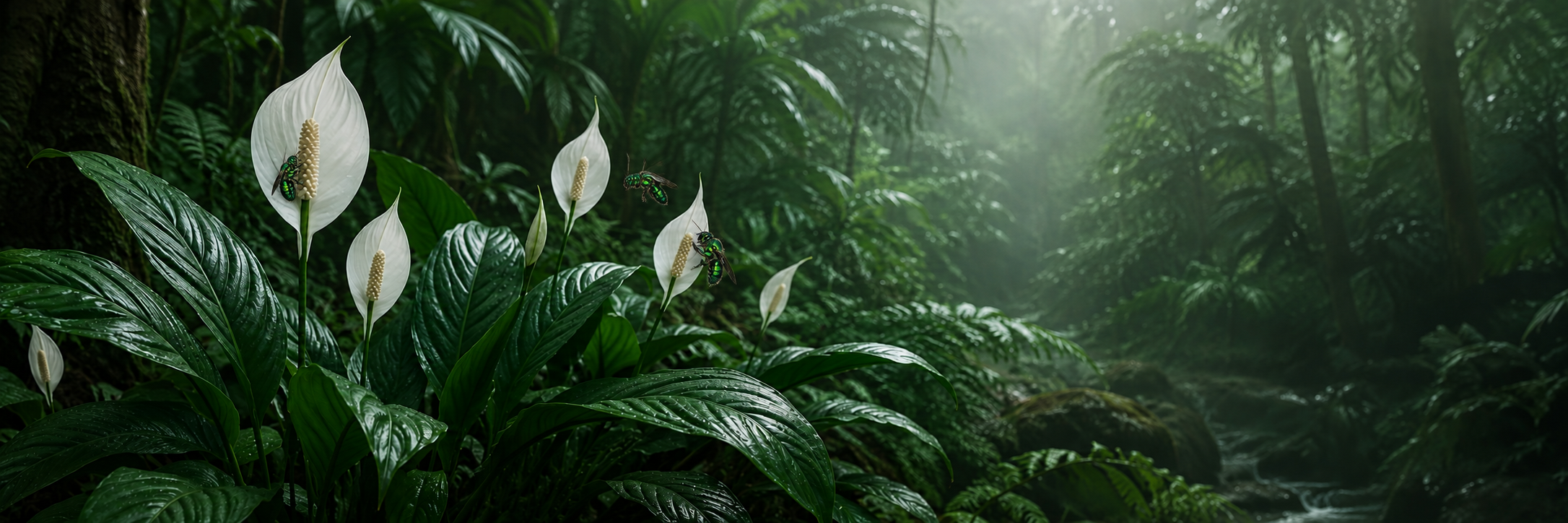
Ask anyone to picture an aroid in flower and they will picture this genus: a white blade held open behind a pale column — the peace lily on the office windowsill. Every other genus on these pages runs its pollination in some kind of enclosure: Arum’s overnight prison, Monstera’s heated chamber, Philodendron’s resin-lined vault. Spathiphyllum encloses nothing. The spadix stands fully exposed, the spathe is an open sail, the scent runs in the morning, and the visitors are bees that come and go as they please.
Take it to the plant
Not here for the botany, and just want to make a cross? The printable field card is the whole method on one sheet — how to read the phase off the pollen, the weeks-long morning schedule, the six-month cold-storage numbers for the pollen — with a second side carrying the three corrections that matter most at the bench, including why bees robbing your spadix are not a problem and why berries in a bag prove nothing.
That makes this genus the family’s other pole — and the pole the rest of the family gets measured against. When the authors of the most recent Monstera field study wanted to say what their beetle-run, chamber-built system was not, the genus they reached for was this one: bisexual-flowered groups “which lack a floral chamber and heat production, such as Anthurium … and Spathiphyllum”. Same flower plan — both organs in every flower, female phase first — opposite machine.
What this page is really about
Who the bees are. The answer has been corrected twice in fifty years: first the perfume-collecting orchid bees (1976), then the pollen-robbing stingless bees doing the real work by accident (1986), and finally — with two species watched side by side (2021) — both answers at once, a different one per species. One species has since been caught skipping pollinators altogether. The corrections are the story, and this page tells them in order.
How much this rests on, said plainly
The genus has 76 accepted species. Five have had their pollination properly studied in the wild — Spathiphyllum friedrichsthalii on Barro Colorado Island over fifteen months, Spathiphyllum croatii and Spathiphyllum ortgiesii side by side in Mexico, Spathiphyllum humboldtii in French Guiana over two field seasons, and Spathiphyllum grandifolium briefly in Colombia. A 1976 survey adds identified visitors for eight more. That is thin — but it is the best-watched bisexual-flowered genus in the family, and more than twice the coverage Monstera has.
One habit this page keeps
The famous plant on the windowsill is a cultivated Spathiphyllum — and no commercial peace lily has ever been watched in the wild. Everything below is about the wild genus; where it bears on the plant in your kitchen, the page says so explicitly.
Part I
The Flower, and What It Wears
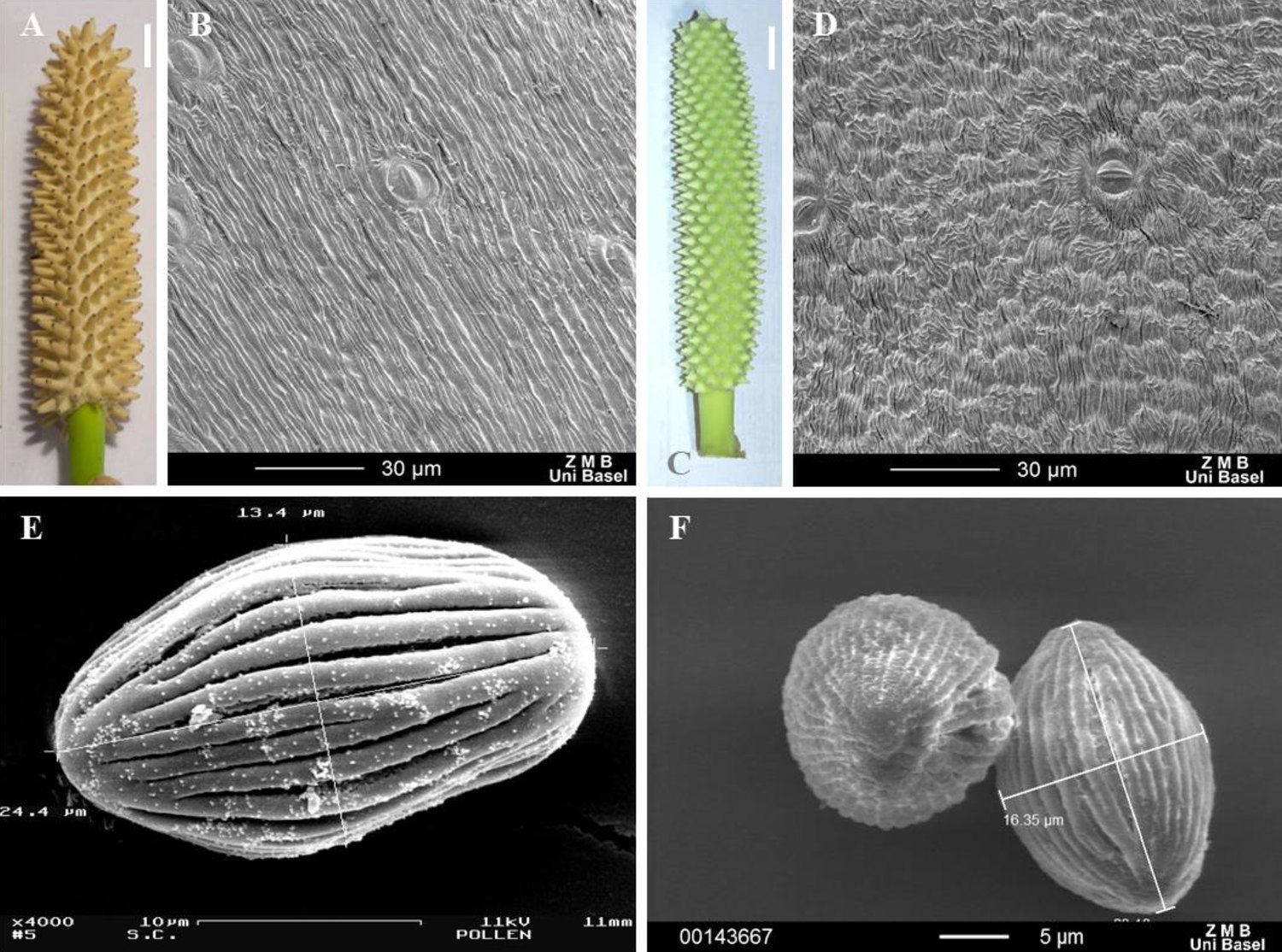
A Spathiphyllum spadix is a column of small, identical, two-sex flowers — each with stamens and an ovary together, female phase first. So far, that is Monstera’s plan. The difference is everything around it: these flowers are clothed, and this spadix is naked to the air.
Clothed flowers on an unclothed spadix
Unlike the bare flowers of Monstera, every Spathiphyllum flower carries a perianth — a ring of tepals around the pistil. In most of the genus the tepals are free; in one group they are fused into a little cup around the pistil. That detail is not trivia: the genus’s own classical taxonomy — the four sections erected in the 1960 revision — is built on how the perianth is put together, and Part II shows the molecules taking that architecture seriously.
And where the flowers gained a garment, the inflorescence lost one. The spathe is a flat, open blade — usually white — standing behind the spadix like a sail. It does not curl into a tube, does not close overnight, does not make a chamber, and holds no visitor for so much as a second. Every flower on the spadix is exposed to open air for its entire working life. The floral chamber that defines Monstera’s system — and the trap that defines Arum’s — simply has no equivalent here.
The working parts, quickly
Protogyny runs the clock: stigmas receptive first, anthers opening days later — the sexes separated in time inside each flower, exactly as in Monstera. When the male phase comes, the pollen does not sit in the anthers waiting: it emerges as a “contiguous powdery ribbon” — the 1986 study’s phrase — dangling from the spadix where a foraging bee cannot miss it. And one absence worth naming: in the two species checked closely, the receptive stigmas carry no pollination drop — the glistening stigmatic secretion that feeds Monstera’s whole bee-story has no counterpart here.
Numbers a reader can hold onto
A flower’s pollen-to-ovule ratio here runs around 8,000 — against roughly 14,000 in Monstera adansonii. The page gives that as description, not diagnosis: in aroids the P/O ratio has been tested against real breeding systems and flatly fails to predict them, so nothing below leans on it.
One more tie worth knowing about. The needle-shaped trichosclereid cells that run through Monstera’s tissues — the fruit armour of that page’s Part X — run through this genus too. In fact, when the subfamily was put to molecular test, trichosclereids came out as the one morphological character still holding Monsteroideae together. The two genera on these pages that look least alike in flower are held in one subfamily by their needles.
Part II
The Genus: Seventy-Six Species and One Impossible Address
Most aroid genera live on one side of the planet. Spathiphyllum — after the molecular era finished redrawing its neighbours — is the last aroid genus left standing in both the Old and New World tropics: a big American family with three species stranded across the Pacific.
How many species, depending on when you asked
| Source | Count |
|---|---|
| The 1960 revision | 35 American species, plus one in the western Pacific |
| The 2004 Colombian synopsis | About 50, 47 of them neotropical |
| The 2020 estimate | “More than 89” |
| POWO, this site’s standard | 76 accepted species |
The heartland is the northern Andes, thinning northward through Central America into Mexico, with one species reaching Cocos Island in the Pacific. And then, an ocean away: three species and only three — one spread across Malesia to Micronesia, one on the Solomon Islands, one in New Guinea. Two other aroid genera used to share this both-worlds address; molecular work re-sorted both (the American “Schismatoglottis” species turned out to be their own genus entirely), leaving Spathiphyllum alone with the distinction. Part IX takes up what those three Asian outposts might mean for pollination — because nobody has ever watched one.
The sections, and a 39-year-early prediction
The 1960 revision cut the genus into four sections on the perianth: three with free tepals, and section Massowia — all three Asian species plus a couple of American ones — with the tepals fused into a cup. The first molecular test, in 2015, could resolve only so much (the genus’s DNA is remarkably uniform — over 97% identical between species even across the ocean gap), but two results stood: the genus is monophyletic, and one section — the long-pistilled section Spathiphyllum — is a strongly supported natural group sister to everything else.
The odd man in
Holochlamys beccarii, a one-species genus from New Guinea, keeps turning up inside Spathiphyllum in the molecular trees — specifically inside the fused-cup section, with the Asian species. The support is low and the authors declined to merge the genera; the page reports it as an open question. The arresting part is the date on the idea: the 1976 pollination survey, working from tepals and placentas alone, had already argued that Holochlamys is best derived from an advanced Spathiphyllum. The molecules, 39 years later, keep landing on the same suggestion — and keep failing to make it stick.
And the plant on the windowsill
The peace lily of commerce is this genus domesticated — the horticultural literature hangs the classic ‘Mauna Loa’ on Spathiphyllum floribundum, and the trade has bred freely since. What matters for this page: the cultivated peace lily figures in exactly one study below — a pollen-storage experiment — and in none of the field biology. The best-known aroid inflorescence in the world enters its own genus’s pollination literature as a pollen donor in a Florida lab, and nowhere else.
Part III
1976: The Orchid Bees, Behaving Like It’s an Orchid
The genus’s pollination story opens not with an aroid worker but with two orchid specialists, who noticed that male euglossine bees were doing at a white aroid sail exactly what they do at a Stanhopea: collecting the smell itself.
The behaviour, in the authors’ own words
Male euglossine bees — the iridescent “orchid bees” of the neotropics — gather volatile fragrance compounds and stash them in pouches on their hind legs; the standard reading is that the perfume figures in courtship. At Spathiphyllum spadices, Williams and Dressler watched the full orchid routine: “the bees land, brush on the surface of the spadix with the front tarsal brushes, launch into the air and transfer the substance they have collected to their inflated hind tibiae, and return to the spadix.” The reward is not nectar and not pollen — the reward is the scent. They noted the genus’s fragrances sit closest to exactly the orchid groups those bees pollinate.
Their survey put identified visitors on eight species of Spathiphyllum across the American tropics, mostly central Panama, with vouchered bees behind every record — and all of it in the morning, because male euglossines work from dawn to noon.
The pattern that made it a theory
The striking result was not that bees came — it was which bees came where. Of 26 euglossine species recorded at the genus, only 3 visited more than one species of Spathiphyllum — and every pair of plant species sharing a bee was “either allopatric or in different sections of the genus.” Each species, wherever the data were dense enough to tell, drew its own bee or its own small set. From there the authors built the genus’s founding hypothesis: shift the fragrance blend slightly, attract a different male euglossine, and a population is reproductively isolated — speciation driven through the perfume, the same engine then being argued for the orchids.
What 1976 could not do
Two honest limits, both later filled. No chemistry: the authors wrote that it had “not been possible to date to obtain gas chromatographic analyses” of the fragrances — the scent driving the whole theory was unmeasured (Part VI picks up that thread). And no experiment: this was a visitation survey. Bees were caught, identified and vouchered; pollen transfer and seed set were inferred from behaviour, not demonstrated. The demonstration — and the surprise inside it — is Part IV.
The exception filed in plain sight
One species in their own Table 1 broke the pattern already: Spathiphyllum kalbreyeri, in central Panama, drew no euglossines at all — its recorded visitor was Trigona, a stingless bee, there for pollen. And for the three Asian species, with no euglossines on their side of the Pacific, the authors could only speculate; their best guess was pollination “by randomly searching insects collecting pollen, just as occurs in Spathiphyllum kalbreyeri.” They even hung a biogeographic argument on it: the near-absence of Pacific speciation — three species against dozens in America — as the signature of a genus missing its speciation engine. Hold onto kalbreyeri. Ten years later it stopped being the exception.
Part IV
1986: The Wrong Bees Are Doing the Work
Ten years after the perfume theory, two researchers spent fifteen months with Spathiphyllum friedrichsthalii on Barro Colorado Island and did what 1976 hadn’t: counted every visit, phase by phase, and measured what actually set seed. The orchid bees showed up. They just weren’t the story.
The count
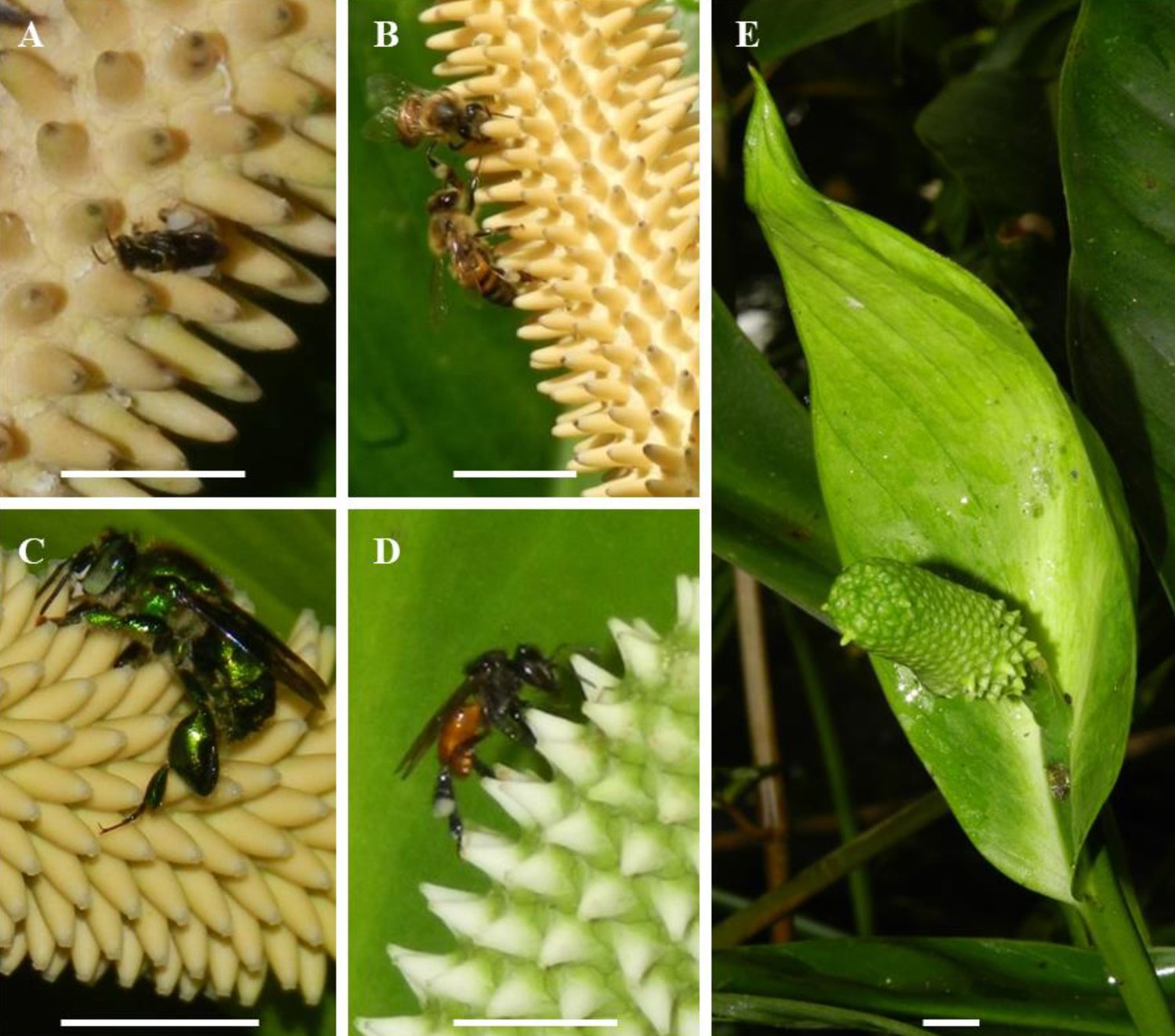
Pollen-foraging stingless bees made 87% of all visits — and the analysis laid most of the seed set at their feet. Fifteen species of euglossines came for the fragrance, orchid-fashion, exactly as 1976 described — and collectively they were minor: barely a quarter of inflorescences received even one euglossine visit during the female phase, the only phase where a visit can set seed.
Why “mistake” is the right word
Here is the mechanism, and it is worth slowing down for. A stingless bee visits this plant for pollen — so it works male-phase inflorescences, where the pollen ribbons hang, at a rate of 40:1 over female-phase ones. The female-phase inflorescence offers a pollen forager nothing at all. The visits it does receive are errors — a bee misreading the display for seconds, finding no pollen, and leaving. But a forager arriving from a male-phase plant carries loaded pollen baskets, and in those seconds of error the load brushes receptive stigmas. The authors named the system “mistake pollination”: the plant is pollinated by the visits that fail. The euglossines, for contrast, visited the two phases about 1:1 — the fragrance runs in both — and stayed minutes at a time, model pollinators in every respect except numbers.
And the experiment underneath
The bagging and hand-pollination arms made it quantitative. Self pollen works — the species is self-compatible — but nothing happens without a carrier: bagged, untouched inflorescences set 2.4% fruit against 100% when pollinated by hand. And the wild bees were not keeping up: hand pollination filled 84% of ovules; open pollination managed 34%. Seed set on Barro Colorado was pollination-limited — a plant drawing two whole guilds of bees, and still short-changed.
What survived, what changed
Nothing in 1976 was retracted here. The perfume bees are real; the behaviour is real; the strong sweet fragrance — running about five hours every morning, in both phases — is exactly the signal the perfume theory needs. The authors even kept a role for the euglossines: long-haul pollen movement between distant plants, with the stingless bees working the neighbourhood. What changed is the center of gravity: in this species, on this island, the pollination system is a by-product of pollen theft, and the elegant perfume-collection story is a sideshow. Whether that verdict generalises to the genus — or whether kalbreyeri and friedrichsthalii are one end of a spectrum with the perfume species at the other — needed two species watched side by side. That took another 35 years.
Part V
2021: Two Species, Side by Side, Two Different Answers
The genus’s modern benchmark comes from Los Tuxtlas, Mexico: two Spathiphyllum species growing within reach of each other — one in open, sunny streamside crowds, one scattered through forest understorey — studied with the full kit. Same genus, same forest, two pollination economies.
The pair
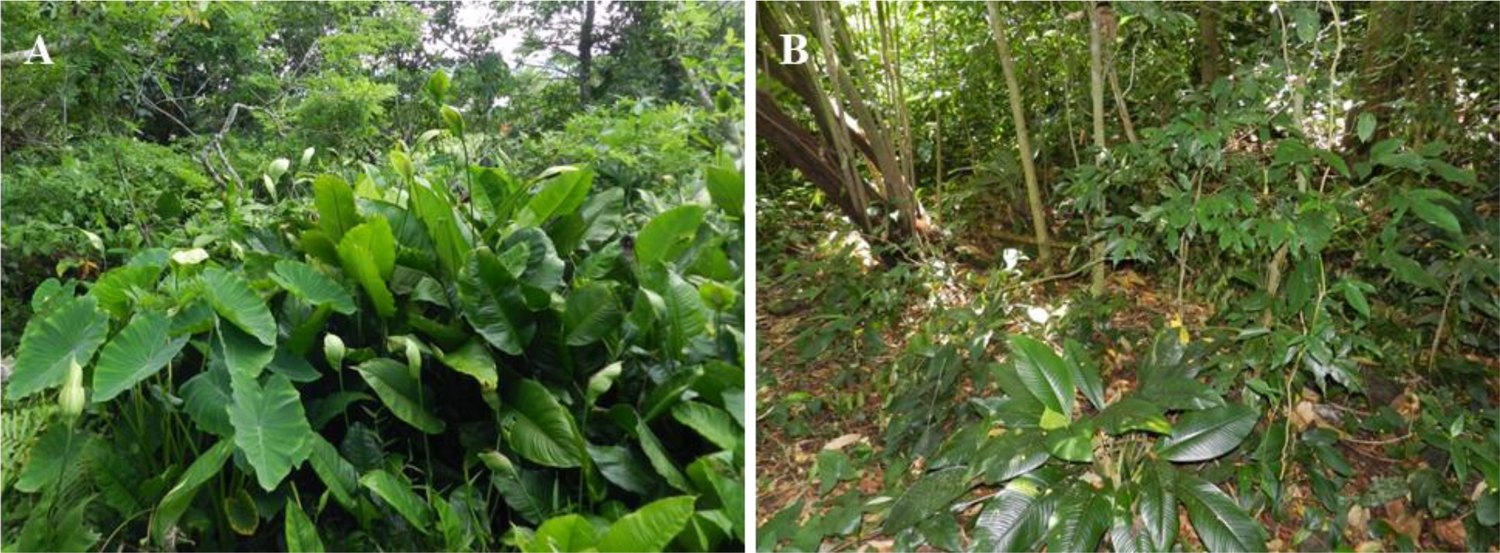
Spathiphyllum croatii grows in big riparian colonies in the open; its inflorescences pull a broad crowd — more than 60% of visits from small stingless Plebeia bees plus the introduced honeybee, with the rest spread across a mixed guild. Spathiphyllum ortgiesii, scattered in the shade, runs the opposite book: a single stingless bee, Trigona fulviventris, makes over 90% of all visits. And the orchid bees of Part III? Present — under 10% of visits — and caught doing something suggestive: wiping the bases of the styles, which may be where the scent is actually made. Even as minor players they behave like connoisseurs.
The result that needs no statistics
Bagged away from insects, ortgiesii set zero fruit and croatii next to none (a few inflorescences at around one percent) — both species are, in practice, obligate outcrossers. Open to their bees, both species set fruit in 100% of flowers. Not 100% of inflorescences — every single flower counted set a fruit. Compare the genus next door: in Monstera obliqua, 71% of naturally pollinated inflorescences abort outright. Two bee-run bisexual aroids, and one of them runs at saturation while the other fails wholesale — nobody has explained the spread.
Two bee guilds, one genus
Put Parts III–V together and the fifty-year argument resolves into a spectrum. friedrichsthalii: mistake pollination by pollen thieves, euglossines marginal. croatii: a broad pollen-foraging crowd. ortgiesii: one specialist stingless bee, near-monopoly. The perfume-bee species of 1976 — cannaefolium, laeve, quindiuense and the rest — still stand as recorded, each with its own euglossine set. The genus did not pick one system; it runs both, sorted by species — and Part VI shows the scent data making the same point from the chemistry side.
Hybrids, and a name that changed mid-study
Where the two Mexican species meet, the authors found four natural hybrids — and their hand-crosses between the species took. So the wall between these two gene pools is not genetic incompatibility; it is ecology: different habitats, different flowering ecologies, different bee guilds. The fragrance-isolation engine of 1976 reappears here wearing field clothes — and it leaks. One housekeeping note a careful reader deserves: the riparian species was studied for years under the name Spathiphyllum cochlearispathum before being recognised, in 2021, as an undescribed species and named Spathiphyllum croatii — a reminder that in this genus even the species list is still settling.
Part VI
The Scent: Measured at Last, and Full of Surprises
The 1976 theory ran entirely on an unmeasured smell — its authors said plainly that gas chromatography of these fragrances had “not been possible to date.” The measurements came in two instalments, twelve and forty-five years later — and each one complicated the story it was meant to confirm.
1988: the first chemistry, from an unexpected direction
The genus’s first GC-MS study was done not by a pollination biologist but by fruit-fly chemists in Queensland, chasing a nursery plant locals called the “fruit-fly lily.” The headspace of a Spathiphyllum cannaefolium spike came back dominated by benzyl acetate (~59%) with methyleugenol (~20%), methylchavicol and p-methoxybenzyl acetate — sweet benzylic perfume through and through. And the timing told its own story: the young inflorescence is nearly odourless, the scent arrives with the pollen, peaks in the early morning, and dies away with the ageing spike — the same morning schedule the bee studies keep finding.
The fruit-fly twist — and its limits
Methyleugenol and benzyl acetate happen to be commercial male fruit-fly lures — which is why this aroid has a career in pest control: in northern Thailand it is planted around orchard perimeters to draw male tephritid flies away from the fruit, and in Queensland one plant was reported drawing hundreds of flies a day. Read the evidence grade before repeating that: the attraction reports are a newspaper item, growers’ accounts and an entomologist’s observation, and the paper’s own bioassay was a few open vials beside a cage. And no one has ever claimed, let alone shown, that fruit flies pollinate the plant. What the episode really documents is sharper: on a continent with no euglossine bees, the same perfume that reads “orchid-bee” in Panama reads “male fruit-fly lure” — the signal has no fixed audience.
2021: the chemistry meets the visitor counts
The Mexican pair study measured both species’ scent through the day. Spathiphyllum croatii, the open-riverbank crowd plant, emits a strong blend of 49 compounds through the morning (07:00–11:00). Spathiphyllum ortgiesii, the shade specialist, emits three compounds — in the female phase, 93% of it a single one, 2-phenylethanol, the smell of roses — weakly, around midday. Neither emits anything at night. Habit, guild and perfume line up as a syndrome: big scent for a big mixed crowd, one quiet note for one faithful bee.
The mismatch worth remembering
Most of the major compounds in both blends are known euglossine attractants from the orchid literature — and yet at these two species the euglossines were under 10% of visits. A scent profile does not predict the pollinator. Anyone reasoning from floral chemistry to visitor list — in this genus or any other — should have that result pinned above the desk.
And in French Guiana, the isolating wall itself was measured. Spathiphyllum humboldtii grows alongside two Anthurium species; all three are perfume flowers working the same euglossine pool, and each keeps its own bees — no bee species is a principal visitor of two of the plants. The chemistry keeps them apart: humboldtii’s bouquet is nothing like its neighbours’ — over 95% dissimilar from both — and it is a strange perfume to wear at all, 60% ipsdienol, a compound better known as a bark beetle’s aggregation pheromone. The authors’ conclusion is 1976’s theory in field clothes: the scent differences “most probably” sort the bees, and with an open spadix offering no way to place pollen selectively, scent has to carry the whole isolating load. Their own caution travels with it: the case is correlational — nobody has yet run the bioassay.
The genus’s newest species turns the same signal to a different job. In 2024, Spathiphyllum hentrichianum — a Tabasco endemic long confused with Spathiphyllum cochlearispathum — became the first species in the genus described with its scent chemistry as a segregating character: a cinnamyl-ester perfume found as a dominant nowhere else in the genus, printed in the protologue beside the leaf measurements. So the scent that fails to predict the pollinator turns out to succeed as a species fingerprint — the same signal, read for two different purposes.
Part VII
The Clock: Weeks Long, Cold, and Run in Public
An Arum spends one violent night on its whole performance; a Monstera chamber runs its beetles on a headed schedule of days. A Spathiphyllum inflorescence works for two to four weeks, entirely in the open, entirely by daylight — and, as far as anyone has reported, without heating a single degree.
The tempo
In Spathiphyllum friedrichsthalii the female phase runs 3–4 days and the male phase 7–8, the whole inflorescence working for 11–12 days. The Mexican pair stretch the same shape further: female 6 days against male 18 in Spathiphyllum croatii; female 8 against male 24 in Spathiphyllum ortgiesii. And the French Guiana species runs the whole clock at double speed: Spathiphyllum humboldtii compresses its female phase into a single day — two at most — against five male days, the whole spadix done in about a week. The proportion is the constant — the male phase runs three to five times the female — and it has a visible consequence a field worker can count: at any moment a population stands about three pollen-offering inflorescences for every receptive one. That standing imbalance is the house the mistake-pollination system lives in: a pollen forager’s world is mostly male-phase spadices, and its rare wanderings onto a female-phase one are the pollination events.
The polarity, placed in the family
Across the bisexual-flowered aroids the female phase is typically the shorter one. Spathiphyllum runs that standard polarity at its extreme — and Monstera, once again the odd one out, is the review literature’s explicit exception, the only bisexual aroid with the female phase longer than the male. Two neighbouring genera, the same protogyny, opposite emphasis: this one spends on pollen presentation, that one on receptivity.
A clock with no furnace attached
Every other guide page on this site has a heat section. This one has a sentence: no study of this genus has reported thermogenesis — no warmed spadix, no scheduled pulse, nothing — and the family’s reviewers class Spathiphyllum, with Anthurium, among the bisexual aroids that lack both chamber and heat production. Worth saying precisely: that is an absence of reports, not a measured zero — nobody appears to have wired a spadix and published the flat line. But everything the heat does elsewhere in the family — volatilising scent into a cold dawn, warming a chamber full of overnight guests — is work this genus has no use for. The scent runs in the warm hours of the morning; the bees keep bees’ hours; nothing here works at night, and the 2021 study found no scent at night to work with.
And afterwards, no hurry either
The one measured fruiting schedule is as unhurried as the flowering: about 72 days from pollination to mature fruit in Spathiphyllum friedrichsthalii — quick against Monstera’s two-to-fifteen months, slow against the family’s one-night wonders, and, like everything else in this genus, conducted in plain view.
Part VIII
Self and Cross: One Genus, Every Answer
Ask whether a Spathiphyllum can fertilise itself and the literature answers: which one? Species by species, the genus runs the entire spectrum — from bees-or-nothing to needs-nobody — and the page lists it as the spectrum it is.
The spectrum, one species at a time
| Species | Breeding system, as tested |
|---|---|
| Spathiphyllum croatii · Spathiphyllum ortgiesii | Obligate outcrossers in practice — bagged inflorescences set zero and near-zero fruit; open to bees, 100% of flowers set |
| Spathiphyllum friedrichsthalii | Self-compatible but helpless alone — own pollen works by hand (100%), yet bagged plants set 2.4%; no autonomous selfing, no apomixis |
| Spathiphyllum grandifolium | Selfs by design — anthers open above still-receptive stigmas and pollen falls onto them; bagged set equals open set |
| Spathiphyllum humboldtii | “Might be apomictic” — bagged and pollinator-free plants set near-full fruit with germinable seed, and no self-pollen path exists; suspected facultative apomixis, not yet proven by embryology |
| Spathiphyllum patinii | Nucellar polyembryony reported — extra embryos from maternal tissue; a 1925 record, held at second hand |
The strange one, given its full weight
The Spathiphyllum grandifolium record deserves its details, because they are the mechanism. In this Colombian species the protogyny is incomplete: anthers begin opening at the spadix tip while the stigmas below are still receptive, and the pollen — shed in clotted masses rather than loose powder — falls onto those stigmas by gravity. A bagged inflorescence set 100% fruit, matching the unbagged plants; the authors called the flowering pattern “exceptional not only for the genus … but also for the family,” and read it as delayed autonomous self-pollination — day one still permits outcrossing; selfing is the built-in fallback. And the weight statement travels with the claim: this is a short communication built on three flowering plants watched for six days. It earns its table row, not a law.
Why this spectrum matters beyond the genus
Monstera’s two field studies collide on exactly this question — strict outcrosser in one species, partial selfer in the other — and this genus shows that collision is the normal condition: breeding system in these aroids is a species-level trait, not a genus-level one. Any sentence that starts “Spathiphyllum is self-compatible…” — or “self-incompatible…” — has already gone wrong.
The bench payoff: pollen that keeps
One study in the genus was done entirely for breeders, on the windowsill plant itself — ‘Mauna Loa’ pollen in a Florida lab — and it answers the practical question this spectrum raises: if your two plants flower apart, can pollen wait? It can, if you keep it cold and — unusually — not too dry. Fresh pollen germinated at 80%; stored at 7 °C and 65% relative humidity it held above 70% for three months and still gave 57% at 24 weeks. At room temperature it was effectively dead within a month at every humidity. The odd part — the authors flag it themselves — is the humidity: most pollens store best quite dry, below 50%; this one wanted 65%. The study’s stated purpose is the crosser’s charter: stored pollen “would facilitate hybridization of species which flower at different times.” Part V’s four natural hybrids say the genus is willing.
Part IX
What Nobody Knows, Listed Without Cushioning
For the family’s best-watched bisexual genus, the blank spots are still enormous — and unusually specific. Each of these is a real question a fieldworker could start on tomorrow.
| Gap | State of the evidence |
|---|---|
| The three Asian species | No pollination observation of any kind, ever. The 1976 authors wrote “we have no data” and guessed at pollen-collecting generalists; half a century on, the guess is still all there is — on the side of the planet with no euglossines |
| The peace lily itself | The world’s most-grown flowering aroid appears in this literature once, as lab pollen. No wild field study touches Spathiphyllum wallisii or any commercial cultivar’s parent populations |
| Scent vs visitors | Both Mexican species emit known euglossine attractants; euglossines were under 10% of visits. Unexplained by the study that found it |
| Heat | No thermogenesis has ever been reported — but no published measurement exists either. Nobody has wired a spadix and printed the flat line |
| The sections | The 1960 perianth-based sections have never been fully tested — the 2015 molecular study says so itself, and could resolve one section of four |
| Feast or famine | The Mexican species set fruit in 100% of flowers; Barro Colorado’s was pollination-limited at 34% of ovules. Both numbers are solid; nothing explains the spread |
| Holochlamys | Inside the genus or beside it? Nested in every tree, supported in none — 39 years after morphology first suggested the merge |
| 71 of 76 species | No proper field pollination study — visitor lists at best |
The cleanest experiment on this list
The Asian gap is not just a blank — it is a natural experiment already set up. Three species of a euglossine-perfume genus have spent their history where euglossines have never existed. Whatever pollinates Spathiphyllum commutatum in Malesia is the answer to the question 1976 could only pose: what does this flower do when its theory-approved bee is not an option? A week of mornings with a notebook in the right forest would double what is known.
Five species watched properly, seventy-one to go, an ocean-sized natural experiment nobody has visited, and the most familiar aroid flower on Earth still scientifically anonymous in its own home. The open-air genus is, in the end, barely more read than the locked-room ones.
Sources
Sources, and What Kind of Evidence Each One Is
Four field studies, one visitation survey, one chemistry note, one molecular test, one bench experiment and two reviews: the working literature of the family’s best-watched bisexual genus, each entry graded by the weight it will bear.
- Williams, N. H. & Dressler, R. L. (1976). Euglossine pollination of Spathiphyllum (Araceae). Selbyana 1: 349–356. The founding survey and Part III entire: the male-euglossine perfume behaviour, visitor records for eight species with vouchered bees, the 26-bees-but-only-3-shared result, the fragrance-shift speciation hypothesis, the kalbreyeri exception, and the old-world guesses. Grade: multi-locality visitation records with collected vouchers; pollination inferred from behaviour, not demonstrated. Note: the archive’s copy is a poor scan; every number and binomial this page uses was verified against the page images, and nothing else is quoted.
- Montalvo, A. M. & Ackerman, J. D. (1986). Relative pollinator effectiveness and evolution of floral traits in Spathiphyllum friedrichsthalii (Araceae). American Journal of Botany 73: 1665–1676. Part IV entire, and the strongest single study on this page: fifteen months on Barro Colorado Island; the 87% stingless-bee count, the 40:1 phase preference, mistake pollination, and the bagging and hand-pollination arms behind self-compatible-but-helpless and the pollination-limitation verdict. Also the phase lengths and the ~72-day fruit of Part VII and the pollen ribbon of Part I. Grade: measured field study with experiments and stated sample sizes.
- Díaz Jiménez, P., Hentrich, H., Dötterl, S., Krömer, T., MacSwiney G., M. C. & Aguilar-Rodríguez, P. A. (2021). Reproductive biology of two Spathiphyllum (Araceae) species in Los Tuxtlas, Veracruz, Mexico. Flora 285: 151958. The modern benchmark and Parts V–VI’s backbone: the two-species contrast, the bagged-versus-open experiment (zero and near-zero against 100% of flowers), the visitor counts, the GC-MS scent chemistry (49 versus 3 compounds), the daily emission schedules, the four natural hybrids, and the scent-versus-visitor mismatch. Grade: measured field study with scent analysis and exclusion experiments, two species, one region. Note: its riparian species was redescribed mid-project — work published earlier under Spathiphyllum cochlearispathum (including a conference poster of this same study) is the same organism and is never cited separately here.
- Díaz Jiménez, P., Hentrich, H., Ruiz-Idarraga, J. M., Gibernau, M. & Zuluaga, A. (2019). The exceptional flowering behaviour of Spathiphyllum grandifolium Engl. (Araceae) — an indicator for self-pollination? Ecotropica 21: 201910. The delayed-autonomous-selfing record of Part VIII — incomplete protogyny, basipetal anthers, gravity-fed pollen, bagged set equal to open. Grade: short communication — three flowering plants, six days; this page carries only what was directly watched, plus one older record it relays: Spathiphyllum patinii nucellar polyembryony (Schürhoff & Jüssen 1925), held at second hand through this paper. (The Spathiphyllum humboldtii apomixis record it also cites is now taken first-hand — see the Hentrich entry.)
- Hentrich, H., Kaiser, R. & Gottsberger, G. (2010). Floral biology and reproductive isolation by floral scent in three sympatric aroid species in French Guiana. Plant Biology 12: 587–596. Now held and read in full — the study behind Part VI’s isolation paragraph, Part VII’s one-day female phase, and Part VIII’s humboldtii row. Two field seasons at one French Guiana site: 224 vouchered visits, seven euglossine species with the top two at 80.4%; scent 60% ipsdienol; ~96% fruit set over 5,053 fruits; three bagged inflorescences plus a pollinator-free greenhouse plant setting germinable seed behind the “might be apomictic” verdict. Grade: measured field study with vouchers and bagging; the scent-isolation mechanism is the authors’ own explicitly hedged inference (no bioassays), and the apomixis has no embryology behind it yet — the page carries both hedges.
- Díaz Jiménez, P., Dötterl, S., Fuchs, R., Pérez-Farrera, M.Á. & Aguilar-Rodríguez, P.A. (2024). A new Spathiphyllum (Araceae) from Mexico segregated by its morphology and floral scent from closely related species. Taxon, doi 10.1002/tax.13147. Part VI’s closing turn: Spathiphyllum hentrichianum, the first species in the genus described with GC/MS scent data as a segregating character (a cinnamyl-ester perfume dominant nowhere else in the genus), plus the first scent data for Spathiphyllum cochlearispathum. Also a clean confirming phenology: female 4–6 days against male 21–23, with no overlap observed. Grade: taxonomic description with measured chemistry; small samples, partly cultivated material; no pollinator was observed — this page never cites it for one.
- Lewis, J. A., Moore, C. J., Fletcher, M. T., Drew, R. A. & Kitching, W. (1988). Volatile compounds from the flowers of Spathiphyllum cannaefolium. Phytochemistry 27: 2755–2757. The genus’s first GC-MS scent analysis and Part VI’s fruit-fly story: benzyl acetate and methyleugenol dominant, scent arriving with the pollen and dying with the spike. Grade: measured chemistry on cultivated material; the fly-attraction reports around it are anecdotal (a newspaper item, growers’ accounts, a minimal cage-side bioassay) and are presented as practice, not measurement. Its speculation on the species’ native range is wrong and is not repeated here.
- Henny, R. J. (1978). Germination of Spathiphyllum and Vriesea pollen after storage at different temperatures and relative humidities. HortScience 13(5): 596–597. Part VIII’s bench numbers: fresh pollen at 80% germination; 7 °C and 65% RH holding 57% at 24 weeks; room temperature effectively dead within a month; the unusual moist optimum. Grade: controlled storage experiment on one cultivar (‘Mauna Loa’). Note: the archive’s copy is a rough scan; the abstract and Table 1 were verified against the page images before any number was used.
- Zuluaga, A., Cameron, K., Croat, T. & Medecilo, M. (2015). Testing the monophyly of Spathiphyllum, and the relationship between Asian and tropical American species. Aroideana 38E(1): 107–115. Part II’s frame: genus monophyly, Spathiphylleae sister to the rest of Monsteroideae, the last-disjunct-genus result, the one strongly supported section, the low-support Holochlamys nesting (explicitly left unacted-on), and the >97% sequence uniformity. Grade: four-marker molecular study, eleven accessions of the genus — low resolution, honestly reported. The 1960 sections and their perianth characters are carried through this paper and the 1976 survey; Bunting 1960 itself is not in the archive.
- Díaz Jiménez, P., Hentrich, H., Aguilar-Rodríguez, P. A., Krömer, T., Chartier, M., MacSwiney G., M. C. & Gibernau, M. (2019). A review on the pollination of aroids with bisexual flowers. Annals of the Missouri Botanical Garden 104: 83–104. The family frame behind Parts I and VII: the chamberless, heatless placement of this genus and the female-phase-shorter polarity with its Monstera exception. Grade: synthetic review — cited for its catalogue, not its generalisations.
- Chouteau, M., Barabé, D. & Gibernau, M. (2006). Pollen-ovule ratios in some Neotropical Araceae and their putative significance. Plant Systematics and Evolution 257: 147–157. The Monstera adansonii pollen-to-ovule figure Part I compares against. Grade: measured — and the aroid literature’s own verdict that P/O fails to predict breeding system travels with it.
- Prieto, D. & Cascante-Marín, A. (2017). Pollination by nitidulid beetles in the hemi-epiphytic aroid Monstera lentii (Araceae: Monsteroideae). Flora 231: 57–64. Quoted in the Opening for its naming of this genus as the chamberless, heatless pole the Monstera system “quite differs” from. Grade: measured field study (of the other genus) — used here only for that comparative sentence.