
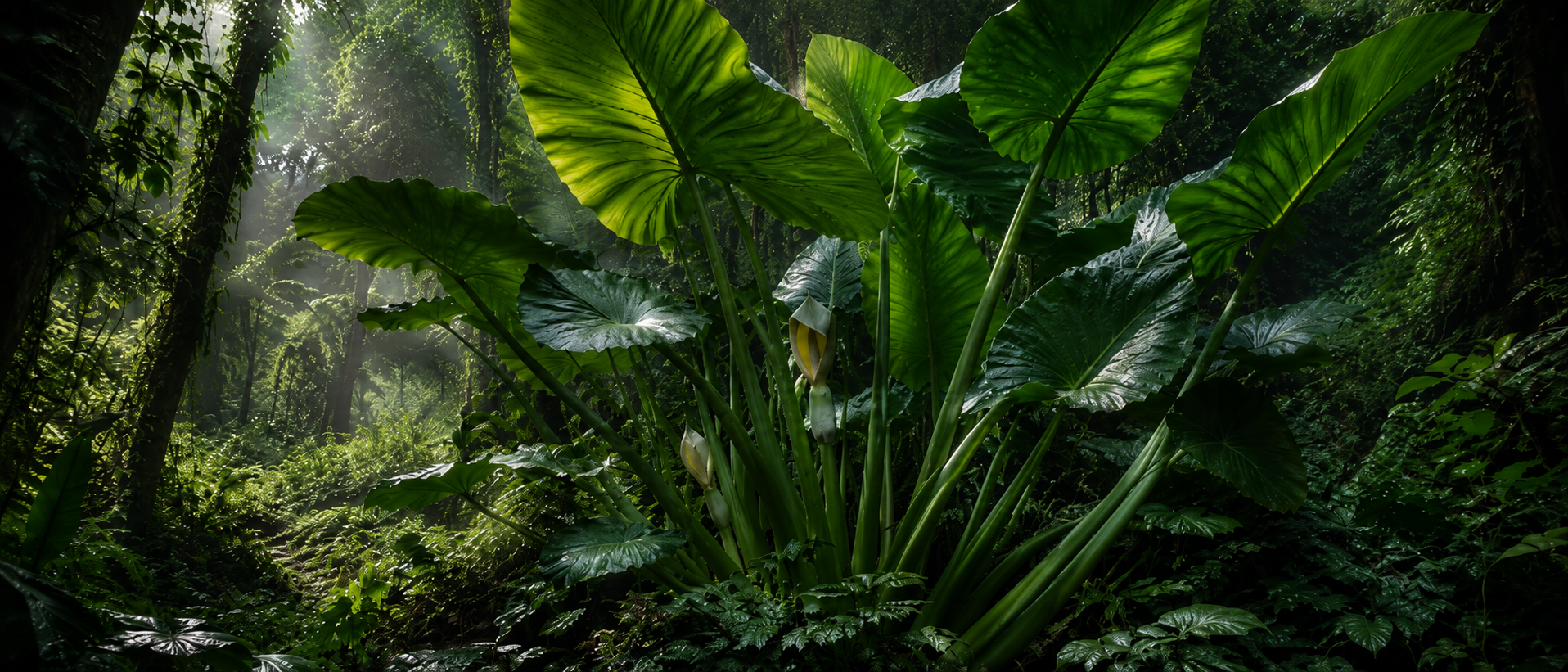
Araceae · Reproductive Biology
THE ALOCASIA INFLORESCENCE
The path to a hybrid
An Alocasia inflorescence is a machine for avoiding its own pollen. It opens female, closes a door on itself, and only then sheds. To cross one deliberately you have to understand what that machine is doing — and then stand in for the insect it is built to wait for.
Take it to the plant
Not here for the botany, and just want to make a cross? The printable field card is the whole method on one sheet — the clock, the steps in order, the numbers that decide it, and what to do when it fails — with a second side of photographs showing what each stage looks like in your hand, so you can tell a receptive stigma from one that closed yesterday.
Reading path
Two articles share this page. The method parts are the ones you follow with a brush in your hand; the botany parts explain why the method is shaped the way it is. Read only the method and you will still get a hybrid. Read the botany and you will understand why your first three attempts failed.
- I Anatomy of the inflorescence Method
- II The zones in detail Botany
- III Anthesis: the two-morning clock Method
- IV The fly, the heat and the scent Botany
- V Reading your own inflorescence Method
- VI Collecting and storing pollen Method
- VII Making the cross Method
- VIII The berries Method
- IX Inside the fruit Botany
- X Seed: cleaning, sowing, germination Method
- XI When it doesn’t work Method
- XII What crosses with what Method
- — Sources Botany
One thing to know before you start
Flower visitors have now been recorded from something like a dozen Alocasia species, but the record is far thinner than that count suggests. Pollination has actually been demonstrated — by bagging, by pollen loads, by seed counts — in three: Alocasia odora, Alocasia cucullata and Alocasia macrorrhizos. Everything else is a list of insects someone found inside an inflorescence, which is not the same claim.
And the genus does not tell one story. In Asia the pollinators are Colocasiomyia flies that breed inside the inflorescence and damage nothing. In Australia, the one place anyone has run the experiment, the most conspicuous resident fly was tested and ruled out — heads with none of it still set 98% of their seed — and the leading candidates are beetles. Two systems, one genus.
So: where a number below is species-specific, it says so. Treat figures from Alocasia macrorrhizos as the best available guide for your Alocasia azlanii, not as a measurement of it.
Part I
Anatomy of the Inflorescence
Before pollinating anything, you need to be able to name four zones and one door. Everything in this article happens at that door.
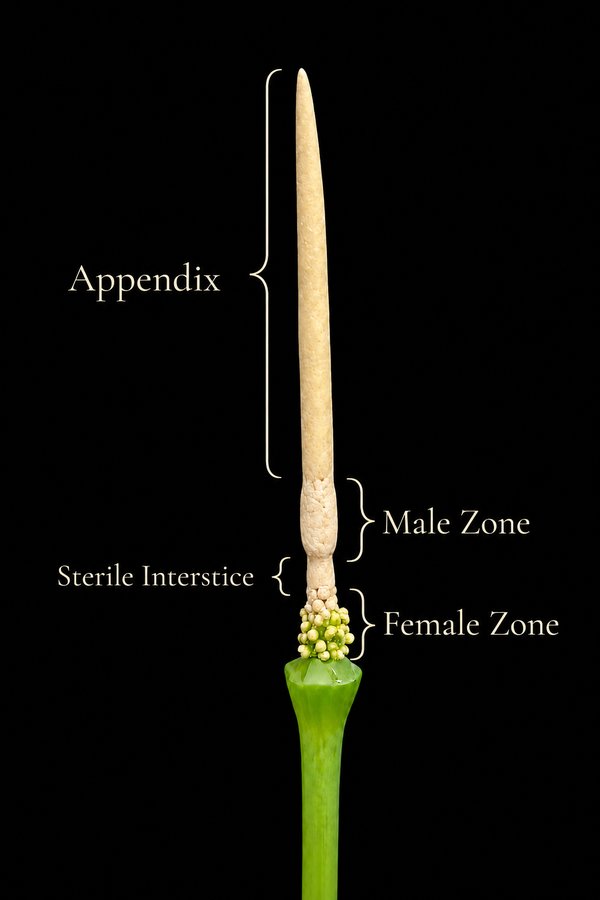
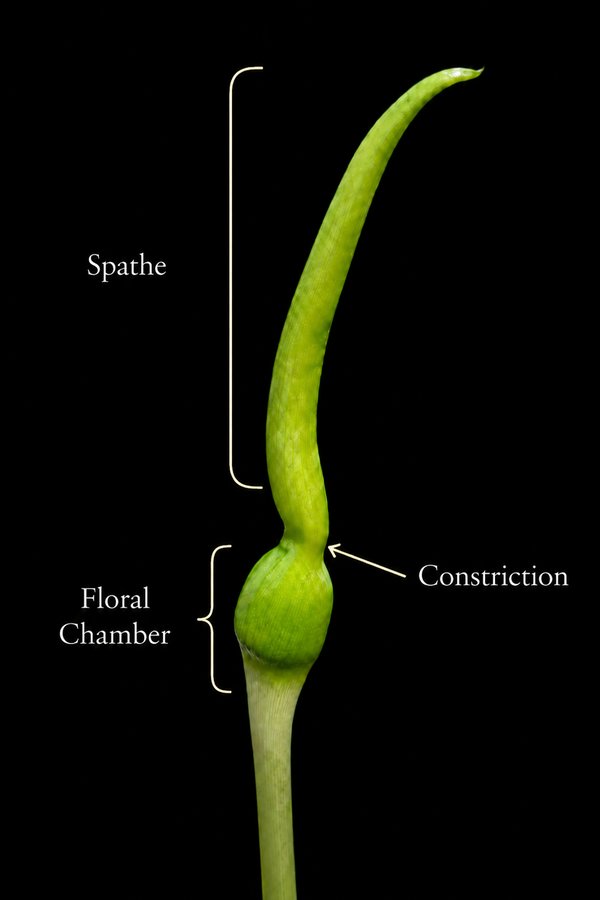
Photographs by Nadine Hafke
What gardeners call an Alocasia flower is not a flower. It is an inflorescence — a crowded column of many tiny flowers, the spadix, wrapped in a single modified leaf, the spathe. The flowers themselves are unisexual and the plant is monoecious: male and female flowers sit in separate zones on the same column. Reading it correctly is the whole skill, because the plant hides the part you need and displays the part you don’t.
The spadix, bottom to top
Four zones sit in a fixed order. Learn them in this direction, because it is the order the plant uses them in and the order your brush will travel:
1. The female zone sits at the very bottom, hidden inside the closed base of the spathe. It carries the pistillate flowers — each an ovary topped by a stigma, sometimes with a short style between them. These are the only structures on the entire inflorescence that can make you a seed.
2. The sterile interstice — also called the synandrodial zone — is a narrow band directly above the female zone. It carries synandrodes: male flowers that have been reduced to sterile ornaments. They make no pollen. Their job is partly spacing and partly, as Part IV describes, catering.
3. The male zone carries the fertile flowers. In Alocasia the stamens of each male flower are fused into a single button-like synandrium, and the synandria are packed shoulder to shoulder into a sleeve. The anthers are extrorse — they face outward, away from the axis — and they are numerous and minute beside the stamens of most flowering plants. This is where your pollen comes from.
4. The appendix is the sterile tip, and the part that carries no flowers at all. In the big species it is also the longest section of the spadix — but not always: Alocasia yunqiana from Yunnan has a short-conical appendix of just 1.5 cm against a staminate zone of 4.5–6 cm, so treat “the appendix is the biggest part” as a tendency, not a rule. It looks like the least important structure on the inflorescence. It is arguably the most active one, and Part IV is mostly about it.
The proportions are lopsided — Alocasia macrorrhizos, n = 51
60% · 25% · 8%
Of the spadix’s length, the sterile appendix takes 60.2%, the male zone 24.9%, and the female zone 8.1% — the sterile band makes up the rest. On a mean spadix of 28.9 cm that is an appendix of 17.4 cm above a female zone of just 2.35 cm.
Read that as a warning about scale. The organ you need to reach is the smallest one on the column, and it is at the bottom, inside the closed part. (Ivancic et al. 2005, Table 1.)
The spathe, and the door in it
The spathe is one bract in two halves, separated by a visible constriction partway up. Below the constriction it is thicker, closed and persistent, forming the floral chamber that encloses the female zone. Above it the spathe is thinner and ephemeral — a pale, membranous hood that opens during anthesis, then decays and drops away within days of pollen release. The lower half stays on the plant and becomes the case your berries ripen in.
The constriction is the door, and it is a genuinely tight one. In Alocasia macrorrhizos it measures 0.83 cm across on average (range 0.65–1.08), against 1.50 cm for the male zone just above it. It is not a decorative waist; it is a valve that opens and shuts on a schedule, and Part III is the schedule.
But it is not always level with the sterile band
The tidy picture — constriction exactly at the sterile interstice, male zone above it, female below — is the common case, not a rule. Hay records whole groups where the constriction sits well above the interstice, so that part or even all of the male zone is shut inside the lower chamber with the female flowers. It is a defining character of the Scabriuscula Group and appears in the Puber, Princeps and Cuprea groups too; in Alocasia scabriuscula the fraction enclosed varies from about a quarter to two thirds within the same species.
Worth knowing before you cut: on those species the geometry you are cutting into is not the one drawn in most diagrams, and the plant’s own pollen may be inside the chamber with the stigmas.
Why this shape matters to you
A closed floral chamber is a container the plant does not intend you to open. Every hand-pollination method in Part VII is a different answer to the same question: how do you get pollen onto stigmas that are sealed inside a tube narrower than a pencil?
A dissection: Alocasia lauterbachiana
Alocasia lauterbachiana (Engl.) A.Hay is native to the Bismarck Archipelago of northern New Guinea, and is distinctive in the genus for its narrow, wavy-margined leaves. Its inflorescence is small — the whole thing measures about 7 cm in the specimen plated here — and it follows the four-zone plan exactly, at a fraction of Alocasia macrorrhizos’ scale.
Two species of fly are recorded pollinating it, drawn by an almost fermenting odour. They lay their eggs among the female flowers; pollen is released afterwards; and the resulting swarm of pollen-dusted flies carries it to the next pungent, receptive inflorescence.
A note on the flies’ name — and why it matters
The New Guinea flies were recorded as Drosophilella. That genus name is a junior synonym of Colocasiomyia de Meijere, 1914 — the two were formally merged by Okada in 1988, on re-examination of the original type material — which means the flies observed on Alocasia lauterbachiana in New Guinea belong to the same genus as the pollinators studied in Sabah, Okinawa and Hainan and described throughout Part IV. The “almost fermenting” smell fits: the appendix-enriched volatiles identified in Alocasia odora are short-chain methyl esters — methyl propionate, methyl butyrate, methyl 2-methylbutyrate — which is the chemistry of fermenting fruit, and precisely what a drosophilid fly is built to find.
The behaviour recorded on this species also matches the best-documented case in the genus. In Alocasia macrorrhizos in Sabah, flies are drawn by the odour of a female-phase inflorescence in the early morning of the first day of anthesis; they feed, mate and oviposit inside it for one day; and on the second morning they leave the now male-phase inflorescence dusted with pollen, bound for the next female-phase one (Takenaka Takano et al. 2012).
The ovaries are packed in a close grid, each carrying its stigma on the outermost face, and they are bright green when unpollinated, ripening to a bright orange — a colour shift that in this family usually signals dispersal by birds.
Not a trap, and not a deception
It is tempting to read a chamber with a closing door as a trap, and Araceae certainly contains famous deceivers — Arum, Helicodiceros, Amorphophallus — that mimic dung or carrion and pay their visitors nothing. Alocasia is not one of them. Its flies are fed (on exudate from the sterile zone, their only food source), housed, and given somewhere to mate and breed, and their larvae do not damage the developing fruit. The plant is not cheating anybody: it is running a genuine mutualism, and the only thing the closing constriction excludes is the plant’s own pollen. Part IV has the evidence.
- A. The whole inflorescence opened lengthwise — green ovaries of the female zone at the base, the male zone above them, the appendix rising clear of the spathe.
- B. An intact inflorescence, spathe still closed. 7 cm.
- C. The sterile appendix, detached — the longest section of the spadix. 4 cm.
- D. A single synandrium — the fused stamens of one male flower, anthers extrorse. 125×.
- E. Lobed pale bodies around a granular centre.
- F. The sterile interstice, which separates the male and female zones. 1 cm, occasionally to 1.5 cm.
- G. The sterile zone at magnification — neither pollen-bearing stamens nor ovaries. 125×.
- H. The floral chamber opened, showing the female zone: ovaries packed in situ. 2 cm.
- I. Ovaries in their close grid, each with its stigma on the outermost face.
- J. The same, closer — a single stigma above its ovary.
- K. An ovary in cross-section, with an ovule in clear view.
Part II
The Zones in Detail
Six structures, and what each one is actually for. Skip this and the method still works — but every instruction in Part VII is downstream of something on this list.
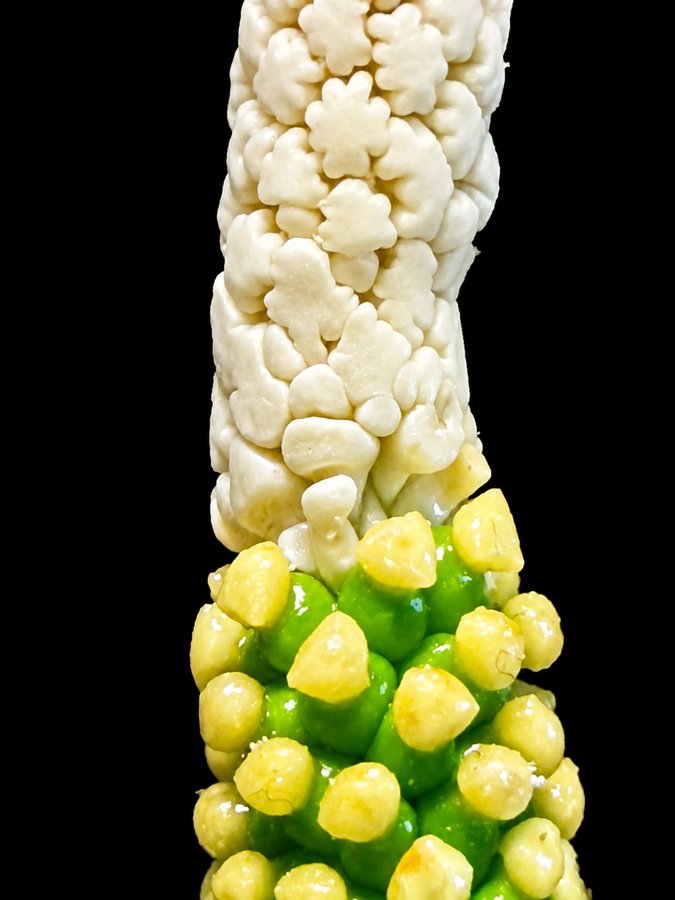
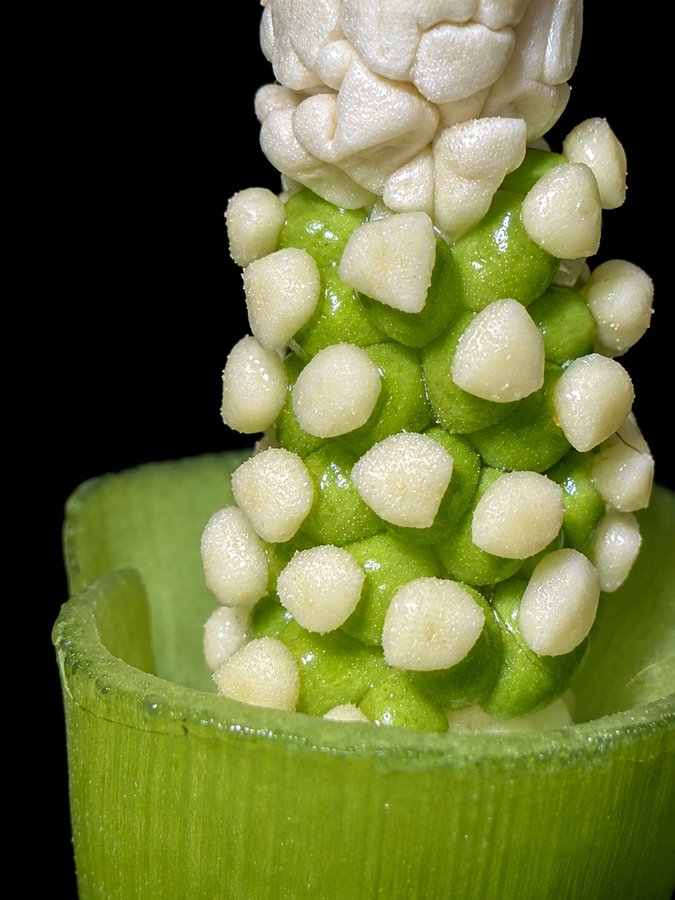
Photographs by Nadine Hafke
Everything else on this page describes a single inflorescence. But an Alocasia almost never makes one. The unit the plant actually builds is a synflorescence — a cluster of inflorescences produced together in a leaf axil, wrapped in membranous cataphylls, and characteristically a pair.
The plant works in a repeating rhythm: a leaf, then two flowers, then a leaf, then two flowers. The flowers arrive in twos — and the gap between them is not an accident.
Pairs are not a tendency, they are the architecture. Hay’s revision of the genus defines the unit precisely: a bimodular synflorescence subunit, consisting of a cataphyll subtending one inflorescence, and a second inflorescence arising in that cataphyll’s axil behind its own two-keeled prophyll. Two. He notes that the organ numbers inside that unit “appear constant throughout the genus”, the only exception being the handful of species — Alocasia minuscula among them — whose inflorescence is solitary.
The growing tip that had been making leaves turns itself into a flower and stops. But the last scale-leaf it made has a bud tucked in its armpit, and that bud makes exactly one more flower before it is spent too. Then the job passes to a new shoot lower down. Two is simply how far one growing tip can go.
Three ways the pairs can be arranged
What happens after that first pair is what makes one Alocasia look so different from another in flower:
One pair, then leaves again. The flowering episode is over in two — the usual case in Alocasia reversa.
Pairs alternating with leaves. Pair, leaf, pair, leaf, so the inflorescences end up scattered along the stem and appear lateral. This is Alocasia macrorrhizos, and it is why the Vanuatu plants read as a continuous sequence.
Pairs stacked with no leaves between. Subunit after subunit, up to about twenty pairs in a robust species like Alocasia sarawakensis, forming a cluster in the middle of the leaf crown. When growth resumes, the stem can carry a whole ring of infructescences below the new leaves, as in Alocasia robusta.
Field surveys agree with the anatomy. In Vanuatu, clusters of three or more inflorescences were extremely rare, and where they occurred two were normal and the rest smaller and sterile; only 0.8–1.5% were deformed or sterile overall.
The two do not open together
This is the part that matters for a cross. The members of a pair open in sequence, about 4.1 ± 0.7 days apart (n = 18). The next pair then follows about 8.3 ± 1.2 days after the second of the last one (n = 16). A well-grown plant runs 8–16 clusters through a season and then rests for 4–12 months.
One honest gap
Hay describes the developmental order — which inflorescence is built first — but nowhere states the order in which a pair actually opens. That they open oldest first is a reasonable inference from how they are built, and it matches the field intervals below, but it is an inference.
- Measured on wild Alocasia macrorrhizos; your plant’s intervals will differ, its rhythm will not.
Why the plant cannot reach itself
Lay the intervals against the two-morning clock from Part III and the architecture becomes an argument. An inflorescence is receptive from the day it opens and sheds its own pollen about two days later. Its partner does not open for another four. By the time the first is shedding, the second is not yet receptive; by the time the second is receptive, the first is finished.
Which is exactly what was observed in Borneo: across 23 plants, no two inflorescences on the same plant were ever in the female and male phases at the same time. The spacing is a geitonogamy-avoidance device — a third lock, after protogyny and self-incompatibility.
But a big plant can break its own rule
Those intervals describe one succession of clusters. A large plant can carry up to eight active inflorescences at once across several clusters at different stages, and then overlaps do occur. That is precisely how the repeated self-pollinations in Part VII were possible: the researchers chose plants carrying five or more clusters and moved pollen between them on successive mornings.
Count the clusters before you plan. One flowering plant is a timetable, not a single chance — miss a pair and the next is roughly a week and a half away. And if you want a hybrid rather than a self, that timetable is telling you to find a second plant.
The plant keeps the record
The flowering history stays legible on the stem. Old clusters leave residual scars on the corm: five-year-old plants carried one to three such regions, and the highest count recorded was 36. If you have an established plant, its own stem will tell you how often it has flowered before you ever saw it.
The spathe is a modified bract, and in Alocasia it is two organs pretending to be one. The lower half is thick, closed, persistent, and forms the floral chamber. The upper limb is thin, pale and membranous — in Alocasia macrorrhizos described as a pale yellow oblong hood — and it is disposable: it decays within days of pollen release and drops off, while the lower half stays to carry the fruit.
The limb does not snap open. In Alocasia macrorrhizos it begins unfolding 18–24 hours before the spadix reaches its most intense scent, and it keeps unfolding right through until pollen is released. Only afterwards, once the male zone and appendix have gone soft, does it bend downward — which is what creates the natural pollen tray described in Part VI.
The spathe is also thermal insulation, and this is measurable rather than assumed. Across 183 Alocasia macrorrhizos inflorescences, spathe width correlated with how far the spadix rose above ambient — r = 0.409 for the appendix, 0.392 for the sterile region, 0.258 for the male zone. A wider spathe shelters the column from convective cooling. When you cut a spathe away to reach the stigmas, you are removing a blanket as well as a lid.
The appendix bears no flowers, occupies about 60% of the spadix, and is the organ that does the advertising. It is also, in one species, one of the hottest pieces of plant tissue ever measured.
In wild Alocasia macrorrhizos in Vanuatu, the appendix reached a mean maximum of 43.9 ± 0.6 °C across 59 inflorescences while the air beside it sat at 22.4 ± 0.5 °C. The highest single reading was 47.4 °C, at 05:50 on a cloudy December morning; a later survey of the same populations recorded 47.8 °C. The greatest departure from ambient was 25.6 °C. Temperature climbs from just before midnight to its peak in about six hours, then falls roughly 10 °C in four.
Bigger appendices run hotter: appendix length against its own temperature deviation gave r = 0.405, and appendix cross-section r = 0.426. Some appendices flush pinkish as flowering ends.
And it is the scent organ
Two independent experiments put the attraction in the appendix rather than anywhere else. In Alocasia odora, when spadices were partitioned inside bags and the visitors counted, 67% of 847 flies were caught at the appendix compartment against 2.5% at the female end. In a four-choice field assay of dissected zones, the appendix drew 4.4 ± 5.6 flies per trial against 0.7 ± 1.3 for the male zone and effectively zero for the sterile and female zones.
Most tellingly, cutting the appendix off reduced fruit set, and cutting off the appendix plus the male zone reduced it further — the first demonstration that the size of an olfactory display feeds through to a plant’s reproductive success.
Do not generalise the fever
In Alocasia odora the appendix runs just 2.4 ± 1.1 °C above ambient — a tenth of the Alocasia macrorrhizos figure — and it is not even the hottest zone. Same genus, same organ, entirely different order of magnitude.
Each male flower in Alocasia has its stamens fused into a single button, the synandrium, and the synandria pack together into a sleeve whose surface texture varies enough between species to help identify them.
The male zone is thermogenic too, and in Alocasia macrorrhizos it runs on a different schedule from the appendix — two peaks, not one. It starts warming 4–7 hours earlier than the appendix, in the late afternoon; its first peak arrives 15 minutes after the appendix peak (+5.8 °C above ambient); and it peaks a second time the following morning, at the moment pollen is released (+6.3 °C). Within a few hours of shedding, it is back to within 1 °C of the air.
In Alocasia odora the relationship inverts: the male zone is the hotter of the two thermogenic parts at 3.5 ± 1.8 °C above ambient, and heat production tracks the air temperature rather than holding a set point — so Alocasia odora is thermogenic but not thermoregulating, unlike the sacred lotus which defends 30–35 °C.
One practical property: Alocasia pollen is dry and light, and has been judged capable of moving short distances on the wind. That is why isolation matters more in a collection of many flowering plants than in a garden with one.
The band between the male and female zones carries synandrodes — male flowers reduced to sterile structures that produce no pollen. Nadine’s draft describes them correctly as spacers separating the two fertile regions. Recent work shows they are also the restaurant.
In Alocasia odora, the sterile zone’s surface seeps an exudate rich in sugars and amino acids, and it is the only food available to the pollinating flies, which have sponging mouthparts and physically cannot eat solid pollen. The consequence is an enormous standing crowd: over 60% of all adult flies aggregate on the sterile zone, including 86.6% of Colocasiomyia alocasiae males and 92.1% of Colocasiomyia xenalocasiae males, lapping at its base.
How much this matters shows in a crude survival test: newly emerged flies given only water mostly died within three days, while flies given a female-phase spadix to feed on lost fewer than 20% over the same period. The sterile band is not filler. It is the reward that keeps a pollinator on the plant long enough to be useful.
And it feeds the next generation too
The exudate feeds the adults. In at least one species the synandrodes themselves feed the larvae — and the zone is built for it. In Alocasia yunqiana, described from Yunnan in 2020, the synandrodes are dimorphic: irregular and green at the base of the sterile interstice, elongated and ivory above it. Its pollinator’s larvae were observed feeding on the green basal ones during anthesis while the ivory ones remained untouched.
The same larval feeding has been seen in Alocasia odora, but without the structural specialisation — its synandrodes are not shaped to the job. Which makes Alocasia yunqiana the clearer case of a sterile zone that has been remodelled around its pollinator’s appetite. (The authors are explicit that further work is needed on what that dimorphism does to fly behaviour.)
So this narrow, apparently pointless band is the restaurant, the nursery’s larder, the spacer and the hinge — it is also the level at which the spathe’s constriction closes.
Each pistillate flower is an ovary carrying ovules on a basal placenta, topped by a stigma. A style may sit between them, may be very short, or may be absent altogether depending on the species. The ovary may be a single chamber or partly divided into locules in its upper part.
Unlike everything above it, the female zone of Alocasia macrorrhizos does not generate heat. This was settled by comparison with a non-thermogenic control: the female zone’s temperature curve tracks that of ordinary petiole tissue almost exactly, except during the roughly 40 hours when the parts above it are burning. It rarely sits more than 2.0 °C above ambient, and its warmest moment (06:00–06:30) lags the appendix peak by 30–45 minutes — the signature of heat conducted downward, not made locally. The narrow constriction and the funnel of the open spathe above it both restrict how much warmth can reach it.
Do not read that as a genus rule. In Alocasia odora, probes set into the female zone found it 1–4 °C above ambient while the spathe was still firmly closed — before any scent, any visitor, or any heat from the zones above it — in agreement with an older report from Okinawa. One species’ female flowers are passively warmed; another’s run a small fire of their own. On this point the genus does not have one answer.
Receptivity — the number that matters most
During the receptive phase the stigmas secrete a stigmatic fluid and visibly wet. That wetness is your signal, and it appears far earlier than most growers expect: in Alocasia macrorrhizos, artificial pollination showed stigmas became fully receptive roughly 24–26 hours before the inflorescence reached peak scent — which is to say about two days before that same inflorescence sheds its own pollen.
And the window is not narrow. Preliminary work found stigmas remained fully receptive for at least three days. Part V returns to this, because it is the single fact that most changes how calmly you can work.
Where suitable pollen lands on a receptive stigma it germinates and pushes a pollen tube down through the tissue toward the ovules. A fertilised ovule becomes a seed; the ovary around it becomes a berry.
The floral chamber is the closed lower spathe, and it is a room with a door that shuts on a timetable.
In Alocasia macrorrhizos, during the night before pollen is released, the constricted section of the spathe tightens until it closes off the space between the male and female zones, while the spathe immediately above it — previously funnel-shaped — flattens out. In Alocasia odora the same thing happens on the same cue, at night, marking the end of the female stage.
Two readings of why, and they are complementary rather than competing. The first is defensive: with the door shut, the plant’s own descending pollen cannot reach its own stigmas, and the chance of selfing drops to a minimum. The second is logistical: insects that were down among the pistils are pushed up and out into the male zone, where there is now more room to move — and where they cannot avoid being loaded with pollen on the way past. The closing door is simultaneously a chastity belt and a turnstile.
Chamber size has consequences. In Alocasia macrorrhizos the female zone is under a tenth of the spadix, so the chamber is small — too small, its observers judged, for the large earwigs that dominate its visitors to move around the pistils comfortably. A small chamber is read as evidence of adaptation to small pollinators.
Part III
Anthesis: the Two-Morning Clock
An Alocasia inflorescence spends about two and a half days doing something very deliberate, and almost all of it happens between four and seven in the morning.
Alocasia are protogynous: the female phase of an inflorescence runs before its male phase. Nadine’s draft puts it plainly — the stigmas are receptive before the same inflorescence releases its own pollen — and that is the fact the whole method is built on.
But the timing alone does not do what it is usually credited with, and it is worth being precise, because the imprecise version makes growers panic about a window that is wider than they think.
- Appendix tissue
- Ambient air
The correction: the windows overlap
In Alocasia macrorrhizos, stigmas become fully receptive around 24–26 hours before the inflorescence reaches peak scent, and pollen is shed a day after that peak. So receptivity begins roughly two days before the plant’s own pollen appears. So far, so protogynous.
The complication is that stigmas stay fully receptive for at least three days. Do the arithmetic and the receptive window is still open on the morning the same inflorescence sheds. Protogyny staggers the two phases; it does not separate them.
What actually keeps the plant from fertilising itself is two other things. First, mechanical: the spathe constriction tightens during the night before pollen release, sealing the female chamber off from the pollen about to fall. Second, physiological: Alocasia macrorrhizos is judged predominantly self-incompatible, and in a controlled test 20 strict self-pollinations and 20 pollinations between plants of the same clone produced no mature seed at all — a few berries began to swell and then stopped, in most cases after about three weeks.
The consequence you have to design around
0 of 40
Strict selfs and same-clone crosses gave zero mature seeds. Your bottleneck is almost never the calendar — it is needing genetically different pollen. Two divisions off the same mother plant are one clone, and crossing them is the same experiment that failed forty times.
The clock, hour by hour
| When | What the plant is doing | What it means for you |
|---|---|---|
| Day 0, early morning | Stigmas become fully receptive and begin secreting stigmatic fluid. The spathe limb starts to unfold, 18–24 h ahead of peak scent. | The window opens here — roughly 2 days before this inflorescence sheds its own pollen. If you have stored pollen, you can already work. |
| Day 0, 15:00–20:00 | Thermogenesis begins. The male zone starts warming first — 4–7 h before the appendix does. | Nothing to do. The plant is preheating. |
| Day 0, near midnight | Appendix temperature starts climbing steeply, reaching its peak in about six hours. | — |
| Morning 1, 05:45–06:00 | Appendix peak — 43.9 °C mean, up to 47.8 °C, as much as 25.6 °C above ambient — coinciding with maximum scent. The male zone peaks 15 minutes later at +5.8 °C. | Peak advertising, and the end of the female phase. Stigmas are still receptive. |
| Morning 1, to midday | Appendix falls about 10 °C in 4 h; the first heating cycle ends between 11:00 and 13:00. | — |
| Night 1 | The constriction tightens shut, sealing the female chamber; the spathe above it flattens from its earlier funnel shape. | The door closes. Access to the stigmas from above is now blocked — this is the deadline that actually matters. |
| Morning 2, 05:45–06:00 | Pollen released. The male zone peaks a second time at +6.3 °C. Rain delays shedding by 30–45 min, sometimes over an hour, and sometimes it does not shed at all. | Collect pollen now, at first light. This is the harvest, not the pollination. |
| Morning 2, 08:00–09:00 | Thermogenesis ends, 36–42 h after it began. The male zone is back within 1 °C of air temperature. | Over. The upper spathe and spadix will now decay and drop. |
Clock times are Vanuatu, not your windowsill
Every time above comes from wild Alocasia macrorrhizos near Luganville, at 15°S, where sunrise is early and the coldest hour is 03:00–05:00. The sequence is what transfers — receptive first, scent peak, door shuts, pollen at first light. The clock face will shift with your latitude, season and growroom lights. Growers report that in cool weather pollen shed slips to two or three days after opening, while in warm weather it comes the very next day.
Part IV
The Fly, the Heat and the Scent
Why does a plant run a 44 °C fever at six in the morning? Because somewhere there is a fly that has organised its entire life around being there when it happens.
There is no such thing as the Alocasia pollination system. Published work reaches a handful of species in four situations, and they are so different that a single summary sentence would be false about all of them. Three of the four are the Asian fly partnership at different degrees of completeness. The fourth is a different continent and a different answer.
Case one — the obligate partner
In Alocasia odora on Okinawa, two drosophilid flies — Colocasiomyia alocasiae and Colocasiomyia xenalocasiae — made up 99.5% of every floral visitor collected. They are not casual visitors. They breed on the plant, feed on it, mate in it, and lay their eggs in it; congeners in the genus are found only on Araceae, Arecaceae and Magnoliaceae, and each fly species usually associates with just one or two host plants.
Their arithmetic inside the inflorescence is striking. During the female phase there were 13.6 ± 3.6 flies per spadix, mostly below the constriction. During the male phase there were 154.8 ± 66.3 — more than a tenfold increase — and every single one was above the constriction, because by then the door had shut behind them.
Case two — the same partnership, proved by subtraction
In Alocasia macrorrhizos in Sabah, Borneo, two more (still undescribed) Colocasiomyia species do the same job, and a bagging experiment settled how much of the job is theirs. Thirteen plants each carried three inflorescences under three treatments:
| Treatment | What it excluded | Fruit fertility rate |
|---|---|---|
| Open control | Nothing — tagged and left alone | 0.89 ± 0.13 |
| Coarse mesh, 2 mm | Bees and other large insects. Flies still got through. | 0.85 ± 0.19 — statistically indistinguishable from the control (P = 0.367) |
| Fine mesh stocking | Colocasiomyia and essentially every other visitor | 0.002 ± 0.007 (P < 0.0001) |
Exclude the bees and nothing happens. Exclude the flies and the plant fails almost totally: only one of thirteen inflorescences set fruit at all — three berries — and each of those inflorescences carried more than a hundred pistils. The bees were there, collecting pollen in quantity; they simply are too large to get down into the chamber where the stigmas are.
Case three — the same species, orphaned
Now move Alocasia macrorrhizos to Vanuatu, thousands of kilometres outside its native range, where it was almost certainly carried by people. Everything about the flowering still works. Plants flower abundantly. Pollen is fertile, stigmas are receptive, and the thermogenesis is the most powerful ever recorded in the genus.
And almost nothing sets seed
2 of 513
Across fourteen wild populations, two flowering plants out of 513 developed normal fruit heads with viable seed. A separate survey found viable seed in two of 552 infructescences — 0.36%. The plants propagate almost entirely by cloning themselves.
The commonest visitor there is not a fly but an earwig, Labidura truncata — over two centimetres long, flightless, and there to eat the pollen. There were 2.45 ± 0.32 of them per flowering inflorescence, more than five on large ones, and inflorescences without any were rare. Being flightless, they cannot move pollen between populations. Drosophilids appeared only rarely, and when they did the earwigs chased them up to the appendix.
Whether the earwigs are the cause of the failure is unresolved — the researchers put it forward as a hypothesis and proposed the exclusion experiment that would test it, but did not run it. Three explanations sit side by side in their paper: too few effective pollinators, earwig interference, and self-incompatibility compounded by the fact that neighbouring plants are mostly the same clone. What is certain is the outcome.
And without an insect, nothing at all
0%
At Mulu in Sarawak, bagged inflorescences of Alocasia princeps and Alocasia sarawakensis — along with eleven other aroids — set no fruit whatsoever, showing that neither apomixis nor autonomous self-pollination occurs. Left open to insects the same species set 61.7% and 81.1% of their female flowers as fruit.
An Alocasia cannot pollinate itself unaided. Something has to carry the pollen — and indoors, that something is you.
This is the case your plant is in
There are no Colocasiomyia in your growroom. Your Alocasia is in the Vanuatu situation: a fully functional inflorescence advertising at full volume to an audience that does not exist. Hand pollination is not a shortcut past nature. It is you taking the fly’s job.
What the fly actually does in there
The Sabah sequence is worth having in full, because it is the behaviour every step of Part VII is imitating. On the first morning the spathe opens a narrow slit and the chamber emits a strong odour; the flies arrive around sunrise, between 05:50 and 06:20, and go in. They stay a full day — feeding, mating, and laying eggs in the spaces between the pistils and staminodes. On the second morning pollen begins to fall before 04:40 and continues until about 06:00, at which point the constriction starts to tighten. The flies escape the closing chamber by crawling up the spadix through a shower of pollen, then fly off to find a female-phase inflorescence on a neighbouring plant.
Their young stay behind. Eggs sit among the pistils; the larvae develop inside the swelling infructescence, bathed in its own secretion; as it dries they pupate in the cavities between the fruits, especially where a fruit has aborted; and the adults emerge, 62 to 89 days later, on the day the ripe infructescence splits open. On the second day of one dehiscence, more than a hundred new adults came out.
And here is the elegant part. In the famous obligate mutualisms — figs and fig wasps, yuccas and yucca moths — the plant pays for pollination by surrendering some of its seeds to the pollinator’s larvae. Colocasiomyia larvae do not damage the fruit. They live on the secretion, not the seed. The plant gets pollinated and keeps everything.
The two zones may be two different nurseries
This part has treated the partnership as one plant and one fly. There is a report that it can be finer-grained than that. Within the spadix of a single plant species, different drosophilid species have been reported to lay their eggs in the male zone and in the female zone — not competing for one nursery, but using two.
The same account names Alocasia, Colocasia and Homalomena as genera whose inflorescences drosophilid flies breed inside. If it holds, the sterile interstice that divides the spadix is not only a barrier for the plant — it is a boundary between two insect territories.
Reported, and thinly sourced
This comes from a Malay-language account of Bornean aroids which states it as established fact and cites no study for it. No pollinator counts, no oviposition tallies and no species names accompany the claim.
Treat it as a lead, not a finding. It is included because it is specific, testable and would change how the zones on your own plant should be read — and because anyone growing these plants with flies present is in a position to look.
How the heat steers them — in Alocasia odora
Thermogenesis is usually explained as a way to volatilise scent, and that is part of it. But recent work on Alocasia odora shows the heat doing something more specific: steering the flies up and down inside a single inflorescence.
Because only the upper spadix heats, and the lower chamber does not, the inflorescence carries a thermal gradient that reverses between day and night. By day, the warming upper zone pushes flies down into the cool lower chamber — onto the receptive stigmas. By night, with the lower chamber fallen to ambient, the still-warm upper zone pulls them back up — onto the pollen. Flies cycle this way one to three times across the female stage, which the authors propose is how a densely packed cylinder of stigmas gets evenly covered instead of patchily visited.
They then tested it directly, by warming and cooling the outside of the spathe:
| Manipulation | Flies in the upper part, before → after |
|---|---|
| Noon: cool the top to 22 °C, warm the bottom to 30 °C | 10.4% → 89.2% — the daytime descent reversed (P < 0.05, n = 10) |
| Midnight: warm the bottom to 25 °C, cool the top to 17 °C | 91.4% → 8.0% — the nighttime ascent reversed (P < 0.05, n = 10) |
| Night: 2,000 lux of light | 79.8% → 72.4% — no detectable effect (P > 0.05) |
Temperature moves them; light essentially does not. The heating traces back to a single gene: an alternative oxidase, AOX1b, switched on specifically in the thermogenic tissue — expressed some 1,800-fold higher in the male zone than in the female zone immediately below it.
Scent gets them there, but does not steer them
The same study ruled scent out as the fine-scale cue, with an argument that is hard to escape: volatile emission is highest at noon on the first day and falls to ambient levels by that night. Yet noon is exactly when the flies are away from the fragrant upper zone, and night — when there is almost nothing to smell — is when they return to it. Scent is the billboard on the highway; the heat is the signage inside the building.
For Alocasia odora the billboard has been read chemically. Nine compounds account for 94.5% of total emission, and six are markedly concentrated in the appendix: methyl propionate, methyl butyrate, methyl 2-methylbutyrate, methyl benzoate, (E)-4,8-dimethylnona-1,3,7-triene and methyl salicylate. Three more — methyl isobutyrate, β-caryophyllene and humulene — are spread evenly across the spadix. Five of the nine are shared with the related Alocasia cucullata, which draws the same flies.
What it actually smells like — and where the smell comes from
Two Bornean species were described at the source in 2019: Alocasia sarawakensis smells ginseng- or mint-like, Alocasia princeps sweetly of jasmine. In both the odour comes from the appendix, is strongest at 06:00 on the first morning, and is present only during the female phase — the male phase is marked by its absence.
But the appendix is not always the source. Hay records species where the scent appears to come from inside the lower spathe itself, not from any floral organ — Alocasia alba and Alocasia robusta among them — against Alocasia odora, where it is the appendix. So “the appendix is the scent organ” is true of the species that have been studied closely, and should not be assumed of yours.
No chemistry exists for the hot one
Those compounds are Alocasia odora. Nobody has published the floral chemistry of Alocasia macrorrhizos — the studies that measured its 44 °C fever never described what it smells like, let alone what it is made of. If you read a compound list attributed to Alocasia macrorrhizos, check the source.
Case four — the one that doesn’t fit
Everything above is the Asian story, and it is a good one: a fly that cannot live anywhere else, a plant that cannot set seed without it. It is also not the only story this genus tells.
In southeast Queensland, Alocasia brisbanensis — the Australian species that spent a century being called Alocasia macrorrhiza in the literature — has its own conspicuous resident fly, Neurochaeta inversa. It lives on the leaves and in the spathe, lays its eggs on the female flowers, and its larvae develop inside the sealed chamber in the broth left behind when the sterile florets dissolve. Up to 77 of them have been counted in a single head. It looks exactly like the partner you would expect.
It is also, on its own merits, one of the strangest insects in this story. Its describer knew it for years as the “upside-down fly”: on any vertical or sloping surface it holds its head downwards, always, and compensates by being able to run in any direction — backwards is simply uphill. Put a jar of them on its side and every fly turns at once to restore the orientation. Across thousands of individuals in the field he recorded no exception but injured ones.
The flies were never found on cultivated plants — not once, despite the species being common in Sydney gardens and despite years of sweeping the vegetation around them. They live only with Alocasia in its original rainforest habitat.
Hold that beside what the garden plants do, because the two halves fit together and nobody put them together at the time: the fly is absent from cultivated Alocasia, and cultivated Alocasia sets seed perfectly well.
It was tested, twice, and it failed.
The number that settles it
98.1%
Seed set in a garden plant at St Lucia, Brisbane — a site where not one Neurochaeta inversa was ever recorded. Across 41 heads, seed set showed no relationship to the number of flies present; the regression was not significant. Heads packed with the fly set as little as 4.2%. Heads with none of it set as much as 98.1%.
It is worth being fair to the original claim, because it was never a strong one. The fly’s describer wrote only that egg-laying females “may well be pollinators,” and added in the same sentence that since many insects come to the flowers they are “probably not the sole pollinating agents.” He reported no pollen on any fly — the word does not appear in the paper — and never witnessed oviposition either. The later work did not overturn an observation. It tested a hedge, and the hedge did not hold.
So who does it? Nobody has proved it. The authors’ own best candidates were the two visitors present at every site they sampled — a sap beetle, Brachypeplus, and an unidentified rove beetle — which also happens to agree with a record from 1898 naming a Brachypeplus as the pollinator of this plant. The stingless bee Trigona carbonaria is the other possibility, and a good one: pollen pellets taken from returning bees were almost pure Alocasia, six samples with four foreign grains between them. But Trigona is absent from some sites that set seed well, which is the same objection that killed the fly.
Do not assume the insect you keep finding in your inflorescence is the one doing the work. The most abundant visitor in Alocasia brisbanensis turned out to be a lodger, not a pollinator — it uses the chamber as a nursery and contributes nothing on the way in. Two careful studies, twelve named insect taxa, and the honest answer for that species is still we don’t know.
Which is also the argument for doing it yourself. A brush is the only pollinator whose behaviour you can be certain of.
Case five — the one nobody cites
There is a fourth Alocasia with a named pollinator, and it has been sitting in Javanese journals since 1933. In Alocasia puber, the flies that do the work are not Colocasiomyia at all. They are flies of the genus Atherigona — filed under Anthomyiidae when they were recorded, placed in Muscidae today; a different family from the Bornean pollinators either way — and their life cycle is, if anything, more tightly bound to the plant than the Bornean one. The original account, read at the source: the eggs are laid on the male flowers during the female stage; the larvae feed on those male flowers as they rot into a sour liquor inside the sealed, still-living lower spathe; the seal is the spadix axis itself, and the flies emerge at exactly the moment it rots through — six adults were reared from a single spathe. The plant does not merely host them. It times their release.
The same account describes the plant recruiting them in three steps — odour from a distance, then colour from about half a metre, then the male flowers themselves at contact, possibly through taste organs in the flies’ feet.
Read this one carefully
The 1933 original has now been read, and it upgrades some of this and retires the rest. The brood cycle above is first-hand 1933, reared to adults. The famous temperature is not: the figure of 24.5 °C above ambient that later summaries carried appears nowhere in the original. What 1933 actually prints, thermometer in hand: an appendix at 39.9 °C against morning air of 21.7; another at 41 °C on the surface and 45.3 °C in the pith; in the author’s own words, “a good 20°” above the air, burning from about 5 to 9 in the morning. Two honest limits remain: pollination itself is the author’s inference from flies moving between old and young inflorescences — no pollen transfer was ever observed — and a second, smaller fly that went deepest into the chamber was never identified, because the captured specimens were eaten by a housemate.
What it changes is the shape of the claim. Colocasiomyia is the Asian rule and the best-documented mutualism in the family, but it is not the whole of the genus even inside Asia. Java has a muscid. Queensland has something nobody has identified. Five species have been watched properly, and they have not all given the same answer.
A last piece of context
A survey of every published case of floral thermogenesis — 147 species across 15 families — found that 90.5% separate their male and female structures in space, and that of the 71 species maturing their sexes in sequence, 70 are protogynous. Beetles pollinate 70.1% of them and flies 32.2%. Your Alocasia is not an oddity. It is a well-drilled member of a large club whose members all keep insects on the premises for hours or days at a time, rather than for the seconds a bee spends on a rose.
Part V
Reading Your Own Inflorescence
You cannot control the clock, so the skill is reading where on it you already are. Five signals, in the order they arrive.
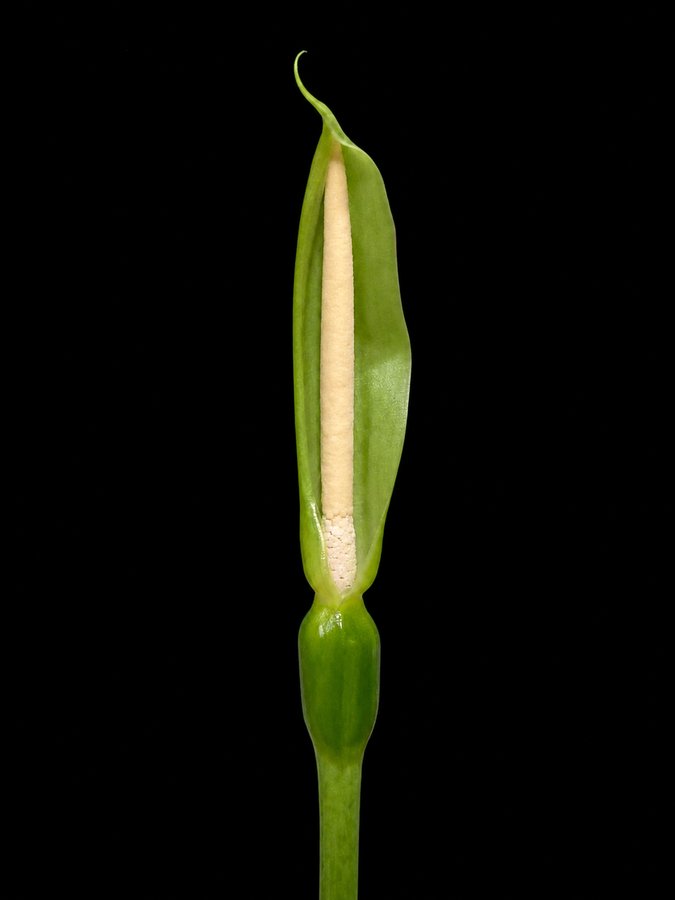
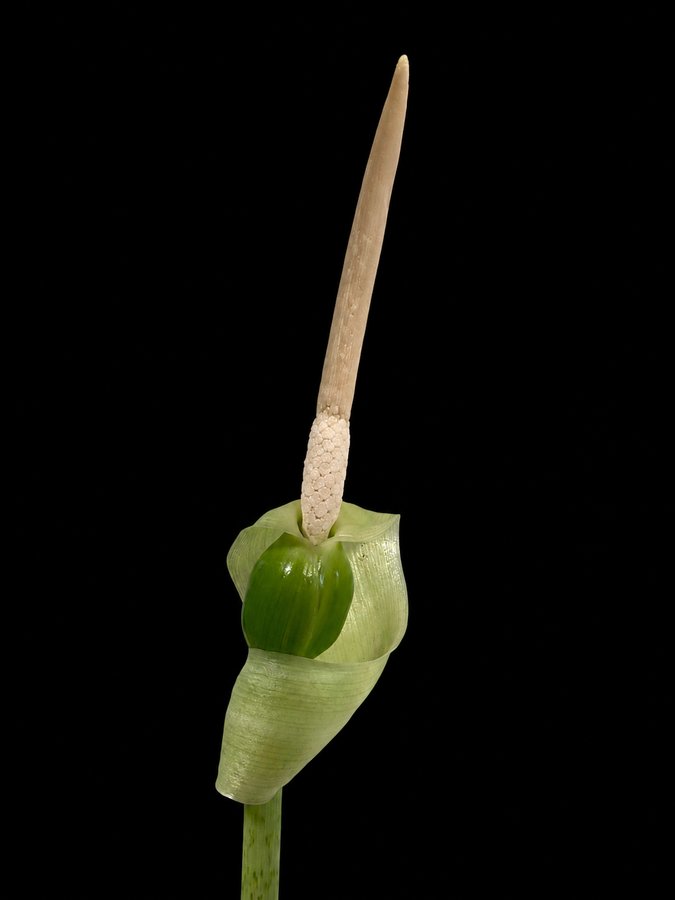
Photographs by Nadine Hafke
First, the thing that will calm you down
Minutes vs. days
Collecting pollen is a same-morning, once-only job — miss the hour and that inflorescence’s pollen is on the floor. Putting pollen onto stigmas is not: they stay fully receptive for at least three days. Almost every “I missed the window” story is really a missed collection, not a missed pollination.
1 · The spathe starts to unfold
Not a snap, a slow unwrapping — beginning roughly a day before the inflorescence reaches peak scent, and continuing right up to pollen release. Often it starts during the night, which is why the habit that matters more than any technique is looking at your plants in the morning. An inflorescence you check only in the evening can pass through its entire female phase unseen.
2 · A slit you could post a fly through
Long before the spathe gapes, it opens a narrow slit — and in the wild that is already enough. This is the stage at which Colocasiomyia walk in. Nadine’s instruction is exactly right and worth repeating: even a gap just wide enough for a small fly means you should be checking the stigmas. Do not wait for the spathe to look open in a way that satisfies you.
3 · The constriction loosens
The waist of the spathe relaxes as the female phase begins — this is the plant opening the door for its pollinator, and it is the access route you will use. It is also the signal with a deadline attached, because the same constriction tightens shut during the night before pollen release and does not reopen. Once it has closed, that inflorescence is finished as a mother.
4 · The stigmas are visibly wet
This is the one that decides. During receptivity the stigmas secrete stigmatic fluid and glisten — described in the aroid literature as a tiny drop of liquid on each tip. Wet stigmas mean go. Dry ones mean you are either early or, more likely, late.
That fluid is not only a signal. It is what makes the whole brush technique work: dab a dry brush on wet stigmas and the brush picks up just enough moisture to hold dry pollen on the next dab. Part VII depends on this.
Read the fluid, not the calendar
Clear & sticky, or milky?
Growers who do this often watch the quality of the secretion, not just its presence. Clear, shiny and sticky means receptive. When it turns milky, dull or watery, that flower is finished — the stigmas will not take pollen however wet they look.
This is the most precise field signal in the whole article, and it resolves an apparent contradiction. The measured receptive window is at least three days; experienced growers often say “the first day.” Both can be true, because the fluid does not switch off — it degrades. Judge the state, not the elapsed hours.
The one published version of this test says something different
The rule above is grower practice, and no published study tests it. The only researcher to describe the same surface day by day was Dorothy Shaw, working on Alocasia brisbanensis, and what she recorded runs the other way. Receptive stigmas were white, opaque and rough, and held their shape when touched with the tip of a needle. By about the fourth or fifth day they turned glossy and smooth — “like white toothpaste” — and collapsed under the same needle. She saw no free moisture on or around the pistils at all until roughly day seven, when the sterile florets above them deliquesce and flood the chamber.
So in her species, glossy is the late sign, not the ready one, and visible wetness arrives after the window has shut.
The two may not really disagree. Growers are judging a droplet of exudate; Shaw was judging the stigma surface itself under a microscope, in a different species, through a cut window. But nobody has run the experiment that would settle it — pollinating at known intervals and counting seed — and Shaw says so herself, in as many words. Until someone does, use both: if the fluid looks clear and the stigmas still look matte, you are early enough. If either has gone glassy, assume you are late and try the next inflorescence.
5 · Scent, and — sometimes — heat
The scent peaks in the early morning, one day before pollen falls. On a strongly thermogenic species you can also simply feel it: an appendix at 43 °C against a 22 °C room is unmistakably warm to a fingertip, and it tells you the plant is at peak advertising.
But do not use heat as a gate
The 44 °C figure is Alocasia macrorrhizos, a giant. Alocasia odora runs about 2.4 °C above ambient at the appendix — real, measurable with a thermocouple, and completely undetectable by hand. Feeling no warmth on an Alocasia azlanii tells you nothing at all. Trust the wet stigmas.
Is this one a mother or a father?
Every inflorescence is both, two days apart, so the question is really about what else you have available. Decide early, because the choice changes what you do to it:
-
As a mother
You need pollen already in hand — from another plant, fresh that morning or out of the freezer. Get access to the stigmas while the constriction is still loose, and keep its own male zone from contaminating the result.
-
As a father
You need to be there at first light on the second morning with something to catch pollen on. Then it goes straight onto a receptive stigma, or straight into the freezer.
-
As both, on the same plant — probably not
Pollen from one inflorescence onto its neighbour on the same plant is a self, and selfs mostly fail: 20 strict selfs plus 20 crosses between plants of the same clone produced no mature seed. Worth doing only as the deliberate repeated-pollination experiment in Part VII, not as a first attempt.
Planning ahead: the plant’s own rhythm
Two inflorescences at once is not luck, it is the norm — Alocasia characteristically produce them in pairs. Field measurements on wild Alocasia macrorrhizos give the intervals you can plan around:
Within a pair, the second inflorescence opens about 4.1 days after the first. Between one pair and the next, about 8.3 days. A well-grown plant in season runs through 8–16 clusters and then rests for 4–12 months. So a flowering plant is a predictable sequence of chances over several weeks, not one chance — and if you miss this week’s, next week’s is on its way.
One further detail with a sting in it: in Borneo, no two inflorescences on the same plant were ever in the female and male phases at the same time, which the observers read as the plant actively avoiding pollinating itself. Your plant is not trying to help you cross it with itself. Plan around a second plant, or around stored pollen.
Write it down the same morning
Record the date the spathe first opened for every inflorescence you are watching. After two or three you will know your own plant’s intervals under your own conditions, which is worth more than any figure in this article — and it lets you predict, roughly a week out, when a second plant will be receptive for pollen you are about to collect.
Part VI
Collecting and Storing Pollen
This is the appointment you cannot reschedule. Pollen falls once, early, and gravity takes it away.
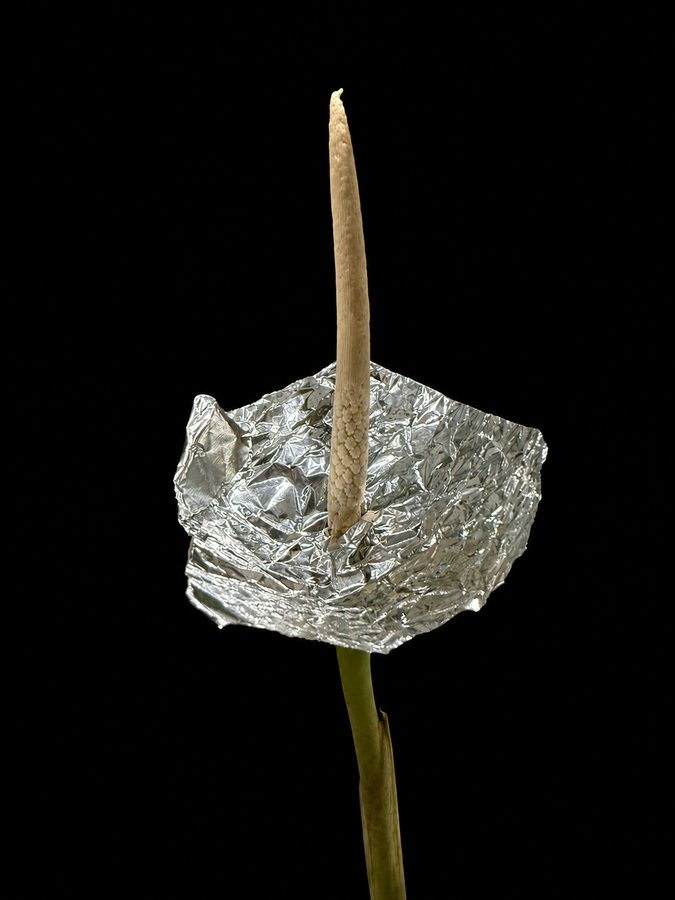
Photograph by Nadine Hafke
Because Alocasia are protogynous, a controlled cross needs a pollen donor before it needs a mother — and unless you have two plants conveniently two days out of step, that means catching pollen and keeping it.
When
Early. In wild Alocasia macrorrhizos the first pollen appeared between 05:45 and 06:00, and in Borneo shedding had already begun before 04:40 and ran until about 06:00. Growers are advised to plan crosses for early morning precisely because thermogenesis, scent and pollen release are all synchronised there.
Weather moves it. On rainy days shedding was delayed 30–45 minutes, in extreme cases more than an hour — and sometimes pollen was not released at all. Growers report the same in reverse: cool conditions push shedding to two or three days after the spathe opens, warm conditions bring it to the very next day.
-
Method one — let the spathe be the tray
Wait until the upper spathe bends outward and downward. This is not wishful thinking: once the male zone and appendix soften after anthesis, the spathe does fold down, and it forms a natural collecting surface directly beneath the male zone. Falling pollen gathers there and you lift it off with a brush.
Simplest, cuts nothing, and costs you no access. The trade-off is that you are relying on the spathe to bend the way you want, when you want.
-
Method two — the foil collar
Once the spathe has opened, remove it down to roughly halfway along the floral chamber so the male zone is freely accessible, using a sharp craft knife or fine-pointed scissors. Cut a small square of aluminium foil, slit it from one edge to about the centre, and slide it around the spadix so it sits directly under the male zone as a collecting tray.
More reliable, and it lets you see what you are doing. It also commits that inflorescence — you have opened the chamber.
-
Lift it with a dry brush
Alocasia pollen is dry, unlike the moist, stringy pollen of Philodendron and Caladium. A clean, completely dry brush is all you need. If you are pollinating immediately, go straight to Part VII.
Why storage is worth attempting at all
Binucleate
Aroid pollen comes in two kinds. Trinucleate grains — Arum, Amorphophallus paeoniifolius — are finished within days whatever you do. Binucleate grains store: Amorphophallus pollen frozen at −24 °C has produced seedlings after seventeen months, and titan arum pollen held at −80 °C was still viable after three years.
Alocasia is binucleate. Nobody has tested how long its pollen keeps, but it is the type that ought to.
Storing it
One rule governs everything else: if the pollen contacts moisture it will not stay viable. Every step below is in service of that.
-
Dry container, desiccant, airtight
Brush the pollen into a small paper envelope, and put the envelope into a small airtight container with a silica gel packet.
Paper first is the point, and growers are emphatic about it: glass and plastic hold moisture against the pollen, while paper lets it move away. Some skip the outer container entirely and keep pollen in paper alone for that reason. The published protocol uses a capped glass tube with desiccant — which works for the same underlying reason, because the desiccant is doing what the paper does. What ruins pollen in every account is trapped damp.
-
For a shy species, keep the brush with the pollen
Jewel Alocasia and other small species can shed so little pollen that most of what you collect is lost on the way to the envelope. A neat fix from growers who breed them: use a cheap single-use brush to sweep the pollen up, then store the brush inside the envelope with it. Whatever stayed in the bristles is still there when you come to pollinate, and you apply it with the same brush.
-
Label it before it goes in
Plant name and collection date, on the container. This sounds like housekeeping and is actually the experiment: unlabelled pollen in a freezer six months later is not pollen, it is a guess.
-
Freeze it
Into the freezer, sealed. No published source specifies a temperature for aroid pollen — the protocol in the literature says simply “a freezer,” so a domestic one is what the method has actually been tested in.
-
Thaw slowly, and never onto cold glass
Take the container out a few hours before you need it and let it come to room temperature still sealed. The reason is the rule above: a cold container opened in a warm room condenses water on the inside, straight onto the pollen. Warming it shut is what prevents that.
How long it lasts — honestly
The one published estimate is several months, possibly up to a year, with the frank rider that used within a year “the chances are fair it will be viable” and that the method does not always work. No viability assay for Alocasia pollen appears to have been published at all — there is no germination curve, no percentage, no half-life. Treat stored pollen as probably good and increasingly doubtful, and when a cross fails, suspect the pollen before you blame the plant.
Why freezing is reasonable here — an inference, not a citation
The published caution against freezing aroid pollen is specifically scoped to genera whose pollen is wet and stringy — Philodendron and Caladium are the named cases, and long-term frozen storage of those is expected to fail. Alocasia pollen is dry, which places it on the other side of that line. No source states this directly; it follows from combining the two, and you should hold it as a well-founded inference rather than an established fact.
Dry pollen travels
Alocasia pollen is not just dry but light enough to be judged capable of short-distance wind dispersal. Two consequences. Work with open vials away from other flowering inflorescences. And in a collection with several plants in bloom, isolating a pollinated inflorescence stops being optional — which is Part VII’s last step.
Part VII
Making the Cross
Nine steps and a clean brush. The one that decides it is step nine — going back and doing it again tomorrow.
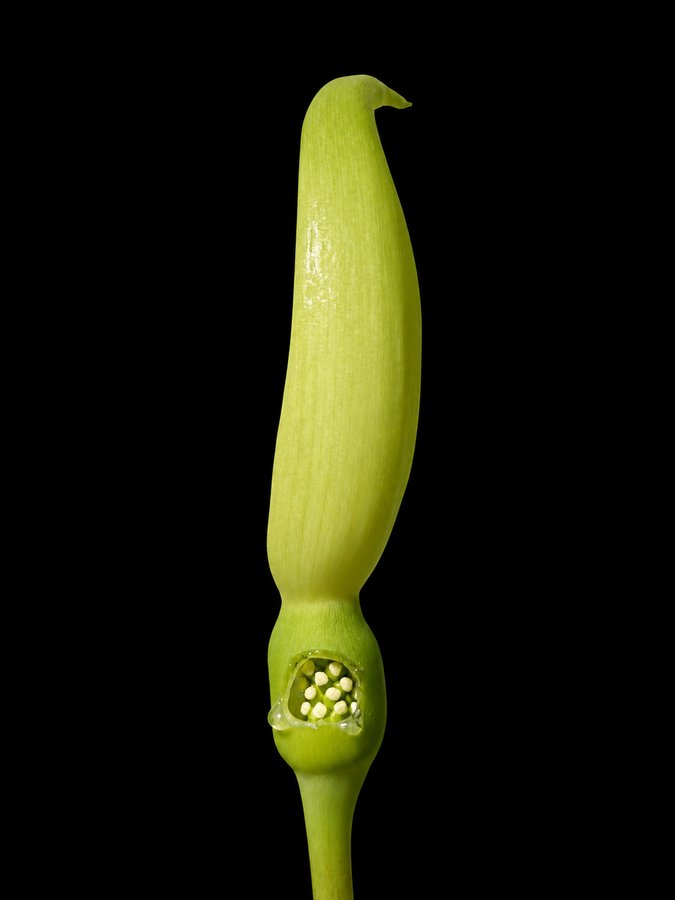
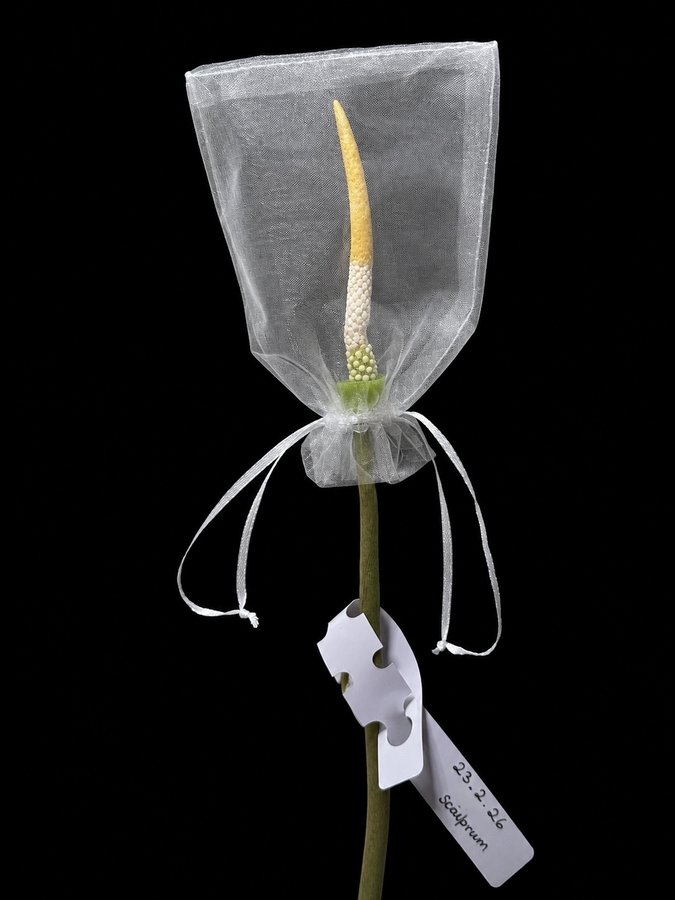
Photographs by Nadine Hafke
Why “as many as possible” is the instruction
More is safer
In wild Alocasia macrorrhizos, fruit heads that reached maturity were observed to carry at least twenty berries with viable seed, while heads with only a few developing berries usually failed to reach maturity. The researchers offer this as the likely reason so little seed was set in that population.
Read it as a reason to cover every stigma you can reach — a thinly fertilised head on a large inflorescence is more likely to be shed than carried.
But twenty is not a pass mark
That figure is an observation, not a tested threshold, made on a giant species carrying more than a hundred pistils, in a population where only two plants in 513 set seed at all. It describes whether the head stays on the plant — not whether a seed is viable.
Plenty of smaller Alocasia never carry twenty ovaries even when every flower is fertilised, and growers have raised new hybrids from a single mature berry. If you get three berries, you have three berries worth having. Do not read a low count as a failed cross.
-
Check in the morning, and confirm the stigmas are wet
The spathe often begins opening overnight, so make the morning inspection a habit. As soon as a gap has appeared — even one only wide enough for a small fly — look at the stigmas. If they are moist with stigmatic fluid, they are receptive and today is the day. Do not put it off; the constriction shuts on its own schedule.
-
Get access — but leave the lower spathe on
Two options, both with a sharp craft knife or fine-pointed scissors. Either cut the spathe down to roughly halfway along the floral chamber, or cut a small window — a “keyhole” — into the chamber over the female zone.
Growers choose between them by where the plant lives. Under glass or outdoors, the keyhole wins: the remaining spathe keeps rain and insects off the developing berries. Indoors, with neither to worry about, it is easier to take the whole outer layer of the spathe off and work in the open.
If your plants are grown open-sided or outdoors, it is also worth wiping the spathe with rubbing alcohol before you cut, and using a sterile blade. You are opening a moist chamber that will stay closed for months.
Whichever you choose, do not strip the whole spathe away. Experienced breeders deliberately keep the remainder because it goes on protecting the developing berries for months afterwards — and, as Part II notes, it is also thermal insulation for the column.
-
Optional: emasculate, for a cross you can defend
For a rigorous result, remove the inflorescence’s own male zone together with the appendix, cutting through spathe and spadix at the constricted region, before it starts attracting insects. This is the protocol used in the Vanuatu breeding programme, and it eliminates the plant’s own pollen as a variable.
The cost is real: you are removing the scent organ and most of the thermogenic tissue. For a hand cross that does not matter, because you are not recruiting anybody. Pollinate immediately after emasculating.
-
Load the brush off the stigmas themselves
With a clean, dry brush, first dab gently at the stigmas. This does two jobs: it loads the brush with the sticky fluid that will hold the pollen, and it clears some of the excess so the grains actually meet the stigma rather than floating on it. Then dab the brush into your pollen.
Check the fluid as you go. Clear, shiny and sticky means you are in time; milky, dull or watery means that flower is already past it (Part V).
Add no water. The stigmatic fluid is the only adhesive the system needs, and it is the only one that does not risk the pollen.
-
Cover as many stigmas as you physically can
Dab the loaded brush gently and as evenly as possible across the stigmas — every one you can reach. Thoroughness here is what makes the difference between a head the plant carries and one it sheds. A large inflorescence may hold well over a hundred pistils; a small species may hold a dozen. Cover what is there.
-
Come back tomorrow, and the morning after
This is the step almost every grower guide omits, and the evidence for it is strong. Because stigmas stay receptive for at least three days, you can pollinate the same inflorescence two or three times on successive mornings, at intervals of one or two days.
It matters enormously. Single self-pollinations produced mature seed zero times out of forty. Selfs repeated two or three times gave 17 mature infructescences out of 46, one of them carrying more than eighty seeds. Whatever the mechanism — more ovules reached, or incompatibility wearing down — repetition converts failures into fruit.
-
Bag it
Enclose the inflorescence in a fine-mesh organza bag and secure it carefully at the bottom, so no insect can reach the female zone and add pollen you did not choose. In the Vanuatu programme cotton was used for the same purpose. This matters more than it sounds: Alocasia pollen is dry, light, and judged capable of drifting on air currents, and berries have been observed setting on inflorescences where no pollination was attempted at all.
-
Label the plant, not your memory
Attach a loop-lock label carrying the date and both parents, seed parent first. Months from now, when several plants are carrying berries, the label is the only thing standing between you and a seedling of unknown parentage — which is, for breeding purposes, no seedling at all.
Bagging looks like it should ruin everything — it doesn’t
Part IV reported that bagging in fine mesh cut fruit fertility from 0.89 to 0.002. That experiment was testing natural pollination: the mesh kept the flies out, so no pollen ever arrived. You have already delivered the pollen by hand. The bag is now doing only the second half of the flies’ job — keeping other pollen out — which is exactly what you want.
What to expect from a genuine outcross
When the pollen is compatible and comes from a genuinely different plant, the success rate is high. Of 88 artificial pollinations between five different Alocasia macrorrhizos morphotypes from different wild populations, 79 developed large infructescences — carrying up to 236 seeds, at nought to four seeds per berry.
If you are choosing between candidate parents, the hybrid dashboard records 153 crosses that have already been made and which species they used — a faster answer to “will this work?” than any generalisation.
Set that beside 0 of 40 for single selfs and same-clone crosses and the practical conclusion holds: the hard part of hybridising Alocasia is sourcing unrelated pollen, not the brushwork. Two divisions of the same plant, or two imports from the same tissue culture line, are one clone.
Hard, though, is not the same as impossible — and it is worth knowing where the line actually falls. Repeating a self on two or three successive mornings lifted it from 0 of 40 to 17 of 46. And in Kerala, five plants raised from a single accession — genetically one clone, insect-visited but never hand-pollinated — set 488 berries and 618 seeds between them. So a plant that has no partner is not barred from setting seed. It is simply a much worse bet than an unrelated cross, and the seedlings will not be hybrids.
A fourth point on the same line
96 seedlings
A 2025 study of leaf‑trait inheritance lists a selfed Alocasia odora among its twenty crosses and scores 96 progeny from it. Pollen was collected fresh and applied daily, through a season and a half of flowering.
That is worth setting beside the numbers above, and it is worth reading carefully. The paper was not studying breeding systems. It reports no success rate — ninety‑six is the number of seedlings scored for leaf shape, not a percentage, and how many attempts produced them is not recorded. It is also a different species from the one behind the 0 of 40.
What it does establish is that a self in this genus can carry all the way to a hundred raisable seedlings — which “zero of forty” on its own does not lead anyone to expect. And the method that got there is the one this part already teaches: repeatedly, not once.
One further fact, offered as nothing more than a fact. Alocasia odora is a tetraploid — 2n = 56, against 28 across most of the genus. Nobody has tested whether that has anything to do with it, and nobody has proposed that it does.
The wet-slurry method, and why this page doesn’t teach it
You will find an older aroid protocol that mixes pollen into sterile water as a thick “pollen soup,” dribbles it into an uncut floral chamber with a dropper, and tapes the spathe shut. It exists to solve the problem of reaching stigmas without cutting anything — and the same source warns that pollen which contacts moisture loses viability. Cut a window instead and the difficulty the slurry was invented for disappears. If you do try it, treat it as an experiment rather than the standard method.
Part VIII
The Berries
Now the part that takes the most patience and offers the least feedback: waiting, and learning not to trust what you see.
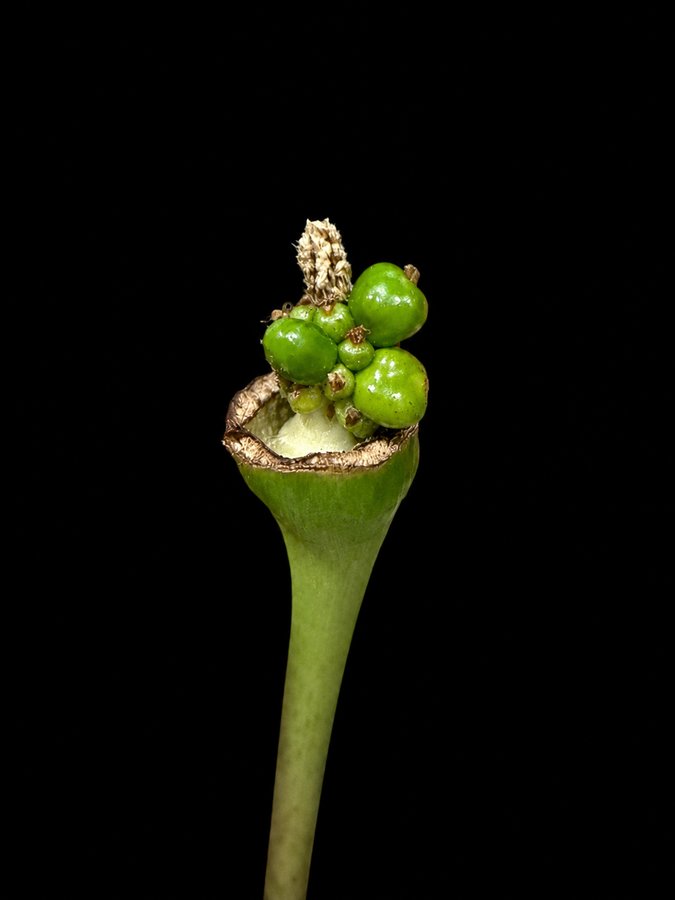
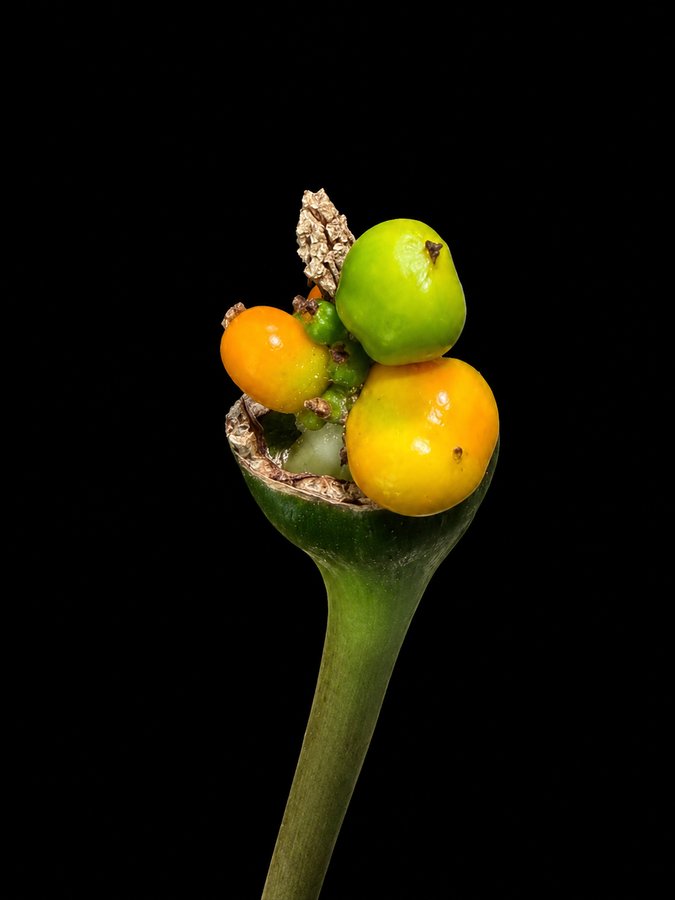
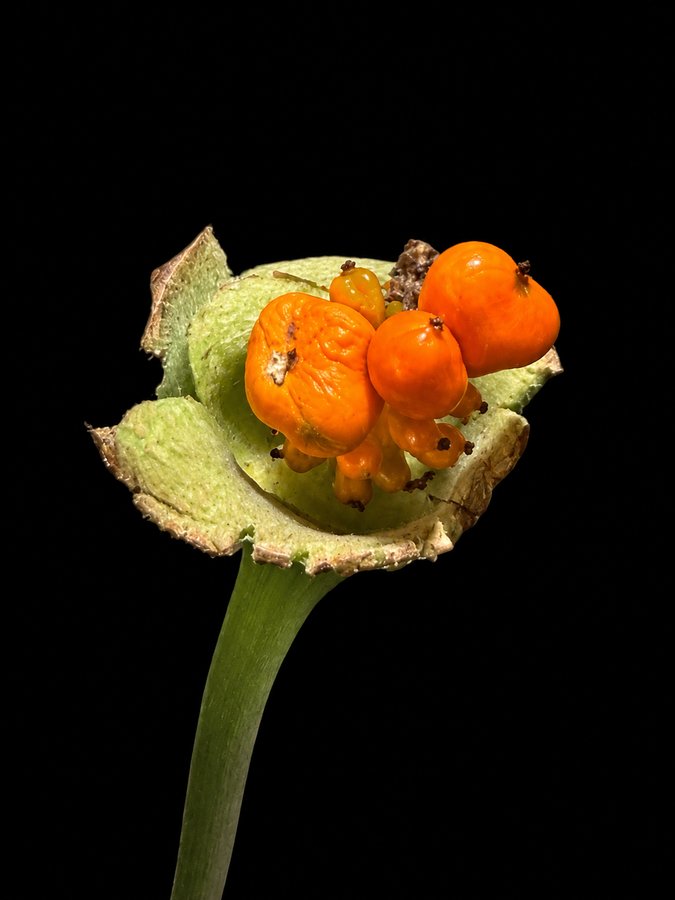
Photographs by Nadine Hafke
Over the weeks after pollination the ovaries either begin to swell or they do not. Swelling is the first encouraging sign — and it is not evidence of anything.
Berry set is not seed set
Ovaries can enlarge without containing developed seed. Breeders who do this routinely report cleaning a particularly heavy head of berries and recovering fewer than a dozen seeds with a fair chance of being fertile. Worse, berries have been observed forming on inflorescences where no pollination was attempted at all — a plant can self from a neighbouring inflorescence without your help.
So a swelling head is not proof your cross worked. The proof is seedlings large enough to show hybrid characters, which is the standard serious breeders actually hold themselves to.
The two-day sign, and what it is worth
There is an earlier tell than anything in the literature. Growers report that a successfully fertilised pistil often develops a dark spot within a day or two of pollination. It is the first thing you will see, and it comes weeks before the head declares itself.
Treat it as encouragement, not proof. It says a pollen tube found its way; it does not say a seed will follow, and the same head can still arrest at three weeks. (Grower observation; no published study tests it.)
The three-week test
There is one early read available, and it is worth knowing because it saves months. When pollen is incompatible, development does not simply fail to start — a few berries begin to swell and then stop, in most cases after about three weeks. The same stalling was seen in taro.
What to watch for at week three
~3 weeks
A head that swells and then arrests around week three is telling you the pollen was incompatible — most likely a self, a same-clone cross, or an interspecific combination the plant rejects. A head still visibly gaining volume at week four is a genuinely good sign. Either way you have your answer months before the colour changes.
How long full ripening takes
Longer than you want, and the honest answer is a wide range that depends on the species and the cross:
| Reported time to ripe seed | What was measured |
|---|---|
| 45–90 days | Wild Alocasia macrorrhizos in Sabah — the general figure for how long fruits take to mature there. |
| 9–11 weeks | Alocasia macrorrhizos in Vanuatu, from 79 documented artificial outcrosses: infructescences were ready for harvest 9–11 weeks after crossing. |
| 1.5–3 months | Wild Alocasia princeps and Alocasia sarawakensis at Mulu, Sarawak — 2.5–3 months and 1.5–3 months respectively. |
| ~5 months | A documented hobbyist cross of Alocasia azlanii × Alocasia baginda ‘Dragon Scale’ — the berries took five further months to ripen. The longest of the Alocasia figures, and an interspecific cross of two small species. |
| Up to 6 months | Reported by hobbyist growers in cultivation. Not a published figure, but consistent enough to plan around — the upper end of what a grower should expect before assuming failure. |
| Over a year | Not Alocasia. A family-wide upper bound quoted for Araceae generally. Included here only so you can recognise it as out of scope if you meet it — do not plan around it. |
Plan for something between two and five months, expect the longer end for a cross between species — and do not panic past it. Hobbyist growers report waits of six months, and the spread between one grower and the next is wide enough that no published figure will settle it for your plant. Expect to keep watering and watching the whole time. The breeder of that five-month cross records allowing the fruiting plant no neglect — not even on holiday.
Reading the colour
Berries start pale — white to tan — then move through green and yellow into the warm shades. Where they finish is more variable than most guides admit. A survey of 34 Alocasia species compiled for this article breaks down as:
Ripe infructescence colour, 34 species
24 · 7 · 3
24 species ripen somewhere in the orange range — light orange through orange to red-orange, taking in Alocasia macrorrhizos, Alocasia zebrina, Alocasia reversa and Alocasia cucullata. 7 ripen red, among them Alocasia odora, Alocasia sanderiana’s neighbours in the red-orange group and — relevant to the plate above — Alocasia lauterbachiana.
And 3 do not go warm at all: Vietnamocasia dauae (published as Alocasia rivularis) and Alocasia scalprum ripen pale cream, and Alocasia azlanii ripens white.
So “wait for red” is wrong for roughly two thirds of the genus, and waiting for any warm colour is wrong for three species. Learn your own plant’s progression the first time through; after that it is the only reference you need.
What the spathe does at the end
In most Alocasia the lower spathe stays wrapped around the developing head for the whole ripening period — which is why Part VII asks you not to remove it. As the fruit matures it eventually opens by itself, splitting and bending back to expose the ripe berries. In some species it instead withers or falls away before the fruit is fully ripe.
There is a nice species-level wrinkle here. In many Alocasia a hole develops at the apex of the infructescence before it splits, because the tip of the spadix axis decays as the fruit ripens. Alocasia macrorrhizos is an exception: its axis persists, so the head stays completely sealed until it dehisces. Which of these your plant does determines whether you can see in before it opens.
When to harvest
Let them ripen fully on the plant. Pick only once they have developed a clear ripe colour — or simply wait for fully ripe berries to detach and fall, which is the plant’s own signal.
You are not the only one waiting
In the wild, ripe fruits are eaten fast. Bird dispersal used to be an inference from fruit colour; at Mulu it was watched happening — bulbuls and sunbirds taking the exposed berries of Alocasia sarawakensis as the lower spathe split back. Fruits are also taken after the head opens and sometimes before it does. If your plant fruits outdoors or in a greenhouse with access, the last few weeks are exactly the wrong moment to stop protecting it. Leaving the organza bag on through ripening costs nothing and also catches any berry that drops while you are not looking.
Part IX
Inside the Fruit
A swelling berry is the outside of the story. Inside, three things are happening at once — and only one of them is yours.
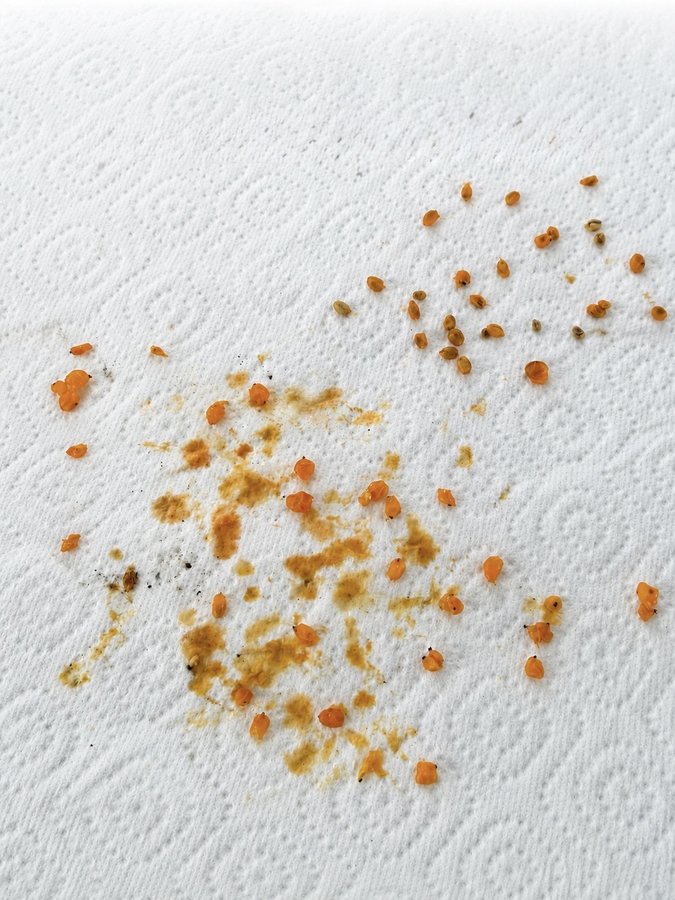
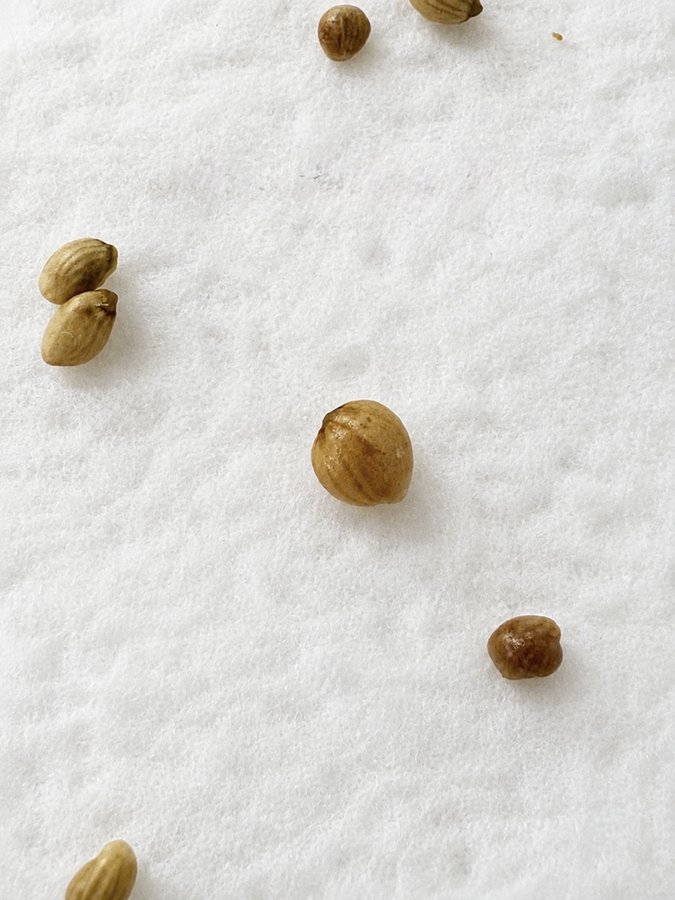
Photographs by Nadine Hafke
Each fertilised ovary becomes a berry, and each fertilised ovule inside it becomes a seed. Because the pistillate flowers were packed shoulder to shoulder along the spadix, the berries that develop from them are packed just as tightly: collectively they form the infructescence, the fruiting head.
Meanwhile the rest of the inflorescence is dismantled. The upper spathe and the upper spadix — appendix, male zone, and the sterile band — begin to decay within days of pollen release, wither, and drop away. Only the lower spathe and the female zone continue.
The ovary, and how much it varies
An Alocasia ovary carries several ovules attached to a basal placenta in its lower part. The details are not fixed across the genus: the ovary may be a single chamber or partly divided into locules in its upper region, and the orientation of the ovules varies too. This is one of the reasons Alocasia seed counts are so inconsistent between species.
Not every ovule becomes a mature seed, and the shortfall is normal rather than a fault. Counts from wild plants give one to five seeds per berry in Borneo and nought to four in Vanuatu — note that nought is in the range. A single berry containing no seed at all sits happily among its fertile neighbours, looking identical.
What a good head can hold
100+ berries · up to 236 seeds
An infructescence on an old, large wild plant usually carries more than a hundred berries. The best documented artificial outcrosses yielded up to 236 seeds from a single head. That is the ceiling this whole procedure is aiming at — on a plant big enough to reach it. A compact species working at a tenth of that scale is not underperforming; it is simply a smaller plant, and a handful of good seeds from it is a result.
What is in a finished seed
Three structures matter. The testa, or seed coat, encloses and protects everything. The embryo is the young plant itself, from which the seedling develops at germination. And the endosperm is nutritive tissue — the packed lunch that carries the embryo through its first days, before it can feed itself.
So the seedling you will eventually see above the soil began forming inside the seed long before anything was visible from outside. Whether your ovules actually became fully formed seeds is a question that only gets answered when you open the ripe berries in Part X.
The third thing happening in there
In the wild the ripening head is not only making seed. It is running a nursery.
Shortly after pollen release, a young Alocasia macrorrhizos infructescence in Borneo becomes bathed in its own secretion — and the Colocasiomyia larvae hatched from eggs laid among the pistils during the female phase develop inside that liquid, apparently feeding on the secretion itself, or on the yeasts and bacteria multiplying in it. Which of those it is has not been settled.
Then the head begins to dry, and the drying is thought to be the cue: the larvae pupate in the spaces between the fruits and the inner wall of the spathe tube — especially in the cavities that form around aborted fruits. The berries that failed become the shelter for the insects whose parents made the rest of them succeed.
They wait a long time. From egg to emergence took somewhere between 62 and 89 days — unusually protracted for the genus, and attributed to the fact that an Alocasia macrorrhizos head stays completely sealed, so the adults cannot leave until it splits. When it finally does, they go all at once: on the second day of one dehiscence, more than a hundred adult flies emerged from a single head. The rush is thought to be necessary because ripe fruit gets eaten quickly.
None of this happens in your growroom
Your infructescence will still produce its secretion and still dry down, but there will be no larvae in it. That is entirely fine for seed production — the larvae never fed on the seed anyway. It is worth knowing only so that a wet, slightly unappealing young head does not read as rot when it is behaving exactly as designed.
Part X
Seed: Cleaning, Sowing, Germination
The berries are ripe. From here the seed is on a clock again — and this time the enemy is drying out.
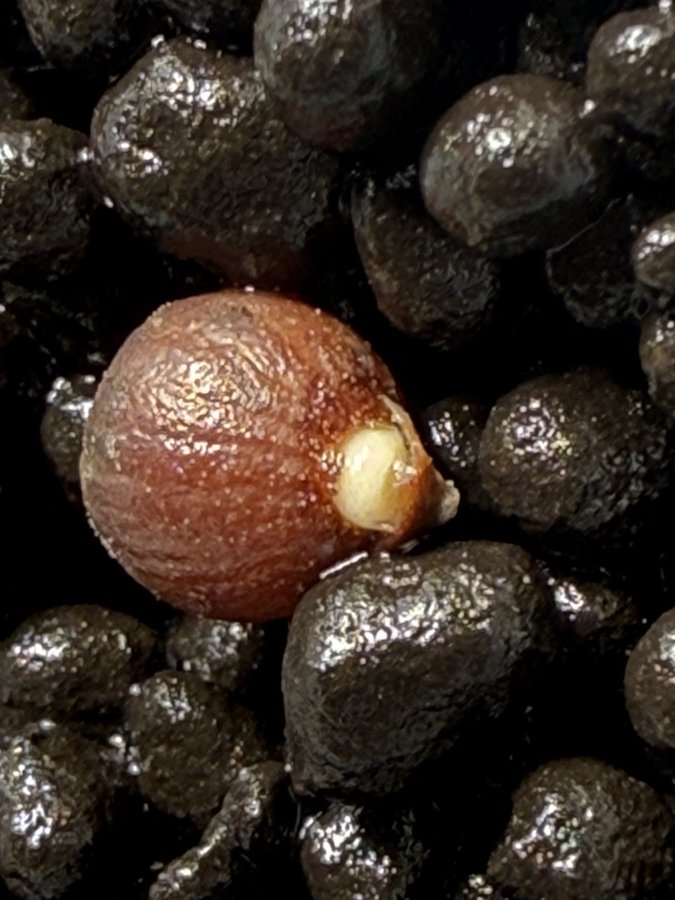
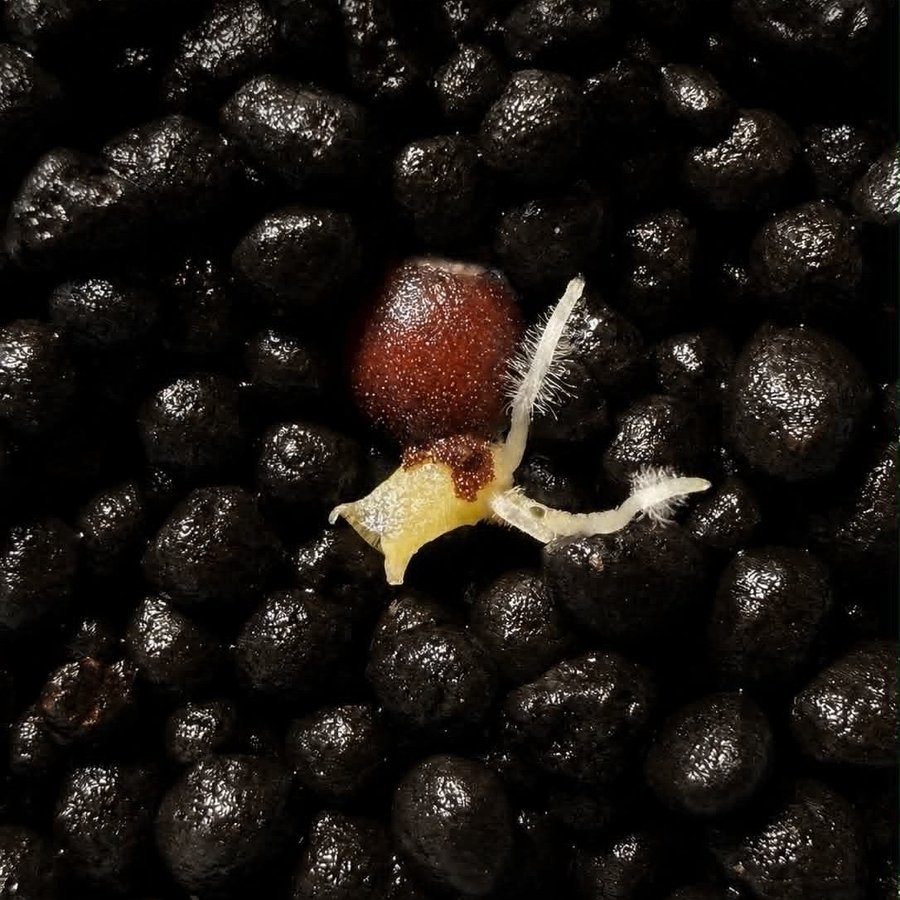
Photographs by Nadine Hafke
Wear gloves — this is not squeamishness
Alocasia tissues carry calcium oxalate, and it is worth knowing what form it takes. Sectioned, Alocasia macrorrhizos proves to have abundant raphides — bundles of needle-shaped crystals packed into specialised cells, sitting against the walls of the laticifers, the vessels that carry the milky sap. Break the tissue and you release needles in latex. That is why the sap irritates skin and inflames mucous membranes, and why wild Alocasia macrorrhizos is described as extremely acrid.
Fruit pulp is the specific hazard here: across aroids it ranges from mildly to highly irritant, and cleaning seed by hand is exactly the operation that crushes it. Glove up before you open a single berry, and keep your hands away from your eyes until you have washed.
-
Open the berries
Lay the fully ripe berries on paper towel and squeeze the soft ones gently so the seeds and pulp come out. This is also the moment you find out what you actually made — the question of whether your ovules became seed has no earlier answer.
-
Clean them completely
Rinse thoroughly with water and remove every trace of pulp and adhering fruit tissue. No pulp should remain. This is not tidiness: residual fruit tissue is exactly what invites rot and mould under the warm, moist conditions germination requires. A seed sown dirty is a seed sown with its own pathogen supply.
-
Clean it last, not first
This reverses the obvious order, and it matters. Viability falls away fast once the seed leaves the pulp — so the berry is the best container it will ever have. Leave the seed inside the fruit until you are ready to sow, then clean and sow in one movement.
That instruction is well attested in practice. What was never established is the physiology behind it, and the one controlled experiment that exists points somewhere else.
A trial that cuts against the usual explanation
Seed of Alocasia longiloba was air-dried at room temperature for two weeks and then tested. It showed 89% viability (tetrazolium, n = 100).
Untreated, that seed germinated at 25.0% over 30 days. Given fifteen minutes in 30% sulfuric acid it germinated at 87.5% in 19 days. The authors read the barrier as a hard seed coat — physical dormancy — not as an intolerance of drying.
If that holds, the reason to sow quickly is not that the seed dies when it dries. It may be that a cleaned, dried coat is simply harder to get through.
The advice above does not change on the strength of it. One species, one laboratory, seed taken from wild-collected ripe fruit, and an acid step no grower is going to run on a handful of seed from a cross that took months to make. Sowing fresh costs nothing and is still the reliable move.
But the word recalcitrant has been removed from this block. It carries a specific meaning — seed that cannot survive drying — and the only experiment anyone has run on an Alocasia found the opposite. Describing the seed that way was borrowing a term from other families without the evidence.
If you must hold cleaned seed a few days, keep it damp but not wet: folded in moistened kitchen paper (not tissue, which disintegrates) inside a plastic bag, in a cool room. And treat bought seed with suspicion — commercial aroid seed germinates poorly, and seed sold dry, in or out of the berry, is usually already dead.
-
Sow shallow — aroid seed needs light
This one catches people out. Aroid seed needs light to germinate, so bury it barely or not at all. Alocasia seed is medium-sized — about a black peppercorn — and wants covering to its own depth and no more, then watering in well.
Any organically rich, moisture-retentive but well-drained medium works: equal parts sieved coir and perlite, or ground sphagnum and perlite, are both proven, and in a temperate climate a soil-less compost and perlite at 1:1 is the better bet. Keep it moist but never waterlogged, under a propagator lid or a loosely-sealed bag on a bright but not sunny sill. When seedlings appear, loosen the bag rather than pulling it off — give them two or three days to meet the drier air by degrees.
-
Warm to germinate, then bright but out of direct sun
Warmth supports germination — the same source stresses that a warm, moist environment is a requirement, not a nicety. Once seedlings are up, move them to a bright position without strong direct sunlight. For light levels and substrate as they grow on, the genus page’s cultivation section applies from here: Alocasia morphology and cultivation.
-
Move them at the second leaf — and never bury the stem
Let a seedling finish its second leaf before you touch it, and transplant as the third is emerging. When you do, do not bury the base of the stem: it “invariably leads to either fungal or bacterial rotting.” After that, pot on with as little root disturbance as you can manage — Alocasia grow steadily less tolerant of it as they mature.
Be mean with pot size, too. The genus rots readily when its roots sit in more wet substrate than they can occupy.
How long, and how many
Germination — Alocasia
2–3 weeks
At a minimum of 21 °C and a maximum of 29 °C (70–84 °F), in medium shade, sown at its own depth. That makes Alocasia one of the quicker tropical aroids — against 3–5 weeks for Amorphophallus, and 2–3 days for Cryptocoryne.
Those figures are horticultural observation, not trial data — more than twenty years raising aroids from seed in Europe and four more in equatorial Malaysia, offered by their author as neither comprehensive nor final. There is still no published germination percentage, no viability curve and no controlled experiment for any Alocasia. Not every seed lifted from a berry is fully formed; a plump seed is promising and nothing more, and germination remains the only viability test there is.
When the first root appears, you are through. From that point the young Alocasia is simply a plant, and you can watch it put out its first leaves.
Never put a copper fungicide on an aroid
Seedlings are vulnerable to damping off and the reflex is to reach for a fungicide. Metallic copper fungicides are fatal to Araceae — the warning is set in capitals in the source, and it applies to the whole family. Hydroxyquinoline sulphate is the recommendation in its place.
And if one seedling turns out to be the one
A hybrid worth keeping is, at first, a single individual — and Alocasia oblige by offsetting readily, which is the ordinary way to multiply it. Shoot-tip tissue culture is the other route, and it is what rescued Alocasia scabriuscula (published as Alocasia guttata) var. imperialis when the plant was known from a single collection and was rare even in Borneo. Two cautions from the same source: micropropagated plants are not automatically disease-free unless tested for the specific pathogen, and somaclonal variation in culture is more likely to throw something worse than something better — though Alocasia ‘Black Velvet’ did produce a larger, thicker-leaved variant that way.
What began with an inflorescence and a little pollen is now a plant that did not exist before. That is the end of this article — and the beginning of whatever you decide to call it.
Part XI
When It Doesn’t Work
Most failed Alocasia crosses fail for one of about a dozen reasons, and they look different from each other. Find your symptom.
| What you saw | Most likely reason | What to do differently |
|---|---|---|
| The spathe was open but the stigmas were dry | Almost always late, not early. The constriction shuts during the night before pollen release and does not reopen. | Inspect every morning, and act on a gap only wide enough for a fly. Do not wait for the spathe to look properly open. |
| No pollen appeared on the morning I expected it | Weather. Rain delayed shedding by 30–45 min, sometimes over an hour — and sometimes pollen was not released at all. | Check again later the same morning, and again the next. In cool conditions shedding can slip two or three days past spathe opening. |
| Berries swelled, then stopped at about three weeks | Incompatible pollen. This is the signature arrest: a few berries start, then development halts, in most cases after about three weeks. | Assume a self, a same-clone cross, or a rejected interspecific combination. You need genuinely unrelated pollen — not another division of the same plant. |
| Some berries set, then the whole head dropped | Probably too few flowers fertilised. In wild Alocasia macrorrhizos, heads that reached maturity were observed to carry ≥ 20 berries, and thinly set heads usually failed — an observation on a giant species, not a pass mark for the genus. | Cover far more stigmas, and pollinate again on the next one or two mornings while they are still receptive. On a small species, a handful of berries is a normal result, not a failure. |
| Plenty of berries, almost no seeds inside | Normal, and the commonest way to be fooled. Ovaries swell without containing developed seed — a heavy head has yielded fewer than a dozen likely-fertile seeds. | Nothing is wrong with your technique. Judge success by seedlings, not by berries. |
| Berries formed on an inflorescence I never touched | Spontaneous selfing from another inflorescence on the same plant, or an insect you did not see. Documented on plants where no pollination was attempted. | Bag every inflorescence you care about, and treat unbagged berries as parentage-unknown. |
| One particular cross fails every single time | Interspecific rejection, which is documented in the genus: some combinations are refused from the start or abort partway. | Repetition will not breach this one. Change a parent — and check the hybrid record first to see what that parent has already worked with. |
| Fresh pollen works, stored pollen never does | Storage failure. There is no published viability curve for Alocasia pollen; the one estimate available is hedged at several months to perhaps a year. | Suspect condensation first: warm the container to room temperature still sealed. Then suspect age. Always run a fresh-pollen control before concluding your plant is at fault. |
| Seeds rotted or moulded after sowing | Residual pulp. Fruit tissue left on the seed encourages rot and mould in exactly the warm, moist conditions germination needs. | Clean far more aggressively — no pulp at all — and keep the medium moist but never waterlogged. |
| Nothing germinated | Either the seeds were never viable, or they dried at some point between cleaning and sowing. | Sow as fresh as possible and never let seed dry out. A well-formed seed is only promising — germination is the only viability test there is. |
| The plant stopped flowering altogether | Normal rhythm. Well-grown plants run through 8–16 inflorescence clusters and then rest for 4–12 months. | Nothing. Use the pause to find a second, unrelated plant so the next flush has a partner. |
| I felt no heat, so I assumed it wasn’t ready | A misapplied test. The 44 °C figure is Alocasia macrorrhizos; Alocasia odora runs about +2.4 °C, which no fingertip can detect. | Ignore heat as a gate on any species but a giant. Wet stigmas are the signal. |
If you only change one thing
Find unrelated pollen
Genuine outcrosses succeeded 79 times out of 88. Single selfs and same-clone crosses succeeded 0 times out of 40. No amount of technique closes that gap, and no amount of bad technique fully squanders it. If your crosses keep failing, the first question is not how you pollinated — it is whether the two plants were ever really two plants.
Selfing is a poor bet rather than a closed door: repeated on successive mornings the same crosses reached 17 of 46, and a clonal group in Kerala set 488 berries unaided. If a self is all you have, repeat it daily through the receptive window — just do not expect a hybrid at the end of it.
And there is a published shape to it
3 clusters
An AFLP study fingerprinted 23 cultivars across 17 species and sorted them into three genetic clusters. Its finding is the one a hybridiser wants: every documented Alocasia hybrid was developed from species within a single cluster, and none between them. The authors put it as a likelihood rather than a law — species sharing high similarity “are more likely to be intercrossable”.
Cluster I holds most of the familiar hybrid parents — Alocasia cuprea, Alocasia longiloba, Alocasia macrorrhizos, Alocasia micholitziana, Alocasia sanderiana among them. Cluster II is a smaller group built around Alocasia odora, Alocasia cucullata and Alocasia portei. The third cluster held a single plant, ‘Hilo Beauty’, so unlike the rest that the authors suspected it belonged to another genus — it is now referred to Caladium.
Read it at its real weight. This is a retrospective look at hybrids that already existed, not a crossing experiment. No pair was tested and found incompatible. What it tells you is where the successes have clustered, which is a better starting point than nothing and is not a guarantee.
Before you plan a cross, look up what has already worked
153 hybrids · 30 species
Nobody has crossed every pair, so there is still no compatibility matrix in the strict sense — but there is now a published structure, and there is a record. Aroidpedia maintains a master list of 153 named hybrids, 152 of them with stated parentage, drawing on 30 species and 78 distinct parents. It is searchable, and it will tell you in a few seconds whether the cross you are contemplating has a precedent.
The record is lopsided in a way worth knowing. A handful of parents do most of the work — Alocasia odora appears in 28 crosses, Alocasia longiloba in 21, Alocasia baginda ‘Silver Dragon’ in 18, Alocasia sanderiana in 16 — and 96 of the crosses are species × species, against 45 involving a cultivar and only 4 between two cultivars. If a species you want to use has never appeared in the list, that is not proof it cannot be crossed, but it does mean you are the experiment.
Search the Alocasia hybrid dashboard — parentage, synonyms and lineage for every recorded cross.
Two kinds of failure, two responses
It is worth naming the distinction the table is built on, because the advice reverses depending on which you have. Timing failures — dry stigmas, missed pollen, a door already shut — reward persistence: try again next week, and the week after. Compatibility failures — the three-week arrest, the cross that never takes — do not. Repeating an impossible cross more carefully still yields nothing. Telling them apart is the whole skill of not wasting a season.
Part XII
What Crosses with What
The most-asked question in the hobby, and the one the scientific literature is least able to answer. So here is the record instead.
No compatibility matrix has been published for Alocasia, and no study explains why particular combinations fail. What exists is the accumulated record of what people have actually managed — and it is substantial enough to plan from. Two published studies now sit either side of that record: one that says where the successes cluster, and one that says what the offspring will look like.
Where the successes cluster
An AFLP study of 23 cultivars across 17 species sorted them into three genetic clusters, and reported that every documented hybrid was made within a cluster and none between them. Cluster I contains most of the familiar parents — Alocasia cuprea, Alocasia longiloba, Alocasia macrorrhizos, Alocasia micholitziana, Alocasia sanderiana. Cluster II is smaller and built around Alocasia odora, Alocasia cucullata and Alocasia portei.
It is retrospective, and that limit matters: it observed hybrids that already existed rather than testing pairs. No combination was tried and found impossible. Treat it as a map of where the ground has proved firm.
What the offspring will look like
The first inheritance study in the genus crossed four species and four cultivars in 20 combinations and scored the seedlings. Leaf-base lobing and margin notching both follow incomplete dominance — a very shallow parent crossed with a medium one gives shallow progeny, two very deep parents give very deep progeny, and every cross matched its expected ratio. The velvety leaf texture of Alocasia micholitziana ‘Green Velvet’ is dominant, passing to progeny crossed with non-velvety species; the texture itself turns out to be an air space under the surface. A convex surface beside the vein is dominant over a flat one.
That study also reaches back and explains an old hybrid: Alocasia × chantrieri, from very shallow Alocasia cuprea and very deep Alocasia sanderiana, has medium lobing — which is exactly what incomplete dominance predicts.
The record, as it stands
153 hybrids · 30 species
153 named hybrids, 152 of them with stated parentage, drawn from 78 distinct parents of which 30 are species. Ninety-six of those crosses are species × species; 45 involve a cultivar, and only 4 are between two cultivars.
The distribution is lopsided, and that is the useful part. A handful of parents do most of the work: Alocasia odora appears in 28 crosses, Alocasia longiloba in 21, Alocasia baginda ‘Silver Dragon’ in 18, Alocasia sanderiana in 16, then ‘Aurora’ and Alocasia scalprum at 13 each, Alocasia cuprea at 12 and Alocasia reginula ‘Black Velvet’ at 11.
Thirty species out of roughly ninety have ever been bred from. If the plant you want to use has never appeared in this list, you are not looking up an answer — you are the experiment. That is a fine thing to be. Just know it before you spend five months waiting.
Search it
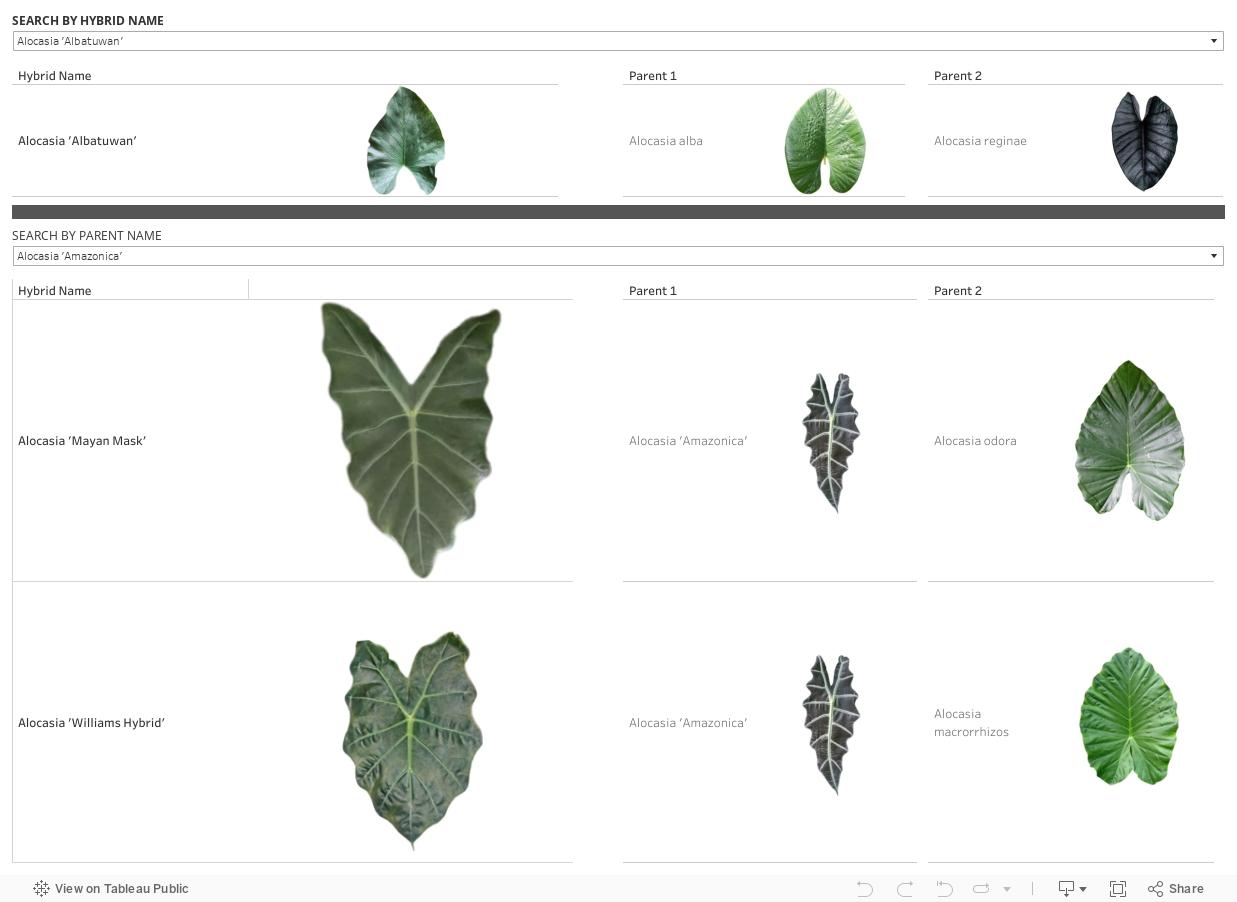
The dashboard above is served by Tableau Public. If it does not load — a blocked script, a slow connection — open it directly: the Alocasia hybrid dashboard.
The half that is still missing
This is a record of successes. Nobody keeps the other list — the crosses attempted and lost — and that is the more useful one for anyone deciding what to try. A failed cross tells you something a successful one cannot, and at the moment that information evaporates the moment a head is shed.
If you have kept records of crosses that didn’t take, they are worth more than you think. The contact page reaches us.
Araceae · Reproduction
Sources
Thirty-six published sources spanning 1838 to 2022, and three grower accounts. Where they disagree, the article says so rather than choosing quietly.
Peer-reviewed literature
- van der Pijl, L. (1953). On the flower biology of some plants from Java. Annales Bogorienses 1(2): 77–99. The 1953 summary behind Case five in Part IV: Alocasia puber (the papers print “pubera”; puber is the accepted name) and its Atherigona flies, condensed by the author from his own 1933 paper. Now superseded as the citation of record — the 1933 primary has been read (next entry) and Part IV cites it directly. One number died in the checking: the 24.5 °C differential this summary attaches to the species appears nowhere in the 1933 original and is not used on this page.
- van der Pijl, L. (1933). Welriekende vliegenbloemen bij Alocasia pubera. De Tropische Natuur 22: 210–214. (In Dutch.) The primary source of Case five, read at last: the fever anecdote and the thermometer series (39.9; 41 surface / 45.3 pith against 21.7 morning air; “a good 20°”; heat window 5–9 a.m.), the phenology table, the egg-laying on the male flowers, the brood in the sealed living spathe with the spadix axis as the seal, and six flies reared from one spathe. Grade: single-site natural history with real measurements and rearing; pollination itself is inference — no pollen transfer was observed, and the second fly species was lost. The genus is printed “Anterigona” and the family “Anthomyidae” — the modern placement of Atherigona is Muscidae, and the page says so. Every number this page takes from it was verified against the printed pages.
- Vrolik, G. & de Vriese, W. H. (1839). Nouvelles expériences sur l'élévation de température du spadice d'une Colocasia odora. Annales des Sciences Naturelles, 2e série, Botanique 11: 65–85. — with its 1840 sequel, same journal, 359–362. Among the earliest quantitative measurements of spadix heating ever made, and they were made on this group: the plant is printed as Colocasia odora (Caladium odorum), almost certainly today's Alocasia odora. One inflorescence followed over three consecutive days; sealed in pure oxygen while still attached to its plant it reached 30.8 °C; sealed in nitrogen it stopped heating, stopped growing and lost its scent entirely. All values Centigrade. Two cautions. The identification is a modern reading of a nineteenth-century name and has not been checked against a taxonomic authority, and most of the numeric tables are damaged in the scan — only the marginal maxima survive, two of which are arithmetically inconsistent with their own surviving cells.
- Cleghorn, M. L. (1913). Notes on the pollination of Colocasia antiquorum. Journal of the Asiatic Society of Bengal 9: 313–315. The closest relative with an early pollination account, and the contrast Part IV draws on: the trap is a valve of spathe tissue, not a ring of sterile hairs, with the lower spathe opening to admit flies and closing by evening, and a separate upper aperture releasing them two days later. Her strongest observation is the brood site — a fruiting spadix “full of the minute maggots of these flies”. Pollination itself is narrated, not demonstrated: no exclusion, no pollen loads, no seed-set comparison, the flies identified only as “a species of Acalyptrate Muscidae”, and her own word is “it seems”.
- de Meijere, J. C. H. (1914). Studien über südostasiatische Dipteren. Tijdschrift voor Entomologie 57: 137–275. — with Duda (1923, 1924) and Wheeler (1969), A note on the genus Drosophilella. University of Texas Publications 6918: 543–546. The nomenclatural chain behind the Colocasiomyia / Drosophilella synonymy this guide relies on. de Meijere erected Colocasiomyia in 1914, nine years before Duda's Drosophilella, so on priority the senior name is unarguable — and both type series came out of the same 1911 Java collection, same locality, same collector, same Colocasia host, which is almost certainly why they were merged. None of these papers actually makes the synonymy; the formal act is later and has not been read here. Wheeler also destroys Duda's separating character, finding the ocellar bristles Duda said were absent. Note too that none of them claims pollination — they are the historical host record.
- Okada, T. (1975). The oriental drosophilids breeding in flowers. Kontyu 43(3): 356–363. The Alocasia host records that underpin Part IV's fly story: swept from Alocasia in Ishigaki and Taiwan, and from Alocasia odora in Okinawa with larvae breeding in the decaying spadix and adults reared out within a month — the only closed life cycle in that older literature. Two species were found emerging from one inflorescence at different times, partitioning it. The word “pollination” does not appear in it; the author's own title is “breeding in flowers”.
- Ivancic, A., Roupsard, O., Quero Garcia, J., Lebot, V., Pochyla, V. & Okpul, T. (2005). Thermogenic flowering of the giant taro (Alocasia macrorrhizos, Araceae). Canadian Journal of Botany 83: 647–655. doi:10.1139/B05-040 — the source of the 43.9 °C fever, the two heating cycles, the clock times, the 24–26 h receptivity lead, and Table 1’s morphometrics.
- Miyake, T. & Yafuso, M. (2003). Floral scents affect reproductive success in fly-pollinated Alocasia odora (Araceae). American Journal of Botany 90(3): 370–376. The appendix as the attractant: 67% of 847 flies, the 13.6 → 154.8 fly shift across the constriction, and the appendix-removal fruit-set experiment.
- Quero Garcia, J., Ivancic, A. & Lebot, V. (2008). Morphological variation and reproductive characteristics of wild giant taro (Alocasia macrorrhizos, Araceae) populations in Vanuatu. New Zealand Journal of Botany 46: 189–203. The self-incompatibility test (0 of 40), the repeated-pollination result (17 of 46), the 79-of-88 outcrosses, the 9–11 week harvest, the ≥3-day stigma receptivity, and the earwigs.
- Chen, J., Devanand, P. S., Henny, R. J., Norman, D. J. & Chao, C.-C. T. (2004). Interspecific relationships of Alocasia revealed by AFLP analysis. Journal of Horticultural Science & Biotechnology 79(4): 582–586. The three genetic clusters, the finding that every documented hybrid was made within a cluster, and the chromosome numbers relayed from Marchant 1971. Retrospective over existing hybrids — no pair was tested for compatibility.
- Hsieh, C.-W., Kuo, H.-T., Wei, T.-Y. & Yeh, D.-M. (2025). Inheritance of leaf traits and mechanisms of velvety leaf texture and vein coloration in Alocasia. HortScience 60(11): 1968–1974. doi:10.21273/HORTSCI18887-25 — the incomplete dominance of lobing and notching, the dominant velvety texture, and the selfed Alocasia odora that produced 96 seedlings.
- Takenaka Takano, K., Repin, R., Mohamed, M. B. & Toda, M. J. (2012). Pollination mutualism between Alocasia macrorrhizos (Araceae) and two taxonomically undescribed Colocasiomyia species (Diptera: Drosophilidae) in Sabah, Borneo. Plant Biology 14: 555–564. doi:10.1111/j.1438-8677.2011.00541.x — the bagging experiment (0.89 / 0.85 / 0.002), the two-morning fly cycle, the secretion nursery, and the 45–90 day fruit maturation.
- Fartyal, R. S., Gao, J.-J., Toda, M. J., Hu, Y.-G., Takenaka Takano, K., Suwito, A., Katoh, T., Takigahira, T. & Yin, J.-T. (2013). Colocasiomyia (Diptera: Drosophilidae) revised phylogenetically, with a new species group having peculiar lifecycles on monsteroid (Araceae) host plants. Systematic Entomology 38: 763–782. doi:10.1111/syen.12027 — the genus revision behind the flies’-name note in Part I — and, until the primary arrived, the anchor for the Drosophilella synonymy, which it pins to Okada 1988 via the recombination “Colocasiomyia gigantea: Okada, 1988: 36” and that paper’s own title, “with generic synonymy”. Okada 1988 itself is cited here at second hand — this page has not seen it. Also names the genus-wide cohabitation rule: pistilicolous flies breed in the female zone, stamenicolous flies in the male zone, and the stamenicolous partner consistently makes more, smaller eggs.
- Okada, T. (1988). Taxonomic note on Colocasiomyia cristata de Meijere (Diptera, Drosophilidae) with generic synonymy. Proceedings of the Japanese Society of Systematic Zoology 37: 34–39. The synonymy act itself, now held and read: Drosophilella Duda, 1923 sunk under Colocasiomyia de Meijere, 1914 (“Syn. nov.”, p. 34), on examination of a male syntype of Colocasiomyia cristata lent by the Zoological Museum of Amsterdam, with every Drosophilella species newly combined at p. 36. Grade: formal nomenclatural act, verified against the printed pages. Part I’s flies’-name note now cites it directly.
- Bian, F., Luo, Y., Li, L., Pang, Y. & Peng, Y. (2021). Inflorescence development, thermogenesis and flower-visiting insect activity in Alocasia odora. Flora 279: 151818. doi:10.1016/j.flora.2021.151818 — wild winter-blooming Alocasia odora in Yunnan, probes in all four zones: the female zone measured 1–4 °C above ambient while the spathe was still closed — the counter-case to the Alocasia macrorrhizos no-heat result in Part II. Its insect watch ran 08:00–18:00 only, so it can neither confirm nor refute the Okinawa sunrise clock; its flies are identified to genus only.
- Yu, Y., Luo, Y., Zhang, W., Ding, X., Song, X. & Luo, Y. (2026). Thermogenesis-derived spatiotemporal microclimates guide pollinator movement to ensure pollination. Journal of Integrative Plant Biology. doi:10.1111/jipb.70318 — the thermal push–pull manipulations, the nine volatiles of Alocasia odora, the ruling-out of scent as the fine-scale cue, and AOX1b.
- Osuji, J. O. & Ihenko, S. C. (2023). Comparative morphology, anatomy and phytochemistry of Cyrtosperma senegalense (Schott) Engl. and Alocasia macrorrhizos L. (Araceae). International Journal of Environment and Climate Change 13(10): 3862–3872. The anatomy behind the gloves: Alocasia macrorrhizos carries abundant raphide bundles in idioblasts against the laticifer walls — needles suspended in the milky sap. Note the paper sections leaf, petiole and root, NOT fruit; the fruit-pulp irritancy is Boyce’s.
- Chai, S. K. & Wong, S. Y. (2019). Five pollination guilds of aroids (Araceae) at Mulu National Park, Sarawak, Malaysian Borneo. Webbia. doi:10.1080/00837792.2019.1653425 — two more Alocasia with pollinator records, the first published DESCRIPTIONS of the scent, the 26–27 h anthesis clock, open fruit set of 61.7% and 81.1%, bird dispersal, and the bagging test showing an Alocasia sets NO fruit without an insect.
- Hay, A. (1998). The genus Alocasia (Araceae-Colocasieae) in West Malesia and Sulawesi. Gardens’ Bulletin Singapore 50(2): 221–334. And Hay, A. (1999), …in the Philippines, 51(1): 1–41. The structural backbone: the bimodular synflorescence subunit, the three flowering architectures, the spathe-constriction character, and the sterile-interstice homologies. Also the honest 1998 verdict — “next to nothing is known in detail about how they work” — which the four papers above have since begun to answer.
- Boyce, P. C. (2007). Germinating aroid seeds — some observations. Aroideana 30: 145–161. The germination data in Part X: 2–3 weeks at 21–29 °C for Alocasia, seed kept in the berry until sowing, sown shallow because aroid seed needs light, and the warning that copper fungicides are fatal to Araceae.
- Ma, Z. et al. (2020). Taxonomic notes on the Alocasia-Colocasia Clade (Araceae) in China I: Alocasia yunqiana, a new species from Tongbiguan Nature Reserve, Yunnan Province. Phytotaxa 460(4): 277–284. doi:10.11646/phytotaxa.460.4.5 — a THIRD Alocasia with a named pollinator (Colocasiomyia aff. xenalocasiae, preliminary, pending DNA barcoding), and the dimorphic synandrodes whose green basal half is eaten by the pollinator’s larvae. Also the counterexample to “the appendix is the longest zone”.
- Georgusis, J. (1983). Propagation of Alocasias. Aroideana 5(4): 101–102. Corm propagation and the seedling grow-on practice used in Part X. Contains no pollination content — checked.
- Hyndman, S. E. & Bickell, A. (n.d.). Micropropagation of Aroids. International Aroid Society. See also Hyndman, S. E. (1987), The advantages of tissue culture for the aroid collector, Aroideana 10(3): 7–10. The Alocasia guttata var. imperialis rescue and the somaclonal-variation cautions. Contains no seed, embryo or pollination content — checked.
- Shaw, D. E. & Cantrell, B. K. (1983). A study of the pollination of Alocasia macrorrhiza (L.) G. Don (Araceae) in southeast Queensland. Proceedings of the Linnean Society of New South Wales 106(4): 323–335. The only pollination EXPERIMENT ever run on an Australian Alocasia: 143 heads across seven sites, seven bagging and emasculation treatments. Source of the 3–4 mm gape, the one-day chamber, the two-day pollen shed, the full visitor list, and the Trigona carbonaria pollen pellets. — Note the plant is what we now call Alocasia brisbanensis; Shaw herself accepted the correction in 2003.
- Shaw, D. E., Cantrell, B. K. & Houston, K. J. (1982). Neurochaeta inversa McAlpine (Diptera: Neurochaetidae) and seed set in Alocasia macrorrhiza (L.) G. Don (Araceae) in southeast Queensland. Proceedings of the Linnean Society of New South Wales 106(1): 67–82. Forty-one sealed heads dissected. The fly is present in every rainforest head and absent from every garden head, and seed set does not follow it — the regression is not significant. The source of Part IV’s 98.1%, and of the Fusarium solani / Fusarium oxysporum identifications in the decaying spadix.
- Shaw, D. E. (2005). The stigma and style of Alocasia brisbanensis (F. M. Bailey) Domin (Araceae). Aroideana 28: 91–100. Receptivity assayed with peroxidase test sticks from three days BEFORE the spathe opens to at least three days AFTER it closes, reached through a 1 cm² trapdoor cut in the back of the chamber — the published ancestor of the window in Part VII. Also the rough-versus-glossy stigma test, and papillae 160–220 µm long on a style with no canal.
- Shaw, D. E. (2001). Fertile florets, stigmatic lobes and ovules of Alocasia brisbanensis (F. M. Bailey) Domin (Araceae) in Queensland. Aroideana 24: 56–65. 1,987 pistils scored. 117–231 florets per head (mean 165.6); 2–10 ovules per ovary (mean 5.7); berries per head 2–210 — which is why the “twenty berries” figure cannot be a retention threshold. No head has ever been recorded at 100% fertilisation.
- Shaw, D. E. (2001). The natural stimulation of some unfertilized female florets of Alocasia brisbanensis (Araceae) in Queensland. Aroideana 24: 66–68. Unfertilised florets beside real berries swell and deepen in colour while staying seedless — 6.4% to 34.4% of all florets, and on one head outnumbering true fruit two to one. The reason Part VIII says to cut a berry open rather than trust its size.
- Shaw, D. E. (2003). Dimorphic pollen of Alocasia brisbanensis (Araceae) in Queensland. Aroideana 26: 96–105. 21,201 grains counted. Normal grains average 40.0 µm, starchy and able to germinate; small aborted grains average 27.7 µm, starchless and inviable, at a steady 6.4% of every sample. Under a scope the duds are visibly smaller and take no stain.
- Toda, M. J., Takano, K. T., Katoh, T., Xiao, L., Gao, J.-J. & Yafuso, M. (2022). Coexistence mechanisms of Colocasiomyia species (Diptera: Drosophilidae) sharing inflorescences of Alocasia odora (Araceae) as a host plant. Entomological Science 25: e12506. doi:10.1111/ens.12506 — the spadix cut into nine sections and every egg mapped. Colocasiomyia alocasiae breeds in the male zone, Colocasiomyia xenalocasiae in the female zone, and where a third species occurs it takes the sterile interstice between them. Larvae eat decayed tissue and staminode exudate; ovules and seed are never touched.
- Yafuso, M., Bui Tuan Viet & Adaniya, S. (2015). Pollination mutualism between flower-breeding flies of the genus Colocasiomyia (Diptera, Drosophilidae) and their host plant routes of Araceae in Vietnam. Aroideana 38E(1): 94–106. Thirteen years of survey across eleven Vietnamese sites. Adds Alocasia atropurpurea to the host list, and gives the pollen-longevity numbers behind Part VI: germination 57.9% on day one falling to 4.8% by day five, and 71.3% for pollen carried on the flies themselves.
- Miyake, T. & Yafuso, M. (2005). Pollination of Alocasia cucullata (Araceae) by two Colocasiomyia flies known to be specific pollinators for Alocasia odora. Plant Species Biology 20: 201–208. The third Alocasia with demonstrated pollination, and the evidence that the Alocasia odora fly pair is not confined to a single host: these are the same two flies that pollinate Alocasia odora.
- Takano Takenaka, K., Katagiri, C., Katayama, N. et al. (2015). Chemical analyses of exudates, as a floral reward, from staminodes of Alocasia odora (Roxb.) K. Koch (Araceae) in Okinawa, Japan. Aroideana 38E(1): 21–22 (conference abstract). What the flies are actually paid: TLC and HPLC of the staminode exudate found no lipid, and peaks matching glucose, sucrose and fructose. Ordinary floral nectar, presented next to the female flowers during the female phase. Presented as a conference abstract; the full analysis has not appeared as a paper.
- Vimala, B. (2011). Flowering and seed set in giant taro (Alocasia macrorrhizos (L.) G. Don f.). Aroideana 34: 86–89. Five plants raised from one Assam accession — genetically one clone — set 488 berries and 618 seeds between them. The strongest single argument that selfing in Alocasia is unlikely rather than impossible. Only 6 of 25 spadices set seed at all; ripening took roughly three months.
- Shaw, D. E., Hiller, A. & Hiller, K. A. (1985). Alocasia macrorrhiza and birds in Australia. Aroideana 8(3): 89–93. A Regent Bowerbird taking twenty berries at a sitting, and a Lewin’s Honeyeater stripping the same two heads later the same day. Also the finding that the berries are odourless to ten human noses — a bird diaspore, not a mammal one.
- Shaw, D. E. (1998). Damage to plants and ingestion of fruit and seeds of Alocasia brisbanensis by the Brush-turkey (Alectura lathami, Megapodiidae) in Queensland. Aroideana 21: 13–22. A third bird added, and a hundred cleaned seeds eaten one after another in a feeding trial. Note what all three bird papers say in almost identical words: nobody knows what happens to the seed afterwards. Ingestion is observed; dispersal is inferred.
- Hay, A. (1990). Collecting Alocasia in New Guinea. Aroideana 13(1–4): 4–13. The nomenclatural ruling this article follows: Alocasia macrorrhizos is nowhere wild in New Guinea and does not occur in Australia at all, “the name having been repeatedly misapplied” to Alocasia brisbanensis. Also that species around Alocasia macrorrhizos — Alocasia portei, Alocasia odora and their relatives — freely interbreed.
- Matthews, P. J., Nguyen Van Dzu, Tandang, D., Agoo, E. M. & Madulid, D. A. (2015). Taxonomy and ethnobotany of Colocasia esculenta and C. formosana (Araceae). Aroideana 38E(1): 153–176. Records Colocasiomyia moving between Alocasia and Colocasia hosts, including two flies named after Alocasia recovered from Colocasia inflorescences. The specificity is real but not absolute — and shared pollinators are a route to hybridisation.
- Arriaga-Varela, E., Wong, S. Y., Kirejtshuk, A. & Fikáček, M. (2018). Review of the flower-inhabiting water scavenger beetle genus Cycreon (Coleoptera, Hydrophilidae), with comments on its biology. Deutsche Entomologische Zeitschrift 65(1): 99–115. doi:10.3897/dez.65.26261 — cited for a negative result. Beetles swarm the inflorescences of related genera in Borneo, over a thousand specimens; targeted sampling of Alocasia in Mulu returned none, and the single Alocasia longiloba record is one beetle. Whatever pollinates Alocasia in Borneo, it is not this.
- Simpson, B. B. & Neff, J. L. (1981). Floral rewards: alternatives to pollen and nectar. Annals of the Missouri Botanical Garden 68(2): 301–322. The framework for what an inflorescence can offer that is neither pollen nor nectar. Its one Alocasia record — Atherigona flies breeding in Alocasia pubera, after van der Pijl (1953) — arrives third-hand, under a plant name no longer in use, and with no pollination ever demonstrated. It is a lead, not a record.
- Bay, D. C. (1995). Thermogenesis in the aroids. Aroideana 18: 32–39. A review, not a study — no Alocasia temperature is measured in it, and any 44 °C figure attributed to it is misattributed. Useful for two things only: the 1879 heat observation on what was then Colocasia odora, and El-Din’s single odour compound from Alocasia portei.
- McAlpine, D. K. (1978). Description and biology of a new genus of flies related to Anthoclusia and representing a new family (Diptera, Schizophora, Neurochaetidae). Annals of the Natal Museum 23(2): 273–295. The original description of Neurochaeta inversa and the source of everything the article says about it: the fixed head-down posture, the larvae that feed on micro-organisms in the chamber fluid without damaging the fruitlets, and the adults that eclose inside a sealed spathe and cannot leave until it splits. Also the observation that makes the Queensland result make sense — the flies were never found on cultivated plants, only on Alocasia in original rainforest. — On pollination it says one hedged sentence and claims no more: egg-laying females “may well be pollinators” but are “probably not the sole pollinating agents.” No pollen was observed on any fly; the word does not appear in the paper.
- Wong, S. Y. (2015). Keladi Hutan di Borneo [Wild Aroids of Borneo]. (In Malay.) The source for one claim only: that different drosophilid species lay their eggs in the male and the female zones of a single spadix, in Alocasia, Colocasia and Homalomena. It states this as established and cites no study for it, and gives no counts, no localities and no fly species names. Part IV presents it as a lead rather than a finding for exactly that reason. If the primary study is found, this entry should be replaced by it.
Grower and breeder accounts
- Aroidpedia. Alocasia hybrid master list and dashboard. 153 named hybrids, 152 with stated parentage, 30 species, 78 distinct parents. public.tableau.com/app/profile/rfw5/viz/AlocasiaHybrids — the source for Part XI’s parentage figures, and the nearest thing the genus has to a compatibility record.
- Aroidpedia (2026). Summary of Alocasia infructescence colours. Unpublished compilation, 34 species. The source for Part VIII’s colour tally: 24 species ripening in the orange range, 7 red, and 3 pale — Alocasia rivularis and Alocasia scalprum cream, Alocasia azlanii white. Held in the archive rather than published; ask if you want the sheet.
- Boos, J., with additional input by Lucas, S. Natural and artificial pollination in aroids. Exotic Rainforest. The only published aroid pollen-storage protocol, and the wet-slurry method Part VII declines to teach.
- Aroidia Research. In the Field and Fruit of Our Labor. The dry-brush technique, the cool-vs-warm shedding delay, and “berry set does not mean seed set.” The one source among the three actively breeding Alocasia.
- Sisti, L. Patenting a Plant. All The Plant Babies. The five-month ripening of Alocasia azlanii × Alocasia baginda ‘Dragon Scale’, and interspecific rejection as a distinct failure mode.
- Abdulhafiz, F., Mohammed, A., Kayat, F., Zakaria, S., Hamzah, Z., Pamuru, R. R., Gundala, P. B. & Reduan, M. F. H. (2020). Micropropagation of Alocasia longiloba Miq and comparative antioxidant properties of ethanolic extracts of the field-grown plant, in vitro propagated and in vitro-derived callus. Plants 9(7): 816. doi:10.3390/plants9070816 — the first controlled germination trial for any Alocasia, and the source for the call-out in Part X. Seed air-dried two weeks then 89% viable (tetrazolium, n = 100); untreated germination 25.0% in 30 days against 87.5% in 19 days after 15 minutes in 30% sulfuric acid. The authors attribute the barrier to a hard seed coat rather than to desiccation intolerance. Scope: one species, one laboratory, wild-collected fruit — which is why Part X presents it as a conflict rather than replacing its advice with it. The paper is primarily a micropropagation study; its tissue-culture figures are not used on this page.
What We Still Don’t Know
Writing this article meant repeatedly reaching for a number that does not exist. These are the eight largest holes, and any one of them is a real contribution waiting to be made.
1. What Alocasia macrorrhizos smells like. The species with the most powerful thermogenesis ever recorded in the genus has no published floral chemistry — and the papers that measured its fever never even described the odour in words.
2. How long stored Alocasia pollen actually keeps — as a number. The fresh curve exists for one species: Alocasia odora germination falls from 57.9% on day one to 4.8% by day five at 85% humidity, and faster in damper air. Nothing comparable exists for any other Alocasia.
The gap here is not that nobody has tried freezing it. Growers do it routinely, and have for years: catch the pollen on foil, fold the foil, put it in a zip bag with silica gel, seal it and freeze it. Crosses made from pollen stored that way are reported to work at up to six months. That is a consistent result from many people rather than a single anecdote, and any account that says the practice is untried is simply wrong about what the hobby does.
What is missing is the measurement. No published trial gives a germination percentage against storage time for any Alocasia, at any temperature. So the six-month figure records what worked, not what the ceiling is, and nobody can yet say whether viability falls off a cliff at seven months or holds for two years.
What has changed is that the question is no longer blind. Aroid pollen sorts into two classes: binucleate grains, which store, and trinucleate grains, which are dead within days. Amorphophallus konjac is binucleate and keeps for months; Amorphophallus paeoniifolius and both Arum species are trinucleate and do not. The split predicts the results: Arum pollen at 15 °C was finished inside a week, while binucleate Amorphophallus pollen frozen at −24 °C produced berries and seedlings after seventeen months, and titan arum pollen held at −80 °C stayed viable for three years.
Binucleate — the storable class. That is Grayum's survey of the family, and it is the same finding Shaw leant on when she classed Alocasia stigmas as wet.
So the three lines of evidence agree, which is worth saying plainly: Alocasia pollen has the cell biology of pollen that stores; the freezer protocol growers already use is the same one that produced berries and seedlings after seventeen months in a binucleate relative; and growers using it report crosses taking at six months. What is missing is nobody writing down the numbers — a batch split into portions, thawed at intervals, germinated and counted. That is a season's patience and a notebook, and it would turn a reliable practice into a published curve.
3. How much of the seed germinates. The timing is now on record — 2–3 weeks at 21–29 °C — but that is horticultural observation, and there is still no germination percentage, no viability curve and no controlled trial for any Alocasia.
4. How fast viability actually falls — still open, but the question has changed. There is now one controlled germination trial for the genus (Abdulhafiz et al. 2020, below), and it reports 89% viability after two weeks of air-drying in Alocasia longiloba. That cuts against calling the seed recalcitrant, and the term has been removed from Part X.
What is still missing is the measurement the growing advice actually rests on: how fast viability falls in seed left moist in the pulp, and how fast it falls once cleaned. The trial used dried and acid-scarified seed and does not answer either. Nobody has attached a number of days to quickly.
5. Which species will cross with which. Still no compatibility matrix in the strict sense — nobody has crossed every pair, and no study explains why particular combinations fail. What has appeared is a published shape: an AFLP study sorts the cultivated species into three genetic clusters and finds that every documented hybrid was made within one of them. It is retrospective, so it records where success has clustered rather than testing where failure begins. The positive half is no longer folklore either: Aroidpedia’s hybrid dashboard records 153 named hybrids from 30 species, with parentage. What is missing is the negative space — the crosses people attempted and lost, which nobody writes down.
6. Who pollinates almost all of them. Pollination has been demonstrated for three species — Alocasia odora, Alocasia cucullata and Alocasia macrorrhizos — and all three are pollinated by Colocasiomyia flies. Named flies have also been collected from the inflorescences of Alocasia atropurpurea, Alocasia princeps, Alocasia sarawakensis and, preliminarily, Alocasia yunqiana, but nobody has tested whether they carry pollen that sets seed.
Against seventy-odd species in the Oriental and Papuan regions alone, that is a thin record — and the one place the question was put to a proper experiment, in Queensland, the answer was not a Colocasiomyia and remains unresolved (Part IV). Assuming the rest of the genus works like Alocasia odora is an assumption, not a finding.
7. Whether the earwigs are actually the culprits in Vanuatu. The researchers proposed that pollen-eating Labidura truncata displace the true pollinators, designed the exclusion experiment that would test it, and did not run it.
8. Whether the larvae eat the fluid or what grows in it. Most of this gap has closed. The larvae are now known to feed on decaying spadix and spathe tissue, on the sterile staminodes as they break down, and on exudate from the pistils — never on ovules or seed. The adult reward has been analysed too: no lipid, and sugars matching glucose, sucrose and fructose. What remains open is the last step. Larvae develop bathed in that fluid, and nobody has established whether they digest it directly or graze the yeasts and bacteria multiplying in it.
If you keep records, they are worth more than you think
Dates of spathe opening, dates of shedding, which crosses took and which arrested at three weeks, how long your stored pollen stayed good — that is precisely the data missing from the literature above. Aroidpedia would like to publish it. If you have it, get in touch through the contact page.