
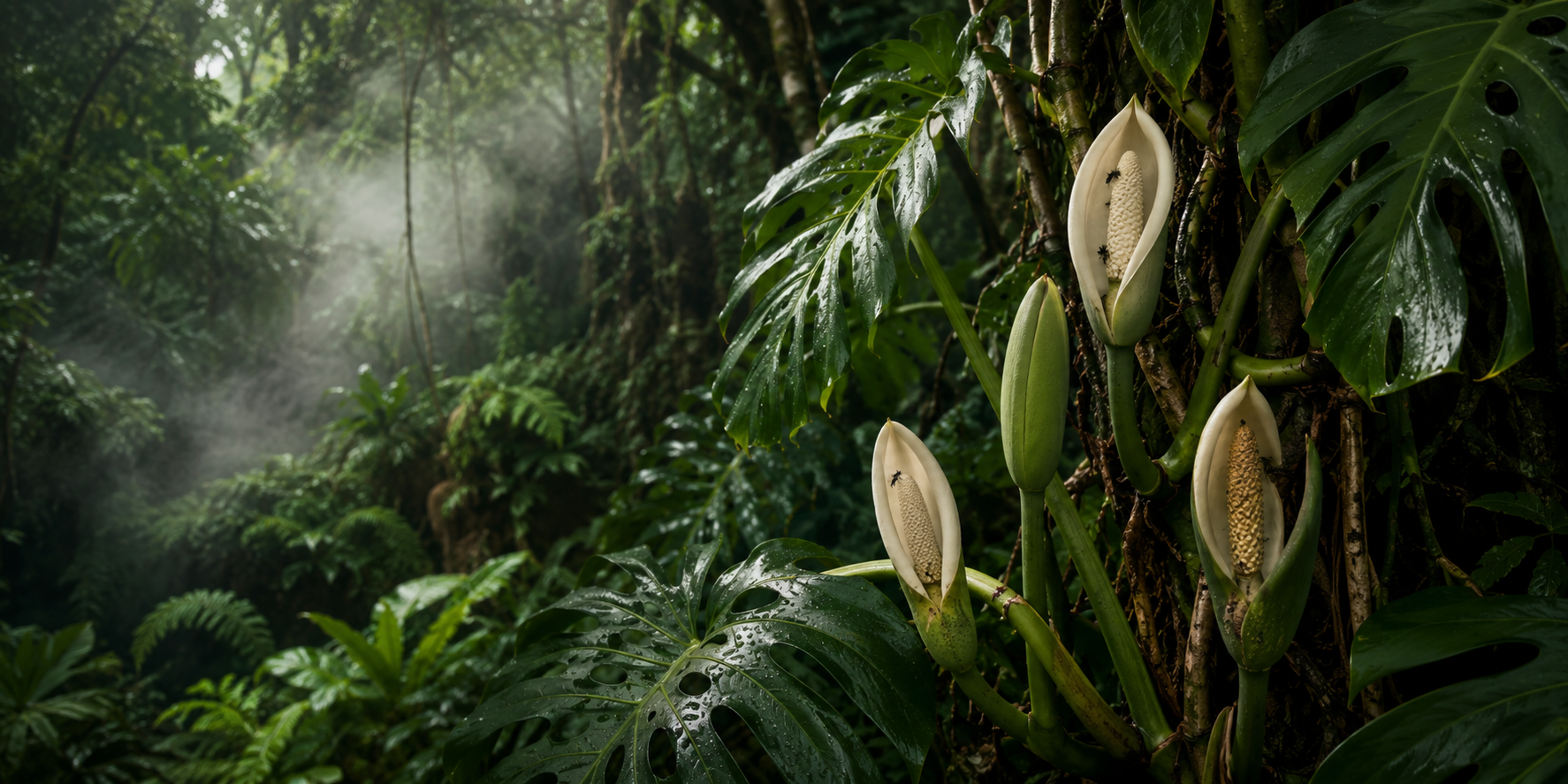
The Araceae · Reproduction
AROID REPRODUCTION
One blueprint — a spike of flowers wrapped in a leaf — and from it heated chambers, false corpses, insect nurseries, and doors that open on a timetable.
The Structure
The Inflorescence, and What It Is For
A spike of flowers wrapped in a leaf. That is the whole invention — and every trapdoor, furnace and false corpse in the family is a modification of it.
-
1 blueprint
Spadix + spathe,
the whole family -
90.5%
Of thermogenic flowers
separate the sexes in space -
70 of 71
Mature female first,
where the sexes are sequential -
Hours–days
How long a pollinator stays
— not seconds
What is sold as an aroid “flower” is not one. It is an inflorescence: a dense column of many individually tiny flowers — the spadix — subtended by a single modified bract, the spathe. That is the family’s signature, and it is remarkably conserved. Every inflorescence morphology in Araceae can be read as a variation on that one theme.
Which makes the family’s reproductive diversity the interesting puzzle. A group with an almost invariant floral architecture has nevertheless produced one of the widest ranges of pollination systems in the flowering plants — beetle brood chambers, fly nurseries, carrion mimics, sweet-scented bee flowers, and at least one lineage that heats itself past 47 °C before dawn.
Why unisexual flowers changed everything
The usual explanation for that range starts with a single structural decision: in much of the family, the flowers are unisexual. Male and female flowers occupy separate territory on the same column instead of every flower carrying both sexes.
That separation did two things. It made zoning possible — and zoning, in turn, opened the door to sterile flowers. Once a stretch of the spadix no longer had to make pollen or ovules, it was free to do something else entirely. The results are the family’s specialist organs, and they are worth naming as a set because almost every aroid you will meet has some combination of them:
A barrier. Sterile tissue between the sexes that physically keeps pollen away from stigmas.
An advertising organ. A sterile terminal appendix whose job is scent, sometimes at spectacular scale — in Alocasia macrorrhizos it is 60% of the spadix and carries no flowers at all.
A furnace. Tissue specialised for thermogenesis, which volatilises the scent and, in some species, is a reward in its own right.
A restaurant. Sterile male flowers that secrete food for the visitors — in Alocasia odora the sterile zone exudes a sugar- and amino-acid-rich liquid that is the only food its pollinating flies can eat.
The general principle
In most flowering plants, a structure that stops making gametes is on its way to being lost. In Araceae, sterile flowers became the family’s toolkit. Nearly everything interesting an aroid inflorescence does — smell, heat, feed, trap, block — is done by a part that gave up reproducing.
The chamber, and the door in it
The second great innovation is the floral chamber. In many aroids the lower spathe does not open at all: it stays wrapped into a closed vessel around the female flowers. Add a constriction partway up — a waist that can tighten and relax — and the inflorescence acquires something no open flower has. It can hold its pollinator.
That is a genuine step change. An open flower gets whatever contact a visitor makes in the seconds it is present. A chamber keeps its visitors for hours or a few days, through a whole scripted sequence: attracted during the female phase, retained while the stigmas are receptive, and released only once pollen is being shed — past the anthers, on the way out.
What does the retaining varies, and the distinction matters more than it might seem. Some species hold visitors with genuine rewards — food, warmth, a mating arena, shelter from daylight. Others hold them with trap mechanisms, slippery walls and a constriction that simply shuts — and, in some genera, rings of stiff sterile flowers that work as a size filter rather than the one-way valve they are usually described as. And in some the same closing door does both at once: the constriction in Alocasia shuts on visitors already inside while excluding everything that arrives afterwards.
“Aroids trap their pollinators” is too broad
It is true of a famous minority, and it is the wrong question for many others — because retention and deception are separable, and the word “trap” smuggles the second in with the first.
Alocasia is the clean illustration. Its constriction really does close with flies inside: they have been counted in sealed chambers, and their larvae grow to adulthood in there before the spathe opens again. That is retention. But the flies are fed nectar from the sterile staminodes, they mate and breed on the plant, and their larvae eat only decaying tissue, never ovules or seed. An Arum holds its midges for about a day and gives them no brood site and nothing for their larvae — the plant counterfeits the dung the midge came to lay eggs in, and the midge leaves having laid none. Same closing door; entirely different transaction.
And the two are related in a specific direction — with the hedge the original authors put on it. Trapping inflorescences have evolved in the family at least ten times, and for the traps that grew out of fly pollination — six of those ten origins — the reading is that they were most probably derived from ancestors that offered brood sites: the nursery came first and the counterfeit came out of it. The beetle-ancestral and ambiguous origins are murkier, and the inference itself rests on a reconstruction rather than a measurement. Arum is what happens when a plant keeps the advertisement and withdraws the nursery.
So the useful question is not “does it trap?” but “does the visitor leave better off than it arrived?” Question 7 in the next section is where that gets decided genus by genus.
That the two really are separate is not just a tidy distinction. Colocasia settles it: its spathe seals its pollinators in overnight, and those same flies are fed, mate inside, lay their eggs there and raise larvae that damage nothing. Bagged away from them, cultivated Colocasia esculenta sets fruit on 0.7% of its flowers against 26% when the flies can reach it (Bröderbauer et al. 2014). Locked in, and paid.
Carry the word cultivated, because it is doing real work. The same study scored 85% in wild Colocasia fontanesii and 81% in Colocasia lihengiae. Taro's 26% is not what the genus can do — it is what a plant selected for its corms for several thousand years can still do, and the authors read the gap as reproductive traits degraded under domestication. The low number is the interesting one precisely because it is low. Arum creticum splits the difference more finely still — its bees come and go freely in the phase when there is pollen to collect, and are held only in the earlier phase, when there is nothing.
Female first: protogyny
Almost universally among aroids with separate sexual phases, the female phase runs first. The stigmas become receptive, the plant advertises, visitors arrive — and only afterwards does the same inflorescence release its pollen. This is protogyny, and its prevalence is striking: among thermogenic-flowered species whose sexes mature in sequence, 70 of 71 are protogynous.
The logic is straightforward. An insect arriving at a female-phase inflorescence is arriving from somewhere else, and whatever pollen it carries is another plant’s. By the time this inflorescence contributes its own, its stigmas are — in theory — already past use. Outcrossing gets the first attempt.
But protogyny alone is not a lock
The windows overlap
It is widely repeated that protogyny prevents self-pollination. Measured carefully, in Alocasia macrorrhizos, it does not quite: stigmas stay fully receptive for at least three days and pollen is shed on day two. The phases are staggered, not separated.
What closes the gap is the machinery around it — the constriction sealing the chamber the night before shedding, and self-incompatibility underneath. Protogyny is the first line of defence, not the only one.
The second lock: self-incompatibility
Behind the choreography sits chemistry. Where it has been tested in the family, self-pollination frequently fails outright rather than merely being made difficult. In wild Alocasia macrorrhizos, 20 strict self-pollinations and 20 crosses between plants of the same clone produced no mature seed at all — a few berries started, then stopped after about three weeks. Crosses between genuinely different plants of the same species, by contrast, took 79 times out of 88.
For anyone hoping to breed aroids, that asymmetry is the single most important fact on this page, and it reframes the whole exercise: the hard part is almost never the technique. It is having two plants that are really two plants. Divisions of one mother, or two imports from the same tissue-culture line, are one individual wearing two pots.
The Mechanism
Heat, Scent, and the Price of Admission
Some aroids run a fever. It is the most theatrical thing the family does, and it turns out to be doing at least three different jobs.
The furnace
A number of aroids generate metabolic heat in their inflorescences during anthesis, and the range across the family is enormous. Taro, Colocasia esculenta, never exceeded 7 °C above the surrounding air. Wild Alocasia macrorrhizos reached a mean maximum of 43.9 °C against 22.4 °C ambient, with single readings to 47.8 °C and a departure from ambient of 25.6 °C. Its close relative Alocasia odora manages about 2.4 °C.
Two species in one genus, an order of magnitude apart. Thermogenic capacity is not a family-level trait you can assume from a relative.
Mechanistically it runs on the alternative oxidase pathway — respiration deliberately uncoupled from making usable energy, so the output is heat. In Alocasia odora a single gene, AOX1b, is switched on specifically in the heating tissue, expressed some 1,800-fold higher in the male zone than in the female zone immediately below it. The fuel, at least in the appendix, appears to be carbohydrate.
Thermogenesis is not thermoregulation
Worth separating, because they get conflated constantly. Thermogenesis is making heat. Thermoregulation is defending a set point regardless of the weather — sacred lotus holds itself at 30–35 °C. Alocasia odora is thermogenic but not thermoregulating: its output rises and falls with ambient temperature. Many aroids are in the same category. A plant can be dramatically hot without controlling its temperature at all.
There is also a third possibility that looks exactly like the second. In the dead-horse arum, Helicodiceros muscivorus, the male flowers hold a near-constant temperature through the night — and it is not regulation. Respiration rate and tissue temperature turn out to be unrelated, and plants left in steady weather were less constant rather than more. What looks like a defended set point is a daily rhythm of heat production running against a falling night temperature, the two happening to cancel. A flat line on a chart is not by itself evidence that anything is being controlled.
A hot chamber is a hot organ in a cool room
Stamens +7–10 °C, the air beside them +0.2
Almost every temperature published for an aroid is the temperature of tissue — a thermometer pushed into the spadix. The air the insect is actually sitting in is a different and much cooler number. Measured properly in Arum italicum, with separate probes for tissue, air and the chamber wall, the stamens ran 7–10 °C above the outside air while the air at the bottom of that same chamber sat within 0.2 °C of ambient. The whole gradient — about 8 °C, and up to 11 in some plants — is packed into less than seven centimetres. So a “furnace” is a hot surface in a cool space, not a heated room, and which of the two a given figure describes changes what it means for the animal inside.
Three jobs the heat does
1. It volatilises the scent. This is the standard explanation, and the one nearly every paper on the subject assumes: warm tissue evaporates volatile compounds faster, so the advertisement carries further. The supporting evidence is that heat and scent peak together — in Alocasia macrorrhizos the temperature maximum and the moment of maximum odour coincide exactly, at 05:45–06:00. What is missing is a direct test. Nobody has yet blocked an aroid’s own heat and measured what happened to its scent, and the argument against sufficiency is strong: heating often continues for as long as the insects stay, not merely while they are being recruited, and in some species the temperature that gets defended is the one inside the chamber rather than the one at the scent organ.
The nearest thing to a test runs the experiment the other way round, and it is worth knowing because it separates the two things this job confuses. In the dead-horse arum, Helicodiceros muscivorus, the foul smell is produced only on the first of the two days the inflorescence is open; by day two it is undetectable, and visits fall away significantly. Put the missing compounds back — a synthetic blend on cotton rolls inside the chamber — and day-two plants drew as many flies as they had on day one. Odour alone restored the long-range signal. When heat was then added on top of the synthetic odour, it made no difference to how many flies arrived. So in the one aroid where the two have been pulled apart experimentally, the recruiting is done by the chemistry, not by the temperature — which does not refute this job, but does show that heat is not what carries the advertisement in that plant. What heat does there instead is job 3.
2. It is sometimes the reward — demonstrated once. In Philodendron solimoesense a warm chamber is metabolically valuable to its pollinating scarab, Cyclocephala colasi, which would otherwise burn its own reserves staying warm. Measured overnight in 20 inflorescences, the floral chamber ran 3.4–5.0 °C above the outside air while the beetles were active; the energy that saves them was then calculated, at between 2.0 and 4.8 times. The plant is not advertising with heat so much as paying with it. Two limits are worth carrying: no beetle has ever been measured inside a flower, and where the same question was asked of flies, the answer came back negative — the blowflies leaving a Helicodiceros muscivorus chamber were too cold to fly and warmed themselves by shivering, not by the plant. Their thoracic temperatures ran 3–5 °C above ambient on average, and the chamber air sat at 16–19 °C while the male florets were close to 25 °C — the warmth was right beside them and they did not take it. One beetle, one plant, one demonstration.
Heat was a curiosity for a hundred and ten years before it was a story about insects
The first record of an aroid running hot is from 1777; the first thermometer reading, of a spadix nearly nine degrees above the air, followed soon after. By 1838 two Amsterdam botanists had a spadix sealed in pure oxygen while it was still attached to its plant, and had watched it climb to thirty degrees; sealed in nitrogen instead, the same species stopped heating, stopped growing and lost its smell entirely. By 1851 a physician in Lille had one measured against the other in a single vessel — eleven and a half degrees above the room while the flower drew thirty-one times its own volume in oxygen in an hour.
Not one of them suggests the heat has anything to do with an animal. They call it a fever, they treat it as respiration made visible, and they compare it to a germinating seed. In 1913 the first careful account of pollination in this group — flies shut into a taro spathe overnight, their maggots later filling the fruiting head — does not mention heat at all. The two lines of work ran side by side for over a century without touching.
3. It steers the insect once inside. The newest and most surprising result. Because only the upper spadix of Alocasia odora heats, the inflorescence carries an internal thermal gradient that reverses between day and night — and that gradient, not scent, is what moves the flies. By day the warming top pushes them down onto the receptive stigmas; by night the still-warm top pulls them back up onto the pollen. Warming and cooling the outside of the spathe flipped the flies’ distribution from 10.4% to 89.2% in the upper chamber at noon, and from 91.4% down to 8.0% at midnight. Two thousand lux of light at night did essentially nothing.
It is no longer a single case. The same job turns up in a completely different plant, with a different pollinator and a cleaner experiment. In Helicodiceros muscivorus the heat is confined to the appendix and to day one, and it works as a landing beacon rather than a gradient: a fly that finds the appendix is three times as likely to go on into the trap chamber than one that lands on the spathe — 33.0% against 10.2% — and 69.4% of the flies that got in came that way. Wind a resistance wire round the appendix of a second-day plant, warm it to the level the plant itself manages, and the proportion of arrivals that find the appendix climbs back from 24.0% to 39.6%, statistically indistinguishable from an untouched first day. The control matters: the same wire was fitted, unpowered, to the plants it was being compared against.
Read the two together and the job sharpens. In one plant the heat sorts the insects inside the chamber; in the other it decides how many get in at all. Neither is advertising. Both are steering an animal that has already arrived — which is a different claim from the one the textbooks make about aroid heat, and much better evidenced.
Why temperature is a better signal than colour or smell
It can’t be unlearned
The argument advanced for why a plant would bother: insect responses to colour and scent can be re-learned and overridden by experience. Thermal preferences cannot. Heat-seeking and heat-avoidance are hard-wired and conserved across invertebrates, which makes temperature a signal the pollinator has no capacity to become jaded about. (Reasoning from the Drosophila literature, not tested on the aroid’s own flies — the authors flag it as argument, not result.)
The smell, and what it is made of
Aroid scent spans just about the whole olfactory range available to a plant: sweet and fruity at one end, and at the other, faithful reproductions of dung, carrion and rotting fungus. The scent is the long-distance signal — the part that recruits from outside the plant — and in the species where it has been localised, the sterile appendix is doing most of it. Partition an Alocasia odora spadix and offer the pieces separately and the appendix takes 67% of 847 flies, against 2.5% at the female end.
Chemistry is published for very few aroids. In Alocasia odora, nine compounds account for 94.5% of emission, six of them concentrated in the appendix: methyl propionate, methyl butyrate, methyl 2-methylbutyrate, methyl benzoate, (E)-4,8-dimethylnona-1,3,7-triene and methyl salicylate. Note what most of those are — short-chain methyl esters, the chemistry of fermenting fruit. Which is exactly what you would build if your intended audience were drosophilid flies.
And the display size matters, not just its composition. Cutting the appendix off an Alocasia odora inflorescence measurably reduced its fruit set; removing the appendix and the male zone together reduced it further. Bigger advertisement, more seed — the first demonstration in any plant that the magnitude of an olfactory display feeds through to reproductive success.
Reward, or deception
Every pollination system is a transaction, and aroids resolve it in two opposite ways. The distinction is the most useful single axis for understanding any aroid you meet.
Rewarding systems pay. The visitor gets food, warmth, shelter, a mating arena, or a place to lay eggs, and both parties profit. The Alocasia–Colocasiomyia relationship is the fully developed version: the flies feed on the sterile zone’s exudate, mate inside the chamber, lay their eggs among the pistils, and their larvae grow up inside the ripening fruit head — without damaging the fruit. Compare that to figs and fig wasps, where the plant buys pollination by surrendering seed. Here the plant pays nothing it needs. The flies are so committed that across the genus Colocasiomyia — 25 described species and some 65 still awaiting description — they are found on essentially nothing but Araceae, Arecaceae and Magnoliaceae, and one lineage breeds only on Colocasia, Alocasia and Steudnera.
Deceptive systems do not pay. Instead the inflorescence mimics the thing its pollinator is actually looking for — faeces, a fungus, a dead animal — and the insect arrives expecting a place to feed or breed and leaves with nothing but pollen. This is the strategy behind the family’s most notorious smells, and it is where Amorphophallus, Arum and Helicodiceros live. The mimicry can be good enough that insects lay eggs on it, and the larvae then starve.
For most of the family that word — mimicry — is doing more work than the evidence supports. It usually rests on a human nose and a resemblance. In exactly one aroid it has been tested properly, and the result is worth carrying because it sets the standard the rest of the family has not yet met.
The dead-horse arum’s smell was run through a gas chromatograph alongside the headspace of an actual rotting carcass, with a blowfly’s antenna wired in as the detector. Three compounds did the work — dimethyl mono-, di- and trisulphide, the chemistry of decaying protein — and the antenna responded to the flower and to the carcass no differently. On the strength of that the authors make the careful claim, and it is the right one: a carrion fly cannot separate the mimic from the model by smell alone. The flies it catches are overwhelmingly female — 78% at the flower and 100% at the carcasses — which is what the mimicry predicts, since it is the females that need somewhere to lay.
Three honest limits. Those three compounds are the ones the antenna reacted to, not the plant’s whole bouquet, and “no different” is a failure to find a difference on eight runs rather than a proof of identity. The visual half of the resemblance — the hairy spathe, the dark opening the authors describe as an illusion of a rectal opening complete with a tail — has never been tested at all. It is a photograph and a caption, not a result. And the chemistry rests on very little material: the study that first identified these compounds worked from a single cultivated plant in a glasshouse, sampled twice, which could not even be bagged because it was on public display.
The smell is not the proof
It is tempting to run the argument backwards — this plant smells of sulphur compounds, therefore it is a carrion mimic — and the chemist who identified them says not to. Dimethyl oligosulphides are characteristic of carrion odours, but they are not diagnostic of carrion mimicry: the same compounds turn up in the floral scent of bat-pollinated plants, which are advertising something else entirely. What makes the dead-horse arum a demonstrated mimic is not the presence of the compounds. It is the paired carcass control, the antenna that could not tell the two apart, and the flies that came back when the compounds were put back.
Do not assume from the smell
A foul-smelling aroid is probably a deceiver and a sweet-smelling one probably pays — but the correlation is loose enough to be a trap for the reader. Alocasia smells faintly of fermentation, which sounds like fruit-mimicry deception, and is in fact one of the most generous mutualisms in the family: real food, a nursery, and no cost to the seed. The smell tells you who is being recruited. It does not tell you whether they are being paid.
The Variations
Seven Questions
There is no useful taxonomy of aroid pollination systems — the variables cut across each other too freely. What works better is a checklist. Answer these seven about any inflorescence and you have characterised it.
-
Are the flowers bisexual or unisexual?
- Bisexual
- Unisexual
The first fork, and it decides most of what follows. Bisexual (“perfect”) flowers each carry both sexes and the spadix is undifferentiated — Anthurium, Monstera, Spathiphyllum. Unisexual flowers are zoned by sex, which is what makes sterile zones, appendices and chambers possible at all — Alocasia, Philodendron, Amorphophallus, Colocasia, Arum.
It is also the fork that decides how much of this page applies. The bisexual condition covers 31 genera and roughly 1,500 species — about two-fifths of the family — and it is the ancestral state: every early-diverging branch has it, and the zoned, chambered, trapping architecture belongs to a single late-diverging group. Of the traits sorted by these seven questions, flower sexuality is the one that predicts the pollinator best.
-
Open spadix, or a closed chamber with a door?
- Open
- Chamber
- Chamber + constriction
An open spadix presents everything at once and takes whatever contact a visitor makes. A closed lower spathe creates a chamber around the female flowers; add a constriction that can tighten and the plant gains control over when the chamber is reachable. This is the difference between brushing a spadix and cutting a window into one.
-
Is there a sterile appendix — and how big?
- None
- Vestigial
- Dominant
The sterile terminal section is the advertising organ, and its size tracks how much the plant invests in recruitment. It can be 60% of the spadix in Alocasia macrorrhizos, or absent. Where it is rudimentary, self-pollination is sometimes suspected instead — a plant that has stopped advertising may have stopped needing visitors.
-
Is there a sterile zone between the sexes, and does it feed anyone?
- Absent
- Barrier only
- Barrier + food
Easy to dismiss as a spacer. In Alocasia odora the sterile zone secretes the sugar- and amino-acid-rich exudate that is the only food its flies can eat — they have sponging mouthparts and cannot swallow solid pollen — and over 60% of all adult flies aggregate on it. In Philodendron, sterile male flowers are likewise the beetles’ food source. Ask what the sterile zone is secreting before assuming it does nothing.
-
Does it heat — and does it regulate?
- No
- Thermogenic
- Thermoregulating
Three states, not two. Many aroids make no measurable heat. Many make a lot but simply track the ambient temperature. A few defend a set point. And the magnitude spans +7 °C in taro to +25.6 °C in Alocasia macrorrhizos — with +2.4 °C in Alocasia odora, which is a warning against inferring from a close relative.
Two cautions come with the answer. The first is that a steady temperature is not proof of a thermostat: in the dead-horse arum a near-constant night reading turned out to be a daily rhythm of heat production cancelling against a falling night temperature, with no relationship at all between how hard the tissue was respiring and how warm it was. The second is to ask what was measured. Nearly every published figure is the temperature of tissue, and the air a few centimetres away can be eight degrees cooler — see the previous section.
-
Who comes?
- Beetles
- Flies
- Thrips
- Bees
And, just as important, how long do they stay? Aroid pollinators are residents, not tourists. Where a bee spends seconds on a flower, an aroid’s visitors typically stay hours to days. Everything about the design — chamber, food, warmth, mating space — follows from keeping somebody rather than merely touching them.
-
Does it pay, or does it deceive?
- Reward
- Deception
The transaction. Rewarding systems supply food, heat, shelter or a nursery. Deceptive ones mimic dung, fungus or carrion and supply nothing — sometimes convincingly enough that insects lay eggs that then starve. Both are common in the family, and the smell alone will not tell you which you are looking at.
The same seven questions, across eight genera
The genera this hub covers, answered as far as the literature currently allows. Every row now carries numbers, and every number was checked against the paper it came from — which is a recent state of affairs, and one that says as much about how little of this family has been studied as about how much.
| Genus | Flowers | Spathe | Appendix | Heat | Pollinators | Transaction |
|---|---|---|---|---|---|---|
| Alocasia | Unisexual, zoned | Closed chamber; constriction shuts the night before shedding | Dominant — to 60% of the spadix | +2.4 to +25.6 °C, strongly species-dependent | Colocasiomyia flies (Drosophilidae) in Asia — but the one Australian species tested has a different, unresolved answer | Reward — food, mating and a nursery, at no cost to the seed |
| Anthurium | Bisexual — no sexual zoning | Open; spathe is a backing bract, not a vessel | None | Looked for in 8 species and found in none | Euglossine bees above all, but also halictids, stingless bees and honeybees; flower weevils that pollinate and eat the inflorescence at the same time; hummingbirds in one species; and thrips, which are 72–95% of visitors above 2,600 m. Of 1,460 species, 71 have any floral record at all and 8 have a confirmed bee pollinator | Reward — pollen, collectable perfume, edible floral tissue, and a sugary secretion from the tepals |
| Monstera | Bisexual — but the female phase runs longer than the male | A real chamber: the spathe opens only slightly and stays nearly shut until pollen is shed | None | +0.5 to +2.5 °C through the female phase, rising to +5 °C as the anthers open | Small nitidulid beetles. Stingless bees are recorded but ruled out — they arrive only once the chamber has opened. One of the two beetle records has been questioned by its own authors | Reward — shelter, a mating site and pollen |
| Philodendron | Unisexual, zoned | Closed chamber with a constriction | None — but a sterile male zone that feeds the beetles, and a sticky resin that glues pollen to them on the way out. The resin comes from the inner face of the spathe in some species and from the male zone of the spadix in others, and from both in Philodendron acutatum | Strong, and in two peaks on consecutive evenings: +11 to +13 °C when the stigmas are receptive, +7 °C at pollen release the following evening. The fertile male zone is the hottest part; the enclosed female zone stays within half a degree of the air. True regulation is shown in one species and explicitly fails in another — and respirometry shows heat production continuing all night while the trace falls back toward ambient, so the two peaks record what the spadix keeps, not what it makes | Cyclocephaline scarab beetles. Four species have now been tested by exclusion and none set a single seed when bagged; in one, two or three beetles pollinate 94% of some 170 flowers. But natural fruit set runs from 11% to 92% across the genus, and the best predictor is simply how many beetles arrive | Reward — food, resin, a mating chamber, and warmth. Whether the warmth is itself a payment is the most contested claim in the family: beetles measured inside the chamber were no warmer than the air around them, so what the plant offers is an avoided cost rather than a delivered gain, and the familiar two-to-fivefold saving is a calculation, not a measurement |
| Amorphophallus | Unisexual, zoned — female at the base, male above | Chamber in many species; the constriction is absent in a good many | Usually dominant — but absent altogether in two species, and shorter than the male zone in others | 0 to +21.7 °C. Of 80 species measured, 25% do not heat at all | Beetles above all — dung, carrion, sap and rove beetles. Recorded for 22 species out of 246 | Deception — mostly. Where a fleshy sterile zone exists, the beetles eat it |
| Arisaema | Unisexual — but the plant is what switches: small plants flower male, large ones female, and a setback sends them back. Experimentally reversible in both directions since 1922 | A tube under a hood, with no constriction and no closed chamber. The wall is coated in loose wax that clogs a fungus gnat’s foot pads, so the insect falls in and cannot climb out. Male spathes grow a 1–2 mm exit at the base; female spathes have none | Present and often dominant, purely as a scent organ — thread-like and up to several decimetres in some species, trailing to the ground as a path for insects that barely fly | None found. Measured once, in 1 species on 6 plants, against the petiole as a control and under shade: no increase in either sex, and the night air was warmer than the appendix. The only genus here that runs a full trap cold | Fungus gnats — Mycetophilidae and Sciaridae — and often just one or two species per plant, which is how the genus keeps its species apart. Gall midges matter in North America and barely register in Japan. Of 224 species, detailed pollinator data exist for 14 of the 53 in Japan; most of the genus, including all eight African species, has never been watched | Deception — and in females, terminal. The one trap in the family that never opens: the gnat pollinates, fails to climb out, and dies inside. Since 2024 that has been softened, not overturned — in three species some gnats breed in the trap and escape, and in four Chinese species the larvae eat the trapped corpses |
| Arum | Unisexual, zoned; monoecious and protogynous — the female phase runs the first evening, the male the next | A true chamber, closed off by a ring of downward-pointing sterile bristles. Not a fish-trap: four experiments on Arum nigrum showed no insect ever walks in — they all fall, off a slide zone. And the bristles do not wither to open a door: the spadix wilts, becomes climbable, and escape is upward, past the anthers | Dominant — the scent and heat organ. A second, chemically distinct scent source sits inside the chamber; a claim about what the plant smells of is incomplete without saying which organ | +8.6 °C (Arum maculatum) to +18.5 °C (Arum italicum) side by side in one French population, and it thermoregulates toward about 30 °C. But Arum italicum’s appendix is six times the volume: per unit of tissue Arum maculatum makes four times the heat. The heat attracts nothing — a heated model caught none in 13 days, and one moth fly avoided warmth in 2 of 4 trials | Moth flies (Psychodidae), above all Psychoda phalaenoides — overwhelmingly egg-laying females. That is true in England and Germany, false in northern Italy, and unverified for most of the 27 species | Deception — and disputed. The mimicry is not in doubt: p-cresol is a major volatile of cow dung, where the fly breeds, and it out-caught every rival compound in a field trial. What is disputed is the textbook claim that the flies get nothing. It rests on a single negative observation, and the stigmatic fluid measures a 9–12.5% sucrose equivalent — slightly sweeter than cut phloem |
| Spathiphyllum | Bisexual, protogynous — and the male phase runs much the longer: female 3–8 days against male 7–24 | No vessel at all. The spathe is an open white blade standing behind a fully exposed spadix — no chamber, no constriction, nothing to fall into. The family’s opposite pole | None | None reported in any study of the genus | Bees, and which kind depends on the species: male euglossine bees collecting the scent itself as perfume, and pollen-gathering stingless bees that pollinate by mistake while robbing. Both answers are real and they sort by species. Of 76 species, 5 have been field-studied properly and 8 more have identified visitors | Reward — collectable perfume, or pollen, depending on who arrives. One species, on a small sample, skips pollinators altogether: its anthers shed clotted pollen onto its own receptive stigmas by gravity |
How much to trust this table
All eight rows now rest on papers read in full, and every figure in them is traceable to a named study. That was not true until recently: Anthurium and Philodendron spent a long time deliberately pitched without numbers, because a number would have implied a measurement nobody had checked. They have both been checked.
What has not changed is that a filled cell is not a settled one. Two examples worth carrying in your head. The Philodendron beetle figures come from nine days of observation at one site — and the same plant species uses a different beetle in Panama. And Anthurium’s heat cell says heat was looked for in eight species and not found, which is a real result about eight species and a guess about the other sixteen hundred.
The Monstera row changed most in this revision, and it is worth saying why. It used to describe an open spadix with heat “reported in some species” and no identifiable pollinator. That was wrong rather than merely cautious: the genus has a real floral chamber, measurable heat, and beetles. What has not improved is the pollinator evidence — one of the two beetle records was later questioned by the same authors who published it — and no Monstera has ever had its scent chemically analysed. Two of the seventy-one species have had a pollinator identified in the wild.
The Arisaema row is new in this revision, and its heat cell is the thinnest in the table — one species, six plants, one Quebec population, one May. It is a good measurement, with the right control and the sunlight deliberately excluded, and it is the only one anyone has ever made in the genus. What it licenses is no heating found in Arisaema triphyllum; what it does not license is a claim about the other two hundred and twenty-three species. The row is worded that way on purpose.
The Arum row is the one to read most carefully, because it is the only row whose Transaction cell is still an open argument. Every other genus here is a reasonably settled Reward or Deception. Arum is the textbook deceiver — and the claim that its flies get nothing rests on a single negative observation, against which the sugar content of the stigmatic fluid cuts the other way. The cell says “disputed” because it is. Two more corrections sit in its Spathe cell: the trap is a slide, not a funnel, and the way out is upward — both of which contradict the account in most textbooks.
With these two rows the table finally covers every genus that has a guide page on this site. It took three revisions in one day to get there, and the gaps it now shows are gaps in the literature rather than gaps in this page.
What actually visits an aroid
Across the world’s thermogenic flowers — the group aroids dominate — the pollinator records break down as 70.1% beetles, 32.2% flies and 4.6% thrips, out of 87 species with data. (The percentages exceed 100 because a species can have more than one.) Bees barely feature, and where they do appear they are often taking rather than pollinating: in Alocasia macrorrhizos, stingless bees and honeybees turned up in numbers to collect pollen and contributed essentially nothing, because they are too large to enter the chamber where the stigmas are.
That is the pattern to hold onto. Aroids are overwhelmingly a beetle-and-fly family, and their pollinators are specialists that live on the plant rather than generalists passing through. Colocasiomyia — 25 described species and some 65 more awaiting description — occur on essentially nothing but Araceae, Arecaceae and Magnoliaceae, and one lineage breeds only on Colocasia, Alocasia and Steudnera. Cyclocephaline scarabs have a comparably tight relationship with Philodendron.
And for the overwhelming majority, nobody knows
Araceae runs to thousands of species, and pollinators have been properly documented for a tiny fraction of them. Alocasia is a good measure of how thin the record is. In a genus of ninety-two species, pollination has actually been demonstrated in three — Alocasia odora, Alocasia cucullata and Alocasia macrorrhizos — all three by Colocasiomyia flies. Named flies have been collected from four more, including Alocasia princeps and Alocasia sarawakensis, without anyone testing whether they carry pollen that sets seed. Finding an insect inside an inflorescence is not the same claim as showing it pollinates the plant.
And the one place the question was put to a proper experiment, the answer was not a Colocasiomyia at all. In Queensland, Alocasia brisbanensis sets seed just as well in gardens where its resident fly is entirely absent — up to 98% — so the obvious candidate was ruled out and the real pollinator is still unidentified. Given how host-specific these insects are, there are almost certainly many undescribed partnerships waiting, in cultivation collections as much as in the field.
What this means if you want to breed them
The seven questions are not academic. Two of the answers change your technique outright.
Question 1 decides how you get access. With bisexual flowers — Anthurium, Monstera — the whole spadix is exposed and there is nothing to cut: you brush it. With unisexual flowers inside a closed chamber — Alocasia, Philodendron, Amorphophallus — the stigmas are sealed in a tube and every technique is some answer to reaching them. That is a fundamentally different job, and it is why a guide written for Anthurium can mislead you badly on an Alocasia.
And pollen does not behave the same way across the family. Alocasia pollen is dry and light. Philodendron and Caladium shed moist, stringy pollen, and long-term freezing of those is expected to fail — whereas dry pollen is the kind that stores. So the freezer trick that bridges the protogyny gap in one genus may simply not be available in another.
Beyond that, the constants hold across the family: female phase first, outcross pollen strongly preferred, and the real bottleneck being two genuinely unrelated plants in flower near enough in time to use each other.
Which leaves the question this section cannot answer: unrelated by how much, and can two plants be too far apart to work? A cross between plants with different chromosome numbers will often still set seed, and that seed will often still grow — and the plant it becomes may then be unable to make working pollen of its own. A mismatch does not usually stop a cross; it stops the generation after.
What is known about where those limits fall is gathered in Why Some Crosses Fail. The short version is that no aroid genus has a tested compatibility matrix — one genus has a breeder's record of what failed, one has a map of what succeeded, one has chromosome counts and nothing else, and the rest of the family has none of the three.
The Genera
Pollination, Genus by Genus
Each section answers the seven questions for its own genus, and carries the practical method for crossing it by hand.
-
Read now
Alocasia
Protogynous, chambered, and pollinated by flies that breed inside the ripening fruit without damaging it. The complete method — reading the spathe, catching the pollen, making the cross, and raising the seed — plus the anthesis clock and the 44 °C fever behind it.
Read the guide
-
Read now
Amorphophallus
The family’s great deceivers — enormous appendices, powerful thermogenesis, and a smell built to counterfeit a dead animal. Visitors are recruited on a promise of somewhere to breed, and paid nothing at all.
Read the guide
-
Read now
Philodendron
The genus where the family’s most contested claim lives — that the warmth is itself a reward, and not merely the machinery that lifts the scent. It rests on a calculation, and no beetle has ever had its energy budget measured inside a flower. What is beyond doubt is sturdier: not one of the twenty-three species tested can pollinate itself, a single beetle visit is enough to set a whole infructescence, and natural fruit set swings from a tenth to nine-tenths depending on how many beetles turn up.
Read the guide
-
Read now
Anthurium
The outlier, and the genus where the simplest question is still open: what the flower is offering. Bisexual flowers on an undifferentiated spadix mean no zones, no chamber, nothing to cut — and no trap anywhere in the genus. One body of work holds that aroids reward nothing and that Anthurium is nectarless; another, reviving a 1930 experiment, finds sugar secreted from the tepals as well as the stigmas, sweeter than the stigmatic fluid and continuing after the stigmas have dried. Selfing varies by species — nine of twenty set seed when bagged away from every insect, while seven others set none — and several species fruit with no pollination at all, which means berries are not proof that a cross worked.
Read the guide
-
Read now
Arum
The trap everyone has heard of — and the one whose standard explanation was disproved in 1926 and never corrected. The bristles are not a valve, the insects do not walk in, the heat attracts nothing, and a single clone can pollinate itself.
Read the guide
-
Read now
Monstera
The genus that breaks the tidy split. Bisexual flowers like Anthurium, but a genuine floral chamber, real thermogenesis and beetles that stay the night — the trap architecture, arrived at a second time and from the other side. It also runs its female phase longer than its male, which nothing else in this group does. Two species of seventy-one have had a pollinator identified in the wild — and the two disagree: one cannot pollinate itself at all, the other does it inside a sealed bag. No Monstera scent has ever been analysed.
Read the guide
-
Read now
Spathiphyllum
The peace lily’s genus, and the family’s open-air pole — no chamber, no heat, no trap, just a white sail and a morning scent. Who pollinates it has been corrected twice: first perfume-collecting orchid bees, then pollen-robbing stingless bees pollinating by mistake, and now — two species watched side by side — both systems at once, sorted by species. Breeding runs the whole spectrum, from bees-or-nothing to one species that pollinates itself by gravity; where the bees do come, fruit set can reach every single flower.
Read the guide
-
Read now
Arisaema
Jack-in-the-pulpit, and the one genus in the world whose flowers keep their pollinators. Every other trap on this page is a night’s detention that ends in release; Arisaema males have an escape hatch grown into the spathe, and Arisaema females have none — the gnat pollinates, and dies where it landed. It runs the family’s most complete trap without any heat at all, on wax and geometry and a scent most people cannot smell. The plants change sex with the size of their corm, and visits are so rare that one season yielded 133 insects from nearly 7,000 inspections. Two hundred and twenty-four species; fourteen studied properly. And since 2024, three of them have turned out to let some pollinators breed inside the trap and walk back out.
Read the guide
About the sources behind this overview
The measured figures on this page — temperatures, fruit-set rates, receptivity windows, the volatile chemistry, the fly-behaviour experiments — are drawn from the primary literature. Those covering Alocasia, Amorphophallus and Philodendron are traceable to a named paper in the sources section of the Alocasia guide, its Amorphophallus counterpart, or the thirty-three references behind the Philodendron guide.
The Anthurium figures are traceable through the sources section of the Anthurium guide, and the Monstera figures through the sources section of the Monstera guide, and the Spathiphyllum figures through the sources section of the Spathiphyllum guide, and the Arisaema figures through the sources section of the Arisaema guide — every genus on this page now has a guide of its own behind it.
Two caveats worth stating plainly. First, the broad framing in “Why unisexual flowers changed everything” rests on review literature cited at second hand — Mayo et al. 1997 and Gibernau 2003 on functional specialisation, Lack & Diaz 2001 on the floral chamber, Vogel 2000 on the diversity of systems — and those reviews are summarised here through the papers that cite them rather than quoted directly. Second, the survey figures (90.5%, 70 of 71, the beetle and fly percentages) describe thermogenic-flowered species across fifteen families, not Araceae specifically. Araceae dominates that list, but the distinction is real and this page keeps it.
If you keep records, they are the missing data
3 of 92
Pollination has been demonstrated in three Alocasia species out of ninety-two. Flies have been collected from four more without a pollination test, and in the one species where the obvious candidate was tested, it turned out not to be the pollinator. A fresh-pollen viability curve now exists for a single species; there is nothing at all on stored pollen, no germination percentage, and no compatibility matrix for the genus. Dates, crosses that took, crosses that arrested — that is precisely what the literature lacks. Aroidpedia would like to publish it: get in touch through the contact page.
The Words
A Short Glossary
Every field has a private vocabulary, and this one is worse than most: half the words are Latin, and several of them mean something different in an aroid than they do in a rose. Nothing on this page needs a degree. Here is the whole vocabulary it uses.
You can read the rest of the site without this section. It is here for the moment a sentence stops making sense — and because the single biggest barrier to a grower publishing what they have seen is not the observation, it is the fear of using the wrong word for it.
The parts you are looking at
- Inflorescence
- The whole flowering structure, not a single flower. When people say an aroid “flower” this is almost always what they mean, and it is the reason this site avoids the word.
- Spadix
- The central column, carrying dozens to thousands of tiny true flowers. say: SPAY-dix · plural spadices
- Spathe
- The hood, cup or blade wrapped around the spadix. It is a modified leaf, not a petal, which is why it is so often green on the outside. say: SPAYTH
- Appendix
- The sterile tip of the spadix, above all the flowers — the bare spike in an Amorphophallus, the smooth club in an Alocasia. It carries no flowers at all and exists to advertise: it is usually the part that heats, and usually the part that smells.
- Staminate and pistillate
- Male and female. In most of the genera on this site the two are in separate bands on the same spadix — female at the bottom, male above — and knowing which band you are looking at decides where you cut and where you put the pollen.
- Constriction
- The waist where the spathe pinches in between the female and male zones. It is the door: when it is open the chamber can be entered, and when it tightens, whatever is inside stays inside.
- Floral chamber
- The sealed space below the constriction, containing the female flowers. In many aroids this is where the entire transaction happens, out of sight.
- Staminode · synandrode · synandrium
- Sterile male structures. A staminode is a stamen that has stopped making pollen and taken up another job — feeding the visitors, blocking the passage, making scent or making heat. A synandrium is several stamens fused into one unit, which is why an Alocasia male flower looks like a single button rather than a ring of anthers; a synandrode is the sterile version of that.
- Anther · dehiscence
- The anther is the part that holds pollen; dehiscence is the moment it opens and lets it go. “Anthers dehisce on day two” simply means the pollen appears on day two.
- Stigma · style · ovary · ovule
- The female chain, from the outside in. Pollen lands on the stigma, grows down through the style, and fertilises an ovule inside the ovary. One fertilised ovule becomes one seed, which is why counting ovules tells you the most seed a berry could ever hold.
- Peduncle
- The stalk holding the whole inflorescence up.
- Infructescence
- What the inflorescence becomes once the berries form — the fruit head.
- Corm · tuber · offset · division
- The underground storage organ and the ways it multiplies. An offset is a new plant budded off the parent; a division is one you cut apart yourself. Both matter here for an uncomfortable reason: neither is a new individual.
- Cataphyll
- The papery sheath that wraps a new shoot before it opens. Useful as a timer — it often tells you something is coming before you can see what.
The clock
- Anthesis
- The flowering event itself — the hours or days when the inflorescence is actually open and functioning, as opposed to merely present. In many aroids the whole of anthesis is over in 24 to 48 hours, which is why timing dominates this subject. say: an-THEE-sis
- Receptive · receptivity
- The window when a stigma can still accept pollen and do something with it. A stigma that looks fine may be long past it, and this is the single most common reason a hand cross fails.
- Protogyny
- Female first. The stigmas mature and are ready before the same inflorescence releases its own pollen — nearly universal in this family, and the reason a single plant usually cannot pollinate itself. say: pro-TOJ-in-ee · adjective protogynous
The heat
- Thermogenesis
- The plant making its own heat, deliberately, by burning stored fuel in its flowering tissue. Some aroids run more than twenty degrees above the surrounding air; a quarter of one large genus does not do it at all. say: ther-mo-JEN-e-sis · adjective thermogenic
- Thermoregulation
- Not the same thing, and constantly confused with it. Thermogenesis is making heat; thermoregulation is defending a set temperature whatever the weather does — producing more heat as the night cools. Most aroids do the first. Very few do the second.
- Alternative oxidase
- The biochemical trick behind it: a respiratory pathway deliberately uncoupled from making usable energy, so that the output comes off as heat instead. It is the reason an aroid can run a fever without a muscle.
The smell
- Volatile
- Any compound light enough to evaporate and travel through air. A “scent profile” is just the list of volatiles a flower emits and their proportions.
- Osmophore
- The specific tissue that manufactures and releases the scent. It is usually somewhere on the appendix — but in at least one genus it turned out to be the fertile male flowers instead, so it is worth asking rather than assuming. say: OZ-mo-for
The bargain
- Reward · deception
- The two ways a flower can get an insect to work for it. A rewarding system pays — food, warmth, shelter, a place to breed. A deceptive one imitates something the insect wants, usually dung or carrion or fungus, and delivers nothing.
- Brood site
- A place an insect lays eggs and its larvae grow up. Some aroids genuinely provide one, which is about the strongest bond a plant and an insect can have; deceptive ones only pretend to, and the larvae die.
- Mutualism
- An arrangement where both sides come out ahead. Worth keeping separate from “pollination” in general, because plenty of pollination is not mutual at all.
Making seed
- Self-incompatibility
- A plant's built-in refusal to accept its own pollen — a chemical rejection, not a timing problem. It is why some crosses can never work no matter how well you time them.
- Clone
- Genetically one individual, however many pots it occupies. Two divisions of one plant, or two imports from the same tissue-culture line, are a clone — and crossing them is a self, with all the failure that implies.
- Fruit set · seed set
- The proportion of flowers that go on to make fruit, or seed. It is the number that tells you whether a pollination actually worked, and the one most often missing from the literature.
- Viability
- Whether pollen is still alive enough to germinate, or a seed still alive enough to sprout. Pollen viability in this family is measured in days, not weeks, and often falls by half within 24 hours.
- Apomixis
- Making seed with no fertilisation at all. Rare, but worth knowing about, because it can produce a berry full of seed that looks like a successful cross and is genetically just the mother. say: ap-o-MIX-is · adjective apomictic
- Raphides
- Bundles of needle-shaped calcium oxalate crystals in the tissue. They are why aroid sap stings and why gloves are advised. They are also widely said to protect the seed — and when someone finally sectioned twenty-one species to check, the ovules themselves turned out to be crystal-free. It is the wall around them that is loaded. say: RAF-id-eez
Who turns up
Insect family names look forbidding and mostly are not. The endings are regular: -idae means a family, -inae a subfamily. The ones that recur here, in plain terms:
- Drosophilidae — the vinegar flies
- Small flies most people know from overripe fruit. Colocasiomyia, the genus that pollinates Alocasia and Colocasia, is one of these.
- Nitidulidae — sap beetles
- Small, flattened beetles that feed on sap and fermenting matter. They turn up inside a surprising number of aroids.
- Staphylinidae — rove beetles
- Narrow beetles with strikingly short wing cases, so most of the abdomen is exposed.
- Cyclocephaline scarabs
- Heavy, blunt, nocturnal beetles — the ones that spend the night inside a Philodendron. Large enough that a warm chamber is worth real energy to them.
- Psychodidae — moth flies
- Tiny, furry, moth-like flies that breed in wet decaying matter. The classic Arum captives.
- Anthomyiidae — root-maggot flies
- House-fly-like in build. Named as the pollinator of at least one Alocasia, which is a reminder that the fly story in that genus is not finished.
Two words this site is careful about
A visitor is an insect seen on or in an inflorescence. A pollinator is one shown to carry pollen between plants and cause seed. Most of what is published about aroids records the first and is quoted as though it established the second — and where this site can tell the difference, it says which one it means.
The other is trapping. Holding an insect and cheating it are separate things, and a plant can do either without the other. One genus seals its pollinators in overnight and feeds them, houses their mating and raises their young while they are in there.