
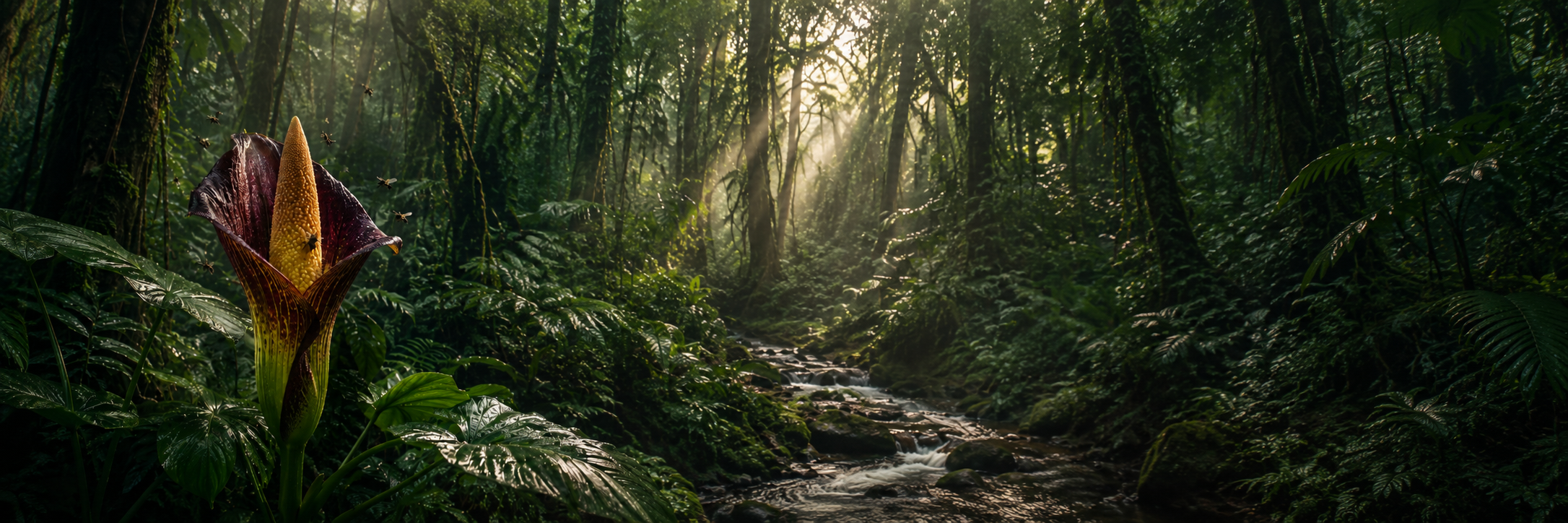
Araceae · Reproductive Biology
THE AMORPHOPHALLUS INFLORESCENCE
Heat, stench, and a window measured in hours
An Amorphophallus inflorescence is a machine for telling a lie. It builds heat it cannot use, releases a smell it gains nothing from, and offers its visitors a breeding site that will never feed a single larva. It runs the whole performance twice in two days and then throws itself away. This is a guide to reading that performance on your own plant, and to intervening in it with a paintbrush.
Take it to the plant
Not here for the botany, and just want to make a cross? The printable field card is the whole method on one sheet — the sequence from bud to berry, the three checks that decide the day, the eight steps in order, the freezer protocol that actually determines whether you get seed, and what to do when nothing happens.
Most of what a grower needs is timing. The female flowers of nearly every species in this genus are receptive on the first day, often for a matter of hours, and the same inflorescence sheds its own pollen a day or two later — by which point its own stigmas have shut. That single fact governs everything downstream: it is why you cannot self a plant casually, why a second plant almost never obliges by flowering the same week, and why the practical heart of this article is not the cross at all but Part VIII, on keeping pollen in a freezer until the next inflorescence arrives.
The rest is worth knowing because it tells you what you are looking at. The heat and the stench are not decoration around the reproductive parts; for most of this genus they are the recruitment strategy, and the plant has no second one. When a cross fails, the failure is usually in that machinery rather than in the pollen.
Three species this page keeps returning to
-
Amorphophallus titanum
Titan arum · Sumatra
The famous one, and the most misleading. Nearly everything the public knows about the genus is really about this species — and its wild pollinators have been watched on three occasions, which disagreed with each other.
-
Amorphophallus paeoniifolius
Suweg · elephant foot yam
The crop, and therefore the best-documented life cycle in the genus: bud to bloom to dormancy, measured in days. Most of what this page says about development comes from here.
-
Amorphophallus konjac
Konjac · devil’s tongue
The one most readers can actually grow and flower. It is also the species with real respirometry behind its heat — watts, not just degrees — which almost nothing else in the genus has.
Caution · this is a genus, not a species
246 species are currently accepted, and the estimate including undescribed material is over 300. Insect visitors have been reported for 22 of them. Temperature has been measured in 80, and a quarter of those turned out not to heat at all.
So every figure on this page travels with the species it came from and a chip saying how well it was measured. Where a number is from one plant on one night, it says so. Do not lift a measurement off this page and apply it to your species unless the species matches — the spread inside this genus is wider than the difference between many plant families.
The reading path
Twelve parts. The ones badged method are what you need to make a cross; the ones badged botany explain why the method is shaped the way it is. If you are here because something is flowering right now, start at Part VII and come back.
- I Anatomy of the inflorescence Botany
- II What varies across the genus Botany
- III The two-day clock Method
- IV The furnace Botany
- V The smell, and where it is made Botany
- VI Who actually comes Botany
- VII Reading your own plant Method
- VIII Pollen: catching it, keeping it Method
- IX The cross Method
- X Fruit, seed and the long wait Method
- XI The corm, and why it flowers at all Method
- XII When it fails Method
- — Sources, and what nobody has measured Botany
A note on what this page is willing to say
The Amorphophallus literature is unusually honest about its own thinness, and this article inherits that. Where two papers disagree — and on the smell of the titan arum, four of them do — the disagreement is printed rather than resolved by picking a favourite. Where a widely repeated number turns out to be a calculation rather than a measurement, it is labelled as one.
If you grow these plants and keep records of what flowered, when, what you crossed and what came of it, you hold data the published literature does not have. Part XII and the sources block both say where the holes are.
Part I
Anatomy of the Inflorescence
Four zones stacked bottom to top inside a single wrapped leaf. Learn them in that order and every instruction later in this article tells you where to put your hands.
What looks like one enormous flower is a spadix — a fleshy column carrying hundreds of tiny naked flowers — wrapped in a single modified leaf called the spathe. The flowers themselves have no petals and no sepals. A female flower is an ovary with a style and a stigma on top; a male flower is little more than an anther on a stalk. They are unisexual, and they are sorted into bands.
The tall spike is not a flower. It is a pole covered in flowers, and the huge coloured thing around it is a leaf doing the job petals normally do.
Bottom to top, on the spadix
1 · The pistillate zone. The female flowers, at the very bottom, hidden inside the closed base of the spathe. Each is an ovary with 1–4 locules, topped by a style that may be almost absent or several millimetres long, and a stigma that may be lobed, capitate, discoid, conic or bilabiate depending on the species. This is the zone you are trying to reach.
2 · The staminate zone. The male flowers, in a band immediately above the females. Each carries one to three stamens (occasionally six to eight), and the anthers open by pores or by terminal slits. This is where pollen appears — a day or two after the females below it have already closed for business.
3 · The sterile zone, if there is one. Between the two fertile bands some species carry a ring of staminodes (also called synandrodes or neuter flowers) — sterile structures that are shield-like, globose, hairlike, conic, warty or spiny, according to species. Many species have none at all and the two fertile zones simply touch. Where the ring exists it is not filler: in Amorphophallus konkanensis and Amorphophallus sylvaticus the swollen neuter flowers are the food that keeps beetles inside the chamber for days.
4 · The appendix. The sterile column on top, carrying no flowers at all, and in most species the largest single thing in the inflorescence. This is the scent organ and, where the plant heats, the principal furnace. Its shape is one of the genus's main taxonomic characters — conic, fusiform, cylindric, mouse-tailed, pendulous, deeply corrugated like a brain, or covered in filaments or staminodes.
The appendix is not always the biggest part — or present
It reaches more than nine tenths of the spadix in Amorphophallus canaliculatus and is two to three times longer than the entire spathe in Amorphophallus elatus. It is shorter than the male zone in Amorphophallus umbrinus, and in Amorphophallus margaritifer and Amorphophallus coudercii there is no appendix at all. Amorphophallus margaritifer still smells — faintly of cheese — so in that species the scent must be coming from the flowers or the staminodes instead.
And around all of it, the spathe
The spathe divides into a base and a limb. The base wraps on itself — the term is convolute — and encloses the fertile zones in a chamber that stays shut while the limb above it opens out. In many species the two are separated by a constriction, a waist where the spathe pinches in; in others the constriction is shallow, and in a good many there is none.
The inside surface of that base is where the plant does its physical work on an insect. It may be smooth, ridged, warty, or lined with hair-like filiform processes — and in several species it is coated with a secretion that makes it slippery enough to fall down and hard to climb out of.
Caution · a common statement of this is upside down
A popular article now circulating states that the male flowers sit at the base of the spadix and the female flowers at the top. It is inverted, and the error appears twice in that piece, so it is not a slip. The female zone is at the bottom, inside the closed part of the spathe; the male zone sits above it.
This matters practically rather than pedantically. Cut a window at the wrong height and you will be looking at anthers when you wanted stigmas — and on a plant that gives you one day, that is the whole attempt.
The character states, as the keys record them
The table is here because the genus does not have a standard inflorescence. If you are trying to describe your own plant, or to work out which species you have, these are the axes the literature actually measures it on.
| Structure | States recorded across the genus | Why it matters to a grower |
|---|---|---|
| Spathe base | Convolute (wrapped on itself) · open · connate (edges fused) | Decides whether there is a chamber to cut into at all, and whether an insect can get out. |
| Base–limb junction | Strong constriction · shallow constriction · none · urceolate · funnel-shaped | A strong constriction is your landmark for where the female zone ends. No constriction means no landmark. |
| Inside of the spathe base | Glabrous · verrucose (warty) · grooved · papillate or filiform | Warty and hairy surfaces are the slippery-trap machinery. Also the surface a blowfly will lay eggs on. |
| Female–male zone connection | Contiguous · separated by a sterile zone | A sterile band is a visual divider between your target and the pollen source. |
| Zone proportions | Male shorter than, equal to, or up to 10× the female zone | Do not assume. In Amorphophallus claudelii and Amorphophallus pulchellus the male zone is roughly ten times the female. |
| Style | Absent or subsessile · up to 2–3× the ovary height | Sessile stigmas sit flush against the ovaries and are far harder to brush individually. |
| Stigma | Lobed · hemispheric · capitate · discoid · conic · bilabiate · convex | What you are looking for when you check for a wet, sticky surface. |
| Sterile zone | Staminodes · mixed with pistillodes (rare) · partly naked · entirely naked · absent | Where present and fleshy, it is the reward that holds a beetle in place for two to five days. |
| Appendix | Absent · contiguous · separated by a constriction or a short stipe; conic, fusiform, cylindric, myosuroid, globose, corrugated, filament-covered | Its size is not a guide to how hot the plant runs — see Part IV. |
| Anther opening | One or two apical pores · round or elongate pores · terminal slits | Determines whether pollen arrives as dust, as a paste, or as extruded strands. |
Character states after Scholten 2023 (239 spp.) and the Hetterscheid & Ittenbach descriptor set as enumerated by Anil et al. 2023 Measured
One more thing to notice about that list
Every row is a range, and several of them are ranges that a single species covers on its own. That is not a failure of the keys; it is the genus. Part II is about how much a species varies from itself, and it is the most important caveat on this page.
Part II
What Varies Across the Genus
Two hundred and thirty-nine accepted species, and a variation so wide that several of them cannot reliably be told apart — including from themselves. This is the part that decides how much of the rest of the page applies to your plant.
The scale first. Across the genus, leaves run from 2 cm long in Amorphophallus pusillus to 5 m long and 7 m across in Amorphophallus titanum. Inflorescences run from under ten centimetres tall, in Amorphophallus aphyllus and Amorphophallus terrestris, to a spadix over 100 cm in Amorphophallus titanum on a plant that has been recorded at close to three metres overall. Some species flower almost entirely underground.
The number that governs this page
22 of 246
Species with any reported insect visitor Compiled review
Insect visitors or pollinators have been reported for 22 species — under 10% of the genus. The count of 22 is the review’s, published in 2021, and it is a floor rather than a ceiling: a single Bornean study in 2022 added visitor records for three more species. The denominator is the current accepted total, and the published figures for it range from 230 to 246 depending on the year, which is its own small illustration of the problem. About a third of those reports rest on a single inflorescence. And the actual outcome, fruit set, has been quantified in the wild for a handful of species — four cases in the older record, and two more added in 2022.
Set beside that, the thermogenesis data look luxurious: temperature has been logged in 80 species. That is the best-sampled trait in the genus, and what it found was that a quarter of them do not heat. Part IV takes that apart.
There is no emblematic Amorphophallus inflorescence. The keys carry a species at nearly every point on every axis, and the extremes are not rare curiosities — they are ordinary members of the genus.
At the small end: an inflorescence under ten centimetres (Amorphophallus aphyllus, Amorphophallus terrestris), a spathe under five (Amorphophallus malkmus-husseinii), a spathe limb under one (Amorphophallus juliae), a peduncle under two (Amorphophallus hemicryptus, Amorphophallus pusillus, Amorphophallus serrulatus). At the large end: a spadix over a metre (Amorphophallus titanum), a peduncle over a metre and a half (Amorphophallus gigas, Amorphophallus adamsensis), an appendix two to three times longer than the entire spathe (Amorphophallus elatus).
The keys split the genus roughly in half at the very first couplet, on whether the spadix is longer than the spathe or shorter. Both halves are well populated. Several species do without an appendix; one carries a disc part way up the male zone; one has staminate flowers arranged in distinct spirals; one has filaments on the female zone; one carries lids on its lower male flowers.
The practical consequence is Part IV's headline: size does not predict heat. Some of the hottest species measured are among the smallest, and Amorphophallus gigas — one of the largest — shows no temperature rise at all.
This is the pane to read if you take one thing from Part II.
Seven accessions of Amorphophallus paeoniifolius — five wild, two cultivated — were grown side by side in one garden, ten plants each, in identical pots and identical mix, so that anything that varied could not simply be blamed on the site. Six of the seven flowered. What the seven produced was six distinguishable inflorescence morphotypes, within a single species.
90–95% vs <10%
Pollen viability, acetocarmine · Amorphophallus paeoniifolius, 7 accessions in a common garden Measured
Six morphotypes stained 90–95% viable. One — accession P19 — produced very few grains at under 10%, with shrivelled macropollen and a male zone under a centimetre against a female zone of four to five. One species. One garden.
The exine sculpture varied too, across six distinct states in the one species — striate, megareticulate, matted reticulate, granulate-clumped and more. The spathe pattern varied across six states, and in every accession it matched that plant's own petiole pattern, which is a quiet demolition of the idea that reproductive and vegetative characters are independent. Genetic markers put two of the accessions only 29% similar to one another. And one named cultivar, karunaikizhangu, has never flowered in this study or in any earlier one — a member of the species that never produces the organ the genus is keyed on.
Every accession carried the same chromosome number, so they are probably all compatible with one another.
Why this changes how you read the rest of the page
Zone length in this species is stated to depend on the size of the corm, not the genotype. So a measurement of "the male zone in Amorphophallus paeoniifolius" is a measurement of one plant that had eaten a certain amount. Treat every absolute dimension on this page the same way, and use ratios and sequences — which are far more stable — when you need to decide something.
The 2023 global key — the first in twenty-seven years, covering 239 accepted species and adding 137 that the previous treatment never reached — is built on inflorescence characters and nothing else, on the stated grounds that leaf and tuber characters are “variable and of little taxonomic value”.
In the same paper, three species were sunk for falling inside another species' variation. Amorphophallus angolensis (published as Amorphophallus angolensis (published as Amorphophallus hetterscheidii)) went into Amorphophallus angolensis, its distinguishing characters “further obscured by the existence of intermediate specimens”. Amorphophallus bufo (published as Amorphophallus bufo (published as Amorphophallus manta)) went into Amorphophallus bufo after filament length and anther density — the characters separating them — proved variable in both. Amorphophallus konjac (published as Amorphophallus konjac (published as Amorphophallus nanus)) went into Amorphophallus konjac, being indistinguishable from short-peduncled konjac cultivars; there are at least a dozen such cultivars, which the author notes has made parsing the species' natural variation a real difficulty.
Beyond those, eight species formerly placed in Pseudodracontium occur together in one region of Southeast Asia and are separable only by fine quantitative characters — spadix length, peduncle length, ovary diameter — which are themselves “known to vary to some degree in other species of Amorphophallus”. Intermediate plants abound. They may be a hybrid swarm; they may be one variable species wearing eight names.
The author names the structural cause plainly: fewer than ten people worldwide have contributed to Amorphophallus taxonomy in thirty years, and molecular work is concentrated on the two crop species.
The honest framing for a grower is therefore this: inflorescence characters are the best available signal in this genus, not a reliable one. If your plant does not key cleanly, that may be the genus rather than you.
Some species in this genus set seed without pollination at all. Amorphophallus bulbifer, Amorphophallus muelleri and Amorphophallus kiusianus are recorded as apomictic. The first two carry 39 chromosomes and therefore cannot form normal haploid gametes — sexual reproduction is not available to them, and the seed they set is a clone.
This is a trap for anyone assuming it is general. It is not. When four species — Amorphophallus eichleri, Amorphophallus johnsonii, Amorphophallus beccarii and Anchomanes dalzielii — were grown indoors with no insects and no wind, not one of them produced an infructescence without hand pollination. Separately, all 46 observed inflorescences of Amorphophallus paeoniifolius in a botanic-garden study set zero fruit.
Caution · do not wait and hope
Apomixis in this genus is species-specific. A grower who assumes their plant will do it unaided will, for nearly every species, get nothing at all — and will have spent the one receptive day finding out.
Note also what an apomictic species does to a breeding programme: because Amorphophallus propagates readily from corms and offsets, a sterile or apomictic variant that arises is maintained anyway by vegetative increase. That is part of why the cultivated material is so tangled.
Amorphophallus pollen is inaperturate — it has no pores and no furrows, no defined place where the tube emerges. That is a genuine genus-level character and worth stating positively, because it is unusual.
Size across the genus runs roughly 25–90 µm. An Indian survey of eight taxa measured 25–70 µm and found six of the ten known exine types in that one small sample — psilate, striate, verrucate, fossulate, scabrate, and a new pseudofossulate type. Amorphophallus paeoniifolius came out 66–70 µm and scabrate; Amorphophallus titanum is reported at 45–75 µm, psilate.
A disagreement the article does not resolve
An earlier palynological survey described the pollen of Amorphophallus paeoniifolius and Amorphophallus konkanensis as psilate — smooth. The Indian survey found them scabrate and verrucate respectively, and says so explicitly. The 2023 common-garden study then found six different sculptures across accessions of Amorphophallus paeoniifolius alone, without citing either.
That third result probably explains the first two — but nobody has said so in print, so the page presents all three rather than picking. If you are identifying material by exine, this is the hazard.
One more practical point. Pollen in this genus is often not dust. It is described as a mass, a shower, a paste, or — in Amorphophallus titanum and others — as strands extruded from the anthers on the second day. Part VIII is about collecting it, and the form it arrives in changes how.
Genus figures after Scholten 2023 · intraspecific data from Anil et al. 2023 · pollen from Punekar & Kumaran 2010 and Raman et al. 2017 · visitor tally from Claudel 2021
How thin the wild record actually is
Nearly everything on this page was measured on a plant in a pot. That is not a stylistic choice, it is the state of the field — and it is worth seeing the size of the gap.
Every Amorphophallus titanum ever counted in Sumatra
371
That is the total across the entire published survey literature to 2023, pooled from eight studies. Of the plants found, the proportion in flower at any one visit runs between zero and about six per cent: 0 of 20 at one Bengkulu site, 3 of 52 across three others, 2 of 42 in West Sumatra. At the first of those sites the only flowering event was reconstructed after the fact from a rotted spadix, and dated to roughly two months before anyone arrived.
Against that, cultivation: 21 recorded blooms in the whole first century of the plant in gardens, 1889 to 1989 — then a near-vertical climb after one seed collection in 1993, to 608 by 2018. The modern literature exists because of that seed.
The cultivated sample is biased, not just partial
Cultivated inflorescences average about 190 cm against a wild potential near 350 cm, and the three tallest ever recorded are all wild or wild-collected. The constraint appears to be pot size rather than genetics — tuber mass predicts inflorescence height, and a pot caps tuber mass. So the plants our numbers come from are systematically smaller than the plants the numbers are about.
One more thing the wild record does establish, and it matters for Part IX: these plants do set fruit unaided. Two wild infructescences in West Sumatra carried 315 and 283 fruits. But the fruits were markedly smaller than hand-pollinated ones at Bogor — 0.8 to 4.1 cm long against 2 to 5 — and the heads were visibly sparse. Wild pollination happens here; it happens badly.
Part III
The Two-Day Clock
The female flowers open first and close before the male flowers on the same spadix have shed a grain. That gap is what makes the plant outcross, and it is what makes hand pollination a scheduling problem rather than a manual skill.
Amorphophallus is protogynous: female first, male second, on one inflorescence. Anthesis usually lasts two days. On day one the stigmas are receptive and the plant does its entire advertising campaign — heat, smell, colour. On day two the anthers open and pollen appears, by which time the stigmas below have already gone over.
The plant is female on Monday and male on Tuesday. It cannot pollinate itself, and neither can you — not with its own pollen, on the day you have it.
This is the single fact that shapes the whole practice. You cannot wait for the pollen to appear and then use it, because by then there is nothing receptive left to put it on. Either a second inflorescence is open at the right moment — which almost never happens, because these plants flower once every few years and rarely in step — or you are working from stored pollen. Part VIII is the answer to that problem, and it is why it is the longest method section on this page.
The instruction the literature actually gives
Day 1, early
Genus-level practice from >400 plants, ~130 species in cultivation Long observation
“The pollen must be put on the stigmas on the first day of flowering, as early as possible. The stigmas are very sticky and no pollen will fall off. On the day that pollen is released the stigmas are no longer receptive.”
Two useful things are hiding in that. The first is the deadline. The second is the reassurance: the stigmas are sticky, so pollen you manage to land will stay landed — you do not need to seal anything, tape anything, or come back and repeat it.
Caution · a hot male zone does not mean pollen
The heat cycle and the sexual cycle are not the same clock, and the figure above compresses them into one line for readability. In the one species where both were logged carefully, the appendix peaked and the male zone peaked 7 h 40 min apart — both inside a single day — while the pollen did not appear until the next.
So a warm male zone is not a signal that there is anything to collect. It heats first and sheds later. Part VII has the cue that does track pollen release: the appendix visibly deflating.
Caution · there is no single clock time
Three species measured under controlled conditions peaked at 14:00, 09:00 and 20:00. The titan arum's famous midnight performance is a titan arum trait, not a genus trait — and even within it, one study logged the spathe opening at 14:00 and closing at 08:00 the following morning, while another watched two blooms of the same species dehisce a day apart from each other.
Watch your own plant. The sequence is reliable; the hour is not.
What is known, species by species
| Species | Female → male | When things happen | Evidence |
|---|---|---|---|
| Amorphophallus johnsonii | 1–2 days | Six inflorescences, six intervals: 1, 2, 2, 1, 1, 1 days. The most consistent series in the literature. | Repeated |
| Amorphophallus eichleri | 2 days | Pollinated 11 Jan, own pollen shed 13 Jan. | One plant |
| Amorphophallus paeoniifolius | 1 day | Limb opens either 08:00–10:00 or 14:00–17:00. Female anthesis one day before male. Heat peak ~09:00. Second thermogenic phase reported 24–26 h after the first ends. | 46 infl. |
| Amorphophallus konjac | ~1 day | Two heat episodes, one per day, both starting about 10:00 and peaking about 14:00. Pollen absent at 12:10 on day two; present as a brown coating that afternoon. | One plant |
| Amorphophallus titanum — account 1 | 1–2 days | Full bloom towards midnight; carpels receptive only briefly, gone by early next morning; anthers opened in the morning, one day later in one bloom and two in the other. | Two blooms |
| Amorphophallus titanum — account 2 | ~1 day | Male phase on the night following the female phase, not the morning. Directly contradicts account 1, and the authors of account 1 say so. | Cultivated |
| Amorphophallus titanum — the hours | — | Spathe opened 14:00, fully open 18:00, warming from 22:00, fluid exuded after the temperature peak, spathe closed 08:00 next morning. Smell changed character three times across that night. | One plant |
| Most of the genus | <12 h female phase | The pistillate phase in most species is described as short, often under twelve hours, with a great deal of scent discharged in it. | 80 spp. |
| Anchomanes dalzielii | 0 days | Not an Amorphophallus, included because it is the exception that proves the rule: stigmas stayed receptive until the anthers shed, and it selfed successfully with its own same-day pollen. | One clone |
Intervals for Amorphophallus johnsonii, Amorphophallus eichleri and Anchomanes are derived here from the published per-inflorescence dates — the pollination date and the date that same inflorescence's pollen was collected. The authors never printed an interval. The arithmetic is theirs; the conclusion is ours.
How long the whole thing lasts, which is a different question
The receptive window is hours. The inflorescence lasts a good deal longer, and the two get confused constantly. In Amorphophallus paeoniifolius, measured: the shine goes off the spathe and appendix one day after full bloom; the inflorescence withers at three to five days; it collapses at eight to eleven; and the peduncle detaches from the corm at thirteen, at which point the plant returns to dormancy.
Across the genus, the full thermogenic sequence takes about 48 hours in 74 of the 80 species measured. Four run to five or six days. One — Amorphophallus schmidtiae — has been recorded running for up to three weeks.
If you pollinated successfully, do not read the collapse as failure
The inflorescence is supposed to fall apart. What matters is what is happening at the base: a pollinated pistillate zone keeps developing while everything above it rots away. Part X is about the months that follow, and the first thing it says is that the wreckage on top is normal.
Part IV
The Furnace
Some of these plants run twenty degrees above the room. A quarter of them do not warm at all. Nobody has yet tested what the heat is for.
Thermogenesis in Amorphophallus is the best-sampled thing about the genus, because one project spent seven years pushing thermocouples into 119 inflorescences across 80 species — against the nine species that had ever been measured before it. What that survey found was not a genus-wide furnace. It was a spectrum with a large cold end.
The hottest inflorescence measured in the genus
+21.7 °C
Above ambient · Amorphophallus longituberosus 80-species survey
Matched by only two other species in the whole subfamily. Two further species — Amorphophallus albispathus and Amorphophallus tenuispadix — clear +15 °C. None of the three is a large plant.
| Category | Definition | Species | Share |
|---|---|---|---|
| Non-thermogenic | Under 1.5 °C in both the appendix and the male zone — at or below the instrument's own uncertainty | 20 | 25% |
| Weakly thermogenic | Under 2 °C in both | 8 | 10% |
| Thermogenic | 2–10 °C in at least one part | 36 | 45% |
| Strongly thermogenic | 10 °C or more in at least one part | 16 | 20% |
80 species · thermocouples 2–3 mm deep in the female zone, male zone and lower appendix, logged every five minutes from the onset of anthesis Measured
Bigger is not hotter
The intuitive rule fails outright. Some of the hottest species in the genus are among the smallest; Amorphophallus gigas, one of the largest, shows no temperature rise at all. What the statistics do find is subtler and points the other way from size: hotter species tend to be shorter and thicker — the strongest correlation is with the radius of the male zone, not with any length.
The authors' conclusion is worth carrying: there is no emblematic thermogenic inflorescence, and floral traits cannot substitute for actually measuring the temperature.
Caution · the titan arum is not the genus
Nearly everything the public knows about aroid heat comes from Amorphophallus titanum, and the survey above exists precisely because the knowledge base was “incomplete and biased towards a single species”. If your plant does not get warm, that is not a fault — on the published odds it is a one-in-four outcome.
Which parts heat, and in what order
There is no canonical sequence either. The textbook pattern — appendix on day one, male zone on day two — holds for a majority, but the survey documented species doing nearly everything else:
| Pattern | Example | What it looks like |
|---|---|---|
| Appendix first, then male zone | Amorphophallus lewallei | The textbook two-day sequence: appendix peaks on day one, male zone on day two. |
| Male zone before appendix | Amorphophallus prainii, Amorphophallus yunnanensis | The male zone peaks first — in Amorphophallus yunnanensis before the appendix heats and before any scent is released. |
| Several appendix peaks | Amorphophallus fuscus | Multiple episodes, and the only species recorded ending anthesis with an appendix temperature rise. |
| Several male-zone peaks | Amorphophallus vogelianus | Repeated episodes confined to the male zone. |
| Appendix cools | Amorphophallus lambii | Appendix and spathe base both drop below ambient, and the cooling is not interrupted when the male zone heats. |
| Uneven within one organ | Amorphophallus fuscus, Amorphophallus yunnanensis | Heat travels bottom-to-top or top-to-bottom rather than rising evenly — which means where you put a sensor changes the number you get. |
An eighty-first species, measured after the survey closed
Amorphophallus koratensis was not among the eighty. It was logged separately in 2024, on a plant grown at home with four thermocouples, and it is worth having because it puts a number on the gap between the two heat peaks — which almost nothing else in this genus does.
The interval between the two furnaces
7 h 40 min
Appendix peak to male-zone peak · Amorphophallus koratensis One plant
The appendix reached 36.2 °C — +10.3 °C over the room — and the male zone reached 29.9 °C, or +4.5 °C, seven and three-quarter hours later. One peak each, where its close relative Amorphophallus opertus runs three or four in the male zone; and unlike its other close relative Amorphophallus paeoniifolius, its appendix did not drop below ambient afterwards.
Three close relatives, three different curves. That is the eighty-species survey's lesson arrived at independently: the thermal pattern is a species character, and knowing a plant's nearest cousin does not tell you what it will do.
One consistent finding, across every source
The female zone does not generate heat. Where it warms, the warmth is conducted passively from the hot male ring sitting on top of it. Eighty species agree, and the one Amorphophallus study with real respirometry agrees too. No paper in the set dissents.
The same genotype, two different patterns
Clonal ramets usually repeat their parent's thermal signature, which makes one exception genuinely strange. Clones of Amorphophallus schmidtiae — identical genotype, identical morphology — produced two distinct thermogenic types: one running for weeks, one finishing in two days. Scent was noticeable only on day one in the long type. The authors treat this as proof that genotype and shape cannot explain the pattern by themselves, and leave it open.
Degrees, and then watts
Only three species have ever been followed with anything more than a thermocouple, and the numbers do not translate neatly.
| Species | Where the heat is | Figure | Evidence |
|---|---|---|---|
| Amorphophallus konjac | Appendix, two episodes — day 1 and day 2 | ~3 W at 14:00 on day one, ~1.6 W on day two, from oxygen consumption. Appendix temperature rose only +2.9 °C. | One plant |
| Amorphophallus paeoniifolius | Male florets, strongly; appendix barely | Male florets +8.5 °C at the surface and +9.0 °C at 3 mm depth. Appendix essentially flat outside, +2.6 °C inside. Respiration rose about sevenfold. | One plant |
| Amorphophallus titanum | Appendix, tip first, spreading downward | Tip reached 36.6 °C, then held a plateau at 35.7 °C against ambient 24.4 °C — a differential of 11.3 °C. No periodicity was seen, contradicting an earlier study of the same species. | One plant |
Caution · the famous wattage was never measured
The 74 W figure attached to the titan arum — the one behind every “puts out as much heat as a person” line — is a calculation, not a reading. The plant was too large for a respirometer, so its heat output was reconstructed from the geometry of a cone plus assumed values for tissue density, boundary-layer thickness, radiative split and evaporation.
The only other published estimate for the same species is 3.0 W. The two differ by a factor of about twenty, and the disagreement is unresolved. Use the figure if you like — but say it is calculated.
A live argument worth knowing about
The respirometry study reported water running down the appendix at peak heat and concluded that evaporation was carrying away most of the output — which would mean temperature readings badly understate what the plant is doing. The 80-species survey disputes it on three grounds: the droplets in other species have been identified as odoriferous secretion, not water; the appendix has a thick cuticle and, in Amorphophallus titanum, no stomata at all; and the species that genuinely do cool below ambient are the ones emitting large amounts of highly volatile trimethylamine, which points at scent release rather than transpiration as the coolant.
It goes further: a high respiration rate at anthesis may not mean heat at all. It may be the cost of making and releasing the smell, which is expensive. The precedent is cycad cones, where exactly that turned out to be the case.
A third observation, from the Amorphophallus koratensis work above, lands on the survey's side. A thermal camera caught the appendix at 31.0 °C and, in the same frame, the inner wall of the spathe at 23.8 °C — the coldest thing in the picture, cooler than the room. On that same wall, at the peak of heat production, the surface was visibly moist and carrying droplets, and a strong sulphurous smell was coming off the plant. The author's reading is the direct one: the liquid was evaporating, and evaporating cooled the wall.
That is a different claim from the original one, and a more careful one. It is not that the furnace is losing its heat to evaporation. It is that a separate, cool surface is shedding a scented liquid at the same moment. The nearest thing to a controlled version of this is work on Amorphophallus gigas, published under the title the cooling effect of the odorous liquid — which is where the survey's argument came from in the first place.
So what is the heat for?
Two hypotheses have been in the literature for decades. The first is that heat volatilises the scent — and it has real support in the chemistry, because the hottest species in the genus emit benzenoids with very low volatility that would struggle to get airborne cold. The second is that the heat is itself the reward: warming the visiting insect directly, or providing a heated chamber worth sheltering, feeding or mating in.
The honest state of the question
Untested
Both hypotheses have, in the words of the study that measured 80 species, never actually been tested. Neither has the specific claim that heat is what volatilises those low-volatility compounds. A third possibility — that the released carbon dioxide is the cue, since insects detect and track CO2 gradients — has never been tested either.
Two pieces of evidence sit awkwardly with the reward story. In Amorphophallus titanum the air inside the floral chamber stayed flat at ambient all night while the appendix above it ran twelve degrees hotter — so whatever the heat is doing, it is not warming the room the insects are in. And in a related aroid, the fly that pollinates it was shown to actively avoid heated targets.
The survey's own position is that the function is probably not fixed or universal — that it varies with each species' chemistry and climate, and that the links are “loose and non-deterministic”. Given that a quarter of the genus manages to reproduce without heating at all, that is hard to argue with.
The objection is ninety years old
The scent-volatilising explanation is usually presented as the settled one, and it is worth knowing that the man who proposed it withdrew it himself. Working in Java in the 1930s, he had argued in 1933 that the heat served to evaporate the smell. Four years later he published the reason it could not be the whole answer, and it was his own data: in one species the male flowers heat and produce no odour at all, and in others the warmth and the smell simply do not coincide in time.
His three species make the point better than any general argument, because they disagree with each other completely.
| Species | What heats | How much |
|---|---|---|
| Amorphophallus oncophyllus | The appendix only. “The male flowers never did this from the beginning.” | +6 °C at 05:00, rising to +7–10 °C at 06:00, then nothing at all from 09:00 to 15:00, then a second, smaller peak of +5 °C at 17:00 |
| Amorphophallus titanum | The male flowers only. “The appendix never showed any increase of temperature.” This row did not survive: every modern instrumented record finds both organs heating — the tip-first appendix plateau in the table further up this page is an appendix measurement. | Not measured — described only, at second hand, and since corrected |
| Amorphophallus variabilis | Nothing detectable | No rise perceptible by hand — and the appendix starch was still there afterwards, “hardly diminished” |
Three species · Java, cultivated and wild · thermometer bored into the appendix pith for Amorphophallus oncophyllus; hand only for Amorphophallus variabilis; Amorphophallus titanum reported by a correspondent in Sumatra · van der Pijl 1937
What this is and is not
Only the Amorphophallus oncophyllus curve is instrumented, and its author names his own flaw: boring the thermometer into the pith traps warm air, so the small readings between the two peaks are partly artefact. The Amorphophallus titanum pattern has no numbers and came from a correspondent. The Amorphophallus variabilis negative was established by touch, not by instrument — though it is supported by something harder, since a heating appendix burns its starch and this one had not.
Taken together they are still the earliest evidence that this genus does not have a thermogenic pattern — though only two of the three 1937 claims stand. The instrumented Amorphophallus oncophyllus curve and the starch-backed Amorphophallus variabilis negative have held for ninety years; the second-hand Amorphophallus titanum report has not. That is a fair scorecard for one 1937 paper — and the part that mattered, that congeners run different fires, was confirmed on eighty species.
Where it came from
Mapped onto the phylogeny, thermogenesis appears to have arisen once, at the base of the genus, and to have been lost independently several times in unrelated branches. It did not drive the genus's diversification — the model in which speciation is independent of thermogenesis fits better than the one in which it is not.
And one measurement from the forest
Everything above was measured in a glasshouse. There is exactly one published set of readings taken from a wild Amorphophallus titanum standing in Sumatran forest, and it is worth knowing precisely because it looks like it contradicts the rest.
The only field thermometry that exists
+1 °C
Contact thermometer, a wild plant on a steep slope, ambient 26 °C. The spadix sat at ambient until about two in the afternoon and then reached 28 °C. The male flowers, before the spathe had even opened, were about two degrees up. The base of the spathe ran one degree below ambient all day.
The observers watched through the day and left. They came back at nine the next morning. The night was never sampled — and the night is when every glasshouse study finds the peak. These are readings from the rising limb, not the summit.
So the honest position is that nobody has measured a wild titan arum at its hottest. The greenhouse figures are the only amplitude data anyone has, and they come from plants in pots.
Two details from the thermal images
The two-night scheme has a shape that is easy to miss. On the first night the appendix peaks around midnight. On the second the male florets peak between about 18:40 and 20:00 — four hours earlier in the evening, not later. If you are trying to be present for pollen release, that is the practical consequence.
The heat does not warm the chamber
Data loggers inside the spathe of three intact inflorescences found no warming inside the floral chamber relative to ambient air. Whatever the heat is doing — volatilising scent, signalling, something untested — it is not centrally heating the room the insects are standing in. Any explanation that depends on a warm shelter has to answer that measurement.
Part V
The Smell, and Where It Is Made
Rotting meat is the famous answer and it is the majority answer. It is not the only one. Species in this genus have been described as smelling of anise, bananas, carrots, lemon, mushrooms, chocolate and very strong cheese.
Around ninety species have had their inflorescence odour analysed by gas chromatography, and the results sort into seven chemical families. The largest by far is the sulphur group: some proportion of dimethyl oligosulphides turns up in 58 of 92 species, and dimethyl trisulfide specifically in 47. Those are the compounds of decaying protein, and they are what a carrion insect is built to find.
But the remaining categories are not marginal. Whole clades have gone somewhere else entirely, and in several cases a species' scent is one compound at over ninety per cent.
| What it smells of | The compound behind it | Species |
|---|---|---|
| Rotting meat, gas leak, sewage | Dimethyl di-, tri- and tetrasulphide | The majority. Amorphophallus konjac, Amorphophallus maximus, Amorphophallus paeoniifolius, Amorphophallus bulbifer, Amorphophallus prainii, Amorphophallus titanum and many more. |
| Anise, aniseed | 4-methoxyphenethyl alcohol, at over 90% | Amorphophallus albispathus, Amorphophallus longituberosus, Amorphophallus tenuispadix — and these are also the hottest species in the genus. |
| Strong cheese | 4-methylpentanoic (isocaproic) acid, at 94–100% | Amorphophallus elatus, Amorphophallus atroviridis, Amorphophallus macrorhizus, Amorphophallus linearis |
| Fried fish | Trimethylamine, up to 85% | Amorphophallus brachyphyllus, Amorphophallus eburneus. Both also cool below ambient — see Part IV. |
| Fruity, sweet, grated carrot | 1-phenylethyl acetate, near-exclusively | Amorphophallus dunnii, Amorphophallus putii, Amorphophallus thaiensis, Amorphophallus yunnanensis |
| Bananas | Isoamyl acetate + ethyl acetate | Amorphophallus haematospadix |
| Mushrooms, fungus | Isoamyl and other alcohols · or 2-heptanone | Amorphophallus obscurus and Amorphophallus polyanthus — the same perceived smell from chemically unrelated routes. |
| Dung | Indole, skatole, 2-heptanone alongside the sulphides | Amorphophallus eichleri, Amorphophallus abyssinicus, Amorphophallus henryi. Rarer here than in Arum, where dung is the signature. |
| Almond, shoe polish, cinnamon | Acetophenone, methyl cinnamate | Amorphophallus symonianus, Amorphophallus amygdaloides, Amorphophallus cicatricifer |
Chemistry from a GC-MS survey of 92 species mapped onto a phylogeny, with earlier headspace work Measured Most species were sampled once.
Two neighbouring species can smell nothing alike
Sister species split hard. Amorphophallus ongsakulii is 90% 2-nonanol; Amorphophallus myosuroides is 75% α-ketoisocaproic acid; Amorphophallus sumawongii is dimethyl oligosulphides. Amorphophallus mossambicensis smells of carrion and runs on esters, while its sister Amorphophallus abyssinicus smells of dung and runs on terpenoids and alkanes. Whatever is driving scent in this genus, it is not slow and it is not conservative.
Where the smell sits on the family tree
A separate survey ran headspace analysis on 80 species and laid the results against published molecular phylogenies. Two things came out of it that a grower can use.
The first is geographic. Odours built mainly of dimethyl oligosulphides — the ones described as “gaseous” rather than as rotting meat — were found only among the Asian species, and several of those cluster in particular branches of the tree, including two within subgenus Metandrium. So the smell is not scattered at random across the genus.
The second is that it is not neatly inherited either. Some gaseous-smelling species turn out to be close relatives of rotting-meat species, whose dominant oligosulphides carry a set of minor components alongside them. The authors describe the pattern as both phylogenetic constraint and plasticity, and this page follows them: knowing a plant’s section narrows the guess and does not settle it.
One correlation is worth carrying into the greenhouse. Odour has co-evolved with colour: the species that smell of rotting meat have darker inflorescences, while the gaseous-smelling ones are generally paler. Species with pleasant benzenoid odours form two groups that are not close relatives at all. It is a tendency, not a key — but a dark spathe is a reasonable prior for what is about to happen to the air.
And a species can disagree with itself
Repeat analyses of the same species land in different chemical categories. Amorphophallus eichleri has been recorded at 62%, 56% and then 23% dimethyl disulfide, with 2-heptanone climbing 7% → 25% → 30% — the third sample would be classified as an alcohols-and-ketones species rather than a sulphur one. Amorphophallus symonianus came out 60% acetophenone in one plant and 89% 1-phenylethyl acetate in another.
The titan arum is the extreme case, and it deserves its own box.
Caution · four analyses of Amorphophallus titanum, four different answers
One found 75% dimethyl disulfide with 10% trisulfide. One found the disulfide abundant but odourless to the human nose, with dimethyl trisulfide doing the perceptual work and trimethylamine dominating the fluid the spadix exudes after its temperature peak. One found neither disulfide nor trisulfide, with benzaldehyde instead. One found no dimethyl sulfides at all and reported isovaleric acid, butyric acid and benzyl alcohol.
These are not four species. They are four sampling methods, at four points in a night during which the smell demonstrably changes character three times. The last two teams both acknowledge their method's blind spots — one of them explicitly says multiple fibre types are needed. This is a measurement problem, not a finding that the titan arum lacks sulfides.
A useful detail from the one study that used a human nose
Only one analysis put assessors at the sniffing port alongside the detector, and it found something the chemistry alone would have hidden: dimethyl disulfide, present in quantity, produced no perceptible smell at all. Its threshold is too high. What people actually smell is dimethyl trisulfide — and the disulfide is apparently there chiefly as the trisulfide's precursor.
The same study logged the smell's shift through the night: rotten fruit at first, then something like pickled radish, then rotten egg; a constant rotting-animal smell once the spathe was fully open; and after the temperature peak, once the spadix began exuding fluid, a switch to rotten fish. That last phase is the trimethylamine, and it comes out of the liquid rather than the tissue.
The oldest dissent, and it is worth reading
The strongest objection to the carrion generalisation is also the earliest. In Java in the 1930s, a botanist working on Amorphophallus variabilis noted that the local name for it, kembang bangke, means carrion flower — and then disagreed with it, in print, standing next to the plant:
Written in 1937, about a plant whose own common name says otherwise
“The smell is certainly not putrescent, though most people say so… personally, I find the smell of Amorphophallus variabilis more like that of the durian fruit.”
One nose, one species, and no instrument — so it settles nothing on its own. But it is a first-hand observation from someone who had the plant in front of him, it agrees with what the fermenting-fruit species in this genus are now known to emit, and it makes the point that the carrion reputation was being over-applied ninety years ago by people who had not smelled the plant they were describing.
Amorphophallus variabilis · Bandoeng, Java · one observer, unaided nose Single observation
Where the smell is actually made
The scent-producing tissue is called an osmophore. Only one species in the genus has ever had one described anatomically, and it is worth knowing what that study found because it contradicts the usual shorthand.
The received wisdom is that the appendix is the scent organ. In this species it is the strongest, but not the only one. Secretory tissue was found on the appendix (strongest), the staminate flowers (weaker), and the inner face of the spathe (weak, and only in its upper and middle parts). Vital staining came back positive in all five regions tested — including the spathe base, where a human nose detects nothing.
Structurally the gland is simple: a thin-walled epidermis doing the emitting, over two to seven layers of tightly packed parenchyma stuffed with starch grains, with small vascular bundles running right up against it. Deeper in sit larger, emptier cells that look like a storage tissue, and the spadix's core is a well-developed system of large air spaces — the ventilation a tissue respiring that hard needs.
Under the electron microscope the appendix surface is covered in wax sticks, with two-micrometre droplets pushing through the cell wall in the gaps between them and around the stomata. Stomata are present but sparse and sunk under heavy cuticle — about 8 per mm² on the appendix against 62 per mm² on the outside of the spathe base. Many osmophores in other plant families have none at all, so their role here is probably contributory rather than essential.
A thin skin over a battery of starch, plumbed directly into the plant's veins, with an air system beneath it and droplets of the finished product squeezing out through the surface.
The scope of everything in this section
1 of ~239
Species with a described osmophore anatomy One study, no stated n
One paper, one species, published in 1995, with no sample size stated anywhere in it. No electron-microscope work on the cell interiors, no mitochondrial counts, no ultrastructure at all — starch, lipid droplets and the surface are the whole evidence base. Nothing in this genus has ever had its scent chemistry and its osmophore anatomy described in the same species.
The plume is not a sphere
Everything above concerns what the smell is made of. There is one published account of where it goes, and it comes from the same Sumatran fieldwork that produced the only wild thermometry in Part IV.
The scent did not surround the plant. It came in waves and only in certain directions, always issuing from the overlap of the spathe — and almost always downhill, where it was “perceptible even several meters away”. Uphill it was “nearly undetectable.” In both plants observed, the spathe overlap faced downhill.
Two plants, one nose, no instrument
Scope: two inflorescences on roughly 50% slopes, assessed by smell. No anemometry, no concentration measurement, and no test of whether the overlap orientation was cause or coincidence.
It is here because it is the only description in this archive of the shape of an aroid scent plume, and because anyone with a flowering plant on a slope can check it. If the overlap really does aim the plume, that is a placement decision the plant is making.
The plume is not a sphere
Everything above concerns what the smell is made of. There is one published account of where it goes, and it comes from the same Sumatran fieldwork that produced the only wild thermometry in Part IV.
The scent did not surround the plant. It came in waves and only in certain directions, always issuing from the overlap of the spathe — and almost always downhill, where it was “perceptible even several meters away”. Uphill it was “nearly undetectable.” In both plants observed, the spathe overlap faced downhill.
Two plants, one nose, no instrument
Scope: two inflorescences on roughly 50% slopes, assessed by smell. No anemometry, no concentration measurement, and no test of whether the overlap orientation was cause or coincidence.
It is here because it is the only description in this archive of the shape of an aroid scent plume, and because anyone with a flowering plant on a slope can check it. If the overlap really does aim the plume, that is a placement decision the plant is making.
Which insect is each smell aimed at?
Almost entirely a matter of inference. No study has ever tested an insect's response to any Amorphophallus compound. Every match on this page is drawn by analogy — from Arum, from blowfly baits, from the chemistry of fish decay, from what is known to attract beetles in other systems.
The analogies are reasonable ones. Dimethyl disulfide is an ingredient of commercial screwworm bait. Trimethylamine is the marker of decaying fish and a known housefly attractant. 4-methoxyphenethyl alcohol — the anise compound in the hottest species — is a strong beetle attractant elsewhere. But 1-phenylethyl acetate, the whole scent of the sweet-smelling clade, is not a known attractant for anything, and nobody knows what visits those species.
What a grower can take from it: the smell is a species character worth recording. If your plant smells of something other than death, that is information — and given how thin this literature is, it may be information nobody has written down.
Part VI
Who Actually Comes
Beetles, mostly. But the honest version of that sentence is longer, because the difference between an insect seen on an inflorescence and an insect that moved pollen between two of them is the difference this literature most often fails to make.
Start with the shape of what is known. Insect visitors have been reported for around two dozen Amorphophallus species, under a tenth of the genus. About a third of those reports come from a single inflorescence in the wild — one plant, one night, one observer. And the outcome that actually matters, whether fruit was set, has been quantified in the wild for a handful of species.
Against that, the family-wide picture is that Amorphophallus is comparatively well studied. It is one of a handful of aroid genera with all three major insect orders on record, and it carries eight beetle families — the highest count in the family. Fifty-six aroid genera have no pollinator records at all.
What the plant is offering, and what it is not
No aroid is known to offer nectar. Most Amorphophallus species are running a deception: the smell advertises a carcass or a dung pat, an insect that breeds in such things arrives, and there is nothing there. It leaves dusted in pollen and no better fed than it came.
The exceptions are real and worth knowing. Where a species has a fleshy sterile zone, that tissue is food, and the beetles eat it. Stigmatic fluid is drunk. Appendix tissue is chewed. Those are payments — small ones, but the transaction is not always a pure swindle.
The three grades, and why they are kept apart
Throughout this section a chip says how good the record is. Pollinator means the insect was shown to carry pollen from one inflorescence to a receptive zone on another. Putative means it was seen in the reproductive zone, doing something plausible. Visitor means it was on the plant. The published lists mostly do not sort these, and the compilation that lists them all says so in its own text: only a few — sometimes only one — are the real pollinators of any given species.
| Species | Best-supported insect | What was actually seen | Record |
|---|---|---|---|
| Amorphophallus hohenackeri | Epuraea motschulskii — sap beetle, Nitidulidae | Five to fifteen beetles at a time on one spadix. They land on the slippery appendix, fall to the spathe base, climb over the receptive stigmas to reach the neuter flowers, eat those for three to four days, then leave over the by-then-open anthers. The clearest sequence in the genus. | Pollinator |
| Amorphophallus konkanensis | Epuraea sp. — Nitidulidae | The only insect observed. Beetles arrive already carrying pollen, land on the wet appendix and fall in, feed on the swollen sterile flowers for 2–5 days, and crawl out over the male zone. | Pollinator |
| Amorphophallus johnsonii | Phaeochrous amplus — Hybosoridae | One of only two species in the genus with a demonstrated effective pollinator. The base of the appendix is broadened into an overhanging wall that obstructs an insect trying to leave. | Pollinator |
| Amorphophallus abyssinicus subsp. akeassii | Cleptocaccobius uniseries — dung beetle, Scarabaeidae | Named the main pollinator out of a very long visitor list — seventeen further beetle taxa were recorded as putative. All from one inflorescence in an Ivorian savanna. | One infl. |
| Amorphophallus commutatus var. anmodensis | Onthophagus sp. — dung beetle | Many individuals inside the chamber day and night, leaving loaded with pollen and moving to adjacent inflorescences. “Surprisingly no other insects were observed.” | One infl. |
| Amorphophallus henryi | Onthophagus spp. — five named species | The broadest single-species survey in the genus: several populations, four sampling areas. Also the longest visitor list, down to spiders and cockroaches. | Multiple |
| Amorphophallus paeoniifolius | Phaeochrous spp. and Peltonotus nasutus | Five independent accounts that only partly agree. Hybosorids and scarabs recur across four of them. The fifth — read here in the original — names a quite different beetle (Adoretus) plus a bee genus that does not occur in Asia, and hedges every one of them: “Some of these insects might be pollinators.” A botanic-garden study separately nominated a stingless bee as the only pollinator. | Contradictory |
| Amorphophallus titanum | Unresolved | Three field observations, three incompatible answers. One found a carrion beetle and a rove beetle. One found no insects at all on day one and stingless bees on day two. One found weevils, hister beetles, hybosorids, flies, ants, cockroaches and spiders. | Unresolved |
| Amorphophallus konjac | Hister, sap and rove beetles · earwigs | Blowflies, houseflies and flesh flies were recorded as putative only. Fruit set was not investigated, so their effectiveness is unsubstantiated. | No fruit-set test |
| Amorphophallus bulbifer | — | Listed with pollinators in the reviews, but this species produces very few pollen grains and mostly apomictic seed. A “pollinator” designation here means very little. | Moot |
Sorted after a 2021 review that split every published record into pollinator, putative and visitor. Where that review and the primary field papers disagree, this table follows the primary.
The trap, and whether it is really a trap
Several species hold their visitors inside overnight, and the machinery has been described in detail for a few. A field study in western India laid it out as five successive traps: a visual one — the shape and colour of the spathe and the height of the peduncle; an odour one; a slippery one, where the wet appendix and the inner spathe wall send the insect sliding to the bottom; a food one — stigmatic fluid, sterile flowers, appendix tissue; and finally a reproductive one, a dark sheltered place to mate and lay eggs in.
The mechanism of the slippery phase, where it has been looked at, is hairs: the inner spathe base carries rounded warts bearing unicellular hairs that “secrete certain chemicals that make the basal inner part of the spathe slippery”. In two species the base of the appendix flares into an overhanging wall that physically blocks the way out.
What the night looks like from inside
>20 beetles
In one spathe · Amorphophallus commutatus, western India One population
Beetles hover, land on the wet appendage, slip into the bottom of the spathe and accumulate. “Visiting beetles often end up mating while trapped inside the bloom overnight.” By 22:00 the appendix dries and the smell fades. Some beetles do not get out at all — the authors note that a spathe full of dead insects might reasonably be called protocarnivory.
Caution · the trapping may not be mechanical at all
A broader review pushes back on the whole picture. Most Amorphophallus species do not form complex traps. Insects have repeatedly been watched being “disinclined” to leave for no apparent physical reason — nothing blocking them, nothing slippery. One author's conclusion is that “the pollinators are kept by the smell.”
Both readings are in print and neither has been tested against the other. If you watch your own plant overnight, which of the two you see is worth recording.
One first-hand record has since been added to the mechanical side. In Sarawak, rove beetles in an Amorphophallus eburneus spathe were watched being unable to climb back out. It is a single observation and it settles nothing on its own — but until now the mechanical reading in this genus rested largely on second-hand accounts of Amorphophallus titanum.
Amorphophallus eburneus, Sarawak · observed directly, not inferred from a trapped-insect count Watched once
An idea worth having in your head while you watch
One review floats a hypothesis that reframes the whole guest list: that some of these insects are not fooled at all, and are not there for the imaginary carcass. They are there to hunt the insects that were.
The evidence is circumstantial but pointed. Creophilus rove beetles are named as the exclusive pollinators of one species — and Creophilus are predators, feeding on carrion-visiting adults and their larvae. Maggots have been reported inside two other species' inflorescences. Spiders, cockroaches and ants turn up in every one of the more detailed studies. The idea is old: it was argued in 1889 about a related aroid, that the flies were the pollinators and the beetles merely followed them in to eat them.
Nobody has investigated it in this genus. It is listed in the sources block as one of the open questions, because a grower who sits up with a flowering plant and a notebook is in a position to say something about it.
What none of this changes about hand pollination
Very little, and that is the point of putting this part in the botany track. You are not recruiting an insect; you are replacing one. What the pollinator literature gives a grower is mostly diagnostic — it tells you what the plant is trying to do, so that when nothing happens you know which part of the performance failed. Part VII is where the practical thread picks up again.
What was actually found inside a wild titan arum
The visitor records above are almost all from cultivated plants. One account is not. In Sumatran forest, a flowering Amorphophallus titanum was opened and its chamber emptied, and what came out was a beetle assemblage rather than a single partner: Histeridae and Hybosoridae — including Phaeochroops emarginatus, the same genus recorded from Amorphophallus paeoniifolius — plus weevils, rove beetles, scarabs and cockroaches. Stingless bees, Trigona geissleri, were photographed resting on the stigmas.
Collected, not demonstrated. Nobody excluded anything, counted pollen loads or followed a berry. But it is the only list anyone has from a wild plant of this species, and the hybosorid overlap with the one genus that does have a demonstrated pollinator is the most suggestive thing in it.
The same observer recorded something else worth carrying: at about five in the afternoon the smell changed character, from rotting flesh to excrement. Two audiences, or one audience and a shift in what the plant is claiming to be.
A fifth species, watched for eight years
The most recent addition to this thin list is Amorphophallus napalensis, in Nagaland, north-east India, followed at a wild site and a cultivated one from 2008 to 2016. The visitor is a scarab, Parastasia, and the account of it is unusually specific about what the beetle does rather than merely that it was there. It arrives at dusk — the observer records that nothing else comes at night — shelters through the following day at the base of the spadix under the in-rolled spathe, and leaves around half past five in the afternoon, flying up to fifteen metres at a stretch to the next inflorescence that has just opened and is smelling strongly.
Three other insects were watched and explicitly set aside, which is rarer and more useful than it sounds: honeybees and stingless bees arrive only on the third day and were never seen to reach the spadix base, and the drosophilids stayed on the male flowers and the appendix and were “never found visiting female flowers.”
The natural experiment in the same paper
Fruit in the wild, none in the pot
The wild population set fruit and seed. The cultivated site, where only one inflorescence was open, set none at all. That is exactly what an obligate outcrosser with a beetle relay should do — no second plant, no pollen, no fruit — and it is the same lesson the pollen chapter arrives at from the other direction. Treat it as a demonstration of the principle rather than a measurement: no count, no percentage, no number of infructescences is given.
Wild and cultivated sites, Nagaland · eight seasons · no sample size stated anywhere in the paper · the only figure it reports is the fifteen-metre flight
A second kind of payment
Part of this genus feeds its beetles on sterile flowers. Another part does something different: in Amorphophallus galbra and Amorphophallus variabilis the inside of the spathe base carries an area of greasy yellow tissue, and those species smell of fermenting fruit rather than carrion.
For Amorphophallus variabilis that tissue has actually been sectioned, by the man who first described it in 1937. The yellow patch runs a centimetre or two up from the spathe floor, and beneath it lie about ten layers of cells packed with starch grains and oil droplets — the outermost two almost pure oil, with very delicate walls. He cut a spathe off, put it under a microscope with the beetles still on it, and watched their mouthparts working at the surface. After a few days of feeding, white patches mark where they have eaten down to the tissue beneath. The plant is not damaged; it has grown a layer to be eaten.
So there are at least two independent reward systems in the genus — edible sterile flowers, and an edible patch on the spathe floor — and they go with different smells.
Part VII
Reading Your Own Plant
You get one day. Everything here is about knowing which day it is going to be, and then knowing that it has arrived.
A colour cue, from one species
In Amorphophallus flammeus the stigma is golden yellow while it is receptive and turns chocolate brown once it is finished — described as taking about two days.
Watch the colour, not the calendar. A brown stigma is a closed door, whatever the clock says.
Scope — one species, observed in a botanic garden, with no instrument. Anthesis length varies widely across this genus (Part III), so do not carry the two days across to another species — only the direction of the change.
If something is open right now, read this paragraph first
The female flowers are receptive on day one, in many species for under twelve hours. The plant's own pollen does not exist yet and will not until day two or three, by which time the stigmas are shut. If you do not already have pollen in hand, this inflorescence cannot be pollinated. What you can still do is collect its pollen tomorrow and store it — go to Part VIII. That is not a consolation prize; it is how most crosses in this genus actually get made.
Months ahead: is it going to flower at all?
After dormancy, the bud at the centre of the corm becomes either a leaf or an inflorescence — one or the other, not both. And you can tell which, by hand, well before it commits to anything visible.
| Squeeze it gently between finger and thumb | Leaf bud | Inflorescence bud |
|---|---|---|
| Outline | Narrowly elliptical | Broadly elliptical |
| Tip | Pointed | Rounded |
| Feel | Rather hard | Soft |
| How it grows | In height only | In height and width |
Field observation · Amorphophallus paeoniifolius, 46 inflorescences followed daily Measured
Why the squeeze test is the most valuable thing on this page
57–127 days
Dormancy before the bud emerges · Amorphophallus paeoniifolius
Because the whole problem in this genus is lead time. Knowing in advance that a bud is reproductive is what lets you find a pollen donor, ask another grower, or thaw what you have already banked — instead of discovering it on the morning the spathe opens, when it is too late to do anything but watch.
Weeks ahead: the stages
From a visible bud to full bloom takes roughly three to five weeks in the species this has been measured in. The sequence is reliable even where the day counts are not.
It can also be startlingly fast. A wild Amorphophallus gigas followed in Sumatra went from a 58 cm bud to 166 cm in four days — better than 25 cm a day — then slowed, reaching its full 230 cm two days before the spathe opened. Height finishes first; the spathe opens on a stem that has already stopped growing.
Amorphophallus gigas, North Padang Lawas, Sumatra · one inflorescence, measured every two days Single plant
-
The bud appears
It pushes out of the centre of the corm after two to four months of dormancy. Its size scales with the corm's — a big corm makes a big inflorescence, which is why absolute measurements in this genus mean less than they look like they do.
-
The cataphylls peel away
Three or four sheathing bracts wrap the bud and dry off in order as it extends. The first goes at 3–7 days, when the bud is 7–8 cm; the second at 6–11 days; the third at 10–12. This whole stage runs 3–14 days. It is the least eventful part and the easiest to misread as a stall.
-
The spathe forms
10–19 days. Height climbs from about 35 cm to over 50 in the measured species.
-
The appendix develops
Begins when the spathe tip parts, at 15–24 days from the bud's first appearance. How long this takes depends on the appendix's shape: conical appendices are quickest at 6–11 days, rounded ones slowest at 12–14.
-
Full bloom — the limb opens
In the measured species, either 08:00–10:00 or 14:00–17:00. Other species open at other hours, and the titan arum famously reaches full bloom around midnight. The clock is a species trait; the sequence is not.
-
Female anthesis — your window
Three signs together: the spathe is fully open, the smell is at full strength, and the stigmas are wet and sticky. All three, not one. Go to step 07 below before you touch anything.
-
Male anthesis — a day or two later
The anthers open — by pores, by slits, or by extruding strands — and pollen appears, usually described as golden-yellow. The smell is gone by now and the insects have stopped coming. The stigmas below are no longer receptive. This is a harvest, not an opportunity.
Stage timings · Amorphophallus paeoniifolius, 46 inflorescences, 10 measured in detail Measured A formal growth-stage scale for this species was published in 2026 and is cited in the sources.
On the day: the three checks
1 · Is it fully open?
The limb has to have finished unfurling. A spathe that is still parting is not yet in the female phase, and cutting into it early wastes the window you were trying to protect.
2 · Does it smell?
Full-strength scent is the female phase. Whatever your species smells of — and Part V is the reason not to assume it is carrion — peak intensity and receptivity coincide. In practice the field literature uses the smell as the trigger: pollinate after the scent has developed.
The one published hand-pollination programme in the genus put it exactly that way: “Where possible we pollinated after the development of the scent.”
3 · Are the stigmas wet?
This is the check that decides it. A receptive stigma carries visible fluid and is tacky to a brush. The published descriptions say the stigmas are “very sticky and no pollen will fall off” — which is both the test and the reassurance. If the surface is dry, you are early or late.
Caution · no receptivity test exists for this genus
Nobody has published a peroxide test, a staining assay, or a measured receptivity curve for any Amorphophallus. Appearance is the only tool. Wet and sticky is what every source uses, and none of them validated it against anything.
That is a genuine hole rather than an oversight, and it is one a determined grower could close: a peroxide test on a spent inflorescence costs nothing and nobody has reported one.
Two more free instruments
The appendix changes size. Watched daily through one anthesis, it swelled as it approached peak heat and then shrank — to less than its starting size — around the time the pollen was released. A visibly deflating appendix is therefore a sign that the female window has closed and the male phase is arriving. If you are waiting to collect pollen, that is your cue.
And it changes colour. Through the same sequence the appendix went pale green to pale reddish-purple, the lower inner wall of the spathe went red to deep purple, and the upper inner wall went bright green to bright reddish-purple. The author's suggestion is that the shift is a visual signal to insects; either way it is a maturity clock you can read without touching the plant.
A free thermometer
If you want to know whether your plant is heating and you have no instrument, look at the surface of the spadix. One field study used droplet density as its heat proxy for exactly this reason — the more droplets standing on the appendix, the hotter it is running. It tracks the peak well enough to time an observation by.
Look at the inside wall of the spathe too. In one plant imaged with a thermal camera at peak heat, that wall was the coldest surface in frame — well below the room — while the appendix above it ran ten degrees hot, and it was visibly wet and beaded. Hot column, cold wet wall, strong smell, all at once.
What those droplets are is disputed. One reading is condensed water, which would mean the plant is losing most of its heat to evaporation. The other is that they are the scent secretion itself, arriving at the surface. Part IV has the argument. For a grower it does not matter much: either way, droplets mean the performance is at full tilt.
What to write down
Dates of bud emergence, opening, peak smell and pollen shed. What it smelled of, in your own words. Whether anything visited it, and what. Which way round the heat went, if you can feel it. Whether the plant leafed afterwards or went straight back to dormancy.
That is not busywork. Wild fruit set has been quantified for only a handful of species, the smell of most species rests on a single sample, and pollinators are known for around two dozen species out of more than two hundred. A grower's notebook is competitive with the published record here in a way it is not in most genera.
Both counts are moving, and upward: a single 2022 study in Sarawak added wild fruit set for two species and visitor records for three Field study
If the stigmas are wet and you have pollen: go to Part IX. If they are wet and you do not: there is nothing to be done today, but Part VIII is how you make sure that is not true next time.
Part VIII
Pollen: Catching It, Keeping It
In most genera, storing pollen is a convenience. Here it is the whole practice. A plant that flowers once in three years, closes its stigmas before its own anthers open, and has no neighbour in step with it leaves exactly one route to a seed: something in a tube in the freezer.
The longest documented success
17 months
Frozen at −24 °C, then 61 berries · Amorphophallus beccarii One event
Seventeen months and nineteen days between collection and use. Fifty-three seeds followed, and forty-nine seedlings. The shortest success in the same programme was eleven days. Both worked; nothing in between was reliable.
Read the storage results the right way round
Here is the whole published record for this genus, and the useful thing about it is that it does not sort by duration.
| Species | Stored | Temperature | Result |
|---|---|---|---|
| Amorphophallus johnsonii | 12 days | −24 °C, 3 °C and 20 °C pooled | 89 berries |
| Amorphophallus johnsonii | 17 days | −24 °C, 3 °C and 20 °C pooled | 67 berries |
| Amorphophallus eichleri | 11 days | −24 °C | 24 berries |
| Amorphophallus eichleri | 11 months | −24 °C | 14 berries |
| Anchomanes dalzielii | 12 months | −24 °C | 39 berries |
| Amorphophallus beccarii | 17 months 19 days | −24 °C | 61 berries |
| Amorphophallus beccarii | 2 and 5 months | −24 °C | Failed — five ovaries swelled, then stopped |
| Amorphophallus beccarii | 7 months | −24 °C | Failed |
| Amorphophallus johnsonii | 11 months (three attempts) | −24 °C | All failed |
| Anchomanes dalzielii | 12 days | −24 °C | Failed — and the same species succeeded at twelve months |
One private collection, indoors, no insects, no wind · 20 pollination events across 1999–2003 One programme
Caution · these are fruit-set results, not viability measurements
Nobody assayed the pollen. There is no germination test, no stain test and no viability percentage anywhere in this programme, and therefore no viability curve exists for any species in this genus. A failure in that table might be dead pollen, a missed receptive window, or an incompatible cross — the authors say plainly that they can no longer tell which.
Do not read the table as “pollen survives 17 months”. Read it as “a cross has succeeded from pollen 17 months old”. Those are different claims and only the second one is supported.
So what actually explains the failures?
Probably not time. The authors identify their own likeliest confound and it is a mundane one: they used no desiccant, and “in some cases we found the pollen wet after opening the tubes”. Their stated intention for next time was to “dry the air in the tubes before freezing”.
That lines up with what the Alocasia guide concluded from entirely separate sources: what ruins stored pollen is trapped damp. Two genera, two literatures, one answer. Until somebody runs the assay this genus is missing, treat moisture as the variable you control and duration as the one you tolerate.
What fresh pollen looks like when it is good
90–95%
Acetocarmine-stained, fresh · Amorphophallus paeoniifolius, six morphotypes Measured
A single fresh time point, but a useful baseline: healthy Amorphophallus pollen stains at over ninety per cent. The one accession that failed the test came in under 10%, with visibly shrivelled grains and a male zone under a centimetre long — which is to say, a bad donor is often visibly a bad donor. If the male zone is stunted and sheds almost nothing, believe it.
Collecting it
-
Be there when it opens
Collect immediately after the anthers release. The one published programme notes candidly that they could not always manage this, and it is a plausible source of some of their failures. Pollen sitting in an open spathe in a warm room is losing something every hour.
-
Know what form it will arrive in
Amorphophallus pollen is often not dust. Depending on the species it is described as a mass, a shower, a paste, or strands extruded from the anthers — the titan arum does the last. Anthers open by apical pores, by lateral pores or by terminal slits, and which of those your species does changes whether you are tapping, scraping or lifting.
-
Take it into something small and dry
The published method is a glass test tube, roughly 5 mm across and 35 mm long. Small matters: a large container holds a large volume of humid air against the pollen. Dry the tube first, and add a desiccant — that is the one change the authors themselves said they would make.
-
Label it with a date, not a season
The entire storage record above is reconstructable only because every tube carried a date. If you are going to add to what is known here, dates are the minimum.
-
Freeze it
−24 °C is what produced every long-duration success. A refrigerator at 2–3 °C and even room temperature at 20–22 °C also appear in successful pollinations — but see the caution below before concluding anything from that.
-
Thaw it sealed
“Before application the pollen was defrosted in the closed tube for about one hour at room temperature.” Sealed is the point: open a cold tube in a warm room and you condense water directly onto the pollen, which is the failure mode the whole method is built to avoid. One hour, lid on, then use it.
Caution · room temperature is not proven equivalent
The published note that storage success “did not depend on the storage temperature” is easy to over-read. In those trials the −24 °C, 3 °C and 20 °C portions of a single donor were applied together to the same inflorescence. So the experiment shows that at 12–17 days at least one of the three worked. It does not show that all three did, and every success beyond a month came from the freezer.
The unripe-pollen route, and its one honest test
A botanic garden reported selfing Amorphophallus titanum using pollen dissected out of anthers that had not yet opened — which, if it works, defeats protogyny entirely, because you can take pollen from an inflorescence on the same day its own stigmas are receptive.
It was tried on Amorphophallus beccarii, with a magnifying glass, a scalpel and needles. It failed. Four ovaries swelled and then the peduncle withered. The growers' own explanation is size: Amorphophallus beccarii anthers are far smaller than a titan arum's, and dissecting immature pollen cleanly out of them may simply not be possible by hand.
So: a real technique on a large-anthered species, unproven and once-failed on a small one. If you have a titan arum and no donor, it is the only same-plant option there is. If you have something the size of a konjac, do not count on it.
The single most useful thing you could contribute
A viability assay on stored pollen. Acetocarmine, a slide and a microscope; count stained grains against total; repeat at intervals. Nobody has published one for any species in this genus, and the entire storage practice above rests on twenty fruit-set outcomes from one private collection between 1999 and 2003.
With pollen in hand and a wet stigma in front of you, go to Part IX.
Part IX
The Cross
Cut a window, brush the wet stigmas, walk away. The technique is genuinely simple — simpler than in most aroids, because the stigmas are sticky enough to hold what you give them without any sealing at all. Everything hard about this cross happened before you picked up the brush.
Before you start · three things to have ready
Pollen, thawed sealed for an hour if it came from a freezer. A fine brush. And something to mark the spadix with, if you are using more than one donor.
You do not need bags, tape, foil, water or a syringe. None of them appear in the published method and the reason is in step 03.
Gloves, and why specifically
The usual aroid caution applies here with an unusually direct mechanism. Anatomical work on Amorphophallus titanum found calcium-oxalate raphides — bundles of needle-shaped crystals 30–90 µm long — through the spathe and the ovaries, and, pointedly, free raphides dispersed in the stigmatic fluid itself.
That is the fluid you are about to put a brush into and then, at some point in the next ten minutes, touch your face with. Gloves, and keep the brush away from your eyes.
-
Confirm the window is open
Spathe fully unfurled, scent at full strength, stigmas visibly wet and tacky. All three. The published practice is to pollinate after the scent has developed, and the deadline is the first day — “as early as possible”. If the stigmas are dry you are on the wrong day and nothing below will help.
-
Cut a window in the front of the spathe
Remove the front part only — the published description is “as much as is common practice for taking photographs of the interior of an aroid inflorescence”. You want to see and reach the pistillate zone at the base, and no more. Leave the back and sides intact: they are still holding the structure up and, in an open-sided glasshouse, still sheltering it.
Cut low. The female zone is at the very bottom, inside the closed part of the spathe — not, as one widely circulating article has it, at the top.
-
Do not close it again
The published method leaves the aperture open: “the cut aperture was not closed e.g. with a foil.” No bag, no tape.
The reason is the stigmas themselves. They are “very sticky and no pollen will fall off”, so there is nothing for a bag to retain — and sealing a warm, wet, actively respiring chamber is a good way to rot it.
-
Brush the stigmas
Pollen onto a fine brush, brush onto every stigma you can reach through the window. It will stick. There is no slurry, no water and no second application in the published method — and in a species whose female phase runs under twelve hours, there is usually no second morning to make one on.
-
Accept that you cannot reach the back
You will not get the stigmas at the rear of the spadix. Nobody does. The documented consequence is that the ripening infructescence bends towards the side that set fruit — and the documented follow-up is that bending did not prevent it developing. A lopsided fruit head is a normal outcome of hand pollination, not a symptom.
-
Mark the zones if you used more than one donor
The published trick is a set of dashes drawn directly on the spadix in dark ink, dividing it into areas before you start. It is how one inflorescence can test several pollen sources at once — which matters enormously in a genus where the next inflorescence may be three years away.
-
Cover as many stigmas as you can, and here is the honest reason
Growers who watched partly-pollinated heads abort concluded that “a minimum number of fertilized ovaries is necessary for the successful growth of an infructescence”. Note the word presume: this is an inference from observation, never a tested threshold, and no number was ever attached to it.
So it is a reason to be thorough, not a pass mark. A small species that sets a handful of berries has not failed.
-
Label it and leave it
Date, seed parent, pollen parent, pollen age. Then stop touching it. The spathe and appendix above your window are going to wither, collapse and rot off over the next week or two — that is the normal end of anthesis, not a sign that the cross failed. Part X is what happens next.
Protocol from the one published hand-pollination programme in the genus · private collection, 24 inflorescences, 20 pollination events, 1999–2003 One programme
Can you self it?
Sometimes, badly, and rarely usefully. The evidence is thin and it points in both directions at once, so here it is in full rather than summarised into a rule.
| What was tried | Outcome |
|---|---|
| Amorphophallus beccarii × its own pollen, same day | Failed. “Amorphophallus beccarii seems, as expected, to be protogynous.” |
| Amorphophallus eichleri, parent plant → its own offset | Succeeded — 24 berries. Genetically a self, between two inflorescences of one clone. |
| Amorphophallus curvistylis, two selfings | Three viable seeds in total. Technically a success; practically, no. |
| Amorphophallus atroviridis | Selfing reported successful, but such cases “usually lead to only very partial seed-set”. |
| Anchomanes dalzielii, own pollen, same day | 19 berries, 19 seeds. But this is a different genus and it is not fully protogynous — its stigmas stay receptive until its own anthers shed. |
| Unripe pollen from unopened anthers | Reported successful on Amorphophallus titanum; failed on the much smaller-anthered Amorphophallus beccarii. See Part VIII. |
The pattern, such as it is: a self needs a second inflorescence to carry it — another bloom on the same plant, or an offset, opening at the right distance in time. On one inflorescence alone, protogyny usually wins. And when a self does take, it tends to give very little seed and nothing new.
Crossing between species
It has been done. Two interspecific hybrids were raised at a European botanic garden — Amorphophallus longituberosus × Amorphophallus albispathus, and Amorphophallus dunnii (published as Amorphophallus odoratus) × Amorphophallus yunnanensis — though neither was released. Cross-clone pollination within a species is described as “usually successful”.
Against that, an attempted cross between two forms of the same species, Amorphophallus beccarii, produced only slight ovary swelling and then nothing. Compatibility in this genus is not a solved question and there is no published matrix for it.
Why the cross is worth making at all
0 of 46
Inflorescences setting fruit unaided · Amorphophallus paeoniifolius, botanic garden Measured
Forty-six inflorescences, observed daily, no fruit at all — attributed by the observers to the female and male phases never overlapping. Separately, four species grown indoors with no insects and no wind produced no infructescence whatsoever until they were pollinated by hand.
Some species do set seed unaided, by apomixis (Part II). Most do not. If nobody intervenes, most of these plants in cultivation are simply decorative.
And a third, independent finding that says the same thing
A field study in the Western Ghats followed both wild and cultivated plants. Among the wild ones — Amorphophallus bulbifer, Amorphophallus commutatus and wild Amorphophallus paeoniifolius — flowering shoots occasionally decayed without setting seed. In cultivated Amorphophallus paeoniifolius, every single one did.
The authors put it down to three things acting together: no pollinators, inherited sterility, and “extreme protogyny”. That is a useful diagnosis, because two of the three are conditions you can substitute for with a brush. It also means poor seed set in a cultivated plant is the expected result, not a sign that something is wrong with yours.
Part X
Fruit, Seed and the Long Wait
The inflorescence collapses and rots off within a fortnight. That is supposed to happen. What matters is the swelling cluster at the bottom, and the several months of nothing that follow it.
Pollination worked if the ovaries keep growing after the rest of the inflorescence has gone. In Amorphophallus paeoniifolius, measured: the shine leaves the spathe a day after full bloom, the whole structure withers at three to five days, collapses at eight to eleven, and the peduncle detaches from the corm at thirteen. None of that tells you anything about the seed.
The berries then take, in the one programme that recorded the interval, somewhere between two and four months from pollination to harvest.
How to know they are ready
Soft
The only ripeness cue in the published protocol One programme
Berries were “harvested when they became soft”. That programme never described a colour sequence at all. Colour is reported elsewhere in the genus, but see the caution below before you rely on it. Softness is what the one set of successful harvests was actually judged on.
Caution · “wait for red” is not safe advice in this genus
Ripe Amorphophallus fruit is usually described as green turning orange-red or bright red, and for the common species that is right. But the published description of Amorphophallus yuloensis — a small Vietnamese and Chinese species — says its berries are violet blue, and says it three times, treating the colour as one of the characters that separates it from its relatives.
So know your species' fruit colour before you start waiting. A grower holding out for red on a blue-fruited plant will wait past ripeness and into rot. When you do not know, go by feel — softness is the cue that has actually produced seed.
What is inside
Not much, per berry, and the best data come from a field study that opened several hundred of them.
| Species | Fruits opened | Seeds per fruit | Mean |
|---|---|---|---|
| Amorphophallus paeoniifolius | 112 | 1 to 3, rarely 4 — and the fourth was very small. Most common: 2. | 1.98 |
| Amorphophallus bulbifer | 106 | 1 to 4. Most common: 1. | 1.45 |
| Amorphophallus commutatus | 73 | Every fruit held exactly one seed. No variation at all. | 1.00 |
Wild and cultivated material, Uttara Kannada, India · failed and undeveloped fruits excluded from the counts Measured
The hand-pollination programme's own harvests agree in shape if not in detail: “the berries contained either one or two seeds, and occasionally no seed at all.” Seed size varies enormously with species — from about 80 mg to over 750 mg in that one collection.
The ceiling has an anatomical reason. In the species where the ovary has been described in detail it carries two cells with one ovule in each, so two seeds is the structural maximum and anything less is an ovule that was not fertilised. Species with three- and four-celled ovaries exist, which is where the occasional third and fourth seed comes from.
One oddity worth knowing about, because it will look like failure: fully developed berries collected from wild Amorphophallus prainii in Malaysia contained no seed at all — only fragments of seed coat. Nobody has explained it.
The top of the spike ripens first
On a fruiting Amorphophallus paeoniifolius the upper fruits are smaller and ripen earlier, the lower ones larger and later. So an infructescence does not come ready all at once, and a single harvest will take some fruit too early and leave some too long. Pick over it in stages.
A grower’s rule for when to cut
1/3 down
Bench practice, not a published protocol Grower report
Alan Galloway, who has made more Amorphophallus crosses than almost anyone, harvests on position rather than on the whole spike: “in my experience you can safely harvest the seedhead once the colour begins to develop about 1/3 down from the top … it seems to speed up the ripening process of the remaining berries.”
That is a useful answer to the problem the paragraph above sets out. If the top ripens first and the bottom last, waiting for the whole spike guarantees losing the top; cutting at a third gives the rest somewhere to finish. Why detaching the head should speed the remaining berries along is not established — it is one grower’s repeated observation, offered as such, and nobody has tested it against a spike left on the plant.
And it can take far longer than you expect
19 months
Longest ripening reported to this page Grower report
Some of Galloway’s crosses have taken nineteen months to ripen fully. Set against the germination times further down — where a pot can sit for the better part of a year before anything shows — a single cross in this genus can run to two and a half years from pollen on a stigma to a seedling in a tray.
The practical consequence is the same one the whole page keeps arriving at: do not throw anything away early. Not the infructescence, and not the pot.
Caution · the seed cannot be dried, and this is irreversible
“Once dry, Amorphophallus seeds cannot be rehydrated successfully.” There is no endosperm and the seed coat is thin — there is no reserve to come back from.
Practically: do not put these on a windowsill to dry, do not post them in a paper envelope, and do not store them for the season. Clean them and sow them, or leave them in the fruit until you are ready to. Everything else about this genus is forgiving of a slow grower. This is not.
Sowing
-
De-pulp completely, and wash
The published method removes the pulp entirely and rinses the seed in water. Gloves stay on — aroid fruit pulp ranges from mildly to highly irritant across the family.
-
Sow shallow
About 1 cm deep.
-
Use an open mix — this was tested by accident
Fifty per cent sand, fifty per cent ordinary potting soil. The same species sown into a denser, loamy mix in the same programme gave half the seedlings — 15 of 30 against 60 of 75 — and the growers annotated that batch “sowing soil too dense”. It is the closest thing to a controlled comparison anywhere in this literature and it cost them thirty seeds.
-
Warm
25–28 °C. Whether the seed needs light has never been reported for this genus — unlike Alocasia, where it is documented. Sowing shallow covers both possibilities.
-
Then wait longer than you think
See the table. A pot that has done nothing for four months may be a perfectly normal Amorphophallus johnsonii.
The same five steps, done by hand on Amorphophallus titanum, in ninety seconds.
Ripe fruit off the spike; the pulp worked off in a jug of water until the seed comes out clean; then damp sphagnum in a closed box, and the radicles and first green shoots that follow. It ends where the table below begins — trays of seedlings.
One difference worth noticing: the seed here is germinated in sphagnum inside a sealed container, not sown straight into a mix. Both work. The closed box lets a grower watch what is happening and lose nothing to a pot that has dried out; the mix above is what the published programmes used, which is why it is what the sowing steps describe.
Film by RustyExotics Nursery, used with permission. A grower’s demonstration rather than a trial — there are no counts or timings attached to it, and the germination figures below come from the published programmes, not from this film.
| Species | Time to germinate | Seedlings raised | Notes |
|---|---|---|---|
| Amorphophallus eichleri | 16–35 days | 45 of 49 — 92% | Fast and near-total. |
| Amorphophallus beccarii | ~1–3 months | 49 of 53 — 92% | Sown over two weeks, germinating over two months. |
| Amorphophallus johnsonii | 7.5–11 months | 60 of 75 — 80% | From fresh seed. The growers call this “unusual for Amorphophallus species” and speculate it is a drought adaptation in its native range. |
| Amorphophallus johnsonii | 8.5–11 months | 15 of 30 — 50% | The dense-mix batch. Same species, same protocol otherwise. |
| Anchomanes dalzielii | 2–8 months | 39 of 39 — 100% | A six-month spread within one batch. Wild-collected seed of the same species behaves the same way. |
| Genus, fresh seed | 1–3 weeks | — | The general expectation from long cultivation experience — which the Amorphophallus johnsonii figures above flatly contradict. |
Germination percentages are derived here from the published seeds-sown and seedlings-raised columns; the source tabulated counts, not rates. One programme
The practical rule
Do not discard a pot for a year. The spread within a single batch of one species ran from two months to over eight. There is no published viability curve to tell you when hope is unreasonable, so the only safe policy is patience and a label.
And do not assume one seed means one plant
Polyembryony
Recorded in wild and cultivated Amorphophallus paeoniifolius Field observation
A single seed of this species can produce several leafy shoots. If a pot comes up as a clump, you have not mixed your labels — and the seedlings in it are probably not siblings but copies. Worth knowing before you record a cross as having produced “six offspring”.
What a successful cross costs the plant
This is the part nobody mentions until afterwards. Among the Asian non-evergreen species, a plant that has flowered and been effectively pollinated will not produce a leaf that season. In the wild, fruiting plants are simply never found carrying leaves. African species behave differently and leaf out regardless of whether they set fruit.
The word effectively is load-bearing, and a separate Indian field study shows why. There, flowering shoots that decayed without setting fruit were followed by fresh leaves from the same tubers, in every case, wild and cultivated alike. So it is not flowering that costs the plant its season — it is fruiting. A cross that fails leaves the corm free to make its leaf and try again next year.
Caution · the trade-off is real, and it is your decision to make
A corm that flowers, fruits and then skips its growing season gets no photosynthesis to recharge it — it pays for the inflorescence and the fruit out of stored reserves and receives nothing back until the following year. On a small or recently-flowered corm that is a genuine setback, and it is why the same plant will not oblige you again soon.
If the corm is precious and the cross is speculative, that is worth weighing. If the cross is the point, feed the plant well the season before rather than the season after — there will not be a season after.
Where the seed goes in the wild
Birds — and unlike almost everything else on this page, this part has actually been watched rather than inferred. In the Western Ghats, two bulbuls and the koel are the regular takers, well enough known locally that people snare birds at fruiting plants. A captive koel offered ripe fruit ate hundreds over two days, and both regurgitated and defecated the seed — regurgitation about 35 minutes after feeding, defecation later. Since the gap decides how far a seed travels, the two routes disperse very differently.
Gape size sorts out who gets what. The lower, larger fruits on a robust Amorphophallus paeoniifolius spike are too big for a bulbul to swallow; when only those are left, bulbuls stop visiting and the koel finishes the job. Hornbills take the six-centimetre fruits of Amorphophallus titanum in Sumatra, and birds of paradise have been reported on Amorphophallus paeoniifolius in New Guinea. Whether a species' fruit gets moved at all seems to depend on how tidily it is arranged on the spadix: Amorphophallus bulbifer, whose fruits sit irregularly on a thin watery peduncle that bends when a bird lands, is dispersed noticeably less well than its neighbours.
Why this belongs in a pollination guide at all
Because the same study reports these populations shrinking, and names the mechanism: large-scale habitat change is “breaking their ecological links with their pollinators and dispersal agents”. A plant that cannot be pollinated and a plant whose seed cannot be moved fail in the same direction.
It also sharpens what a grower's records are worth. Seed set in cultivation is not a curiosity here — for several of these species it may end up being where the sexual generation actually happens.
Part XI is the corm the seedling is now building, and why it will be several years before any of this happens again.
Part XI
The Corm, and Why It Flowers at All
A single leaf, once a year, feeding a tuber underground until the tuber is large enough to spend itself on a flower instead. That is the whole life cycle, and it is why an Amorphophallus cross is planned in years rather than weeks.
These are geophytes: the plant is a corm, and everything above ground is temporary. In a growing season the corm sends up one leaf — a single dissected blade on a long petiole, umbrella-shaped, sometimes enormous. The leaf feeds the corm, dies back, and the corm sits dormant.
Then, at the start of the next cycle, the bud at the centre of the corm becomes either another leaf or an inflorescence. Not both. Part VII is how to tell which, by feel, months in advance.
The plant spends years saving up in the tuber, and a flower is what it does when it can finally afford one. It buys the flower instead of that year's leaf.
The cycle, as it has been formally described
A growth-stage scale was published for Amorphophallus paeoniifolius in 2026, from a year of fieldwork in the Philippines — the first formal phenological framework for the species. It runs from dormancy, through leaf development and pseudostem elongation, into inflorescence and fruit development, and back through senescence to dormancy. In that population the cycle was bimodal and monsoon-locked: a long dormant phase over the drier months and an active reproductive-and-vegetative phase through the wet ones.
That is the frame to hold. The practical numbers below sit inside it.
The most useful thing in that paper, if you own one of these
You can tell before it emerges
The scale splits at its very first stage. On a dormant corm, the bud that will become a leaf and the bud that will become a flower are described as visually distinguishable before either breaks the surface — the flower bud “large, short and swollen at the centre with an inward-tapering base.” If that holds on your plants, it tells you months in advance whether a season is going to be worth clearing a diary for.
The same work puts numbers on the end of the sequence that the rest of this page could not: once the spathe is fully open, anthesis begins within 24 to 48 hours and lasts up to two days; the spathe and appendix are withered three to seven days after it ends; and if pollination worked, fruit takes 150 to 180 days to develop. In that population flowering was confined to June and July, and about a quarter of the plants were reproductive in the survey year, the rest in leaf.
Do not add these intervals up
The stage durations in that paper sum to something between fourteen and eighteen months, inside a study describing a twelve-month cycle with flowering locked to two months of the year. They are pooled idealised intervals across alternating leaf years and flowering years, not a calendar you can run end to end. Use each one on its own, for the transition it describes.
Two smaller cautions from the same paper: its abstract and its results disagree about when the active season starts, and the leaflet measurements are printed in units that cannot be right for a plant with a two-metre pseudostem.
Amorphophallus paeoniifolius · Bohol, Philippines · 1,264 individuals followed · one year, June 2024 to May 2025 · wild and cultivated mixed Measured
| Stage | Figure | Species and scope |
|---|---|---|
| Dormancy before the bud shows | 57–127 days | Amorphophallus paeoniifolius — 46 inflorescences observed daily Measured |
| Visible bud to full bloom | 22–36 days | Amorphophallus paeoniifolius Measured |
| Emerged bud to anthesis | 31–49 days | Amorphophallus muelleri, 300 tubers. From a dormant tuber an earlier study gives ~54 days — a different starting line, not a different plant. Measured |
| Age and size at first flowering | 3 years, >500 g | Amorphophallus muelleri. Mean tuber weight in that trial was about 1.3 kg. Measured |
| “7 to 10 years to first bloom” | — | Widely repeated, unsourced. It comes from a popular article with no primary references, which also states the sexual zones the wrong way round. Unsourced |
| Inflorescence to detachment | 13 days | Amorphophallus paeoniifolius — the peduncle separates from the corm and dormancy resumes. Measured |
Caution · a successful cross skips a season
Among Asian non-evergreen species, a plant that flowers and sets fruit does not produce a leaf that year — in the wild, fruiting plants are never found carrying one. So the corm pays for the flower and the fruit out of reserves and gets no growing season back. African species leaf out regardless.
Plan the feeding before the flowering year, not after. There will not be an after.
The one thing that can go wrong before anthesis
The rule that a corm makes either a leaf or a flower is a tendency, not a law, and when it breaks the result is bad. In a 300-tuber trial of Amorphophallus muelleri, a leaf and an inflorescence emerged together on 57 tubers — about a sixth to a fifth of them. The emerging petiole strangles the peduncle, and the dense mat of roots at the petiole base crowds it out.
When both come up at once
~40%
Of co-emerging inflorescences that died before setting fruit · Amorphophallus muelleri, 300 tubers Measured
An earlier study puts it higher still, at 11 of 19. If you see a petiole pushing up beside your peduncle, the inflorescence is at real risk — and there is nothing published about how to save it.
Can you make it flower?
There is one hormone trial in the literature and it deserves careful reading, because it is easy to make it say more than it does. Three hundred tubers of Amorphophallus muelleri, gibberellic acid and an auxin, five concentrations each, sprayed onto the bud and planted the next day.
| What was measured | Result |
|---|---|
| Inflorescence height | GA3 at 500 ppm gave the tallest — 32.7 cm against 26.4 cm for the control. At 1000 ppm it went the other way, down to 23.3 cm. |
| Male and female zone diameter | Increased at 500 ppm — 3.4 and 3.1 cm against 2.5 and 2.6 in the control. |
| Zone length, peduncle, spathe, appendix | No significant effect from either hormone. |
| Proportion of tubers that flowered | No significant effect — but every group was already at 87–100%. These tubers already had visible flower buds. |
| Time to anthesis | No significant effect. |
| Sex expression | Not measured at all. No sex-ratio data were collected. |
| Abnormalities | 9 deformed inflorescences — 5 from GA3, 4 from the auxin. Split cones, twisted or blunt cones, cones entirely absent, and double spathes. Why GA3 produces a second spathe “remains unclear”. |
300 tubers · Amorphophallus muelleri, 3 years old, >500 g, buds already visible · conference proceedings, peer-reviewed Measured
Caution · three things this trial does not show
It does not show that GA3 changes sex expression. It changed zone diameter. Zone length and ratio were unaffected and sex ratio was never counted.
It does not show that GA3 fails to induce flowering. The tubers already carried buds and were flowering at ~96% untreated. Separate work — an unpublished thesis, so treat it accordingly — reports GA3 inducing flowering in two-year-old tubers at 30–35%, where none flower unaided.
It does not give a clean dose. The paper's own abstract says stay below 500 ppm to avoid deformity; its discussion says use 500 ppm to avoid deformity. Those are incompatible, and 500 ppm is also its best-performing dose. Both are printed here rather than resolved.
One more thing about a flowering tuber
It barely roots. During inflorescence growth Amorphophallus muelleri tubers produced only five to eight roots — a known trait of the species while flowering and fruiting. A plant in that state is not taking up much of anything, which is another argument for feeding it in the previous season.
Why the plant does not really need you
Worth facing directly, because it explains a great deal about the state of this genus in cultivation: Amorphophallus has three separate ways of copying itself without any sex at all.
| Route | What it produces | Where it has been counted |
|---|---|---|
| Offset tubers | Daughter corms beside the mother, which take over if she rots | Amorphophallus commutatus: 0–10 per tuber, averaging 4.6 across 68 tubers |
| Bulbils on the leaf | Small tubers at the joints of the leaf blade; they drop and root | Amorphophallus bulbifer: 1–18 per leaf, depending on the plant's vigour |
| Bulbils on the rachis | The same trick, on the branching points of the leaf axis | Amorphophallus yuloensis, where it is a diagnostic character — they “develop a new plant after dropping to the ground” |
The consequence for anything you cross
Vegetative increase this effective means that a plant which is sexually useless — sterile, apomictic, or simply never flowering — persists anyway, and spreads. That is part of why the cultivated material in this genus is so tangled: several named entities are maintained entirely by division, and at least one named cultivar has never produced an inflorescence in any published study.
Practically: two plants you bought separately may be one clone, and crossing them is a self. Where you can, get pollen from a different collection or a different grower, not a different pot.
The planning consequence, in one paragraph
Between the multi-year build-up, the two-to-four-month dormancy before a bud appears, the three-to-five weeks from bud to bloom, the twelve-hour female window and the season the corm loses to a successful cross, a single Amorphophallus pollination is a multi-year operation with a one-day aperture in the middle of it.
Which is the argument for Part VIII all over again. The freezer is not a backup plan in this genus. It is the plan.
Part XII
When It Fails
Sorted by what you can actually see, because in this genus several quite different problems look identical from outside — and the only people who have published a run of attempts admit they could not tell their own failures apart.
| What you see | Most likely | What it does not rule out | What to change |
|---|---|---|---|
| Nothing swelled at all | You were on the wrong day. The female phase is often under twelve hours and closes before the plant's own pollen exists. | Dead stored pollen; an incompatible cross; a sterile donor. None of these has ever been separated from the others experimentally in this genus. | Next time, judge by the stigmas — wet and tacky — not by the calendar. And bank pollen so the window is not the binding constraint. |
| A few ovaries swelled, then stopped | Too few stigmas were reached. Growers watching partly-pollinated heads abort concluded a minimum number of fertilised ovaries is needed — though they wrote “presume”, and no threshold was ever tested. | A partly viable pollen batch. Or simply a small species: this is the exact pattern that produced five swollen ovaries and then nothing on a stored-pollen attempt. | Cover every stigma you can reach through the window. Consider a second donor on marked zones of the same spadix. |
| The whole inflorescence withered and rotted off | Nothing. This is normal. Measured in Amorphophallus paeoniifolius: withering at 3–5 days after full bloom, collapse at 8–11, peduncle detaching at 13. | — | Watch the base. A pollinated pistillate zone keeps developing while everything above it disintegrates. |
| The fruit head bent to one side | Nothing. Also normal. You could not reach the stigmas at the back of the spadix, so one side set and the other did not. | — | Nothing. It is documented that bending did not prevent the fruit developing. |
| Only a handful of berries | Possibly a normal result. Inflorescence size in this genus tracks corm size, so a small or recently-flowered plant carries few ovaries to begin with. | Partial pollination; partial compatibility. | Nothing, if the berries mature. A cross that yields three seeds is still a cross — two selfings of one species produced three viable seeds between them and that is in the literature as a success. |
| Berries ripened but held no seed | Unexplained. Fully developed berries of wild Amorphophallus prainii contained only fragments of seed coat. Nobody has accounted for it. | Everything. This is a genuine hole. | Record it. This is one of the observations the literature would benefit from more of. |
| Seed sown, months of nothing | Probably still coming. Fresh Amorphophallus johnsonii seed took 7.5–11 months; one Anchomanes batch spread across six months. | Seed that dried out at some point — which is unrecoverable. | Do not discard a pot for a year. If germination is poor across a whole batch, suspect the mix: a dense loamy mix halved the seedlings in a direct comparison. |
| Seed was posted or stored and then failed | It dried. “Once dry, Amorphophallus seeds cannot be rehydrated successfully.” No endosperm, thin coat, no reserve. | — | Nothing retrospectively. Next time keep the seed in the fruit until you are ready to sow, and move it wet. |
| A petiole came up beside the peduncle | The leaf is strangling the flower. Documented in Amorphophallus muelleri: the petiole constricts the peduncle and its roots crowd the base. About 40% of co-emerging inflorescences died. | — | Nothing published. If you find something that works, it is new information. |
| The plant never leafed after fruiting | Expected, in Asian non-evergreen species. Fruiting plants are never found in the wild carrying leaves. | — | Nothing now. Feed the corm heavily in the season before you intend to flower it. African species leaf regardless. |
| The male zone was stunted and shed almost nothing | A bad donor, visibly. The one accession that failed a viability test had a male zone under a centimetre, mostly fused to the appendix base, with shrivelled grains and under 10% staining. | — | Believe what you can see, and find another donor. Healthy fresh pollen in this genus stains at 90–95%. |
| The plant never smelled, or never got warm | Quite possibly the species. 25% of the 80 species measured are non-thermogenic, and another 10% barely register. | Nothing about fertility. Heat and scent recruit insects; they are not needed for a hand cross. | Nothing. A cold, odourless inflorescence can be pollinated perfectly well. |
| You could not find the stigmas | You may have cut too high. The female zone is at the bottom, inside the closed part of the spathe. | A species with sessile stigmas sitting flush against the ovaries, which are genuinely hard to see. | Cut low and in the front only. Read Part I's schematic before, not after — a widely circulating article has the sexes the wrong way up. |
| The bud aborted before opening | Not documented. No published study reports bud abortion rates or causes in this genus. | Everything. | Record the corm size, the conditions and the stage it reached. There is nothing to compare it against yet. |
If you change only one thing
Bank the pollen
Almost every failure above that is actually a failure traces back to the same structural problem: the female window opened when there was no viable pollen within reach. Technique is not the bottleneck in this genus — a brush and a sticky stigma is not a hard skill.
Collect from every inflorescence you get, even one you have no immediate use for. Dry tube, desiccant, dated label, −24 °C. A cross has been made in this genus from pollen seventeen months old.
Why this table is shorter on causes than you might expect
Because the experiments that would separate them have not been done. There is no viability assay for stored Amorphophallus pollen, no measured receptivity window, no test for stigma receptivity, and no compatibility matrix for the genus. The one published programme of repeated attempts concluded that its failures came from its own varying conditions and then added that it could no longer verify that assumption.
That is the honest position, and it is why the middle column of this table exists. When a cross fails here, you usually cannot know why — and a troubleshooting guide that pretends otherwise would just be inventing diagnoses.
The corollary, which is more cheerful
A careful grower keeping dated records of what they crossed, with what, how old the pollen was, and what came of it is generating exactly the dataset this genus does not have. Wild fruit set has been quantified for only a handful of species, and most of those records are a few years old. Twenty pollination events from one private collection are still the reference standard for pollen storage, more than twenty years on.
The sources block lists the specific holes. If you can close one, get in touch through the contact page.
Araceae · Reproduction
Sources
Twenty-four papers stand behind this guide, and five more are listed with the reason they were set aside. Where they disagree — and on the smell of the titan arum four of them do — the disagreement is printed rather than settled by picking a favourite.
Peer-reviewed literature
- van der Pijl, L. (1937). Biological and physiological observations on the inflorescence of Amorphophallus. Recueil des Travaux Botaniques Néerlandais 34: 157–167. The oldest first-hand account of this genus and still one of the most careful. Source of the three thermogenic phenotypes in Part IV — Amorphophallus oncophyllus heating the appendix only on a two-peak daily curve, Amorphophallus titanum heating the male flowers only, Amorphophallus variabilis apparently not heating at all — and of the author's own withdrawal of the heat-volatilises-scent hypothesis he had proposed four years earlier. Also the food-tissue anatomy in Part VI (roughly ten cell layers of starch and oil, beetles watched feeding under a microscope), the durian remark in Part V, and the Also titanum trap observations relayed from Jacobson. Read in full 2026-08-01. Read the hedges with it: the titanum pattern is second-hand and carries no figures, the variabilis negative was established by hand rather than by instrument, and the author names his own method flaw — boring a thermometer into the pith traps warm air and inflates the readings between peaks.
- Chaturvedi, S. K. (2017). Pollinators and visitors of Amorphophallus napalensis (Wall.) Bogner & Mayo. Pleione 11(2): 336–340. doi:10.26679/Pleione.11.2.2017.336-340 — the fifth species in Part VI, and the wild-versus-single-pot fruit-set observation. Eight seasons in Nagaland. Unusually careful about what it rules out: the bees arrive only on the third day and never reach the spadix base, and the drosophilids were never seen at the female flowers. Cite with care. No sample size appears anywhere — the fifteen-metre flight is the paper's only number — the abstract asserts self-incompatibility that the methods never test, and its dimethyl-oligosulphide line is borrowed from work on other species, so it is not a source for napalensis chemistry. It contains no thermometry at all.
- Claudel, C., Loiseau, O., Silvestro, D., Lev-Yadun, S. & Antonelli, A. (2023). Patterns and drivers of heat production in the plant genus Amorphophallus. The Plant Journal 115: 874–894. doi:10.1111/tpj.16343 — the backbone of Part IV. 119 temperature series across 80 species, the four thermogenic categories, the 25% that do not heat, the +21.7 °C maximum, the pattern variants, the single origin with multiple losses, and the statement that the function of the heat has never been tested.
- Claudel, C. (2021). The many elusive pollinators in the genus Amorphophallus. Arthropod-Plant Interactions 15(6): 833–844. doi:10.1007/s11829-021-09865-x — the source of Part VI's structure. Sorts every published record into pollinator, putative and visitor; supplies the 22-species tally, the one-third-from-a-single-inflorescence figure, the four documented fruit sets, and the “pollinating predator” hypothesis. Where it and the primary field papers disagree, this guide follows the primary — Part VI says where and why.
- Claudel, C. & Lev-Yadun, S. (2021). Odor polymorphism in deceptive Amorphophallus species – a review. Plant Signaling & Behavior, e1991712. doi:10.1080/15592324.2021.1991712 — Part V's chemistry table, the seven categories, the oligosulphide tallies (58 and 47 of 92 species), the sister-species splits, and the four conflicting titan-arum profiles. Its summary table reproduces the FLUID column of the GC-olfactometry study under a “gas sample” heading; this article follows the primary paper.
- Scholten, J. (2023). An updated identification guide to the species of Amorphophallus (Araceae): new synonyms and a set of global dichotomous keys. Blumea 68(2): 139–161. doi:10.3767/blumea.2023.68.02.03 — the 239-species count, the zone terminology, the size extremes and the three synonymisations in Part II. Its glossary exists only as ARTWORK in Figures 3–8; a text extraction of that paper returns none of it.
- Tran, V. T., Nguyen, V. D. & Nguyen, C. S. (2017). Biological characteristics and distribution of the species Amorphophallus yuloensis H. Li (Araceae) in Vietnam. Aroideana 40(1): 57–62. Primarily taxonomy and economic botany — it records no pollinators and no thermogenesis. Cited for three specific things: the violet blue berries that break the “wait for red” rule in Part X, the rachis bulbils in Part XI, and the two-celled, one-ovule-per-cell ovary behind that part's seed ceiling. Flowering April, fruiting June to August.
- Anil, S. R., Devi, A. A., Asha, K. I., Beevy, S. S. & Siril, E. A. (2023). Intraspecific inflorescence and palynological variations in the morphotypes of Amorphophallus paeoniifolius. Genetic Resources and Crop Evolution. doi:10.1007/s10722-023-01631-7 — the common-garden study behind Part II's central argument: six inflorescence morphotypes, six exine states and 90–95% versus <10% pollen viability within one species. A Research Square preprint of the same work also circulates (doi:10.21203/rs.3.rs-2441719/v1); it is the same study and is cited once here.
- Lamprecht, I. & Seymour, R. S. (2010). Thermologic investigations of three species of Amorphophallus. Journal of Thermal Analysis and Calorimetry 102: 127–136. doi:10.1007/s10973-010-0891-9 — the watts. Amorphophallus konjac's 3 W and 1.6 W episodes, Amorphophallus paeoniifolius's +9 °C male florets, Amorphophallus titanum's 36.6 °C tip, and the 74 W estimate — which is CALCULATED, not measured. n = 1 for each species.
- Barnett, L. J. K. (2024). Thermogenesis in Amorphophallus koratensis (Araceae). Aroideana 47(3): 15–24. The eighty-first species. Source of the 7 h 40 min gap between the appendix peak and the male-zone peak — a figure almost nothing else in the genus supplies — and of Part VII's two new grower cues, the appendix swelling then shrinking, and the colour shift through anthesis. Its thermal image of a cold, wet spathe wall beside a hot appendix is a third voice in Part IV's evaporation argument. One plant, grown at home. Written by a high-school student; see the closing note below.
- Kiehlmann, M. & Kiehlmann, D. (2003). Propagation of Some Aroids by Hand Pollination with Stored Pollen. Aroideana 26: 56–65. The only published hand-pollination protocol for this genus, and the only pollen-storage data. Parts VIII, IX and X rest on it: the window-cutting method, the 17-month storage success, the no-desiccant caveat, the germination times, and the demonstration that four species set nothing without hand pollination. A private collection, 20 pollination events, self-describedly non-standardised.
- Punekar, S. A. & Kumaran, K. P. N. (2010). Pollen morphology and pollination ecology of Amorphophallus species from North Western Ghats and Konkan region of India. Flora 205: 326–336. doi:10.1016/j.flora.2009.12.024 — the richest field study in the set. Eight taxa, the five-phase trap model, the secretory hairs, the beetles that stay 2–5 days, the >20 beetles in one spathe, and the pollen sizes and exine types. Sample sizes are not stated anywhere in it.
- Singh, S. N. & Gadgil, M. (1995). Ecology of Amorphophallus species in Uttara Kannada District of the Karnataka State, India: implications for conservation. Aroideana 18: 5–20. The primary field study behind several figures that are more usually quoted from later reviews. Supplies the real seeds-per-fruit counts in Part X (112, 106 and 73 fruits opened), the observed bird dispersal with a captive feeding trial, polyembryony, the finding that cultivated Amorphophallus paeoniifolius set no fruit at all, and the confirmation that plants which fail to fruit do leaf normally afterwards. It hedges every insect it names — “some of these insects might be pollinators” — where the review promotes one of them to a confirmed pollinator. Part VI follows this paper.
- Hetterscheid, W. L. A. & Ittenbach, S. (1996). Everything you Always Wanted to Know about Amorphophallus, but Were Afraid To Stick Your Nose Into!!!!! Aroideana 19: 7–131. The genus-wide cultivation treatise. Source of the day-one deadline and the sticky-stigma reassurance, the apomictic species, the “once dry, seeds cannot be rehydrated” rule, the interspecific hybrids, and the observation that Asian species refuse to leaf after effective pollination. It circulates widely under a filename belonging to a different paper, which is worth knowing if you go looking for it.
- Handayani, T., Yuzammi & Hadiah, J. T. (2020). Inflorescence morphology and development of suweg (Amorphophallus paeoniifolius (Dennst.) Nicolson. Biodiversitas 21(12): 5835–5844. doi:10.13057/biodiv/d211247 — Part VII's stage sequence and the squeeze test that distinguishes a leaf bud from an inflorescence bud. Also the 57–127 day dormancy, the droplets-as-thermometer cue, and the 0-of-46 natural fruit set. The published title carries an unclosed parenthesis; reproduced as printed.
- Shirasu, M., Fujioka, K., Kakishima, S., Nagai, S., Tomizawa, Y., Tsukaya, H., Murata, J., Manome, Y. & Touhara, K. (2010). Chemical identity of a rotting animal-like odor emitted from the inflorescence of the titan arum (Amorphophallus titanum). Bioscience, Biotechnology, and Biochemistry 74(12): 2550–2554. doi:10.1271/bbb.100692 — the only study in the set that put human assessors at the sniffing port, and therefore the source of the finding that dimethyl disulfide is abundant but odourless while the trisulfide does the perceptual work. Also the three-stage shift in the smell across one night.
- Kite, G. C. & Hetterscheid, W. L. A. (2017). Phylogenetic trends in the evolution of inflorescence odours in Amorphophallus. Phytochemistry 142: 126–142. Headspace GC–MS on 80 species mapped onto molecular phylogenies — Part V’s gaseous-odours-are-Asian finding, the constraint-and-plasticity reading, and the correlation between rotting-meat odour and darker inflorescences. Note this is 80 species, a different sampling from the 92 in the odour-polymorphism review; the two tallies are not interchangeable.
- Kite, G. C., Hetterscheid, W. L. A., Lewis, M. J., Boyce, P. C., Ollerton, J., Cocklin, E., Diaz, A. & Simmonds, M. S. J. (1998). Inflorescence odours and pollinators of Arum and Amorphophallus (Araceae). In: Owens, S. J. & Rudall, P. J. (eds), Reproductive Biology, pp. 295–315. Royal Botanic Gardens, Kew. The perceived-odour classes across the genus — anise, bananas, cheese, chocolate, mushrooms, lemon, carrots — and the appendix chemistry behind them. For Amorphophallus, one inflorescence per species. Its Arum field trapping is the only measured insect-attraction data in the set, and it found the pollinating fly actively AVOIDING heat.
- Raman, V., Tabanca, N., Demirci, B. & Khan, I. A. (2017). Studies on the floral anatomy and scent chemistry of titan arum (Amorphophallus titanum, Araceae). Turkish Journal of Botany 41: 63–74. doi:10.3906/bot-1604-34 — the anatomy behind the gloves: calcium-oxalate raphides 30–90 µm long, including free raphides dispersed in the stigmatic fluid. Also the hollow, stomata-free appendix — evidence neither side of Part IV's evaporation dispute had — and the organ-resolved scent chemistry. Two blooms. Its heat statements are secondary.
- Weryszko-Chmielewska, E. & Stpiczyńska, M. (1995). Osmophores of Amorphophallus rivieri Durieu (Araceae). Acta Societatis Botanicorum Poloniae 64(2): 121–129. The only osmophore anatomy for the genus. Scent tissue on the appendix, the stamens and the inner spathe — not the appendix alone, as the earlier literature had it. One species, no sample size stated anywhere, no ultrastructure. Amorphophallus rivieri is conventionally treated today as Amorphophallus konjac, though the paper never says so.
- Sulthoni, B. Z., Santosa, E., Widodo, W. D. & Wiendi, N. M. A. (2025). Gibberellin and auxin applications confirm flower variation in porang (Amorphophallus muelleri Blume). IOP Conference Series: Earth and Environmental Science 1528(1): 012009. doi:10.1088/1755-1315/1528/1/012009 — peer-reviewed conference proceedings. 300 tubers. Part XI's hormone results, the co-emerging leaf that strangles the peduncle, and the 3-year/500 g flowering threshold. It measured no sex-ratio data at all, and its abstract and discussion give incompatible dose recommendations.
- Gibernau, M. (2003). Pollinators and Visitors of Aroid Inflorescences. Aroideana 26: 66–83. The family-wide context: 49 genera, 56 with no pollinator records at all, and Amorphophallus carrying the highest beetle-family count in Araceae. Its own text warns that its table “does not distinguish between pollinators and visitors” — the warning Part VI is built around. It lists Asilidae (robber FLIES) under beetles; do not propagate that.
- Sivadasan, M. & Sabu, T. (1989). Beetle-pollination — cantharophily — in Amorphophallus hohenackeri (Araceae). Aroideana 12(1–4): 32–37. One of only two species in the genus with a demonstrated effective pollinator. The clearest visit sequence published: land on the slippery appendix, fall in, cross the stigmas, eat the neuter flowers for three to four days, leave over the open anthers. Cited elsewhere as 1991; the running heads say 1989.
- Ayop, H. P., Gentallan, R. P. & Estrada, J. L. (2026). Description of BBCH-based phenological growth stages of the geophytic aroid Amorphophallus paeoniifolius (Araceae). Annals of Applied Biology 188(1): 111–124. doi:10.1111/aab.70059 — the formal growth-stage scale in Part XI, and the monsoon-locked bimodal cycle. The life-cycle and growth-stage diagrams that circulate for this species are its figures; the paper is paywalled, so Aroidpedia cites it and draws its own schematic rather than reproducing them. Read in full 2026-08-01, which supplied the anthesis timings and the leaf-bud versus flower-bud distinction on the dormant corm. Three cautions. Its stage durations sum to fourteen to eighteen months inside a twelve-month cycle, so they are pooled idealised intervals and must not be run end to end as a calendar; its abstract and results disagree about when the active season starts; and every temperature in its discussion is borrowed from work on Aroidpedia titanum, Arum and Philodendron — it measures no heat and observes no pollinator of its own.
- Ruprecht, U., Socher, S. A. & Dötterl, S. (2021). Unexpected occurrence of Cladosporium spp. on the inner surface of the spathe of the titan arum, Amorphophallus titanum. Acta Mycologica 56: 563. doi:10.5586/am.563 — a 15–20 cm band of fungus growing on exactly the papillate, waxy surface that makes the chamber slippery, raising the possibility that it disables the trap. Hypothetical, and never recorded in the wild. Contains no thermogenesis content despite its subject.
- Giordano, C. (1999). Observations on Amorphophallus titanum (Becc.) Becc. ex Arcangeli in the forest of Sumatra. Aroideana 22: 10–19. The only published thermometry and visitor list from a wild titan arum. Source of the +1 °C field reading — and of the reason it is not a refutation, since the team never sampled the night. Also the beetle assemblage, the Trigona geissleri on the stigmas, and the smell changing from carrion to excrement at about 5 p.m.
- Korotkova, N. & Barthlott, W. (2009). On the thermogenesis of the titan arum (Amorphophallus titanum). Plant Signaling & Behavior 4(11): 1096–1098. Authors in this order — frequently cited reversed. The two-night scheme with the appendix peaking near midnight and the male florets four hours earlier the following evening, and the negative result that matters: no warming inside the floral chamber. Note 36–38 °C is an ABSOLUTE temperature against 26 °C ambient, not an excess.
- Yusniwati, Setiawan, R. B. et al. (2024). Expedition and characterization of the corpse flower (Amorphophallus titanum Becc.) in West Sumatra. Jurnal Manajemen Hutan Tropika 30(2): 258–264. doi:10.7226/jtfm.30.2.258 — 42 wild plants, 2 in flower, 2 in fruit, every one GPS-fixed. The 315 and 283 fruits per wild head, and the size comparison against hand-pollinated Bogor fruit that turns those counts into evidence of pollen limitation.
- Faristy, A. F. P. & Vauzia (2024). Population study of the titan arum (Amorphophallus titanum Becc.) in Sumatra. Jurnal Biologi Universitas Andalas 12(2): 79–85. A literature synthesis, not fieldwork — and cited as such. Pools eight surveys to a total of 371 individuals ever counted in Sumatra, and records the IUCN sequence: Vulnerable 1997, delisted 2002 for want of population data, Endangered by 2024.
- Gibson, T. C. (2018). Saving giant flowers: using patterns of blooming in cultivated titan arums to promote in situ conservation of wild populations in Sumatra. Aroideana 41(2–3): 260–270. An advocacy paper built on cultivation records scraped from public lists — weak provenance, stated openly by its author. Cited here for two things only: 21 blooms 1889–1989 against 608 by 2018, and the size bias (cultivated mean 190 cm against a wild 350). — Its claim that hornbills are the sole disperser is rejected by both West Sumatran field teams.
- Hay, A. (1988). Amorphophallus (Araceae) in Australasia. Aroideana 11(1): 14–18. The second reward system: a patch of greasy yellow food tissue inside the spathe base of Amorphophallus galbra and Amorphophallus variabilis, both of which smell of fermenting fruit rather than carrion, with nitidulid pollination reported by van der Pijl.
- Calaramo, M. A., Batuyong, S. J. F., Bulawin, J. A. & Alejandro, G. J. D. (2022). Notes on the genus Amorphophallus Blume ex Decne. (Araceae) of northwestern Luzon, Philippines, including a new species. Nordic Journal of Botany 2022: e03491. The source for the stigma colour cue in Part VII — in Amorphophallus flammeus the stigma is golden yellow while receptive and turns chocolate brown once finished, over about two days. The same account records male anthesis two days after full opening, scent onset in late afternoon, and pollen “erupting in strands”. Scope: one species, observed ex situ in a botanic garden, with no instrument — which is why the page takes the direction of the colour change and not the two-day figure. The paper is primarily a floristic treatment with a new species description.
- Wong, S. Y., Nor Fathiah, M. A. & Hetterscheid, W. L. A. (2022). Phylogeny of Amorphophallus (Araceae) on Borneo with notes on the floral biology of three species. Taiwania 67(1): 55–66. The reason three counts on this page moved. It quantifies wild fruit set for two species — Amorphophallus hewittii at 82.7%, Amorphophallus eburneus at 54.1 ± 14.4% and 75.6 ± 11.2% — and supplies Part VI's only first-hand trapping observation in this genus: rove beetles unable to climb out of an Amorphophallus eburneus spathe. It also records two co-occurring congeners running mirror-image clocks: Amorphophallus hewittii 36 hours female then 13 male, Amorphophallus eburneus 24 then 40. Its best-evidenced pollinator candidate is a stingless bee, Tetragonula melanocephala, carrying pollen across both zones. Read the fruit-set figures beside their denominator: only three of ten Amorphophallus eburneus inflorescences fruited at all, so these are high rates from few successes. Its Table 1 is defective as published — the caption promises means and ranges it does not give, and one family name is misprinted — and its species total of “approximately 220” is the oldest figure in circulation and is not used here.
Listed with the reason they were not used
- Delpino, F. (1874). Ulteriori osservazioni e considerazioni sulla dicogamia nel regno vegetale. Atti della Società Italiana di Scienze Naturali 17. Read in full 2026-08-01 for this genus and set aside. Delpino was one of the two most serious early theorists of aroid pollination, and on Amorphophallus he has exactly one sentence — inferred from the colour and shape of the spathe, with no insect, no locality and no specimen. It is listed because it is useful as a negative: it shows that the nineteenth-century literature people assume covers this genus does not, and the first-hand record really does begin with van der Pijl in 1937. Worth knowing, too, that Delpino classed the genus as a shelter and not a trap — the opposite of van der Pijl's reading sixty-three years later.
- Engler, A. (1889). Araceae. In Engler & Prantl, Die natürlichen Pflanzenfamilien II.3. Read for this genus 2026-08-01 and set aside. The standard family monograph of its day contains no pollination observation whatsoever for Amorphophallus, Hydrosme, Alocasia or Colocasia — and, more surprisingly, no thermogenesis section at all: a search of the whole treatment for the German words for temperature, warmth and heating returns only “hothouse”. It is cited here for that absence. One thing in it may yet matter: a measured wild Atti titanum infructescence, six decimetres long with three-centimetre berries, which would be a rare fruiting record — but Engler is compiling Beccari's material, and the original should be traced before the figure is used.
- Kirschner, G. K. (2023). A hot topic: thermogenesis in Amorphophallus. The Plant Journal 115(4): 872–873. doi:10.1111/tpj.16413 — a Research Highlight commentary on reference 1. No original data. Useful for project backstory. It also overstates its subject's protocol twice and states the pollinator function as fact rather than hypothesis; this article cites the primary paper throughout.
- Karunathilaka, S., Madushani, N. T. & Darshana, D. (2024). Assessment of antibacterial activity and brine shrimp lethality of Amorphophallus paeoniifolius inflorescence extracts. Abstract PP 11, Proceedings of the International Research Conference in Health Sciences, University of Sri Jayewardenepura. A one-page pharmacology abstract, from a single inflorescence. Checked for pollination content and contains none. Recorded so that a future editor does not go looking.
- Gowtham, K. M., Hemlanaik, B. & Chandrashekar, S. Y. (2026). The Amorphophallus flower: a fascinating giant of nature. GreenariA (agricultural monthly e-magazine) 4(2): 85–89. Cited as a source of errors, not of facts. Popular, not peer-reviewed; its eight references are all website landing pages and none is primary literature. It states twice that the male flowers are at the base of the spadix and the female at the top, which is inverted, and it is the origin of the widely repeated but unsourced “7 to 10 years to first bloom”. Both are corrected in Parts I and XI because readers arrive holding them.
Eleven things nobody has measured
Each of these is something this guide would have liked to state plainly and could not, because the measurement does not exist. They are listed because several are genuinely within reach of a grower with a microscope, a notebook and patience — which is not true of most research gaps.
The state of the evidence, in three numbers
25 · 6 · 0
About 25 species out of roughly 240 with any reported insect visitor. 6 species for which wild fruit set has been quantified. 0 published pollen-viability curves for any species in the genus — the one number here that has not moved.
The first two counts stood at 22 and 4 when this page was written, on a 2021 review; a single 2022 study in Sarawak moved both Field study
-
A pollen viability curve — for any species
None exists. The whole storage practice in Part VIII rests on twenty fruit-set outcomes from one private collection. Acetocarmine, a slide and a microscope, sampled at intervals, would close it.
-
A test for stigma receptivity
No peroxide test, no stain, no measured receptivity window has been published for any Amorphophallus. “Wet and sticky” is the only tool, and it has never been validated against anything.
-
What the heat is for
Both standing hypotheses — scent volatilisation and heat-as-reward — are, in the words of the 80-species survey, untested. So is the third possibility, that the released carbon dioxide is the cue.
-
Any insect response to any Amorphophallus compound
Not one study has tested it. Every scent-to-pollinator match on this page is drawn by analogy from other genera, from blowfly baits, or from the chemistry of decay.
-
A compatibility matrix
Which species cross with which is unrecorded. Two interspecific hybrids are known to have been raised; an attempt between two forms of one species failed. There is no pattern to consult.
-
Scent chemistry and osmophore anatomy in the same species
The chemistry covers ~92 species. The anatomy covers one. They do not overlap.
-
Whether the trapping is mechanical or chemical
One literature describes slippery secretory hairs and overhanging walls. Another reports insects declining to leave with nothing physically stopping them, and concludes they are held by the smell. Never tested against each other.
-
Whether some visitors are predators rather than dupes
The suggestion that certain beetles come to hunt the insects the deception attracted has never been investigated in this genus. Spiders, cockroaches and ants appear in every detailed study.
-
Whether the seed needs light
Documented for Alocasia; unreported here. Sowing shallow hedges it, but nobody has actually looked.
-
Why one clone ran two different thermal patterns
Clones of Amorphophallus schmidtiae — same genotype, same shape — produced a two-day pattern and a three-week pattern. Unexplained, and it undercuts any attempt to predict heat from morphology.
-
Bud abortion — rates, causes, anything at all
No published study reports it. If your bud aborts, there is nothing to compare it against.
This is not a rhetorical invitation. Here is someone who did it.
Species 81
The eighty-species survey that most of Part IV rests on was published in 2023. The following year a high-school student in Tokyo added an eighty-first — Amorphophallus koratensis, grown at home, logged with four thermocouples his parents bought him, and published in Aroideana. He thanks the survey's lead author for comments on the draft.
That paper is cited five times on this page. It supplies the only measured interval between the two heat peaks in the genus, two grower cues nobody had written down, and a third data point in an argument between two professional research groups. Equipment: a logger, a plant, and the patience to sit with it for two days.
If you keep records, they are the missing data
Dates of bud emergence, opening, peak scent and pollen shed. What your species smelled of, in your own words. What colour the berries went. What visited it. Which crosses took and which arrested, and how old the pollen was. Germination times, and the pots that came up after everyone had given up on them.
In most genera that is a hobbyist's notebook. In this one it is competitive with the published record. Aroidpedia would like to publish it — get in touch through the contact page.
Colophon
Contributor Written by Robert Wainblat for Aroidpedia, July 2026. Part of the Aroid Pollination series, alongside the Alocasia guide.