
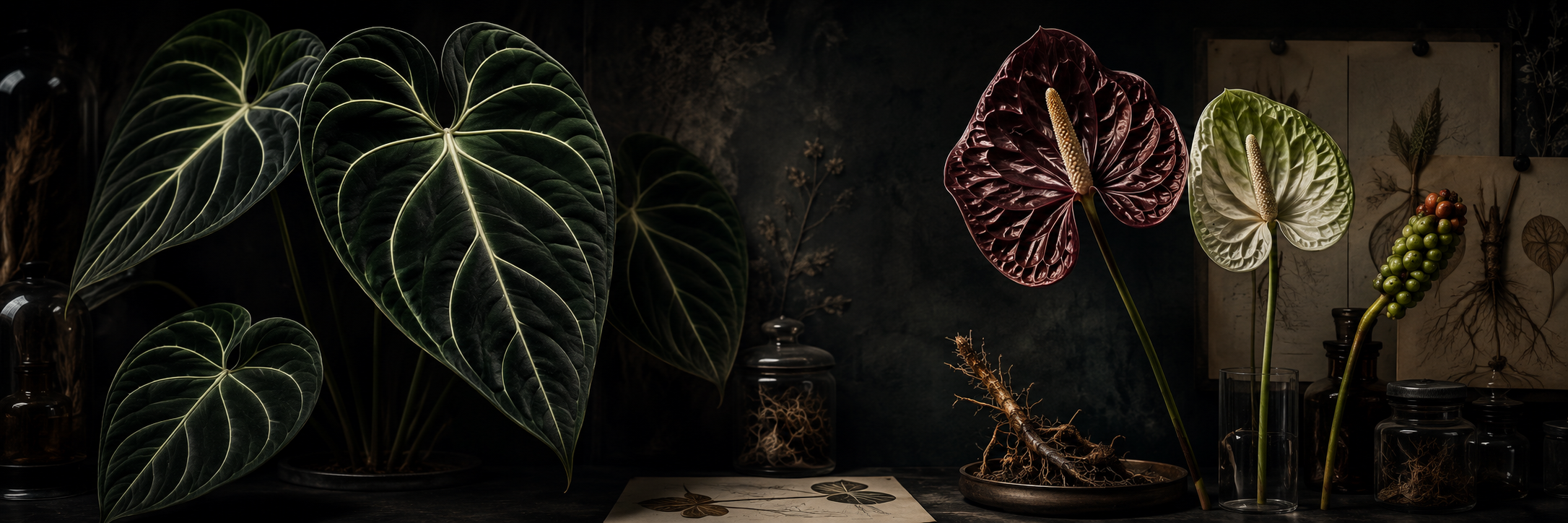
Araceae · Morphology
THE
ANTHURIUM LEAF
How to read shape, venation and proportion
Opening
The genus that wrote down
how to describe itself
Most plant groups are described in whatever words the describer reached for. Anthurium is not one of them. In 1979 Thomas Croat and George Bunting published a paper whose entire purpose was to fix the vocabulary — character by character, with lettered drawings of the shapes a blade can take, the shapes a sinus can take, and the categories a vein can belong to1.
That paper is why this page can exist. It means the words below are not a house style invented for a website; they are the terms a taxonomist uses, in the order a taxonomist uses them, and each of them has a published picture attached.
The one rule that changes how you look
Before any of the shapes, there is a warning worth taking seriously, because it contradicts what almost every plant description online does. Croat states it plainly: the length of a petiole, like the overall size of any morphological part of Anthurium, is highly unreliable, because plants often flower when quite young and the overall size of leaves and inflorescences varies remarkably over the life of the plant2.
What survives is not the measurement but the ratio. The length of the petiole compared with the length of the inflorescence. The length of the peduncle compared with the length of the petiole — variable on its own, relatively constant as a ratio2. The length of the spathe compared with the length of the spadix. A blade described as “ovate 2:1” carries information; a blade described as “30 cm long” mostly carries the age of the plant.
What this means in practice
A photograph of one leaf beside a ruler tells you less than the same leaf photographed with its own petiole and its own inflorescence in frame. The proportions are the character. The centimeters are the plant's biography.
Two orders, and why this one
Croat and Bunting's checklist runs down the plant in a fixed sequence, and it is worth knowing because it is the order a formal description is written in: internodes, then leaf scars, then cataphylls, then the leaves as a whole — number, arrangement, whether erect, spreading or pendent — then the petiole, the sheath, the geniculum, and only then the blade1. Nothing about the flower until the whole vegetative plant has been accounted for.
This page runs the other way. It begins at the blade — its outline, its venation, its surface — then works down through the petiole to the stem, the roots, and finally to the sections that all these characters are used to build. That is not the order a taxonomist writes in. It is the order you meet the plant in: the leaf is what you are looking at, and the stem is what you find when you go looking.
Describe first. Interpret second.
Part I
The outline, and its ratio
Blade shape in Anthurium is described in two pieces: a named outline, and a number. The number is the ratio of length to width, and it does most of the work. Croat and Bunting's first figure lays out the simple, entire blades — the ones without conspicuous posterior lobes — and each is given with its ratio1.
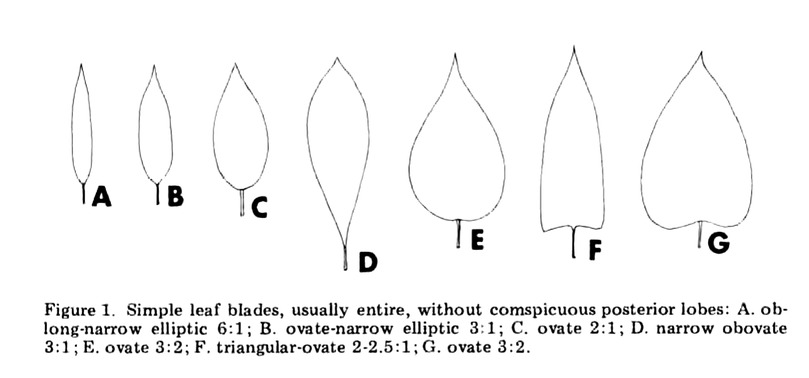
Read the series and the logic becomes obvious. A and B are both narrow-elliptic, and the only thing separating them is 6:1 against 3:1. E and G are both ovate 3:2, and what separates them is the base. The vocabulary is built so that outline and proportion are recorded separately, because a plant can change one without changing the other as it matures.
The sinus, and the compound blade
Once a blade has posterior lobes, a second character opens up: the space between them. It is described by its own set of named shapes, and it is genuinely diagnostic — two species with the same outline can differ entirely in whether that space is arcuate, parabolic, or closed to a narrow slit. Blades that are lobed to the point of division get their own vocabulary again1.
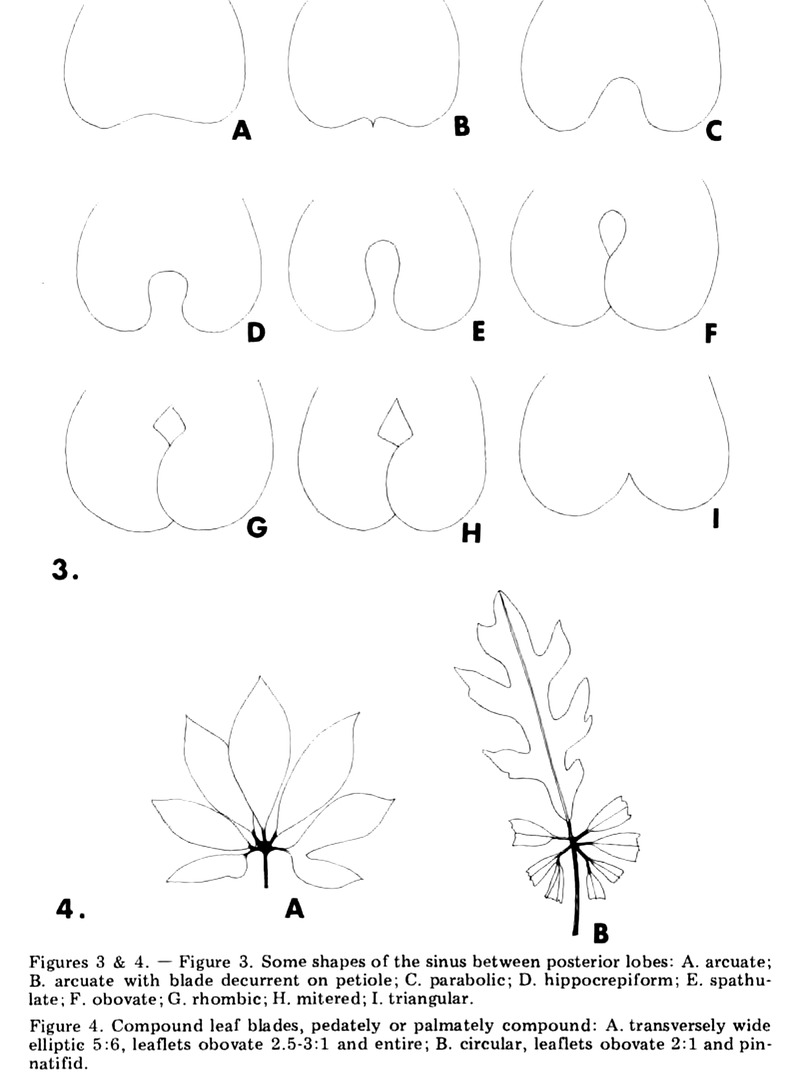
The outline is the least stable thing on the plant
Croat's warning about size applies with force here. A juvenile Anthurium can carry a blade of a different outline class from the adult of the same plant, and a species can flower before it has finished changing shape2. An outline recorded without the plant's stage attached is a description of a moment, not of a species.
Which is why the outline, on its own, identifies almost nothing. It is the first thing you can see and the last thing you should lean on. The venation is where the genus keeps its structure.
Part II
The veins, in categories
Anthurium venation is reticulate — net-like, superficially closer to a dicot leaf than to the parallel-pinnate pattern of Philodendron or the colocasioid pattern of Alocasia4. But “reticulate” is a family-level word, and it is not what a description of an Anthurium actually records. What it records is which category each visible vein belongs to.
There are eight, and they are lettered the same way on every diagram1: the midrib; the primary lateral veins running off it; the interprimary veins that lie between them; the secondary and tertiary veins beneath those; the collective vein that gathers them and runs toward the apex; and, on blades with posterior lobes, the basal ribs and basal veins.
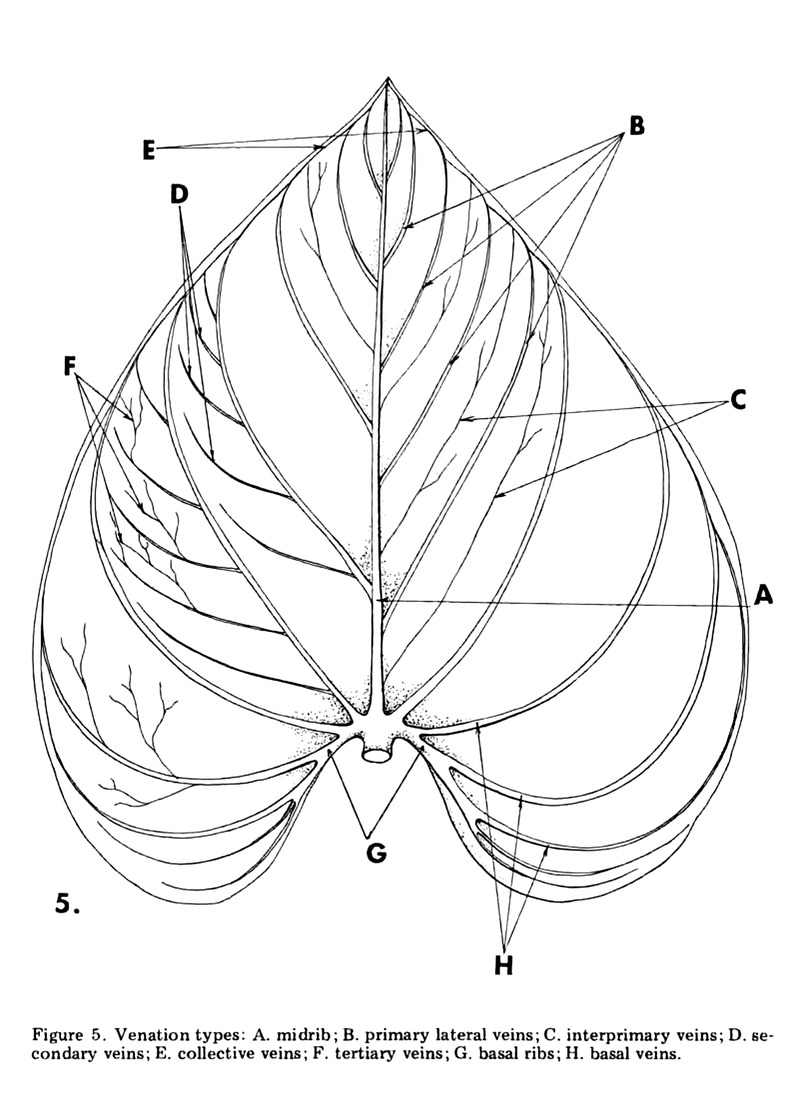
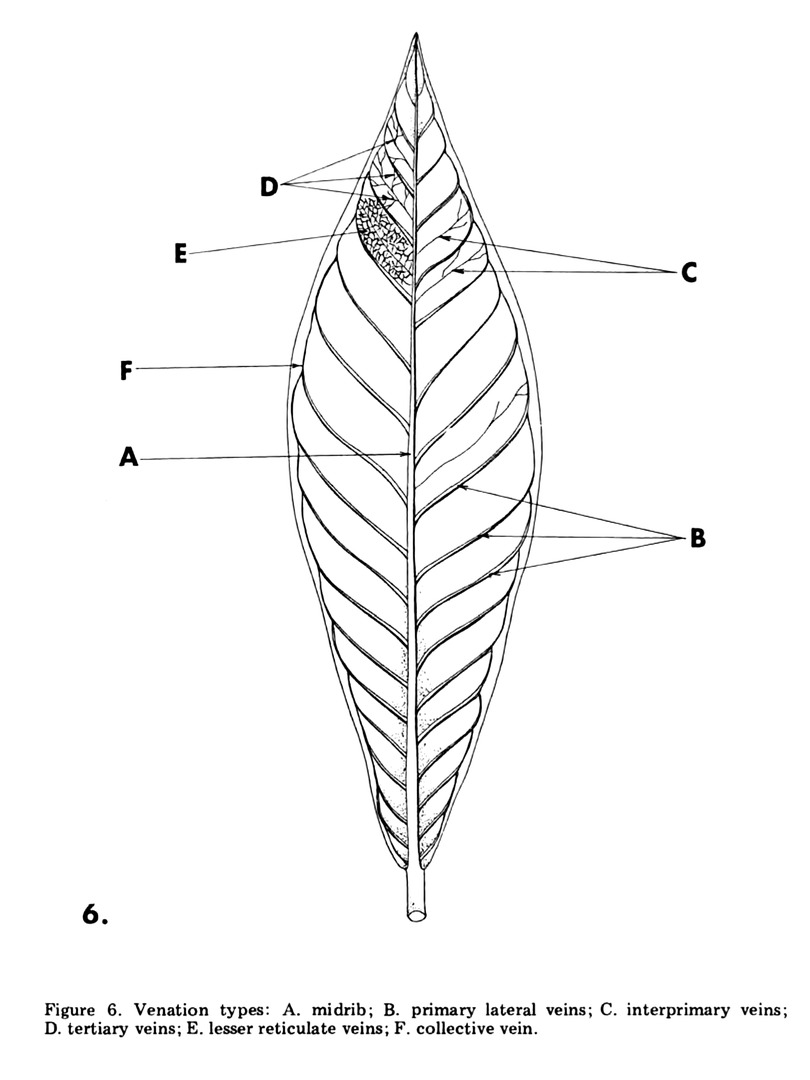
The two diagrams matter more together than either does alone. They letter the same categories on two different blade types — one with posterior lobes and basal ribs, one without — which is the whole intention of the scheme. A vein's category is defined by where it starts and what it connects to, not by how thick it looks or where it sits on this particular leaf.
The collective vein is the one to find first
Of all eight, the collective vein is the one worth training your eye on. It runs inside the margin, gathering the ends of the veins below it, and how far from the edge it runs — and whether it arises from the lowest primary lateral or from the basal veins — separates species that otherwise look alike. In Croat's Central American treatments it is one of the characters that carries whole couplets of the key2, 3.
A note on where to look
Collective veins are usually easier to see from beneath, and easier again on a leaf held up to the light than on one lying flat. What you are looking for is not a line but a junction: the point where the smaller veins stop running to the margin and start running into something else.
Part III
The surface, and why it is velvet
Three things can be read off the face of an Anthurium leaf that are not shape and not venation: whether the surface is velvet, whether it is dotted with glands, and whether you can see the crystal cells inside it.
Velvet is a shape, not a coating
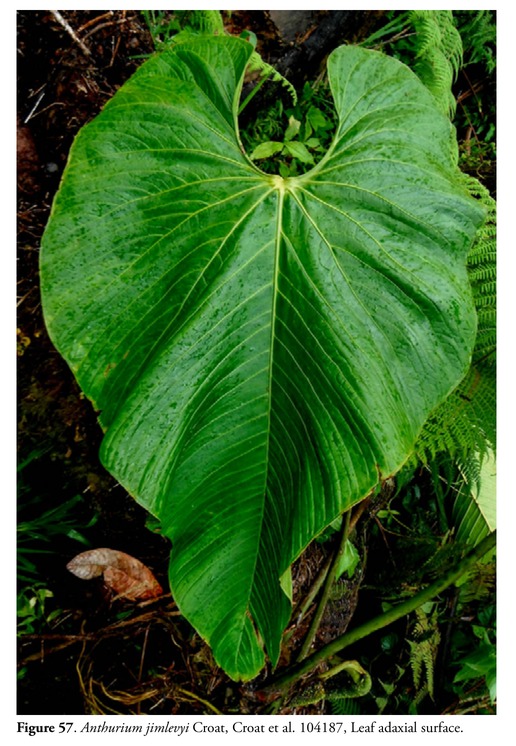
A velvety Anthurium is not hairy. Nothing is growing out of the surface. The individual cells of the upper epidermis are papillate — domed, raised into little bumps instead of lying flat — and it is that microscopic relief which scatters light into the matte, bottomless look the trade calls velvet.
Croat uses exactly this character to separate sections. One arm of his key reads: blades usually metallic green or blackish-green, the epidermal cells papillate or otherwise raised, petioles frequently ribbed, B-chromosomes present — section Cardiolonchium2. The other arm reads: blades not velvety, usually smooth and semiglossy to glossy, epidermal cells flat, not papillate or raised2. The distinction is not impressionistic. It is a statement about the shape of a cell.
What a domed cell does to light
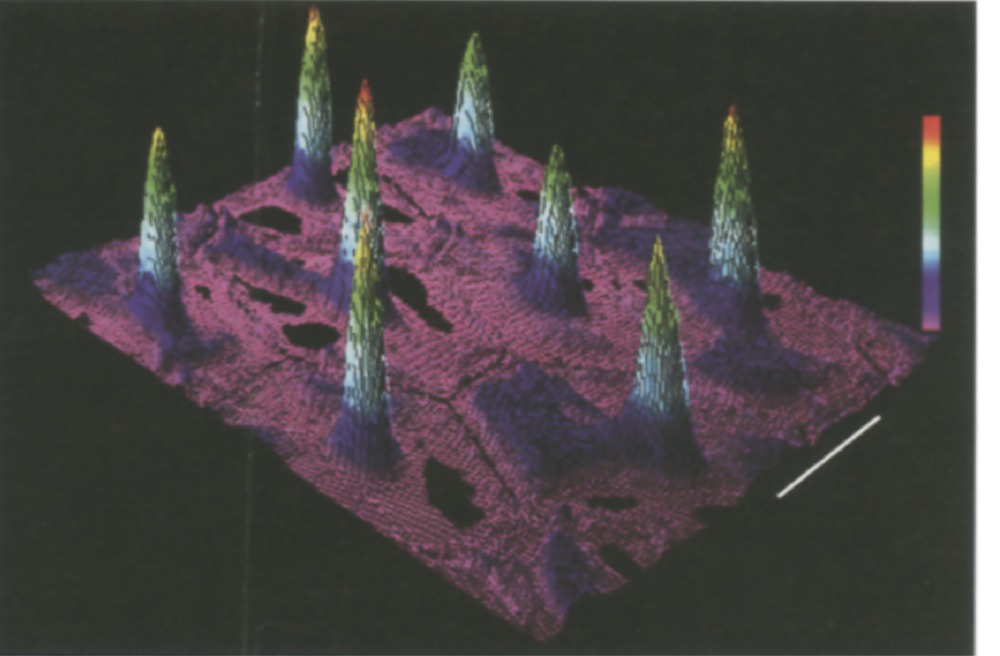
Convex epidermal cells behave as lenses. Strip the mesophyll and lower epidermis from a leaf, leave the upper epidermis intact, and shine collimated light through it: each cell focuses the beam to a spot about 50 micrometers beneath the surface, and at that focus the light can reach fifteen times the intensity of the light that went in7. The effect is not exotic — it is a recognized feature of shade-adapted leaves generally, and the epidermis is treated in the optics literature as an active optical element rather than a transparent skin8.
Two solid facts, and the join between them is not
Croat establishes that Cardiolonchium has papillate epidermal cells2. The optics work establishes that convex epidermal cells focus light, and it does so in Begonia and in shade plants generally7, 8. It is very tempting to conclude that velvet Anthurium leaves are papillate in order to harvest dim understory light — and no study in this genus has measured that. The cell shape is documented. The optics of that cell shape are documented. The purpose, in Anthurium, is inferred.
Glandular punctations
Some species carry glandular punctations — fine dots on one or both blade surfaces. They are consistent enough to characterize section Porphyrochitonium, but they have also evolved independently in otherwise dotless groups such as section Calomystrium2. Their absence is diagnostic too: section Cardiolonchium is described as lacking them entirely5.
The crystal cells you can see
Every aroid carries raphides — needle-shaped calcium oxalate crystals — but in some Anthurium they are large enough to be visible in the blade as short pale lines, and Croat notes them as especially prevalent in section Calomystrium2. Croat and Guan describe the same thing in Cardiolonchium as pale short-linear cellular inclusions in the dried blade5. Held to the light, a leaf can show you its own crystal cells.
Part IV
The petiole, in cross-section
Among the more useful characters in the genus, Croat writes, is one that had been overlooked: the shape of the petiole where you cut across it2. Not its length — which, as the opening said, is mostly the plant's age — but its section.
He then drew every shape he had seen. Thirty-seven of them, in five groups.
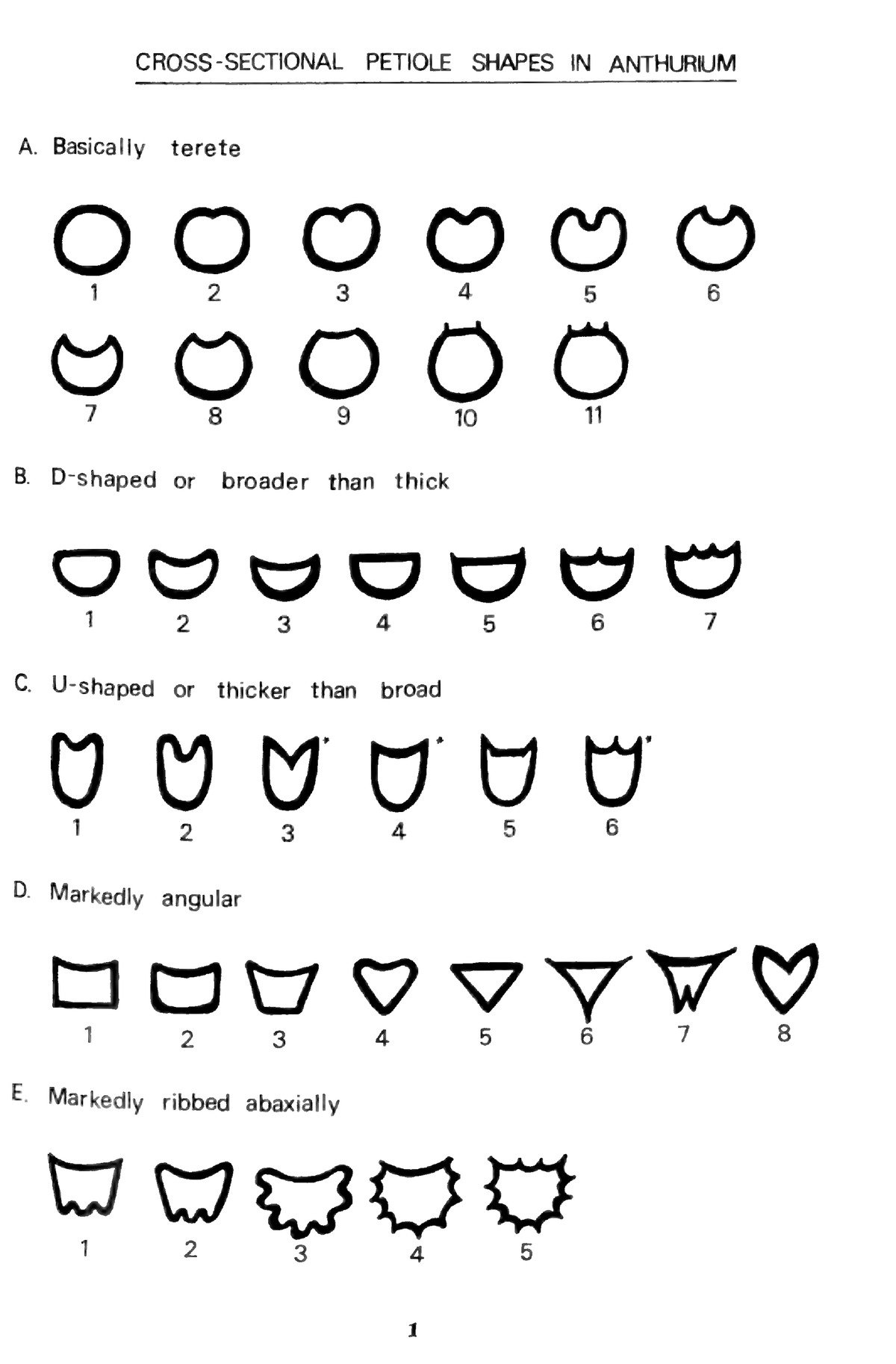
Most species of Anthurium are terete or subterete: group A, running from perfectly round through progressively deeper channels on the upper side. Many Mexican species are D-shaped or broadly sulcate — group B. Others are sharply triangular, trapezoidal or square, or terete with several to many sharp ridges — groups D and E2. The degree of channelling is a character in its own right.
There is a detail in that plate worth pausing on. A few of the shapes carry an asterisk, and Croat's caption explains it: not yet observed but to be expected2. He drew the gaps in the series along with the species he had in hand — a small, honest piece of prediction sitting inside a taxonomic figure.
It is not constant within a species
Petiole section is useful, not decisive. In wide-ranging, variable species such as Anthurium schlechtendalii, the cross-sectional shape varies considerably within a single population2. One cut petiole is a data point about one plant.
The sheath and the geniculum
Two more structures sit at the ends of the petiole. The sheath wraps its base, and is recorded by length, width at midpoint and color1. At the far end, where the petiole meets the blade, is the geniculum — a distinct joint, usually paler than the petiole and sometimes tinged red, described by its length, its thickness relative to the petiole below it, and its cross-sectional shape where that differs from the petiole's1. In deeply divided and compound leaves it may extend onto the bases of the basal veins, or onto the petiolules1.
The geniculum is the character most often reached for as Anthurium's signature, and it is a real one. It is written into the description standard, it separates the genus from most of what it gets confused with, and it still carries weight in current work: the key in Croat and Guan's 2025 revision of section Cardiolonchium opens on it, splitting the whole section at couplet one on whether the geniculum sits at the base of the blade or remote from it5.
What the geniculum does is not established
It is repeated everywhere, including in otherwise careful sources, that the geniculum lets the blade swivel to track the light. That may well be true. But it is an assertion about function, and no study testing it appears in the taxonomic or physiological literature surveyed for this page — the descriptive works define the geniculum by its shape, color and dimensions, not by a measured behavior1. That has not changed with time: a 2025 study of Anthurium that is explicitly anatomical, sectioning petioles and reporting their tissues, still records the geniculum as a measurement — length by width, and its color10. Treat the movement as plausible and undemonstrated, and describe the structure rather than its purpose.
Part V
The stem, and what it keeps
The stem itself is disappointing, and Croat says so. Its outward appearance yields few good characters beyond the length and width of the internodes; stems are usually scurfy and brown with age; and while the leaf scars differ considerably between species in size, shape and how deeply they are indented, those differences have never been worked into the taxonomy2. Stem anatomy, he adds, has not been adequately studied.
What is worth attention is not the stem but what stays attached to it.
Cataphylls, and the way they fall apart
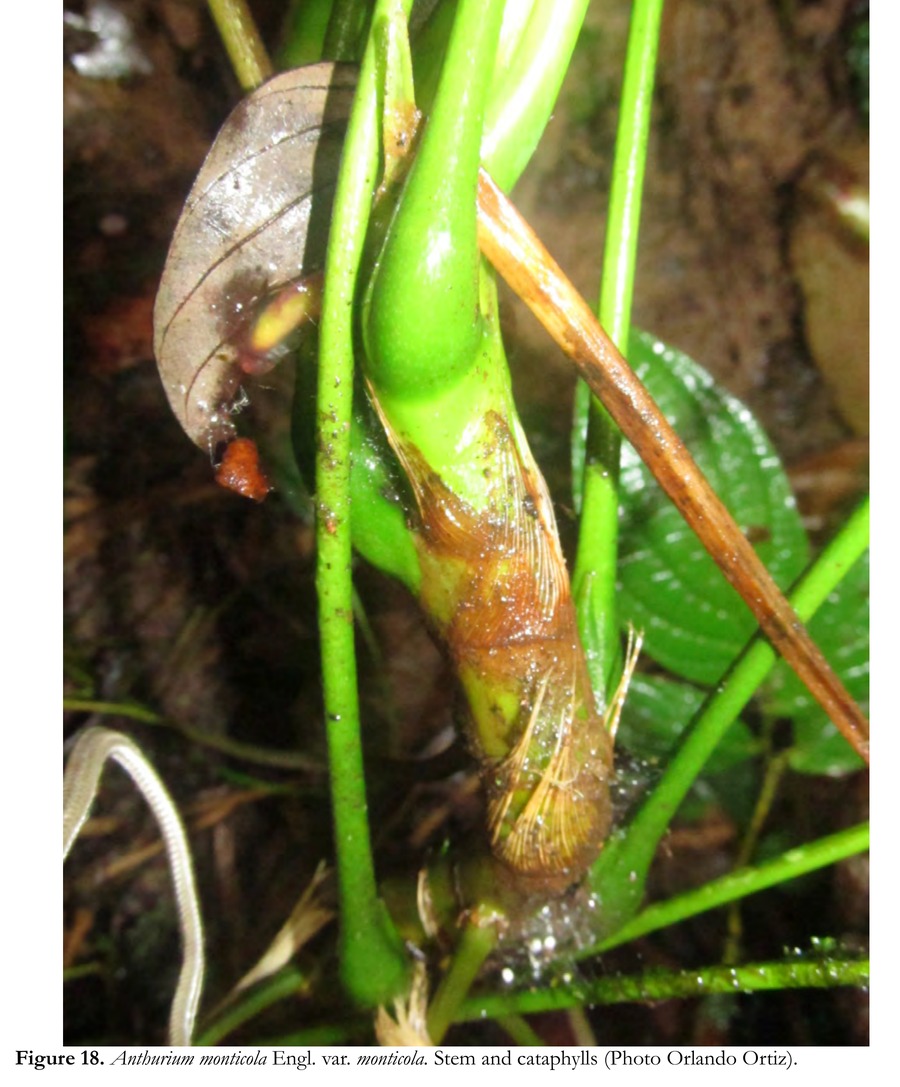
A cataphyll is a bladeless sheathing leaf — the scale that protects each new shoot. In many Anthurium it persists long after it has done that job, and Croat rates the persistent cataphylls as far more useful than the stem beneath them: their color, their texture, and the degree of weathering they undergo are all taxonomically useful2.
That last one is the interesting one, because it is a character made of time. A cataphyll can drop away clean. It can dry and stay whole. It can lose its soft tissue and leave a lattice of fibers standing on the stem. Croat and Guan describe the Cardiolonchium condition as moderately thin, drying pale brown to tan, often persisting as loosely arranged pale brown fibers, sometimes with fragments of the old epidermis still caught in them, and eventually deciduous5. Four stages of decay, written into a species description.
Do not tidy the plant before you read it
The fibrous remains around the top of a stem are diagnostic material. Pulling them off — the reflex of anyone repotting — removes a character that a taxonomist would have recorded, and it cannot be recovered from a photograph taken afterward.
Below the cataphylls the stem gives out, and another organ takes over.
Part VI
The roots, which nobody described
“Although roots have not been used traditionally as taxonomic characters, they display a wide variety of qualitative characters.” Croat wrote that in 19832, and it is still the most interesting sentence in the introduction to his revision — an author noting, mid-monograph, that an entire organ had gone unread.
What he then describes is not a uniform structure at all.
How many, and where
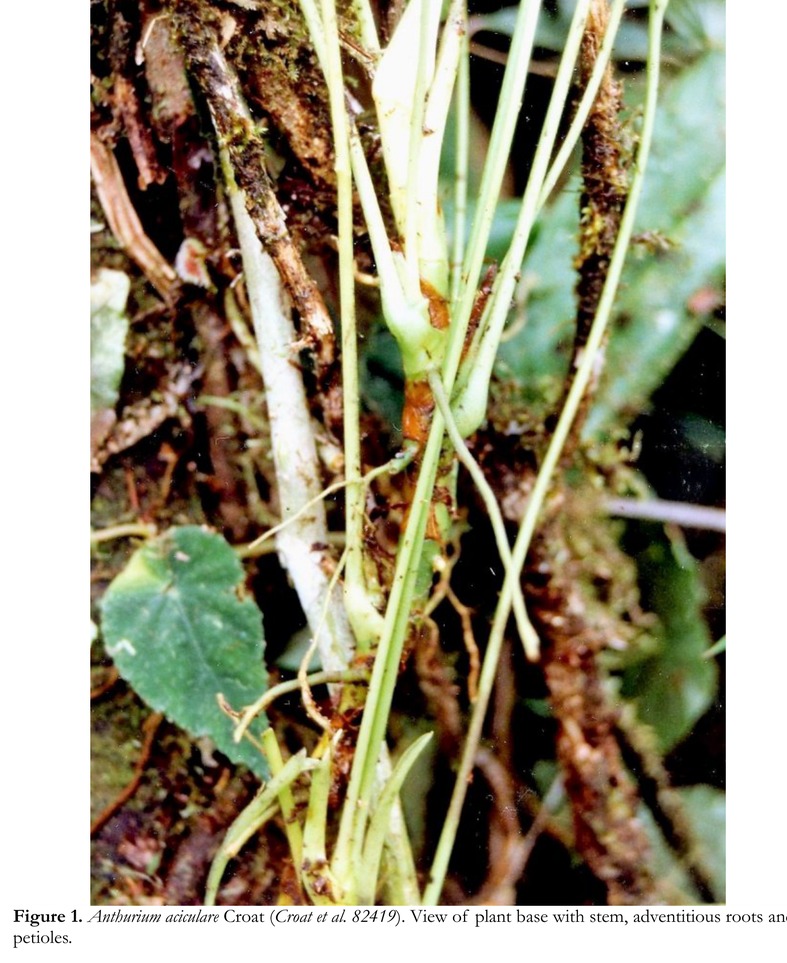
Typically one or more roots develop at each node. In section Polyphyllium they are numerous, short and slender, and are borne along the internodes rather than only at the nodes. In most of section Pachyneurium — and in short-stemmed species generally — there are far more roots per node, and because the internodes are so compressed the whole root mass becomes large and dense, the roots contiguous or nearly so2.
Roots that do different jobs
Croat then records something growers see constantly and rarely name. In many species the roots have diverged in function. Some are directed upward, where they collect falling debris; others grow into the rosette of leaves and collect it there2. That is the bird's-nest habit of section Pachyneurium11 doing what it is for — the plant building its own soil out of what the canopy drops — and it is the roots, not the leaves, that are doing the collecting.
In pendent species the support roots run the other way: they are negatively geotropic, growing upward against gravity to hold a hanging plant onto its branch2.
Two things you can only see up close
Roots commonly look smooth when fresh. Let one dry and the surface resolves into a dense mass of woolly trichomes that were there all along2. And in some species — not all, which is the taxonomically useful part — the root carries a thick white velamen, the spongy absorptive layer familiar from orchids, useful for taking moisture out of the air. Other species investigated lack it entirely2.
A character still mostly unrecorded
Forty years on, root characters remain thinly used in Anthurium descriptions. If you grow these plants you are looking at something the literature has barely written down — which is an invitation, and also a reason not to assume that what your plant does is what the species does.
Part VII
The sections, and how they shift
Everything above describes one leaf. Sections are how the genus is cut into groups of leaves that resemble each other — and they are where a grower most often meets a name that has quietly changed underneath them.
Six groups, tested by crossing
In 1976 Sheffer and Kamemoto did something unusual: they sorted Anthurium into six morphological groups using Engler's characters, and then tried to break the grouping by hybridizing across it. Crosses within a group produced numerous hybrids. Of all the crosses between groups, only two combinations produced any hybrid at all — and they concluded that the integrity of the six groups had been confirmed6.
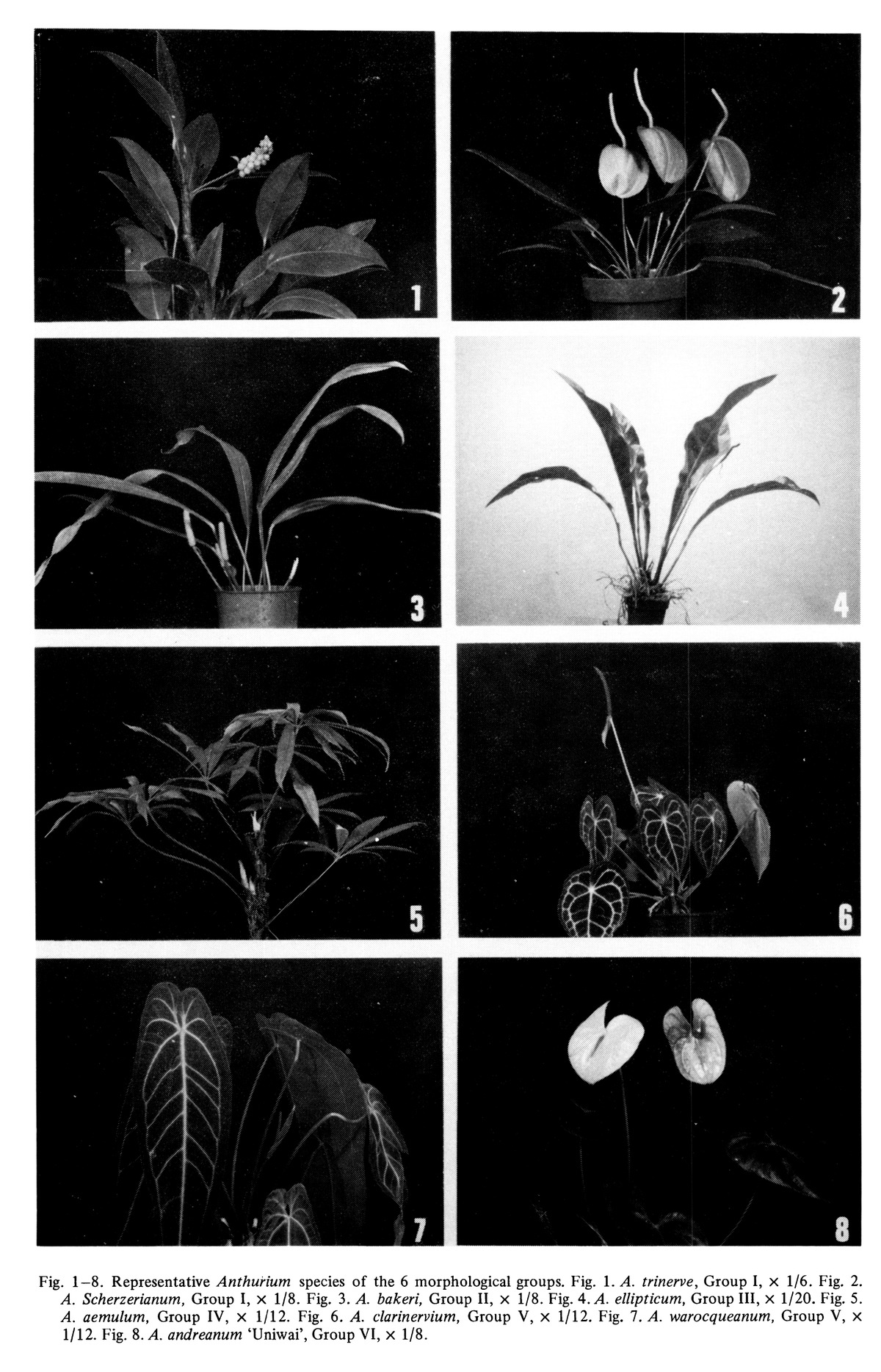
The same study recorded chromosome numbers group by group, and one number matters for Part III: the velvet-leaved species run at 2n = 30 like most of the genus, but Anthurium crystallinum carries an extra B-chromosome6 — the supernumerary chromosome that appears in Croat's key as one of the marks of section Cardiolonchium2.
And then the sections moved
Sections are hypotheses, and they get tested. When Poli and co-authors set the classifications side by side — Engler's of 1905, Croat and Sheffer's of 1983, and the clades recovered from molecular data by Carlsen and Croat — section Cardiolonchium did not come out as one branch. It came out spread across three9.
Two species that are no longer where the books put them
Anthurium clarinervium and Anthurium leuconeurum were treated as section Cardiolonchium for decades, including in Croat's own 1983 revision2. In 2025 Croat and Guan move both out, to section Andiphyllum5. The evidence is of two kinds: John Banta's breeding work in Florida showed that these species cross readily with a range of other Mexican species but will not cross with typical Cardiolonchium5; and molecular work separated them as well5. Older sources — and most plant listings — still say Cardiolonchium.
Which is the honest closing note for a page about reading leaves. Section Cardiolonchium now stands at something between 269 and 350 species, from Costa Rica to Bolivia, mostly Andean cloud forest5 — and its own revisers describe it as apparently polymorphic. The characters in Parts I to VI are stable enough to record. What they add up to is not.
The leaf will tell you what it is. It will not always tell you what it is called. Where the leaf runs out, the Aroid Morphology hub sets Anthurium against the rest of the family.
Sources
The papers behind this page
Every lettered figure, every named shape and every ratio on this page comes from one of the following. Links go to the scanned originals.
- Croat, T. B. & Bunting, G. S. (1979). Standardization of Anthurium descriptions. Aroideana 2(1): 15–25. The vocabulary this page is built on. The lettered figures of blade outlines with their ratios, of sinus shapes, of compound blades, and the two venation diagrams; and the character-by-character description standard, including the entries for the sheath and the geniculum. Text at aroid.org.
- Croat, T. B. (1983). A revision of the genus Anthurium (Araceae) of Mexico and Central America. Part I: Mexico and Middle America. Annals of the Missouri Botanical Garden 70(2): 211–416. The petiole cross-section plate and the discussion of taxonomic characters — that absolute size is unreliable and ratios are not, that petiole section had been overlooked, and that it varies within a population in Anthurium schlechtendalii. Biodiversity Heritage Library.
- Croat, T. B. (1986). A revision of the genus Anthurium (Araceae) of Mexico and Central America. Part II: Panama. Monographs in Systematic Botany from the Missouri Botanical Garden, volume 14. The companion volume, and the source for the weight the collective vein carries in the keys. Scanned volume.
- Mayo, S. J., Bogner, J. & Boyce, P. C. (1997). The Genera of Araceae. Royal Botanic Gardens, Kew. The family-level placement of Anthurium's reticulate venation against the other three venation types in Araceae.
- Croat, T. B. & Guan, C. (2025). A revision of Anthurium section Cardiolonchium (Araceae) from Carchi Province, Ecuador. Aroideana 48(3): 81–300. The current treatment of the velvet-leaved section — nineteen new species described and illustrated, with a key that opens on the position of the geniculum. The source for the sectional description, for the section lacking glandular punctations, and for the removal of Anthurium clarinervium and Anthurium leuconeurum to section Andiphyllum.
- Sheffer, R. D. & Kamemoto, H. (1976). Cross compatibility in the genus Anthurium. Journal of the American Society for Horticultural Science 101(6): 709–713. The six morphological groups, the photographs of a representative of each, the chromosome numbers by section including the B-chromosome of Anthurium crystallinum, and the hybridization test of the grouping.
- Nishio, J. N. & Smith, W. K. (1996). Leaves and light capture: light propagation and gradients of carbon fixation within leaves. Trends in Plant Science 1(2): 65–67. The confocal image of epidermal cells focusing collimated light to a spot beneath the surface, at up to fifteen times the incident intensity. In Begonia, not Anthurium.
- Karabourniotis, G., Liakopoulos, G., Bresta, P. & Nikolopoulos, D. (2021). The optical properties of leaf structural elements and their contribution to photosynthetic performance and photoprotection. Plants 10(7): 1455. The epidermis treated as an optical element in its own right rather than a transparent covering.
- Poli, L. P. et al. (2017). Floral vasculature and its variation for carpellary supply in Anthurium (Araceae). PeerJ 5: e2929. Its Table 1 sets Engler's 1905 sections beside Croat & Sheffer's of 1983 and the molecular clades of Carlsen & Croat — the source for section Cardiolonchium falling across three clades rather than one.
- Pimenta, K. M., Amorim, A. M. & Mayo, S. J. (2025). Anthurium malyi and Anthurium radicans (Araceae): endangered Atlantic forest herbs from Bahia, Brazil, with taxonomy, anatomy and commentary on the Icones Aroideae of H. W. Schott. Willdenowia 55. An explicitly anatomical treatment of Anthurium that still records the geniculum only as a measurement — the evidence that its function remains undescribed rather than merely unmentioned.
- Croat, T. B. (1991). A revision of Anthurium section Pachyneurium (Araceae). Annals of the Missouri Botanical Garden 78(3): 539–855. The bird's-nest section, and the short-internode habit that produces the dense contiguous root mass.
- Croat, T. B. & Ortiz, O. O. (2016). A reappraisal of the Anthurium cuspidatum Masters complex, section Polyneurium. Aroideana 39(2). The photograph of an Anthurium monticola stem with a cataphyll breaking into fibres. Photograph by Orlando Ortiz.
- Croat, T. B., Delannay, X. & Wood, C. (2018). A revision of Anthurium (Araceae) section Polyneurium for Carchi Province, Ecuador. Aroideana 41(1). The photograph of the base of an Anthurium aciculare plant, with stem, petiole bases and adventitious roots.