
Araceae · Reproductive Biology
THE ANTHURIUM INFLORESCENCE
The largest genus in the family, and nobody agrees what it offers
Anthurium
What Is on This Page
This is the largest genus in the family, and the one where the simplest question has no settled answer: what the flower is actually offering the animal that visits it.
Take it to the plant
Not here for the botany, and just want to make a cross? The printable field card is the whole method on one sheet — the clock, the steps in order, and four photographs of what a receptive spadix, a male-phase spadix and ripe fruit actually look like, so you can tell the state of your own plant at a glance — with a second side carrying the warning this genus needs and no other in the family does: a spadix full of berries is not proof that your cross worked.
Every other genus in this cluster works the same broad way. A chamber, a smell, an insect that goes in and cannot immediately get out, and a transaction that can be described. Anthurium does none of that. There is no trap anywhere in the genus — the spadix stands in the open, the spathe is a backing sheet rather than a room, and nothing is ever held. Three separate studies say so independently, each having looked for a chamber and found none.
What replaces it is an argument. One body of work holds that the flowers give nothing at all — that Anthurium is nectarless and its visitors are collecting perfume, or being fooled. Another holds that the plant secretes sugar from two different organs, at two different times, and that the second one has simply been overlooked. Both positions are on this page, in the part where they belong, and neither is presented as settled.
Read this before the rest
Almost nothing here is genus-wide. The genus holds well over a thousand species. Pollination has been studied properly in perhaps a dozen, and the answers those dozen give do not agree with each other — different animals, different rewards, different clocks, in some cases different times of day.
So every claim below carries the species it was shown on. Where a finding is from one plant in one forest, the page says so. Reading a result across to your own plant is a guess, and this page tries to be clear about when you are making one.
The order, and why
Parts I to III are what the flower is and how it runs — the structure, the size of the genus, and the sequence a single spadix goes through. Read these once; they make the rest legible.
Parts IV to VII are the argument and the evidence — what the plant may or may not be offering, what it smells like, and every animal anyone has caught doing the job, graded by how good the evidence actually is. Part VII is the one to read if you only read one.
Parts VIII to XII are the operation — reading your own plant, collecting and keeping pollen, making the cross, what happens to the fruit, and what is known about which species will cross with which. That last one is shorter than it should be.
Then the sources, with what kind of evidence each one is.
The one thing worth knowing before you start
9 of 20
Two studies have bagged Anthurium inflorescences to shut insects out and watched what happened. They got opposite answers.
In one, across 20 species, nine produced seeds anyway and were recorded as able to self-pollinate. In the other, across 7 different species — ten inflorescences each at two sites — not one set fruit.
So whether an Anthurium can pollinate itself depends on which Anthurium it is, and for most species nobody has checked. Part XI adds a third possibility: several species set seed with no pollination at all.
Practically: assume yours cannot, and do not treat fruit as proof that your cross worked.
Part I
The Flower, and Why Nothing Transfers
If you have come from the Alocasia, Amorphophallus or Philodendron pages, put them down. This flower is built on a different plan, and most of what you learned there does not apply.
Every flower is bisexual, and the whole spadix is fertile
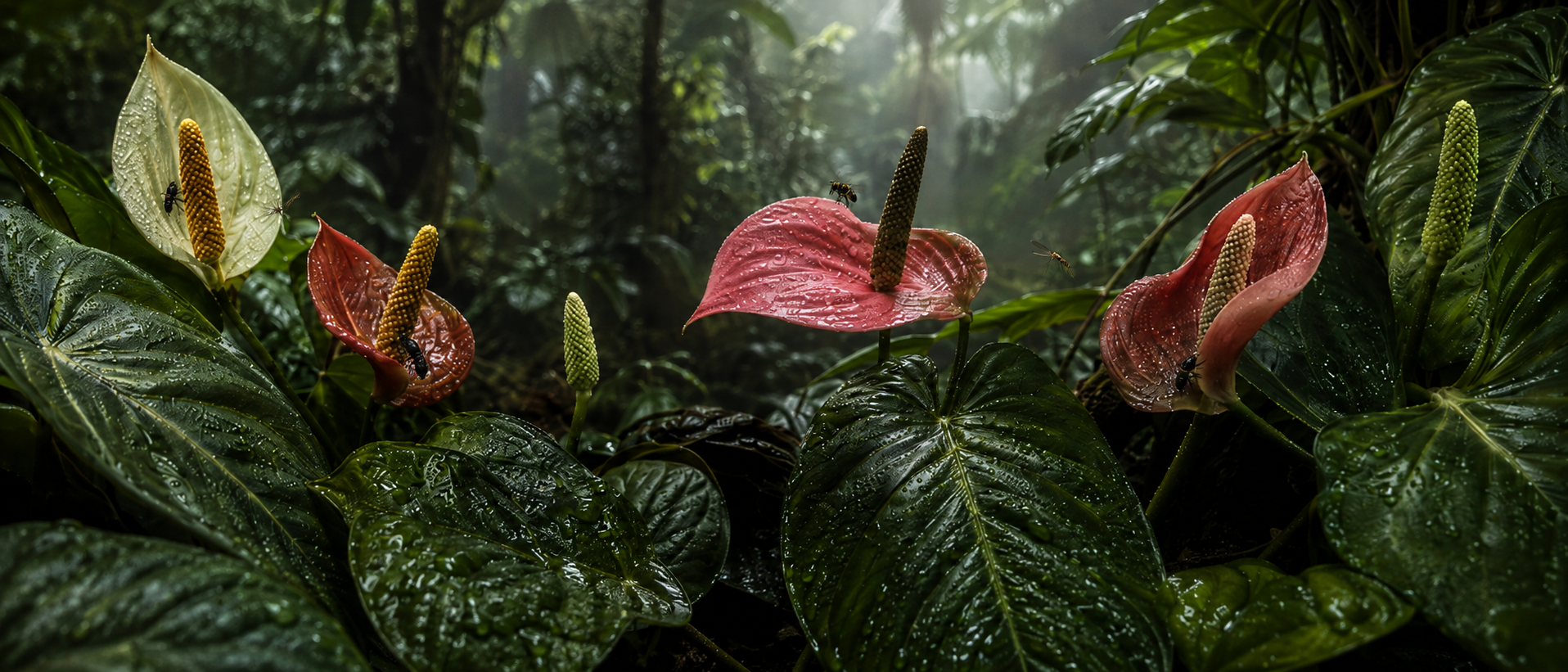
In the other three genera the spadix is divided into zones: female at the bottom, sterile in the middle, male above, and often a sterile appendix on top doing the smelling. An Anthurium spadix has none of those divisions. It is covered, base to tip, in small bisexual flowers — each with its own tepals, its own stamens and its own pistil.
The consequence matters more than the anatomy. There is no sterile zone to feed an insect with, no appendix to run a furnace in, and no chamber to hold anything inside. Everything those genera do with architecture, this one has to do some other way.
The sequence a single flower runs
Each flower is protogynous — its stigma is receptive first, and its own stamens shed pollen later, after that stigma has finished. The spadix works through this from the base upwards, so at any moment a band of the spadix is in one state and the band above it in another.
This is the whole mechanism. There is no trap holding an insect through the switch; there is only timing.
No trap, and this is not a small point
Three independent studies — on weevils, on oil bees and on gall midges — each looked for a trapping mechanism in the species they were working on, and each reported that there is none. Nothing is enclosed, nothing is held, and no visitor is ever prevented from leaving.
Which means the plant has no way of making a visitor stay long enough to be useful. Whatever brings an animal to an Anthurium and keeps it there has to be worth its time — or has to look as though it is. That is the question Part IV is about.
The spathe is not doing what you think
The coloured spathe that sells these plants is a backing sheet, not a room. It does not close, it does not constrict around the spadix, and in most species it reflexes away from it entirely. In the genus's own literature it is treated as a display and orientation surface — a landing board and a background — rather than as part of any mechanism.
What is safe to carry from the other pages, and what is not
Safe: protogyny; that a cross has to be timed rather than attempted whenever convenient.
Not safe, and this one is a genuine difference: that a plant needs a second plant. In the other genera that is structural. In Anthurium it varies by species — nine of twenty tested set seed when bagged away from every insect, while seven others set none at all. See Part III.
Not safe: anything about heat, appendices, sterile flowers, floral chambers, trapping, or the two-night cycle. None of those exist here.
Not safe, and worse: thermogenesis. It is the organising fact of three of the other four pages. In Anthurium it has not been demonstrated at all, and this page does not claim it.
Part II
A Genus Nobody Has Finished
Three facts about Anthurium as a whole shape everything a grower can do with it: its size, the state of its classification, and how narrow the cultivated gene pool is.
The size, and why the number keeps moving
This site counts 1,460 accepted species, from Plants of the World Online. The figure in the recent literature is lower — a 2026 paper gives about 1,300 — and older ones are lower still. These are not corrections of one another. Each is a different authority on a different date, and the gap between them is mostly a disagreement about what counts as a species.
| Source | Species | Sections |
|---|---|---|
| Schott, 1860 | 183 | 28 |
| Rudolph, 1898 — horticultural | ca. 160 | — |
| Engler, 1905 | 486 | 18 |
| Croat, 1995 | perhaps 1,000 | — |
| Croat & Sheffer, 1983 | — | 19 |
| Recent literature, 2026 | ca. 1,300 | 20 |
| Plants of the World Online | 1,460 | — |
The important line in that table is the second one. Engler's 1905 treatment is the last time anybody revised the whole genus. Everything since has been sectional, regional or partial. A genus of well over a thousand species has been running for a hundred and twenty years on a framework built when fewer than five hundred were known.
The sections are mostly not natural
Those sections are how the genus is navigated — how a species gets placed, and how a breeder guesses what might cross with what. Molecular work has not been kind to them.
Stated plainly in the current literature
Of the 20 sections now recognised, “only a minority… are monophyletic” — that is, most of them are groupings of species that are not each other’s closest relatives.
The clearest case is section Pachyneurium, one of the largest at about 120 species. Sequencing across 68 nuclear loci found it not monophyletic as traditionally circumscribed, and the three morphological characters used to diagnose it turned out to be homoplastic — arrived at more than once, independently.
So a shared section is weak evidence of relatedness, and should not be leaned on when choosing parents.
Even the 1983 sectional treatment said as much about one of its own groups, dropping it from the key with the note that it is “a seemingly unnatural group” for which no defining characters could be found. The problem is old and openly acknowledged.
And the plants in the trade are close relatives
Set against a wild genus of over a thousand species, the ornamental material is startlingly uniform.
Eighteen commercial accessions
3 haplotypes
Eighteen commercial Anthurium andraeanum accessions from four provinces produced three haplotypes between them, with genetic distances between accessions close to zero. The authors' own summary: “genetic polymorphism among Anthurium accessions remained relatively low.”
Scope, and it matters: both markers are plastid, which is inherited down the maternal line. This bounds how many mothers the sampled trade material descends from — it is not a measure of total genetic diversity, and it should not be read as “the trade has three genotypes”.
Read with the sections above, the practical shape of the genus is this. Enormous wild diversity, an unfinished classification that cannot reliably tell you what is related to what, and a cultivated pool drawn from a narrow base. Any cross you make is being made without a map.
Part III
The Clock, and Why There Are Three of Them
Every Anthurium runs female first, then male, with the switch working up the spadix from the base. How long that takes depends entirely on which species you have — and the published answers differ by a factor of three.
| Species studied | Female phase | Gap | Male phase |
|---|---|---|---|
| Anthurium formosum | 2–3 days | an inactive interphase | 3–5 days |
| the oil-bee species | ca. 4 days | stated only as no overlap | up to 2 weeks |
| the gall-midge species | 4–6 days | about 24 hours | 12–14 nights |
Do not average these. They are three different species on three continents' worth of forest, measured by three groups to three different standards. Taken together the only safe statement is that an Anthurium inflorescence is in business for somewhere between one and three weeks, and that the male phase is usually the longer half.
How good is each row
The Anthurium formosum figures are quoted from an internet reference by the paper that reports them, not measured in it.
The oil-bee row is measured — 11 inflorescences on 4 plants across two seasons.
The gall-midge row is the most tightly resolved clock anyone has published for this genus, and it is the one to trust for that species.
The one hard statement: the phases do not overlap
In the study that watched most closely, “the two sexual phases never overlapped.” The stigmas finish before the first anther opens.
That is the whole reason this genus needs two plants. By the time an inflorescence has pollen, its own stigmas are done — and unlike the other genera on this site, there is no chamber holding an insect through the changeover to carry pollen from one to the other.
Can a plant rescue itself? The two studies disagree
One route is closed for certain. A large plant cannot pollinate across its own inflorescences, because “each individual… produces several inflorescences during the flowering period; however, only one inflorescence is open at one time” — measured across seven species.
Whether a single inflorescence can pollinate itself is a different question, and here the literature splits.
| Bagged to exclude insects | Species | Set seed anyway |
|---|---|---|
| Study of 20 species | 20 | 9 |
| Study of 7 species, two sites | 7 | 0 |
In the first, bagging at bud stage across twenty species left nine producing seed, which the authors recorded as a capacity to self-pollinate. In the second, ten bagged inflorescences of each of seven species at each of two sites gave “none… produced infructescence, which indicates that seed production depends on pollinators”.
Both are right, and that is the finding
These are different species. No species appears in both lists, so neither result overturns the other. Selfing capacity in Anthurium is a species-level trait, and for the overwhelming majority of the genus nobody has tested it.
It also sits against the no-overlap clocks above. If the phases never overlap, a self needs some other route — and Part XI supplies one: several Anthurium set seed with no pollination at all.
What to do with that: assume your plant cannot self, and work as though it needs a partner — collect pollen from one plant in male phase, keep it, and put it on a different plant in female phase. Parts VIII and IX are about doing that well.
But do not read fruit as proof the cross took, because on this evidence it might not be. Part XII.
One detail worth watching for
The flowers open from the base of the spadix upwards. On a long spadix this means the bottom flowers can be finished while the top ones have not started — so a spadix is not in one state, it is in a gradient. When Part VII talks about a receptive stigma, it means a receptive band.
Part IV
What the Flower Is Offering
This is the open question in the genus. Five different answers are in print, and one of them is “nothing at all”.
The strong claim: aroids pay nobody
A 2002 study of scent across the genus states it for the whole family, and states it flatly:
The nectarless position
“Out of nearly 3000 species in 101 genera, not a single one offers nectar as a reward. No nectaries are developed to produce a sweet energy supply for high-energy demanding pollinators, and the stigmatic exudate is a poor substitute that may be licked only by small Diptera with low energetic requirements.”
The same paper dismisses pollen too, as “seldom, if ever, produced in sufficient amount” to support a pollen-collecting bee.
If that is right, then an Anthurium visitor is either collecting something that is not food, or being deceived. It is a family-wide assertion, and it is the most contradicted sentence in this whole literature.
Against it: somebody measured the sugar
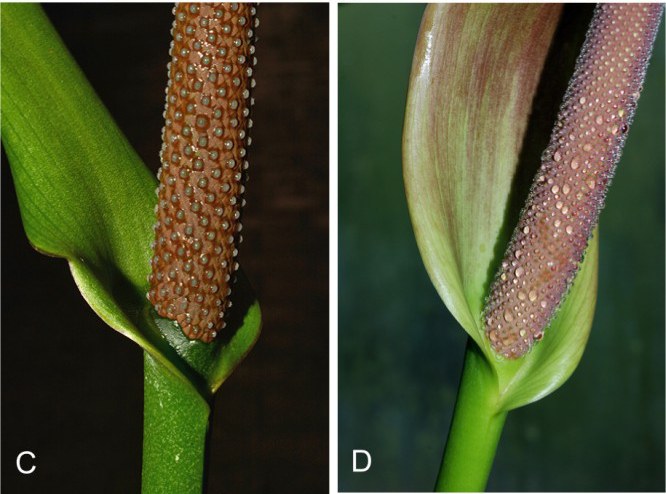
Two species have had their secretions actually tested, and both came back sweet. In Anthurium seibertii the stigmatic fluid ran at 8% sugar — sucrose, glucose and fructose. For comparison, the phloem sap of a related aroid sits at about the same concentration.
The second is older and stranger, and it is the reason this part exists.
A second secretion, from the tepals, and it is sweeter
Working on Anthurium digitatum in 1930, Daumann found sugars in the stigmatic fluid — and then found more sugar somewhere else:
“The liquid droplets, which appear towards the end of the female phase, and especially during the male phase… on the free portion of each tepal, also contain monoses (fructose and glucose) and bioses (sucrose). The sugar content… is higher than in the stigma secretion.”
And it does not stop when the stigmas do: “This secretion still increases, and continues throughout the male phase… at a time when the stigma hairs have already dried up, and pollen… has already been found in various sites between the diverging tepals.”
And it is not a one-off from 1930
Working through his own fresh collections decades later and for entirely unrelated reasons, Croat recorded droplets on the tepals in six Anthurium taxa — and in one of them, Anthurium smithii, described them outright as “a few scattered nectar drops”.
He was writing species descriptions, not testing anything. Which makes it a better kind of evidence than it looks: an observation recorded by somebody who had no argument to win with it.
— But he calls it nectar exactly once. For the other five taxa the word is “droplets”, and this page keeps that distinction. A droplet is a thing you can see; nectar is a claim about what is in it.
So there is a second reward window, opening as the first one closes, from an organ almost nobody inspects. If it is real and at all general, the genus is not nectarless — it is paying twice, and the second payment is timed to the moment the plant has pollen to move.
How common is any of this
The only broad survey is a look at 30 species during the day:
| Stigmatic secretion | Species |
|---|---|
| Large or runny drops, over 1 mm | 5 |
| Small droplets, under 1 mm | 11 |
| Minute drops, needing magnification | 8 |
| Glistening only | 6 |
So every species looked at was secreting something, and about half were producing drops visible to the naked eye. But that is a survey of appearance, not of sugar. Only the two species above have ever had the chemistry done.
Five answers, and which to trust
| The reward is… | Shown how | Weight |
|---|---|---|
| Nothing — no nectar anywhere in the family | Asserted from a scent study | An assertion, family-wide |
| Pollen and floral tissue | Weevils watched feeding | Observed, one system |
| Perfume the visitor collects | Bee behaviour photographed | Hypothesis — the authors' own title ends in a question mark |
| Pollen and stigmatic exudate | Midges watched feeding on both | Measured, one system |
| Sugar, from stigmas and tepals | Sugars chemically tested | Measured, two species, one of them in 1930 |
And then somebody looked properly
The question above — asked in print in 2017, and left at “further efforts are needed” — was answered in 2021, by a structural study that cut sections instead of arguing from chemistry. It found the thing everyone had been looking for in the wrong place.
There are nectaries. They are on the tepals.
“Our results showed for the first time a nectary presence on tepals and true nectar secretion for Anthurium andraeanum.”
They are non-vascularised nectaries at the apex of the tepals, built the way secretory tissue is built — cytoplasm dense with organelles, modified stomata to release through, and a high content of calcium oxalate crystals.
So the genus is not nectarless. The claim in the panel above, made for the whole family, is wrong for at least this species.
And Daumann was right in 1930. He said the sweet secretion was on the tepals rather than the stigmas, and that it ran on into the male phase. Ninety-one years later, sections found the glands exactly where he said the fluid was.
The part that cuts the other way — and it undercuts the numbers above
“Stigmatic secretion appears to be a distinct substance, and its often-reported sugar content seems to be a result of sample contamination.”
The two fluids are produced by different tissue for different reasons, and on a flower this small they mix. Which means the sugar measured in stigmatic fluid — including the 8% figure quoted earlier on this page — may have been nectar that ran into the sample.
The authors say as much: nectar and stigmatic secretion “have been often mistaken in other Anthurium species”.
Where that leaves the argument
The nectarless claim is dead, and the stigmatic-sugar claim is wounded. What survives is stranger and more useful than either: this genus has two different secretions, from two different organs, doing two different jobs — and the sweet one is the one nobody was watching.
One caveat that matters at the bench
The nectar is not reliable. In cultivation it was “occasional and unpredictable” — the same plant produced conspicuous nectar at one flowering and then none at all for several flowerings afterwards.
So the absence of nectar on your plant tells you nothing, and neither does its presence. It is not a receptivity signal. The wet spadix is still the cue — Part VII — whatever the fluid on it turns out to be made of.
What it means at the bench: when your plant is in female phase and the spadix looks wet, that fluid is the receptive signal — Part VII — whatever else it turns out to be. And keep looking at the tepals after the stigmas dry. If Daumann was right, something is still happening there, and almost nobody has looked in ninety-five years.
Part V
The Smell, and What It Tells You
Unusually for this site, there is something here you can use immediately and without equipment: in this genus, what the flower smells of predicts what sort of animal it is for.
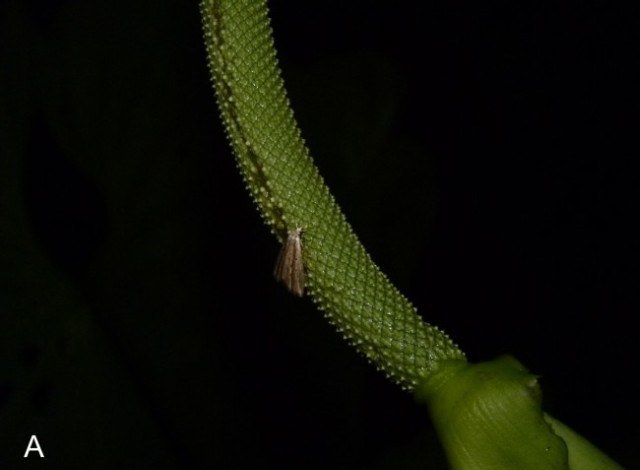
The scent work found that odour type tracks pollinator type closely enough to be judged by nose. Sweet and perfumed points one way; sour, fermenting or fruity points another; nothing at all points a third.
| If it smells of… | Recorded in | Points toward |
|---|---|---|
| Caraway | three species | perfume-collecting bees |
| Sweet, benzyl-acetate-like | two species | perfume-collecting bees |
| Over-ripe banana, fermenting fruit | Anthurium salvadorense | fermentation-seeking insects |
| Fusel oil | Anthurium hookeri | fermentation-seeking insects |
| Cut cucumber, at night | the gall-midge species | gall midges |
| Rotten fruit, at night, in both phases | Anthurium caperatum | night-flying moths |
| Minty | Anthurium antioquiense | a key character, see below |
| Spicy, but not minty | Anthurium amnicola | a key character, see below |
| Nothing you can detect | several species | midges, or something unstudied |
How thin this evidence is
The survey behind most of that table used one sample per species, from one clone per species, with no replication at all. Every entry is a single measurement of a single plant.
How much that matters showed up inside the study itself: one species produced two completely different chemical profiles from different collections, and the authors declined to split it into two species on that basis. If one species can smell two ways, a single sample cannot characterise a species.
The finding that should change how you read any scent claim
In the gall-midge species the scent was analysed, the dominant compound identified, and then — unusually — tested on the insects themselves. The result was not the obvious one.
The dominant compound is not the signal
The midges were attracted by a minor component — the aldehyde responsible for the cucumber note. The dominant compound in the blend attracted nothing, and adding it to the attractive compound did not improve the response.
So the biggest peak in a scent analysis need not be the message. Almost every scent claim in aroid literature — including some on this site — rests on abundance rather than on a bioassay. This is the one case where somebody checked, and abundance was the wrong guide.
Timing is part of the signal
Scent is not emitted continuously, and when it is released tells you when to expect the visitor. The perfume species scent in the morning, and that is exactly when the bees arrive — a tight window, roughly 08:30 to 12:00. The cucumber-scented species is strictly nocturnal, in both scent and visitation. Anthurium caperatum smells at night, in both sexual phases.
That last detail is worth pausing on. A scent that continues into the male phase is not recruiting for pollination of that inflorescence — its stigmas are finished. It is either moving pollen out, or advertising something the plant is still supplying. Which returns to Part IV.
If your plant has no smell
That is not evidence of nothing. Several species recorded as scentless to a human nose were also never sampled instrumentally, and the one species anyone did test that way turned out to have a distinctive blend that no one had noticed.
Smell it at night as well as by day, and close up. Several of the species above give nothing at all at the wrong hour.
Part VI
Who Actually Comes, and What Was Actually Shown
Bees, beetles, flies, midges, moths, butterflies and birds have all been recorded on Anthurium. Being recorded on a flower is not the same as pollinating it, and in this genus the gap between the two is unusually wide.
What it takes to actually show pollination
Three things, in order of difficulty. That the animal carries the pollen. That it touches a receptive stigma. And that it moves between inflorescences, because an animal that does the first two without the third is just rearranging one plant's pollen.
Only two studies in this genus have all three.
| Visitor | Carries pollen | Touches stigma | Moves between plants |
|---|---|---|---|
| Oil bees, males only | yes | yes | yes, and marked bees returned |
| Gall midges, females only | yes, photographed | yes | not filmed — but fruit set |
| Weevils | yes, visible packages | yes | one flight, ever |
| Hummingbirds and a flowerpiercer | yes | never seen | not shown |
| A butterfly | yes | not shown | not shown |
| Moths | not shown | not shown | not shown |
| Fruit flies | not shown | not shown | not shown |
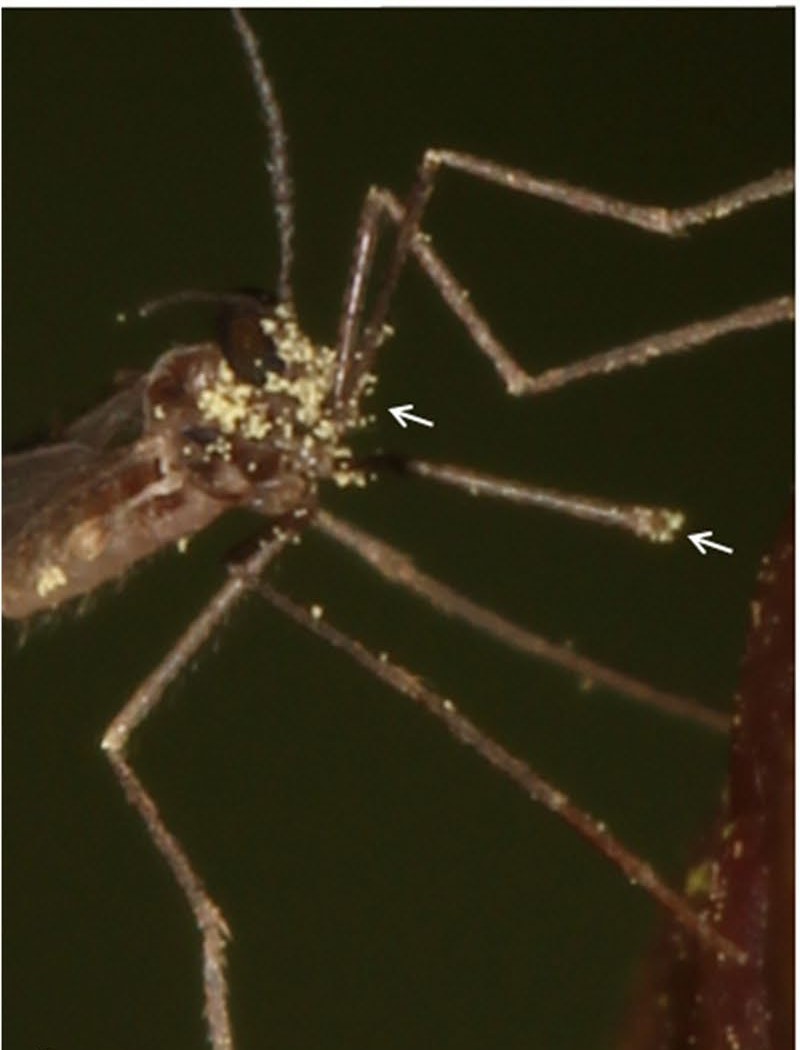
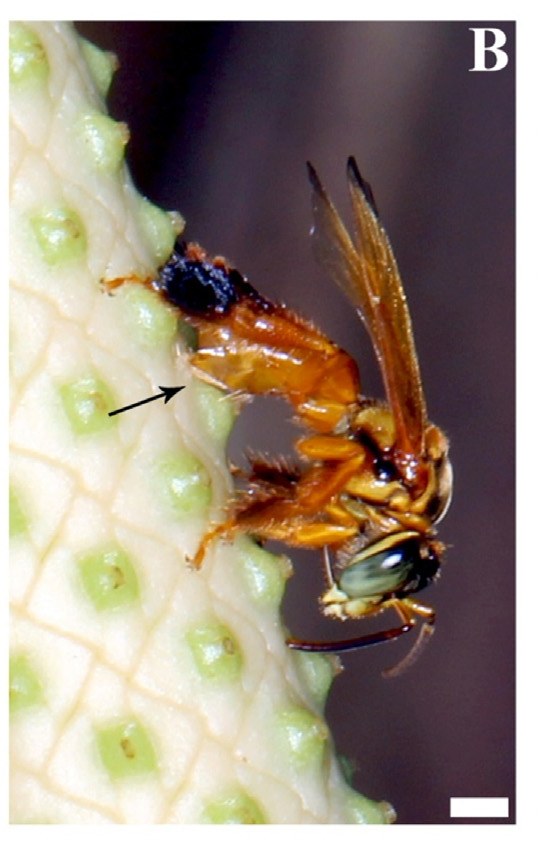
The two strong cases
Male oil bees. Across two seasons they were effectively the sole visitor — carrying heavy pollen loads, contacting stigmas, moving between spadices, and marked individuals came back. This is the best pollination evidence anywhere in the genus.
What makes it strange is the payment. There is no oil, no nectar, no oil-secreting tissue and no trap, and the bees ignored the pollen entirely — a stingless bee collected it while the oil bees would not. The authors' proposal is that the bees come for the scent itself, mopping it up with an oil-filmed brush on the abdomen. Their own title ends in a question mark, and this page keeps it there.
Female gall midges. Named as “the only effective pollinators of the studied plant population” — pollen loads photographed, stigmas contacted, both phases visited, an attractant identified by field bioassay, and fruit set in three of five inflorescences. Here the reward is not mysterious: the midges were watched feeding on stigmatic exudate in the female phase and on pollen in the male phase. Two meals, two visits, one insect.
And notably, no brood site — the midges were checked for egg-laying, which is what gall midges usually do in flowers, and they were not doing it.
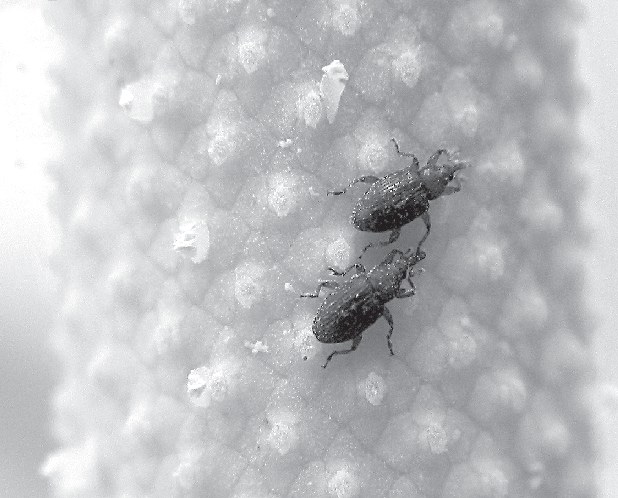
The birds, and why they may not be helping
At 2,700 m in eastern Ecuador, five bird species were watched picking up pollen from a male-phase inflorescence — four hummingbirds and a flowerpiercer — arriving with clean bills and leaving loaded. They were feeding on the fluid.
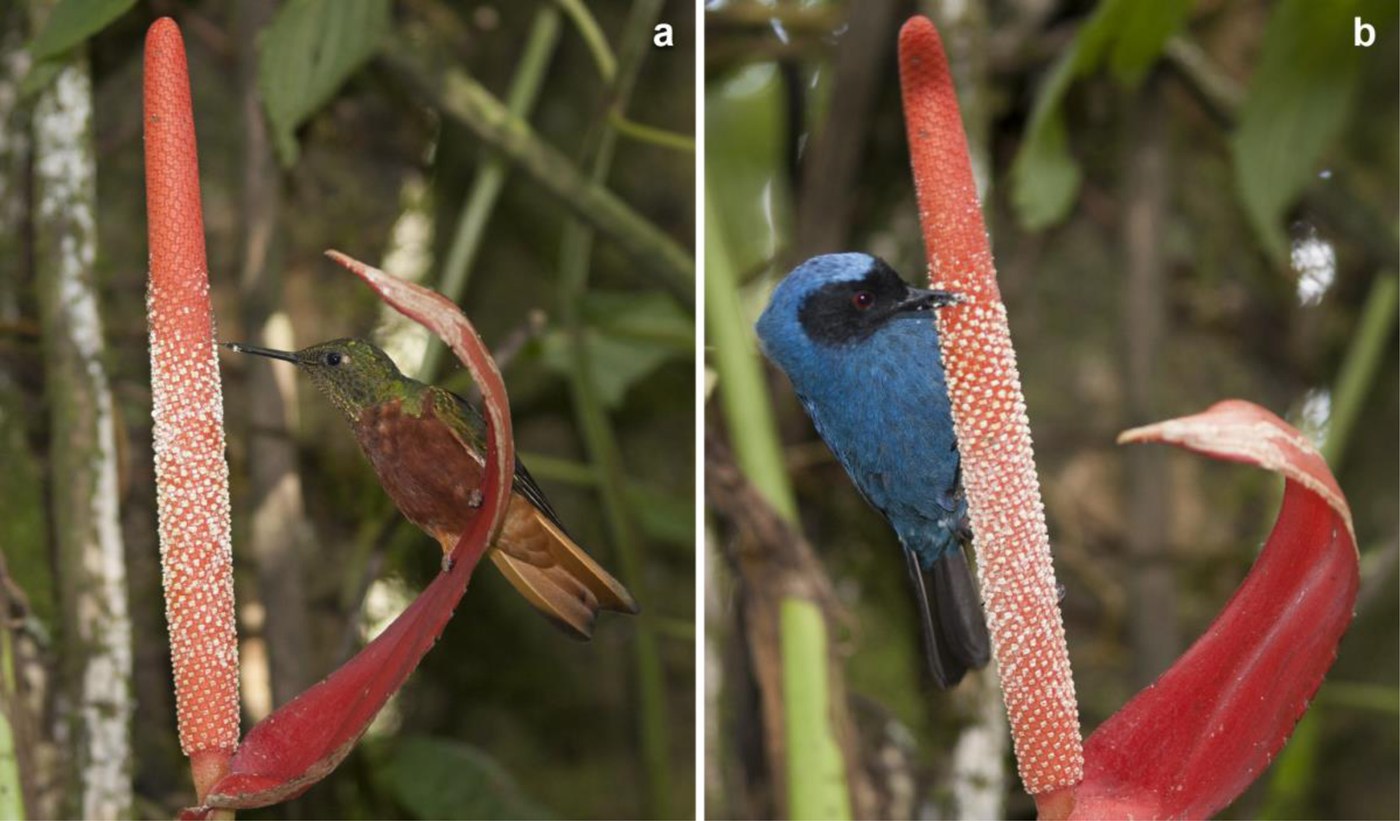
The authors' own caveat, which is the interesting part
“An important caveat… is that pollination requires that birds loaded with pollen also visit female-phase inflorescences; otherwise what we observed could be interpreted as floral parasitism and a reduction in fitness of male-phase flowers through loss of reproductive effort (pollen, nutritive fluids).”
No female-phase visit was ever seen. So these birds are either the pollinators or they are robbing the plant, and thirty-five hours of watching could not tell the difference.
Two details worth keeping. The visits were structured by a dominance hierarchy — one hummingbird held the inflorescence as territory and won every contest — and the birds were feeding on fluid secretions, which returns to Part IV. Whatever the plant is producing, something with a high energy demand was drinking it.
Everything else is weaker, and some of it is very weak
A butterfly on one species carried a pollen load, and the same butterfly species had visited the same plant in female phase two weeks earlier — suggestive, but the two observations are not linked. Moths on another species are identified only to family, and the authors call them visitors twice, in their own words.
Then the weakest link in the chain, which is also the most cited:
Seven species called bee-pollinated without a bee
In the scent survey, seven of ten species were assigned to perfume-collecting bees on the basis of their scent chemistry alone. No bee was watched on any of them.
Meanwhile the weevil study, working where those bees live, demoted euglossine bees from pollinators to unreliable visitors for the species it watched.
“Euglossine-pollinated Anthurium” is, for most species, an inference from a smell. It may well be right. It has not been shown.
One species that will not behave
The sharpest illustration that this genus resists generalisation: two populations of a single species, in two parts of Colombia, with two different smells and two different visitor guilds. One is foul-smelling and fly-visited; the other is scentless and bee-visited.
The authors considered splitting them and deliberately did not, judging the plants “so overwhelmingly similar in appearance” that it would be unwise “without further, more detailed information on their pollination biology”. So one name currently covers two pollination systems — and that is the honest position, not an oversight.
What this means for your plant
None of these animals is in your growroom. Not the oil bees, not the midges, not the weevils, not the hummingbirds.
Which is simpler than it sounds: you are the pollinator, and Parts VIII to X are the job description. What this part is for is knowing what the plant is set up to expect — a visitor that arrives on a schedule, feeds on something wet, and leaves.
Part VII
Reading Your Own Plant
This is the one part of the page where the sources agree. A receptive Anthurium tells you so, plainly, and you can see it across the room.
The cue: the spadix goes wet
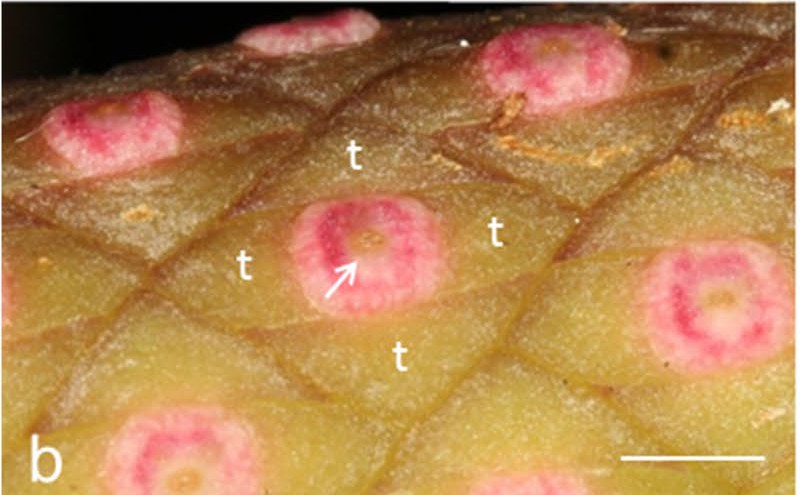
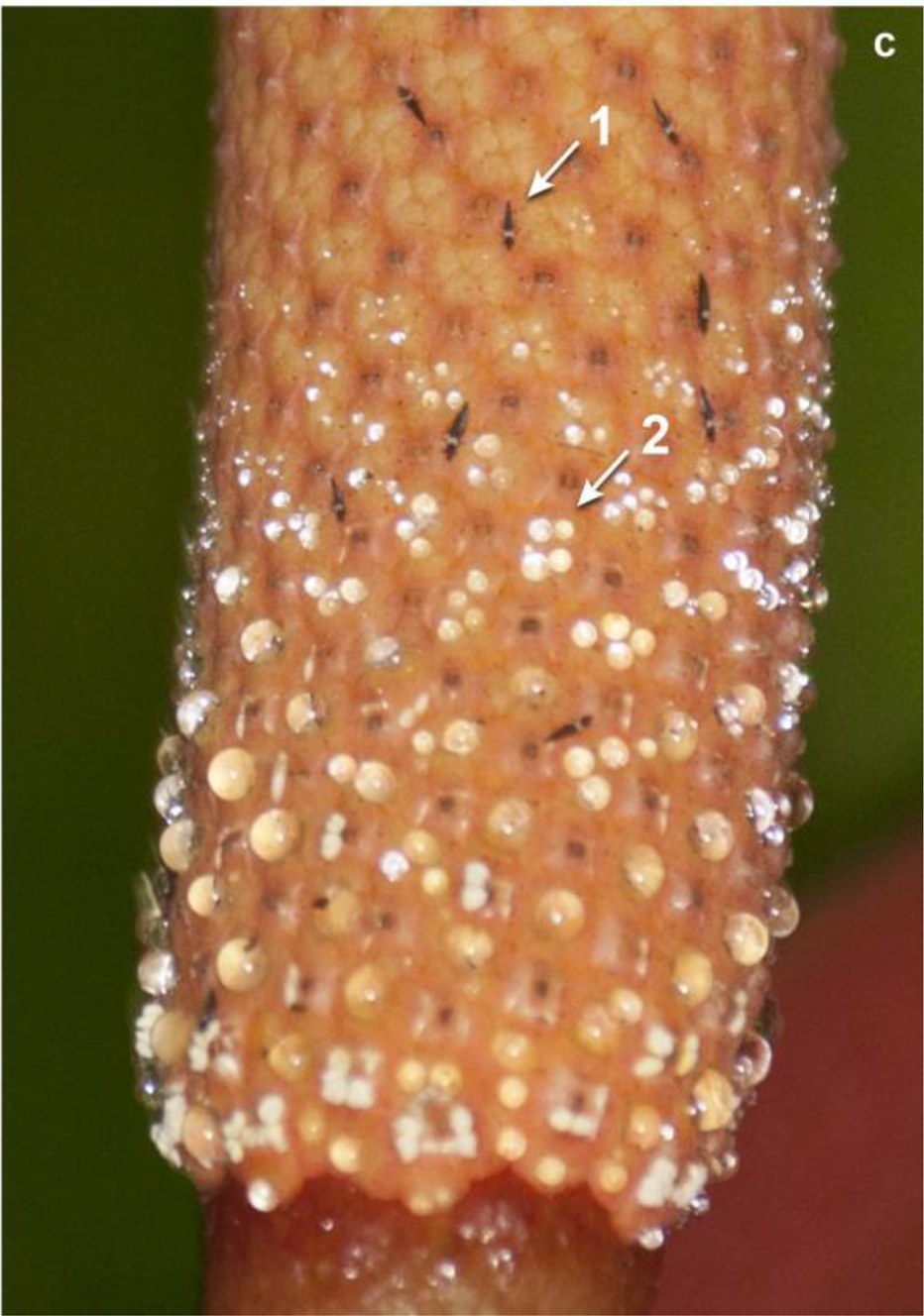
Two independent accounts describe the same thing. Up close, “the stigma will exude a drop of fluid which will sit at the apex of each individual flower on the spadix”. From further back, the whole spadix takes on a “velvety and shiny structure… due to wetness”.
When the droplets are there, the flower is ready. That is the entire signal, and it is more legible than anything the other four genera on this site offer.
And the signal has an off switch
“After the completion of the female phase, the stigmas dehydrate and turn to brown.”
Wet and glistening means go. Dry and browning means that band of the spadix is finished, and no amount of pollen will change it.
When to look
The droplets appear in the early morning. Some species present them on every flower at once; others work up the spadix in succession, which is the base-to-apex progression from Part III seen close up.
Practically: look first thing, and look again the next morning. A spadix that showed nothing at noon may have been wet at seven.
How long the window lasts — and the number nobody has sourced
One breeding chapter states that “each pistil on the spadix remains receptive (can be pollinate) for only 1 day”. It gives no source and no sample size, and the same chapter elsewhere describes a female phase lasting about a week.
Those two can both be true, and probably are: the spadix stays receptive for days while any individual flower is receptive briefly, because the flowers come into phase in sequence rather than together. That fits the base-to-apex progression and the field clocks in Part III.
But it is a reconciliation, not a measurement. Treat it as a reason to pollinate repeatedly over several mornings rather than once — which is what every practical account recommends anyway.
One species, one measured interval
3–4 days
In Anthurium smithii, the stigmas carry droplets three to four days before the first anthers emerge.
That is the only figure anywhere in this literature connecting the droplet you can see to the schedule you are trying to work with, and it was recorded from fresh material.
It does not settle the one-day question above — a spadix wet for three or four days is entirely compatible with any single flower being receptive briefly. What it gives you is a working window: once droplets appear, you have days rather than hours, and you should use all of them.
Two more things worth watching
The stamens come out in a fixed order. Across the genus, “usually the lateral pair of stamens emerg[es] first, followed by the anterior then the posterior stamen” — and the filaments are described as “promptly shrinking and withdrawing the anther to the surface of the tepals” once they have done their work.
So a flower part-way through its male phase has some stamens out and some still in, and a spadix in mid-changeover is showing you its position in the sequence, not a malfunction. In one species the order was tracked up the spadix as well: the apex had its lateral stamens exserted while the bottom third had not yet finished emerging.
Some species change colour as they open
Recorded in species descriptions, not as a general rule: one spadix is “dark yellow-green to pink, usually becoming purple at anthesis”; another spathe is “medium green to pale green, becoming whitish or yellowish at anthesis”. A third species' spadix goes whitish green, then violet as the seeds ripen.
If your plant does this, it is a free calendar. Nobody has written it down as a grower's cue, and it appears often enough in descriptions to be worth watching for on your own species.
What you will almost never see
Fluid and pollen on the same spadix at the same time. The field study that watched most closely reported that the phases never overlapped; the grower literature is slightly softer — “rarely will the same plant have stigmatic fluid and pollen at the same time, although it does happen in some species on occasion”.
If you do see both at once, you have something worth recording. It is uncommon enough that the two literatures disagree about whether it happens at all.
The gap, and what to do in it
Between the stigmas drying and the anthers opening on the same spadix is roughly a week. That gap is not dead time — it is when you line up the other half of the cross. Either a second plant is coming into female phase, or you are about to have pollen and need somewhere to put it. Part VIII is about keeping it until then.
Part VIII
Pollen, and Whether It Keeps
Because the phases do not overlap, almost every Anthurium cross depends on pollen that was collected earlier and kept. How well it keeps is the weakest-evidenced thing on this page.
When it is ready
“Pollen is ready to be collected and/or used when it is visible on the surface of the spadix. The timing of this event is always after the last of the stigmatic fluid is dried up and no longer visible.”
So the sequence on any one spadix is fixed and you cannot rush it: wet, then dry, then later pollen. If you can see pollen, that spadix's own stigmas are already past.
Collecting it
Straightforward, and no equipment worth the name: take it off with a finger or a brush, or tap it into a paper envelope, and keep it cool and dry.
How long it lasts — one number, and it is thin
a week or two
“The pollen will not last more than a week or two.” That is the only viability figure in any of the breeding literature reviewed for this page, and it comes with no sample size and no storage temperature attached.
Plan around it as a working assumption, not a fact. If you have a choice, use pollen fresh.
Where to keep it — genuinely unsettled
The grower literature does not agree with itself, and the honest presentation is to say so.
| Method | Reported by |
|---|---|
| Airtight container, with or without desiccant | some growers |
| Refrigerated | some growers — others report mould |
| Aluminium foil, room temperature | one breeder, specifically to avoid the fridge |
The refrigerator is the disputed variable. One account says pollen kept cold “often becomes moldy”; the primer reports both camps and tells the reader outright to “experiment with various methods to find out which fits their species requirements”.
That is unusual and worth respecting. A practical literature that declines to give one answer is normally telling you the answer depends on something nobody has isolated. Try both, on the same pollen, and write down what happened.
One workaround, with a trap in it
The primer suggests using pollen from an earlier inflorescence on the same plant for a later one, since the plant makes them in succession. Mechanically that works.
But that is a self, and Part XI explains why a self in this genus is the hardest possible result to interpret: several Anthurium set seed with no pollination at all. If the goal is seed, it may be fine. If the goal is knowing what you made, use a second plant.
The better workaround is the one the same source gives next: grow more than one clone of anything you intend to breed, so that a wet spadix and a shedding spadix exist at the same time somewhere in the collection.
Part IX
Making the Cross
After all the argument in Parts IV to VI, the operation itself is almost disappointingly simple. The published protocol is one sentence long.
The whole method, as published
“Simply take the pollen and place in on the spadix and with a brush or your finger smear it up and down and around the spadix. Do this for several mornings in a row or as long as you have fluid and pollen available. Make out a tag with your pollination information on it and wait for the berries to form.”
The four things that actually matter
1. Wet spadix. Not a coloured spathe, not a plant that looks ready — visible droplets, or that shiny wet look across the whole spadix. Part VII.
2. Cover the whole spadix, not a spot. The instruction is to smear up and down and around. The flowers are in a gradient, not a state — some bands are receptive and others are not, and you cannot tell which by looking.
3. Repeat, on consecutive mornings. This is the single most consistent instruction across every practical source, and it is also the right hedge against the possibility that any individual flower is receptive only briefly. One application is a gamble; four mornings is a method.
4. Tag it immediately. Fruit can take anywhere from three months to two years to ripen (Part X). Nothing you remember will survive that. Parents, date, direction of the cross.
What no source mentions, and it is a real gap
Nowhere in the amateur or the commercial literature reviewed for this page is there any mention of bagging, emasculation, or isolating the inflorescence. No source recommends it; no source rejects it. It simply is not discussed.
That matters here more than it would elsewhere. Part VI shows real insects do visit these inflorescences, including in cultivation, and Part XI shows that some Anthurium set seed with no pollination at all. Between those two, an untagged, unbagged spadix that sets fruit has told you almost nothing about what fathered it.
If the cross matters — if you intend to name or distribute what comes out of it — bag it, and say in your records that you did. You will be ahead of the published literature.
Then wait, and expect to wait badly
There is no early confirmation. No colour change, no swelling you can trust in the first weeks. The spadix either begins to develop berries or it does not, and in the slowest species you will not know for the better part of a year.
Which is the practical argument for making several crosses in a season rather than one careful one, and for keeping the records that let you learn something from the failures. Part XII is about what the failures mean.
Part X
Fruit, Seed, and the Wait
The cross worked. Now the timescale stops being measured in days.
How long the fruit takes — and this varies more than anything else here
| Species | Pollination to ripe berry |
|---|---|
| Anthurium effusilobum | under 3 months |
| Anthurium andraeanum, commercially | 6–8 months |
| Anthurium clarinervium | over a year |
| Anthurium berriozabalense | up to 2 years |
An order of magnitude, within one genus. Do not average these into a rule — find out what your species does, and until you know, assume the long end. It is the reason Part IX insists on a tag.
Knowing when it is ripe
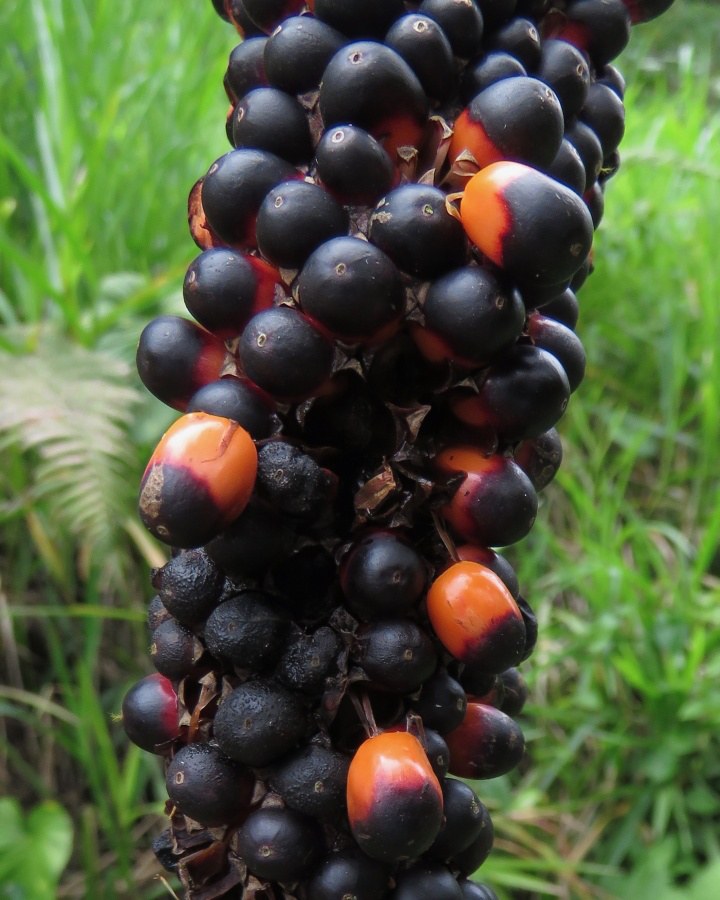
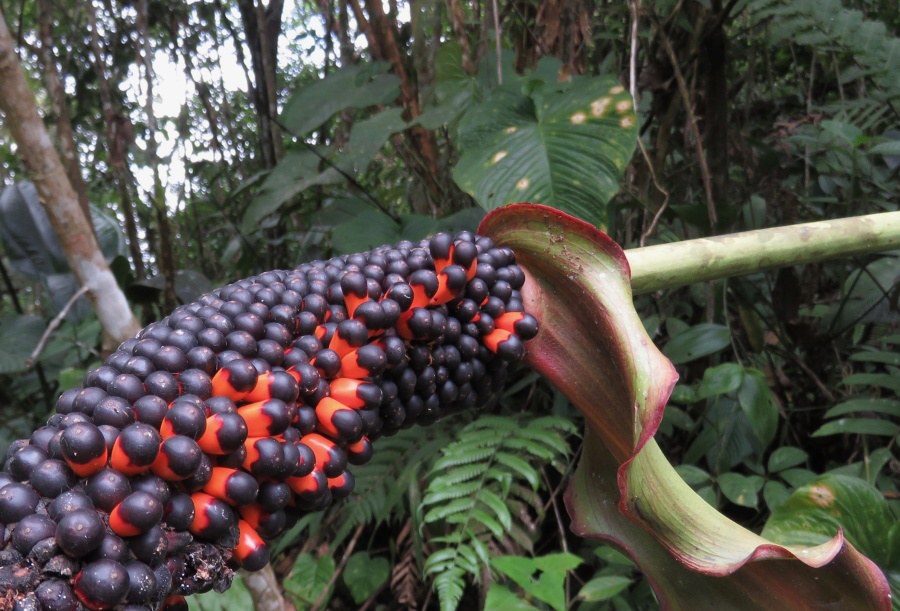
The cue is mechanical rather than visual, and it is unusually definite: berries are ready when they “literally ‘pop out’ of the spadix”. Some species release the lot at once; others let go over several days as they ripen in succession.
Each berry holds one or two seeds, depending on species and on how well the plant is doing.
Sowing
Sow it now
“The seed should be sown immediately as it desiccates easily and is not viable for very long. Storage of seed is of little value.”
Squeeze the seed out of the berry between your fingers and sow it. In many cases it has already started without you — the source notes a small green radicle frequently visible at harvest.
Germination takes one to three weeks in most cases, longer in some species. Use a well-drained soilless mix and watch for fungal and bacterial problems, which are the usual cause of loss at this stage. The commercial equivalent is sowing into cells under 75–80% shade, with plantlets moved on at 4–6 months.
One thing this page will not tell you
There is no germination percentage for any Anthurium anywhere in this literature. Not a rate, not a viability curve, not a controlled trial. The instruction to sow immediately is experience, repeated confidently, and never tested.
It is very probably right. But if you ever sow half a batch fresh and half a fortnight later and count both, you will have produced the first real number in the genus.
What the seed is actually like
Two details from the genus description that no other source here mentions. The berry is two-celled with usually one seed per cell, and the flesh around the seed is “usually translucent, sweet” — which is presumably the point, for whatever eats it.
And the seeds are “usually with a sticky appendage on at least one end”.
That is a dispersal structure, and it is the only mechanical dispersal adaptation recorded for the genus. It also explains something practical: if the seed sticks to your fingers, that is the plant working as designed, not pulp you failed to clean off.
Then the long part
From sowing to first flower, in commercial Anthurium andraeanum: fifteen months at the earliest, thirty to thirty-six months typically — call it three years from seed to bloom.
Add the fruiting time and a cross made today may not be assessable until 2029. That is the real reason to keep records, make several crosses at once, and label everything twice.
Part XI
What Crosses With What
Very little is known, and one thing that is known makes everything else harder to interpret.
Start here: some of these plants make seed without you
Four species that set seed with no pollination at all
Anthurium gracile, Anthurium scandens, Anthurium bakeri and Anthurium clarinervium are all reported to produce viable seed without being pollinated. Of Anthurium bakeri: “This species regularly sets a full spadix of bright red berries without pollination.”
So a spadix full of berries is not proof that your cross took. In most of this site's genera, fruit is the answer. In Anthurium, for at least these four species, it is not evidence at all.
Which means: if you are working with any of them, the seedlings are the only test, and they will take three years to sit it. And if you are working with an untested species, you do not know which situation you are in.
This is also why Part VIII warns against using a plant's own earlier pollen. A self that sets seed and an unpollinated spadix that sets seed look identical.
The two compatibility results anyone has published
Anthurium clarinervium will not cross with its own section. Attempts with other members of section Cardiolonchium failed so consistently that the species' sectional placement itself is now doubted — it is thought instead to be closer to Anthurium berriozabalense, and its section is described as unknown.
That is worth reading twice. A breeding failure was strong enough to overturn a taxonomic placement — which tells you both how weak the sections are (Part II) and how much information a failed cross carries.
Anthurium radicans hybrids are a dead end. The species has produced several attractive foliage hybrids, and “these hybrids all seem to be sterile and will not produce a successive generation”. You can make the first cross; you cannot build a line on it.
And one result that goes both ways at once
The most useful compatibility datum in the genus comes from breeding work reported second-hand in a taxonomic paper. Anthurium amnicola was crossed against two different sections, with opposite outcomes:
One species, two sections, two answers
“Anthurium amnicola will not cross with members of section Porphyrochitonium, but it does cross readily with members of section Calomystrium.”
And it is not alone: Anthurium antioquiense and Anthurium amnicola both “readily interbreed” with Anthurium andraeanum and its section.
This is the only positive-and-negative pair anywhere in the genus — a species tested against two groups, working with one and failing with the other. It is also of practical consequence: Anthurium amnicola is where the lavender spathe in modern hybrids came from.
Note what it does to the sections argument. Here, section membership predicted the outcome correctly — the crosses worked within Calomystrium and failed outside it. In the Anthurium clarinervium case it predicted exactly wrong.
So the sections are neither useless nor reliable. They are a hypothesis that is sometimes right, and the only way to find out which kind of case you have is to make the cross.
How thin all of this still is
Three results for a genus of over a thousand species. None states how many attempts were made, none gives a protocol or a control, and two of the three are reported at second hand from personal communications.
Set against a genus of over a thousand species in twenty sections, most of which are not natural groupings, there is effectively no map.
What the sections can and cannot tell you
The obvious strategy — cross within a section, because those species should be relatives — is weaker than it sounds. As Part II sets out, most sections are not monophyletic, and the diagnostic characters of at least one large section turned out to have evolved more than once independently.
So a shared section means the two plants look alike in ways somebody thought were important in 1905. It is a reasonable place to start and a poor thing to rely on. The Anthurium clarinervium case is exactly this failure caught in the act.
There is a breeding record. It is Victorian.
The largest body of Anthurium crossing data anywhere in this archive is a French glasshouse manual from 1898. It lists roughly twenty-five named hybrids with the cross direction, the breeder and the year, running from 1881 to 1896 — including the first hybrid ever raised from Anthurium andraeanum, made by Bergman in 1881.
And they tested reciprocals
“Les produits d’une fécondation intervertie sont semblables, c’est-à-dire que la plante qui a servi de mère peut servir de père indifféremment et réciproquement.”
The offspring of a reversed cross are alike — the plant that served as mother can serve as father, and the other way round. Attributed to two named breeders' programmes.
Nothing modern replaces this. If it holds, it means the direction of your cross does not matter for the result, only for the record — which is worth knowing before you agonise over which plant to use as the seed parent.
Two other things from the same source, both practitioners' rules rather than experiments. Outcrossing beat selfing: pistillate flowers “set seed better with pollen from another plant of the same species”, and to get any seed at all you needed several identical plants in the house. And bigeneric crosses were doubted even as interspecific ones were called easy.
How to use a 128-year-old pedigree list
As breeding history, not as a parentage reference. No counts, no controls, horticultural names throughout, and several of the parents are now synonyms of something else. The value is that somebody was systematically recording direction, breeder and year in 1898 — which is more than most of the modern trade manages.
The author saw the problem coming. He wrote that the ease with which these plants cross “will one day drag us into extreme confusion from which there will be no way out”. He was right.
Chromosomes
Anthurium has been counted more thoroughly than most aroid genera, and what those counts show — the common number, the polyploid series, and the extra chromosomes carried in one section — sits on the page that deals with the whole family: Why Some Crosses Fail. It is not repeated here, deliberately, so the two pages cannot drift apart.
The short version: the counts exist, and nobody has connected them to a single successful or failed cross. They tell you the genus has room for ploidy barriers. They do not tell you where any of them are.
Part XII
When It Fails
Ordered by how likely each is, which is roughly the reverse of how interesting they are. The exotic explanation is almost never the right one.
1. The spadix was not receptive
Far and away the commonest. A coloured spathe is not a signal — the spathe can be open and perfect for weeks while the spadix is doing nothing. Wet, glistening, droplets at the flower tips. Nothing else counts (Part VII).
And check in the early morning. A spadix inspected at midday may have been receptive at dawn and dry by the time you looked.
2. You only did it once
Every practical source says the same thing: several mornings in a row. Flowers come into phase in sequence up the spadix, and there is a claim — unsourced, but consistent with the rest — that any individual flower is receptive for about a day. A single application catches whichever band happened to be ready.
3. The pollen was dead
The only published figure is a week or two, with no temperature attached, and the storage advice openly contradicts itself (Part VIII). Fresh pollen removes the variable entirely — which is the real argument for growing several clones.
A test worth borrowing
Nobody has published a pollen viability test for Anthurium. The family-level page carries one that has been used on another aroid: pollen in 3% sucrose solution, checked for tubes after a few hours. Why Some Crosses Fail has the detail and the caveats.
It is untested in this genus. But a negative — no tubes at all — would still be worth knowing before you blame the plant.
4. It worked, and you are early
Three months to two years from pollination to ripe berry, depending on species (Part X). Before you conclude anything, check what your species does. More than one grower has thrown out a working cross on a schedule borrowed from a faster plant.
5. The cross genuinely will not go
Last, because it is the least likely and the hardest to establish. Two published cases exist for the whole genus (Part XI) — and one of them was strong enough to move a species out of its section.
Before concluding incompatibility, rule out one to four. And if you do conclude it, write it down with the numbers: parents, dates, how many attempts, what the spadix looked like each time. That record would be a genuine addition to what is known, which is a sentence this site can write about very few things.
And the failure that looks like a success
Berries are not proof. At least four Anthurium species set full spadices of viable seed with no pollination whatsoever (Part XI).
If your species is one of them — or if you do not know whether it is — then fruit set tells you the plant is healthy, not that your cross took. The seedlings are the only test, and they are three years away.
This is the single biggest difference between breeding Anthurium and breeding anything else on this site. Everywhere else, berries mean you succeeded. Here they mean you have to wait and see.
Sources
Sources, and What Kind of Evidence Each One Is
This genus has more published pollination work than Alocasia and less agreement than any of them. The list below is short for a genus of over a thousand species, and that is the point.
Peer-reviewed literature
- Franz, N. M. (2007). Pollination of Anthurium (Araceae) by derelomine flower weevils (Coleoptera: Curculionidae). Revista de Biología Tropical 55(1): 269–277. The weevil system in Part VI, and the “pollen and floral tissue” answer in Part IV. Pollen packages visible on the weevils and stigma contact both shown; only one inter-inflorescence flight was ever witnessed, so transfer is inferred. The author states plainly that he did not study anthesis properly, and the Anthurium formosum timings in Part III are quoted by him from an internet source, not measured.
- Schwerdtfeger, M., Gerlach, G. & Kaiser, R. (2002). Anthecology in the Neotropical genus Anthurium (Araceae): a preliminary report. Selbyana 23(2). The scent chemistry in Part V and the nectarless claim that Part IV is built around. Its central assertion is family-wide and is contradicted by four other papers on this list. Scope is the real limit: one sample per species, one clone per species, no replication, and seven of ten species are called bee-pollinated on scent chemistry alone, with no bee ever observed.
- Etl, F., Francke, W., Schönenberger, J. and colleagues. Chemical attraction of gall midge pollinators (Cecidomyiidae: Cecidomyiinae) to Anthurium acutangulum (Araceae). The strongest reward evidence on the page, and the source of the bioassay in Part V. Pollen loads photographed, stigma contact shown, both phases visited, fruit set recorded, and the midges watched feeding on stigmatic exudate and on pollen. Also the one study anywhere in the genus that tested its scent compounds on the insects — and found the dominant compound was not the attractant.
- A perfume-collecting male oil bee? Evidences of a novel pollination system involving Anthurium acutifolium (Araceae) and Paratetrapedia chocoensis (Apidae). The best-evidenced pollination in the genus: heavy pollen loads, stigma contact, transfer between spadices, and marked bees returning. Also the source of the no-overlap clock in Part III. The reward remains a hypothesis and the authors' own title ends in a question mark — this page keeps it there.
- Hartley, N., Krömer, T. & Gibernau, M. (2017). Lepidopteran visitors of Anthurium inflorescences. Aroideana 40(1): 84–96. The counterweight to the nectarless position, and the most important paper in Part IV. It revives Daumann's 1930 finding that the tepals secrete sugar, more of it than the stigmas, continuing into the male phase, and reports Croat's 1980 survey of 30 species. Its own lepidopteran records are visitors only — the authors say so twice — and the moths are identified only to family. It leaves its central question open in print: “Are these spadix secretions nectar?”
- Bleiweiss, R., Sornoza Molina, F., Freire, E. & Croat, T. B. (2019). Bird visitation to a high Andean Anthurium (Araceae) in Eastern Ecuador. Flora 255: 80–85. Five bird species — four hummingbirds and a flowerpiercer — measured picking up pollen while feeding on floral fluid, with a dominance hierarchy structuring who fed where. Listed partly for its caveat, which this page quotes: no female-phase visit was ever seen, so the observations “could be interpreted as floral parasitism” rather than pollination. A carriage record, not a pollination record.
- Bleiweiss, R., Nogales Trujillo, A. S., Croat, T. B. & Garzón-Santomaro, C. (2019). First observations of butterfly (Pedaliodes: Satyrinae: Nymphalidae) visits to a wild Anthurium (Araceae). A butterfly carrying an Anthurium pollen load — the first lepidopteran record for the family. Pollination is not shown, and the paper does not claim it. Same plant and site as the bird paper above.
- Beltrán Cano, M. F. & Cuartas Hernández, S. E. (2024). Flowering phenology patterns promotes pollination facilitation in coexisting Anthurium species from a mountain forest in Colombia. Arthropod-Plant Interactions 18: 1085–1098. The two measured facts the page leans on hardest: only one inflorescence is open per plant at a time, and bagged inflorescences of seven species set no fruit at all — ten per species at each of two sites. That is the basis for the flat statement in Part I that your plant will not pollinate itself. A year of fortnightly observation, 288 hours.
- Croat, T. B. & Sheffer, R. D. (1983). The sectional groupings of Anthurium (Araceae). Aroideana 6(3): 85–123. The sectional framework in Part II, and the historical counts — Schott's 183 species in 28 sections, Engler's 486 in 18. The authors describe their own system as a modification of Engler's, deferred its justification to a paper that did not follow, and dropped one section from their own key as “a seemingly unnatural group”.
- Camelo, M. C., Pappas, G. J. Jr., Silva, M. C., Temponi, L. G., Coelho, M. A. N., Baumgratz, J. F. A. & Carlsen, M. M. (2026). Applying target capture sequencing to unravel the Anthurium section Pachyneurium (Araceae), with emphasis on Brazilian species. Plants 15(6): 866. The molecular verdict on the sections in Part II. Section Pachyneurium is not monophyletic, its three diagnostic characters are homoplastic, and the paper states that of the 20 recognised sections “only a minority… are monophyletic”. 68 nuclear loci; 18 of about 120 section members sampled.
- Trinh, S. T., Ho, N. T. H., Ho, H. N. & Truong, H. T. H. (2025). Genetic diversity of the ornamental plant Anthurium andraeanum in Vietnam. Research Journal of Biotechnology 20(9): 159–165. Eighteen commercial accessions, three haplotypes, genetic distances between accessions close to zero. Both markers are plastid, so it bounds maternal-lineage diversity and not total diversity — Part II says so, and a later edit should not quietly upgrade it.
- Şen, E. Y., Düzgören, B., Karabıyık, Ş. & Yalçın Mendi, Y. (2022). Anthurium breeding by classical and biotechnological methods. Book chapter. The receptivity cue in Part VII — the “velvety and shiny” wet spadix and the browning that ends it — and the seed-to-flower timings in Part X. Its statement that each pistil is receptive for only one day is unsourced, carries no sample size, and sits awkwardly against its own week-long female phase; Part VII flags all of that rather than repeating the number flat.
- Hay, A. & Cedeño, M. Anthurium decipiens, a gigantic new and apparently sapromyophilous species from western Colombia. The unresolved case at the end of Part VI: two populations of one species with two smells and two visitor guilds, one foul-smelling and fly-visited, one scentless and bee-visited. The authors considered splitting them and deliberately did not. Also states plainly that pollen transfer has never been shown for the species.
- Chouteau, M., Barabé, D. & Gibernau, M. (2006). A comparative study of inflorescence characters and pollen-ovule ratios among the genera Philodendron and Anthurium (Araceae). International Journal of Plant Sciences 167(4): 817–829. The self-pollination result in Parts I and III. Inflorescences were bagged at bud stage and scored as able to self if any fructified: of 20 Anthurium species, nine produced seeds. Read alongside the seven-species study above, which got zero — the two share no species, so both stand and selfing is a species-level trait. Caution for anyone re-reading this paper from extracted text: its Table 1 covers 23 Philodendron species, every one of which was unable to self, and in a text-layer extraction that column of “No” runs straight into the Anthurium table heading. Reading the Philodendron column as the Anthurium column inverts the finding.
- Croat, T. B., Whitehill, J. & Yates, E. (2007). A new subsection of Anthurium section Calomystrium (Araceae) and five new species from Colombia and Ecuador. Aroideana 30. The best compatibility datum in the genus, in Part XI: Anthurium amnicola will not cross with section Porphyrochitonium but crosses readily with section Calomystrium, and both it and Anthurium antioquiense interbreed with Anthurium andraeanum. Also the source of the minty-versus-spicy scent couplet in Part V. The crossing results are reported second hand from a breeder's personal communication, with no counts and no protocol.
- Croat, T. B. (1985). The Anthurium bredemeyeri complex (Araceae) of Venezuela and Colombia. Aroideana 8(4): 118–137. The 3–4 day interval between stigmatic droplets and the first anthers in Part VII — the only figure anywhere tying the visible droplet to the protogyny timetable. Also records “a few scattered nectar drops” on the tepals of Anthurium smithii, the one place in this literature where the tepal secretion is called nectar outright (Part IV), and the stamen emergence sequence used in Part VII. Observed from fresh material while writing a taxonomic revision, which is why it is worth more than its grade suggests: the author had no argument to win.
- Croat, T. B. & Rodríguez de Salvador, J. (1995). Contributions to the Araceae flora in northwestern Pichincha Province, Ecuador. Part 1: Anthurium of ENDESA Reserve. Aroideana 18. The genus-level reproductive morphology in Parts VII and X: the stamen emergence order, and berries “2-celled, usually with one seed per cell” with the mesocarp “translucent, sweet” and seeds “usually with a sticky appendage on at least one end” — the only dispersal structure recorded for the genus. Also the 1995 estimate of perhaps 1,000 species. Contains no pollination, scent, nectar or breeding-system content whatever, which is itself worth recording: floristic revisions are not a source of pollination data.
- Rudolph, J. (1898). Caladium, anthurium, alocasia et autres aroïdées de serre: description et culture. Librairie Agricole de la Maison Rustique, Paris. (In French.) The largest body of Anthurium crossing data in this archive, and it is 128 years old. Roughly 25 named hybrids with cross direction, breeder and year, 1881–1896; the reciprocal-cross result in Part XI; the practitioner's rule that outcrossing beats selfing; and a horticultural count of about 160 species for Part II's drift table. Grade: breeder-reported practice, no counts and no controls, and several parents in the pedigree list are now synonyms of something else — it is breeding history, not a parentage reference. Scanned from Gallica and heavily OCR-corrupted; every numeral in it should be checked against the page image before printing.
- Croat, T. B., Brossart, L. & Kostelac, C. V. (2008). A revision of the 3-segmented species of Anthurium sect. Dactylophyllium (Araceae). Aroideana 31. The colour changes at anthesis in Part VII — spadices becoming purple, spathes becoming whitish or yellowish as the inflorescence opens. Recorded species by species in a taxonomic revision, never as a general rule and never timed, which is how the page presents it.
Grower and breeder accounts
- Carroll, N. (2007, last reviewed 2025). The Anthurium Primer. Includes Croat & Bunting (1979), Standardization of Anthurium descriptions, and an article by John Banta. The only home-grower protocol that exists for this genus, and the backbone of Parts VII to XI: the droplet cue, the smear-and-repeat method, pollen viable “a week or two”, the contradictory storage advice, berries that “pop out”, sow-immediately, and the three-months-to-two-years ripening spread. It is also the only source for the apomixis in Part XI — four species setting seed with no pollination — which is the most consequential claim on the page and rests on this one document. Grade it as experience, carefully recorded, without counts or controls.
What kind of evidence this page is
Two pollination systems are properly demonstrated — the oil bees and the gall midges — each on a single species. One more is close (the weevils). Everything else on Part VI's list is a carriage record, a visitor record, or an inference from a smell.
The reward argument in Part IV rests on two species whose secretions have ever been chemically tested, one of them in 1930. The 30-species survey behind it recorded appearance, not sugar.
The whole operational half of the page — Parts VII to XII — rests substantially on one grower document. It is careful and internally consistent, and it is not a controlled trial.
What is missing
1. Whether the secretions are nectar. The question is asked in print and left open. Nobody has measured sugar in an Anthurium secretion since 1930 except in one species.
2. What the tepal secretion is. It was described in 1930, it is sweeter than the stigmatic fluid, it continues into the male phase, and almost nobody has looked at it since.
3. Any germination percentage. Not one, for any species in the genus. Nor a viability curve, nor a controlled sowing trial.
4. A pollen viability test. None published. The “week or two” figure has no temperature attached and no sample size.
5. How widespread apomixis is. Four species are named. Nobody knows whether it is four or four hundred, and it determines whether fruit set means anything.
6. A compatibility matrix. Two published outcomes exist for the whole genus, neither with counts.
If you keep records, they are the missing data
Four of those six gaps could be closed by a grower with a notebook. Sow half a batch fresh and half a fortnight later, and count both. Split a pollen sample between the fridge and a foil packet at room temperature, and use each on a known-receptive spadix. Bag an inflorescence of an untested species and see whether it fruits anyway.
Each of those would be the first number of its kind. Aroidpedia would like to publish them.