
Pest Management·08 / 08
ARMORED SCALES
Diaspididae — Diaspis boisduvalii, Aspidiotus nerii
Uncommon indoors and the hardest thing here to poison. The insect sits loose under a detached shield, and it does not feed where a systemic travels.
Uncommon on houseplants, and the hardest thing in this guide to poison. Both statements come from the same piece of anatomy.
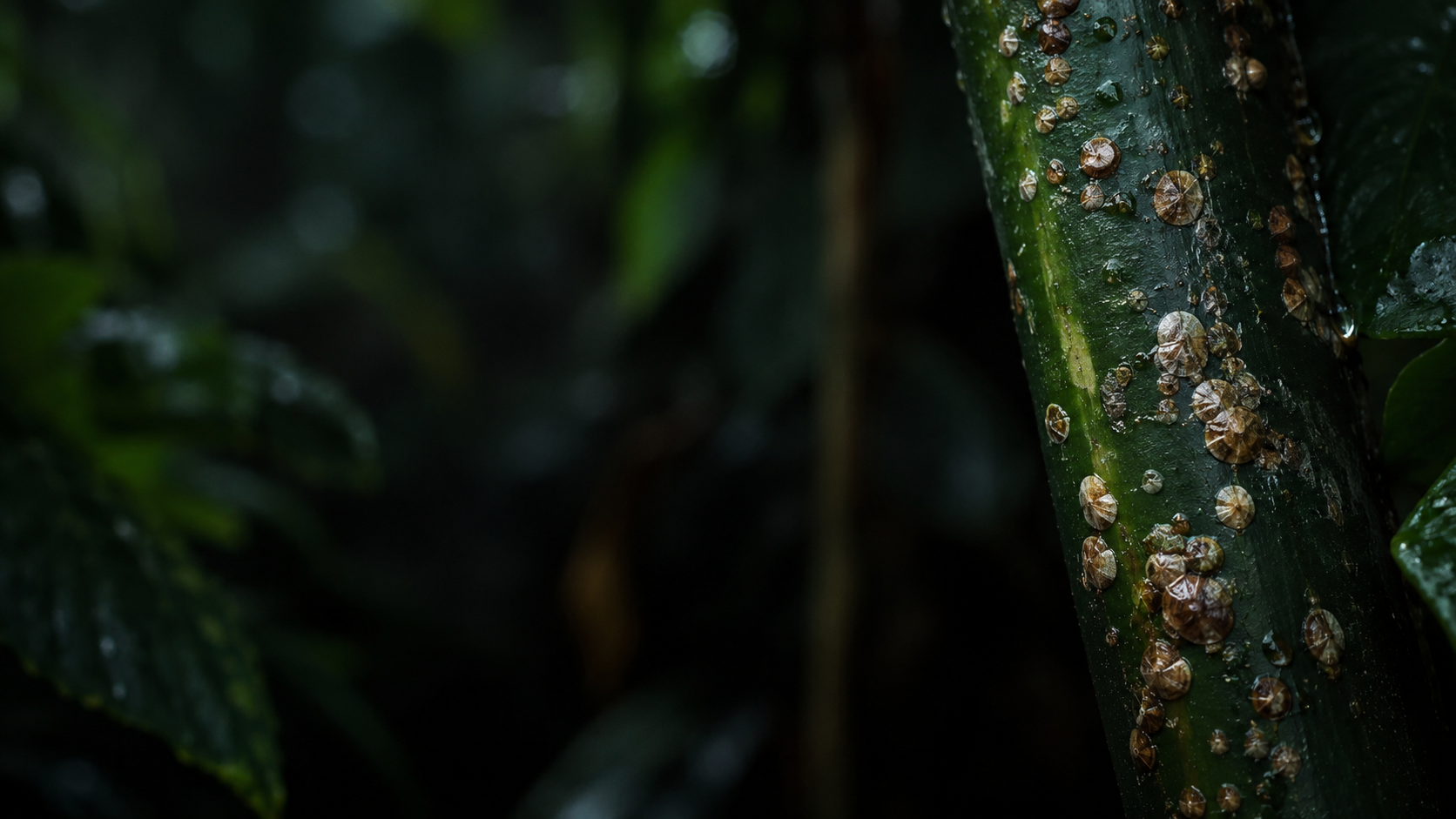
Armored scales, family Diaspididae, build a shield out of shed skins and wax that is not attached to the body. Pry one up and a small, soft, unattached insect sits underneath — that is the definitive test, and it is the opposite of what you find with a soft scale, where the cover is the animal itself.
The second test: armored scales produce no honeydew, ever. No sticky leaves, no sooty mould, and usually no ants. A scaly plant that is not sticky is armored scale.
The ones you are most likely to meet indoors are Diaspis boisduvalii, Boisduval scale, notorious on orchids and occasionally on aroids, and Aspidiotus nerii, oleander scale. Be aware that the males of several species make conspicuous white felted covers, so a badly infested plant can appear to be dusted with small white specks and be misread as mealybug.
A plant declining without the usual sticky warning. That absence is exactly why armored scale is so often caught late.
Feeding produces yellow spotting or chlorotic haloes at each site, and heavily colonised stems die back. On a badly infested plant the decline is general and slow: poor growth, leaves that yellow and drop, and an overall failure to thrive that gets attributed to light or water for months before anyone turns a petiole over.
Because there is no honeydew, none of the secondary signals that give soft scales and mealybugs away are present. The infestation announces itself only by the scales themselves — which look like part of the plant until you learn to see them.
Your original page is right that both contact and systemic insecticides are largely ineffective against armored scale. This is the reason, and it is worth knowing, because it also tells you what does work.
Crawlers hatch beneath the mother’s shield, walk a short distance, settle permanently, and then build a shield over themselves. From that point on the shield is a physical barrier that a contact spray does not penetrate — not a matter of dose, a matter of the spray never arriving.
The systemic failure has a different cause and it is the important one. Armored scales feed on the contents of individual parenchyma cells rather than on phloem sap. A systemic insecticide translocated in the phloem essentially never reaches the tissue they are eating. Soft scales, mealybugs, aphids and whiteflies are all phloem feeders, which is why systemics work so well on them and disappoint here.
Which leaves a short and honest toolkit: hit the crawlers while they are exposed, and suffocate the settled ones with oil. Everything in §04 and §05 follows from that.
On this page these are not the preliminaries. Horticultural oil and physical removal are the primary treatment, and the chemistry section exists mainly to explain what not to expect.
- 01Horticultural or dormant oil — the control for this pest. Mechanical suffocation, so no resistance is possible, and unusually it works on both the crawler and the adult stages, because the shield does not seal. Contact only, no residual, so coverage is the entire treatment: every stem, both leaf surfaces, into the axils, under the sheaths. Repeat every seven to ten days for at least a month to catch successive crawler emergences. Oils burn foliage above roughly 80–85°F and on sensitive leaves — test a couple of leaves first. Oil can also be tank-mixed with other products to improve their coverage.
- 02Manual removal. Rub or pick them off — a soft toothbrush works well on stems. Any disturbance can break the fragile mouthparts, after which the insect starves whether or not you dislodged it.
- 03Mark or scrape what you treat. Scales killed this way look identical to live ones and stay stuck in place for months. Without a way of telling them apart you will not know whether the programme is working.
- 04Alcohol on a cotton swab for small numbers on a plant you want to keep intact.
- 05Prune out and bin heavily encrusted material. On this pest that is usually the fastest route to a clean plant, and it removes the crawler source rather than treating around it.
- 06Isolate. Crawlers walk between touching leaves. A plant with armored scale should not be in contact with anything you care about.
This is the strongest argument for biological control anywhere in the guide, and it is a mechanical argument rather than an ideological one. A parasitoid gets under the shield. A spray does not.
Everywhere else in these eight pages, beneficials are an alternative to chemistry that happens to be gentler. Here they reach a stage of the insect that the chemistry structurally cannot — and that changes the recommendation rather than merely softening it.
Aphytis melinus
Parasitoid wasp
The workhorse against armored scales — California red scale, oleander scale and their relatives — and the reason this section matters. The female lays beneath the shield, onto the scale itself, which is precisely the stage no spray and no systemic reaches. It is one of the great successes of biological control.
Use whenyou have a plant worth keeping and a months-long horizon. Warm conditions; no residues on the plant.
Encarsia citrina
Parasitoid wasp
A parasitoid of armored scales that also works beneath the cover, often present naturally where scale populations persist. Look for small round exit holes in old shields — those are wasps that already emerged, and they mean a population is at work.
Use whenas part of a mixed release, or simply as a reason to check for exit holes before you treat.
Rhyzobius lophanthae
Scale-eating lady beetle
The best all-round scale predator to know. Adults and larvae feed on scales of both kinds and get in under the shield edges. If you have a mixed soft and armored problem, this is the single agent that addresses both.
Use whenan established infestation with enough scales to hold it, in warm conditions.
Chilocorus species
Scale predator lady beetles
Black, red-spotted lady beetles that specialise in scale insects; C. kuwanae and C. nigritus are the ones offered commercially. Adults chew through the covering to reach the insect underneath — a rare mechanical answer to a mechanical defence.
Use whena heavy infestation in a greenhouse or conservatory.
Chrysoperla carnea
Green lacewing · larvae
Generalist larvae that take exposed crawlers. They will not touch a settled, shielded adult, so this intercepts each new cohort rather than clearing the standing population.
Use whenduring a crawler emergence, alongside something that handles the settled stages.
If you have armored scale on a plant you intend to keep, Aphytis melinus plus horticultural oil is a better programme than anything on the guide’s chemistry list, and it is not close. The parasitoid reaches the settled scale under the shield; the oil handles the crawlers and the exposed adults; neither one selects for resistance.
Oil is also compatible in a way most products are not: it has no residual activity, so a few days after an application the plant is habitable again. Bifenthrin and imidacloprid are not like that — they will foreclose a release for weeks or months. Check any residue against the Koppert or Biobest side-effect databases before you order anything alive.
Before treating anything, look for small round exit holes in old scale covers. If they are there, parasitoids are already working on the plant and the best thing you can do is nothing.
A short section, and a deliberately discouraging one. Read §03 first; the mechanism explains everything below.
The only product on this page that consistently works, which is why its entry is in §04 with the other things you should actually do. It suffocates rather than poisoning, so resistance is not possible, and it reaches both crawlers and settled adults.
Expect disappointment, and expect it for the reason in §03: armored scales feed on parenchyma cell contents, not on phloem sap, so a phloem-mobile insecticide never arrives where they are eating. Imidacloprid’s own literature has always excluded armored scale for exactly this reason.
Spirotetramat has the better claim of the two because it moves in both phloem and xylem and it is active on the exposed crawler stages, but treat any result on armored scale as a bonus rather than as a plan.
They reach crawlers, and only crawlers, and only during the days each cohort is exposed. A pyrethroid timed to a crawler emergence can help — but it also removes the natural enemies that are the real answer here, and it lingers for weeks afterwards.
Repeating a product that is not working on armored scale is pure resistance selection with no upside at all. If two rounds have changed nothing, the answer is not a third round or a stronger bottle — it is oil, coverage, patience, and probably a parasitoid.
- 01Confirm armored rather than soft. Pry a shield up; look for honeydew. If the plant is sticky you are on the wrong page — go to soft scales, where the systemics actually work.
- 02Check for exit holes in the old covers before doing anything. Parasitism already underway is worth more than any treatment you were about to apply.
- 03Decide keep or discard early. A heavily encrusted plant is a months-long project with an uncertain ending, and it is a crawler source for everything near it in the meantime. That is a legitimate thing to weigh.
- 04Prune hard. Removing colonised material is the fastest single step available.
- 05Oil, thoroughly, every seven to ten days for at least a month. Every stem, both leaf surfaces, into the axils and under the sheaths. Coverage is the treatment.
- 06Remove what you can by hand between applications, and mark or scrape what you leave so you can read the result later.
- 07Consider a release once the oil has dissipated — a few days is enough, since oil leaves no residual.
- 08Judge success by the absence of new settled scales, not by the disappearance of the old ones. Dead shields stay put. This is a programme measured in months.
- 01Scales — UC Statewide IPM Program, Pest Notes 7408
- 02Boisduval scale — Koppert pest profile
- 03California red scale — Koppert pest profile
- 04Oleander scale — Koppert pest profile
- 05Managing houseplant pests — Colorado State University Extension
- 01Biological control and natural enemies of invertebrates — UC IPM, Pest Notes 74140
- 02California red scale Aphytis parasitoid — UC IPM natural enemies gallery
- 03Armored scale Encarsia parasitoid — UC IPM natural enemies gallery
- 04Scale predatory Rhyzobius lady beetles — UC IPM natural enemies gallery
- 05Scale predatory Chilocorus kuwanae lady beetle — UC IPM natural enemies gallery
- 06Chilocorus kuwanae — Cornell Biological Control
- 07Aphytis melinus — Koppert
- 08Chrysoperla carnea — Koppert