
Pest Management·07 / 08
SOFT SCALES
Coccidae — Coccus hesperidum, Saissetia coffeae
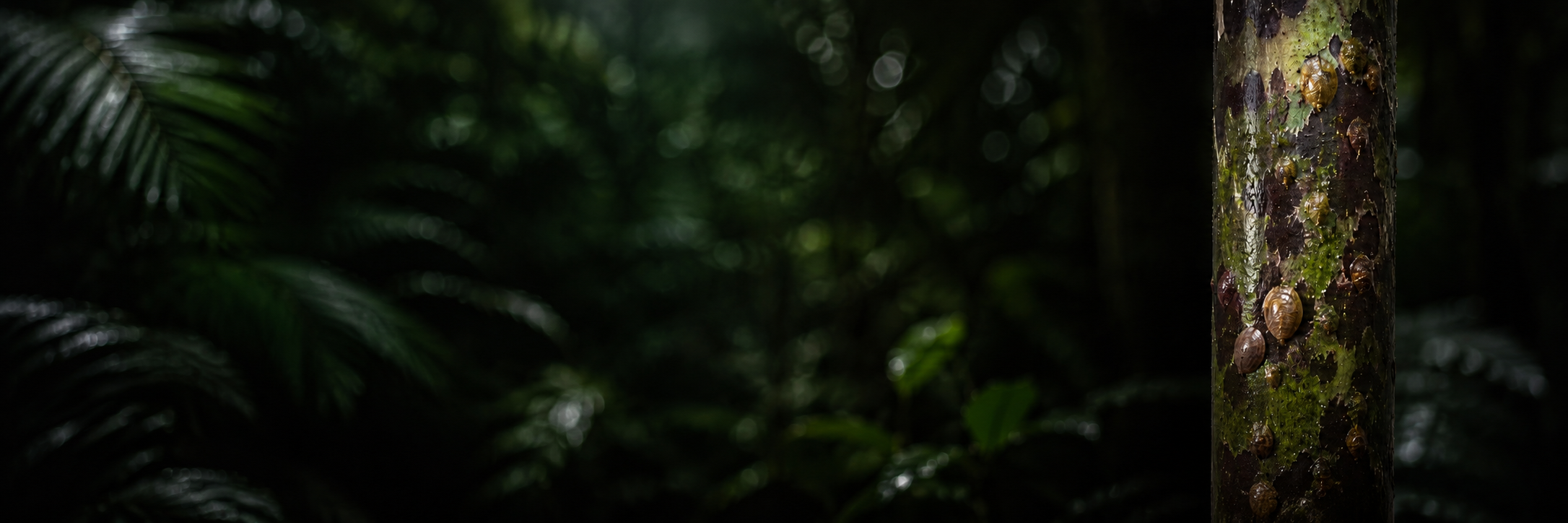
Immobile bumps that are the insect itself, not a shield over it. They run honeydew, they draw sooty mould, and only the crawler stage is easy to kill.
Two tests separate soft scales from armored scales, and everything about the treatment follows from the answer.
Test one: pry one up. On a soft scale the protective covering is part of the insect’s own body and comes away as a single piece. On an armored scale the shield is a separate construction and a small soft-bodied insect sits loose underneath it.
Test two: is the plant sticky? Soft scales produce large quantities of honeydew, and where there is honeydew there is usually black sooty mould and often ants. Armored scales produce none at all.
Several species in the family Coccidae turn up on houseplants — most often Coccus hesperidum, the brown soft scale, and Saissetia coffeae, the hemispherical scale. They differ in shape and colour and not much in how you treat them.
Sap loss first, then honeydew, then the ants that come for the honeydew and stay to defend the colony.
Feeding causes yellowing, weak growth and leaf drop, and a heavy infestation on a stem will kill it back. The honeydew is often noticed before the insects are: a sticky film on the leaves below, or on the floor and the furniture under the plant, with black sooty mould following.
On aroids, check the petiole first, then the geniculum, then along the midrib on the underside of the leaf. Soft scales favour the parts of the plant with the heaviest sap flow, and on most aroids that is not the leaf blade.
There is no single hatch date to time a spray against. That is the whole difficulty.
Eggs hatch over a period of several weeks beneath the protective cover of the mother scale. After hatching, the crawler stage is mobile and exposed and typically moves a short distance to find a feeding site. Once it settles it begins to form its covering and to excrete honeydew, and it keeps growing for the next two to four months.
So the crawler window — the only stage that is easy to kill — is not a window at all. It is open more or less continuously for weeks. That is why coverage has to be maintained across the whole two-to-four-month cycle, and why two applications a fortnight apart reliably fail on this pest.
Scale is slow, immobile and visible, which makes hand work unusually effective — and unusually hard to judge, because a dead scale looks exactly like a live one.
- 01Manual removal. On a small infestation, rub or pick them off. Any disturbance of a scale can break its fragile mouthparts, after which it starves whether or not you dislodged it.
- 02Mark or remove what you treat. Scales killed by hand look identical to live ones and stay stuck to the plant for months. Without a way of telling them apart you cannot tell a finished infestation from an active one. Either scrape them off entirely, or count and mark the ones you leave.
- 03Exclude the ants. Ants tending soft scales for honeydew will move them to new growth and drive off predators and parasitoids. Nothing biological works until they are gone.
- 04Horticultural or dormant oil. A mechanical control — it suffocates, so there is no mode of action to develop resistance to, and it can be tank-mixed with many other products to improve their coverage. Contact only, no residual. Oils burn foliage above roughly 80–85°F and on sensitive leaves — test on a couple of leaves and wait a day before spraying a whole plant. Against soft scale it is unusually good: it works on both the crawler and the adult stages, because the wax covering is also the insect’s weakness.
- 05Insecticidal soap. Kills crawler stages, largely ineffective on settled adults.
- 06Prune out heavily encrusted stems. Often faster, more certain and less work than trying to save them.
A scale insect is a stationary target that cannot flee, cannot hide and cannot be sprayed thoroughly. That is a poor combination against a wasp and an excellent one against a bottle.
The catch is ants. On honeydew-producing pests, ant exclusion is not an optional first step — it is the step that decides whether anything else works at all.
Metaphycus helvolus
Parasitoid wasp
The standard parasitoid of brown soft scale and black scale, attacking the younger settled stages. Females also feed directly on scales they do not parasitise, so they kill more than they lay in.
Use whenbrown soft scale, warm conditions, and where you can leave the plant unsprayed for a couple of months.
Coccophagus species
Parasitoid wasps
A group of soft-scale parasitoids that turn up naturally wherever scale populations persist outdoors, and are commercially available for some species. Worth knowing about because they are often already present on a plant that has summered outside.
Use whenyou are outdoors or your plants summer outside — check for exit holes in old scales before treating.
Rhyzobius lophanthae
Scale-eating lady beetle
Adults and larvae both feed on scale insects, and it works on soft and armored scales alike — the most generally useful predator to know if you have a mixed scale problem. Small, dark, with a reddish head.
Use whenan established infestation with enough scales to hold it. It needs warmth.
Chilocorus species
Scale predator lady beetles
Black lady beetles with red spots that specialise in scale insects; C. kuwanae and C. nigritus are the ones you will see offered. Adults chew through the covering to reach the insect.
Use whena heavy infestation, in a greenhouse or a conservatory rather than a living room.
Chrysoperla carnea
Green lacewing · larvae
Generalist larvae that take crawlers readily. They will not touch a settled adult scale, so this is a way of intercepting each new cohort rather than clearing the existing one.
Use whenduring a crawler emergence, or alongside a parasitoid that handles the settled stages.
Ants first, always. A colony under ant protection will defeat every agent above. If ants are walking the plant, deal with them and then wait a week before releasing anything.
The first sign of success is the honeydew stopping, not the scales disappearing. Dead scales stay glued to the plant for months and look exactly like live ones. Sticky leaves that stop being sticky is the earliest honest signal you have. Look also for small round exit holes in old scale covers — those are parasitoids that have already emerged.
Imidacloprid is very effective against soft scale and lasts about 90 days, during which no release will survive. Check any residue against the Koppert or Biobest side-effect databases before you order anything alive.
Soft scales feed on phloem sap, which is the one useful thing about them: a systemic that travels in the phloem arrives exactly where they are eating. This is the pest class systemics are built for — and the reason the armored scale page reads so differently.
The best-matched product on this page. Soft scales are phloem feeders, so a phloem-mobile systemic reaches every one of them regardless of where it has settled — under a sheath, on a petiole, along a midrib — without depending on coverage you cannot actually achieve.
Two-way movement — up from the roots and from leaf to leaf — active on eggs, larvae, nymphs and adults, with roughly 30–45 days of residual protection. Sold here as Bug Destroyer, 22.4% spirotetramat.
Pyrethroids control soft scales effectively, but only if coverage is maintained across the entire two-to-four-month cycle — otherwise the crawlers emerging after your last application simply restart the infestation. Bifenthrin is the right pyrethroid for exactly that reason: very long residual activity. About $22 for 16oz as Bifen I/T.
The same long residual is why it forecloses biological control for weeks.
Another synthetic pyrethroid with a narrower range. It is the active ingredient in dog flea collars and human lice treatments, and it is a neurotoxin to cats — keep cats away from treated plants until everything is dry, around 12 hours. About $20 for 32oz as Bonide Eight.
A neem-seed limonoid acting as an antifeedant and insect growth regulator — more effective than cold-pressed neem oil, which is a different product. Effective on both adult and crawler stages of soft scales. Oil-based, so apply early morning or late evening; safe for pollinators once dry; short residual. About $25 for 4oz — AzaMax.
Very effective against soft scales, for the same reason spirotetramat is: they are phloem feeders. Slow, because it moves through the roots, so it is a preventive or a partner to a knockdown rather than a rescue.
Extremely toxic to pollinators — banned in the EU and in several US states. Indoor and greenhouse use only, and never on an outdoor plant that will flower within three months. Applied as granules to the substrate and watered in; about 90 days per application. Because it travels through the roots it is slow, so it works better as a preventive than as a rescue. The full entry, including the case for using it indoors, is in the mealybug guide. Bonide systemic houseplant insect control, about $20 for 8oz.
- 01Confirm soft rather than armored. Pry one up; look for honeydew. The two pages recommend almost opposite programmes.
- 02Exclude the ants.
- 03Prune out what is not worth saving, then physically remove what you can from what is.
- 04Mark or scrape the ones you leave, so that in six weeks you can tell whether anything new has settled.
- 05Use a systemic for the settled population and oil for coverage. Soft scales are phloem feeders and this is the pest where that combination genuinely works.
- 06Maintain the programme across two to four months, not two sprays. Crawlers keep emerging for weeks; a fortnight of effort is a fortnight of selection pressure and nothing else.
- 07Watch for the honeydew stopping. It is the first honest sign of progress, well before the plant looks any different.
- 08Re-inspect the petiole bases and the underside midribs monthly for two months after you think it is finished.
- 01Scales — UC Statewide IPM Program, Pest Notes 7408
- 02Brown soft scale — Koppert pest profile
- 03Mealybugs and scales — Koppert pest index
- 04Managing houseplant pests — Colorado State University Extension
- 01Biological control and natural enemies of invertebrates — UC IPM, Pest Notes 74140
- 02Scale insect Metaphycus parasitoids — UC IPM natural enemies gallery
- 03Scale insect Coccophagus parasitoid — UC IPM natural enemies gallery
- 04Scale predatory Rhyzobius lady beetles — UC IPM natural enemies gallery
- 05Scale predatory Chilocorus kuwanae lady beetle — UC IPM natural enemies gallery
- 06Twicestabbed lady beetle — UC IPM natural enemies gallery
- 07Metaphycus — Cornell Biological Control
- 08Chilocorus stigma — Cornell Biological Control
- 09Chrysoperla carnea — Koppert