
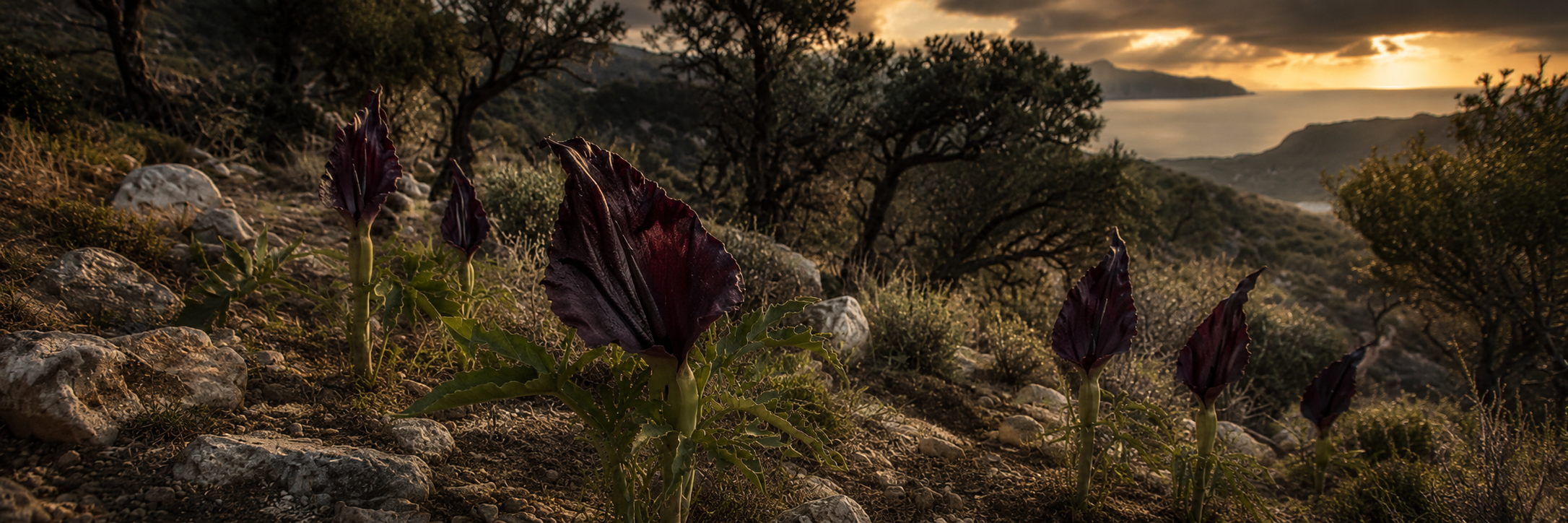
Araceae · Reproductive Biology
THE DRAGON ARUM
The heat it is famous for belongs to another plant — and what it actually does is stranger
The dragon arum is the aroid people meet first: a metre of mottled stem, a spathe the colour of raw liver, and a black spadix standing out of it like a burnt stick. It is usually described as one of the great heat-producing aroids. Every measurement ever made on it says otherwise.
Dracunculus vulgaris grows around the northern Mediterranean, from Portugal to western Asia Minor, on rocky ground and roadsides. It opens for a day, smells powerfully of carrion, fills its chamber with beetles, and is over. Gardeners grow it for the smell and the theatre.
Where the reputation came from, and it is a case of mistaken identity
The dead horse arum — a different plant, on different islands — spent much of its published life under the names Dracunculus muscivorus and Dracunculus crinitus. A famous nineteenth-century study of it is titled Dracunculus crinitus. Its 1976 chromosome count was published that way.
And that plant really is a powerful heater, reaching nearly twenty-four degrees above the surrounding air. Anyone following the dragon arum's literature through those synonyms arrives at those numbers.
What the dragon arum actually does
Measured in the wild in Crete, its spadix runs one or two degrees above the air, at most three and a half, often nothing at all, and not rarely slightly below ambient. Measured in a pot in Pisa fifty years earlier, by a different observer with a different instrument, the answer was the same: at most 2.8 degrees.
And yet — this is the part worth staying for — it burns more carbon than the dead horse arum does. Its appendix is roughly fifteen times heavier and sheds heat as fast as it makes it. A low temperature rise is not evidence of a weak furnace. It is evidence of a large radiator.
A surprisingly experimental literature
For a plant whose modern coverage is thin, the dragon arum has been experimented on more than most aroids in this archive, and mostly a long time ago.
Three experiments this page is built on
1890, Pisa. A three-arm pollination test: bagged with pollen-dusted beetles, left open with no pollen source, and left open beside released beetles. It is the earliest controlled pollination experiment on any Dracunculus in this archive.
1930, western Crete. More than five hundred inflorescences amputated in different ways in the wild, and a paired bait test putting the flowering plant directly against fresh dung and rotting flesh.
1960, Seattle. A seven-day beetle census that separates the visitors into those that go in and those that do not.
What comes out of them is a plant that is much worse at attracting insects than its reputation suggests, that loses a head-to-head contest against real dung within minutes, and that may nonetheless sometimes pollinate itself.
One naming note, applied once and then assumed
The 1930 field study was published as Dracunculus creticus. That name was sunk into Dracunculus vulgaris by the genus's monographer in 1994, along with every other variety described on flower colour and size.
Its results are therefore Dracunculus vulgaris results, and this page treats them as such without repeating the caveat each time.
Part I
The Plant: One Species Wearing Several Names
A tuber, a mottled false stem, a pedately divided leaf and one enormous inflorescence. Almost every variety ever described for it was described on colour and size, and none of them survived.

Where it grows
Around the northern Mediterranean, from Portugal to western Asia Minor, on rocky ground, scree and disturbed roadsides. The tubers, for the size of the plant they throw up, are relatively very small — an observation from the one botanist who dug them up, and one he uses to argue that this plant is spending a great deal on its inflorescence.

The names, and why one of them matters more than the rest
The 1994 monograph places seven earlier names into synonymy under Dracunculus vulgaris, including three Engler varieties raised on inflorescence colour and size, and one name that matters for reading the older literature.
| Name | Why it appears |
|---|---|
| Arum dracunculus L. | the basionym, 1763 |
| Dracunculus creticus Schott | the name the 1930 Cretan field study was published under — so all of that work is Dracunculus vulgaris work |
| Dracunculus vulgaris var. creticus, var. elongatus, var. laevigatus | three Engler varieties, from Crete, Lycia and Rhodes |
| Dracunculus polyphyllus Blume | illegitimate |
The monographer's verdict on all of them
None of the taxa described on variation in these characters can be upheld as taxonomically distinct from Dracunculus vulgaris.
Which is why the two photographs above — a maroon garden plant and a cream wild one — are the same species, and why a great deal of the older literature that looks like it is about several plants is about one.
And the confusion running the other way
The traffic is not one-directional. A different genus spent decades inside this one. The dead horse arum, Helicodiceros muscivorus, carried Dracunculus muscivorus and Dracunculus crinitus as accepted names, and the most-cited nineteenth-century study of it is titled with the second of those.
That is not a footnote. It is the reason this plant is credited with heat it does not produce, and Part II is about the difference.
One relative, kept separate
The genus holds a second accepted species, Dracunculus canariensis, in the Canaries and Madeira. It is a different plant with a pale spathe and a much shorter published record — a single visitor observation in this archive. Nothing on this page is about it.
Part II
The Heat: A Few Degrees, and Sometimes Less Than None
Three people have put a thermometer on this plant, across a hundred and twenty years, in two countries, on wild and potted material. They agree with each other and they disagree with the reputation.
The wild measurement, and how it was taken
In western Crete in the spring of 1928, on plants standing at their natural site in the open air, the spadix ran one to two degrees above ambient. The maximum recorded was 3.4 °C — spadix 24.3 against air 20.9. Often there was no appreciable difference at all, and not rarely the spadix sat slightly below the surrounding air.
The observer's own word for the result was betrüblich — dismal.
A bare field reading and a packed laboratory reading are not the same quantity
These spadices were in no enclosure, no vessel and no packing of any kind — nothing cut, nothing bagged, nothing wrapped — outdoors, in wind, in what the author repeatedly calls an unusually bad spring.
For scale: in a study of Arum, a spadix packed in cotton wool gave a rise of about 13 degrees while a bare one in the same work gave 4.5. Comparing a bare outdoor number with a packed indoor one is a comparison of insulation, not of plants.
Why it is cool, anatomically
The same study cut the appendix open, and the answer is structural. Even in the unopened bud the appendix is already hollow, its pith torn: at six millimetres of diameter the wall is half a millimetre thick. Under the epidermis is a narrow layer of dense tissue, sparsely filled, with starch present only moderately and in very small grains — less even than in the cells of the spathe.
In his words: the absence of self-heating is understandable, since there is little or nothing there to oxidise.
And the reading that makes the whole thing interesting
A low temperature is not a small fire. Measured against the dead horse arum by the researcher who measured both:
The dragon arum burns more carbon and gets less hot
Its appendix is 47.2 g against the dead horse arum's 3.2 g. Its total appendix respiration is 3.6 micromoles per second against 1.4.
So the total rates of heat production are not greatly different — and the dragon arum's is the larger. What differs is the surface it escapes from. A fifteen-times heavier appendix sheds heat about as fast as it can make it.
The other half of the arithmetic: gram for gram, the dragon arum's appendix respires at about one sixth the rate.
What follows for the flies
The 1930 conclusion was blunt: floral heat cannot matter for insect visitation in this plant, because it is far too small. Part IV shows what happened when the same author tested the attraction directly against real carrion, and it supports him.
What this page will not say
Not that the dragon arum lacks thermogenesis — it has it, and in total output it exceeds a plant famous for it.
And not that the measurements conflict. A modern mean of 2.5 degrees sits comfortably inside the 1930 range. The only thing any of this conflicts with is the word “strongly”.
Part III
Who Comes: The Flies Arrive and the Beetles Stay
This plant smells of carrion and it recruits the whole carrion guild. Only half of that guild goes inside — and the half that does is not the half you would guess from the smell.
The separation
Blowflies and flesh flies — Calliphora, Lucilia, Sarcophaga — arrive at a fresh inflorescence in a matter of minutes. They buzz around it, settle on the appendix, and may even lay their eggs on it. And then, as a rule, they do not go into the floral chamber.
Carrion and dung beetles do, and they accumulate there in large numbers.
One inflorescence, one afternoon
162 beetles were taken from a single inflorescence, cut off in the middle of the afternoon of its first flowering day.
Across seven days at the site, 298 beetles of 15 species in 8 families were collected — a mixed dung and carrion guild, with normal habitats ranging from dung to carrion to decaying fungi.
Nobody has ever tested why the flies stay out
This is the most interesting thing on the page and it is completely unexplained. There is no trap-mechanism study of Dracunculus in this archive — nobody has looked at the chamber wall, the hairs, or the geometry with this question in mind.
The Arum answer, where a slippery zone and downward hairs make a one-way door, must not be assumed here. It has not been tested on this plant.
How long they stay
If an inflorescence is left in place overnight, only a few beetles are in it the next morning. That is as much as can honestly be said. The authors immediately note that they never consistently followed the beetle population over time in a single inflorescence.
The beetles are gone by morning, and the departure was never timed. It is not a retention measurement and should not be quoted as one.
And a much older census, in a different country
Beetle visitors were being collected and named from this plant in Pisa in 1879, decades before anything else in this record — and the beetles that turned up there were the same kind of animals: Saprinus and Dermestes, carrion specialists. Those are the beetles used in the 1890 experiment in Part VI, and they are the reason it worked.
The scope, because it is one campus
The seven-day census is cultivated plants on a university campus in Seattle, at one collecting site, in June 1960 — about as far from the Mediterranean as this plant is ever grown. The beetle fauna is a Pacific Northwest fauna.
What travels from it is the separation: flies out, beetles in. The species list does not.
Part IV
The Bait Test: The Plant Against the Real Thing
In 1928 somebody did the obvious experiment that almost nobody does: put a flowering carrion mimic next to actual carrion and watch which one the insects choose. The plant lost, and it lost quickly.
The design
Find a strongly scented inflorescence in the wild. Watch it for at least half an hour and establish what its attraction actually is. Then place fresh vertebrate dung, or rotting flesh, one to three metres away on the ground or on a rock, and keep watching. Repeat at several flowers.
What happened
Fresh dung always attracted insects, and did it in an astonishingly short time — within a few minutes a mass of Diptera, especially small flies, and beetles too, the beetles often arriving in a direct, well-aimed flight. Within a quarter of an hour the bait was usually practically covered.
Rotting flesh worked the same way, though visitation to it was considerably weaker than to dung.
And throughout, the flowering inflorescence stood fairly deserted beside it.
Two things this changes
First, it is a real head-to-head test and there are almost none in the aroid literature. A plant that has spent its entire reproductive budget on imitating decay was outcompeted, in minutes, by a small piece of the thing it imitates.
Second, and less obvious: dung beat carrion. If this plant were a pure carrion mimic, the flesh should have been its closest competitor. It was not. The visitor list this plant draws is a mixed carrion-and-dung guild, and the strongest pull at these sites was dung.
What the test does not have
Numbers. There are no counts on either side, and the number of trials is not stated. It is a well-designed comparison reported qualitatively, and it should be quoted as one.
And the author's own caveat travels with it: the spring was cold and stormy, and the insect fauna may have been depressed by it.
The visitation figures from the same study
Over three weeks, 350 inflorescences were watched in the female stage. In almost a quarter of them there were no visitors at all. In a fifth there were more than six individuals. The maximum seen in any one inflorescence was 13.
Set that beside the dead horse arum, where a single wild inflorescence has held 84 flies and a cultivated one held 387. These are not plants operating at the same intensity, whatever their smells suggest.
The conclusion the author drew, and it holds up
For a plant that builds an enormous inflorescence off a relatively very small tuber, insect pollination is not particularly well secured. Heat cannot be an essential attractant — it is far too small. A considerable amount of insect arrival looks passive, carried on the constant air movement.
But scent still matters, and Part V shows the experiment that proves it.
Part V
The Amputation Series: Cutting Bits Off Five Hundred Flowers
More than five hundred wild inflorescences were amputated in different combinations and followed to fruit. It is the largest experiment of its kind in this archive, and its author refused to publish exact numbers.
What it shows
The spadix matters more than the spathe. That is the whole result, and it is the basis for the author's conclusion that scent is nevertheless of great importance — because otherwise the relatively good fruit set of the spathe-amputated plants would make no sense. A plant with no spathe still has its scent organ. A plant with no spadix does not.
Colour, he thought, probably matters little.
There is one further arm, and it is brutal: with spathe, spadix and the male zone all removed, one plant out of forty-five appeared to set a few fruits — and then died.
Why there are no exact numbers, and why that is to his credit
He refused to publish them. In his words, given the strong sources of error, exact numbers would claim more than can be proved. The percentages above are his own, deliberately rounded where cases were doubtful.
His error list is worth having in full: the weather was unusually bad and may have decimated the insects; the constant wind may make passive insect delivery look more important than it is; time ran out to score fruit set properly in about a quarter of the plants; and a considerable number were damaged or destroyed outright.
And one error he could not correct at all
He could not allow for autogamy, because he noticed the plant does it too late — and, in his own words, especially in the spadix-amputated plants.
That is the arm the scent conclusion leans on. If some of those spadix-less inflorescences were setting fruit on their own pollen, the true cost of removing the spadix is larger than 75 per cent, not smaller — but nobody can now say by how much.
The self-pollination problem
In some cases, autogamy within the inflorescence was established with certainty — though in the open it seems to happen only under quite particular conditions.
That is the whole of the evidence. There is no bagging trial, no emasculation control, no sample size, and no description of the method.
So what may be said about selfing
The genus is called protogynous on morphology and sequence alone — nobody has ever timed the phases. The one field worker who followed fruit set through to the end reported that self-pollination inside an inflorescence does happen, under conditions he did not specify and in numbers he could not quantify.
That is not "the dragon arum selfs." It is a flag on an unanswered question, left by the only person in a position to raise it.
Part VI
The 1890 Experiment: Six Inflorescences and a Bag of Beetles
In a Pisa garden in June 1890, somebody bagged two inflorescences, posted a dozen pollen-covered beetles into them, and left two more with nothing. It is the earliest controlled pollination experiment on this genus, and its design is better than its sample size.
| Date | Treatment | n | Result |
|---|---|---|---|
| 5 June | Bagged in a dense veil sachet, with about a dozen pollen-dusted Saprinus and Dermestes beetles introduced | 2 | Ovaries developed, for the most part to full maturity |
| 5 June | Left open, with no other inflorescence anywhere near | 2 | Withered. The carpels dried and all perished |
| 6 June | Left open, and the previous day's bags opened that morning so their beetles could fly across | 2 | Developed their carpels perfectly and turned them into fertile fruit |
What it demonstrates
Two things, cleanly. Pollen-carrying beetles introduced into a sealed inflorescence effect fertilisation — the bag rules out anything else reaching it. And in the absence of a pollen source, an inflorescence sets nothing and dies.
The third arm is the elegant one: the beetles from the first arm were released the next morning and allowed to find the next day's flowers on their own. Those flowers fruited. The beetles were shown to be carrying viable pollen from one inflorescence to another, by their own flight.
The arm that is missing, and what it costs
Nobody bagged an inflorescence and gave it nothing.
The open-with-no-source arm doubles as a no-pollen control, and it failed — but it was open to the air, not sealed. There is no bagged-and-empty treatment anywhere in the design.
So this experiment does not exclude self-pollination. It cannot tell you whether a sealed inflorescence, left entirely alone, would have set fruit on its own pollen — which is precisely what was reported from Crete forty years later. It should never be cited as disproving selfing.
Scope
Two inflorescences per arm. No statistics. Fruit set scored as present or absent. One garden, one season, on cultivated plants of two varieties that were flowering a week apart.
Read as a demonstration that beetles do the job, it holds. Read as a measurement of anything, it does not.
Why the beetles were the right choice
Saprinus and Dermestes are carrion specialists, and they are the same genera that had been collected from this plant in the same garden eleven years earlier. He was not introducing an arbitrary insect — he was returning the plant's own visitors to it under controlled conditions.
That is also the link to Part III: the beetles that enter the chamber are the ones that matter, and the flies that cover the appendix are not the ones moving the pollen.
Sources
Sources, and What Kind of Evidence Each One Is
Six papers carry this page and three of them are older than 1935. On this plant the nineteenth-century work is not background reading — it is the experimental record.
- Schmucker, T. (1930). Beiträge zur Biologie und Physiologie von Dracunculus creticus. (In German. Published under a name since sunk into Dracunculus vulgaris.) The backbone of the page. Parts II, IV and V are all his: the wild temperature series, the appendix histology, the bait test, the visitation figures and the amputation experiment. Grade: field measurement and field experiment, and unusually candid about its own limits — he refuses to publish exact fruit-set numbers because the error sources would make them claim too much. Scope: one Cretan population, spring 1928, which he repeatedly calls an unusually bad season. The temperature instrument is not named and no sample size is given for the ordinary 1–2 degree range.
- Meeuse, B. J. D. & Hatch, M. H. (1960). Beetle pollination in Dracunculus and Sauromatum (Araceae). The Coleopterists' Bulletin 17. All of Part III. Grade: measured for the beetle counts, single for the fly observation — there are no fly counts anywhere in it. Scope: cultivated plants at one collecting site on the University of Washington campus, Seattle, June 1960, two large clumps. Its load-bearing result is a separation — flies recruited but not retained, beetles retained — and that result travels. The Pacific Northwest species list does not. The overnight-departure note is explicitly disclaimed by its own authors as never systematically followed.
- Arcangeli, G. (1890). Sopra alcuni fenomeni osservati nel Dracunculus vulgaris Schott. (In Italian.) All of Part VI, and the escape-timing and insect records behind Part III. Grade: controlled experiment — three contrasted treatments, and the earliest of its kind on this genus in this archive. Scope: n = 2 inflorescences per arm, Pisa Botanic Garden, 5–6 June 1890, fruit set scored present or absent. Its missing arm matters: there is no bagged-and-empty control, so it does not test self-pollination and must never be cited as ruling it out.
- Arcangeli, G. (1883). Osservazioni sull'impollinazione in alcune Aracee. Nuovo Giornale Botanico Italiano 15: 77 ff. (In Italian.) The 1879 beetle census in Part III, and the earlier of the two temperature series in Part II: an excess of at most 2.8 degrees on a potted plant at Pisa, measured with a surface-contact clinical thermometer whose bulb size he prints, over a twenty-point series on a single inflorescence. Grade: measured, with the apparatus stated — which is what makes an 1883 number usable at all. Scope: n = 1. Note that the paper covers five taxa and only some of them are Dracunculus; its counts are written out in Italian words rather than digits.
- Boyce, P. C. (1994). The genera Dracunculus and Helicodiceros (Araceae: Aroideae). Thaiszia — Journal of Botany, Košice, 4: 175–182. All of Part I: the synonymy, the sinking of Dracunculus creticus and the three Engler varieties, the distribution, and the scent descriptors. Grade: monographic treatment — a formal taxonomic decision, which is the right authority for names and the wrong one for measurements. The monographer of this genus does not mention heat anywhere in eight pages, which is itself worth knowing.
- Seymour, R. S., Gibernau, M. & Ito, K. (2003). Thermogenesis and respiration of inflorescences of the dead horse arum Helicodiceros muscivorus, a pseudo-thermoregulatory aroid associated with fly pollination. Functional Ecology 17: 886–894. A paper about a different plant, used here for one paragraph — the appendix-mass comparison in Part II that explains why this genus runs cool while burning more carbon. Grade: instrumented field measurement with the apparatus fully printed. It is also the source of the 23.9-degree figure that gets misattributed to Dracunculus through the crinitus and muscivorus synonyms, which is why it appears on this page at all.
One figure used here at second hand
The modern mean of 2.5 degrees and 1.7 watts for Dracunculus vulgaris comes from a 1999 study that this project has not read. It reaches the page through a family-level compilation. It agrees with both first-hand measurements, which is why it is included — but it has not been checked against its own source.
What is missing from this literature altogether
There is no trap-mechanism study of this genus. Nobody has examined the chamber wall, the hairs or the geometry to explain why beetles go in and flies stay out.
There is no breeding-system experiment. Protogyny is asserted on morphology; nobody has timed the phases; and the one report of self-pollination has no method, no controls and no numbers.
And there is no modern field study at all. The most recent first-hand work on how this plant reproduces was published in 1960, on a university campus five thousand miles outside its range.