
Araceae · Reproductive Biology
THE DEAD HORSE ARUM
The only aroid whose heat and smell have been switched on separately — and the heat is not the advertisement
Every account of the dead horse arum says the same two things: it smells of rotting flesh, and it makes its own heat. Both are true. What almost every account then implies — that the heat is part of the advertisement — has been tested on this plant, and it is wrong.
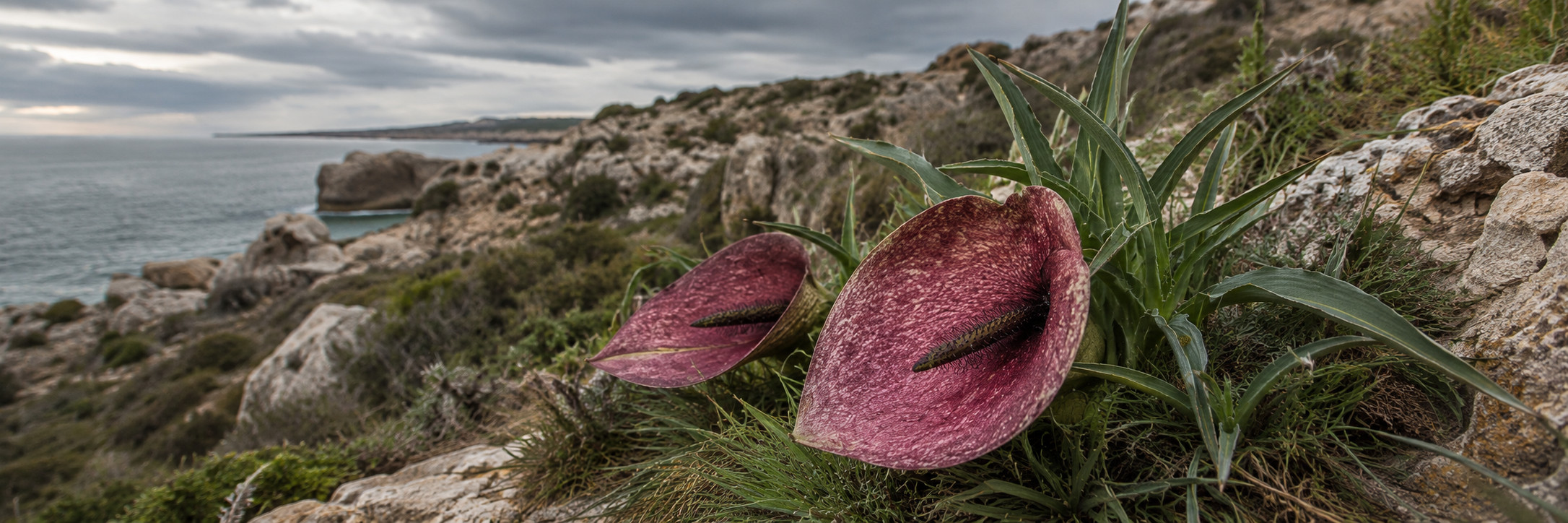
Helicodiceros muscivorus grows on sea cliffs in Corsica, Sardinia and the Balearics, often within reach of gull colonies. For one morning a year each inflorescence opens a pink, hairy, meat-coloured spathe, heats a bristled appendix to something like a fresh corpse, releases a smell built on the same sulphur compounds that come off decaying protein, and fills its chamber with blowflies. The flies spend the night inside. In the morning they leave carrying pollen, and the plant never repeats the performance on that spathe.
It is the most complete carrion mimicry in the family, and it is the only one in this archive where the two halves of the illusion have been switched on and off independently.
What happened when the two signals were separated
On second-day inflorescences — which have stopped smelling — putting the smell back restored fly arrivals to the first-day level. Putting the heat back, with a wire wound along the appendix and a sham control fitted with the current off, did not.
The heat did something else, and something more interesting: it decided where on the plant a fly landed, and a fly that landed on the warm appendix was about three times as likely to walk into the chamber as one that landed on the spathe.
What this page is for
This plant has been measured unusually well and described unusually badly. The measurements are excellent: two independent thermogenesis datasets with their apparatus printed, a scent chemistry with a paired control, three insect censuses spread over a hundred and twenty years, and a manipulation experiment with a sham. The descriptions that circulate are mostly inherited: a fly count that was never made, a beetle that has never been found on the plant, a maximum temperature that is not the maximum, and a century of claims that it eats what it catches.
Everything below is sourced to a paper someone opened. Where two papers disagree — and on this plant two papers by the same two authors disagree about whether it traps its pollinators at all — both are given, and neither is quietly dropped.
One naming warning, because it decides whether you can find the literature
This plant has been published under eight names, and two of them put it in a different genus: Dracunculus muscivorus and Dracunculus crinitus. Anyone filing by the printed binomial files the dead horse arum under Dracunculus. Its 1976 chromosome count was published that way, and a nineteenth-century flowering account was titled that way.
The confusion is in the primary literature, not only in the secondary sources. Part I gives the full list.
Part I
The Plant: Eight Names, Three Islands, One Morning
A single species in a single genus, on the cliffs of three Mediterranean islands. Its literature is scattered across two genus names and eight binomials, which is the main reason so much of it has been cited second-hand.

The names, and why they matter
Under Helicodiceros muscivorus, the genus's monographer lists eight earlier names. Two of them place the plant in Dracunculus.
| Name as published | Year | Status |
|---|---|---|
| Arum muscivorum L.f. | 1782 | the basionym |
| Arum crinitum Ait. | 1789 | illegitimate |
| Arum spirale Salisb. | 1796 | — |
| Dracunculus crinitus (Ait.) Schott | 1832 | illegitimate combination |
| Dracunculus minor Blume | 1836 | — |
| Megotigea crinita (Ait.) Rafin. | 1836 | — |
| Helicodiceros crinitus (Ait.) Schott | 1853 | illegitimate combination |
| Dracunculus muscivorus (L.f.) Parl. | 1857 | — |
This is not a footnote — it is why the records go missing
The 1976 chromosome count for this plant was published as Dracunculus crinitus. A detailed nineteenth-century flowering account was titled Sopra la fioritura del Dracunculus crinitus Schott. And a standard 1909 handbook entered the same plant twice, four pages apart, once as Arum crinitum and once as Helicodiceros muscivorus — a duplication that has since been read as two separate observations.
Part VI shows what that particular mistake cost.
Where it lives
The Balearic Islands — Mallorca and Minorca — Corsica and Sardinia, and nowhere else. Rocky slopes and cliffs close to the sea. A herb to 75 cm, with an inflorescence of 15–45 cm and an infructescence of about 60 orange-red berries.
Two altitude ceilings, and they have never been reconciled
The 1994 monograph gives 25–250 m. A 2003 field study, citing a Corsican survey this archive does not hold, reports populations on inland rocky cliffs up to 700 m on the main island.
Neither figure should be printed without the other.
That same Corsican survey — again at one remove — found seven populations ranging from 4 to 300 individuals, with the flowering fraction varying from 17 to 75 per cent and fruit set from 33 to 85 per cent. Taller plants were likelier to flower, and larger plants set larger infructescences.

The gull story
The monograph notes that colonies almost always occur close to cliff-side gull colonies, and that the flies and beetles associated with those colonies appear to be the main pollinators. It is a memorable idea and it is worth knowing where it comes from: a popular book on flower sexuality, cited at second hand.
Half of that sentence is contradicted by every count ever made on this plant
Three first-hand censuses — in 1883, 2003 and 2014 — collected and identified every insect out of a total of 36 inflorescences between them. Not one adult beetle has ever been recorded. Part VI gives the numbers.
The gulls themselves are a different matter, and one experiment did use a gull. Part IV explains what for.
One more thing, before the biology
Almost every tuber of this plant sold in Europe is wild-collected, from Corsica or Sardinia. It grows readily from seed and flowers in three to four years from sowing. The monographer's own verdict on the collecting is that it is not justifiable.
Part II
The Two Days: One Morning of Smell, One Morning of Pollen
The spathe opens in the dark and is already wide open by half past six. Everything that matters to the flies happens on the first morning; everything that matters to the plant's pollen happens on the second. By the third day the spathe still looks perfect and attracts nothing.
Day one
The spathe loosens the afternoon before, opens sometime during the night, and was wide open every time plants were inspected at about 06:30. It is a deep pink, its hairs erect, with the appendix lying flat along it.
The flies do not come at first light. They were attracted only after the sun shone directly on the inflorescences, and not one fly was ever found in the chamber before sunrise. They land on the spathe, walk over it and over the appendix; some put their heads into the neck of the chamber and back out again; some go in and do not come out.
Two organs, two schedules, and they are twelve hours apart
The appendix does its work in the morning: peak respiration at about 08:56, hottest at about 11:25. That is the advertising organ, and it runs while the flies are arriving.
The male florets do theirs in the dark: a temperature peak at about 23:40, and a respiration peak between two and five in the morning — in every single inflorescence measured. That is the organ next to the trapped flies, and it is busiest while they are shut in with it.
Day two
Pollen is released shortly before sunrise. There was never any pollen on day one, when the flies were being attracted and trapped. On the second morning it was already present at first examination between 06:15 and 06:30 in several inflorescences; tape sampling caught the first grains at 06:45 in one, while another had released before the first check.
The spathe stays open but falls slightly away from the appendix and loses some of its colour. Over following days its edges turn up into a trough around the appendix, meet, and the whole thing withers.
The second day looks identical and is over
The oligosulphide smell is produced only on the first day and is not detectable in odours sampled on the second. Across seven plants, the odourless second day attracted significantly fewer flies.
An open spathe is not evidence of a working inflorescence. On this plant, as on Arum, the signal is the smell and you cannot see it.
The sequence — stigmas receptive while the plant smells, pollen shed the following dawn as the flies leave — is consistent with protogyny, and that is exactly as far as the source goes. No breeding-system experiment has been run on this plant. There is no bagging trial, no hand-pollination, and no test of whether it can set seed with its own pollen.
Part III
The Smell: Two Compounds, Three Signals, and a Warning About All of Them
The smell of this plant has been analysed twice, by two groups, asking two different questions. One asked what the plant gives off. The other asked what a blowfly's antenna can detect. They return different lists, and both are right.
What the plant emits
The only dedicated scent study of this species was done at Kew, on a single accession in the Alpine House that flowered on 10 May 1999. Air was drawn over a Tenax trap about 15 cm from the inflorescence for three hours — and then, crucially, the same trap was run again on the glasshouse air once the inflorescence had stopped smelling.
The control is what makes the result worth anything
Numerous compounds were trapped near the flowering plant. All of them except two were also in the glasshouse-air control.
The two that belong to the plant are dimethyl disulphide and dimethyl trisulphide, identified against standards by both mass spectra and retention indices. Their ratio came out at about 3 : 1 in one analysis and 2 : 1 in the other.
Those are two analyses of one inflorescence on one cultivated plant, so the ratio is a pair of readings and not a species value. No wild Helicodiceros muscivorus has ever been sampled for scent — not in Sardinia, not in Corsica, not in the Balearics.
The trisulphide is real, and that took proving
There is an obvious objection to finding dimethyl trisulphide on a Tenax trap: the trap can manufacture it out of the disulphide. Published work put that conversion at about 4 per cent over the same three-hour sampling time — not enough to account for what was seen.
And then he tested it directly
A trap was deliberately loaded with the disulphide and left for three days before analysis. It yielded only a trace of the trisulphide, at about the level of the impurity already present in the starting material.
So the trisulphide is made by the inflorescence. This matters downstream: it is one of the compounds the blowfly antenna answers to, and the one a separate literature reports as a strong calliphorid attractant.
What the fly detects
The second study asked the other question, on wild Sardinian plants, using a fly antenna as the detector. It found three oligosulphides active — the mono-, di- and trisulphide — with the trisulphide appearing as two structural forms, so four peaks in all.
| Kite 2000 | Stensmyr et al. 2002 | |
|---|---|---|
| Question asked | what the plant emits | what the antenna answers to |
| Material | one cultivated plant, Kew | wild plants, Sardinia |
| Compounds attributed | dimethyl di- and tri-sulphide | dimethyl mono-, di- and tri-sulphide |
| Control | glasshouse air, same trap | gull carcass odour, paired |
| What it cannot do | no minor components — the plant could not be enclosed | no full profile, no quantities, no emission rates |
Two compounds against three is not a disagreement
Kite does not report an absence of the monosulphide. He reports that everything other than his two majors was also in the control air — and dimethyl monosulphide is a common background volatile, so present-but-unattributable and genuinely absent are not distinguished by that method.
Different plants, different questions, different instruments. Do not flatten the two into a single compound list.
How good is the imitation
Blowfly antennae were offered the arum's odour and a carcass's odour in turn. Across eight runs, all four peaks came back with no significant difference between the two sources.
What that result can and cannot be made to say
Four non-significant tests on eight runs are consistent with the two odours being indistinguishable to a fly. They do not demonstrate that the odours are chemically identical, and the difference matters.
The defensible sentence is the authors' own: a carrion fly cannot use smell alone to tell the mimic from the model.
The smell is a one-day signal, and it can be put back
The oligosulphides are produced only on the first day and cannot be detected in second-day samples. Across seven plants the odourless second day drew significantly fewer flies.
Cotton rolls carrying a one-to-one-to-one synthetic mixture of the three sulphides were then placed in the chambers of six second-day plants. Those plants drew a number of flies statistically indistinguishable from their own first day. The smell alone is sufficient to restore the attraction.
The caveat that constrains every carrion-mimicry claim on this site
In the identifying chemist's own words, dimethyl oligosulphides are also found in the odours of bat-pollinated flowers.
They are characteristic of carrion smells. They are not diagnostic of carrion mimicry. No page may reason from “it emits oligosulphides” to “it is a carrion mimic” — and that includes this one, which earns the label from its flies, its sex ratios and its paired carcass control, not from its chemistry alone.
One thing nobody has looked for
The method used at Kew would not have detected ammonia. There is a specific reason to think it may be there: a published observation that hydrochloric acid fumes when it is held close to the appendix of this species. Nothing in this archive follows that up.
Part IV
The Heat: What It Actually Measures
Ten inflorescences on a rocky slope above a railway line in central Corsica, over a fortnight in April and May, with thermocouples pushed into the tissue through a needle hole. It is the best thermogenesis dataset in the family, and almost every number quoted from it is the wrong one.
The apparatus, because the numbers do not mean anything without it
Small thermocouples were inserted into the appendix and the male florets through lateral holes made with a 15-gauge hypodermic needle. Reaching the florets meant cutting a window about 5 × 10 mm in the wall of the floral chamber — which, in a few cases, released the flies trapped inside. Respiration was measured separately for the appendix and the chamber, under a close-fitting hood, on a portable oxygen and carbon dioxide analyser. Every inflorescence was shaded from direct sun under cardboard, and ambient was read in the shaded air beside the plant.
Two numbers are called the maximum, and they are not the same measurement
The appendix temperature at maximum respiration is 29.8 ± 3.2 °C, at about 08:56, when the air beside it was 15.2 °C.
The maximum temperature is 32.1 ± 1.7 °C, and it happens two and a half hours later, at 11:25, when the air had warmed to 22.3 °C.
The much-quoted “30 °C at 15 °C ambient” is the first of these. It is a real pairing and it is not the plant's maximum temperature.
How hot it really gets, and why the answer is a range
Appendix heating scales tightly with appendix size. Across the ten inflorescences the maximum excess over air ran from 9.2 °C in a 1.33 g appendix to 23.9 °C in an 8.88 g one, on a straight line that explains 94 per cent of the variance.
That 23.9 is the number to quote for how hot the dead horse arum gets — and it must be quoted with its mass. It is not a species average.
The male florets behave completely differently. Their maximum temperature ran 25.0–29.3 °C and their maximum excess 11.9–15.5 °C, and neither had anything to do with floret mass across a four-fold range of it.
The correction this plant forces on its sister genus
Dracunculus vulgaris is usually described as a feeble heater beside the dead horse arum, on the strength of a mean elevation of about 2.5 °C against this plant's 23.9. The same author measured both, and the comparison does not survive him.
A low temperature rise is not evidence of weak thermogenesis
The dead horse arum compensates for its small appendix with a mass-specific respiration rate about six times higher. Total appendix respiration is 1.4 against 3.6 micromoles per second, so in the authors' own words the total rates of thermogenesis are not greatly different.
What differs is the surface area over which the heat escapes.
The respiration itself — possibly the highest in any plant tissue
The male florets reached 0.82 ± 0.13 micromoles of carbon dioxide per second per gram, and the appendix 0.45 ± 0.10. Two inflorescences exceeded 1 micromole per second per gram, above the highest individual value ever recorded for Arum maculatum.
The floret figure rests on a stated assumption
Respiration was measured for the floral chamber as a whole. The table carries a footnote — “assumes male florets responsible for all respiration” — and the mass-specific rate is derived by attributing every bit of it to the male florets.
It is a measurement with an assumption inside it, and the assumption should travel with the number.
And it is not thermoregulation
Three things about the male florets look like regulation: their temperature is fairly independent of ambient, it is unrelated to their mass, and it holds steady through most of the night. Three others break it. There was no overall relationship between respiration rate and tissue temperature — two inflorescences ran the expected way, two ran strongly the opposite way, and three showed nothing. The two that bloomed in stable, cloudy weather were less constant, not more. And male floret respiration peaked between two and five in the morning in every single one.
The authors' own verdict, and the word they coined for it
They call it pseudo-thermoregulatory: the male florets can look independent of the falling night air, but the control is circadian, not thermal — the pattern is set by the developmental sequence of the flowers.
And the limit is explicit. Pseudo-regulation applies only to the male florets. In their words, there is “absolutely no evidence of thermoregulation in the appendix”, which simply warms with the time of day alongside its scent.
The sister genus makes the contrast sharper still: in Dracunculus vulgaris the appendix is equally unregulated, but its male florets show true regulation.
Part IV
The Heat: What It Actually Measures
Ten inflorescences on a rocky slope above a railway line in central Corsica, over a fortnight in April and May, with thermocouples pushed into the tissue through a needle hole. It is the best thermogenesis dataset in the family, and almost every number quoted from it is the wrong one.
The apparatus, because the numbers do not mean anything without it
Small thermocouples were inserted into the appendix and the male florets through lateral holes made with a 15-gauge hypodermic needle. Reaching the florets meant cutting a window about 5 × 10 mm in the wall of the floral chamber — which, in a few cases, released the flies trapped inside. Respiration was measured separately for the appendix and the chamber, under a close-fitting hood, on a portable oxygen and carbon dioxide analyser. Every inflorescence was shaded from direct sun under cardboard, and ambient was read in the shaded air beside the plant.
Two numbers are called the maximum, and they are not the same measurement
The appendix temperature at maximum respiration is 29.8 ± 3.2 °C, at about 08:56, when the air beside it was 15.2 °C.
The maximum temperature is 32.1 ± 1.7 °C, and it happens two and a half hours later, at 11:25, when the air had warmed to 22.3 °C.
The much-quoted “30 °C at 15 °C ambient” is the first of these. It is a real pairing and it is not the plant's maximum temperature.
How hot it really gets, and why the answer is a range
Appendix heating scales tightly with appendix size. Across the ten inflorescences the maximum excess over air ran from 9.2 °C in a 1.33 g appendix to 23.9 °C in an 8.88 g one, on a straight line that explains 94 per cent of the variance.
That 23.9 is the number to quote for how hot the dead horse arum gets — and it must be quoted with its mass. It is not a species average.
The male florets behave completely differently. Their maximum temperature ran 25.0–29.3 °C and their maximum excess 11.9–15.5 °C, and neither had anything to do with floret mass across a four-fold range of it.
The correction this plant forces on its sister genus
Dracunculus vulgaris is usually described as a feeble heater beside the dead horse arum, on the strength of a mean elevation of about 2.5 °C against this plant's 23.9. The same author measured both, and the comparison does not survive him.
A low temperature rise is not evidence of weak thermogenesis
The dead horse arum compensates for its small appendix with a mass-specific respiration rate about six times higher. Total appendix respiration is 1.4 against 3.6 micromoles per second, so in the authors' own words the total rates of thermogenesis are not greatly different.
What differs is the surface area over which the heat escapes.
The respiration itself — possibly the highest in any plant tissue
The male florets reached 0.82 ± 0.13 micromoles of carbon dioxide per second per gram, and the appendix 0.45 ± 0.10. Two inflorescences exceeded 1 micromole per second per gram, above the highest individual value ever recorded for Arum maculatum.
The floret figure rests on a stated assumption
Respiration was measured for the floral chamber as a whole. The table carries a footnote — “assumes male florets responsible for all respiration” — and the mass-specific rate is derived by attributing every bit of it to the male florets.
It is a measurement with an assumption inside it, and the assumption should travel with the number.
And it is not thermoregulation
Three things about the male florets look like regulation: their temperature is fairly independent of ambient, it is unrelated to their mass, and it holds steady through most of the night. Three others break it. There was no overall relationship between respiration rate and tissue temperature — two inflorescences ran the expected way, two ran strongly the opposite way, and three showed nothing. The two that bloomed in stable, cloudy weather were less constant, not more. And male floret respiration peaked between two and five in the morning in every single one.
The authors' own verdict, and the word they coined for it
They call it pseudo-thermoregulatory: the male florets can look independent of the falling night air, but the control is circadian, not thermal — the pattern is set by the developmental sequence of the flowers.
And the limit is explicit. Pseudo-regulation applies only to the male florets. In their words, there is “absolutely no evidence of thermoregulation in the appendix”, which simply warms with the time of day alongside its scent.
The sister genus makes the contrast sharper still: in Dracunculus vulgaris the appendix is equally unregulated, but its male florets show true regulation.
Part VI
Who Comes: Three Censuses, a Hundred and Twenty Years, No Beetles
Every insect out of thirty-six inflorescences has been collected and identified, in Pisa in 1883 and in Corsica in 2002. They are all flies. The beetles that appear in so many accounts of this plant have never been found on it.
What is actually in the chamber
Twenty-one second-day inflorescences were bagged, and everything inside was collected and named. Three hundred and fifty-five flies, and nothing else. Four fifths were blowflies; the rest were Fannia.
The sex ratio is the detail that gives the mimicry away
Of the two Calliphora species, only 15 and 13 per cent were male. Every single Lucilia and every single Fannia collected was female.
Female blowflies are the ones looking for somewhere to lay. The plant is not attracting flies in general — it is attracting the flies that are hunting for a corpse.
How many flies one inflorescence catches
The mean was 16.9 flies per inflorescence, with a standard deviation of 18.8 — and a range from 2 to 84. The spread is larger than the mean, which is worth remembering before quoting an average for this plant.
And the counts that everybody repeats
Two figures circulate for the nineteenth-century record: that a single inflorescence held 371 flies and seven beetles, or 385 flies of which 107 were Lucilia caesar. Both come from a 1909 handbook. Neither is what the original says.
What the 1883 paper actually reports
350 flies in the chamber and 37 more in the bag — 387 — of which not fewer than 107 were the fly then called Somomyia caesar. And, in the author's own words, there was no trace whatever of beetles.
The handbook entered this one plant twice, four pages apart, once under Arum crinitum and once under Helicodiceros muscivorus — and a later paper read the two entries as two different inflorescences. The seven beetles belong to the duplicate.
The counts are written out in Italian words rather than digits, which is why they went unchecked for so long.
After the flies
What the visit produces is an infructescence of about 60 berries, ripening from pale green through orange to red while the spathe withers around them and the appendix collapses into a dry cord.

Part VII
The Trap: Four Accounts of One Chamber, and They Disagree
Everyone agrees that flies go into the chamber, spend the night, and leave in the morning covered in pollen. Whether they could have left earlier is genuinely unsettled — and the clearest statement on each side comes from the same two authors.
The case that it is a prison
The 2003 field study is unambiguous. Flies enter, pollinate the female florets and become trapped until the next morning, when pollen is shed and they are released. Its supporting note is a small experiment: five inflorescences were bagged on day one after many flies had gone in, and by the following morning a few had emerged into the bags but most were still inside.
The same paper adds the detail that gives the game away: flies readily escape if a window is cut through the chamber wall in the early morning of the second day. Something is holding them, and it is the architecture.
The case that it is not
Eleven years later, the same two authors wrote the opposite
The 2014 paper says the trap mechanism is not absolute in the way Arum's is, and that blowflies were observed coming in and out of the floral chamber, because there is no efficient physical barrier of the kind other Arum species have.
Same population. Same team. Same fortnight of fieldwork in 2002.
The two statements are not equally supported, and the difference should be stated rather than resolved. The 2003 wording has the bagging note behind it. The 2014 wording is an observation with no counts attached. Neither author has published a retention experiment on this plant.
What the nineteenth century thought was happening
The two earliest accounts both describe a chamber that kills, and they disagree with each other about the mechanism. One 1879 account describes a two-class lethal apparatus. The 1883 Pisa study — the one with the reliable insect counts — describes something closer to a fish weir, and its author calls it exactly that: “that terrible fish-trap”.
And he explains the deaths without invoking digestion
His argument is crowding. In cultivation there are few inflorescences, so an enormous number of flies pile into each one; the agitation kills most of them, and the few that get out are battered. Where the plant is wild and many inflorescences open in succession, each one receives fewer flies.
The wild Corsican maximum, measured a hundred and twenty years later, is 84 flies in one inflorescence. His cultivated Pisa inflorescence held 387.
Where it sits in the modern classification
Structurally the chamber is scored as the Arum trap type, which covers four genera — Arum, Biarum, Dracunculus and Helicodiceros. That grouping is not as tidy as it sounds: Dracunculus is scored as lacking the elongated sterile flowers the mechanism is supposed to depend on. The trap type is a description of some of its members, not a property of the group.
Part VIII
What the Flies Get: Tested, and the Answer Was Nothing
A warm chamber, a cold Mediterranean night, and an insect shut inside it until dawn. The obvious reading is that the plant is paying its pollinators in heat. On this plant somebody put a thermocouple in the flies and checked.
The measurement
Flies were let out through windows cut in the chamber wall before sunrise and their thoracic temperatures taken with a needle thermocouple through the morning. Across the sample the thorax ran on average 3–5 °C above ambient, with a range from 0 to 12.0 °C, and no apparent difference between the fly species.
The flies released before dawn could not fly
They were very sluggish. Thrown into the air, they fell to the ground. Several then began the buzzing that flies use to warm their own flight muscles, and afterwards managed one or two metres.
Whatever the chamber had been doing for them overnight, it had not left them warm enough to leave.
And the chamber was not as warm as the plant
This is the detail that settles it. At the time the flies naturally emerge, the air inside the floral chamber was about 16–19 °C — while the male florets sitting right beside them were close to 25 °C.
The heat was there. It was in the tissue, not in the air the flies were sitting in, and the flies left cold enough to need warming up themselves.
The authors' conclusion, and the hedge that belongs with it
Because of the flies' inactivity just before sunrise, and their subsequent self-warming, the conclusion drawn was that the flies visiting this plant do not appear to benefit from the warming of the male florets.
And then, immediately: until more is known about what the flies actually do in the chamber through the night, the possibility that they are affected by the plant's heat cannot be completely dismissed. The hedge is the authors' own and it is worth keeping.
Why they were so torpid is not known either
Two explanations were offered and neither has been tested. Many flies, and one of the two main Calliphora species in particular, have daily rhythms tied to the light cycle and are simply inactive in the dark. Or the chamber air may be high in carbon dioxide. Both are plausible; both are open.
For scale, other fly families are reported to reach thoracic temperatures of about 25–38 °C at air temperatures around 10–25 °C, while another blowfly has been reported to manage only about 1.2 °C above air. Both figures reach this page at second hand, through the study that cites them.
What the flies actually leave with
Pollen, in quantity. Trapped flies were covered with it, especially on the hairy thorax, and excess accumulated on the floor of the chamber.
That is the transaction. The plant offers a convincing smell, a warm landing target, and an overnight cell — and the fly leaves with a dusting of pollen and, so far as anyone has been able to measure, nothing else at all. No nectar, no brood site, no usable warmth.
Part IX
What It Takes to Flower: Count the Leaves
Two hundred and eighty-six plants were marked on one Corsican slope and followed through a season. Whether a plant flowers is almost entirely a question of how big it has got — and whether it then sets fruit has nothing to do with the plant at all.
Whether it flowers
Of the 286 plants marked, 90 carried an inflorescence — 31 per cent of individuals were reproductive. Reproductive plants were taller, had longer leaves and had more of them, and all three differences were significant.
Of the three, leaf number is the one that behaves almost like a switch.
Whether it then fruits — and this is the surprise
Of 86 reproductive individuals followed through, 57 matured an infructescence — 66 per cent.
What separates a plant that fruits from one that does not is the inflorescence, not the plant
Compare the plants that succeeded against those that failed and height, leaf length and leaf number are all indistinguishable. Not one vegetative trait differs.
What differs is the spathe: both its height and its length, at better than one in a hundred thousand. A failed plant averaged a spathe of about 5.7 cm; a successful one about 9.3 cm.
So a large plant reliably makes an inflorescence, and then the size of that inflorescence — not the size of the plant that made it — decides whether the flies do their job well enough to set fruit. The two questions have different answers and different predictors, and chaining them into a single success rate would lose that.
The scope, because it is one slope in one spring
This is the only study of reproductive success in the genus: one Corsican population, one season, in 2002. It is a good dataset and it is a single site.
A second Corsican survey, reaching this page at second hand, found flowering fractions ranging from 17 to 75 per cent across seven populations. The variation between sites is wider than anything measured within one.
And for anyone growing it
Reproductive plants produce a solitary inflorescence, at the end of the leaf-producing phase. Grown from seed the species flowers in three to four years. If yours has fewer than three leaves, it is not going to flower this year, and the reason is not culture — it is size.
Part X
The Errors: What Gets Repeated About This Plant
This species has been well measured and badly described, and the gap between the two is unusually easy to document. Every correction below has a first-hand source, and most of the errors are older than a century.
It does not eat the flies
The idea that this plant digests what it catches was asserted in 1877, argued at length in 1879, repeated in 1883, and repeated again in a standard handbook in 1909. It had already been refuted, carefully, in 1883.
The refutation, and why it still holds
The objection was anatomical and it was specific: there is no secretion capable of digesting albuminoids, and there are no special organs for absorbing any peptone that might be formed. A modern study reaches the same conclusion and finds no evidence of digestion.
He is explicit that he is not arguing against genuinely carnivorous plants, for which, as he puts it, the facts are eloquent enough. That is what makes it a reasoned rejection rather than a flat denial.
The deaths are real — most of the flies imprisoned in his Pisa inflorescence did die. His explanation is crowding, not digestion, and it predicts the thing that was later measured: a wild inflorescence receives far fewer flies than a lone cultivated one, because the neighbours have already taken their share.
Nobody has counted 371 flies and seven beetles
The pairing comes from a 1909 handbook that entered the same plant twice, four pages apart, under two of its names — and a later paper read the duplicate as a second inflorescence. The original reports 387 flies and, in its author's own words, no trace whatever of beetles.
The rest, briefly
| What gets said | What the sources say |
|---|---|
| It is pollinated by flies and beetles | No adult beetle has ever been recorded on this plant in any first-hand census — 1883, 2003 or 2014 |
| The appendix reaches a maximum of 30 °C | 30 °C is the temperature at maximum respiration. The maximum temperature is 32.1 °C, and the maximum excess is 23.9 °C in an 8.88 g appendix |
| It thermoregulates | It does not. The authors coined pseudo-thermoregulatory for it, applying only to the male florets, and state there is no evidence of thermoregulation in the appendix at all |
| The warm chamber rewards the flies | Measured and rejected. They emerge too cold to fly and warm themselves by buzzing |
| Dracunculus is a weak heater by comparison | Their total appendix respiration is 1.4 against 3.6 micromoles per second. Dracunculus vulgaris produces more heat in total |
| The heat attracts the flies | The smell does. Restoring odour alone restores attraction fully; the heat changes where a fly lands once it has arrived |
| Indole is the aroid stench compound | This plant contains none, in any organ, and stinks |
| The old fly counts show what happens in the wild | Both nineteenth-century sources say the crowding is an artefact of having very few cultivated inflorescences. The wild Corsican maximum is 84 |
And three things nobody has done
The visual mimicry has never been tested. The description of the chamber entrance as an illusion of a rectal opening with a hairy tail is a caption on a photograph. Visual and tactile cues were deferred to future work in 2004 and no such study has appeared.
No wild plant has ever been sampled for scent. The genus's only dedicated chemistry is one cultivated inflorescence at Kew.
No breeding-system experiment exists. There is no bagging trial, no hand-pollination, and no test of self-compatibility on this species.
Sources
Sources, and What Kind of Evidence Each One Is
Seven papers carry this page. Two of them are two pages long and two of them are from the nineteenth century, and on this plant the scope of a study matters more than its length.
- Seymour, R. S., Gibernau, M. & Ito, K. (2003). Thermogenesis and respiration of inflorescences of the dead horse arum Helicodiceros muscivorus, a pseudo-thermoregulatory aroid associated with fly pollination. Functional Ecology 17: 886–894. The backbone of the page. All of Part IV, the timings in Part II, the 301-fly census and the fly-temperature negative in Part VIII. Grade: instrumented field measurement with the apparatus fully printed — thermocouples inserted through a needle hole, respirometry under a hood, every inflorescence shaded from the sun, ambient read beside the plant. Scope: ten inflorescences, one Corsican population, 22 April to 6 May 2002, statistics from seven to nine. Two cautions travel with it: the two “maxima” are different quantities, and the mass-specific floret respiration assumes the male florets are responsible for all of the chamber's respiration — a stated assumption in the paper's own table footnote.
- Angioy, A.-M., Stensmyr, M. C., Urru, I., Puliafito, M., Collu, I. & Hansson, B. S. (2004). Function of the heater: the dead horse arum revisited. Proceedings of the Royal Society of London B (Supplement) 271: S13–S15. The reason this page exists. All of Part V. Grade: manipulation experiment with a sham control — the heating wire was fitted with the current switched off to the comparison plants, which is what lifts it above every other temperature claim in this archive. Scope: Cavoli islands off Sardinia, mid-March to late April, 2002–2003; fifteen plants for the temperatures, eight for the entry behaviour, six plus six for the manipulation. Three limits: the carcass curve is one gull, the visual mimicry is a figure caption and was never tested, and the experiment says nothing about whether heat volatilises the scent.
- Stensmyr, M. C., Urru, I., Collu, I., Celander, M., Hansson, B. S. & Angioy, A.-M. (2002). Rotting smell of dead-horse arum florets. Nature 420: 625–626. Most of Part III. Grade: antennal physiology plus a behavioural restoration experiment, with a paired carcass control — the strongest design of the three scent papers. Scope: wild Sardinian plants; six inflorescences against three dead gulls for the census, eight runs for the antennal comparison, seven plants for the two-day visit counts, six for the restoration. Two cautions: it reports the compounds the fly detects, not the plant's full bouquet; and its “identical antennal response patterns” is a failure to reject on eight runs, not a demonstration of chemical identity.
- Kite, G. C. (2000). Inflorescence odour of the foul-smelling aroid Helicodiceros muscivorus. Kew Bulletin 55(1): 237–240. The identification primary for the compounds, and the rest of Part III. Grade: headspace GC-MS with a paired control — the glasshouse air was sampled with the same trap once the inflorescence had stopped smelling, which is what allows two compounds to be attributed to the plant rather than the room. Also carries a dedicated artefact control clearing the trisulphide. Scope, and it is the tightest on the page: ONE cultivated plant at Kew, two analyses, and the inflorescence could not be enclosed because it was on public display. No wild plant of this species has ever been sampled. It is also the source of the warning that oligosulphides occur in bat-pollinated flowers and are not diagnostic of carrion mimicry.
- Gibernau, M. & Seymour, R. S. (2014). Pollination success of the Corsican Helicodiceros muscivorus (Araceae). Aroideana 37: 61–72. All of Part IX, the complete 355-fly census in Part VI, and one half of the disagreement in Part VII. Grade: field survey with statistics, 286 plants marked. Scope: the same Caporalino population and the same 2002 season as the 2003 paper — which is why its 355 flies and 21 inflorescences include the earlier paper's 301 and 15 rather than adding to them. Its per-species means do not reconcile with its own global mean and are not used here.
- Arcangeli, G. (1883). Osservazioni sull'impollinazione in alcune Aracee. Nuovo Giornale Botanico Italiano 15: 77 ff. (In Italian.) The genus's first named visitors, the fish-trap account in Part VII, and the carnivory refutation in Part X. Grade: first-hand observation and dissection with determined insects, and the reasoning is unusually careful for its date. Scope: cultivated plants at Pisa — which the author himself says is why his inflorescence held so many more flies than a wild one would. Its counts are written out in Italian words rather than digits, which is why they went unchecked for so long: the figure is 387 flies, not fewer than 107 of one species, and no beetles at all.
- Boyce, P. C. (1994). The genera Dracunculus and Helicodiceros (Araceae: Aroideae). Thaiszia — Journal of Botany, Košice, 4: 175–182. Part I: the synonymy, the distribution and measurements, and the conservation note. Grade: monographic treatment — a formal taxonomic decision, which is the right kind of authority for the names. Its ranges have no sample sizes attached. The gull-colony sentence in it is second-hand from a popular book, and the “beetles” half of that sentence is contradicted by every first-hand census on this plant.
How to read the grades on this page
Measured means instrumented and replicated with a stated sample size. Single means observed once, or on one plant — and on this species that includes the entire scent chemistry. Inferred means derived, calculated, or hedged by the source, and it is never promoted.
Where two sources conflict, both are printed. There are two altitude ceilings, two accounts of whether the chamber traps its flies, and two compound lists. None of them has been quietly resolved in favour of the tidier answer.