
AMORPHOPHALLUS DRACONTIOIDES
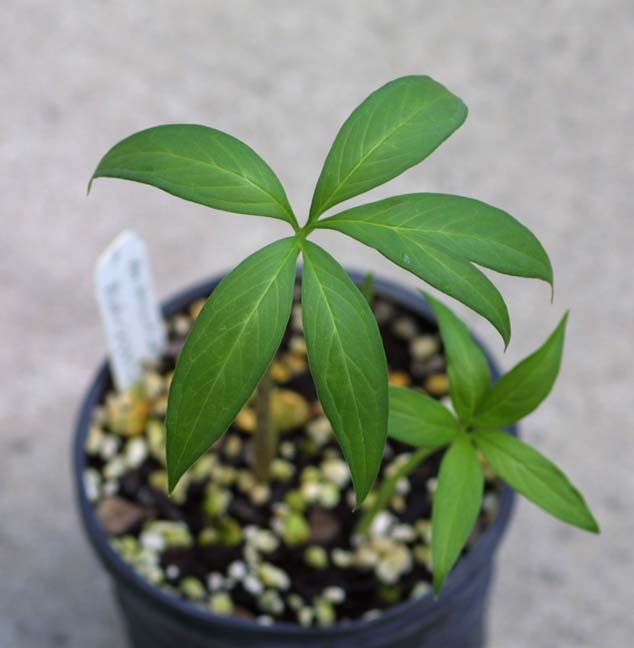
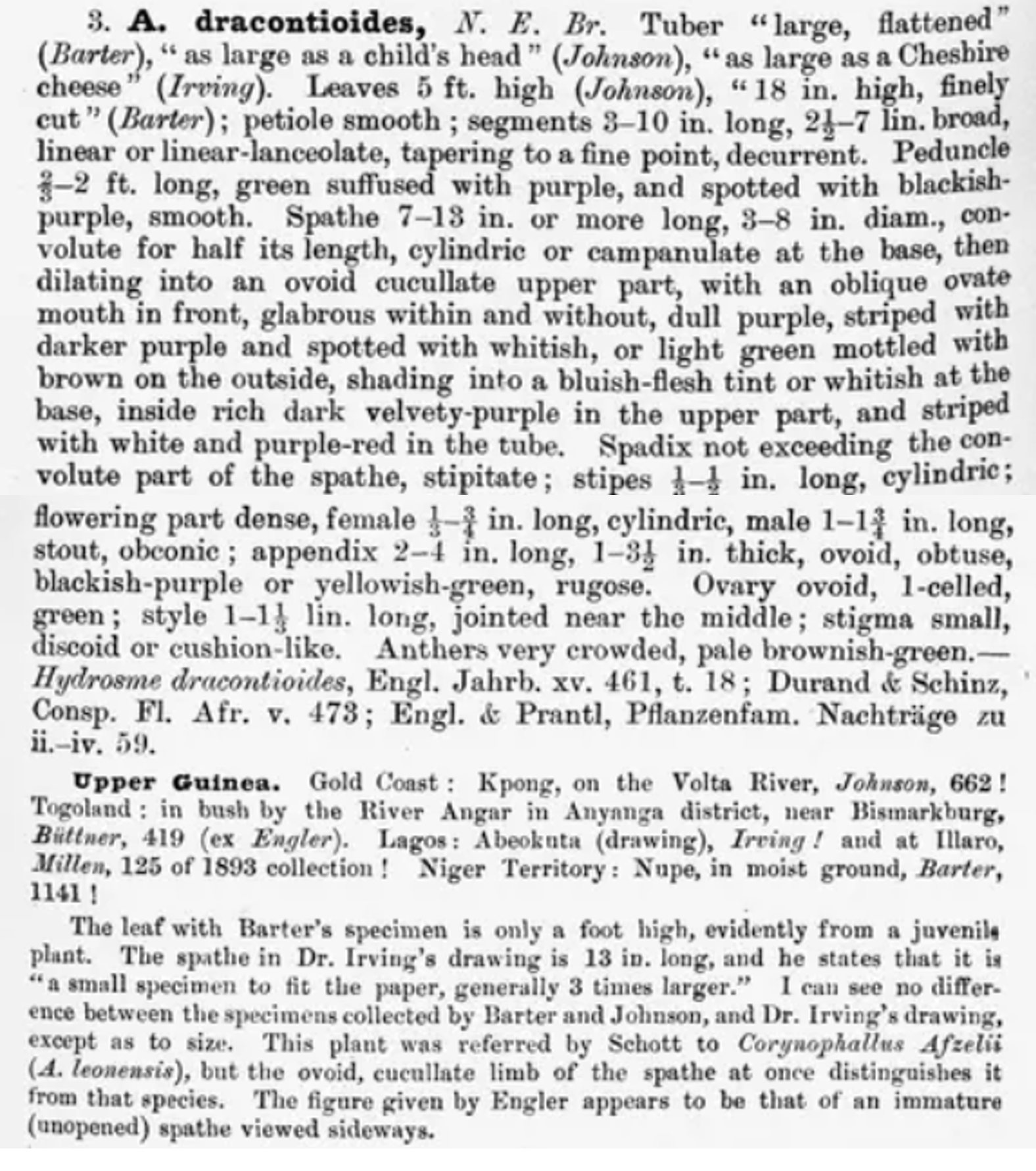
PROTOLOGUE: Amorphophallus dracontioides (Engl.) N.E.Br., published in D.Oliver & auct. suc. (eds.), Fl. Trop. Afr. 8: 148 (1901). The protologue is reproduced below.
SYNONYMS:
HOMOTYPIC SYNONYMS: Hydrosme dracontioides Engl. in Bot. Jahrb. Syst. 15: 461 (1892)
OTHER NAMES: Arabic-Shuwa: gunta; Berom: tutugey; Hausa: kin ciya, burar jaakii, burar karee, gwaazan kwaadoo, gwaazar-giiwaa, gwazar giwa, hantsar giiwaa, kinchiya kunnan jaki, kunnen jaakii, ijo ere otoro; Yoruba: akufodewa (Neuwinger 1996); Idio (Ijaw/Ijo): aere otoro
DISTRIBUTION: W. Trop. Africa to Central African Rep.: Benin, Burkina Faso, Central African Republic, Gambia, Ghana, Ivory Coast, Niger, Nigeria, Togo.
SPECIES DESCRIPTION:
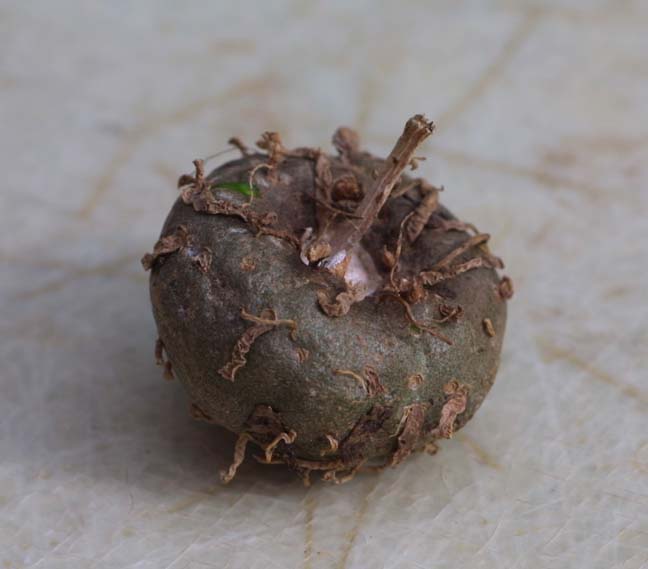
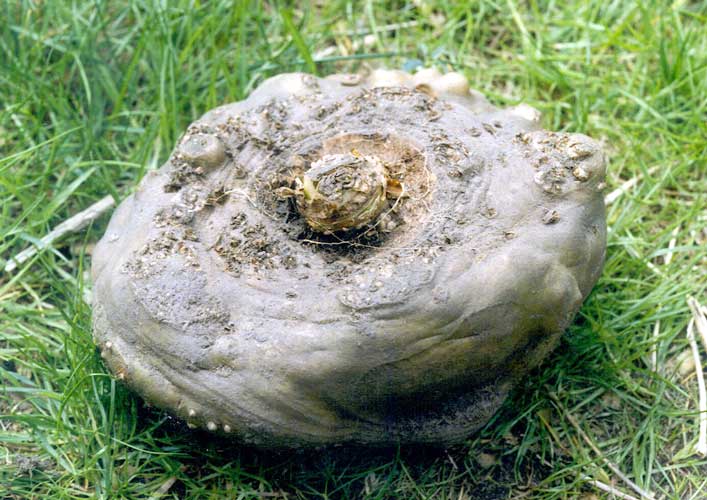
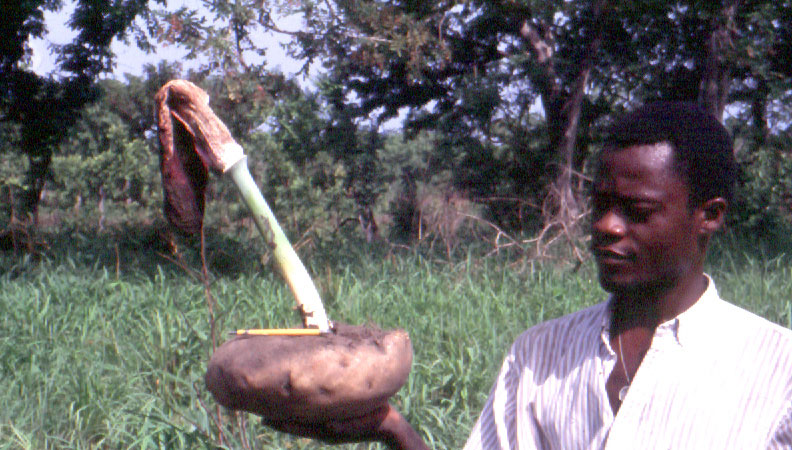
Tuber disc-shaped, 10–25 × 5–15 cm, yellowish brown to gray externally, white internally; surface smooth or somewhat rough. Roots arise from the upper surface of the tuber. Produces rounded daughter tubers.
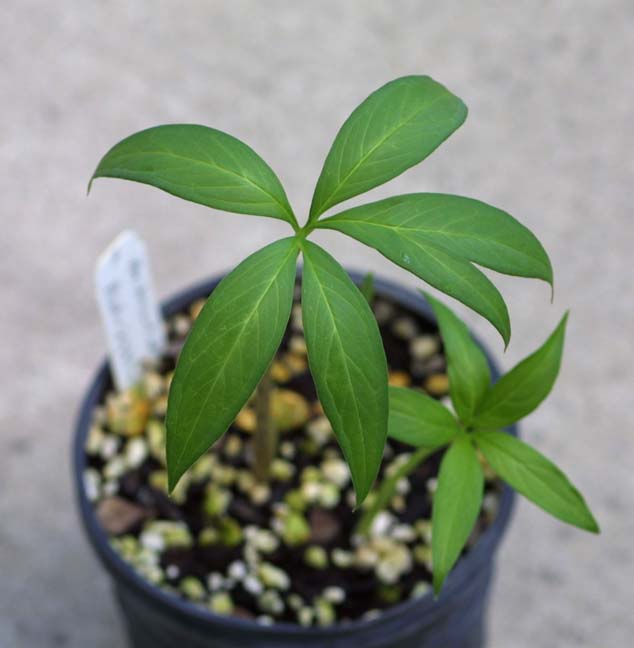
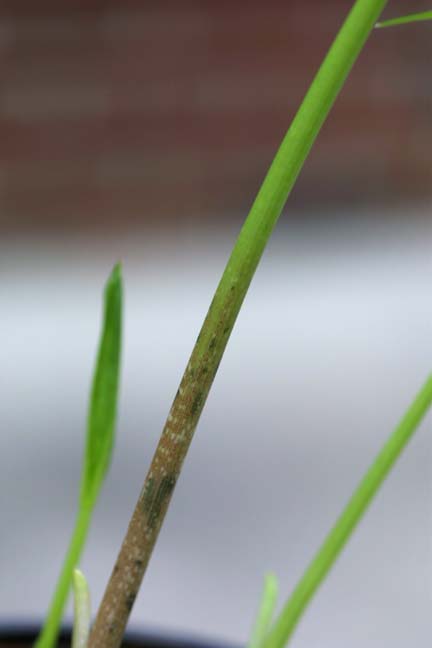
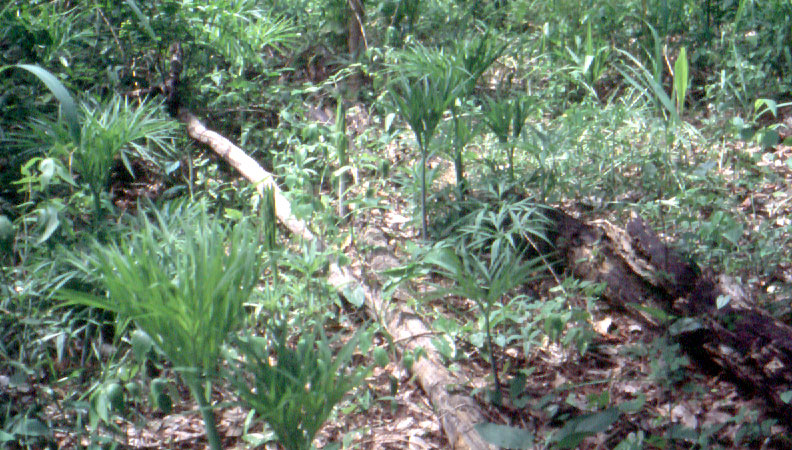
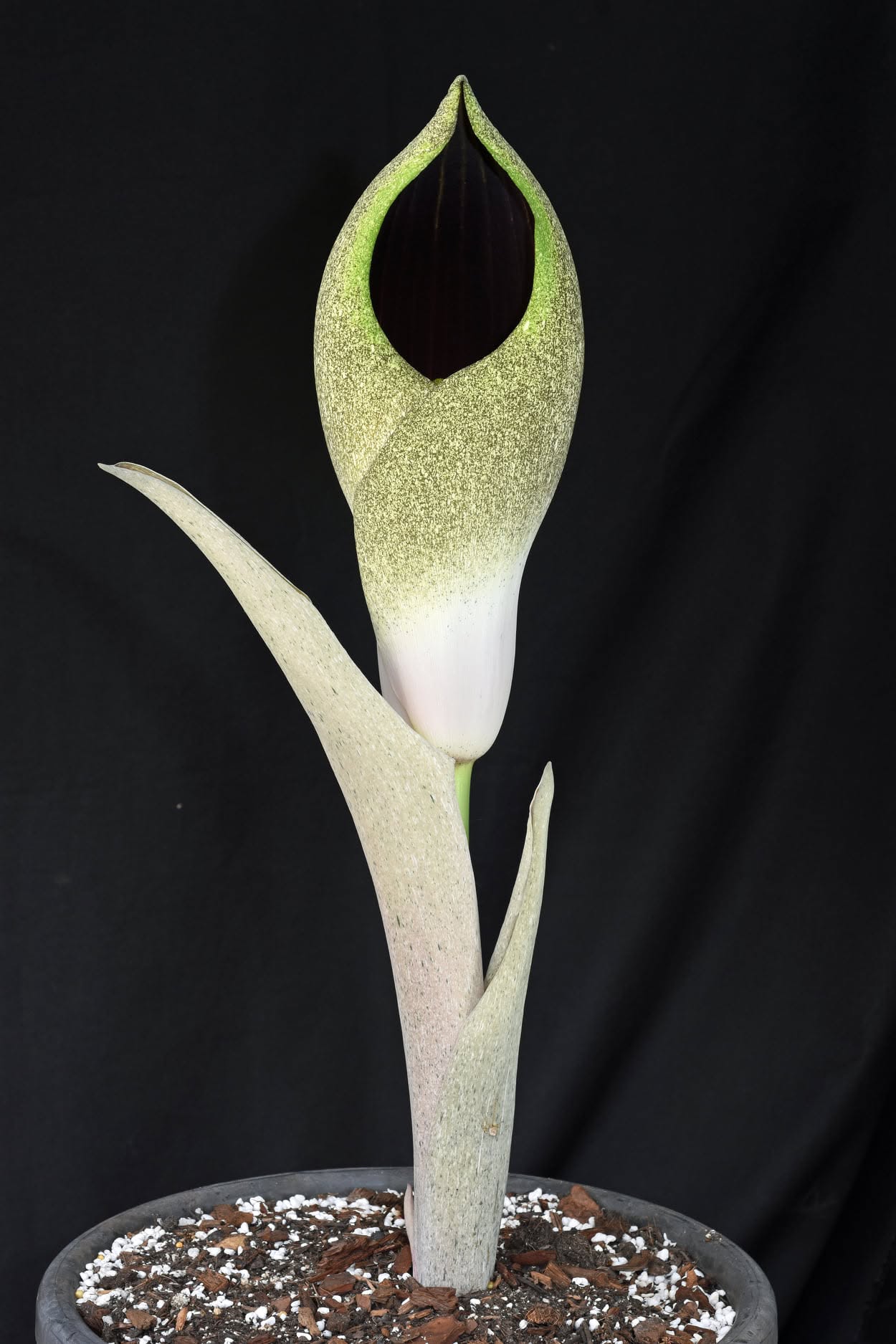
Leaf up to 1.2 m tall, emerging after the inflorescence. Petiole 40–100 cm long, 1–2 cm in diameter, whitish below ground; above ground purple-spotted at the base, becoming uniformly purple farther upward. Blade 50–110 cm in diameter. Rachis narrowly, cuneately winged, becoming broadly cuneately winged in the branches of the highest order. Terminal leaflets lanceolate, 9–30 × 0.5–3 cm, without a distinctly differentiated tip, green.
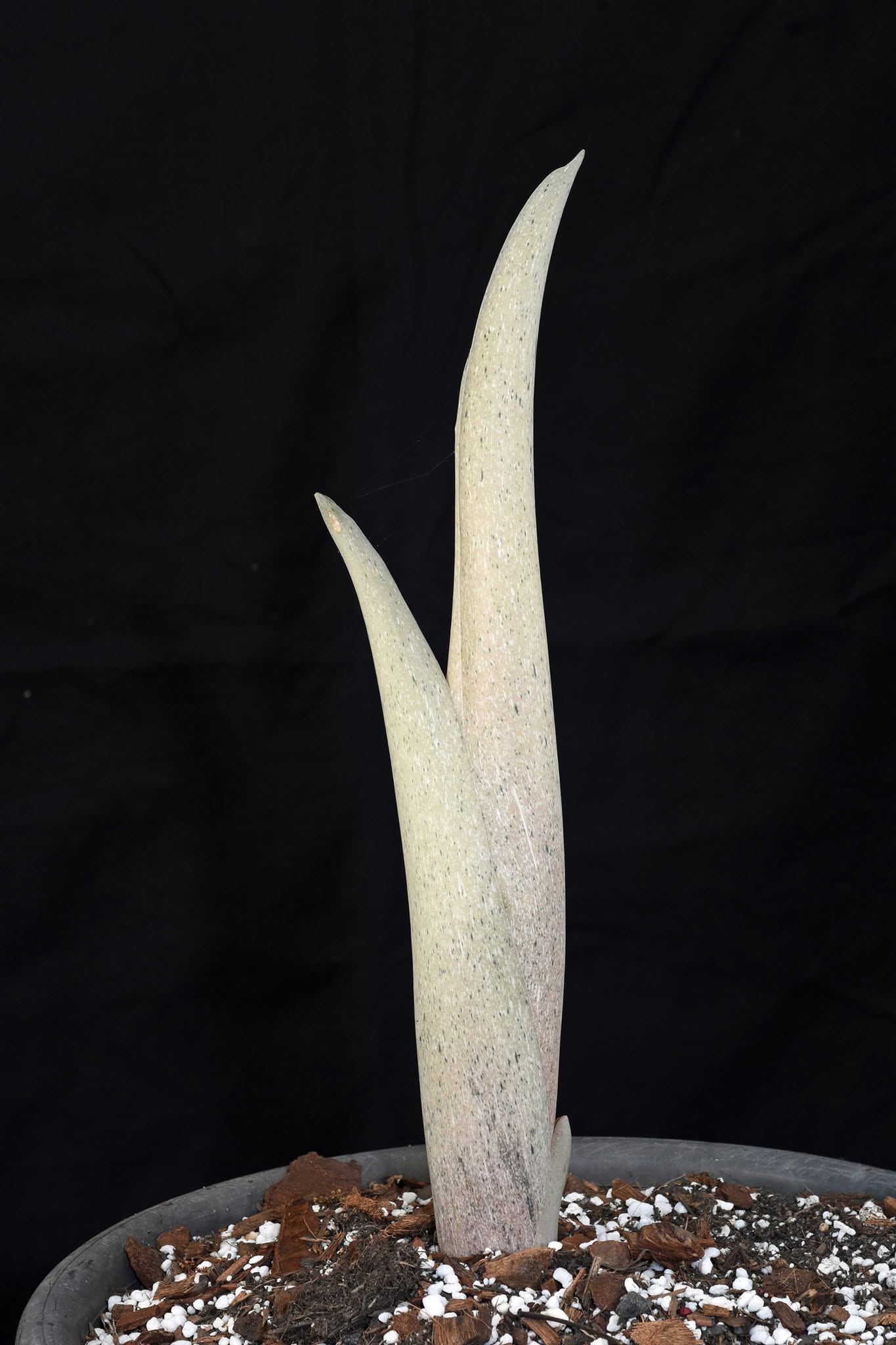
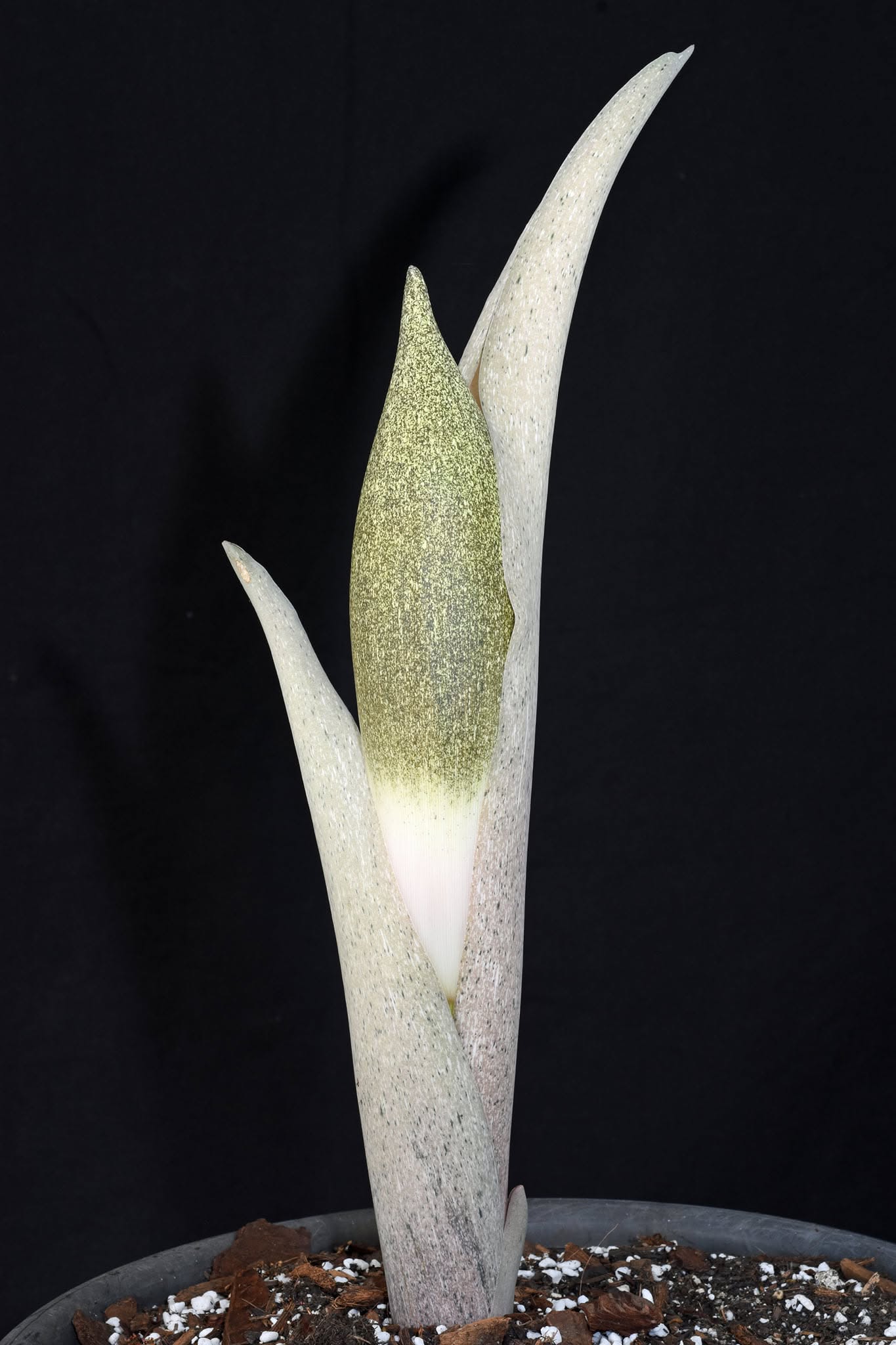
Cataphylls 3; the innermost longer than or as long as the peduncle, 10–35 cm long and 2–5 cm wide, pale pink; the two outer cataphylls shorter than the peduncle, 3–10 cm long.
INFLORESCENCE:
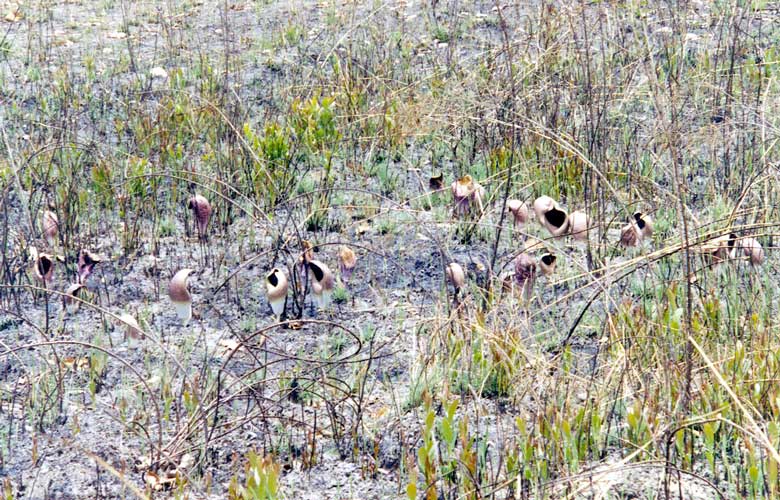
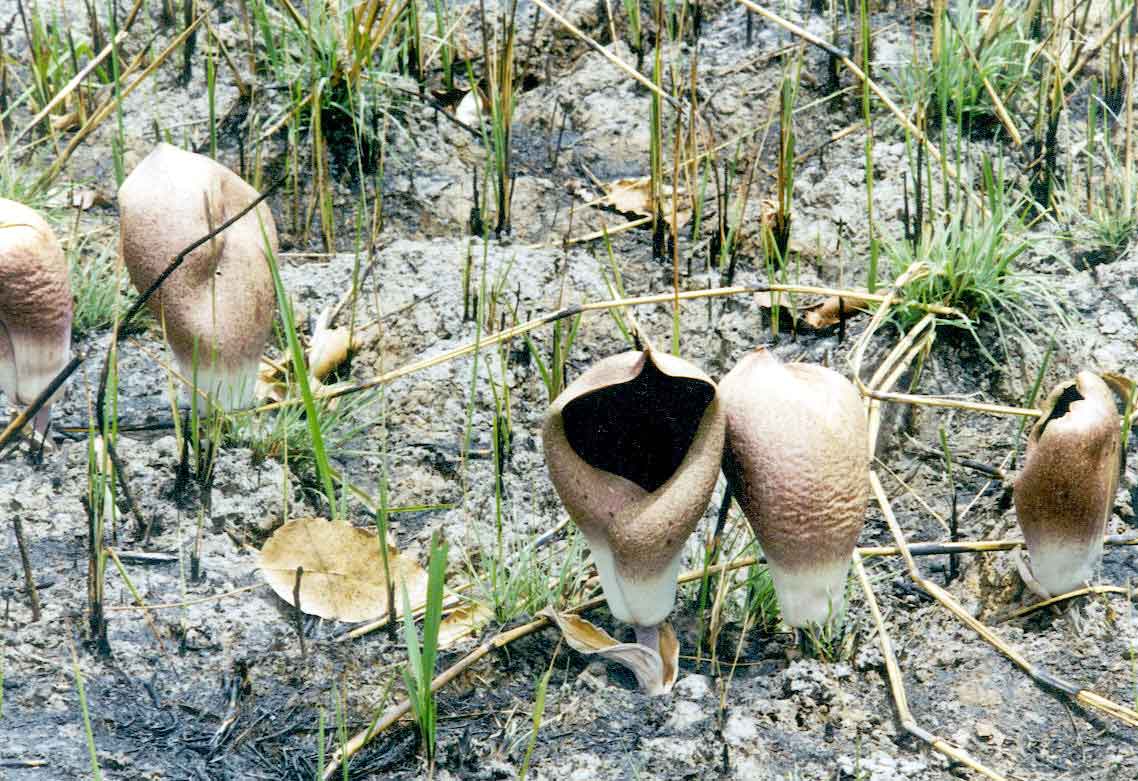
Inflorescence shortly to moderately long-pedunculate, appearing before the leaf. Peduncle 5–30 cm long, 1–2 cm in diameter, uniformly purple to green or marked with green spots.
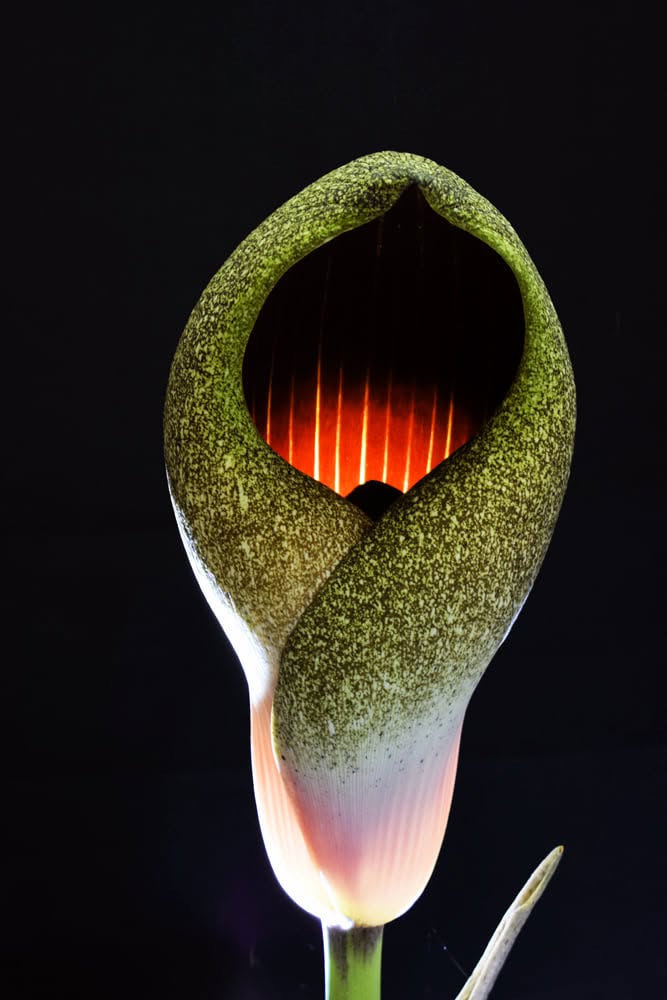
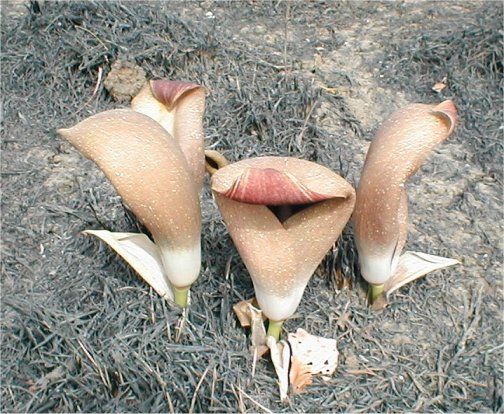
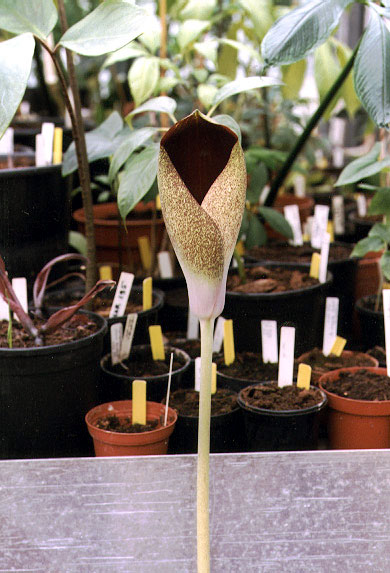
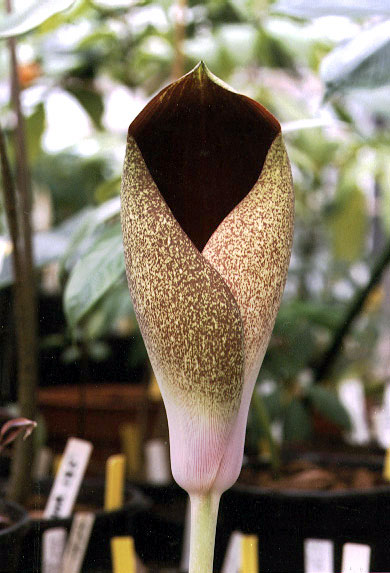
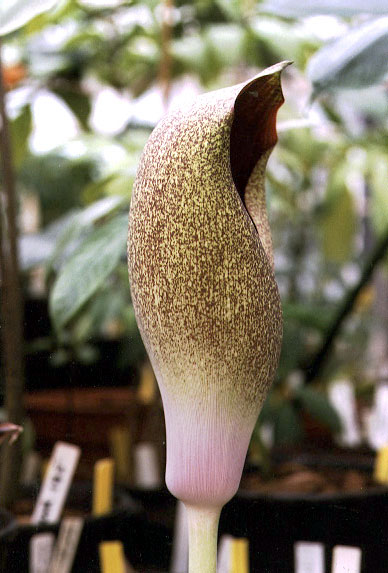
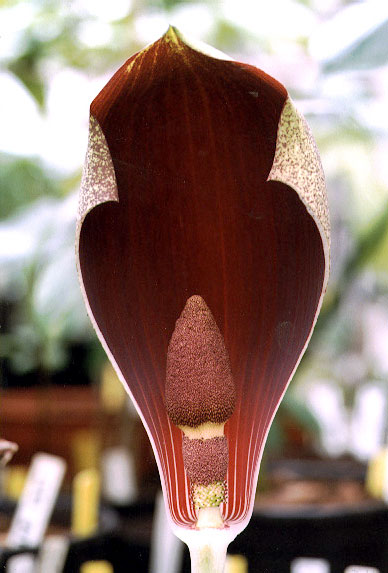
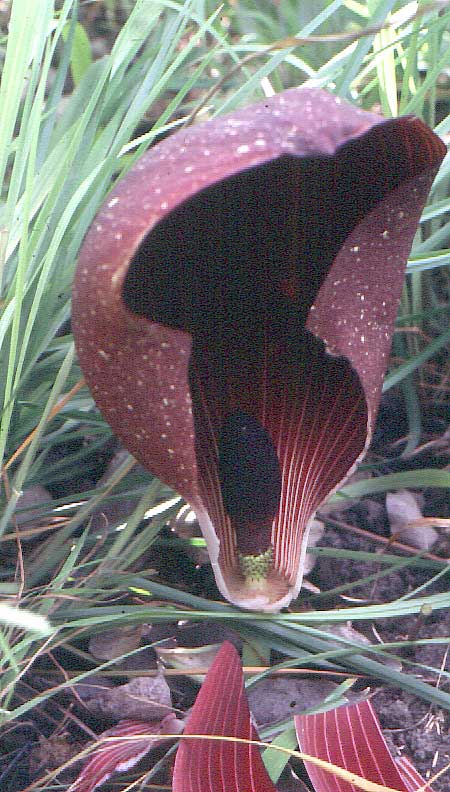
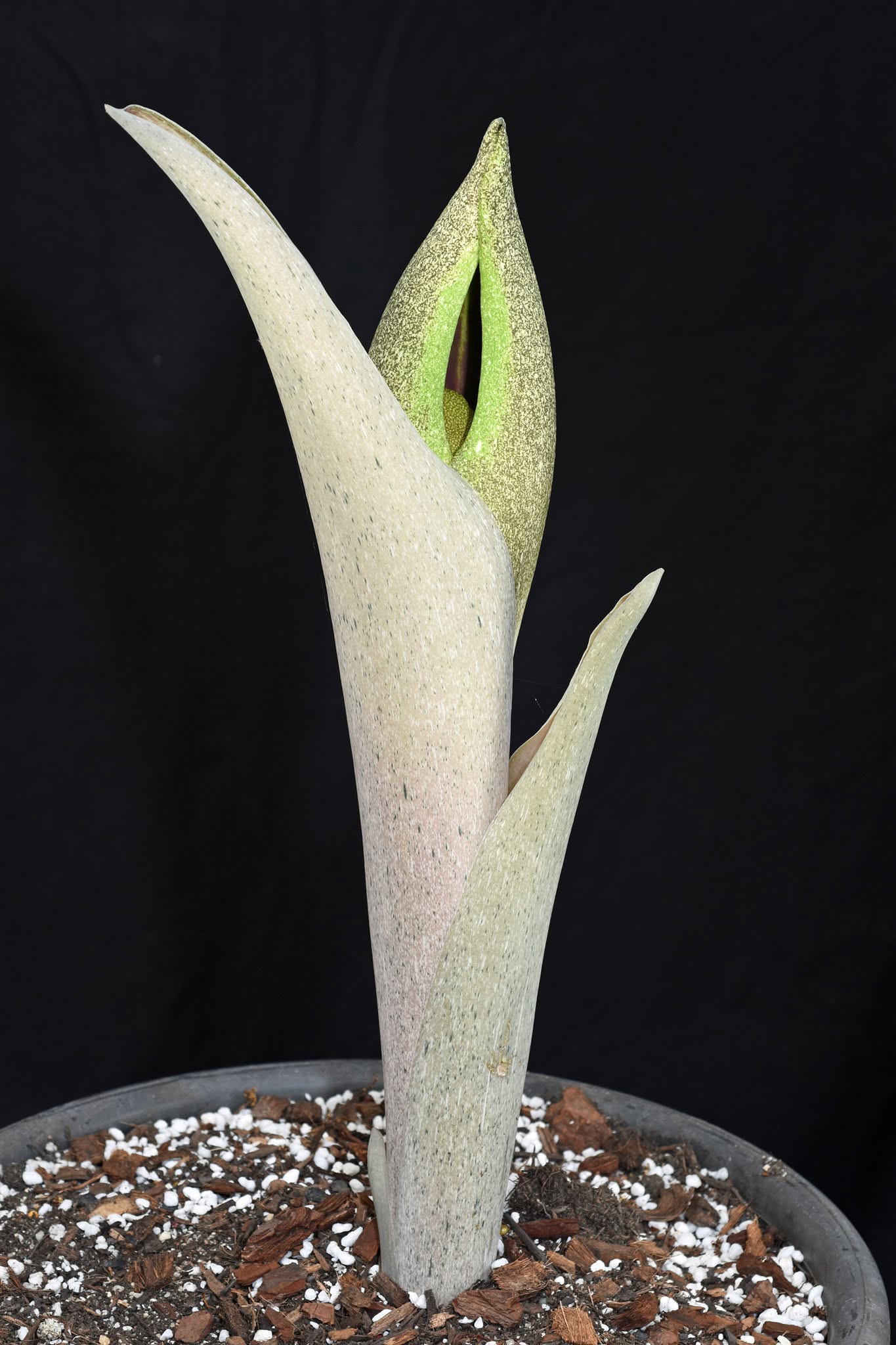
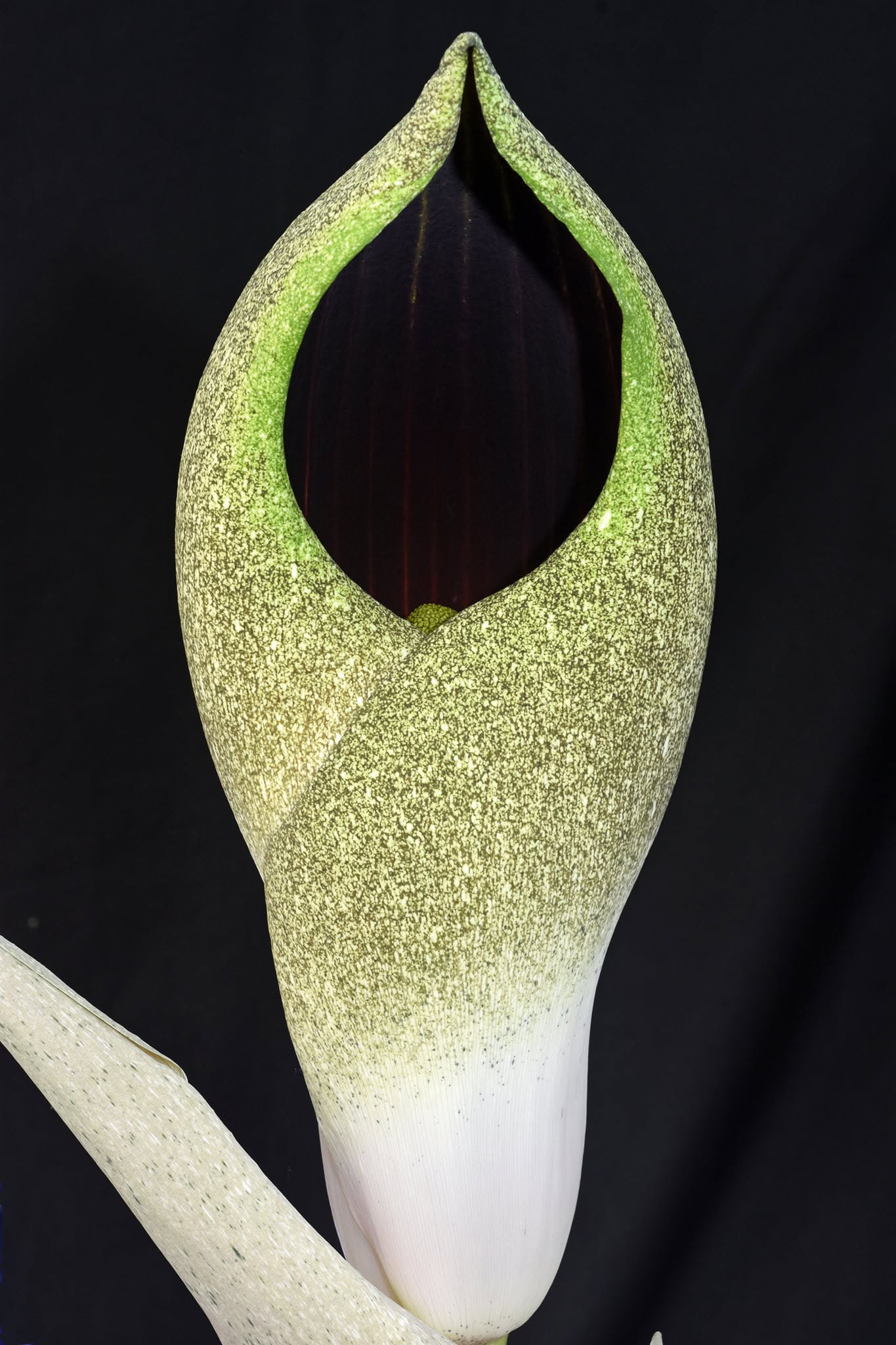
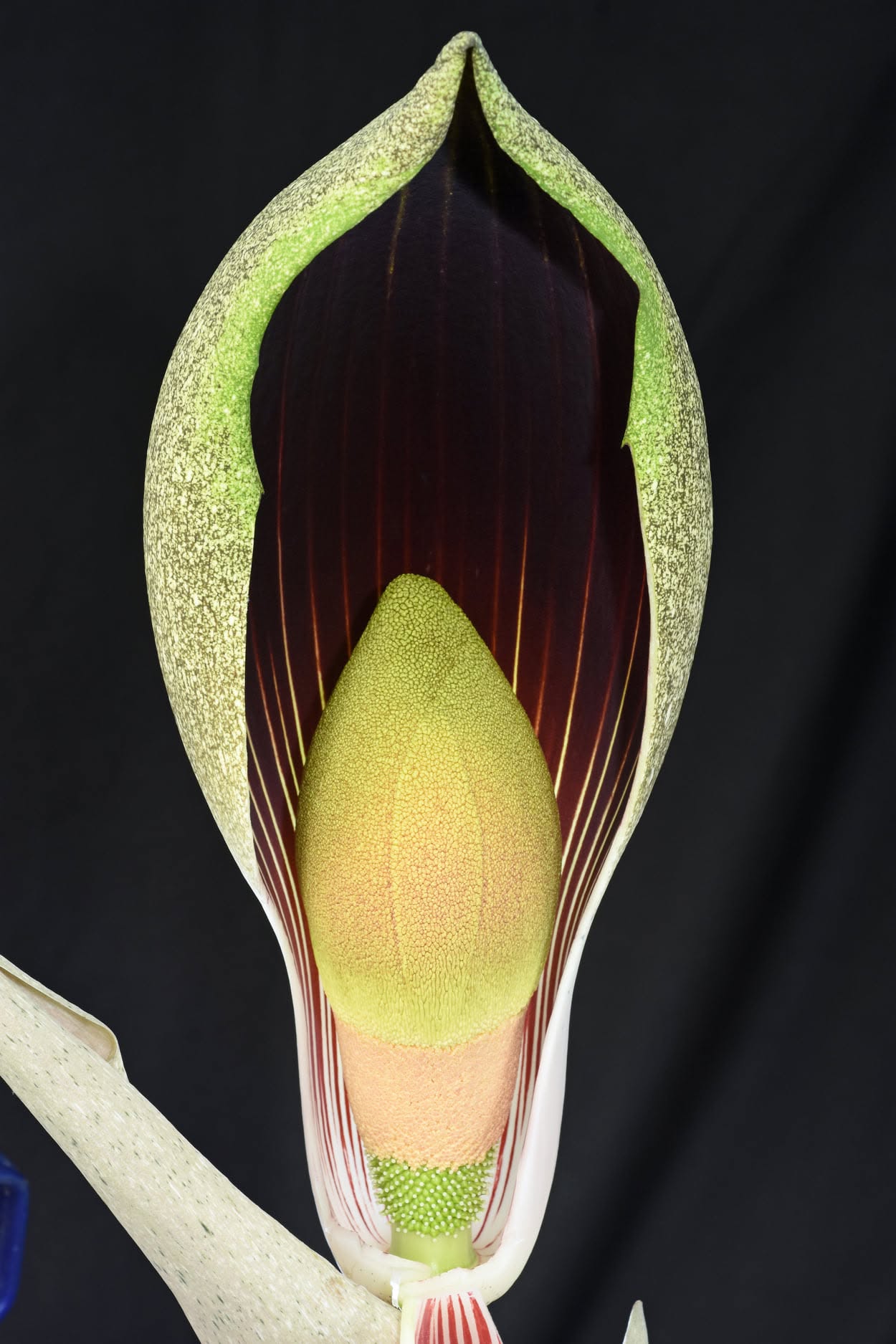
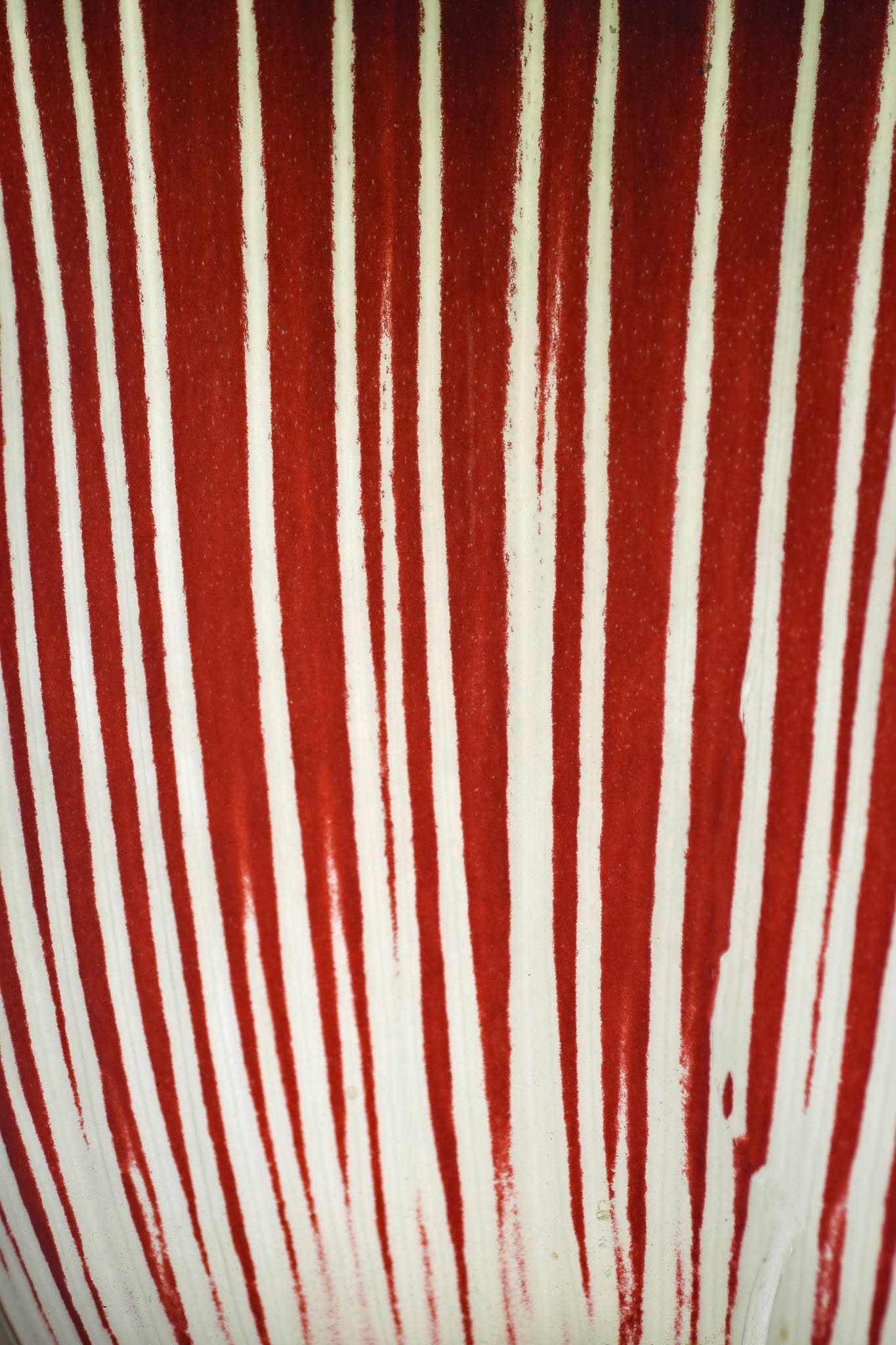
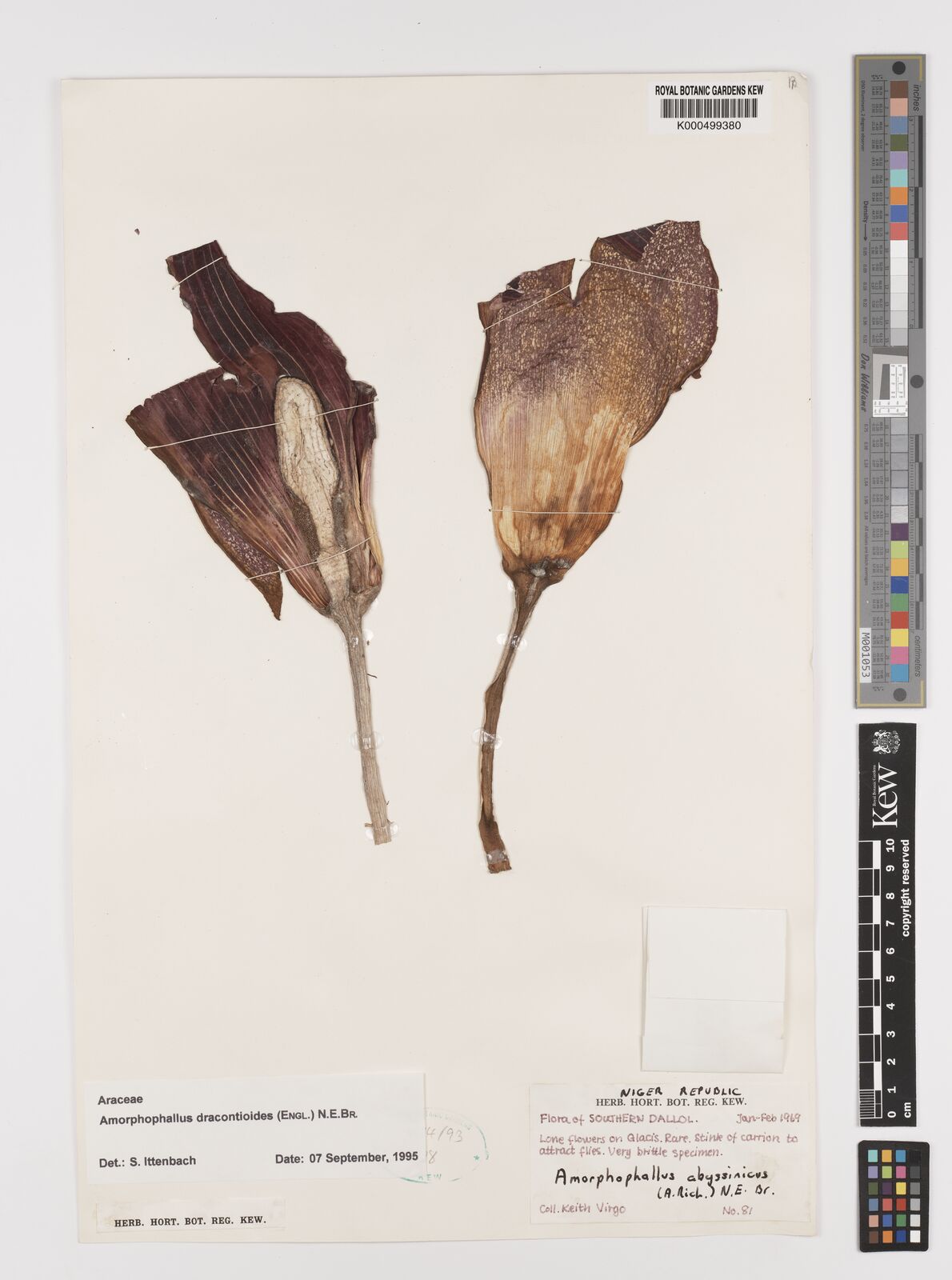
Spathe 10–45 cm tall, broadly ovate, completely enclosing the spadix and extending hood-like above it. Opening unilateral, beginning at about half the height of the spathe and apically overlapped by an open portion of the limb, so that the opening is almost closed. No constriction present. Spathe 3–8 cm wide at the base and 7–15 cm wide at the middle. Externally greenish and marbled whitish to cream, with irregularly shaped greenish spots; margins often with a pale-purple sheen and with cream-colored or purple-green spots. Basal inner surface smooth, dark purple, with narrow, regular white to cream-colored longitudinal stripes, which gradually disappear toward the open portion of the limb.
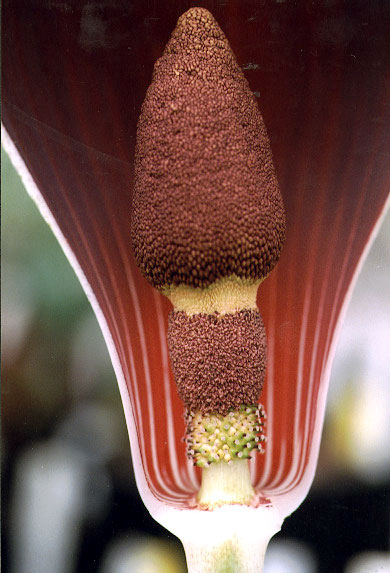
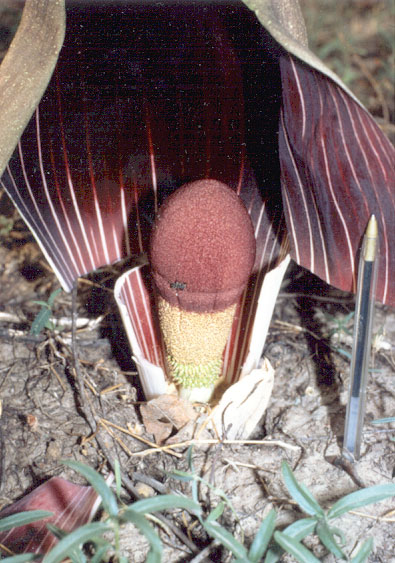
Spadix borne on a stalk 1–1.5 cm long, much shorter than the spathe, 5–17 cm long.
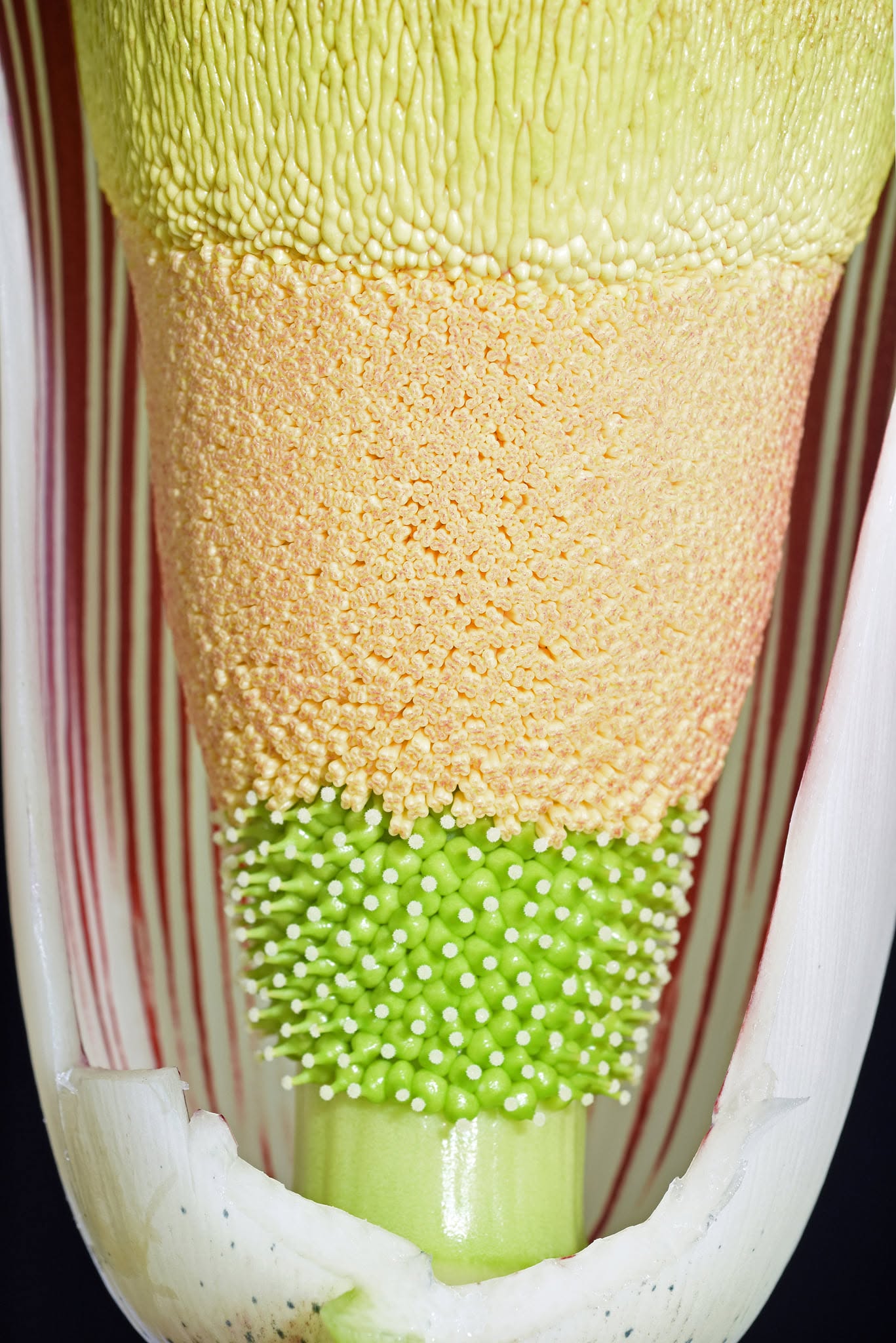
Pistillate zone obconical, 1–2 × 1–2 cm; flowers completely touching one another.
Staminate zone obconical, 1.5–3.5 × 1–4 cm; flowers very densely arranged.
Appendix 4–11 cm long, 2–5 cm in diameter, thick and shortly club-shaped, with an entirely wrinkled surface. In the broad upper portion are dense rows of small, rounded to oval knobs or wrinkles. Toward the base these knobs gradually transition into low, elongated ridges, finally ending basally in a 1–3 cm wide zone of papilliform staminodes. Staminodes are present basally, or extend up to halfway along the appendix, as irregularly shaped papillae and sterile anthers.
A sterile zone between the pistillate and staminate zones is absent. Ratio of pistillate to staminate zone: 0.5–0.7 : 1.
Pistillate flowers 4–6(–7) mm long. Ovary oval, 2–3 × 1.5–2 mm, unilocular, green. Style 2–3(–4) mm long, distinctly differentiated from the ovary, somewhat curved upward toward the axis, cream-colored to greenish yellow. Stigma small, 0.8–0.9 mm in diameter; in lateral view shaped like a pointed cap or flattened on one side, rounded in top view, unlobed, cream-colored to yellowish.
Staminate flowers 1–2 mm long, each consisting of 3–4 stamens. Anthers free, 1–1.5 × 1–1.5 mm, square to rectangular, cream-colored to purple. Filaments free, 0.5–1 mm long and wide. Pores apical, round, 2 pores per theca. Thecae cylindrical. Connective grooved and purple.
Pollen yellow, inaperturate, 28–38 × 28–31 μm, rounded; exine echinate.
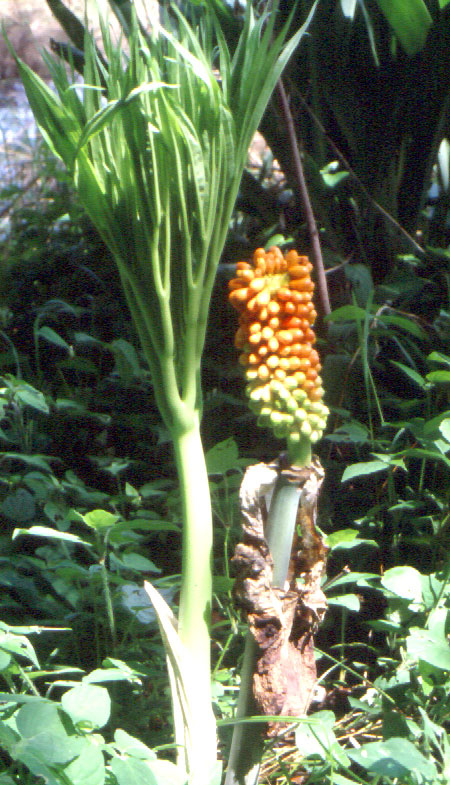
Infructescence often appearing together with the leaf, cylindrical, 10–20 × 3–4 cm, sometimes retaining remnants of the spathe. Berries one-seeded, oblong to ovoid, 1–1.5 × 0.8 cm, orange to red. Seed rough, oblong to ovoid, 0.8–1.2 × 0.5 cm, pale-colored.
Odor: of carrion and feces, attracting primarily flies
Flowers from December through the end of February. Fruits mature from February to March. The leaf is present from March to July.
NOTES:
1. The tubers can be eaten, but are used as food only in times of extreme necessity. Special preparation is required to remove their acrid taste. They are cut into pieces, washed, soaked, and then cooked for one or two days (Burkill 1985; Dalziel 1937).
In northern Nigeria, the tubers are used together with tubers of Solanum incanum as ingredients in arrow poisons, sometimes apparently also in combination with Strophanthus. The tubers are always cooked for this purpose (Burkill 1985; Neuwinger 1996).
The tubers of Amorphophallus dracontioides are regarded as a valuable traditional remedy for asthmatic illnesses. This may also be the species used to provide relief from rheumatic complaints. The Fulani use the tuber in magico-medicinal rituals associated with snakebite. In southern Nigeria, women eat the tubers during pregnancy in the belief that they facilitate childbirth (Burkill 1985; Dalziel 1937). In Niger, the tuber is used medicinally (Berthoud, in sched.).
REFERENCES:
1. Plants of the World Online, Royal Botanic Gardens, Kew — Amorphophallus dracontioides (Engl.) N.E.Br.
2. D.Oliver & auct. suc. (eds.), Fl. Trop. Afr. 8: 148 (1901) — protologue.
3. Alan Galloway — Amorphophallus dracontioides, alangallowaybotanicals.com.