
Araceae · Morphology
THE
MONSTERA SHOOT
Four kinds of shoot, one plant, and why the adult leaf is the last thing to trust
Opening
A Monstera is four plants
before it is one
Somebody once described a juvenile Monstera as a new species of Marcgravia — a dicot, in a different order of flowering plants entirely1. That is not a story about a careless botanist. It is the most economical way to say what this genus does: a single Monstera individual passes through forms so unlike one another that its stages have been sorted into separate species, separate genera, and separate branches of the flowering plants.
The plant most people picture — a broad, holed, glossy blade held out from a trunk — is one phase of a life that began as a bare thread creeping across leaf litter in the dark, and passed through a stage of flat overlapping scales pressed against bark like roof tiles. In the forest those earlier stages have usually rotted away by the time the adult flowers1. You are looking at the last frame of a film and calling it the plot.
The character that does not drift
Michael Madison revised the whole genus in 1977, and buried in his growth-habit section is a sentence that ought to change how anybody identifies a Monstera. Across field and glasshouse studies he observed no deviation from the seedling and juvenile type characteristic of each species, while the growth habits of adults are more variable1.
Read that twice, because it is the reverse of ordinary practice. The part of the plant everyone photographs, keys out and argues about online — the adult leaf — is the part Madison found least dependable. The thread-like seedling and the shingled juvenile, which almost nobody looks at, are the parts that held.
What this means in practice
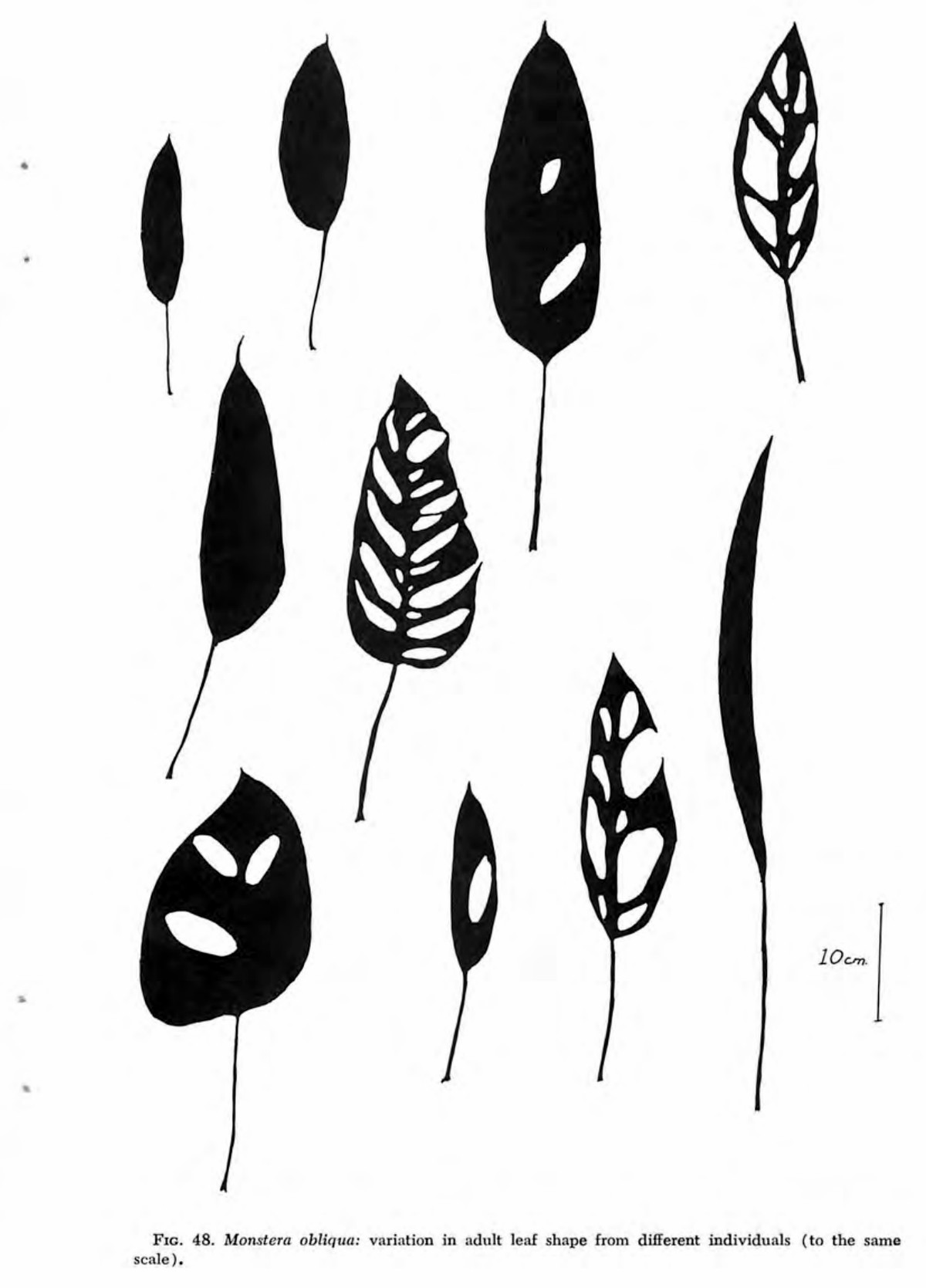
If you have a Monstera whose adult leaves do not match the pictures, that is not necessarily the wrong name. Adult leaf shape varies between individuals of the same species enough to cover several “species” worth of difference — there is a plate further down this page showing eleven leaves of Monstera obliqua that range from entire to a narrow strap. What the plant did on its way up the tree is the more stable question.
How this page is ordered
The two genus guides beside this one begin at the blade and work down, because in Alocasia and Anthurium the blade is where the information is. This page cannot do that. In Monstera the blade is the least reliable organ on the plant, so the page runs in the order the plant itself runs: seedling, then juvenile, then adult, then — only once there is somewhere to put it — the leaf, its joints, and its holes.
The last part is about what a single leaf cannot tell you, which is where a page about leaves ought to end.
Watch the shoot. The leaf is a symptom.
Part I
Four kinds of shoot, on one plant
Most climbing plants have one kind of stem and get bigger. A Monstera may build up to four structurally different shoots in a single lifetime, each doing a different job, and switch between them abruptly rather than by degrees.
Monstera acuminata is the extreme case and the clearest one to learn from. Madison describes four radically different kinds of shoot on that one species1.
| Shoot | What it looks like | What it is for |
|---|---|---|
| Seedling | A thread-like creeper, running across the litter | Finding a trunk, fast, on the food stored in the seed |
| Shingle juvenile | Flat overlapping leaves pressed to the bark like roof tiles | Surviving the move from wet ground to a much drier life on a tree |
| Adult | A massive sub-canopy epiphyte, leaves held out from the trunk | Gathering energy; flowering and fruiting |
| Stolon | Leafless hanging and creeping shoots thrown from the adult | Colonizing further trees, or recovering from a poor host |
The switch between the second and third of these is not gradual. The shingle plant climbs producing steadily larger leaves until it reaches a critical size, and then in the course of a few nodes changes to the adult form with large exserted leaves1.
Two developmental syndromes, and a warning about them
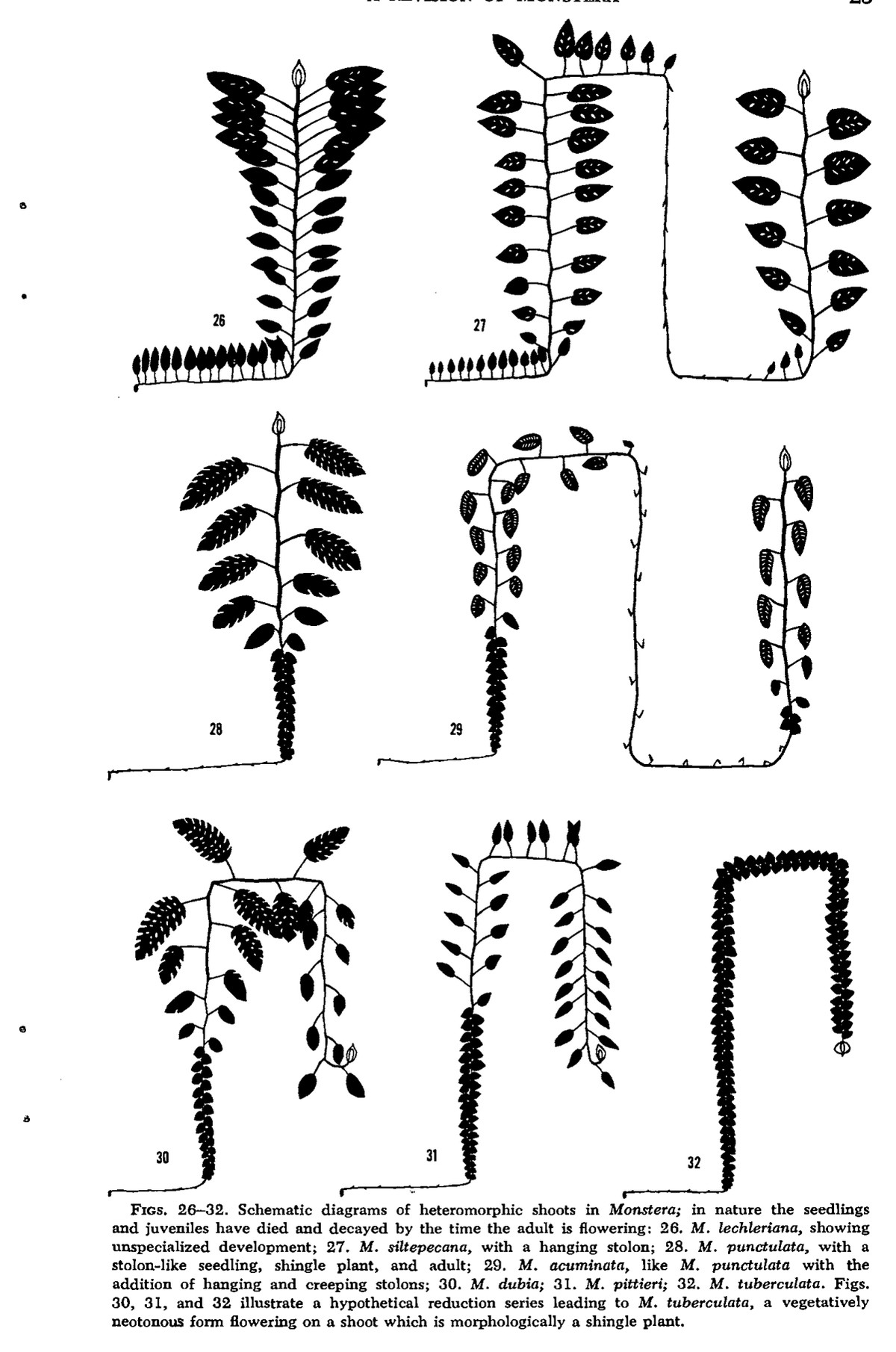
The seven diagrams sort into two broad patterns. In one, the plant increases gradually in leaf size and stem diameter from seedling to adult, with no distinct juvenile stage; Madison calls this unspecialized. In the other, a stolon-like seedling is followed by a shingled juvenile and then an abrupt change to the adult; he calls this specialized1.
Madison ties each pattern to a section of the genus — unspecialized to section Monstera, the stolon-and-shingle pattern to sections Marcgraviopsis and Echinospadix1. The patterns are real. The sections are not groups.
A correction worth carrying
Madison's sections are drawers, not branches, and both modern revisions of the genus say so2, 3. The molecular work shows why: Monstera acuminata and Monstera spruceana, both placed in section Marcgraviopsis, sit among section Monstera species, and Monstera tuberculata — the only species in Echinospadix — nests inside a Marcgraviopsis group4. So the shingled juvenile is a repeatable developmental syndrome, not an inherited badge of one lineage, and a plant does not belong to a section because it shingles.
Of the 71 species POWO currently accepts, 58 have been assigned to a section by somebody; the 13 that have not are all South American, and they are unplaced for the ordinary reason that no one has published a placement for them4.
The rest of this page follows the plant up the tree, one shoot at a time.
Part II
The seedling, which is looking for a tree
A Monstera seed germinates on the ground, not on a tree. Everything the genus is known for happens later and higher up; the plant's first task is to cross the forest floor and find a trunk1.
It does this in one of two ways, and which way is a character of the species rather than of the conditions.
The unspecialized seedling
In the species Madison groups under section Monstera, the first two leaves are cataphylls, foliage leaves follow, and the plant then simply increases in leaf size and stem diameter for the rest of its development1. There is no distinct juvenile stage to look for, which is also why these seedlings are hard to find in the field — there is nothing conspicuous about them, and by the time anyone notices the plant the seed is long gone. Madison found Monstera lechleriana and Monstera adansonii seedlings in the wild with the seed coat already empty and shriveled by the third foliage leaf; in cultivation, Monstera adansonii had emptied its seed by the time the stem had run 3–8 cm from where it germinated1.
The stolon-like seedling
The other kind is strange enough that it is worth describing carefully. The germinating seed produces a green stolon about 1 mm thick, with internodes 4–10 cm long, bearing only cataphylls or minute scale leaves at the nodes. It runs along the ground for up to two meters without increasing in diameter at all, and it does not begin producing foliage leaves until it has started to climb1.
Unlike the unspecialized kind, these are commonly encountered in the wild, and they are always found still attached to the plump seed1. That detail is the whole mechanism: the stolon is running on stored food, and it is spending all of it on distance. Where it is exposed to light it is green and photosynthetic; often it is running under leaf litter instead, and there it is white.
The trade-off, in milligrams
How far a stolon can run depends on what is in the seed, so this habit should push seed size up — and it has. Madison weighed FAA-preserved seed and found a mean of 255 mg for species with stolon-like seedlings against 140 mg for species with unspecialized ones1. Monstera seeds run 6–22 mm overall. These are group means across species, not values for any one species, and bigger seed is not free: it costs more to make, so fewer are made, and in this size range it probably travels less well.
How a seedling finds a trunk
Two mechanisms are described, and they are not equally well supported.
The first is simple and Madison observed it himself: where Monstera seedlings are found on a slope, they almost always grow uphill. The forest floor generally slopes up toward the bases of trees, because litter accumulates there, so uphill is a reasonable bet1.
The second is the famous one. In 1975 Strong and Ray reported that seedlings grow directly toward darkness — skototropism — which works because a potential host tree is a dark sector of the horizon5. It is one of the best-known findings in the family and it is cited constantly.
Which plant was actually studied
Strong and Ray ran the work on a plant they called Monstera gigantea. Madison, revising the genus two years later, flagged that name as ambiguous and said the plant was probably Monstera tenuis or Monstera dubia1. So the single most-repeated behavioral fact about this genus rests on a study whose subject cannot now be named with confidence. The behavior is not in doubt — the 2024 Central American revision treats skototropic seedlings as a genus character3 — but if you need to know which species was tested, the honest answer is that nobody can tell you.
Whichever mechanism gets it there, the seedling's job ends at the bark. What happens next is the strangest thing the genus does.
Part III
The shingle plant, which was mistaken for a dicot
When a stolon-like seedling reaches a trunk and begins to climb, it does not start making the leaves you would recognize. It produces asymmetric foliage leaves flattened against the tree so as to overlap one another and completely cover the stem1. The petiole is very short. The sheathing part of it, which protects the next developing leaf, is drawn out into a ligular outgrowth.
The result climbs the trunk as a flat green mosaic with no stem visible at all. Horticulture has a good name for it: a shingle plant.
It is not a Monstera specialty. The same habit has turned up independently in Marcgravia, Ficus, Metrosideros, Drynaria, Hoya, Scindapsus, Conchophyllum and Teratophyllum1 — ferns, dicots and monocots arriving at the same solution to the same problem.
The mistake in the Opening, paid off
The convergence is close enough to have fooled taxonomists. Shingled juveniles of section Marcgraviopsis have been described as new species of Marcgravia — a dicot genus in an entirely different order1. The section name is itself the fossil of that resemblance: Marcgraviopsis means “looking like Marcgravia”. A juvenile Monstera has been filed not merely under the wrong species but under the wrong half of the flowering plants.
Why a plant would do this
The usual explanation, going back to Goebel and Karsten, is that the appressed leaves protect the young adventitious roots from drying out by covering them1. Madison adds a second: the stomata are confined to the underside of the leaf, so pressing that surface against the trunk keeps them in a still layer of moist air and out of drying winds1.
Then he makes the argument that ties this part of the page to the last one, and it is worth following because it explains why only some species shingle.
A plant of section Monstera beginning to climb has a stem 5–10 mm thick, and behind it a long horizontal run of stem with numerous nodes, each carrying adventitious roots. A shingle plant beginning to climb is attached to a horizontal stem only 1–2 mm thick, with few nodes and few roots. It has a far smaller water-gathering system at exactly the moment it moves into a drier habitat, and it is therefore much more likely to be under water stress1.
The shingled stage is how it gets out of that hole. The stem thickens with each successive node until it can produce adventitious roots of its own; those run 4–10 mm thick and usually reach the ground. Once they do, the plant's water supply is large enough to support the change to adult form1.
How firm is this?
It is an explanation, not a measurement. Madison reasons from stem diameters, root counts and stomatal position, building on Goebel and Karsten; he does not report transpiration or water potential from a shingled plant, and no one else has published either measurement since. The stem and root dimensions are observations. The water-stress account of why is a hypothesis that happens to fit them.
The chain, stated plainly
Three features that look unrelated are one solution. The stolon-like seedling is an adaptation for finding a tree quickly. Finding a tree quickly means arriving with almost no roots. Arriving with almost no roots means water stress. The shingle plant is the answer to the water stress1.
Which is why the species with stolon seedlings are exactly the species that shingle, and the species that creep to a tree the slow way never need to.
Part IV
The adult, and the tree it is scaled to
Seedlings and juveniles come in two patterns. Adults come in many, and Madison's view was that this is where the genus actually did its diversifying: the principal radiation in Monstera has been a diversification of growth habits within one habitat — which trees a species grows on, and how it grows on them — and the combination is distinctive enough that most species can be recognized from a distance1.
That is a useful thing to know before you look at any leaf.
Big plants need big trees
Plant size and host size go together. The largest species — Monstera tenuis, Monstera acuminata, Monstera punctulata, Monstera lechleriana — are found as reproductive individuals only on the largest forest trees. A smaller tree either does not offer enough clear trunk for them to mature on, or cannot carry the weight. They do get started on small trees; what happens then is that on reaching the first branches the stem grows away from its support and the hanging tip runs back down to the ground1.
At the other end, Monstera obliqua, Monstera xanthospatha and Monstera minima have stems 2–10 mm thick and leaves 10–25 cm long, and reach maturity on nearly any woody thing at all, from a forest giant to the twigs of a shrub1. Their habitat is abundant and short-lived. The big species' habitat is rare and stable.
Two species, tagged and re-measured
Madison tagged plants in the field and came back 12–18 months later1.
Monstera obliqua — stem elongation 2–5 m a year, 30–70 new leaves, total leaf area 0.2–0.4 m². Traced back to apparent germination sites, individuals may flower within 1½ years.
Monstera lechleriana — stem elongation 12–20 cm a year, 4–8 leaves, total leaf area 1.2–2.0 m². Apparently does not flower until about 6–8 years old.
The same genus, one growing its stem roughly twenty times faster than the other and flowering four to five times sooner, while carrying a fifth of the leaf area.
Attitude — what the plant looks like from across a clearing
Beyond size, species differ in what Madison calls general aspect, and this is the character that lets you name plants at a distance1:
| Species | Habit |
|---|---|
| Monstera lechleriana, Monstera dilacerata | A tight head or cluster of 10–15 spreading leaves at the top of the stem |
| Monstera punctulata, Monstera tenuis | Open, with arching leaves separated by long internodes |
| Monstera acuminata, Monstera dubia | Long internodes, blades pendent from the petioles and hanging parallel to the trunk — these two often clothe a whole bole to 25 m |
The second search for a tree
Part II described a seedling looking for a trunk. Adults do it again, by a different means.
When Monstera acuminata reaches the branches above its host's bole, the stem converts into a hanging stolon: internodes up to 30 cm, bearing only cataphylls or highly reduced sickle-shaped leaves. It drops to the ground and runs horizontally, often 10–20 m, until it meets another tree and starts climbing1. Engler and Krause called these flagelliform shoots. They turn up occasionally in most species and are especially common in Monstera acuminata, Monstera siltepecana and Monstera obliqua1.
Monstera dubia does something different. On reaching the first or second forking of branches it turns through 180° and grows downward — but as a full shoot, with full-size stems and leaves, not a stolon. Only the adventitious roots mostly abort. This doubles the useful length of the host's trunk, and if the hanging shoot eventually reaches the ground it may root and climb back up. Flowering happens on ascending or hanging shoots indifferently1.
Three species that never come back up
Monstera luteynii, Monstera pittieri and Monstera tuberculata always produce hanging shoots and flower only in the pendent portions. All three have small leathery leaves and thick cuticles, which Madison reads as xeromorphic: a free-hanging rootless shoot is under more water stress than an attached one with adventitious roots1.
The plant that never grew up
Monstera tuberculata closes the argument this page opened. It is vegetatively neotenous: it flowers on a shoot that is, morphologically, a shingle plant1. The juvenile form did not get replaced — it became the adult, and reproduces. If the juvenile stage were merely a phase to be grown out of, this species could not exist.
A word about what to call the habit
Madison describes Monstera as hemi-epiphytic, and later authors have written “secondary hemiepiphyte”. This site uses nomadic vine, following the 2022 Costa Rica revision2, which is the more recent treatment. The disagreement is not cosmetic: it is about whether a plant that germinates in the ground, climbs, and then may or may not keep its ground connection is best described by where it started or by what it does.
Part V
The stem has a front and a back, and two kinds of root
Philip Miller, in 1760, described the stem of Monstera adansonii as varying from “the thickness of a goose quill to that of a man's thumb.” Across the whole genus the range is wider than that: mature stems run from about 2 mm in Monstera obliqua to 8 cm in Monstera deliciosa1.
Dorsiventral — the stem knows which way the tree is
A Monstera stem is not a cylinder with organs arranged around it. It is flattened front to back and has a distinct front and back: the face against the trunk produces the adventitious roots, and the leaves are borne on the opposite face1. The plant is organized with respect to its support.
The leaves are borne distichously — in two ranks — but the angle between those ranks is itself a character. In Monstera lechleriana and Monstera dilacerata the two ranks are nearly opposite; in the species Madison placed in section Marcgraviopsis the divergence is closer to 120°; and in Monstera membranacea and Monstera gracilis it approaches 90°1.
The characters that hold still
Three stem characters are worth more than they look, because they are constant within a species while so much else in this genus is not1:
Internode length. Fairly constant within a species and, in Madison's words, a reliable taxonomic character. The shape of the leaf scars. Also constant and useful. The shape of the axillary buds, which sit in a depression that may run along the internode as a groove.
Surface texture divides the genus too. In sections Monstera and Tornelia the internodes are smooth. In Marcgraviopsis and Echinospadix the stem is usually roughened by numerous hard papillae about 1 mm across and 0.5 mm high, and the cuticle is thick and yellow-brown, shed in large flakes when the stem twists1.
Sections again
As in Part I, these are Madison's drawers and not lineages. The papillae and the smooth internodes are real and repeatable characters; the sections they are being used to describe are not groups the phylogeny recovers4.
Two kinds of root, doing two different jobs
Climbing plants across many families have split anchorage from water-gathering between different roots, and Monstera is a clear case. Went's names for the two are still the useful ones: feeder roots and anchor roots1.
The seedling's radicle elongates a few centimeters at germination and then makes only a limited, apparently short-lived root system. Almost the entire root system of a Monstera is adventitious, and the dimorphism does not appear at all until the plant has begun to climb — usually not until it is more than a meter up and the stem is 7–10 mm thick1. A terrestrial seedling has only one kind of root.
| Feeder root | Anchor root | |
|---|---|---|
| Where it arises | At the nodes, generally one per node, more or less opposite the center of the leaf's insertion | Along the internodes, though it may arise at nodes too |
| Which way it grows | Positively geotropic — straight down, hanging free or against the substrate | Any direction over the substrate, often following a fissure; perpendicular to the stem on a smooth trunk |
| Length | Unbranched until it reaches the ground, which may be 20–30 m away; then it branches profusely | 2–50 cm, usually 10–20 cm |
| How it holds on | — | Root hairs terminating in a kind of suctorial disc |
The claim worth pausing on
Engler and Krause proposed that the feeder roots, not the stem, are the plant's major water-conducting organ1. The observation offered in support is striking: in older plants the stem may lose all connection with the ground — through decay or injury — without the plant wilting or showing any other sign of water stress1.
That is consistent with the idea and it is not a measurement of it. No published figures compare sap flow, conductance or water potential in a Monstera stem against its feeder roots. The survival of severed plants is an observation; the plumbing that would explain it is an inference that has stood since 1908 without being tested.
When the support runs out
Anchor roots need something to touch. When a climbing stem loses contact with its substrate — by reaching the top of a stump, for instance — the following internodes produce fewer roots, and those they do produce go hard and stop growing at about a centimeter long1. Hanging stolons and the pendent fertile shoots of species that normally hang carry no feeder roots at all, only a small tuft of aborted anchor roots at each node1.
The companion section on the family as a whole carries a photograph of the two root types side by side, if you want to see the difference rather than read it.
Part VI
The leaf, and the joints that aim it
Aroid leaf terminology is not the ordinary monocot terminology, and the difference trips people up. A monocot leaf is usually described as sheath, petiole and lamina. In the Araceae the sheath and the petiole together are simply called the petiole, which is then described as vaginate, winged or canaliculate, or as having a sheathing base. The word petiole here covers everything from where the leaf joins the stem to where the blade begins1.
The sheath, and why it is worth looking at
The sheathing part protects the next developing leaf and the terminal bud, and in Monstera it carries real taxonomic weight1. It may be restricted to the lower petiole or run all the way to the blade. Its upper end may finish bluntly, be widely auriculate, or be drawn out into a ligule — and in Monstera tuberculata that ligule is about as long as the petiole itself. Once the next leaf has expanded the sheath may stay green and persist, or dry in place, or fall away entirely. Which of those it does is a character.
The petiole has a joint at each end
A Monstera petiole carries a swollen region — a pulvinus — at both ends. The upper one, sitting at the base of the blade and often conspicuously curved, is the geniculum1. It is the same structure the Anthurium guide treats as that genus's tell, and Madison's definition is the clean one: the geniculum is the upper pulvinus of the petiole, not a separate kind of organ.
Leaves that move after they open
Here is something that follows from having joints, and that most descriptions of this genus leave out. Monstera leaves arise distichously, but you often cannot see that they do, because they move after unfolding. Instead of sitting one above another they fan out — which, as Madison notes, would reduce the shading of lower leaves by upper ones1.
He then reports the one observation in this literature that bears on what the joints are actually for.
One plant, one window, two weeks
A large Monstera deliciosa growing in cultivation was receiving roughly one-sided light from a window. Madison turned the pot through 180°. Over about two weeks the leaves rearranged themselves extensively, apparently ending up less shaded than they had been immediately after the turn — and the rearrangement involved considerable flexion in the region of the pulvini, even in leaves more than two years old1.
An old leaf, on a joint, re-aimed itself when the light moved. That is worth knowing, and it is worth being careful about.
What this does and does not establish
Everywhere you read about aroids you will be told the geniculum exists to angle the blade toward light. The companion guides to Alocasia and Anthurium both decline to repeat it, for the same reason: it is asserted everywhere and no published study tests it.
Madison's note is the closest thing found so far, and it is not a study. It is a single potted plant, rotated once, watched by eye for a fortnight, with no control plant, no measurement of leaf angle and no measurement of light. Madison himself offers it as support for an assumption, not as a result. It also concerns the pulvini in general rather than the geniculum specifically, though the geniculum is one of them.
So: the mechanism is plausible, a careful observer saw the joints flex, and the functional claim still has no experiment behind it. It is a good question, and it is open.
Where the blade begins
Everything above is prologue to the organ everybody actually looks at, which the next part is about — and which, in this genus, has a hole in it.
Part VII
The holes, and 130 years of not knowing why
Perforated leaves are the one thing everybody knows about this genus. They are not unique to it — the companion section lists the other aroids that make them, and the habit turns up outside the family too, in a pondweed and in a coffee relative1. What is unusual about Monstera is how much attention the holes have had and how little has been settled.
How a hole is made
The mechanism has been understood in outline since Trecul, and it is not tearing. Small groups of cells in the developing blade become discolored and die, and the piece of lamina they would have grown into simply never develops. The death starts in the mesophyll — the tissue between the two skins1.
That detail explains an oddity. If the process begins late in development, the mesophyll can be destroyed while the epidermis survives, and the result is not a hole but a window: upper and lower skin meeting over an empty space1. The same outcome is seen in Zantedeschia.
Timing decides the shape of the whole leaf, too. If holes begin early enough they reach the margin, and the leaf is not perforate but pinnatifid — cut into lobes. A second series of holes initiated after that gives a leaf which is both perforate and pinnatifid at once1. One process, run at different times, produces most of the leaf shapes in the genus.
A note on who added what
Trecul's account has proved durable. Madison's assessment of the century of work that followed is blunt: Schwartz, Webber and Melville and Wrigley did not add any substantial observations beyond Trecul's, and Melville and Wrigley's9 attempt to explain the hole pattern through Turing's diffusion-reaction theory of morphogenesis he calls “so abstract as to be unverifiable”1. The drawings in that paper are still the clearest published sequence of a hole forming, and the companion section uses one; the interpretation attached to them is a separate matter.
What the holes are for — six answers, one test
The mechanism is one question. The function is another, and it has been open since at least 1892.
| Year | Proposal | Where it stands |
|---|---|---|
| 1892 | Holes let rain drip through to the roots; otherwise the leaves act as umbrellas7 | Madison's verdict: a fanciful interpretation with no basis in reality1 |
| 1977 | Thermoregulation — holes break up the still air against the leaf, increasing convection and preventing overheating in strong sun, by analogy with lacerated Musa leaves, which run cooler than entire ones1 | Objected to on the grounds that Musa are full-sun gap pioneers while Monstera is a shade plant6 |
| 1981 | Tested it: leaf size and leaf temperature in tropical vines8 | No effect found. The one measured result in the whole chain, and it is a null against thermoregulation, reported in the 2013 review6 |
| 2006 | Thermoregulation again, plus camouflage — a broken outline being harder for a herbivore to resolve | Objected to: camouflage suits plants near the forest floor rather than climbers meters up, and it cannot explain why the juveniles are unperforated6 |
| 2013 | Growth variance — a dissected leaf spans more ground and catches more sunflecks while using a smaller fraction of each, so it gains no extra carbon on average but its day-to-day carbon gain varies less. Because selection penalizes variance, holes can pay without buying anything6 | A model with no data behind it |
| 2013 | Hydraulics — removing lamina between the major veins effectively raises vein density, easing water stress during a sunfleck | Offered by the same author as his own preferred rival to his own model; untested6 |
Read the right-hand column downward. In 130 years the only entry that reports a measurement reports a negative one.
The assumption none of them examine
The thermoregulation and hydraulic explanations share a premise, and it is the author of the 2013 model who points it out: they only work if being large is an advantage for a Monstera leaf in the first place6. If it were not, small entire leaves would do the job and there would be nothing to explain. That premise has not been established either.
The experiment nobody has run
The growth-variance model comes with its own falsification, and it is cheap. Hang grids of light sensors at the height and orientation of real leaves. Punch holes in some grids and not others, keeping the number of sensors the same. After a season, compare the day-to-day variance in the light each grid intercepted. If the holed grids do not show lower variance, the hypothesis is dead6.
It was proposed in 2013 and does not appear to have been published since.
How much of a leaf is missing
The 2013 paper puts a number on dissection: the ratio of leaf area to the ground area a leaf spans. A whole entire leaf sits at 1, and the more dissected the leaf the lower the figure. Measured off the leaf silhouettes in Madison's revision, Monstera species run from about 0.4 up to 16 — and the top of that range is not a rounding artefact. Some species never make a fenestrated leaf at all.
Which is the fact the next part is about.
Part VIII
What one leaf cannot tell you
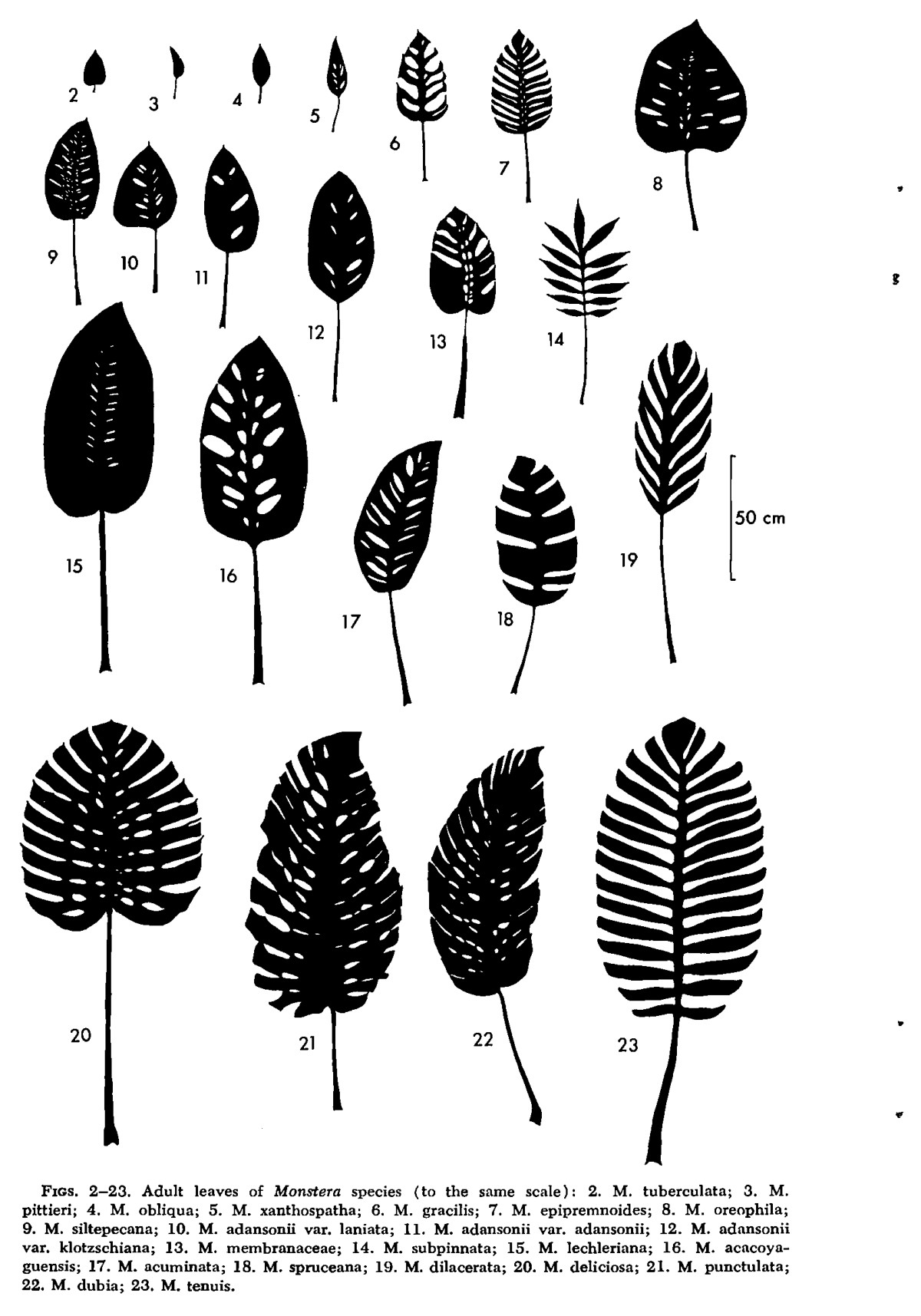
Madison drew the adult leaves of twenty-two Monstera species to a single scale and put them on one page. It is the most useful picture of the genus anyone has made, and it repays a long look.
Now the same thing, within one species
Everything above compares species with species, which is what a plate like that is for. The three plates that follow do something harder to argue with: each shows leaves taken from different individuals of a single species, drawn to one scale.
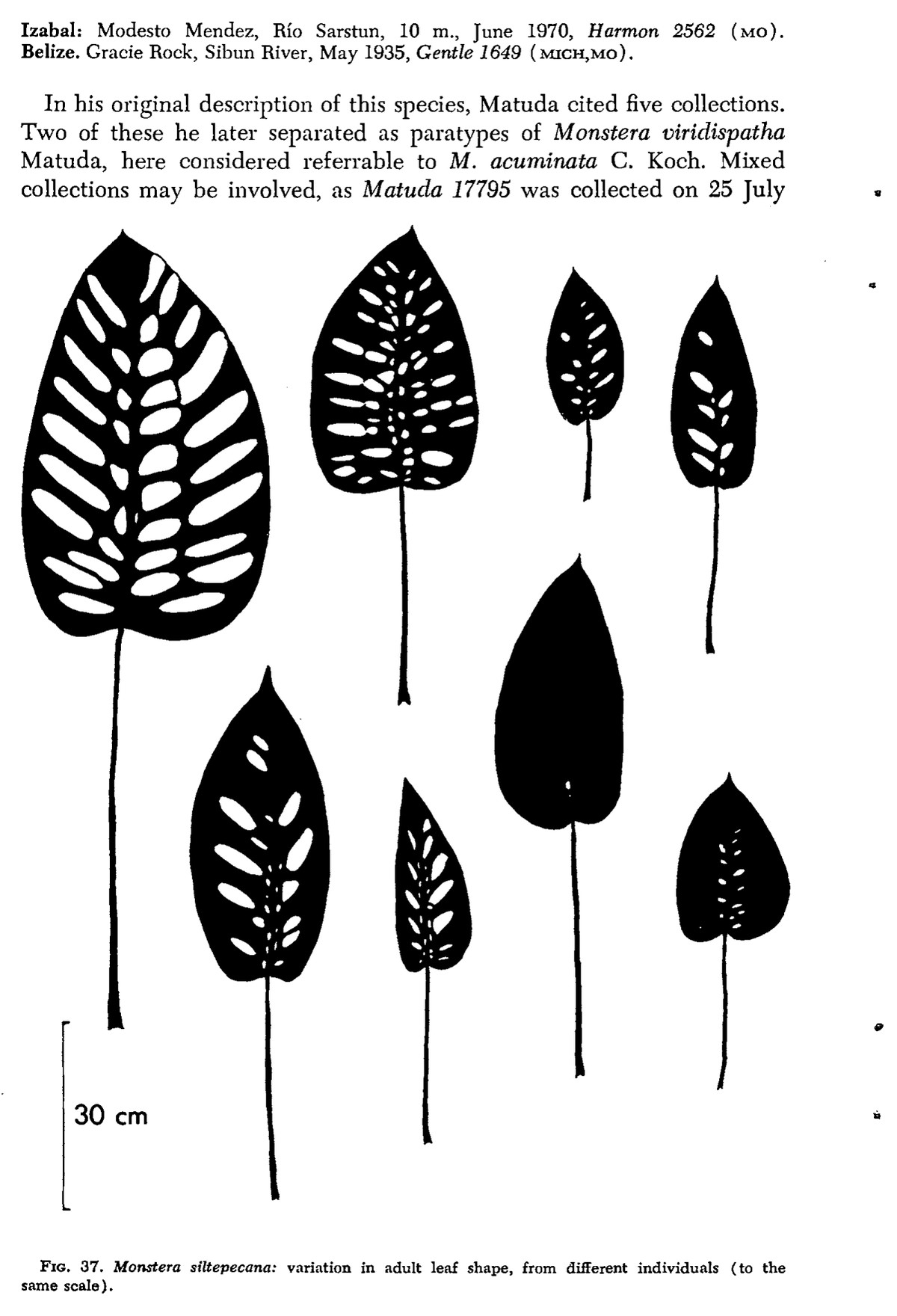
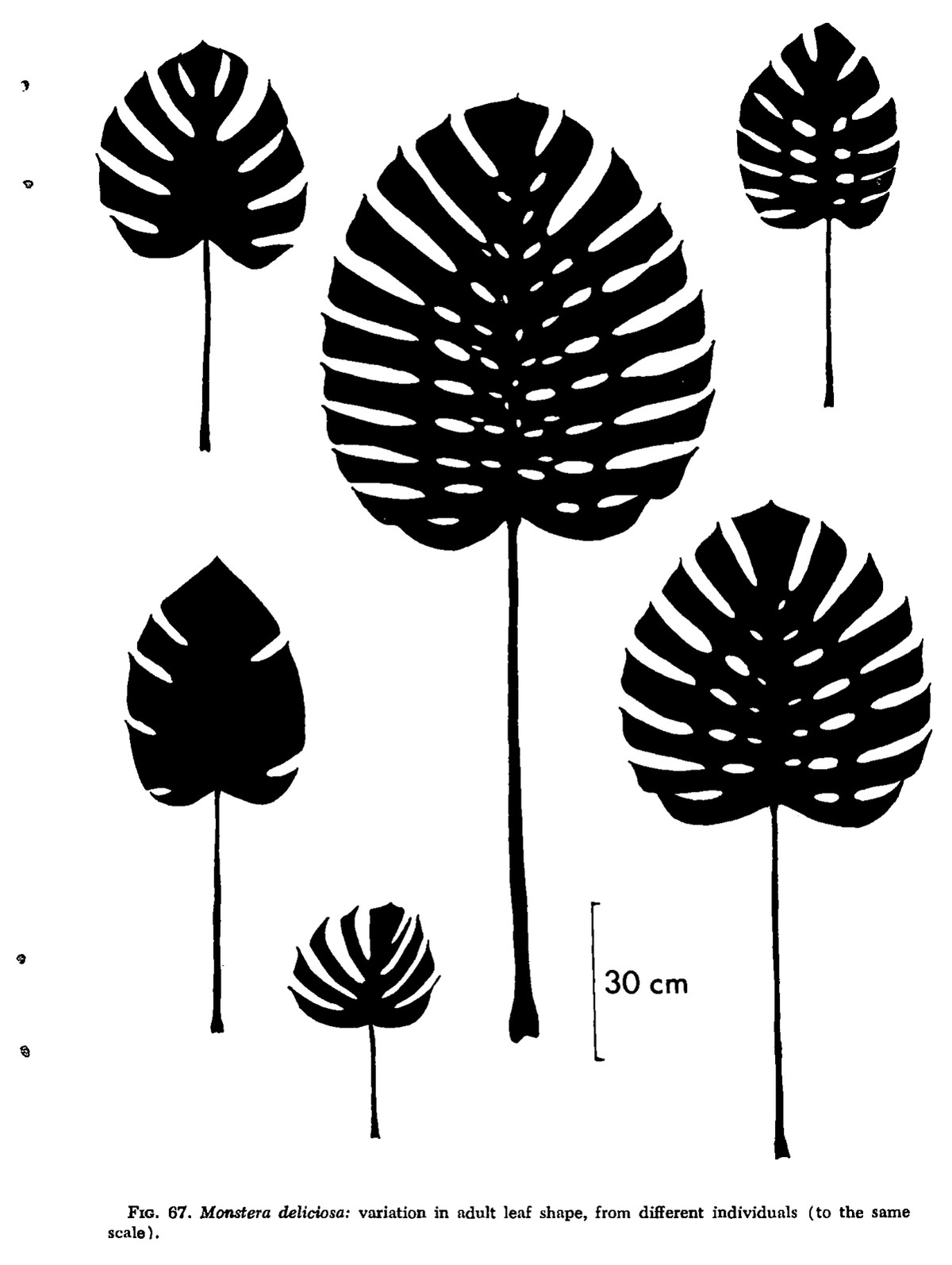
What follows from this
A leaf photographed on its own carries less information than it appears to. It tells you the species' range includes that shape. It does not tell you the species, because the range of one species covers the range of several others, and because the same plant produced different shapes at different points in its own life.
The characters that held, when Madison looked, were the ones this page spent its first four parts on: how the seedling crossed the ground, whether the juvenile shingled, the length of an internode, the shape of a leaf scar, how the adult sits on its tree. None of those is what a photograph of a leaf shows you.
The plant that makes the point twice
Monstera tuberculata appears at the top left of the first plate as one of the small entire leaves, and in Part IV as the species that flowers on a shoot which is morphologically a juvenile. Its leaves never become the thing this genus is famous for. By the leaf it is barely a Monstera at all. By the shoot it is unmistakable.
A leaf is a moment. The shoot is the plant.
The papers behind this page
One revision does most of the work here. Michael Madison's 1977 treatment is the only account of Monstera growth habits written from field observation across the whole genus, and nearly every structural statement on this page comes from it.
- Madison, M. (1977). A revision of Monstera (Araceae). Contributions from the Gray Herbarium 207: 3–100. The spine of this page: the morphology and growth-habit sections, the four shoot types, the two seedling syndromes, the shingle plant and its water-stress explanation, the root dimorphism, the geniculum as the upper pulvinus, the rotated Monstera deliciosa, the fenestration ontogeny, and every figure reproduced above.
- Cedeño-Fonseca, M., Hay, A. & Blanco, M. A. (2022). A taxonomic revision of Monstera Adans. (Araceae, Monsteroideae, Monstereae) in Costa Rica. Aroideana 45(1): 2–197. The source of the term used here for the habit — nomadic vine — and one of the two modern revisions that treat Madison's sections as convenient groupings rather than lineages.
- Croat, T. B., Cedeño-Fonseca, M. & Ortiz, O. O. (2024). Revision of Monstera (Araceae: Monsteroideae) of Central America. Phytotaxa 656(1): 1–197. Fifty-two treatments; the second modern revision, and the source for skototropic seedlings being treated as a character of the genus rather than of one studied plant.
- Zuluaga, A., Llano, M. & Cameron, K. (2019). Systematics, biogeography, and morphological character evolution of the hemiepiphytic subfamily Monsteroideae (Araceae). Annals of the Missouri Botanical Garden 104: 33–48. The phylogeny behind the statement that the sections are not groups: Monstera acuminata and Monstera spruceana sitting among section Monstera species, and Monstera tuberculata nesting inside a Marcgraviopsis group.
- Strong, D. R. & Ray, T. S. (1975). Host tree location behavior of a tropical vine (Monstera gigantea) by skototropism. Science 190: 804–806. The original description of growth toward darkness. The name Monstera gigantea is the one the paper uses; see reference 1 on why the plant cannot now be identified with confidence.
- Muir, C. D. (2013). How did the Swiss cheese plant get its holes? The American Naturalist 181(2): 273–281. The growth-variance model, the ratio of leaf area to spanned ground, the proposed light-sensor falsification, and the objections to the cooling and camouflage explanations. A model, not a measurement — the paper reports no field data.
- King, H. W. (1892). The physiology of Monstera deliciosa. Journal of the Quekett Microscopical Club 5: 125–136. The origin of the idea that the holes let water through to the roots. Reported and rejected in reference 1, which is how it reaches this page.
- Fetcher, N. (1981). Leaf size and leaf temperature in tropical vines. American Naturalist 117: 1011–1014. The measured null against the cooling explanation, summarized in reference 6, which is how it reaches this page.
- Melville, R. & Wrigley, F. A. (1969). Fenestration in the leaves of Monstera. The classical account of a hole forming, and the diffusion-reaction reading of the hole spacing that reference 1 calls unverifiable. The drawings are used in the companion section on the family.
Where to go next
The companion section on aroid morphology puts these characters beside the rest of the family, and carries the venation, root and fenestration figures referred to above. The Monstera reproduction guide covers the inflorescence, the beetles and the fruit, none of which this page touches.