
Araceae · Morphology
THE PHILODENDRON CATAPHYLL
The classification is in the parts you throw away
Opening
The most useful part
is the part you throw away
Every Philodendron makes a cataphyll: a bract-like sheath that wraps and protects each new leaf while it develops, then dries, and then either drops off or does not. Growers pull them off. Photographers crop them out. Thomas Croat, who revised the Central American species across nearly four hundred pages, wrote that in the taxonomy of this genus probably no morphological character is more diagnostic1.
That is the argument of this page, and the genus makes it in an unusually blunt way.
The blade is the problem, not the answer
People buy Philodendron for the leaf. It is the wrong organ to identify one by, and the reason is not that the blade is dull — it is that the blade is too varied. Croat's assessment of adult blade shape in the subgenus is that it encompasses more morphological variation than the other two subgenera, and indeed all the variation exhibited in the much larger genus Anthurium1.
Read that against the companion guide to Anthurium. POWO accepts 1,460 species of Anthurium against 628 of Philodendron2 — eight hundred and thirty-two more — and one subgenus of the smaller genus covers the whole of that range in leaf shape. A character that takes every possible value separates nothing.
The comparison Croat draws himself
Writing about whether cataphylls are deciduous or persistent, he calls it the single feature that makes the preparation of keys to species of Philodendron easier than those for Anthurium1. Two genera, both huge, both hard. The one with an extra throwaway organ is the easier of the two — because that organ behaves consistently while the leaf does not.
What this page looks at, and in what order
It works outward from the stem, because that is where the reliable characters are, and it reaches the blade last — not as a slight, but because by then you can see why it comes last.
The cataphyll first, and how it dies. Then the petiole, which in this genus is read in cross-section like a piece of molding. Then the sap and the resin, which are characters you can only get from a cut plant. Then the stem and the scars a fallen leaf leaves behind. Then the roots, which come in two kinds doing two jobs. And then the blade, with a fair account of what it can and cannot tell you.
Almost none of it survives in a photograph of a leaf.
Look at what the plant discards. It is more honest than what it displays.
Part I
The cataphyll, and how it dies
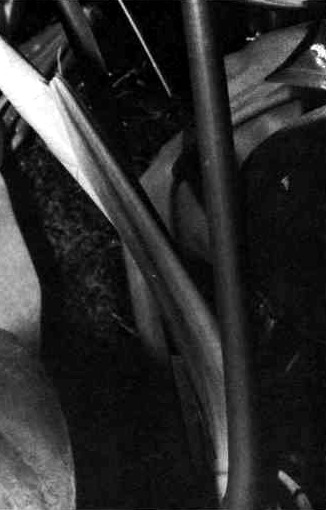
A cataphyll is a modified leaf reduced to its protective job. In Philodendron it wraps the whole circumference of the stem around the next emerging leaf, and it is substantial: narrowly triangular, two and a half to four times longer than wide, its base as broad as the stem itself, and on the largest species more than a centimeter thick at that base1. Size tracks leaf size within a species, running from about 10 to 50 cm long — and to 70 cm at the extreme1.
Then the leaf opens, and the cataphyll's working life is over. What happens next is the character.
Four fates, and they are countable
Croat sorted every Central American species in the subgenus by what its cataphylls do. The result is unusually clean for a morphological character:
| Fate | Taxa | What you would see |
|---|---|---|
| Deciduous | 56 | Falls free. A clean stem, with scars. |
| Persists intact | 6 | Stays whole and dry on the stem. |
| Persists semi-intact | 25 | Partly broken down, still sheathing. |
| Persists as fibers | 17 | Reduced to an organized network of strands. |
Fifty-six against forty-eight, and the forty-eight split three ways1. A few species are tardily deciduous and a few persistent ones eventually shed, but Croat records that relatively few are genuinely hard to place1. That is what a good character looks like: most individuals fall clearly into one state.
The broad rule is that cataphylls are deciduous on vines and persistent on appressed climbers, with exceptions both ways1.
Why a dead sheath is worth keeping
The persistence is not inertia. Even reduced to fibers, the mass retains moisture much as a pile of straw does after rain, and it goes on protecting the stem apex and, particularly, the young roots growing through it1. In some species the youngest cataphylls sit in a gelatinous, mucilaginous fluid filling the gaps in the mass. Fresh cataphylls are rigid and firm, shielding the soft new leaf from physical damage; as the thicker, fleshier ones break down they release watery or gelatinous sap, which Croat suggests may lubricate the emerging leaf1.
Reading one on a real plant
Several things are worth looking at, and they are all visible without a lens1.
Cross-section. Frequently sharply D-shaped, sometimes subterete. A subterete one may be unribbed, bluntly one- or two-ribbed, or sharply one-ribbed. A D-shaped one is often raised along the edges of its flat face so that it reads as two-ribbed. The ribs may be low and close together, or slender and knife-edged and as much as a centimeter high — as in Philodendron auriculatum and Philodendron annulatum.
Color, fresh. Usually green; almost white in Philodendron wilburii; bright red or heavily red-tinged on exposed parts in Philodendron antonioanum, Philodendron niqueanum and Philodendron tysonii; reddish in Philodendron glanduliferum, Philodendron grandipes and Philodendron pirrense.
The fibers, if there are any. Their color runs from almost white through tan and brown or yellow to reddish brown. Their arrangement matters too: some species keep a highly organized network, while in Philodendron tenue and Philodendron panamense the fibers are thoroughly disheveled.
The epidermis. In most species it falls promptly. In some it persists in whole or in part — and in Philodendron schottianum the distinctive yellowish cataphyll epidermis is one of the most characteristic things about the plant1.
A caution about old stems
Given time the lowermost cataphylls simply rot away, even on species that carry a large mass, so the oldest part of a stem ends up bare1. A plant can therefore show you the wrong answer at the bottom and the right one at the top. Look where the leaves are.
Whatever the cataphyll does, it leaves a mark. That is the next part but one, and the marks are readable years later.
Part II
The petiole, read in cross-section
Most Philodendron species have terete or subterete petioles — round, or nearly so. The interest is in the ones that are not, and in what the surface is doing.
The shapes
Cut a petiole across and you get a profile, and the profile is diagnostic1. Some are subterete but sharply grooved on the upper side. Some carry a medial rib — sharp enough in Philodendron jodavisianum, and occasionally Philodendron grandipes, to give the petiole a three-ribbed look from above; more often broad and blunt, as in a long list that includes Philodendron annulatum, Philodendron ligulatum, Philodendron schottianum and Philodendron tripartitum.
At the extremes: Philodendron platypetiolatum is flattened front to back, much broader than thick, its lateral margins nearly sharp. And a few are thicker than broad and U-shaped in section — Philodendron roseospathum, Philodendron jodavisianum, sometimes Philodendron davidsonii, though that last is more often obtusely V-shaped1.
The character is fine enough to separate close relatives: Croat notes Philodendron grandipes with a D-shaped petiole against Philodendron jodavisianum with a U-shaped one1.
The scales, and where they sit
A minority of species carry scales on the petiole, and these behave like a character system of their own — not just present or absent, but of a particular shape, in a particular place1.
In Philodendron malesevichiae, Philodendron glanduliferum and Philodendron squamipetiolatum the scales are needle-like and more or less round in section, and densely granular-scurfy on the surface; spreading in the first two, sometimes pointing backwards near the petiole apex in the third. Philodendron hammelii has short scales broadened sideways, like fish scales, under three times longer than broad.
Two species carry two kinds at once. Philodendron verrucosum has short, broad, often torn scales among long needle-like ones. Philodendron squamicaule has short purplish triangular scales, broader than high and about 2 mm, among green needle-like ones 3–5 mm long1.
Where they are is as diagnostic as what they are
Scattered along the whole petiole in Philodendron squamipetiolatum, Philodendron squamicaule and Philodendron verrucosum. Confined to the upper part and getting denser downwards in Philodendron malesevichiae. Similar but crowded toward the tip in Philodendron glanduliferum. Restricted to a small patch near the apex in Philodendron hammelii. And in Philodendron ornatum, the extreme of the series, reduced to stubby bumps at the petiole apex and nowhere else1.
The ring
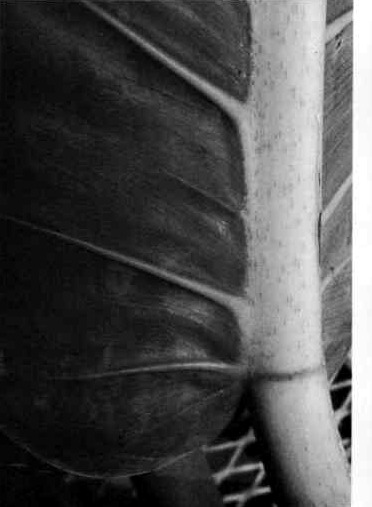
Fresh petioles of Philodendron subsect. Glossophyllum usually carry a distinct ring right around the petiole just below the blade — purplish or purple-black in Philodendron annulatum, Philodendron bakeri, Philodendron correae and Philodendron ligulatum; dark green in Philodendron auriculatum, Philodendron immixtum, Philodendron dolichophyllum, Philodendron pseudauriculatum and Philodendron wendlandii1.
⚠ It is not confined to that group. Croat lists apparently unrelated species with purple rings at the petiole apex, among them Philodendron brenesii, Philodendron davidsonii, Philodendron dressleri and Philodendron warszewiczii1. A ring narrows the field; it does not close it.
Inside the petiole: a pattern named after this genus
Cut the petiole and the outline is only the first thing you get. A survey of 115 species across 56 genera — about half the family — scored the arrangement of collenchyma, the thickened supporting tissue, in cross-sections taken midway along the petiole3. It found essentially two arrangements, and named them after the groups they were first seen in.
The philodendroid pattern is a ring of collenchyma running right round the petiole, either continuous or interrupted. The colocasioid pattern is rounded strands set concentrically and tied to the peripheral vascular bundles3. One of the two standard descriptions of an aroid petiole is named after this genus.
Why that matters for identification
The survey's own finding is that the pattern is very conservative within genera, apparently not changing qualitatively with developmental or environmental conditions3. That is the rarest thing in this whole page: a character that does not drift with the age of the plant or where it was grown — unlike, as Part VI will put it, the blade.
Within Philodendron the ring is often segmented by narrow intrusions of parenchyma, one to four cells across, as in Philodendron uliginosum and Philodendron pedatum3. The genus that gives the pattern its name does not hold it perfectly uniform, which is worth knowing before anyone treats a type as a definition.
A character that did not work
Not every petiole character survives contact with real plants, and one failure is worth recording because it was built into the classification.
Engler and the firmness of a petiole
Engler used petiole firmness as one of his major key characters, separating subsections with very fleshy petioles from groups with firm ones. Croat's verdict is that the character is difficult to quantify and difficult even to describe1. Most species sit somewhere between firm and weakly spongy when squeezed, and are flexible enough to bend a long way without breaking. The one clear observation is a correlation, not a key: genuinely spongy petioles — Philodendron ligulatum can be crushed in the hand — also tend to be brittle.
A character you cannot state a threshold for is a character two people will score differently.
And he had a better one in front of him
This is the part worth sitting with. The collenchyma patterns above were known in Engler's own time. He judged them taxonomically meaningless — because they were not congruent with his classification3. So the petiole offered him a character that is stable within genera and he set it aside for disagreeing with him, while building keys on a firmness he could not describe.
A character is not wrong for failing to confirm you.
The joint at the top, and what it is said to do
In Philodendron a geniculum is typically not obvious as a swelling, but the genicular area is there, and Croat says it serves the same purpose it does in Anthurium: inclining or twisting the plane of the blade, presumably optimizing exposure to sunlight1. Usually the area is a little firmer than the rest of the petiole.
That word is doing a lot of work
“Presumably” is Croat's own. This is now the third major treatment on this site — with Alocasia and Anthurium — to state the geniculum's function as something everybody knows, and no published study tests it. The Monstera guide reports the single nearest observation anybody has found, a potted plant rotated by a window, and explains why one plant is not an experiment.
The structure is real and the movement has been seen. The purpose remains an assumption that three monographers in a row have passed along.
Part III
The sap, which only a cut plant will show you
Some characters cannot be photographed and cannot be got from a herbarium sheet. They need a living plant and a knife, which is why they are underused and why they are worth knowing.
Resin
Cut a Philodendron petiole and it will usually bead with resin, in the same way the stem does, and in time the cut may become completely covered in it1. Resin is not incidental to this genus: the anatomical work Croat summarizes found resin canals with sclerotic sheaths among the distinctive features of Philodendron roots1.
It is the same substance that matters at flowering time, when resin is produced on the inflorescence and ends up on the beetles — the companion reproduction guide covers that side of it. What is worth carrying here is that the resin is a whole-plant character, not a floral one.
And it is a character twice over. Later work on root anatomy found that the tissue sheathing those ducts differs between subgenera — sclerified in subg. Philodendron and subg. Pteromischum, parenchymatous in subg. Meconostigma4. Part V returns to it.
White sap, and a species named for it
A few species do something different. Philodendron albisuccus has copious white sap that turns chalky as it dries — the epithet is built from albus, white, and succus, juice. Croat records only one other Central American species sharing the feature, Philodendron cretosum, and notes it may belong in the same series despite its very different linear to oblanceolate blades1.
A character that outvotes the leaf
That is the argument of this page in one sentence. Two species whose blades look nothing alike are placed together on the strength of what color their sap dries. The leaf is the loud character; the sap is the informative one.
Rarer still is latex. On broken or partly severed petioles of Philodendron malesevichiae Croat records slender strands of it1.
The sap inside a rotting cataphyll
Part I mentioned this and it belongs here too. The thicker, fleshier cataphylls hold a good deal of liquid, and as they break down they release watery or even gelatinous sap. Croat suggests it may lubricate the emerging leaf and protect it from damage on the way out1. In some species the youngest cataphylls sit in a mucilaginous fluid that fills the gaps in the mass.
Sugar on the underside of a new leaf
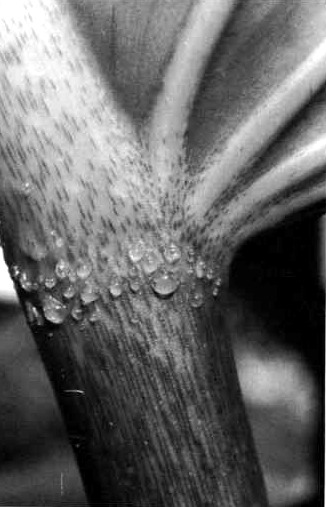
The last one is the strangest. Some petioles produce a cluster of viscid droplets of a sweet, sugary solution on the underside, at the apex, on the youngest leaves only. Croat records it on Philodendron davidsonii subsp. bocatoranum and on Philodendron megalophyllum1.
What the droplets are for is not known
Croat is careful about this and the page will be too. He observes that the droplets have no apparent role in pollination, and then writes that he speculates they attract ant guards, which would protect the plant from plant-eating insects — the more likely, he reasons, because the droplets appear on new leaves, which are the tenderest and most easily damaged1.
That is a hypothesis with a sensible argument behind it and no test. Nobody has excluded ants from a droplet-bearing plant and counted the damage. Until someone does, the droplets are an observation in search of a reason.
Three of the four things in this part — the resin, the white sap, the sugar — disappear the moment a specimen is dried. That is the honest reason they are underused, and it is not a good one.
Part IV
The stem, and the scars it keeps
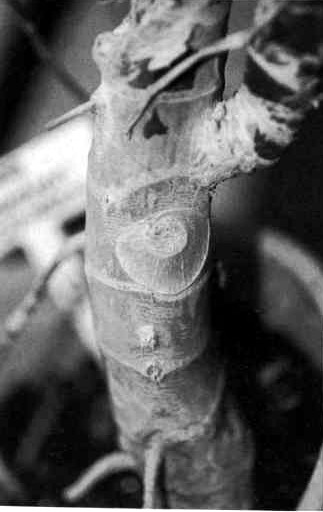
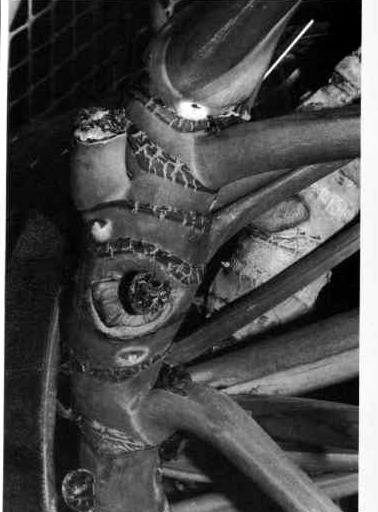
A Philodendron stem is a record of everything it has dropped. Leaves fall away with their petioles; cataphylls fall or rot; inflorescences abscise. Each leaves a mark, and the marks are readable.
Two kinds of scar, alternating
Because a cataphyll is attached around the whole circumference of the stem, when it goes it leaves a scar right around. Those cataphyll scars alternate with the petiolar scars up the stem1 — one leaf, one sheath, one leaf, one sheath — so the stem carries the plant's alternating rhythm in relief.
Petiolar scars are usually the broader of the two, because the petiole is markedly swollen where it meets the stem1.
How big, on 32 species
Petiole scars run from about 1 to 4 cm high — 0.5 at the low end, 7.5 at the high — and roughly 1 to 5 cm across, exceptionally 7. Averaged over the 32 species Croat measured, a petiole scar is 2 cm high and 2.4 cm across1.
That is a sample average, not a value for the genus, and the spread around it is wider than the average itself.
On species with persistent cataphylls the petiolar scars may not show at first, because the mass hides them; they usually appear on older stems. Even then, Croat notes, they are never as conspicuous as the petiolar scars in Philodendron subg. Meconostigma1.
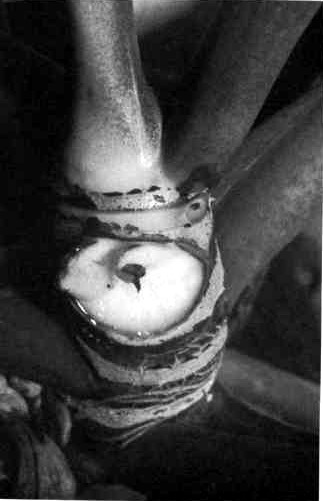
The hole an inflorescence leaves
The peduncular scar is a different matter. It is often conspicuous and deep — and Croat draws an ecological consequence from it that is worth knowing if you grow these plants:
A flowered stem has a way in
The deep holes left when inflorescences fall off are points of entry for plant-eating insects, especially stem borers1. Flowering does not merely cost the plant energy; it opens the stem. A plant that has flowered repeatedly carries a row of these.
A character you need a lens and a subgenus for
Intravaginal squamulae are the small scales sitting in the leaf axils. In Philodendron subg. Meconostigma they are sometimes obvious; in subg. Philodendron they are usually small and inconspicuous1. What matters is not their size but where they sit.
In subg. Philodendron they are always immediately above the cataphyll. In subg. Meconostigma they sit immediately below the cataphyll scars, and often around the foliage-leaf scar as well. Mayo stressed this difference as evidence that the two groups are doing something structurally different1.
Where the stem puts itself
Habit varies more than the word “climber” suggests. Some species are creeping — the stem of Philodendron glanduliferum is usually repent — and most are terrestrial to begin with1. Others hold position in places that ought to shed them: Croat notes Philodendron lentii and Philodendron squamicaule persisting in excellent condition on steep roadbanks1.
The point for identification is the one Part I made about cataphylls: the vines mostly shed theirs, the appressed climbers mostly keep theirs. Habit and cataphyll behavior are not independent characters, and reading them together is more informative than reading either alone.
Part V
Two kinds of root, doing two different jobs
Every Philodendron produces adventitious roots at some or all of its nodes, and how many it makes has more to do with the situation than with the species — plants climbing appressed to a surface, in close contact with it, generally produce the most1. That makes root number a poor character. Root kind is a good one.
Anchor and feeder
The roots come in two types that differ both in form and in anatomy1.
| Anchor root | Feeder root | |
|---|---|---|
| Job | Holding the plant on its substrate | Water and nutrients |
| Form | More numerous and shorter, often with a dense layer of root hairs — sometimes only on the side touching the substrate | Much thicker and longer, running down toward the ground |
| Where it arises | On the internodes | Only at the nodes |
| Inside | Proportionately much smaller central cylinder, and more mechanical tissue to give it strength | Much broader central cylinder, with broader vessels and sieve tubes |
The anatomy follows the job exactly: the root that must hold is built for tension, and the root that must conduct is built as a pipe.
Which way each one grows
Anchor roots are not fussy about direction — they take whatever line the surface offers. They may spread from the nodes, as in Philodendron auriculatum, or run closely appressed to the bark of the host, as in Philodendron gigas1.
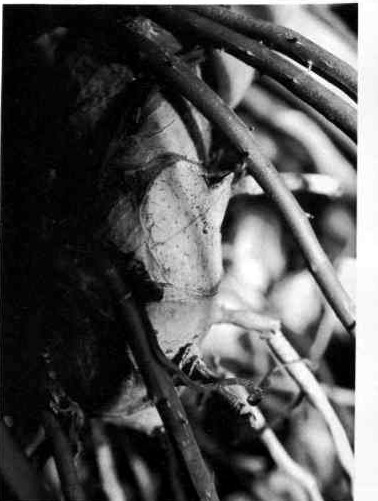
Feeder roots are directional, and for a reason worth stating: the work Croat cites found that aroid feeder roots are negatively heliotropic and positively hydrotropic1 — they grow away from light and toward water. On a plant several meters up a trunk, those two tendencies point the same way, which is down.
The same division, in an unrelated genus
The Monstera guide describes this same split, under the names Went gave it in the 1890s, and with the same details: anchor roots on the internodes holding by root hairs, feeder roots at the nodes running to the ground. Two large climbing genera in different subfamilies, arriving at the same two-tool solution to the same problem — how to hold on to a tree and still drink.
The companion section on the family carries a photograph of the two types side by side.
What the anatomy adds
Under a microscope Philodendron roots have several features worth recording, from the anatomical work Croat summarizes: a distinct exodermis beneath the epidermis with a long-cell/short-cell pattern; a cylinder of thick-walled, pitted sclereids next to the endodermis, with similar sclereids singly or in bands among corky cells in the skin of older roots; a sclerotic hypodermis, shared with the rest of the tribe but distinctive here for sitting next to the exodermis and appearing in the primary axis; and resin canals with sclerotic sheaths1.
That last one connects back to Part III. The resin is not just something that beads on a cut — it has dedicated plumbing, right down into the roots.
What a microtome adds
Croat could only summarize what was known in 1997. A study built entirely on Philodendron adventitious roots has since sectioned them across the genus, from the apex to the mature zones, and asked which anatomical characters carry taxonomic weight4. Its answer is the sharpest evidence yet that in this genus the characters that divide are the ones nobody can see.
| Character | subg. Philodendron | subg. Pteromischum | subg. Meconostigma |
|---|---|---|---|
| Exodermal cell shape | Cylindrical or quadrangular | Quadrangular | Lozenge-shaped |
| Sheath of the resin duct | Sclerified | Sclerified | Parenchymatous |
| Maturity of the endodermis | Stage III | Stage III | Stage I |
| Shape of the stele | Cylindrical | Cylindrical | Lobed |
| Long strands of phloem | Present | Present | Absent |
| Sclerified outer cortex | Absent | Present | Absent |
| Epidermis | Uni- or biseriate | Uniseriate | Uniseriate |
| Thickening in the pericycle | Present or absent | Present | Absent |
| Storied cork | Absent | Absent | Present or absent |
One subgenus separates on five characters at once
Read the right-hand column. Philodendron subg. Meconostigma differs from both other subgenera in the shape of its exodermal cells, the tissue sheathing its resin ducts, how far its endodermis matures, the shape of its stele and the absence of long phloem strands4. Five characters, none of them visible without cutting the root and putting it under a microscope.
Part IV said the two subgenera differ in where a scale sits relative to a scar. This is the same story one order of magnitude further in: the deepest divisions in the genus are recorded in tissue, not in outline.
The lobed stele is the most striking of them — in the feeder roots of Philodendron bipinnatifidum the vascular cylinder is not a cylinder at all4. And the resin ducts of Part III turn out to be a character twice over: not only that they exist, but what tissue wraps them.
How firm is a nine-character table?
Firmer than a guess and softer than a key. The study's own framing is that the three subgenera lack a well-defined classification, and it offers these characters as candidates worth testing rather than as a settled diagnosis4. Several states are given as “present or absent”, which is an honest way of saying the sampling has not yet decided. Treat the table as the best current answer to a question still open.
Why you will rarely see this recorded
Croat notes that root surface features — smooth, coarse, even warty, and the dried color and how much they are fissured or folded — are all recordable characters that have not been used extensively, for an entirely practical reason: the roots are generally removed from the stems before a herbarium specimen is prepared1.
A character can go unused because it is uninformative, or because of how specimens happen to be made. This is the second kind.
Part VI
The blade, and why it comes last
Everything so far has been the parts a photograph misses. This part is about the organ the photograph is of — and about giving it its proper weight, which is real but smaller than anyone expects.
How it comes out of the bud
Like most of the family, Philodendron leaves have supervolute vernation1: the developing blade is rolled, one margin wrapped over the other, rather than folded. That is what the cataphyll of Part I is protecting, and it is why a newly opened leaf can carry the memory of the roll for days.
The heteroblasty that is not there
Philodendron leaves change from juvenile to adult like most aroids. What is notable is how little they change.
Croat draws the comparison himself
Heteroblasty in Philodendron subg. Philodendron, he writes, is not so severe as in other Araceae, especially in the subfamilies Lasioideae and Monsteroideae1. Typically the juvenile blades are not dramatically different from the adults: commonly the same shape, ovate to oblong, and virtually always lacking posterior lobes.
Monsteroideae is Monstera. The companion guide to that genus is largely about a plant that passes through four structurally different kinds of shoot and had a juvenile described as a dicot. Philodendron mostly just gets bigger. Two climbing aroids, opposite answers to the question of how much to change on the way up.
Velvet, and what it costs
A few species do change in one striking way. In Philodendron hederaceum var. kirkbridei the juvenile blades are velvety, and the cause is not hairs: it is markedly convex, even somewhat cone-shaped epidermal cells1. Croat's reading of the ecology is that the lack of glossiness lets nearly all the light falling on the leaf be absorbed rather than reflected away.
In all but a few species the velvety juvenile leaves are replaced by glossy or semiglossy adult ones. Philodendron gigas is the notable exception — it keeps the velvet1.
Readers of the Anthurium guide will recognize this immediately: the same convex-celled surface, doing the same optical job, in a genus where it is one of the headline characters. Here it is a juvenile trait that most species grow out of.
And then the shape, which tells you least
Now the claim this page opened with, in its place at the end.
The range of one subgenus
In adult blade shape, Philodendron subg. Philodendron is “exceedingly diverse, encompassing more morphological variation than is exhibited in” the other two subgenera and indeed all the variation exhibited in the much larger genus Anthurium1 — a genus of 1,460 accepted species against this one's 6282.
Croat adds that virtually the entire range of leaf-shape variation in the genus as a whole turns up among the Central American species alone1. You do not even need the whole continent to see it.
This is why the blade comes last. It is not that leaf shape carries no information — a deeply pinnatifid blade with posterior lobes is telling you something. It is that the variation is so wide, and so much of it turns up within small groups of species, that shape alone will rarely take you to a name. The cataphyll's four states, the petiole's profile, the color the sap dries: those narrow the field faster.
One practical note
Leaves are typically clustered at the end of the stem, and there are rarely more than ten at a time1. Older ones fall free along with the petiole; in some species the blade drops first and the more persistent petiole follows. So a plant is showing you a short window of its own history, and the stem below it — scars, cataphylls, roots — holds the rest.
The leaf is the advertisement. The stem is the record.
The papers behind this page
One revision carries most of this, and a recent anatomical study carries the rest. Thomas Croat's treatment of Philodendron subgenus Philodendron for Mexico and Central America runs to nearly four hundred pages and devotes its whole front section to vegetative morphology, character by character, before reaching a single species description.
- Croat, T. B. (1997). A revision of Philodendron subgenus Philodendron (Araceae) for Mexico and Central America. Annals of the Missouri Botanical Garden 84(3): 311–704. The spine of this page: the cataphyll counts and their four states, the petiole cross-sections and scale types, the petiole ring, Engler's firmness character and why it failed, the resin and the white sap, the sugary droplets, the scar measurements and the stem borers, the two root types, the vernation, the heteroblasty comparison, the velvet epidermis, and the claim about blade variation that this page is built around. It also reports the anatomical and developmental work of French, Mayo, Grayum, Cullen, Goebel and Sandt, and Engler and Krause, named in the text above where their findings are used.
- Canal, D., Köster, N., Celis, M., Croat, T. B. & Borsch, T. (2019). Out of Amazonia and back again: historical biogeography of the species-rich Neotropical genus Philodendron (Araceae). Annals of the Missouri Botanical Garden 104: 49–68. The phylogenetic framework this site uses for the genus. Species totals quoted above follow POWO, as they do across the site.
- Gonçalves, E. G., Paiva, É. A. S. & Coelho, M. A. N. (2004). A preliminary survey of petiolar collenchyma in the Araceae. Annals of the Missouri Botanical Garden 91: 473–484. One hundred and fifteen species across fifty-six genera, roughly half the family. The source of the philodendroid and colocasioid patterns, of the finding that the character is conservative within genera, and of Engler's dismissal of it.
- Ferreira, R. de O., Borges, A. C. C., Campos, J. A. R. dos, Medeiros, A. M. L., Sakuragui, C. M., Vieira, R. C. & Tenorio, V. (2020). Anatomy of the adventitious roots of Philodendron (Araceae) and its importance for the systematics of the genus. Australian Systematic Botany 33: 207–219. doi:10.1071/SB18038 Adventitious roots sectioned across the genus and scored for taxonomic characters. The source of the subgenus comparison in Part V, of the lobed stele of Philodendron bipinnatifidum, and of the resin-duct sheath as a character in its own right.
Where to go next
The companion section on aroid morphology places these characters beside the rest of the family. The guides to Alocasia, Anthurium and Monstera each take a different organ as their subject, and two of them are referred to above — Anthurium for the velvet epidermis and for the comparison Croat draws about keys, Monstera for heteroblasty and for the same two kinds of root. The Philodendron reproduction guide covers the inflorescence, the beetles and the heat, none of which this page touches.