
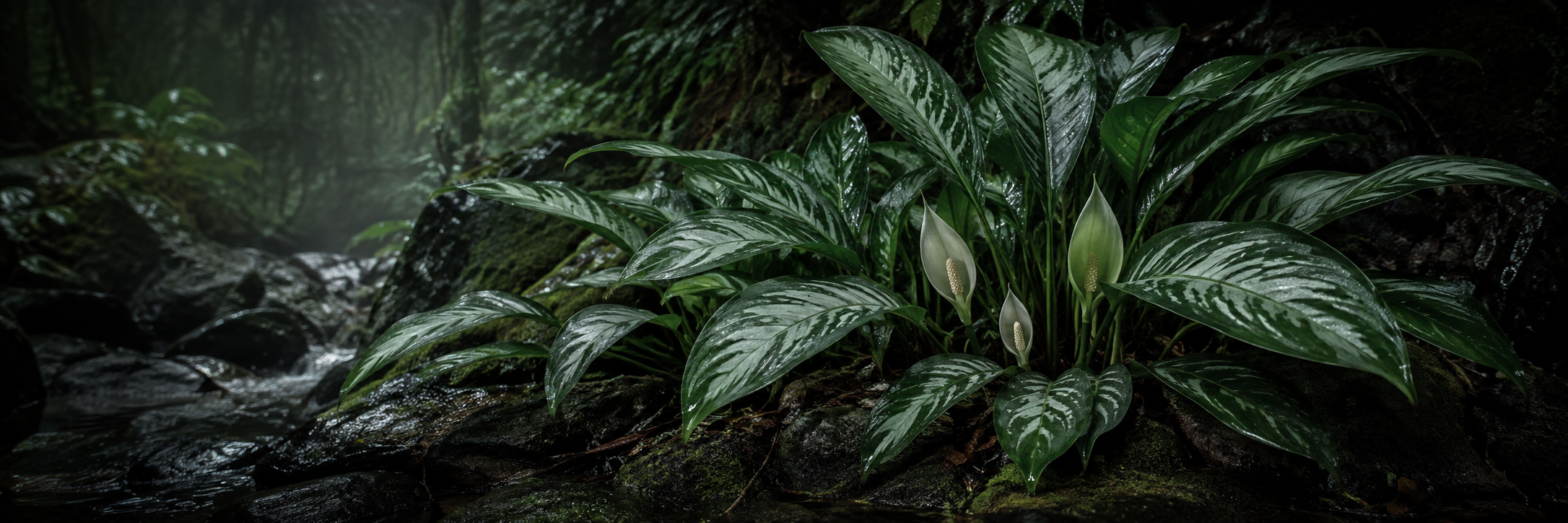
Araceae · Reproductive Biology
THE SCHISMATOGLOTTIS INFLORESCENCE
Four-fifths of every insect caught is one kind of fly — and the beetle that carries fifteen times more pollen had never been recorded in the family
In the best-watched group of this genus a single kind of fly turns up at every inflorescence, in every species, every time — four out of every five insects caught. It is not the most useful pollinator there. A small water-scavenger beetle, six times rarer, leaves carrying several hundred grains to the fly’s few dozen.
Schismatoglottis is a tropical Asian genus of forest-floor and streamside herbs, centred on Borneo and reaching Peninsular Malaysia, the Philippines, Sulawesi and the Moluccas. This site’s own data carries 97 accepted species. Almost all of them have never been watched in flower.
What this page is about, and what it is not about
Everything known about pollination in this genus comes from three studies of 14 species, and all fourteen belong to one group within the genus — the Calyptrata Group.
This page therefore describes that group. Where it names a fly, a temperature or a scent, the subject is the Calyptrata clade or the named species. None of it is established for Schismatoglottis as a whole, and the page does not say that it is.
How much has actually been watched
Ten species have been watched at the flower with a visitor named. Four more have had their temperature recorded but no insect looked for. One of those four has never been described and is carried here as an undescribed collection, not as a species name.
The shelf is recent and it is the work of essentially one group: field campaigns running 2009 to 2015, published 2016, 2018 and 2020, almost all of it Bornean, and experimental rather than anecdotal — bagged inflorescences, mesh exclusions, insect washes counted on a ruled slide, and thermocouples logging every five minutes.
The best-supported statement about this group
Inflorescences bagged before opening, so that no insect could reach them, set no fruit at all. Three species, two studies, one answer.
There is no apomixis and no autonomous self-pollination here. An insect is required. Everything else on this page is about which insect, and how much it is worth.
Two things recorded here for the first time
A beetle nobody had counted as an aroid pollinator
The genus Cycreon is a water-scavenger beetle (Hydrophilidae). Its appearance in these inflorescences is the first record of the genus as a pollinator anywhere in the Araceae, and it has still never been identified to species — in either study, by any of the three specialists who examined it.
Pollen handed from one kind of insect to another
Leaf beetles of the genus Chaloenus sit on the sterile tip of the spadix and eat it. They leave carrying pollen — but not because they went anywhere near the anthers. The flies crawl over them, and the pollen rubs off.
The 2016 study reports this as the first documented transfer of pollen between two unrelated kinds of insect on a flower.
Part I
The Room and the Clock: Twenty-Nine Hours, and the Door Falls Off
The inflorescence is a chamber with a waist and a hood. The female flowers sit in the chamber, the male flowers above the waist, and the hood opens for one morning. On the second morning the hood does not reopen — it drops off the plant.
A Schismatoglottis inflorescence is built to a pattern shared across its whole tribe. The spathe is pinched into a constriction partway up. Below the constriction it is tightly rolled and stays on the plant into fruiting; above it, the limb is shed during flowering. The female zone is partly fused to the wall of the lower spathe, so the fruits are presented on one side of the axis rather than all round it. Above the female flowers is a band of sterile flowers, and above them the male zone, tipped in most species by an appendix made entirely of sterile flowers.
Two mornings, in that order
Flowering runs twenty-five to twenty-nine hours across the nine species watched together, and it is strictly sequential: the female flowers are receptive on the first morning, the pollen is not released until the second. A flower cannot pollinate itself in time. In Schismatoglottis baangongensis, watched on its own, anthesis ran 29 hours.
The door does not reopen
In most trap-flowering aroids the spathe closes over the visitors and then relaxes to let them out. Here the limb abscises — it detaches cleanly at the top of the lower spathe, between 03:45 and 06:00 on the second morning, and falls away. Pollen is shed from the exposed male zone within the next hour or two.
Whatever is inside the chamber is not released. It is uncovered.
The parts of the clock that are not clade-wide
Two departures are worth keeping separate from the windows above, because each belongs to a single species.
Schismatoglottis muluensis begins emitting scent at 21:00 the evening before anthesis — hours ahead of any other species in the group. And in Schismatoglottis pseudoniahensis the scent does not stop in the early afternoon with the rest, but runs on to 16:00.
A second study, on other species, ran two hours late
Four further species had their flowering timed in a separate study. Three of them behaved like the group above, releasing pollen between 06:00 and 06:25. Schismatoglottis ahmadii did not: it opened between 08:00 and 09:00 and released pollen between 08:20 and 08:40, roughly two hours behind everything else.
That study shares no species with the nine above, and no species with the single-species study either. The three sets are kept apart on this page for that reason, and the chart rules a line between them.
After the flower
Fruits ripen in thirty-five to forty days. The lower spathe, which never fell, splits open — sideways or from the base, depending on the species — and presents the berries.
Ants, in a tribe built around water
The wider tribe disperses its seeds by rain: the persistent lower spathe forms a splash cup, and a raindrop knocks the seeds out. In five species of this group the seeds are instead carried off by ants.
The ants have never been identified, in either study. What is recorded is that they take the fruits and the seeds, and that this is not how the rest of the tribe does it.
Part II
The Visitor List: One Fly Everywhere, and Seven Other Things
Across nine species, in three regions, over six years of fieldwork, one fly turned up at every single inflorescence. It accounts for four out of every five insects caught. The other seven kinds share what is left.
The fly that is always there
Only one fly was found, and it is the same one everywhere: a single unnamed species close to Colocasiomyia bogneri. It was present in all nine species, at every inflorescence watched. But how many turn up varies more than fifteenfold between host species.
| Species | Region | Flies per inflorescence | Beetles (Cycreon) per inflorescence |
|---|---|---|---|
| Schismatoglottis adducta | Sarawak | 77 ± 31 | 10 ± 5 |
| Schismatoglottis caesia | Peninsular Malaysia | 436 ± 82 | 81 ± 16 |
| Schismatoglottis calyptrata | Ambon | 39 ± 15 | not recorded |
| Schismatoglottis giamensis | Sarawak | 127 ± 78 | 23 ± 25 |
| Schismatoglottis laxipistillata | Peninsular Malaysia | 28 ± 13 | not recorded |
| Schismatoglottis muluensis | Sarawak | 103 ± 31 | 34 ± 22 |
| Schismatoglottis pantiensis | Peninsular Malaysia | 40 ± 19 | 7 ± 3 |
| Schismatoglottis pseudoniahensis | Sarawak | 46 ± 41 | 1 ± 1 |
| Schismatoglottis roh (Ar1240) | Sarawak | 50 ± 13 | 12 ± 13 |
| Schismatoglottis roh (Ar2445) | Sarawak | 84 ± 28 | 2 ± 2 |
Two species had no Cycreon recorded at all. That is not a count of zero beetles; it is an absence from the record, and the table says so in words rather than printing a figure that was never measured.
The rest of the list
Leaf beetles of the genus Chaloenus — four named species and two undetermined ones — were found in seven of the nine, most abundantly on Schismatoglottis caesia. Ruteline scarabs turned up in three species only, and always the same one, Parastasia nigripennis. Rove beetles of the genus Atheta appeared only in the Sarawak species.
Two insects that came only to the male flowers
On Ambon, and nowhere else, two more insects appeared: chironomid midges and pteromalid wasps. Both laid their eggs on the male zone, neither ever entered the chamber where the female flowers are, and both left before noon.
They are using the inflorescence, but not as pollinators — they never go where the stigmas are. The authors note that chironomid midges had not previously been reported from any tropical aroid.
One insect changed jobs in one species
The rove beetles are passive visitors in every species but one. In Schismatoglottis muluensis they were seen feeding on pollen and leaving with pollen stuck to them — which would make them possible pollinators there.
That is a behavioural observation in a single species, with no pollen counts taken for it. It is recorded here as what it is, and not generalised to the rest.
A geographic pattern the data does not support
The study proposes that mixed fly-and-beetle pollination is the ancestral condition, retained in Borneo and progressively lost eastwards towards Ambon. It is a reasonable reading and it may well be right.
But the paragraph that argues it places two of its own species in the wrong countries — its Methods and its own table contradict it — and one of the four Sarawak species it cites as beetle-visited had no scarabs recorded on it at all. This page reports the gradient as a hypothesis, and does not treat it as shown.
Part III
Abundance Is Not Importance: The Commonest Visitor Is Not the Best One
Insects were caught as they left, washed in alcohol, and their pollen counted on a ruled slide. The fly that makes up four-fifths of every catch turned out to be carrying the smallest load of any insect that carries pollen at all.
Six times, and fifteen times
In Schismatoglottis giamensis the water-scavenger beetles left with 6.6 times the pollen the flies carried. In the Schismatoglottis roh accession the gap was 15 times.
Those are two separate species-level figures and this page keeps them separate. The published abstract compresses them into a single headline of “up to fifteen times”, but that is the larger of the two, from one accession. There is no clade-wide multiplier here.
One of these averages should not be used on its own
The beetle load on the Schismatoglottis roh accession is a mean of 285 grains from five insects — with a standard deviation of 545, nearly twice the mean, and a range running from 8 grains to 1,260.
That is not a tight measurement of a typical beetle. The chart plots the range as the bar and the mean only as a point, so the spread stays visible. Quoting the average alone would imply a precision the five insects do not support.
Where the pollen sits on the animal
Electron micrographs of the captured insects show why the gap exists. On the beetles, pollen was found on the abdomen, the wing cases, the thorax, the femur, the tibia and the feet — effectively all over. On the flies it was found on the feet, and nowhere else.
The same asymmetry was reported in the single-species study two years earlier, on a different plant, by the same method. The flies are smooth and they groom; the beetles are rough-surfaced and they are not built to shed grains.
The insect that carries nothing
Rove beetles were washed along with the rest. They came out with no pollen at all — a measured zero, in two separate species, not an absence of sampling.
They are inside the inflorescence, they are numerous enough to count, and they eat the flies’ eggs. They are not moving pollen. Being present is not the same as taking part.
And the same argument demotes a beetle it might have promoted
In Schismatoglottis giamensis the leaf beetles carried 113 grains against the flies’ 38 — three times more. The study still classes them as opportunists rather than pollinators, because what they do in the flower is eat the sterile tip and the sterile flowers, and much of the pollen on them was rubbed off by the flies rather than collected from the anthers.
A pollen load is evidence that an insect touched pollen. It is not by itself evidence that the insect delivers it. That cuts against the leaf beetle here exactly as it counts in the water-scavenger beetle’s favour elsewhere, and the page applies it in both directions.
What the beetle is, which is not much
The genus Cycreon is a small water-scavenger beetle. It is the most effective pollen carrier in this system, in every species where anyone has weighed the question — and it has still never been identified to species. Three specialists examined the material across the two studies. None of them could put a name on it.
Part IV
What the Bags Proved: No Insect, No Fruit
Bag an inflorescence before it opens and nothing happens. Not a reduced crop — no fruit at all, in every species anyone has tested, in two separate studies. Everything this plant does at flowering is in service of getting an insect to arrive.
Left alone, they do well
Under normal conditions these are not marginal plants. Across ten accessions of nine species, open-pollinated inflorescences converted 71 to 97 per cent of their female flowers into fruit — and there are several hundred to well over a thousand female flowers on a single spadix.
| Species | Fruit set, open | Seeds per fruit |
|---|---|---|
| Schismatoglottis adducta | 82% | 9 ± 4 |
| Schismatoglottis caesia | 82% | 19 ± 9 |
| Schismatoglottis calyptrata | 89% | 14 ± 5 |
| Schismatoglottis giamensis | 81% | 12 ± 5 |
| Schismatoglottis laxipistillata | 83% | 10 ± 3 |
| Schismatoglottis muluensis | 97% | 23 ± 10 |
| Schismatoglottis pantiensis | 71% | 13 ± 5 |
| Schismatoglottis pseudoniahensis | 82% | 14 ± 6 |
| Schismatoglottis roh (Ar1240) | 88% | 12 ± 4 |
| Schismatoglottis roh (Ar2445) | 95% | 13 ± 7 |
The one result that is not in doubt
Inflorescences bagged so that no insect could enter set no fruit whatever — 0 per cent in Schismatoglottis baangongensis, 0 in Schismatoglottis giamensis, 0 in the Schismatoglottis roh accession.
Three species, two research teams, two published studies, one answer. There is no apomixis and no self-pollination without help in this group. The protogyny seen in Part I is not a tendency; it is enforced.
Where the two studies disagree
Both studies ran the same second experiment: a cage of two-millimetre mesh over the inflorescence, fine enough to exclude the large beetles but open enough to let the flies and the small water-scavenger beetles through. The question was whether the small insects alone are sufficient.
The two studies got different answers. In 2016, on Schismatoglottis baangongensis, the caged inflorescences set 88 per cent against 93 per cent open — no significant difference, and the small insects were judged sufficient on their own. In 2018, on two other species, the same cage cost 4 and 28 percentage points, and both drops were significant.
Neither result is the group’s answer
The later study reads the shortfall as the excluded large beetles contributing something after all. That is a reasonable reading of its own two species. It does not overturn the earlier result on a third species, and the earlier result does not survive being generalised either.
What can be said is narrower and firmer: the small-insect guild alone is enough for a full crop in at least one species, and demonstrably not enough in at least one other. This page states both and does not average them.
Hand-pollination did worse than leaving it alone
In the 2016 study, flowers crossed by hand set 36 per cent against 93 per cent for flowers left to the insects — significantly lower, on eight inflorescences.
That is not a measure of pollen limitation, and it should not be read as one. It says that the manual treatment underperformed, on a small sample, on a flower that is only receptive for a few hours. The study does not dwell on it and neither does this page.
Part V
One Molecule: A Scent With Almost Nothing Else In It
Floral scents are usually mixtures — dozens of compounds in shifting proportions. This one is not. In every plant sampled, a single ester accounts for more than ninety-five per cent of everything emitted, and in most of them more than ninety-nine.
The same compound, nine times
Scent was trapped from living inflorescences in the field and read by gas chromatography. Nine accessions were sampled. In all nine the blend is dominated by one ester, at between 95.6 and 99.8 per cent of total emission. What remains is a trace of two or three other compounds, none of them ever exceeding one per cent.
The tenth species in the study, Schismatoglottis pseudoniahensis, was not sampled for scent at all. It has no bar above, and that gap is an absence of measurement rather than a plant that does not smell.
A compound new to the family
When this ester was first identified here, in 2016, it was the first record of the compound in the Araceae. Before that it was known chiefly as a minor component of black locust petals.
Two years later it turned up as the dominant compound in nine more plants across three regions — which makes it, on present evidence, the characteristic scent of this whole group.
The scent stops before the pollen appears
Scent production is confined to the first morning, while the female flowers are receptive. By the time the spathe limb drops and the pollen is released, on the second morning, there are no detectable volatiles at all. This was tested directly in three species across the two studies, and found each time.
The advertisement runs while the plant needs pollen delivered. It is switched off before the plant has pollen to give.
Different parts of the spadix smell of different things
Sampling organ by organ shows the sterile tip is the main source of the dominant ester. But indole comes from the spathe alone — in one species at seventeen to nineteen per cent of that organ’s output, while being undetectable in the whole-inflorescence profile. The same spathe-only indole was found in the 2016 study.
A whole-inflorescence sample would have missed it entirely.
A pattern worth noticing and not worth claiming
Between the early and the late sampling window, output from every organ fell — by a quarter to four-fifths — except the female zone, which roughly doubled. Both studies found the same direction of change. The suggested reading is that a late surge from the bottom of the chamber keeps insects down there among the stigmas.
It is a coherent idea and it may be right. But the statistical test on those organ totals was not significant, in either study. It is a trend in the numbers, and this page does not promote it past that.
Part VI
The Heat: Ten Degrees in One Species, Almost None in Another
Four species had thermocouples pushed into the sterile tip, the male zone and the female zone, logging every five minutes through flowering. Two of them ran nearly ten degrees above the surrounding air. One barely moved at all.
Every one of these plants was in a pot
None of this was measured in the forest. All four species were growing in one shade-house in Kuching, under a double layer of netting. The localities published with them are where the plants were originally collected, not where the thermometers were.
It matters more than usual here, because the published traces show the shade-house air itself climbing above the spadix through the middle of the first day. These are real measurements of real plants, and they are measurements of cultivated plants in shared conditions.
The pattern, where there is one
In the two hottest species the arrangement is the familiar one: the sterile tip is the furnace, running around 9.5 degrees above air at about 06:25, with the male zone warm behind it and the female zone barely above ambient. The heat coincides with the scent, and both stop before pollen is shed.
Schismatoglottis ahmadii does none of this. Its hottest zone managed 0.82 degrees above air, and its peak came at 10:10 rather than at dawn. Some of its individual readings were below the surrounding air — the spadix was cooler than the shade-house.

Kew Science Photographs, via Plants of the World Online
The species with no appendix, and a warm female zone
Schismatoglottis wallichii has no sterile tip at all. In its place a long sterile band sits between the female flowers and a male zone at the very end of the spadix.
In it, the female zone itself warmed — 2.32 degrees above air, where the other three species manage a third to a half of one degree. It is recorded as the first warm female zone reported anywhere in this tribe.
What that result rests on
Two inflorescences. They read 1.64 and 3.00 degrees — a spread wider than half the average between them — and both were pot plants.
The authors are careful about it and this page follows them: they write that the female flowers are probably not themselves thermogenic, and that the zone may simply be heated from above by conduction from the long sterile band, which they did not measure separately. The observation is real. The mechanism is not established, and the sample is two.
Bigger tips run hotter, up to a point
Across twelve inflorescences the temperature of the sterile tip rises with its volume and then levels off: the largest tips, at around three cubic centimetres, top out near 35 to 36 degrees on the first day, and lower on the second. The female zone shows no relationship with size at all.
Two things limit that result. Twelve inflorescences from four species is a comparison between species as much as within them. And for the species that has no appendix, its sterile band was substituted for the missing organ — so the relationship includes a structure that is not the one being measured.
The published summary of this study overstates it
The abstract reports an average of 9.5 degrees for the sterile tips of three named species. Two of those three reach 9.66 and 9.51. The third reaches 0.82. Including it, the average is 6.66.
The figure given for the male zone is one species’ value presented as the group’s. This page takes its numbers from the results, species by species, and the chart above prints each one against its own plant.
Sources
Sources, and What Kind of Evidence Each One Is
Almost everything on this page comes from three papers by one research group, published in 2016, 2018 and 2020. They share no species with one another. That is a strength — it means the pattern has been found three times over in different plants — and it is also the reason no single number here can be called a figure for the genus.
- Hoe, Y. C. & Wong, S. Y. (2016). Floral biology of Schismatoglottis baangongensis (Araceae) in West Sarawak, Borneo. Plant Systematics and Evolution 302: 1239–1252. The first complete pollination study in this tribe, and still the most detailed. One species. It supplies the 29-hour anthesis, the full visitor list with pollen counts, the breeding system including the bagged zero, the pollen-to-ovule ratio, and the first identification of the dominant ester. It is also the source of the two firsts in the opening: the water-scavenger beetle as an aroid pollinator, and pollen transferred between two unrelated insects. Note that its seed count for the hand-crossing treatment is printed with a standard deviation larger than its own mean, which is a misprint in the paper; this page does not quote that figure.
- Hoe, Y. C., Gibernau, M. & Wong, S. Y. (2018). Diversity of pollination ecology in the Schismatoglottis Calyptrata Complex Clade (Araceae). Plant Biology 20(3): 563–578. The multi-species sequel, and the source of most of this page. Nine species, ten accessions, three regions, fieldwork 2011–2015. It carries the visitor shares, the per-species insect counts, the pollen loads for two species, the fruit-set table and the scent analyses. Note three things about it. Its Table 1 is misaligned in the digital text — the species labels do not line up with their own numbers — so the scent values here were read off the printed page. Its discussion attributes the mesh result to the wrong accession, and this page follows the Methods and the table. And the paragraph proposing an east-west gradient in pollination places two of its own species in the wrong countries, which is why Part II reports that gradient as a hypothesis.
- Hoe, Y. C., Gibernau, M. & Wong, S. Y. (2020). Thermogenesis in four species of Schismatoglottis Calyptrata Clade (Schismatoglottideae: Araceae). Feddes Repertorium 131(4): 268–277. All of Part VI. Four species, none of them shared with either paper above, twelve inflorescences, thermocouples logging every five minutes. Note that every plant was cultivated in one shade-house rather than measured in the field, and that the abstract reports an average across three species that is arithmetically the average of two of them. This page takes its temperatures from the results section, species by species. One of the four species is undescribed and is cited here by its voucher rather than by a name.
- Ulrich, S., Hesse, M., Bröderbauer, D., Wong, S. Y. & Boyce, P. C. (2012). Schismatoglottis and Apoballis (Araceae: Schismatoglottideae): a new example for the significance of pollen morphology in Araceae systematics. Taxon 61(2): 281–292. Context, and a caution this page observes. All Schismatoglottis pollen examined is smooth, and the surface crystals on it have been mistaken for spines under a light microscope. The authors argue directly against reading the smooth or spiny character as a signal of pollinator type within this tribe, because these plants are fly-visited and smooth-grained at the same time. No insects were observed in this study.
- Boyce, P. C. & Wong, S. Y. (2007). Studies on Schismatoglottideae (Araceae) of Borneo IV: preliminary observations of spathe senescence mechanics in Schismatoglottis in Sarawak, Malaysian Borneo. Aroideana 30: 56–70. The source for the spathe behaviour in Part I. A morphological survey with a functional argument attached: it rejects the idea that the spathe movements exclude the plant’s own pollen, on the grounds that the stigmas are no longer receptive by the time pollen is shed, and proposes that the movements manage visitors instead. It records no insect counts, no timings and no fruit set.
- Wong, S. Y., Boyce, P. C., Othman, A. S. bin & Leaw, C. P. (2010). Molecular phylogeny of tribe Schismatoglottideae (Araceae) based on two plastid markers and recognition of a new tribe, Philonotieae, from the neotropics. Taxon 59(1): 117–124. The structural description used in Part I. Not a pollination paper. It supplies the tribe-level account of the constricted spathe, the persistent rolled lower spathe, the caducous limb and the female zone partly fused to the spathe wall — the architecture the rest of the page depends on.
What is not here
No pollinator has been named for any Schismatoglottis outside the Calyptrata Group. No study has tested whether the dominant ester attracts anything — it has never been offered to an insect in a choice experiment. The water-scavenger beetle that carries most of the pollen has never been identified to species. And nobody has watched what the ants do with the seeds after they take them.