
Pest Management·02 / 08
THRIPS
Thysanoptera — Frankliniella occidentalis, Echinothrips americanus
Rasping feeders that leave silver scars and buckled new growth. They lay inside plant tissue and pupate in the soil, which is why one treatment is never enough.
Thrips are barely visible, extremely mobile, and the only pest in this guide that can hand your plant a virus as well as eat it.
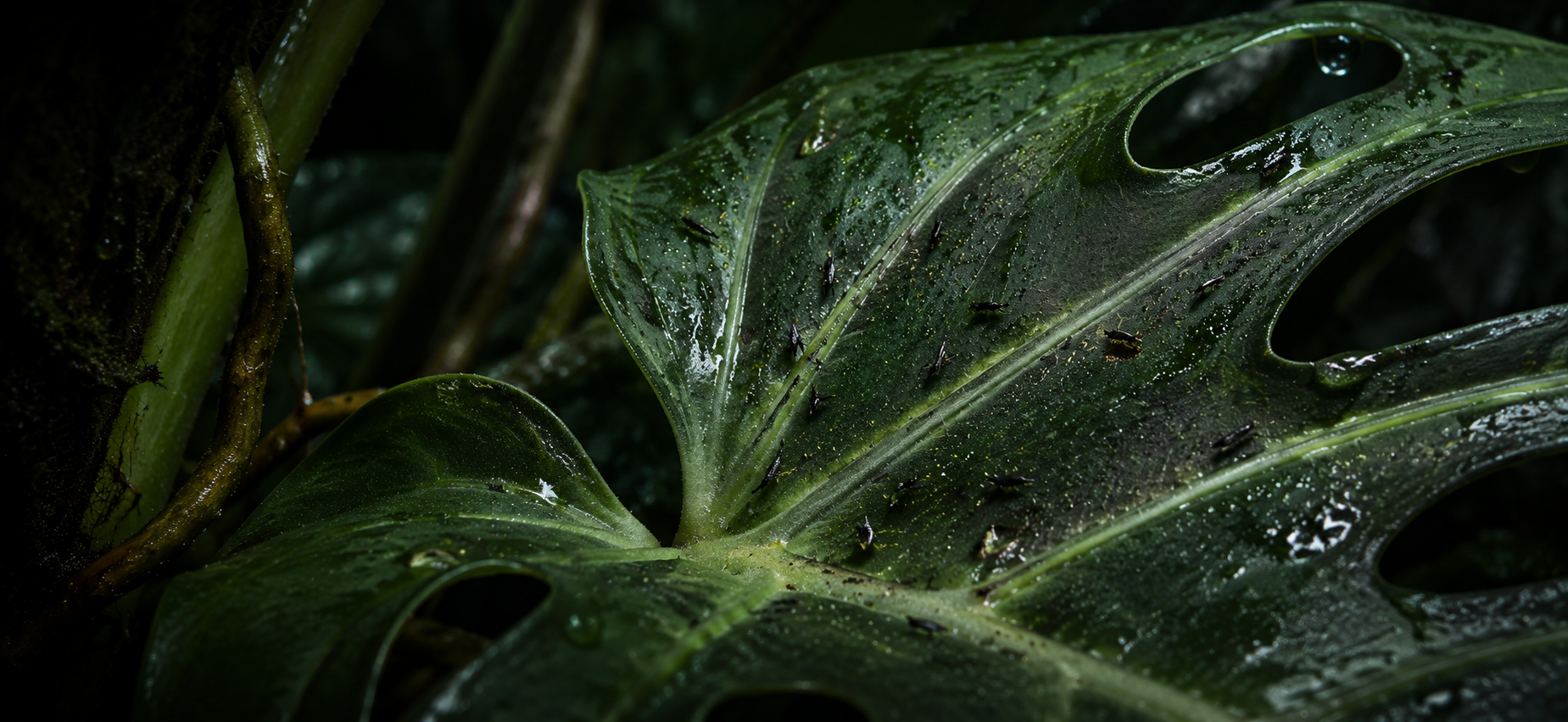
They are insects of the order Thysanoptera, only slightly larger than a spider mite and genuinely hard to see with the naked eye — elongate, usually tan or yellowish, though some species are dark brown or black. The larvae are paler and wingless, and on a leaf they are what you normally spot first: a pale sliver that moves when you breathe on it.
Two species matter indoors, and they are not interchangeable. Frankliniella occidentalis, western flower thrips, lives in flowers and growing points and is the classic greenhouse resistance problem. Echinothrips americanus is the one aroid growers actually get: darker, banded, and it stays out on the leaf blade rather than hiding in a flower. That difference decides which traps work, which predators work, and whether treating the soil is worth the effort — see §05.
They do not pierce single cells the way a mite does. They rasp the surface open and drink what leaks out, so the scar is an irregular silvery patch rather than a field of dots.
The more serious damage is done before you can see it. Thrips feed on young leaves while those leaves are still folded and forming, and the leaf then opens buckled, notched or ruffled — and stays that way for its whole life. The same happens in flowers: infested buds, scarred spathes, sometimes an inflorescence that aborts outright.
Confirmation is the black specks of frass scattered through the silvering. Silver alone can be old mite damage, sun damage or a scald; silver with black dots is thrips.
They are also among the most common insect vectors of plant viruses — the tospoviruses in particular. A virus does not leave when the thrips do, which is the real argument for treating an infestation early rather than tolerating a low one.
At any given moment a large part of a thrips population is somewhere your spray cannot go. That single fact explains every treatment failure on this page.
Eggs are inserted inside plant tissue, where nothing topical reaches them. Two feeding larval stages sit on the plant. Then, in most species, the prepupal and pupal stages drop to the soil or the leaf litter and wait there. Winged adults emerge and start again. Even a perfect application only catches the stages that happen to be exposed on that day.
Echinothrips is the exception that matters: it tends to pupate on the plant rather than in the substrate, so soil drenches and soil-dwelling predators do much less for it. If you have leaf-dwelling thrips and a soil programme is not helping, this is probably why.
Some strains have developed resistance to many products while others are still straightforward to treat, so a product that failed for someone else is not necessarily a product that will fail for you — and vice versa.
Honestly stated: none of these will clear an established thrips population on their own. They lower the number, they buy time, and they tell you what is happening.
- 01Quarantine incoming plants for three to four weeks. Thrips arrive on plants and in flowers. Nothing else here returns as much.
- 02Sticky cards, and use blue rather than yellow. Thrips respond to blue more strongly than to yellow. Cards give early warning and, more usefully, a weekly count so you know whether you are winning. They are not a control.
- 03Remove infested inflorescences. On a flowering aroid the spathe is a breeding chamber — sheltered, humid, full of pollen. Cutting it off an already-infested plant removes a nursery.
- 04Horticultural or dormant oil. Mechanical, so no resistance is possible, but it only reaches exposed stages: not the eggs inside the tissue and not the pupae in the substrate. Contact only, no residual. Oils burn foliage above roughly 80–85°F and on sensitive leaves — test a couple of leaves first.
- 05Soap and peroxide, with a cloth. Real soap — Dr. Bronner’s or Safer insecticidal soap — plus 3–4 tablespoons of 3% hydrogen peroxide per cup of water. Spray, wipe with a soft damp cloth, rinse. Contact only, no residual.
Thrips are the pest that taught commercial growers to stop spraying. They resist chemistry quickly and they hide in three places at once — and predators do not care where an insect is hiding, only whether they can walk there.
Because the population is split between the leaf and the substrate, a serious biological programme is usually two agents, not one: something on the foliage and something in the pot. That is a real cost, and it is why this section is longer than the others.
Neoseiulus cucumeris
Predatory mite · sachets
The standard preventive. It eats first-instar thrips larvae only — not adults, not older larvae — so it works by intercepting each new generation rather than by clearing what is already there. Slow-release sachets hang on the plant and keep producing for weeks.
Use whenbefore you have a problem, or alongside something faster. On its own it will not rescue an outbreak.
Amblyseius swirskii
Predatory mite · warm rooms
A generalist that takes young thrips larvae and whitefly eggs, and survives on pollen between meals so it persists. Stronger and more aggressive than cucumeris, and the better choice for leaf-dwelling Echinothrips.
Use whenthe room stays above about 20°C. It stalls in the cold.
Amblydromalus limonicus
Predatory mite · cooler rooms
Similar role to swirskii but performs better at lower temperatures and lower humidity, and takes slightly larger larvae. More expensive.
Use whenthe room is too cool for swirskii but you still need a leaf-surface predator.
Orius insidiosus
Minute pirate bug
The only agent here that kills adult thrips as well as larvae, and it is fast. It needs a real prey population to stay, and it will diapause under short winter days unless the photoperiod is extended.
Use whenan established infestation in a bright, warm, long-day room — spring through autumn, or under lights.
Stratiolaelaps scimitus
Soil predatory mite
Lives in the top layer of the substrate and takes thrips prepupae and pupae before they can emerge as adults. Also eats fungus gnat larvae, so it does two jobs at once. Persists for months.
Use whenyou have soil-pupating thrips — less useful against Echinothrips.
Steinernema feltiae
Entomopathogenic nematode
Watered into the substrate as a drench, where it finds and kills the soil stages. Can also be applied to foliage in high humidity to reach larvae, though that is a greenhouse technique more than a living-room one.
Use whenas the soil half of a two-front programme. Repeat every one to two weeks at first.
Echinothrips americanus — the dark, leaf-dwelling one aroid growers usually get — pupates on the plant rather than in the substrate, and it is a poor match for the flower-oriented agents. Soil predators and nematodes underperform against it. Amblyseius swirskii, Amblydromalus limonicus and Orius are the ones to reach for.
For flower thrips such as western flower thrips, the split programme is right: a foliar predator plus Stratiolaelaps or Steinernema feltiae in the pot.
Imidacloprid is the hard stop. It is systemic, it lasts about 90 days, and for those 90 days no release will survive on that plant. If biological control is anywhere in your plan, this is the product that ends it.
Spinosad is subtler. It is hard on Orius and on predatory mites while the spray is still wet, and considerably safer once it has dried — but “safer” is not “safe”, and the honest answer is an interval, not a yes or no. Both major producers publish searchable side-effect databases: Koppert and Biobest. Look up your active ingredient before you order predators, not after.
Thrips need repeat applications by definition — the eggs are inside the leaf and hatch after the spray has gone. A single treatment is not a light version of the programme. It is a resistance-selection event.
The only true systemic among the sensible options. It moves up from the roots and from leaf to leaf, so it reaches growing points and folded new leaves that a spray never coats — which is precisely where thrips do their worst damage. Active on eggs, larvae, nymphs and adults, with residual protection of roughly 30–45 days.
Sold here as Bug Destroyer, 22.4% spirotetramat.
Derived from compounds produced by the bacterium Saccharopolyspora spinosa. Highly active on most thrips species, and it kills both on contact and by ingestion, so there is some residual effect. Apply to the tops and undersides of leaves and take care to get it down inside the young folded growth.
Use the same concentration as a soil drench for the pupal stages in the substrate. Treating only the foliage leaves half the population untouched.
Widely available — Monterey Garden Insect Spray, a quart for about $20, or Captain Jack’s Deadbug Brew, 16oz for about $15.
The most common two-part tank mix used by nurseries for thrips, and the answer when a population has already shrugged off spinosad alone. Mixing chart.
Read both labels before mixing anything. Compatibility, order of addition and rate are label matters, not internet matters.
A miticide by design, but it controls thrips as well and is the standard tank-mix partner for resistant strains. Translaminar: it forms a reservoir inside the leaf and reaches the underside from a top-side application, but it is not carried elsewhere in the plant. About $90 — Avid. See the spider mite guide for the full entry.
Toxic to bees, lacewings and predatory mites.
A limonoid from neem seed that works as an antifeedant and an insect growth regulator — substantially more effective as a pesticide than cold-pressed neem oil, which is a different product sold under a confusingly similar name. Short residual.
Oil-based, so apply early morning or late evening to avoid burning leaves. Safe for pollinators once dry. About $25 for 4oz — AzaMax.
A systemic neonicotinoid that kills everything except spider mites and armored scale, including the soil stages of thrips. Applied to the substrate and watered in; protects for about 90 days.
Extremely toxic to pollinators. Several US states have banned it and it is banned in the EU. Where it can be sold it costs as little as $10. Indoor and greenhouse use only — never on an outdoor plant that will flower within three months. The full entry is in the mealybug guide.
- 01Work out which thrips you have. Dark and on the leaf blade points to Echinothrips; pale and in the flowers or growing point points to western flower thrips. It changes §05 completely and it changes whether the soil matters.
- 02Put blue sticky cards up and leave them up. Count weekly. Without a number you are guessing about whether a programme is working.
- 03Cut off infested inflorescences and the worst-scarred leaves before you treat. You are removing shelter, not just tidying.
- 04Treat the foliage and the substrate in the same session unless you have established the thrips are leaf-pupating. Half a programme selects for the half you missed.
- 05Repeat every five to seven days, at least three rounds. The eggs are inside the leaf; they hatch after your spray has dried and gone.
- 06Rotate the mode of action between rounds. Thrips are the fastest developers of resistance in this guide after spider mites.
- 07Choose chemistry or biology and commit. They do not overlap well, and the worst outcome is paying for predators that land on a residue. If you are going biological, do the mechanical work first and skip the spray entirely.
- 08Re-inspect with a loupe ten to fourteen days after the last round, in the folded new growth rather than on the old leaves.
- 01Thrips — UC Statewide IPM Program, Pest Notes 7429
- 02Thrips — Koppert pest profile
- 03Managing houseplant pests — Colorado State University Extension
- 01Biological control and natural enemies of invertebrates — UC IPM, Pest Notes 74140
- 02Biological control of thrips in greenhouses — Michigan State University Extension
- 03Minute pirate bugs, Orius — UC IPM natural enemies gallery
- 04Franklinothrips predatory thrips — UC IPM natural enemies gallery
- 05Western flower thrips Ceranisus parasitoid — UC IPM natural enemies gallery
- 06Orius insidiosus — Cornell Biological Control
- 07Neoseiulus cucumeris — Koppert
- 08Amblyseius swirskii — Koppert
- 09Amblydromalus limonicus — Koppert
- 10Orius insidiosus — Koppert
- 11Stratiolaelaps scimitus (Hypoaspis miles) — Koppert
- 12Steinernema feltiae — Koppert
- 13Insect-parasitic nematodes — Cornell Biological Control
- 01Side effects of pesticides on beneficials — Koppert, searchable database
- 02Side-effect manual — Biobest
- 03Pollinator and beneficial insect toxicity — Intermountain Tree Fruit Production
- 04Tank mixing revisited — GPN magazine PDF · archived
- 05Mode of action classification — Insecticide Resistance Action Committee (IRAC)
- 06Insect control, soaps and detergents — Colorado State University Extension