
Pest Management·03 / 08
MEALYBUGS
Pseudococcidae — Planococcus citri, Pseudococcus longispinus
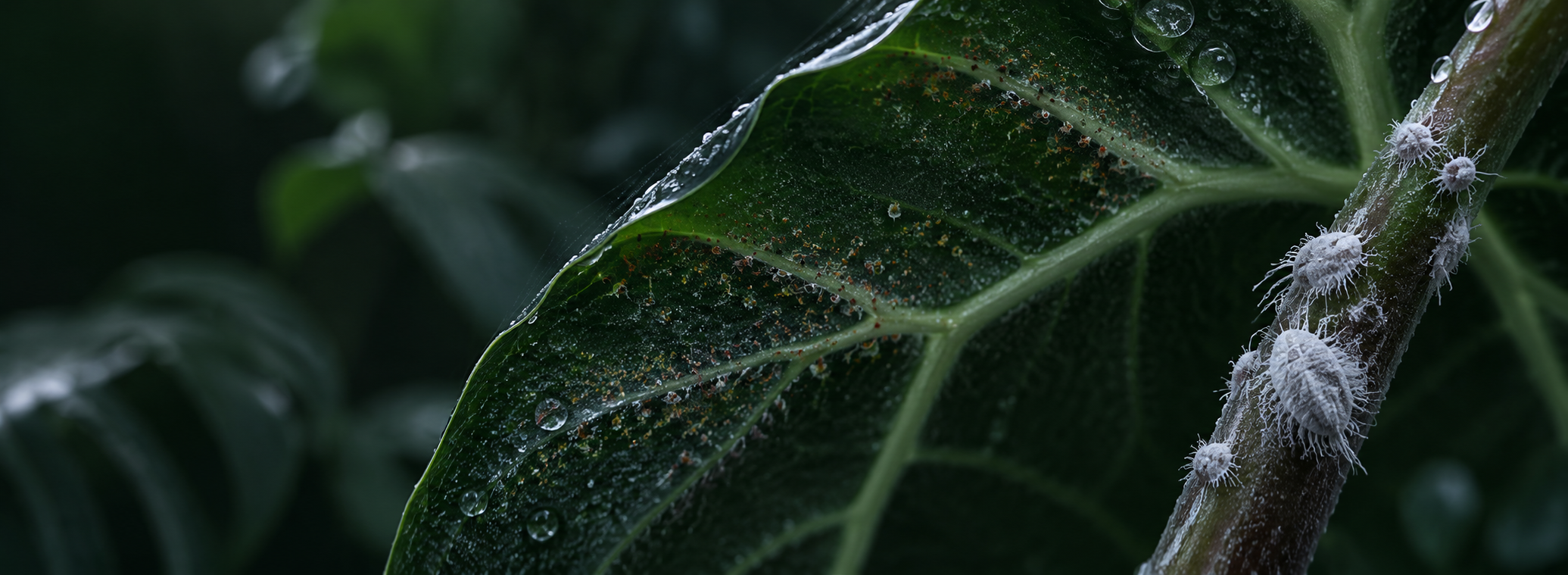
White wax in the leaf axils and the growing point, honeydew below, and very often a second population down in the root ball that never gets treated.
Soft-bodied insects that feed on sap and hide under a coat of white wax they make themselves. The wax is the whole problem: it sheds water, it sheds spray, and it makes a large infestation look like a small one.
They are members of the family Pseudococcidae. Indoors you will meet two: Planococcus citri, the citrus mealybug, short-tailed and the more common; and Pseudococcus longispinus, the longtailed mealybug, with obvious filaments trailing from the rear. The distinction is not pedantry — two of the parasitoids in §05 work on one and not the other.
There is also a third kind, and it is the reason mealybugs come back. Root mealybugs, Rhizoecus species, live entirely below the surface: white wax on the roots and against the inside wall of the pot, invisible until you unpot the plant. If you have cleaned the foliage twice and the infestation keeps returning, stop treating the leaves and look at the root ball.
Sap loss first, honeydew second, and ants third — and the third is the one that undoes your treatment.
Feeding causes stunting, deformed new growth and, in larger numbers, leaf shedding and eventually death of the plant. Like aphids they excrete honeydew, which leaves a sticky film and grows black sooty mould — the mould does no direct harm but it shades the leaf and it is unmistakable.
On aroids, look at the sheathing petiole base first. Between the sheath and the stem is dark, humid, physically sheltered, and almost impossible to spray into. It is where a small population lives before it becomes a visible one. After that, check the leaf axils, the geniculum, the growing point and the undersides of the newest leaves.
Where ants are present they are farming, not feeding — they harvest the honeydew, and in exchange they move mealybugs to fresh growth and drive off the insects that would have eaten them.
About two months from egg to maturity, and then hundreds of eggs from a single female that hatch within a few days.
A mature citrus mealybug lays her eggs in a cottony ovisac; a longtailed mealybug skips the sac and gives birth to live crawlers. Either way the crawler is the mobile, unwaxed, easily-killed stage, and it is the only stage that is genuinely exposed. They are most mobile shortly after hatching, and that is the window everything in §06 is aiming at.
A two-month cycle has a blunt consequence: a treatment programme that runs for two weeks has not finished. Plan on a month at minimum, and re-inspect for a further month after that.
Mealybugs are one of the few pests where careful hand work genuinely finishes the job on a small plant.
- 01Rubbing alcohol on a cotton swab, applied to each insect individually. It dissolves the wax and kills on contact. For a small infestation this is the whole treatment. Alcohol can also be diluted to 25–50% and sprayed, but test that on a small part of the plant first — it burns some foliage. No residual action either way.
- 02Insecticidal soap. Contact only, no residual, and less effective than alcohol because it struggles with the wax.
- 03Deal with the ants before anything else. While ants are tending the colony they will move it faster than you can treat it and they will remove any beneficial you release.
- 04Unpot and look at the roots on any plant that has had mealybugs twice. Root mealybugs are white wax on the roots and against the pot wall. If they are there, bare-root the plant, wash the roots, discard the old mix, and treat the roots directly.
- 05Quarantine incoming plants for three to four weeks, and check the sheath bases and the root ball, not just the leaves.
Mealybugs sit in exactly the places a spray cannot reach, which is the same reason a walking predator does well against them. A lady beetle larva goes into a leaf axil without being told to.
The catch is that the two best parasitoids are species-specific, so this is one of the few pages in the guide where identifying the pest to species actually changes the purchase.
Cryptolaemus montrouzieri
Mealybug destroyer · lady beetle
The best-known mealybug predator, and adults and larvae both feed. The larvae are covered in white wax and look almost exactly like large mealybugs — every year people carefully kill their own beetles. If a “mealybug” is moving purposefully and is bigger than the rest, leave it alone.
Use whena warm room and a real population to eat. It does poorly at low densities and below about 20°C.
Leptomastix dactylopii
Parasitoid wasp
A specialist on the citrus mealybug. The female lays into the mealybug, which swells into a hard brown mummy. Very effective on its target and essentially useless on anything else.
Use whenyou have confirmed Planococcus citri. On longtailed mealybug it is wasted money.
Anagyrus vladimiri
Parasitoid wasp
Another citrus and vine mealybug specialist, often used with Leptomastix or with Cryptolaemus because it attacks different size classes. Also produces mummies rather than visible corpses.
Use whencitrus mealybug, warm conditions, and where you want a standing population rather than a knockdown.
Chrysoperla carnea
Green lacewing · larvae
A generalist: the larvae eat mealybug crawlers, aphids, young scales and small caterpillars indiscriminately. Less efficient than a specialist, more useful when several pests overlap on one plant.
Use whena mixed infestation, or longtailed mealybug where the specialist parasitoids do not apply.
Ants. They defend the colony, and a parasitoid that lands on an ant-tended plant is removed. Exclude the ants first or do not bother.
The wrong species. Leptomastix and Anagyrus are citrus-mealybug specialists. If yours has long tail filaments, you have Pseudococcus longispinus and you want Cryptolaemus and lacewings instead.
Imidacloprid. Systemic, roughly 90 days, and lethal to everything above for the whole of it. Check any residue against the Koppert or Biobest side-effect databases before ordering anything alive.
The wax and the hiding places mean coverage is unreliable by definition. That pushes this pest towards systemics more than any other in the guide except soft scale.
The most useful product on this page. Mealybugs are sap feeders, so a systemic reaches them wherever they are sitting — inside a sheath, in the growing point, or on the roots — without depending on you hitting them. It moves both up from the roots and leaf to leaf, is active on all stages, and gives roughly 30–45 days of residual protection.
Sold here as Bug Destroyer, 22.4% spirotetramat.
A synthetic pyrethroid with a very broad range, including termites and spiders, and unusually long residual activity. Effective on most common houseplant pests and it even suppresses spider mites. It also makes a good barrier spray around the home. Inexpensive — about $22 for 16oz as Bifen I/T.
That long residual is also why it forecloses biological control for weeks, and why it is flagged indoor-only here.
Another synthetic pyrethroid with a narrower range. It is the active ingredient in dog flea collars and human lice treatments, and it is a neurotoxin to cats — keep cats away from treated plants until everything is dry, around 12 hours. About $20 for 32oz as Bonide Eight.
A pesticide that works too well for its own good. If you have heard of neonicotinoids killing bees, this is the one. By 1999 it was the most widely used pesticide in the world; it has since been banned in the EU. Used correctly it is also one of the safest and most effective systemics available to a houseplant grower — it is labelled for greenhouse and indoor plants, neither of which will ever meet a bee.
Never use it on an outdoor plant that will flower within the next three months. It is genuinely good for treating outdoor plants as you bring them in for winter, to kill whatever came with them.
Applied as granules to the substrate and watered in. It kills everything except armored scale and spider mites, including soil-borne thrips, fungus gnats and mealybugs, and lasts about 90 days between applications. Because it travels through the roots it is not instant, and it works better as a preventive than as a rescue for a heavy infestation. Treating every plant as it is potted up or brought home, then reapplying once or twice a year, keeps a collection clean more or less indefinitely.
Where it is still sold: Bonide systemic houseplant insect control, 8oz for about $20. With a lot of plants, Marathon is dearer up front and much cheaper per application — 5lb for about $110 at 1% versus 0.22% for the Bonide.
- 01Find all of them before you treat any of them. Sheathing petiole bases, leaf axils, geniculum, growing point, undersides of the newest leaves — and the root ball if this is a repeat visit.
- 02Exclude the ants if there are any. Nothing else on this list works while they are running the colony.
- 03Swab the visible ones with alcohol first. On a small plant this may be all you need, and on a large one it lowers the number every later step has to handle.
- 04Then treat the population you cannot see. That means a systemic, because the ones in the sheath and on the roots are the ones that restart the infestation.
- 05Repeat every seven to ten days for at least a month. The cycle is two months long; two applications a fortnight apart is not a programme.
- 06Unpot if it comes back a second time. Root mealybugs are the usual explanation and no foliar treatment will ever touch them.
- 07Rotate the mode of action if you go past two rounds, and check the label’s IRAC group rather than the brand name.
- 08Re-inspect monthly for two months after you think you have finished. A single surviving female in a sheath is a full relapse.
- 01Mealybugs — UC Statewide IPM Program, Pest Notes 74174
- 02Mealybugs — University of Wisconsin Horticulture
- 03Citrus mealybug — Koppert pest profile
- 04Mealybugs and scales — Koppert pest index
- 05Managing houseplant pests — Colorado State University Extension
- 01Biological control and natural enemies of invertebrates — UC IPM, Pest Notes 74140
- 02Mealybug destroyer, Cryptolaemus montrouzieri — UC IPM natural enemies gallery
- 03Mealybug Leptomastix parasitoid — UC IPM natural enemies gallery
- 04Mealybug Anagyrus parasitoids — UC IPM natural enemies gallery
- 05Cryptolaemus montrouzieri — Cornell Biological Control
- 06Chrysoperla green lacewings — Cornell Biological Control
- 07Cryptolaemus montrouzieri — Koppert
- 08Anagyrus vladimiri — Koppert
- 09Chrysoperla carnea — Koppert
- 01Side effects of pesticides on beneficials — Koppert, searchable database
- 02Side-effect manual — Biobest
- 03Pollinator and beneficial insect toxicity — Intermountain Tree Fruit Production
- 04How we assess risks to pollinators — US EPA
- 05Insect control, soaps and detergents — Colorado State University Extension