
Pest Management·04 / 08
FUNGUS GNATS
Sciaridae — Bradysia spp.
Mostly a nuisance, occasionally a root problem. The adults you swat are irrelevant; the larvae in the top inch of soil are the whole story.
The insect you can see is not the insect that matters. Adult fungus gnats live a few days, eat nothing, and damage nothing at all — they are an announcement, not a problem.
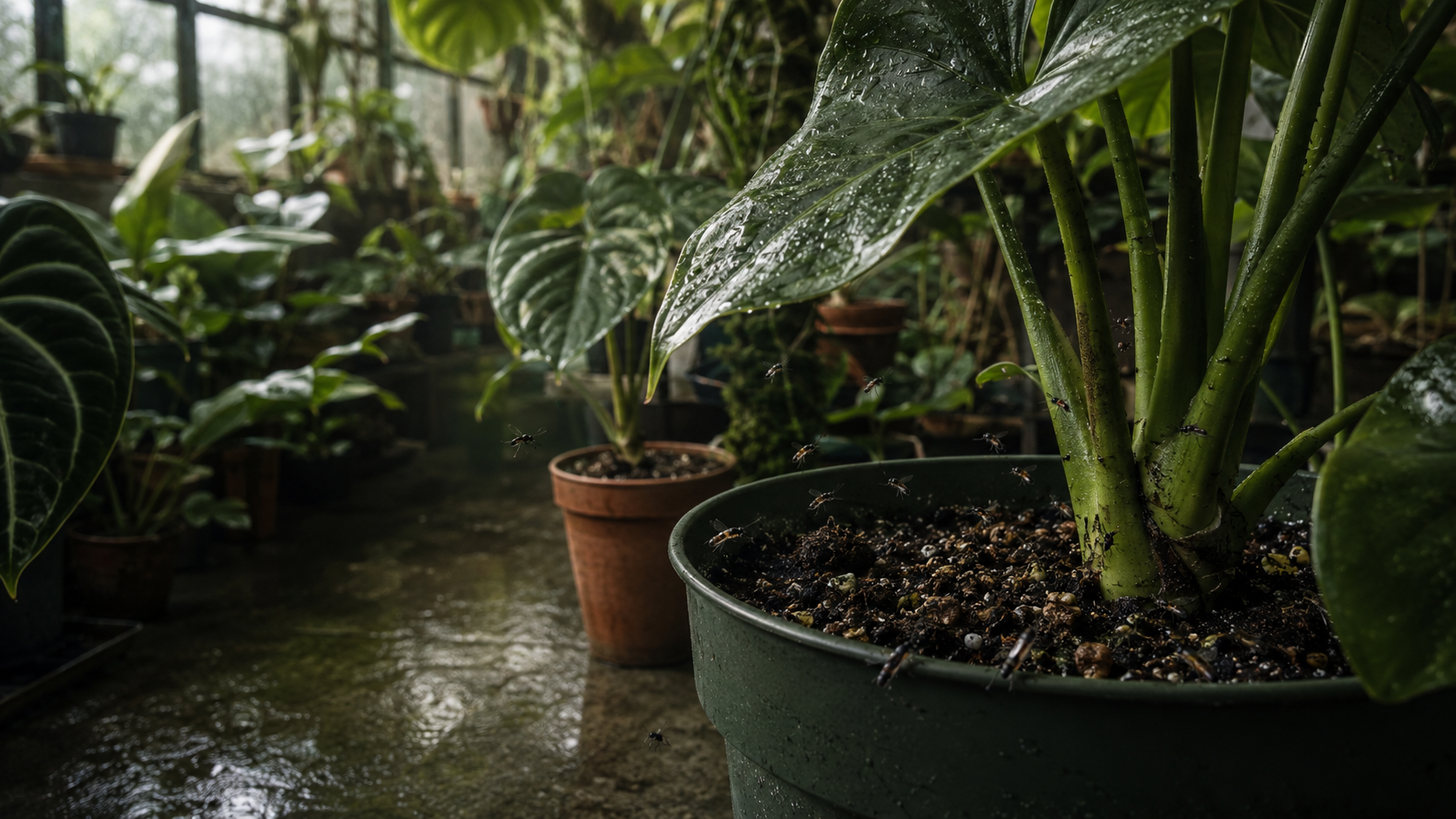
They are small dark flies of the family Sciaridae, mostly Bradysia species, that sit on the surface of the substrate and lift off when disturbed. The larvae are translucent, legless, and carry an obvious black head capsule; they live in the top inch or two of the mix and feed on decaying organic matter and on the fungi growing in it.
Worth ruling out: shore flies look similar but are stouter and darker with short antennae, and they run across the surface rather than fluttering. Their larvae eat algae, not roots, so they are a sign of persistent surface wetness rather than a pest to treat.
Usually cosmetic. Occasionally not — and the difference is entirely about what the plant is doing at the time.
On an established plant in a well-drained mix, a modest gnat population is an irritation and nothing more. The honest version of this page says so rather than inflating the threat.
Where it does matter: the larvae also graze root hairs and fine roots. On a freshly potted division, an unrooted cutting, a plant recovering from root loss, or anything already struggling, that grazing is a real setback — and the wounds are an entry point for root pathogens, which the larvae can also carry between pots. If you propagate, fungus gnats stop being a nuisance and become a production problem.
A large adult population is also a reliable signal about the substrate: it means the top layer is staying wet long enough to grow fungi, which is worth knowing regardless of the insects.
The whole population lives in the pot. Not in the air, not on the leaves — in the top two inches of substrate.
Eggs go into moist mix at the surface. Larvae feed there for roughly two weeks, pupate in the substrate, and emerge as adults that live a few days, mate, lay, and die. At room temperature the full cycle runs about three to four weeks, faster when it is warm.
The practical consequence is the one everybody gets wrong: killing adults changes nothing. Every adult you swat, vacuum or trap was already at the end of its life and had probably already laid. The treatment target is the substrate, and the measure of success is fewer adults next month, not fewer adults today.
This is the one pest in the guide where the cultural controls are not a preamble to the real treatment. They are the real treatment.
- 01Let the top of the mix dry between waterings. The single most effective measure available, and it costs nothing. Eggs and first-instar larvae desiccate readily; an inch of dry surface is a barrier they cannot cross.
- 02Water from the bottom where the plant tolerates it, so the top stays dry while the root zone does not.
- 03Top-dress with something inhospitable. Half an inch of coarse sand, horticultural grit or pumice gives the females nowhere to lay and the emerging adults something to climb through.
- 04Yellow sticky cards. Adults are strongly attracted to yellow. They give modest population reduction and, far more usefully, a weekly count — the only way to tell whether a programme is working when the thing you are killing is invisible.
- 05Reduce the food. Fewer undecomposed organics in the mix, dead leaves cleared off the surface, and no pot left chronically wet. Fungus gnats are a symptom of a substrate that suits them.
- 06The potato test. Lay a slice of raw potato cut-side down on the surface for a day or two, then lift it: larvae congregate underneath. It confirms an infestation, and it tracks whether the numbers are falling.
This is the page where you can reasonably skip the chemistry altogether. Between a soil predator, a nematode drench and a change to how you water, there is nothing left for an insecticide to do.
All four of these live in the substrate, which is where the pest is. None of them touches the plant, none of them is a nuisance in a room, and none forecloses any later option.
Stratiolaelaps scimitus
Soil predatory mite · formerly Hypoaspis miles
Lives permanently in the top layer of the substrate and eats fungus gnat eggs and young larvae — and thrips pupae, and springtails, as a bonus. It establishes and persists for months, so one application becomes a standing garrison rather than a treatment.
Use whenalmost always. It is the default recommendation for this pest and it is compatible with a normal houseplant routine.
Steinernema feltiae
Entomopathogenic nematode
Microscopic nematodes watered into the mix. They locate the larvae, enter them and kill them within a couple of days. Fast, thorough, and completely harmless to people, pets and plants.
Use whenyou want a knockdown rather than a garrison. Needs a moist mix; repeat every one to two weeks at first. It has a shelf life — check the date.
Dalotia coriaria
Rove beetle · formerly Atheta
A small, fast, dark beetle that hunts gnat larvae and pupae through the substrate; adults and larvae both feed. It also takes thrips pupae, and it moves between pots on its own.
Use whena benched collection or a propagation area, where it can patrol many pots at once.
Bacillus thuringiensis israelensis
Bti · microbial larvicide
A bacterium whose toxin is selective for the larvae of certain flies — fungus gnats and mosquitoes — and inert for everything else. Applied as a drench with normal watering. Not a beneficial insect, but it belongs in this section because it is biological, it is selective, and it does not foreclose anything.
Use whenas the backbone of the programme. Apply at every watering for three to four weeks to cover a full life cycle.
Let the top dry · Bti at every watering for a month · one release of Stratiolaelaps scimitus · a top dressing of grit · yellow cards to count.
That is the whole answer for a normal houseplant collection, and it is a good deal cheaper than the alternative. The only reason to reach past it is a large propagation setup, where Dalotia and nematode drenches scale better.
If you have already applied imidacloprid to these pots, wait it out — roughly 90 days — before releasing anything alive. Check any other residue against the Koppert or Biobest databases.
Short section, deliberately. Two products are worth using and everything else is either useless or disproportionate.
A live culture of Bacillus thuringiensis israelensis, a bacterium that selectively targets the larval stage of certain dipterans including fungus gnats and mosquitoes. It will not kill adults, but adults have very short lives and will die off on their own once the larvae stop replacing them.
Commonly sold for mosquito control as bits or dunks — a 32oz container of bits is about $19. Steep them in the watering can, or scatter and water through.
A more concentrated form made specifically for fungus gnats is sold as Gnatrol, by the ounce: 0.5oz for $8, 1oz for $10, 2oz for $15, 4oz for $23 — organicbti.com. It is a live bacterium and it has an expiry date, which is listed on the site. Old stock does nothing.
A systemic neonicotinoid that kills everything except spider mites and armored scale, including soil-borne pests such as fungus gnat larvae. Applied as granules to the substrate and watered in; protects for about 90 days.
It works, but for this pest it is a large instrument for a small job, and it costs you every biological option in this guide for three months. Reach for it if you are already using it collection-wide as a preventive; do not start using it because of gnats. The full entry is in the mealybug guide.
Do not spray the foliage. There is no pest on it. A pyrethroid drench is worse than useless here: it kills the soil predators that would have solved the problem and leaves the larvae, which live below the wetted layer.
Do not treat adults and call it a programme. Fly traps, sprays and vacuums reduce the thing you can see and leave the thing that matters entirely intact.
- 01Confirm it is fungus gnats and not shore flies. Fungus gnats flutter and are slender; shore flies run and are stout. Only one of the two is worth treating.
- 02Put yellow cards up and count weekly. Without a number you cannot tell a working programme from a lucky week.
- 03Change the watering before you buy anything. Let the top inch dry; bottom water where you can. On many collections this alone ends it.
- 04Bti with every watering for three to four weeks — long enough to cover a full life cycle, which is the whole point. Stopping after ten days is why it “did not work”.
- 05Add Stratiolaelaps scimitus, or nematodes if you want faster knockdown, for a population that keeps working after you stop paying attention.
- 06Top-dress with grit on the pots that keep reoffending.
- 07If it persists, stop treating and look for the cause. A chronically wet pot, a dead root system rotting quietly, or a bag of mix that arrived with them. Fungus gnats that will not go away are almost always telling you something about the substrate.
- 01Fungus Gnats — UC Statewide IPM Program, Pest Notes 7448
- 02Fungus gnats — University of Wisconsin Horticulture
- 03Sciarid flies — Koppert pest profile
- 04Managing houseplant pests — Colorado State University Extension
- 01Using biological control agents for fungus gnat management — Michigan State University Extension
- 02Biological control and natural enemies of invertebrates — UC IPM, Pest Notes 74140
- 03Stratiolaelaps scimitus (Hypoaspis miles) — Koppert
- 04Steinernema feltiae — Koppert
- 05Dalotia (Atheta) coriaria — Koppert
- 06Macrocheles robustulus — Koppert
- 07Insect-parasitic nematodes — Cornell Biological Control