
Pest Management·05 / 08
APHIDS
Aphidoidea — Myzus persicae, Aulacorthum solani
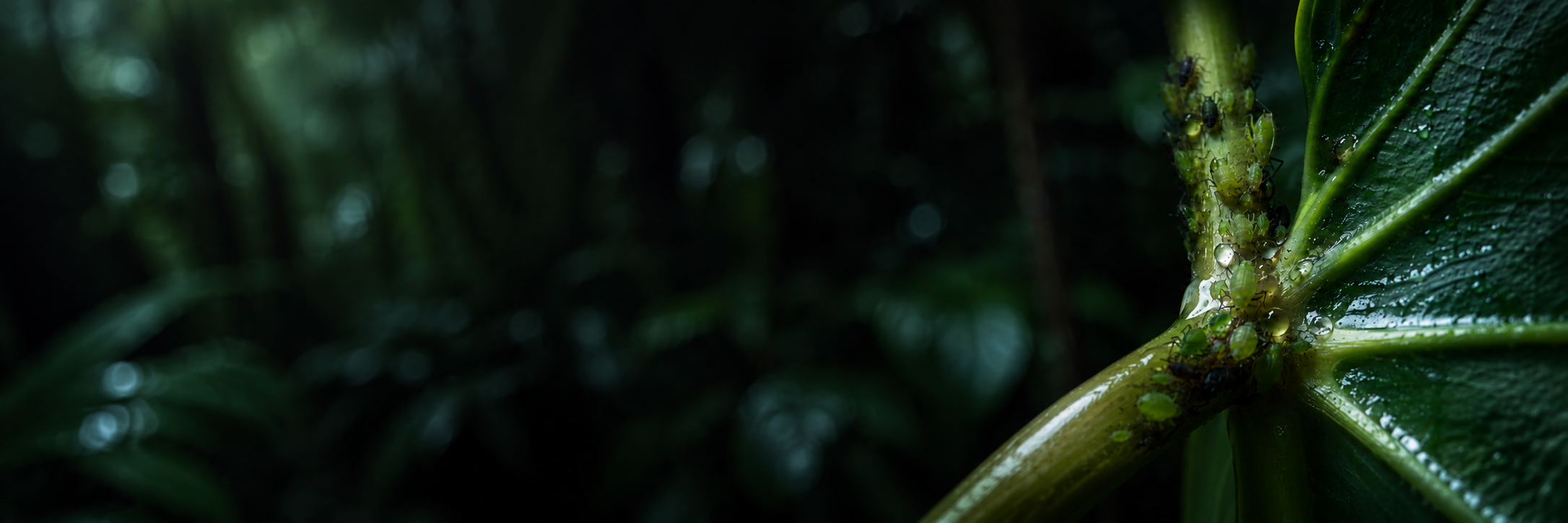
The easiest pest here to kill and the quickest to come back. If ants are walking the plant they are farming, not feeding — and they will defend the herd.
The easiest pest in this guide to kill, and the quickest to come back. Both facts follow from the same piece of biology.
Aphids are small, soft-bodied sap feeders in the superfamily Aphidoidea, and they come in most colours — green, yellow, black, pink, grey. The identifying feature is the pair of cornicles, short tubes projecting from the rear end like tailpipes; nothing else on a houseplant has them. Indoors you will usually have Myzus persicae, the green peach aphid, or Aulacorthum solani, the foxglove or glasshouse potato aphid — a size difference that matters in §05, because the two standard parasitoids are matched to small and large aphids respectively.
Their reproductive strategy is the interesting part: indoors the females give birth to live nymphs, without mating, and those nymphs are already carrying their own developing daughters. Three generations exist inside one insect. That is why a colony goes from a handful to a crust in a week.
Low numbers cause almost nothing. High numbers cause a lot. This is the one pest in the guide where the threshold genuinely matters.
They cluster on the softest tissue — unfurling leaves, growing points, flower stalks, the undersides of the newest leaves — and heavy feeding leaves new growth curled, puckered and undersized. Older leaves are largely ignored, so the damage shows up in the shape of what emerges next rather than in the plant you are looking at.
They produce a great deal of honeydew, which leaves a sticky film and grows black sooty mould. And they are efficient virus vectors, though less notoriously so than thrips in an indoor collection.
If there are ants on the plant, nine times in ten they are not there to hurt it. They are farming. They harvest the honeydew, they carry aphids to fresh growth, and they will actively remove the predators and parasitoids that would otherwise have ended the problem for you.
About a week from birth to reproducing adult at room temperature, no eggs, no males, no pause.
Indoors, aphids reproduce parthenogenetically and viviparously — live young, no fertilisation required — so a single individual is a colony in waiting and there is no egg stage sitting out of reach of a spray. That is what makes them easy: everything is exposed, all the time.
It also sets the arithmetic on failure. A treatment that kills 95% of a colony buys you about five days, because the survivors are already pregnant and their daughters are already forming. Winged forms appear once a colony is crowded or the plant starts to decline, and those are what arrive on the next plant along.
Aphids are the pest most likely to be finished off without buying anything at all.
- 01Water pressure. They cluster, they hold on poorly, and they do not walk back. A firm spray from a hose or a shower head removes most of a colony in one go and works genuinely well on a minor infestation. Repeat every few days while you watch the new growth.
- 02Squash them. On a small plant, a gloved thumb and forefinger run up the petiole is not beneath anyone’s dignity and it is faster than mixing a spray.
- 03Deal with the ants first. Everything else on this list works better once they are gone, and biological control does not work at all until they are.
- 04Horticultural or dormant oil. A mechanical control — it suffocates, so there is no mode of action to develop resistance to, and it can be tank-mixed with many other products to improve their coverage. Contact only, no residual. Oils burn foliage above roughly 80–85°F and on sensitive leaves — test on a couple of leaves and wait a day before spraying a whole plant.
- 05Soapy water. Real soap — Dr. Bronner’s or Safer insecticidal soap — at the dilution on the label. Kills on direct contact only, no residual.
- 06Yellow sticky cards. They catch the winged forms, which is early warning that a colony has started dispersing. Not a control.
- 07Check the new growth on everything nearby. Winged aphids do not travel far, and the plant next to the infested one is where they went.
After spider mites, this is the pest where biological control is most worth doing — and it is the one where it is easiest, because everything is out in the open where a wasp can reach it.
A parasitoid programme against aphids has an unusual property: it leaves visible evidence of success. Bronze mummies glued to the leaf are not a new pest, they are dead aphids with a wasp inside. Once you see them, stop spraying and let them hatch.
Aphidius colemani
Parasitoid wasp · small aphids
Lays a single egg inside an aphid, which swells and hardens into a bronze mummy glued to the leaf. A new wasp emerges from each one and goes looking for more. Matched to smaller aphids — green peach, cotton and melon aphid.
Use whenyou have small aphids and are willing not to spray. Leave the mummies alone; they are the next generation of wasps.
Aphidius ervi
Parasitoid wasp · large aphids
The same mechanism, sized for the larger species — foxglove aphid, glasshouse potato aphid. Colemani struggles with aphids this big, which is why the two are sold separately and often released together as a mix.
Use whenyou have large aphids, or you are not sure which size you have and want to cover both.
Aphidoletes aphidimyza
Predatory gall midge
The adult midge finds aphid colonies by smell and lays among them; the orange larvae paralyse and drain aphids far faster than they can eat them, so a small number does disproportionate damage. Excellent on established hot spots.
Use whenspring through autumn. Short winter days push it into diapause unless the photoperiod is extended, so under a normal home light cycle in December it will stall.
Chrysoperla carnea
Green lacewing · larvae
The larvae are generalist hunters — aphids, mealybug crawlers, young scales, small caterpillars. Less efficient than a matched parasitoid on a pure aphid problem, more useful when several pests overlap on the same plant.
Use whena mixed infestation, or where you want visible predators rather than mummies.
Hippodamia convergens
Convergent lady beetle
Included with a caveat, because it is the one everybody buys. Almost all stock is field-collected rather than reared: the adults are physiologically primed to disperse, most of them fly off within a day or two, and collected stock can carry parasites of its own.
Use whenyou have accepted the odds. Release at dusk onto a damp plant, and expect a fraction to stay. The reared agents above are a better use of the same money.
Ants, again. They will carry parasitised aphids away and attack the wasps. This is the first job, not the last.
Wiping off the mummies. Every mummy is a wasp that has not emerged yet. Tidying them off the leaf is throwing away the second generation you already paid for.
A soap spray the day before. Soap is contact-only and has no residual, which makes it look compatible — but it kills the parasitoids that are on the plant just as efficiently as it kills the aphids. Do the mechanical work first, wait, then release. Check any residue against the Koppert or Biobest side-effect databases before you order anything alive.
Aphids are susceptible to almost every contact and systemic product a grower already owns. On a mixed collection that usually means no dedicated purchase is required at all.
Overkill for a light infestation, and exactly right for a persistent one on a plant you cannot spray thoroughly — it reaches the folded growing point where aphids sit, without depending on coverage.
Two-way movement — up from the roots and from leaf to leaf — active on eggs, larvae, nymphs and adults, with roughly 30–45 days of residual protection. Sold here as Bug Destroyer, 22.4% spirotetramat.
Derived from neem seed; an antifeedant and insect growth regulator, and substantially more effective than cold-pressed neem oil, which is a different product with a similar name. It is unusually good against aphids specifically, it is organic, and it is safe for food crops — though nothing else on this site is, so read the label rather than this sentence.
Oil-based: apply early morning or late evening to avoid burning leaves. Safe for pollinators once dry. Short residual. About $25 for 4oz — AzaMax.
A synthetic pyrethroid with a very broad range, including termites and spiders, and unusually long residual activity. Effective on most common houseplant pests and it even suppresses spider mites. Also a good barrier spray around the home. About $22 for 16oz as Bifen I/T.
That long residual is exactly why it forecloses biological control for weeks, and why it carries the indoor-only flag here.
A synthetic pyrethroid with a narrower range than bifenthrin. Active ingredient in dog flea collars and human lice treatments, and a neurotoxin to cats — keep cats away from treated plants until dry, around 12 hours. About $10.
A systemic neonicotinoid that kills everything except spider mites and armored scale. Effective and long-lasting against aphids, and disproportionate for most infestations of them.
Extremely toxic to pollinators — banned in the EU and in several US states. Indoor and greenhouse use only, and never on an outdoor plant that will flower within three months. Applied as granules to the substrate and watered in; about 90 days per application. Because it travels through the roots it is slow, so it works better as a preventive than as a rescue. The full entry, including the case for using it indoors, is in the mealybug guide. Bonide systemic houseplant insect control, about $20 for 8oz.
Aphids are susceptible to the great majority of contact and systemic products kept for other pests. Before you buy something for aphids, look at what is already on the shelf.
- 01Rinse first. Every time. It is free, it removes most of the colony, and it makes every later step smaller.
- 02Exclude the ants if any are present.
- 03Decide whether this needs chemistry at all. A small colony on a plant that is not currently pushing new growth may not. Rinse it, watch the new growth for a week, and see.
- 04If you are treating, re-check in three or four days, not two weeks. Generation time is about a week, so the survivors show up fast — and a re-check at day three tells you whether the round worked while it is still cheap to fix.
- 05Repeat every five to seven days, two or three rounds.
- 06Or release parasitoids and stop spraying entirely. This is the pest where that is easiest and cheapest, and where the outcome is most visible — count mummies.
- 07Check the neighbours’ new growth before you declare it over. Winged forms went somewhere.
- 01Aphids — UC Statewide IPM Program, Pest Notes 7404
- 02Aphids — Koppert pest profile
- 03Managing houseplant pests — Colorado State University Extension
- 01Biological control and natural enemies of invertebrates — UC IPM, Pest Notes 74140
- 02Aphid Aphidius parasitoids — UC IPM natural enemies gallery
- 03Aphid midge, Aphidoletes aphidimyza — UC IPM natural enemies gallery
- 04Green lacewings — UC IPM natural enemies gallery
- 05Convergent lady beetle — UC IPM natural enemies gallery
- 06Syrphid (hover) flies — UC IPM natural enemies gallery
- 07Aphidoletes aphidimyza — Cornell Biological Control
- 08Lysiphlebus aphid parasitoid — Cornell Biological Control
- 09Hippodamia convergens — Cornell Biological Control
- 10Aphidius colemani — Koppert
- 11Aphidius ervi — Koppert
- 12Aphidoletes aphidimyza — Koppert
- 13Chrysoperla carnea — Koppert