

Araceae · Identification
IDENTIFYING ANTHURIUM
Which key you are entitled to open, and how far it carries
The Guide
You do not look an Anthurium up
A plant arrives carrying a label. The label says Anthurium and then a second word, and the question is whether that second word is right. There is a procedure for answering it. It is not a lookup, it does not begin with a photograph, and its first step happens before you have looked at the plant at all.
This guide is that procedure, for this genus specifically — which key you are entitled to open, what it can and cannot settle, and what to write down when it settles nothing.
- 1,460 species in the genus
- 7 of 20 sections that hold together as groups
- 63 new species in a single 2025 revision
- 19 new species from one Ecuadorian province
Why this genus is its own problem
Anthurium is the largest genus in the family by a wide margin, and the difficulty is not only its size. The internal classification is unfinished in a way that shows. When the accepted arrangement — eighteen sections and two series — was set against a molecular phylogeny of the genus, seven of the twenty held1. The rest were either not natural groups or could not be tested with the material sampled.
That is the state of the map. The territory is moving at the same time. A single revision published in 2025 described sixty-three new species in one section2; another, in the same year, described nineteen from a single province of Ecuador3. This is not a backlog being cleared. It is a genus still being found.
What follows from that, immediately
There is no complete key to Anthurium, there has never been one, and nothing published in the next decade will be one either. Every usable key covers part of the genus — a section, a country, a province, or some combination.
So the first act of identifying an Anthurium is not examining the plant. It is working out which part of the genus you are in, because that decides which key you may open — and opening the wrong one still produces a name.
Where this sits
Two other pages carry the parts this one leaves out. Anthurium Morphology is how to read the plant: the blade and its ratio, the venation, the surface, the petiole in cross-section, the stem and the roots. Every character named on this page is explained there, and this page does not explain any of them again — it only shows what a key asks you to do with them.
Aroid Identification is the general account: what a name is attached to, what a key is and how to fail one without noticing, why names change, and where to check whether a name is current. Read that first if any of this is unfamiliar. This page assumes it.
What is left in the middle — and it is the part nobody writes down — is how those two meet in one genus. That is the whole of what follows.
Part I
Two questions before the plant
Every key to Anthurium that is worth running is bounded twice — once by which part of the genus it covers, and once by where on the map it applies. Neither bound is a formality, and neither is something you can decide after you start.
The key tells you this in its first line
Here is how the key to section Pachyneurium opens — the section that holds most of the bird's-nest anthuriums people grow4.
Key to species of Anthurium section Pachyneurium, couplet 1
1a. Species of Mexico, Central America, Panama, and West Indies.
1b. Species of South America.
That is the first thing the key asks, and it is not a question about the plant. It is a question about a place. There is no character in it, nothing to measure, nothing to hold up to the light. Before the key will let you look at a leaf, it wants to know which side of the Darién you are on.
And the two answers are not adjacent. Choose 1a and you work forward through the couplets in order. Choose 1b and you jump to couplet 514. The two halves of the key are fifty couplets apart, and there is nothing at the join to tell you that you guessed.
The cost of guessing at step one
A plant from Peru run through the Central American half of that key will not stop, complain, or return nothing. It will proceed through couplet after couplet of real characters, correctly compared, and deliver a species name from the wrong continent.
Nothing later in the key can recover the error, because everything later in the key is conditional on it.
Two shapes of key, and you must know which you hold
The published keys to this genus come in two shapes, and they are bounded in opposite directions.
| Shape | Covers | Fails when |
|---|---|---|
| Sectional one section, its whole range |
Every species in one section, wherever it grows — and usually splitting by region early, as above. | Your plant is not in that section. The key has no way to say so. |
| Regional one territory, all its sections |
Every Anthurium in a defined territory: Mexico and Middle America5, or Panama6, or one province of Ecuador. | Your plant grows outside that territory. The key has no way to say so. |
A sectional key asks you to have already placed the plant in a section. A regional key asks you to have already placed it on a map. Neither will do the other's work, and a plant of unknown origin fails both bounds at once — which is the ordinary situation for something bought in a shop.
So what can actually be settled
Put plainly, and it is better to know this at the start:
| What you know about the plant | What is reachable |
|---|---|
| Wild-collected, locality recorded | A species determination, using the regional treatment for that territory and then the sectional revision. |
| Cultivated, origin known to country or region | Usually a section, often a species group, sometimes a species. The regional key is the entry point. |
| Cultivated, origin unknown | A section, at best — and only if the plant is a wild species at all, which Part IV takes up. |
| A named cultivar or a hybrid | No key applies. The name comes from the grower's records or it does not exist. |
That last row is not a failure of the keys. It is a statement about what keys are for. The next part is the routing table: given a section, which treatment covers it, and how much of the genus that leaves uncovered.
Part II
Which treatment covers your plant
Part I said the first job is placing the plant in a section. This is how that is done, and what it gets you — because the sections are very unevenly served. Some have a revision from this year. Some have nothing since the 1980s.
The character that places a bird's-nest anthurium is not the nest
Section Pachyneurium is the one most growers meet first: the rosulate, bird's-nest plants with a short densely rooted caudex and broad, mostly leathery blades. That description will get you to the section most of the time and it is not what defines it.
What the revision actually requires
The defining character of section Pachyneurium is the involute vernation of the developing leaf — the new blade rolled inward from both margins as it emerges. Croat calls it an absolute requirement regardless of habit or blade shape4.
And he names the trap directly: there is a group of species that also has the bird's-nest habit and similar oblong to obovate blades, and does not have involute vernation. They are not Pachyneurium. The habit everyone recognizes is the character that does not decide4.
This is a rare piece of luck for anyone with a living plant. It is a character of the unfurling leaf, so a pressed specimen often cannot show it — but a plant on a windowsill produces one every few weeks, and you only have to look at the right moment. Watch a new leaf come out of the cataphyll and see whether both edges are rolled in toward the middle, or whether one edge is wrapped around the other.
The routing table
What each of these sections holds, and the treatment that covers it. The right-hand column is the one that matters, because it is where the key you are permitted to run actually lives.
| Section | What it holds | The treatment, and what it covers |
|---|---|---|
| Pachyneurium | Bird's-nest plants, short caudex, involute vernation. | 19914 — the whole section, split at couplet 1 into Central America and the West Indies against South America. |
| Cardiolonchium | The velvet-leaved plants, including Anthurium magnificum and Anthurium regale; cloud forest and understory3. | 20253 — but one province of Ecuador only, and nineteen of its species were new in that paper. |
| Xialophyllium | 101 species as the section was redefined in 2025; Mexico through Central America and the Andes, especially the western Andes above 500 m2. | 20252 — the whole section. Sixty-three of the 101 were described as new in it. |
| Stipitata | Split out of Xialophyllium in 2025; Central America to Bolivia7. | 20257 — 46 species at publication, 45 after the errata. See Part IV. |
| Interrupta | Also split out of Xialophyllium in 2025; blades drying blackish8. | 20258 — the whole section, six species. |
| Porphyrochitonium | A large mostly Central American assemblage. | 20229 — a status account describing 120 new taxa, 76 of them Central American. |
| Leptanthurium | Slender plants; three species recognized until recently10. | 202010 — the whole section, expanded to 19 species. |
| Dactylophyllium (Schizoplacium has priority13) |
The compound, finger-leaved species. | 200811 — the 3-segmented species only, not the section. A lettered key, not numbered couplets. |
| Andiphilum | Mexican and Central American species — and since 2025 the home of Anthurium clarinervium and Anthurium leuconeurum. | 201712 — new Central American species, not a revision of the section. |
| Multinervia | Raised to section in 20191; until then a series inside Pachyneurium, mostly Ecuadorian Andes4. | No revision of its own. Its species sit inside the 1991 Pachyneurium treatment4. |
What the table does not say
There are twenty sections and series in the arrangement that was tested in 20191, and three more have been erected since. The table above lists ten. The rest have no treatment that can be pointed at — no revision, or only scattered species descriptions, or work old enough that the section has since been redefined underneath it.
For those, the entry point is a regional treatment rather than a sectional one: Mexico and Middle America5, or Panama6. They cover every Anthurium in their territory, across all sections, which is exactly what you want when you cannot place the section — and exactly what you cannot use if the plant is South American.
Read the dates in that last column again
Five of the ten treatments listed are from 2020 or later, and four of those from 2025 alone. That is not a tidy field being maintained. It is a field in the middle of a rewrite — and a section revised in 2025 was, in three cases, carved out of a different section that earlier books describe as a single group.
A key published before that carving does not become wrong. It becomes a key to a group that no longer has that name.
The next part runs one of these keys on a plant, from the top, to show where it actually stops.
Part III
Running the key, and where it stops
Take the section most people own and run its key from the top. Not to reach a name — to see what the key asks for, in the order it asks, and to find out how far a plant in a pot can actually get.
The plant: a bird's-nest anthurium, new leaves rolled inward from both margins, so section Pachyneurium by Part II's test. It has been in cultivation for years. Nobody recorded where it came from.
Couplet 1 — a continent
1a. Species of Mexico, Central America, Panama, and West
Indies.
1b. Species of South America.4
Stopped. There is no answer. The plant has no locality, and the key offers no third branch.
So assume the best case instead: a nursery label that says Costa Rica, and take 1a. Everything that follows is now conditional on that label being true.
Couplet 3 — a moment, not a feature
3a. Spadix with pistils early emergent, well above the tepals
at anthesis, giving the spadix a rough appearance; stamens often
long-exserted after anthesis.
3b. Spadix with pistils held mostly below tepals at anthesis;
stamens scarcely exserted and retracted to level of tepals after
anthesis.4
Stopped again, and this one is worth sitting with. Both halves turn on at anthesis — the state of the spadix during flowering. Not the spadix as it is now. Not a dried spadix. The spadix during a window that lasts days and has to be watched.
A plant that has never flowered cannot answer this couplet. A plant that flowered last year and was not examined closely cannot answer it either. And the key will not let you skip ahead to the leaf characters below, because a dichotomous key fixes the order — couplet 3 comes before couplet 5 whether or not you can read it.
Couplet 5 — the one you can answer
5a. Blades with collective veins arising from one of the
basal veins (rarely from one of the lowermost primary lateral
veins).
5b. Blades with collective veins arising from one of the primary
lateral veins…4
This one a living plant answers perfectly well. The collective vein runs parallel to the blade margin, gathering the ends of the lateral veins; the question is only which vein it springs from and how far up. Turn the leaf over, find where it starts, and you have your answer. Anthurium Morphology sets out how to find it, and says to find it first.
Here is the thing worth noticing: this is a leaf character, on a mature leaf, visible in a pot, requiring no flowering and no locality. It is the kind of character everyone assumes keys are made of. It is couplet 5 of 165.
Couplets 6 and 7 — and now, meters
6a. Blades with the basal veins all free to the base; sinus
narrowly triangular to closed; less than 300 m.
7a. Blades 44–100 cm long; primary lateral veins
9–20 pairs; southeastern Costa Rica; less than 100 m.
7b. Blades 17–46 cm long; primary lateral veins
5–9 pairs; Cuba; less than 300 m.4
The key has stopped asking for a country and started asking for an elevation. Southeastern Costa Rica below 100 meters is a different answer from Cuba below 300. A wild plant has that written on its collection label. A cultivated plant does not have it at all, and no amount of looking at the plant will produce it.
The tally, through seven couplets
Of the seven couplets above, one — couplet 5 — can be answered from a living plant with no collection data. Two demand a locality, one demands an elevation, and one demands that somebody watched the inflorescence during anthesis.
This is not a defect in the key. Croat built it to separate herbarium specimens, which arrive with locality, elevation and flowering material attached. It does that job. It was answering a different question than the one a grower is asking, and it answers that question confidently either way.
Which raises the practical question this guide has been walking toward. If the key cannot be run to the end, what have you actually got — and what should you write on the label? Part V takes that up. First, Part IV, because there is a second problem with the key, and it has nothing to do with your plant.
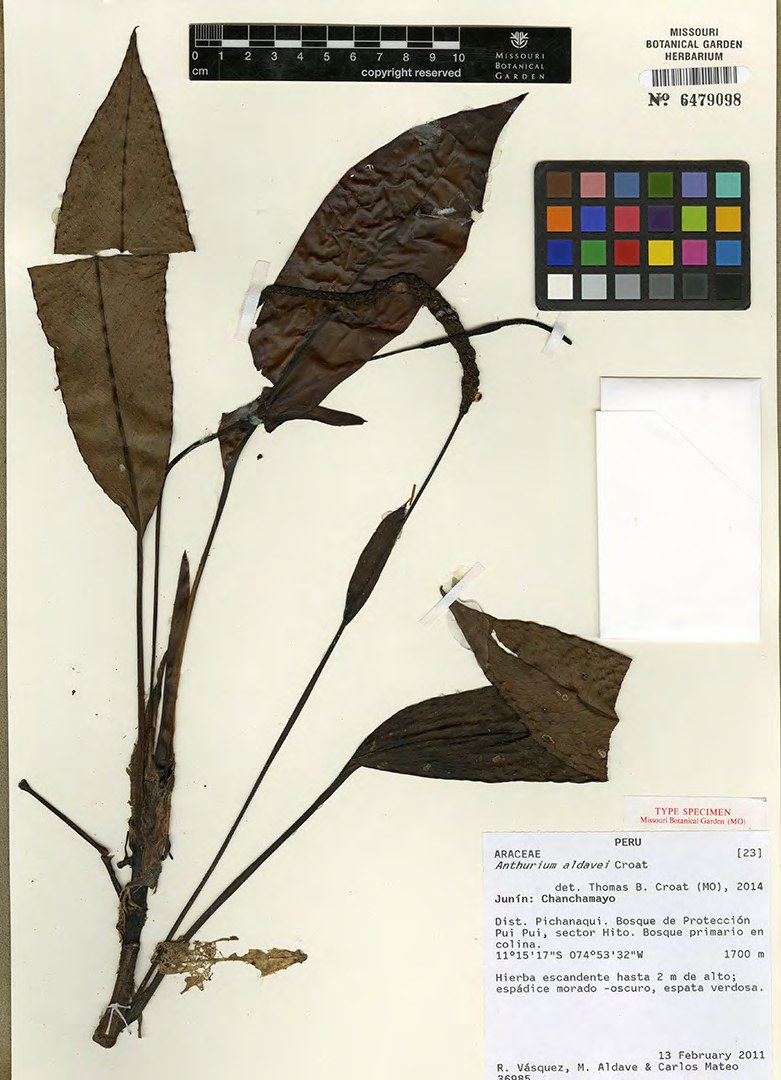
One more thing the sheet has and you do not
A determination, signed and dated. That is not a formality — it is the record of who last decided what this plant is, so a later worker knows whose judgement they are relying on and how old it is. Part V is about writing your own.
Part IV
The key is already out of date
There is a second problem with the key you finally tracked down, and it has nothing to do with your plant. Three sections of Anthurium were revised in one issue of one journal in 2025. The corrections to them were published in the next issue of the same journal14.
Two species that did not survive their own description
The revision of section Stipitata described twenty-two new species7. Two of them were not new.
| Published in the revision as | Already had a name | Now |
|---|---|---|
| Anthurium andaquiense | Anthurium superimpendens, published 2023 | A synonym14 |
| Anthurium huilense | Anthurium amplexispathum, published 2024 | A synonym14 |
Neither is a mistake about a plant. Both plants are real, well described, and correctly circumscribed. What happened is the oldest mechanism in nomenclature: an earlier name existed, so the earlier name wins, and the newer one becomes a synonym on the day the priority is noticed. The Aroid Identification hub sets that mechanism out in Part III. Here it is happening inside a paper published this year.
And the printed key went with them
The section stood at 46 species when the revision was printed. After the corrections it holds 45 — and the authors state that a revised key will be published online14.
So the key bound into the revision is not the current key to that section, and there is nothing on the printed page to tell you so. The only way to know is to have read the following issue.
A diagnostic character that the figures did not show
Section Interrupta is defined largely by blades that dry blackish8. In the published revision the specimen figures came out lighter than intended, and the errata records the consequence plainly: the figures did not show the blackish drying color that is the main characteristic of the section14. Three were reprinted.
Consider what that means. The diagnostic character of an entire section was invisible in the illustrations published to define it, in a peer-reviewed revision, prepared by the specialists in the genus. Anyone who had matched a plant against those three figures would have been comparing against the one thing they failed to record.
This is the strongest available argument against identifying from photographs, and it does not come from a windowsill or a marketplace listing. It comes from the primary literature correcting itself.
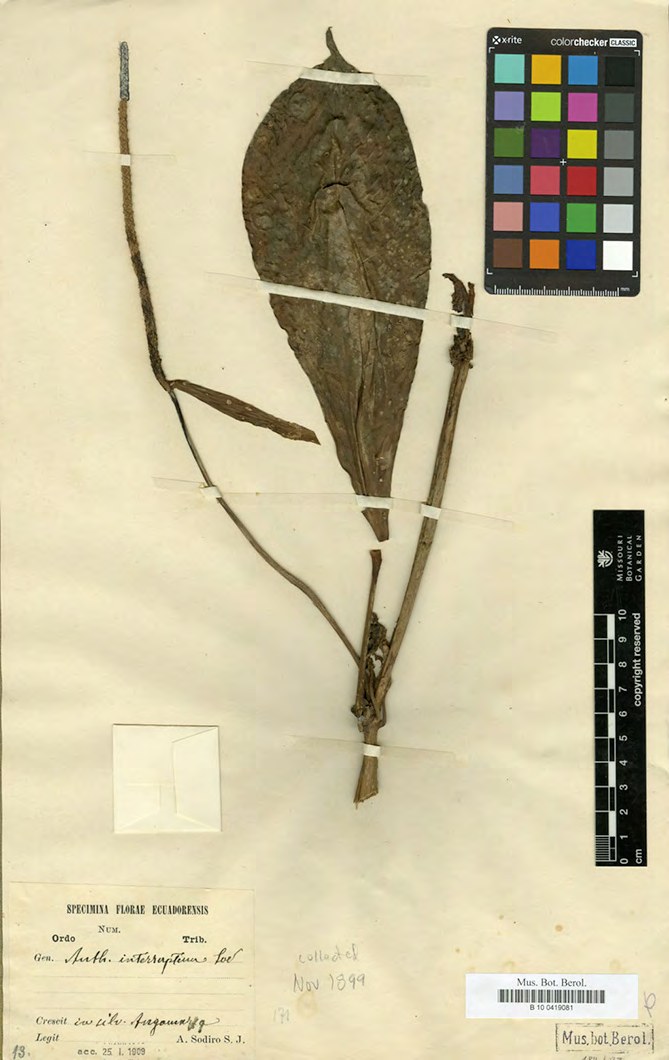
A key that says what it leaves out
One more, from the same 2025 issue. The key to section Xialophyllium — 101 species, the largest of the three — opens by stating that four species were not included in it, because there was not enough geographical or morphological information to place them2.
The hub's warning about keys is that they have no null result: run a plant that does not belong through a key and it still returns a name. This is the same problem seen from inside. Four species of this section are not in its own key. A plant that is one of them will not fail the key — it will come out as something else, because there is nothing else for it to come out as.
What to take from this, and what not to
Not that the revisions are unreliable. They are the best treatments of these sections that exist, they are the ones this guide routes you to, and a field that publishes its own corrections in the next issue is a field working properly.
What to take is the rate. When sixty-three species in one section are new in a single paper, some of them will collide with names published elsewhere the year before. The literature is not a settled reference you consult. It is a conversation in progress, and the date on what you are reading matters as much as what it says.
Part V
When to stop, and what to write
Most attempts to name a cultivated Anthurium end without a species. That is the ordinary result, not a failure of nerve, and there is established notation for saying exactly how far you got. Using it is the difference between a record that stays useful and one that quietly becomes wrong.
The notation
Four ways to write a partial answer, in decreasing order of what they claim.
| Write | It says | Use it when |
|---|---|---|
| Anthurium magnificum | This is that species. | You ran a key that covers the plant, or you have the grower's records back to a determined parent. |
| Anthurium cf. magnificum | Compare with that species. Probably it; not confirmed. | The plant fits the description and something is missing — flowers you never saw, a locality you do not have. |
| Anthurium aff. magnificum | Related to that species. Close to it, and probably not it. | The plant sits beside a known species but differs consistently — including when it may be undescribed. |
| Anthurium sp., section Pachyneurium | A species of that section, not determined further. | You placed the section — by vernation, say — and the key stopped at a couplet you cannot answer. |
The last line is worth defending, because it looks like giving up and is not. Anthurium sp., section Pachyneurium is a real determination. It is a statement about the plant that is true, that a later worker can build on, and that will not have to be undone.
The specialists write it too
This is not a beginner's notation. The molecular phylogeny of Anthurium — the study underlying the sectional analysis this guide has leaned on throughout1 — carries accessions entered as Anthurium cf. obtusum and Anthurium cf. michelii15. Material good enough to sequence, in a study by the people who know the genus best, recorded with the hedge left in.
And look at which species they hedged on
Anthurium michelii is the plant Part II set out as the trap — the species with the bird's-nest habit and without the involute vernation, which had itself once been placed in section Pachyneurium and taken back out4.
It is the hardest kind of plant in the section, so it is the plant the hedge gets used on. The notation is not a measure of inexperience. It is a measure of how difficult the plant in front of you is.
What to put on the label
Write down what you determined, how far the key carried, and what stopped it. Three lines is enough:
-
The name, at the rank you actually reached
Species if you got there. Otherwise section, with sp. — or a species with cf. in front of it if you want to record the resemblance without asserting it.
-
What the determination rests on
Which treatment, and its date. “Keyed in Croat 1991, couplet 5” tells a later reader precisely how much weight the name will bear — and Part IV is why the date belongs there.
-
What you could not answer
“No locality”, “never flowered”. This is the line that lets the plant be identified later, by you or by somebody else, without starting over.
Why the honest answer is the useful one
A species name is copied. It goes onto the label, into the listing, into the post, onto the plant that is given away as a cutting — and it outlives the plant it was guessed on. A name asserted once becomes, within a few years, a name that several sources agree on, because they are all repeating it.
Anthurium sp., section Pachyneurium does not propagate like that. It stays open, invites the next piece of evidence, and is still correct in ten years. A wrong species name is worse than no species name, because it stops the question being asked.
Sources
The papers behind this guide
Fifteen sources. Ten of them are the treatments named in the routing table — they are the working documents of this genus, and most are freely readable. Where a section has a revision, that revision is the answer, and this page exists mainly to point at the right one.
- Carlsen, M. M. & Croat, T. B. (2019). An analysis of the sectional classification of Anthurium (Araceae): comparing infrageneric groupings and their diagnostic morphology with a molecular phylogeny of the genus. Annals of the Missouri Botanical Garden 104(1): 69–82. The thesis of this guide and of the hub. Sets the accepted arrangement — 18 sections and two series — against a molecular phylogeny; seven of the twenty hold. Also the paper that raises Multinervia from a series inside Pachyneurium to a section.
- Delannay, X. & Croat, T. B. (2025). Revision of Anthurium Sect. Xialophyllium (Schott) Engl. (Araceae). Aroideana 48(1): 196–495. The section as redefined: 101 species, 63 of them described as new here. Its key states at the top that four species of the section are not in it, for want of enough information to place them.
- Croat, T. B. & Guan, C. (2025). A Revision of Anthurium section Cardiolonchium (Araceae) from Carchi Province, Ecuador. Aroideana 48(3). Nineteen new species from one province. The velvet-leaved section, horticulturally the best known, including Anthurium magnificum and Anthurium regale. Its key is quoted in the hub as an example of a modern key that is bounded by a province.
- Croat, T. B. (1991). A Revision of Anthurium Section Pachyneurium (Araceae). Annals of the Missouri Botanical Garden 78(3). The key run in Part III, and the source of the guide's most useful single fact: the section is defined by involute vernation, called an absolute requirement regardless of habit or blade shape — not by the bird's-nest habit, which a look-alike group also has. Names Anthurium michelii as the type of that group.
- Croat, T. B. (1983). A Revision of the Genus Anthurium (Araceae) of Mexico and Central America. Part I: Mexico and Middle America. Annals of the Missouri Botanical Garden 70(2). The regional entry point when the section cannot be placed and the plant is Mexican or Middle American. Covers every Anthurium in that territory across all sections.
- Croat, T. B. (1986). A Revision of the Genus Anthurium (Araceae) of Mexico and Central America. Part II: Panama. Monographs in Systematic Botany from the Missouri Botanical Garden 14. The companion regional treatment for Panama. Published in the Monographs series, not the Annals.
- Delannay, X. & Croat, T. B. (2025). Revision of Anthurium Sect. Stipitata Delannay & Croat (Araceae). Aroideana 48(1): 70–195. A section erected out of Xialophyllium: 46 species at publication, 22 of them new, ranging from Central America to Bolivia. Read it with ref 14 beside it.
- Delannay, X. & Croat, T. B. (2025). Revision of Anthurium Sect. Interrupta Delannay & Croat (Araceae). Aroideana 48(1): 38–69. The third of the 2025 revisions, also carved out of Xialophyllium. Six species, two new, defined largely on blades that dry blackish — the character its own figures failed to show.
- Croat, T. B., Grib, J. J., Ortiz, O. O., Tsai, J. & Engin, C. (2022). The current status of Anthurium sect. Porphyrochitonium (Araceae) and allies, with many new species. Aroideana 45(2). One hundred and twenty new taxa in a single paper, 76 of them Central American. The clearest single measure of the rate at which this genus is being described.
- Delannay, X. & Croat, T. B. (2020). Revision of Anthurium Schott sect. Leptanthurium (Schott) Engl. (Araceae). Aroideana 43(1&2). A section that held three species until recently. The revision takes it to nineteen, eight of them new.
- Croat, T. B., Brossart, L. & Kostelac, C. V. (2008). A Revision of the 3-Segmented Species of Anthurium sect. Dactylophyllium (Araceae). Aroideana. Part of a section rather than all of it — the three-segmented species only. Its key is lettered and indented rather than numbered, a reminder that keys come in more than one shape.
- Croat, T. B. & Hormell, R. (2017). New Central American Species of sect. Andiphilum (Araceae): the Anthurium silvigaudens Standl. & Steyerm. complex. Aroideana 40(1). New species rather than a revision, and the nearest thing section Andiphilum has to a modern treatment — which matters now that Anthurium clarinervium and Anthurium leuconeurum have been moved into it.
- Hay, A., Llano-Almario, M. & Carlsen, M. M. (2024). A note on the priority of the simultaneously validated synonymous sectional names in Anthurium Schott (Araceae—Pothoideae), sect. Schizoplacium (Schott) Engl. and sect. Dactylophyllium (Schott) Engl., and typification of their respective lectotype species. Aroideana 47(3). Why the routing table carries a caveat on Dactylophyllium: treated as synonyms, the two names are separated not by date but by the first published choice between them, which was Engler's in 1898 in favor of Schizoplacium. Both names remain in use.
- Delannay, X. & Croat, T. B. (2025). Errata in the recently published revisions of Anthurium sect. Stipitata Delannay & Croat, sect. Interrupta Delannay & Croat and sect. Xialophyllium (Schott) Engl. Aroideana 48(2): 204–211. The whole of Part IV. Two species described as new in ref 7 are antedated and become synonyms, leaving the section at 45; a revised key is to follow online; the Interrupta figures did not show the blackish drying color that characterizes that section; and a synonymy in ref 2 is withdrawn.
- Carlsen, M. M. & Croat, T. B. (2013). A Molecular Phylogeny of the Species-Rich Neotropical Genus Anthurium (Araceae) based on Combined Chloroplast and Nuclear DNA. Systematic Botany 38(3): 576–588. The phylogeny underlying ref 1. Cited in Part V for its own use of the hedge: two accessions are entered as Anthurium cf. obtusum and Anthurium cf. michelii — the latter being the very species ref 4 names as the classic Pachyneurium look-alike.