
The Araceae · Identification
AROID IDENTIFICATION
A name is not a label someone chose. It is a claim about a plant, anchored to a single dried specimen — and like any claim, it can be revised.
The Section
Two questions that look like one
“What is this plant?” and “what is this plant called?” feel like the same question. They are not, and they have different answers, arrived at by different means. The first is a question about the plant in front of you. The second is a question about two centuries of argument, conducted in print, about which name that plant is entitled to.
This section is about the second question. It is the one that makes a plant arrive under one name, appear in a monograph under another, and sit on a nursery bench under a third.
- 1 dried specimen a species name is tied to
- 1692 the engraving one name in use still rests on
- 303 new aroid names in one journal since 1978
- 7 of 20 Anthurium sections that survive a test
Where this sits
Two companion sections answer the other questions. Aroid Morphology is how to read the plant — the parts, what they are called, and which of them carry information. It already sets out the one vegetative feature a taxonomist reaches for first in each genus, so telling the genera apart is settled there and not repeated here. The Araceae tree is about relationship: which genera are each other's closest kin, and when they diverged.
What is left is the name itself. How a plant gets one. What the name is actually attached to. How far a key can carry you, and where it stops. Why the name changes, and what a changed name does and does not mean. And why the plant you bought is, more often than not, not a species at all.
The names move because the work is not finished
It is tempting to read a name change as a correction — someone got it wrong, someone else fixed it. Usually it is not that. It is a new piece of evidence arriving: a specimen refound, a molecular tree published, an older name noticed in a book nobody had read for a century.
The scale of that ongoing work is easy to underestimate. Counting only Aroideana, the journal of the International Aroid Society, and only since its first issue in 1978: 303 aroid names have been published or recombined in its pages — a new subfamily, two new genera, and among the species 105 Anthurium, 41 Philodendron, 29 Typhonium and 26 Amorphophallus. That is close to 8% of all accepted names in the family, from one society journal1.
A caution that governs the whole section
A name is a hypothesis with a specimen attached, not a fact. When two sources disagree about what a plant is called, the useful question is never “which one is right?” but “what is each one anchored to, and what has been published since?” Every part of this section is a way of answering that.
Part I
What a name is attached to
A botanical name looks like a label. It behaves like a legal instrument. Every part of it — including the parts most people skip — is doing work.
The part everyone skips
Take a name in ordinary use:
One name, read slowly
Amorphophallus paeoniifolius (Dennst.) Nicolson
Amorphophallus — the genus. paeoniifolius — the species epithet, meaning peony-leaved. (Dennst.) — Dennstedt published this plant's name first, in 1818, but in a different genus, as Dracontium paeoniifolium. Nicolson — Dan H. Nicolson moved it into Amorphophallus, where it now sits.
The parentheses are the whole history. They say: someone named this plant before, somewhere else, and their epithet came with it.
An author citation is not a courtesy. It is a pointer to a published description, in a stated place, on a stated date — and those three things are what makes a name checkable rather than merely asserted.
The specimen underneath
Here is the part that surprises people. A species name is not attached to a species. It is attached to one preserved specimen — the type — sitting in a named herbarium. The species is a hypothesis about which plants belong with that specimen. If the hypothesis changes, the name follows the specimen, not the idea.
For names published before herbarium practice settled, the anchor can be a picture. Dennstedt's 1818 name rests on plate 19 of van Rheede's Hortus Malabaricus — an engraving published in 16922. A name in daily use in nurseries today reaches back, through an unbroken chain of citation, to a seventeenth-century engraving.
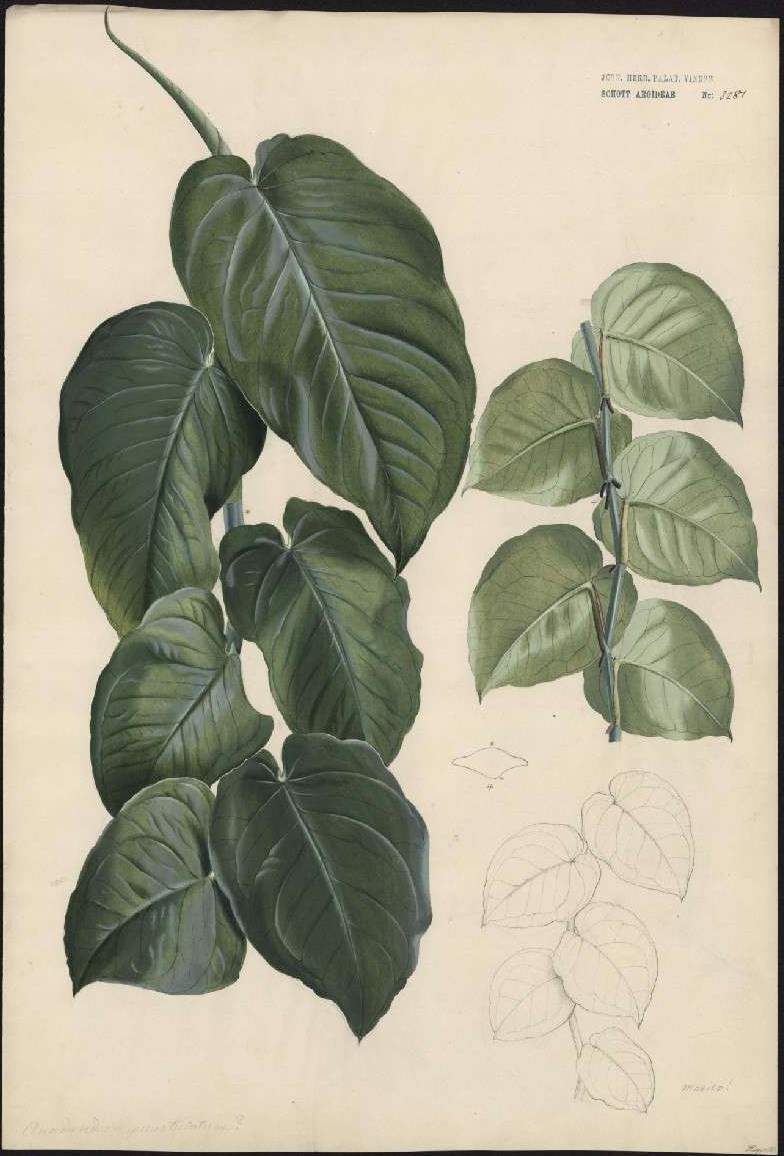
And a picture can still be doing that job today. This is the type of Monstera punctulata — not a pressed specimen, but a nineteenth-century drawing from Schott's collection of aroid illustrations in Vienna. The specimen it was drawn from is gone; the drawing is what the name now hangs on9.
Why the older name wins
The rule is priority: among validly published names for the same plant, the earliest is the one to use. That is what put Dennstedt's 1818 name ahead of Arum campanulatum, Roxburgh's much better known binomial — and it did something sharper than merely outranking it. Roxburgh had himself cited Rheede's plate 19 in his synonymy. Citing the basis of an earlier name inside your own makes the new name illegitimate2. Not merely second in line: not available at all.
This is why Amorphophallus campanulatus persists in older horticultural writing and is not the accepted name.
The specimen can be wrong
Anchoring a name to a physical object is what makes the system stable. It is also where it can fail, because objects can be mislabeled and sheets can be made up badly.
When Pseudodracontium was folded into Amorphophallus, its species Pseudodracontium harmandii could not simply move across: the name Amorphophallus harmandii was already occupied by a different plant, so the incoming species needed a new one and became Amorphophallus pseudoharmandii3. In the course of that work the type material of the occupying name, Amorphophallus harmandii, was examined — and both the holotype and the isotype turn out to be mixed collections: inflorescences of one species mounted on the sheet with leaves of the other3.
So any statement about that species' leaves, traced back to its own type, may be describing a different plant. The name is anchored; the anchor is two plants.
None of this is exotic. It is ordinary taxonomic housekeeping, and it is going on continuously — which is the subject of Part III.1
Part II
What a key is, and how to fail one honestly
A dichotomous key is a decision tree. At each step it offers two statements, you pick the one that matches, and it sends you either to another step or to a name. It is the oldest working instrument in taxonomy and it is astonishingly effective — inside its own limits, which are almost never printed on it.
A real one, from 2025
This is how a current key opens. It is the key to section Cardiolonchium — the velvet-leaved Anthurium — in the revision of that section for Carchi Province, Ecuador4:
Key for Anthurium section Cardiolonchium from Carchi
1a. Leaf blade with geniculum of petiole remote from base of
apparent blade; sinus arcuate with a decurrent petiole; found in Carchi
at 796–2200 m ···
Anthurium lancea Sodiro
1b. Leaf blade with geniculum of petiole at base of blade; sinus
mostly hippocrepiform to parabolic or spathulate
··· 2
2a. 1 or 2 pairs of basal veins free to base
··· 3
2b. 0 or 3+ pairs of basal veins free to base
··· 35
3a. Leaf blades drying dark brown or blackened
··· 4
3b. Leaf blades drying greenish or grayish green
··· 14
Notice what the first three couplets actually ask for. Couplet 1 wants the position of the geniculum — a character the morphology guide covers — and then, in the same breath, it wants the province and the elevation. Couplet 3 wants to know what color the blade goes when it dries.
A living plant on a windowsill has no drying color, and it is not at 796 meters in Carchi. This key is not being coy about that: its title says from Carchi. It is a precision instrument for identifying pressed specimens collected in one province of Ecuador, and it is excellent at that. It was never a lookup table for a plant in a pot.
The one rule worth carrying away
A key answers “which of these is it?” It never answers “what is it?”
Every key is built over a defined set — a genus, a section, a country, a province. Run a plant from outside that set through it and the key will still deliver a name, confidently, with no warning. Keys have no null result. There is no couplet that says none of the above.
Keys that do not make you choose an order
The dichotomous key's other constraint is that it fixes the sequence. If couplet 1 asks about the fruit and your plant has never fruited, you are stopped at the first step, holding a plant with fifty other visible characters you are not permitted to use yet.
Multi-access keys invert this. You enter whatever characters you can actually see, in any order, and the set of candidates narrows as you go. The aroid family was an early subject: the CATE Araceae project at Kew built descriptions, images and interactive keys onto the web as part of a broader move to put descriptive taxonomy online5, and that work has continued since, growing to cover a large fraction of the two biggest genera.
Three ways to fail a key without noticing
All three produce a name. That is what makes them dangerous.
Keying the wrong stage. In Monstera the adult leaf — the thing everyone photographs — is the least reliable character in the genus, while the seedling and juvenile forms hold steady within a species. Key the adult and you are working from the most variable evidence the plant has. The Monstera guide is built around that inversion.
Keying one part of one leaf. Some characters vary from sector to sector within a single blade. A character that does that cannot separate two plants by which value it takes, because both plants show both values — it separates them only if one stops showing a value at all. The Alocasia guide works through the case in detail.
Keying something the key was never given. If the plant is a garden hybrid or a named cultivar, no key to wild species contains it, and every one of them will still return a species name. Which is Part IV.
Part III
Why the name keeps changing
A name change is rarely a correction. Almost always it is evidence arriving — a specimen refound, a tree published, an older name noticed in a book nobody had opened in a century. The plant has not changed. What is known about where it belongs has.
Four things move a name, and they move it in different ways and for different reasons. Telling them apart is most of what it takes to read a disagreement between two sources.
1 · The genus boundary moves
Sometimes a whole genus turns out to sit inside another one. When that happens every species in it needs a new combination, and the old genus name survives only as a synonym.
Pseudodracontium went this way in 2012, absorbed into Amorphophallus3. Furtadoa followed in 2025, absorbed into Homalomena, with all three of its species recombined. The standard references for the family were published between the 1990s and the 2000s, while both genera were still standing — which is exactly why a name looked up in a good book can be out of date without the book being wrong.
The move is not always clean. Pseudodracontium harmandii could not simply become Amorphophallus harmandii, because that name was already occupied by a different plant, so it needed a replacement and became Amorphophallus pseudoharmandii3. An awkward name is often the fossil of a collision like this one.
The boundary moves outward too, and that case is the more instructive one, because it shows a plant sitting under the wrong genus for nearly thirty years without anyone having made a mistake.
An aroid found in Sarawak in 1994 was described as Nephthytis bintuluensis — a startling record, because Nephthytis is otherwise entirely West African. It was put there because it matched. The Bornean plant differed from the African species in essentially one respect: it is deciduous and carries a single leaf, dying back underground between seasons, where the African plants are evergreen creepers usually holding two or more leaves at once. On the characters available, Nephthytis was the right answer. When molecular data finally included it, the plant grouped not with African Nephthytis but with Asian Aglaonema — while the African species grouped with African Anchomanes. It was separated as a genus of its own, Boycea, in 202213.
The resemblance had been pointing at the wrong continent. That is worth holding on to, because it is the same thing the measured result further down this page says in numbers.
2 · The species moves between groups
A species can keep its name and still move — from one section of a genus to another. Nothing about the binomial changes, so the move is easy to miss, and older sources go on saying the old thing indefinitely.
Anthurium clarinervium and Anthurium leuconeurum were placed in section Cardiolonchium, the velvet-leaved group, for decades. In 2025 both were moved out, to section Andiphilum4. The evidence was of two kinds: breeding work showed they cross readily with a range of other Mexican species but will not cross with typical Cardiolonchium, and molecular work separated them as well4. Most plant listings still say Cardiolonchium.
3 · The classification itself is tested
The largest kind of change is when someone asks whether the groups are groups at all.
The sections of Anthurium were set out on leaf shape, seed number and spadix form, and the arrangement growers know was laid out in 19837. In 2019 the accepted classification — 18 sections and two series — was set against a molecular phylogeny of the genus. Seven of the twenty groups held. The rest were either not monophyletic or could not be tested with the sampling available6.
What that result does and does not mean
The reason the sections fell was measured, not asserted: of 22 morphological characters examined, three quarters showed high levels of homoplasy — the same form arising independently, again and again, in unrelated lineages6.
This is not a finding that the characters are useless. A character can be superb for recognizing a plant and still be poor evidence of what that plant is related to. Velvet is a good example: distinctive, easy to see, and evolved more than once. It tells you a great deal about which plant you are holding and very little about its cousins.
Identification and relationship are two different questions, and a character can answer one while failing the other. Most of the confusion around name changes comes from treating them as the same question.
All four, on one sheet
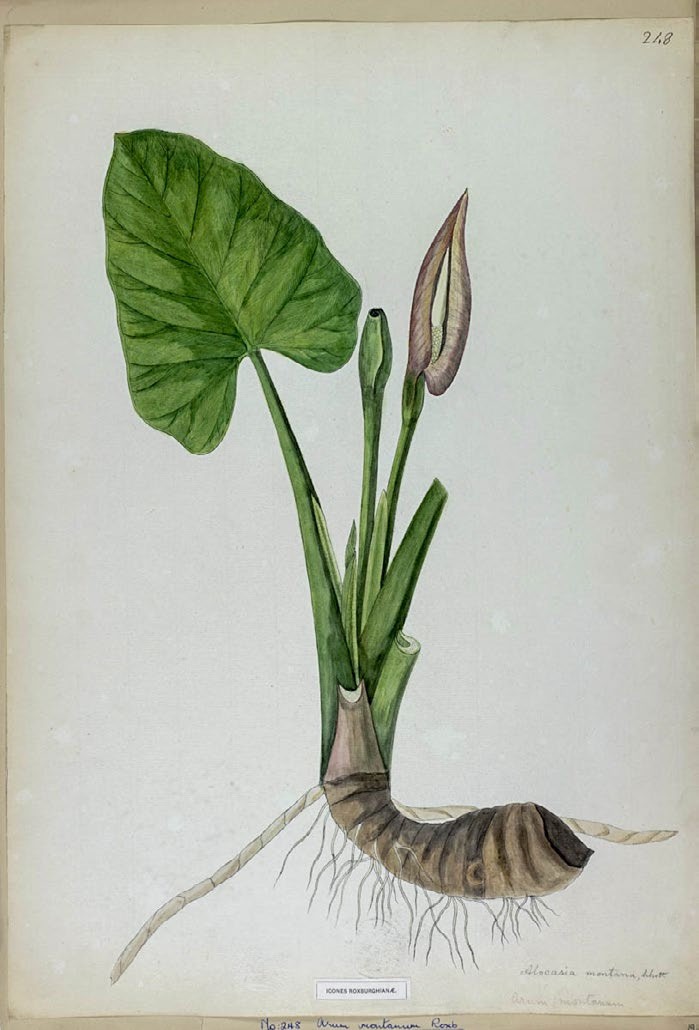
Occasionally a single object carries the whole story. The painting below is Roxburgh's, numbered 248 in the Icones Roxburghianae. Read the writing on it from the bottom up and you have three names for one plant, applied in sequence over two centuries10.
And one of those names went somewhere else
Schott's combination Alocasia montana was published without any comment on the plant's characteristics. Later authors picked the name up and applied it to a different, Javan species altogether10.
That is a fifth mechanism, and the most troublesome of all: the name does not change, and its meaning does. A name in a book is only as good as the specimen the author had in front of them.
4 · An older name surfaces
The last mechanism is the one Part I follows in detail: someone establishes that a different, earlier name has priority, or that the name in use was never legitimately published. The plant is unchanged, the group is unchanged, and the name still moves.
A 2024 case runs entirely inside Anthurium, and it turns on a decision taken in 1898. Two sectional names in Anthurium — Schizoplacium and Dactylophyllium, between them the finger-leaved species with radiately or pedately compound blades — were validly published in the same act, so neither is older and no date can separate them. The Code answers that situation by giving the decision to the first author who publishes a choice between them — and that choice, once published, holds permanently. Engler made it in 1898, when he treated Dactylophyllium as a synonym and kept Schizoplacium14.
It went unnoticed for a hundred and fifteen years. In 2013 the two names were revisited by authors who understood the choice to be still open to them, and who anchored Schizoplacium to the single species in it that molecular work places inside the Dactylophyllium group. That welded the two names together: on current evidence they name one section, and the name it must carry is the one Engler chose14.
Nothing about any plant changed. The name moved because of a sentence written in 1898 and a specimen chosen in 2013. Dactylophyllium is the name most taxonomists would rather keep, and it will go on appearing in print14. Priority is not a matter of preference.
None of this is unusual, and none of it is a sign of a field in disarray. It is the ordinary rate of work in a family where new species are still being described in quantity every year1 — and where a good deal of what is in cultivation has never been through the process at all. Which is Part IV.
Part IV
The plant you bought is probably not a species
Everything so far has been about wild species and the names attached to them. Most plants in cultivation are not wild species, and no amount of keying will make them into one.
Three different kinds of thing
A species is a wild population with a Latin binomial and a type specimen. A hybrid is the offspring of two species. A cultivar is a selected plant maintained by propagation — often a single individual, cloned indefinitely, so that every plant bearing the name is in a real sense the same plant.
They are written differently, and the writing tells you which you have:
Reading the typography
Alocasia reginula — italic, Latin, lower-case
epithet. A species.
Alocasia reginula 'Black Velvet' — the addition is
upright, not italic, capitalized, in single quotes. A cultivar of that
species.
Alocasia 'Purple Moon' — a cultivar with no species
epithet at all, because it does not belong to one species. It is a
hybrid8.
Single quotes are not decoration or emphasis. They are a statement about what kind of plant this is.
What the parentage does to identification
Take a real group of named plants, published with their parentages8:
| Published in 2010 as | Parentage as published | Called now |
|---|---|---|
| Alocasia 'Brisbane Blue' | Alocasia odora × Alocasia brisbanensis | unchanged |
| Alocasia 'Shimmering Velvet' | Alocasia odora × Alocasia reginula 'Black Velvet' | Alocasia 'Regal Shields' |
| Alocasia 'Purple Moon' | Alocasia odora × Alocasia robusta | Alocasia 'Robudora' |
| Alocasia 'Sarawak Moon' | Alocasia odora × Alocasia sarawakensis | unchanged |
| Alocasia 'Manta Ray' | Alocasia odora × Alocasia nycteris | Alocasia 'Nyctedora' — and see below |
All five were published as crosses with the same parent, Alocasia odora, and all five came from one introducer8. They carry a family resemblance to each other and to that shared parent which has nothing to do with wild relationship. Run any of them through a key to wild Alocasia and it will return a species name, because a key has no way of saying this is not a wild plant.
And then read the third column
Fifteen years later, three of those five names no longer mean what they did, in two different ways.
Two were renamed and the old name kept as a pointer. ‘Purple Moon’ is now ‘Robudora’, and ‘Shimmering Velvet’ is now ‘Regal Shields’. Both superseded names are recorded against the current entry, so a plant that arrived under the old label can still be traced.
The third was not renamed at all. Alocasia ‘Manta Ray’ is still in use — for a different cross. The plant sold under that name is now recorded as Alocasia macrorrhizos ‘Borneo Giant’ × Alocasia nycteris, while the 2010 cross is called ‘Nyctedora’. The label stayed and the plant behind it changed.
Which is the difference between the two kinds of name
A botanical name is governed by a code with rules of priority and typification, and a change leaves a trail. A cultivar or trade name is not. It can be reassigned, retired or reused with nothing obliging anyone to write it down — so where the older names above survive, that is somebody choosing to keep the trail rather than a rule being followed.
The Alocasia guide works this through, with the measured parentage of every named cross on record.
The same list shows how a trade name behaves. Alocasia nycteris is a species, and it moves in the trade as 'Bat Wing'8. A name in quotes on a label may be a published cultivar, an unpublished selection, or a marketing name for an ordinary species — and the label looks identical in all three cases.
What makes a cultivar name real
A cultivar name is not real because a nursery uses it. The rules are set out in the International Code of Nomenclature for Cultivated Plants, and they are stricter than most people expect. A cultivar, in the Code's own words, is an assemblage of plants that "has been selected for a particular character or combination of characters" and "remains distinct, uniform, and stable in these characters when propagated by appropriate means"11.
To become established, the name must be published with a description, in dated, printed matter distributed to the public or to institutions with libraries. An undated catalog does not establish a name. And — the part that surprises everyone — electronic publication does not establish a name: not a website, not a post11. A trade catalog that exists only online can be made to count, but only by printing it and depositing two copies in a designated library11.
Registering is not the same as establishing
These are two separate acts and they are constantly conflated. A name is established by publication. Registration is the later step of recording it with the body that keeps the list for that plant group.
For aroids that body is the International Aroid Society, named in the Code as the registration authority for Araceae — excluding, for historical reasons, Calla and Zantedeschia11. The Society was given the role in 1985, and began, sensibly, with a single genus: Anthurium12.
Which is why so many plants in circulation carry names that look formal and are not. Alocasia shows the scale: 92 species are currently accepted in the genus, while the Aroid Journal lists 151 named hybrids and 53 named cultivars. Not one of those names appears in any key in Part II, because none of those keys was written to contain them.
The practical consequence
If a plant came from a nursery rather than a mountainside, the first question is not “which species is it?” but “is it a species at all?” Asking them in the wrong order is the single most common way to arrive confidently at a wrong name.
Part V
Who decides, and where to look
There is no registry that issues plant names and no office that approves them. There are publications, and there are people who read the publications and form a view. Knowing which of those you are looking at is most of the skill.
Four resources, doing four different jobs
They are routinely treated as interchangeable. They are not, and the differences are exactly where mistakes happen.
| Resource | Answers | Does not answer |
|---|---|---|
| IPNI | Was this name published, by whom, where, and when? | Whether anyone accepts it. An index records names, including the ones now treated as synonyms. |
| POWO | Which name is currently treated as the accepted one, and what is synonymized under it. | Anything final. It is a considered editorial view, and it is revised. |
| Tropicos | What specimens exist, where they are held, and how names connect to them. | A verdict. It is a working database, not a judgement. |
| Botanicus and comparable libraries | What the original description actually said — the protologue itself, scanned. | Nothing. This is the primary evidence every other resource is summarizing. |
The family has also had its own effort at putting descriptive taxonomy online rather than leaving it in print: the CATE Araceae project, building descriptions, images and interactive keys onto the web with the aroid community's involvement5. Part II covers what that changes about keying.
“Accepted” is a judgement with a date on it
This is the part most worth internalizing. When a checklist says a name is accepted, it is not reporting a measurement. It is reporting that the people maintaining it have read the published arguments and formed a view. Two careful authorities can hold different views of the same plant and both be honest, because the disagreement is about how much difference makes a species — which is not a question evidence alone settles.
So a name is never simply right. It is accepted by someone, as of some date, on some published argument. When two sources disagree, those three things are what to compare.
How fast this actually moves
It is easy to imagine the naming of a well-known ornamental family as long settled. Counting only currently accepted species, and only those described since 2020:
| Genus | Accepted species | Described 2020 or later |
|---|---|---|
| Anthurium | 1,460 | 366 |
| Amorphophallus | 246 | 20 |
| Monstera | 71 | 25 |
Roughly a quarter of the accepted species of Anthurium, and over a third of Monstera, have been described in the last few years. A monograph from the 1990s is not wrong; it is describing a smaller genus than the one that exists now.
Where this site's numbers come from
Every species total on Aroidpedia is taken from the accepted-name list, not from the figure quoted in any particular paper. Published species counts age quickly and the literature does not agree with itself — for a single genus it is easy to find four different totals in circulation, none of them current. Where this site's figures differ from a source it cites, that is why.
Reference
The words, plainly
Every term used across this section, in the sense the taxonomic literature uses it.
- Binomial
- The two-part name: genus plus species epithet. Anthurium clarinervium is a binomial; Anthurium alone is not.
- Epithet
- The second word. It has no independent existence — it belongs to a genus, and it travels with the species if the species moves.
- Author citation
- The name or names printed after the binomial. Not a courtesy: a pointer to the published description that made the name valid.
- Basionym
- The earlier name an epithet came from, when a species has been moved. The reason an author citation carries a name in parentheses.
- Combination
- A name made by moving an existing epithet into a different genus. The person who does it is cited after the parenthesis.
- Type
- The single preserved specimen — or, for some old names, an illustration — that a name is permanently attached to. The species is a hypothesis about what belongs with the type.
- Holotype / isotype
- The one specimen the author designated, and duplicates of the same gathering distributed to other herbaria.
- Protologue
- Everything published with a name when it first appeared — description, illustration, specimens cited. The primary evidence for what the name was meant to denote.
- Priority
- The rule that among validly published names for the same plant, the earliest is the one to use.
- Illegitimate name
- A name that was published but is not available for use, because of a defect in how it was published — for instance citing the basis of an earlier name inside it.
- Homonym
- The same name used for two different plants. Only one can stand; the other needs replacing.
- Replacement name
- A new name coined because the obvious one is already occupied. Often the explanation for an awkward-looking epithet.
- Synonym
- A name for a plant that is now called something else. A synonym is not an error; it is a name that lost priority or a group that was merged.
- Accepted name
- The name a given authority currently treats as correct. A judgement, held by someone, as of a date.
- Section
- A named group of species inside a genus, below genus and above species. Sections are hypotheses and are regularly revised.
- Monophyletic
- Containing an ancestor and all of its descendants. A group that fails this test is not wrong to use, but it is not a natural group.
- Homoplasy
- The same form arising independently in unrelated lineages. A homoplasious character can still identify a plant reliably; it just does not indicate relationship.
- Dichotomous key
- An identification tool built of paired statements, each choice committing you to a branch until you reach a name.
- Couplet
- One such pair, numbered, conventionally written 1a and 1b.
- Multi-access key
- A key that lets you enter whatever characters you can see, in any order, narrowing the candidates as you go rather than fixing the sequence in advance.
- Cultivar
- A selected plant maintained by propagation, its name written upright and capitalized in single quotes. Frequently a single clone.
- Hybrid
- The offspring of two species. Written with a multiplication sign between the parents, or given a cultivar name of its own.
- Trade name
- A selling name. It may look exactly like a cultivar name and carry none of the same obligations.
Next
Where this goes next
This hub is about names in general. The work of actually reaching one happens genus by genus, because every genus has its own keys, its own contested groups, and its own characters that look diagnostic and are not.
Four genera have a guide. They are not four versions of the same page — each one is built around the particular thing that makes that genus hard, and those things turn out to be entirely different from each other.
-
Read now
Alocasia
Most cultivated Alocasia are not species at all, so the first question is not which species but whether it is one — with the parent table that shows how few species make most of the crosses, and why a difficult plant growing easily is evidence against its own label.
Read the guide
-
Read now
Anthurium
You do not key an Anthurium; you key a section from a place. The first couplet of a standard key asks for a continent, not a character — and of its first seven couplets, exactly one can be answered by a living plant with no collection data.
Read the guide
-
Read now
Monstera
The only revision of the whole genus recognized twenty-two species. Costa Rica alone now has thirty-five. What that arithmetic does to a key, why the characters in it were measured on dried plants, and what borsigiana and obliqua actually turned out to be.
Read the guide
-
Read now
Philodendron
The argument in this genus is not about any plant. Everyone agrees on the tree; the disagreement is what to call one of its branches — and both answers produce natural groups, which is why the tree cannot settle it.
Read the guide
The rest of the family
More genera will follow. A guide goes up when there is something specific to say about identifying that genus — a key worth running, a contested group worth explaining, a character that misleads. Until then, the two companion sections carry most of what is needed.
Aroid Morphology is the vocabulary. Nearly every couplet in every key on this page is asking about a structure described there — the geniculum, the collective vein, the cataphyll, the sinus — and its genus-by-genus table gives the single vegetative character a taxonomist reaches for first in each genus. If a key asks something you cannot answer, that is usually where the answer is.
The Araceae tree is the other half of Part III. When a section fails a monophyly test or a genus is dissolved into another, the tree is the picture of what replaced it.
And Aroid Reproduction covers the flowering biology that sits behind several of the arguments here — including the crossing experiments that moved two well-known Anthurium species out of the section they had been in for decades.
Sources
The papers behind this section
Fourteen sources carry this hub. Two of them — a short essay and a two-page nomenclatural proposal — do more work than their length suggests, and both are worth reading whole.
- Boyce, P. C. (2011). The Quest for Understanding — Just What Makes it a ‘New’ Species? Aroideana 34: 93–95. The spine of this hub. A working aroid taxonomist setting out how the judgement is actually made, and the source of the count of new and recombined aroid names published in Aroideana since 1978, its share of all accepted names in the family, and the per-genus breakdown.
- Nicolson, D. H. (1977). Proposal to change the typification of 723 Amorphophallus, nom. cons. Taxon 26(2/3): 337–338. The priority chain in Part I: Dennstedt's 1818 name, its basis in van Rheede's plate of 1692, and the reason Roxburgh's better-known binomial is illegitimate rather than merely later. The paper's own subject is the typification of the genus; the species-level consequence follows from it and from the accepted authority string, and is not a claim the paper makes in those words.
- Hetterscheid, W. L. A. & Claudel, C. (2012). The End of Pseudodracontium. Aroideana 35: 40–46. The dissolution of a genus, the replacement name required when the obvious combination was already occupied, and the finding that the type material of the occupying name is a mixed collection.
- Croat, T. B. & Guan, C. (2025). A Revision of Anthurium section Cardiolonchium (Araceae) from Carchi Province, Ecuador. Aroideana 48(3): 81–300. The key quoted in Part II, verbatim from its opening couplets, and the transfer of Anthurium clarinervium and Anthurium leuconeurum out of section Cardiolonchium in Part III.
- Haigh, A., Lay, L., Mayo, S. J., Reynolds, L., Sellaro, M., Bogner, J., Boyce, P. C., Croat, T. B., Grayum, M. H., Keating, R., Kostelac, C., Hay, A., Hetterscheid, W., Mora, M. & Wong, S. Y. (2008). A New Website for Araceae Taxonomy on www.cate-araceae.org. Aroideana 31: 148–154. The CATE Araceae project: descriptions, images and interactive keys built for the family, and the wider move to put descriptive taxonomy online.
- Carlsen, M. M. & Croat, T. B. (2019). An analysis of the sectional classification of Anthurium (Araceae): comparing infrageneric groupings and their diagnostic morphology with a molecular phylogeny of the genus. Annals of the Missouri Botanical Garden 104(1): 69–82. The monophyly test in Part III. Seven of twenty sections and series hold; the diagnostic characters prove highly homoplasious, with the consequence that a character can identify a plant well and indicate its relationships poorly.
- Croat, T. B. & Sheffer, R. D. (1983). The Sectional Groupings of Anthurium (Araceae). Aroideana 6: 85–123. The sectional arrangement as it was set out for growers, and the classification the 2019 analysis tests.
- Cultivar Name Establishment. (2010). Aroideana 33: 267–270. The named hybrids and their published parentages in Part IV, and the trade name of Alocasia nycteris. An editorial listing, published without an author. Its account of what establishes a cultivar name still matches the Code; the rules in Part IV are cited to the Code itself.
- Cedeño-Fonseca, M., Hay, A. & Blanco, M. A. (2022). A taxonomic revision of Monstera Adans. (Araceae: Monsteroideae) in Costa Rica. Aroideana 45(1). The neotype of Monstera punctulata in Part I — Schott drawing no. 3281 — and the account of how a drawing came to serve as the type after the presumed holotype was destroyed.
- Hay, A., Boyce, P. C. & Hein, K. Z. (2022). On the identity of Arum montanum Roxb. and Alocasia gageana Engl. & K.Krause — two earlier names. Aroideana 45(3). The painting in Part III. Lectotypifies Arum montanum on Icones Roxburghianae no. 248, makes the combination Englerarum montanum, places Alocasia gageana, Englerarum hypnosum and Alocasia lihengiae in synonymy, and records the misapplication of Alocasia montana to a Javan species.
- Brickell, C. D. et al. (eds.) (2016). International Code of Nomenclature for Cultivated Plants, Ninth Edition. Scripta Horticulturae 18. International Society for Horticultural Science. The rules in Part IV, read from the Code itself. Art. 2.3 for the definition of a cultivar; Art. 25.1 for publication, including that electronic media do not establish a name, and Art. 25.1 Note 3 with Rec. 25C.1 for the library-deposit route; Art. 26 for dating. Appendix I lists the International Aroid Society as the registration authority for Araceae, excluding Calla and Zantedeschia.
- Banta, J. (1985). Notice [designation of the International Aroid Society as International Registration Authority for the Araceae]. Aroideana 8(1). The designation itself, by the ISHS Commission for Horticultural Nomenclature and Registration — and the decision to begin registration with a single genus, Anthurium.
- Hay, A. (2022). Boycea, a new genus of the Tribe Aglaonemateae Engl. (Araceae). Aroideana 45(2). The segregation case in Part III. Describes Boycea for the Bornean plant published in 1994 as Nephthytis bintuluensis, which molecular data place with Asian Aglaonema rather than with the West African Nephthytis it closely resembles. Sets out what separates it from both.
- Hay, A., Llano-Almario, M. & Carlsen, M. M. (2024). A note on the priority of the simultaneously validated synonymous sectional names in Anthurium Schott (Araceae—Pothoideae), sect. Schizoplacium (Schott) Engl. and sect. Dactylophyllium (Schott) Engl., and typification of their respective lectotype species. Aroideana 47(3). The priority case in Part III. Works out that the two sectional names, having been validated together, are separated not by date but by ICN Art. 11.5 — the first published choice between them, which was Engler's in 1898, in favor of Schizoplacium. Also lectotypifies Pothos palmatus and neotypifies Anthurium kunthii, and states plainly that the infrageneric classification of Anthurium remains extensively unresolved.