
Pest Management·06 / 08
WHITEFLIES
Aleyrodidae — Trialeurodes vaporariorum, Bemisia tabaci
A cloud of adults when you brush the plant, and the nymphs underneath doing the actual damage. Which of the two species you have decides which treatment works.
Not flies. Whiteflies sit with the aphids and the scales — sap feeders with a waxy coat — and they behave like scales for most of their lives and like flies for a few days of it.
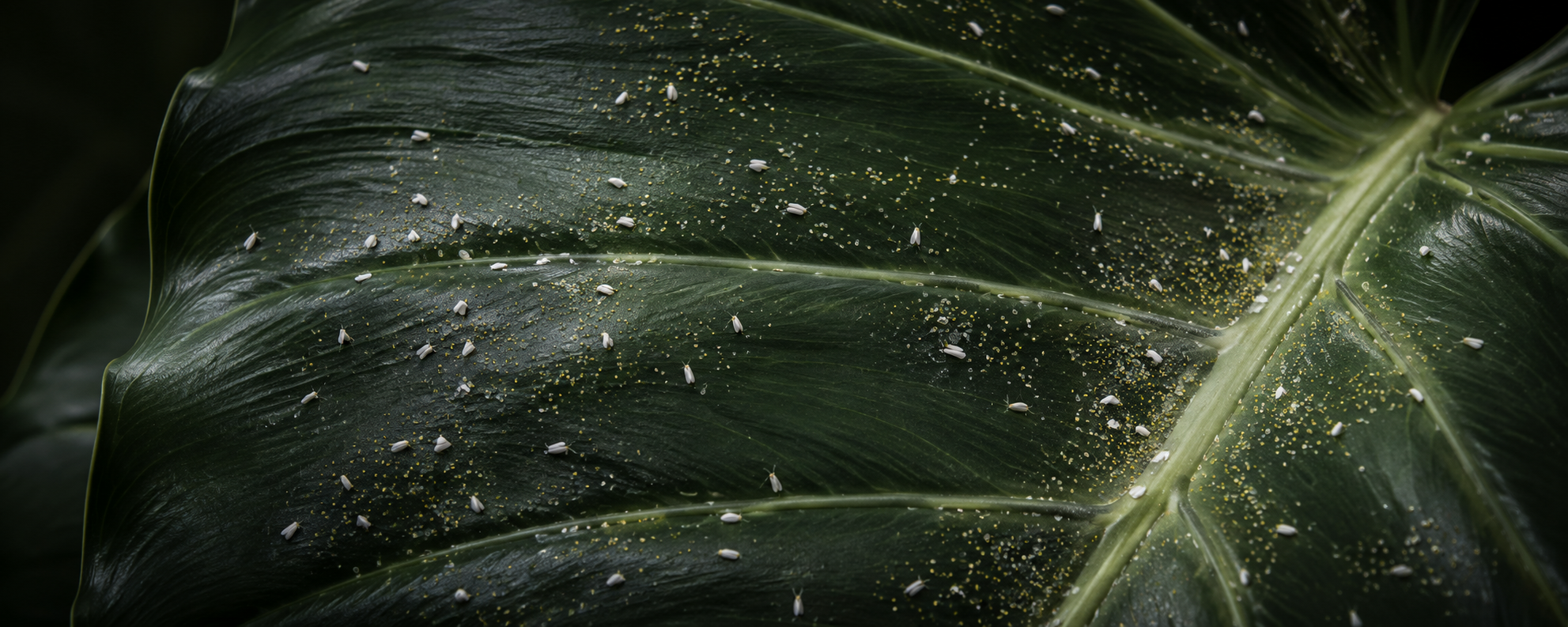
Adults are tiny, white and mealy-looking, cluster on the undersides of leaves, and rise in a cloud when the plant is brushed. That cloud is the reason people notice them; it is not where the damage is.
Two species dominate indoors, and telling them apart is the most useful ten minutes you can spend on this page. Trialeurodes vaporariorum, the greenhouse whitefly, holds its wings almost flat and roof-like over the body, and its pupal case carries a fringe of long waxy filaments. Bemisia tabaci — sweetpotato or silverleaf whitefly — is smaller, holds its wings tented at a steeper angle and slightly apart so the yellow body shows through, and its pupal case is smooth without the filament fringe. Bemisia is far more resistant to insecticides, and it takes a different parasitoid.
The adults you can see are the smallest part of the problem. The nymphs you cannot — flat, translucent, glued to the leaf underside — do most of the feeding.
Sap removal causes yellowing, general decline and, in heavy infestations, leaf shedding. Like aphids and soft scales they excrete honeydew, so expect a sticky film and black sooty mould below any colonised leaf.
After the first mobile crawler stage the nymphs settle and do not move again until they emerge as adults. From then on they are effectively small scale insects with a waxy cover — which is exactly why contact sprays reach them so poorly and why every treatment on this page has to be repeated.
Both species vector plant viruses. Bemisia is one of the most serious virus vectors in world agriculture, which is another reason to know which one you have.
Three to four weeks, warm, and only two stages of it are reachable.
Adults lay on the undersides of leaves; eggs hatch in three to seven days. The first instar is a mobile crawler that walks a short distance and settles. It then passes through three further immobile instars and a pupal stage under a waxy cover before a new adult emerges.
So the population at any moment is: eggs, which most sprays do not kill; settled nymphs, which most contact sprays do not penetrate; and adults, which fly away when you approach. Repeat applications are not optional here — the interval exists to catch each cohort as it hatches, before it settles under a cover.
All of these work on part of the population. None works on all of it, which is the recurring theme of this pest.
- 01Vacuum the adults. Genuinely effective and faintly ridiculous. Disturb the plant so they take off, then catch them in the air with the hose — do not try to vacuum them off the leaf. It removes a large fraction of the egg-laying population in a few minutes and can be repeated daily at no cost.
- 02Yellow sticky cards. Whiteflies are strongly attracted to yellow. These give real if modest population reduction and, more importantly, a weekly count.
- 03Horticultural or dormant oil. A mechanical control — it suffocates, so there is no mode of action to develop resistance to, and it can be tank-mixed with many other products to improve their coverage. Contact only, no residual. Oils burn foliage above roughly 80–85°F and on sensitive leaves — test on a couple of leaves and wait a day before spraying a whole plant. Against whitefly it kills the nymph stage only — not eggs, not adults.
- 04Insecticidal soap. Kills nymphs on contact, nothing residual, and it needs to reach the underside of the leaf to do anything at all.
- 05Remove the worst lower leaves. The oldest colonised leaves carry the densest nymph population, and on a plant that can spare them, cutting is faster and more thorough than spraying.
Whitefly is where biological control started. Encarsia formosa has been sold to growers since the 1920s, and it remains the standard answer for the greenhouse species.
The reason it works so well here is structural: the settled nymph that a contact spray cannot penetrate is a defenceless, immobile target for a wasp that lays through the cover. The pest’s best defence against chemistry is its worst defence against parasitism.
Encarsia formosa
Parasitoid wasp · greenhouse whitefly
The most famous biological control agent in horticulture — in commercial use since the 1920s. It lays into whitefly nymphs, and parasitised greenhouse-whitefly scales turn black, which makes progress visible on the leaf. Excellent on Trialeurodes, much weaker on Bemisia.
Use whenyou have greenhouse whitefly, the room is above about 18–20°C, and it is reasonably bright.
Eretmocerus eremicus
Parasitoid wasp · both species
Attacks both whitefly species and tolerates higher temperatures than Encarsia. Parasitised scales turn amber or yellow rather than black. The right choice when you have Bemisia, or when you are not certain which you have.
Use whenBemisia is present or suspected, or the room runs hot.
Amblyseius swirskii
Predatory mite
Eats whitefly eggs and crawlers — the two stages the parasitoids do not touch — and thrips larvae as well. It survives on pollen between meals, so it stays on the plant rather than dying out.
Use whenwarm conditions above about 20°C, and especially alongside a parasitoid, because the two cover different stages.
Delphastus catalinae
Whitefly lady beetle
A very small black beetle whose adults and larvae eat whitefly eggs and nymphs, and it works best precisely where the parasitoids struggle — at high density. It largely avoids parasitised scales, so it can be run alongside Encarsia without eating the programme.
Use whenthe infestation is heavy and you need numbers brought down before a parasitoid can keep up.
Encarsia formosa released onto Bemisia tabaci is money spent for very little. Check the wings: flat and roof-like with a filament-fringed pupal case is greenhouse whitefly and Encarsia is right; steeply tented and slightly apart with a smooth pupal case is Bemisia and you want Eretmocerus eremicus.
Black or amber scales on the leaf undersides are not a second pest. They are parasitised whitefly with a wasp developing inside. If you see them, stop spraying — the programme is working, and every spray from here kills the wasps rather than the whitefly.
Imidacloprid is the hard stop: systemic, roughly 90 days, and lethal to all four of the agents above for the whole of it. Check any residue against the Koppert or Biobest side-effect databases before you order anything alive.
Adults are mobile and easy to hit; nymphs are covered and hard to hit; eggs are neither. Every product below is strong on one of those and weak on the others, which is why the interval matters more than the choice.
The most complete option, because it reaches the settled nymphs on the leaf underside without depending on you coating them — which is the single hardest part of treating whitefly by spray.
Two-way movement — up from the roots and from leaf to leaf — active on eggs, larvae, nymphs and adults, with roughly 30–45 days of residual protection. Sold here as Bug Destroyer, 22.4% spirotetramat.
Pyrethroids are excellent against adult whiteflies, and bifenthrin is the pick of them for its very long residual. A synthetic pyrethroid with a broad range including termites and spiders; it also suppresses spider mites, and makes a good barrier spray around the home. About $22 for 16oz as Bifen I/T.
Weak on the covered nymph stages, which is why it belongs in a programme rather than on its own. The long residual also forecloses biological control for weeks.
Another synthetic pyrethroid with a narrower range. It is the active ingredient in dog flea collars and human lice treatments, and it is a neurotoxin to cats — keep cats away from treated plants until everything is dry, around 12 hours. About $20 for 32oz as Bonide Eight.
A limonoid from neem seed acting as an antifeedant and insect growth regulator, and substantially more effective than cold-pressed neem oil — a different product with a similar name. Effective on both adult and larval stages, which few things here are.
Oil-based: apply early morning or late evening to avoid burning leaves. Safe for pollinators once dry. Short residual. About $25 for 4oz — AzaMax.
Extremely effective against whitefly — probably the most effective single product listed — but it is a systemic and it takes time to move, so it works as a preventive or alongside a knockdown rather than as a rescue.
Extremely toxic to pollinators — banned in the EU and in several US states. Indoor and greenhouse use only, and never on an outdoor plant that will flower within three months. Applied as granules to the substrate and watered in; about 90 days per application. Because it travels through the roots it is slow, so it works better as a preventive than as a rescue. The full entry, including the case for using it indoors, is in the mealybug guide. Bonide systemic houseplant insect control, about $20 for 8oz.
- 01Identify the species. Wings and pupal case, under a loupe. It decides the parasitoid, and it tells you how much resistance to expect.
- 02Yellow cards up, counted weekly.
- 03Vacuum the adults before every treatment. Fewer adults means fewer eggs laid tomorrow, and it costs nothing.
- 04Cut off the worst lower leaves.
- 05Treat the undersides, not the tops. Everything that matters is underneath, and a spray applied from above is a spray applied to the wrong surface unless the product is translaminar or systemic.
- 06Repeat every five to seven days, at least three rounds, so each hatch is caught before it settles under a cover.
- 07Rotate the mode of action between rounds — particularly with Bemisia, which has beaten more chemistries than any other pest in this guide.
- 08Or go biological and stop spraying. Then watch for black or amber scales, which are the sign it is working.
- 01Whiteflies — UC Statewide IPM Program, Pest Notes 7401
- 02Whitefly — Koppert pest profile
- 03Managing houseplant pests — Colorado State University Extension
- 01Biological control and natural enemies of invertebrates — UC IPM, Pest Notes 74140
- 02Whitefly Encarsia formosa parasitoid — UC IPM natural enemies gallery
- 03Whitefly predatory Delphastus lady beetles — UC IPM natural enemies gallery
- 04Encarsia — Cornell Biological Control
- 05Eretmocerus — Cornell Biological Control
- 06Encarsia formosa — Koppert
- 07Eretmocerus eremicus — Koppert
- 08Amblyseius swirskii — Koppert
- 09Macrolophus pygmaeus — Koppert