
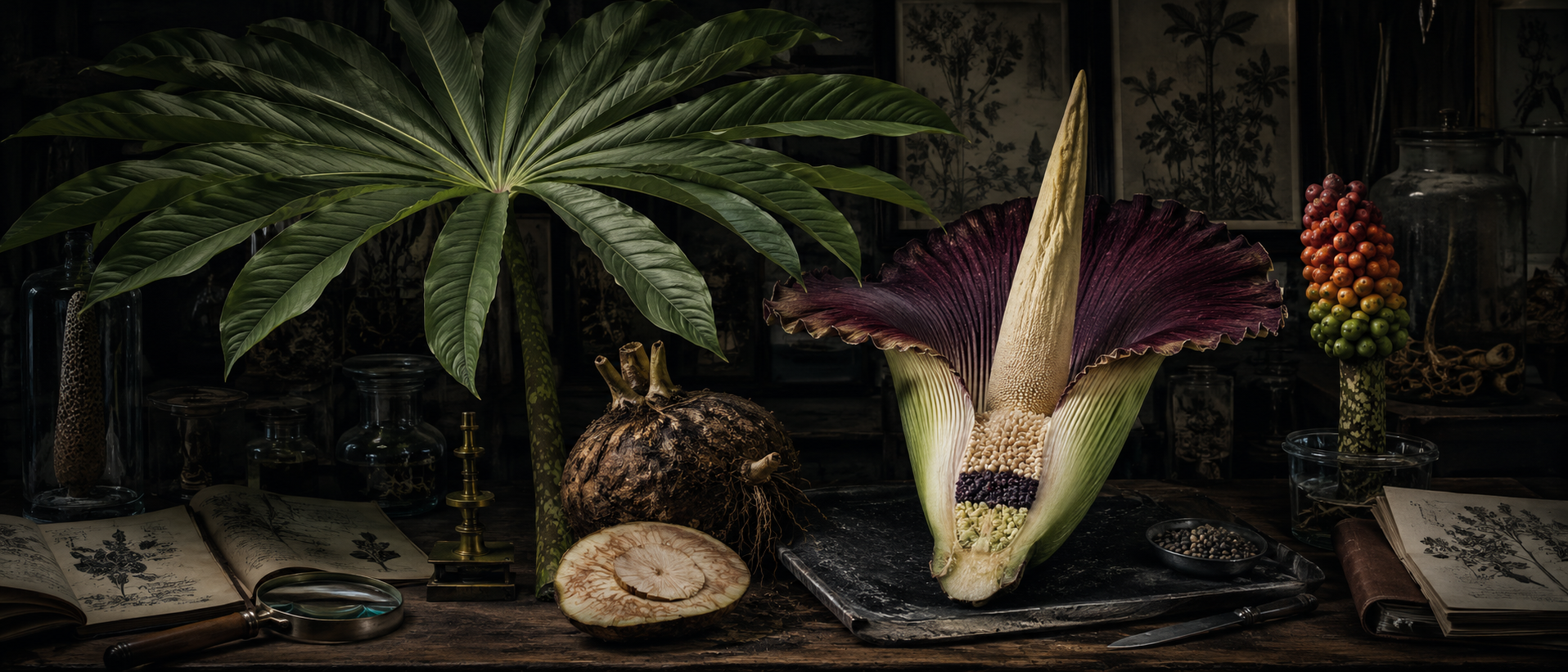
Araceae · Morphology
THE AMORPHOPHALLUS LEAF
One leaf, one stalk, and a tuber that does the rest
The Guide
One leaf, and it is the whole plant
Most aroids give you a stem with leaves along it. Amorphophallus gives you one leaf. It comes up from a tuber, on a single stalk, and divides into a crown that in the largest species stands taller than a person — and then, at the end of the season, the whole thing dies back to the tuber and the plant is underground again.
The two people who have written most about the genus put it plainly: the morphological variation here is unmatched by any other genus in the family1. This page is about the vegetative half of that variation — the tuber, the leaf and the stalk it stands on.
- 1 leaf the plant carries at a time
- 246 species in the genus
- 75 kg what a single tuber can reach
- 0 blade characters in the table that names species
Read the last one again
When the genus was revised, the author tabulated the characters that actually do the work of telling species apart. The table runs to thirty-one entries: fifteen on the spadix, ten on the spathe, three on the peduncle, and three on the petiole2.
The petiole's three are its length, its color and its surface. There is no entry for the blade — not its outline, not its divisions, not its venation. The most structurally extraordinary leaf in the family contributes the stalk it stands on, and nothing else.
Which is why this page is worth reading, not why it is not
A character that will not name a species can still be the most interesting thing about a plant. The Amorphophallus leaf tells you how the genus solves being a seasonal geophyte that has to build a tree's worth of photosynthetic surface in a few months and then throw it away.
It just does not tell you which Amorphophallus you have. Knowing that in advance saves a great deal of staring at leaflets.
How this page is ordered
The tuber first, because in this genus the tuber is the plant and everything above ground is temporary. Then the alternation — the reason you will rarely see a leaf and a flower on the same plant. Then the leaf itself and how it is built, then the stalk and the surprising thing its markings may be doing. The last part returns to that zero.
Amorphophallus Reproduction is the companion, and it owns the inflorescence entirely — its anatomy, the two-day clock, the heat, the smell, and who arrives. Where this page needs the inflorescence it names it and moves on.
Part I
The tuber, which is the plant
An Amorphophallus has no stem above ground. It is an acaulescent herb — what looks like a trunk is the stalk of a single leaf — and the plant proper is an underground tuber, formed from the stem itself2. Everything you can see is seasonal. The tuber is the continuous thing.
A range of sizes almost nothing else in the family matches
The smallest are trivial. Amorphophallus barthlottii, from the Liberia–Côte d'Ivoire border, and Amorphophallus angulatus from Sarawak, make tubers only 2–3 cm across. Amorphophallus gigas and Amorphophallus titanum make tubers of over 75 kg2.
That is the same organ, in the same genus, across four orders of magnitude of mass. Shape varies too, though here the record is regional: among the African species, discus-shaped tubers dominate, with rounded ones typical of the smaller species and elliptical ones exceptional. Large species have small round tubers in their juvenile stages and change shape as they grow2 — so tuber shape is a character that depends on the plant's age.
It rebuilds itself every year, and it sinks
This is the part worth knowing if you grow one. The tuber does not simply enlarge. Each season the plant spends the stored reserves, and the assimilates from that season's leaf build a new tuber, which forms above the remains of the old one. The previous year's tuber can be found as a spent remnant on the underside or flank of the new one2.
And then it pulls itself back down
Building each new tuber on top of the last one would walk the plant steadily up towards the surface. It does not happen, because contractile roots haul the new tuber back down to depth2.
So a tuber you lift in autumn is not the tuber you planted. It is this year's, sitting on the wreck of last year's, at a depth the plant chose.
Offsets that wait for the parent to die
Tubers commonly produce rounded daughter tubers or elongate stolons. The daughters frequently do not develop while the mother tuber is still growing — they run out only once she is destroyed or breaks down with age2.
Which is a useful thing to know before you conclude a plant has failed to offset. It may simply be waiting.
Where the growth comes from
On the apical face of the tuber there is a depression, and the growing point sits in it2. After dormancy — up to six months — roots form first, and then, as a rule, the inflorescence2. What happens next is Part II.
A word about the word
The revision that most of this page rests on calls the organ a Knolle — a tuber — throughout2. The phenological literature more often calls it a corm3. Both are used for this organ and neither is wrong; this page says tuber and means the same thing you will see called a corm elsewhere.
Part II
One or the other — but only in Asia
The single most consequential fact about this genus is not a shape. It is a schedule — and the schedule is not the same across the genus. Where the plant comes from decides whether you ever see its leaf and its flower at the same time.
Two calendars, and a continent between them
Asian species, as a rule, do one or the other. The non-evergreen ones, in the wild, refuse to produce a leaf after flowering and effective pollination — so, in the words of the genus-wide account, “fruiting plants are never found with leaves.” In cultivation most behave the same way, though a plant whose inflorescence is removed will sometimes make a leaf after all1.
African and Madagascan species do both, every time. They “all develop a leaf in the same season as flowering, with or without pollination and fruit set” — most raising a leaf shoot directly alongside the peduncle, some after a short rest1.
It is a couplet in the key
This is not a footnote to the descriptions. It is couplet 41 of the genus key, and the question that splits the genus in two there is a question about timing1:
41a — leaf and inflorescence in the same season,
inflorescence always preceding the leaf (African, Madagascan).
41b — leaf and inflorescence usually in separate seasons;
when in the same season, the leaf always precedes the inflorescence
(Asian).
To answer it you have to have watched the plant. No amount of looking at the plant in front of you today will settle it.
A warning that follows from it
When you cut away the spent inflorescence of an African species, do not cut the leaf shoot coming up alongside the peduncle. On those species it is already there1.
The order, and what pays for what
The African revision describes that second cycle in full. After dormancy of up to six months, roots form first. Then, as a rule, the inflorescence comes up — from a tuber, with no leaf to feed it, spending stored reserves. Once it has finished and consumed a large part of those reserves, a leaf normally follows, and the fruits ripen while it stands2.
Read that last clause again: the fruits ripen while the leaf stands. That is 41a — both organs in one season — written out as a growth cycle.
So the sequence is: reserves → flower → leaf → new reserves. The leaf is not decoration on a flowering plant; it is the plant paying itself back, and building the tuber that will fund next year.
Measured, in one species, across one year
The measured case that follows is an Asian species, and it keeps the Asian calendar. A 2025 study staged the whole cycle formally — the first comprehensive phenology of the genus's best-known crop species, using the BBCH scale, on Amorphophallus paeoniifolius in Dimiao, Bohol, in the Philippines, followed from June 2024 to May 20253.
| When | What the plant is doing |
|---|---|
| June–September | The active phase, reproductive and vegetative3. |
| June and July | Flowering — and only then3. |
| October–November | Leaves yellow and wilt3. |
| December–May | Complete death of the aerial parts. Only the tuber remains, underground3. |
The cycle proved bimodal and tied to the monsoons, the shift out of dormancy driven by the onset of the Southwest Monsoon — rising rainfall, sustained humidity, rising temperatures3. The authors read the alternation itself as a resource allocation trade-off, the tuber alternating between reproductive and vegetative investment according to those cues3.
Those months are one species in one place
Amorphophallus paeoniifolius on Bohol runs on the Philippine monsoons. A species from seasonal Indochina, or one in a pot in a temperate greenhouse, will not keep that calendar. What carries across is the shape of the cycle — dormancy, then one structure, then the other, then dormancy again — not the dates.
What this does to identifying the plant
It means you are rarely looking at the whole organism. A key to Amorphophallus asks about the spadix, the spathe, the peduncle and the petiole — and on an Asian species the first three belong to a structure that is not there when the leaf is, and vice versa. Answering such a key from a single visit to a single plant is usually not possible. You are working across seasons, or working from someone else's notes on the half you did not see.
And couplet 41 goes further than that. It asks not what the plant looks like but what it did last season — a character you can only hold if you were keeping a record.
That is a fact about the plant's schedule rather than about the key, and no amount of care with a hand lens gets around it.
Part III
How the leaf is built
The crown looks like a small tree, and the instinct is to read it as many leaves on branches. It is one leaf. Underneath the complexity there is a very simple plan, repeated.
It starts as three bumps
The leaf base is conical and raises three small humps. The two outer ones begin dividing asymmetrically early; the middle one holds unified growth longer before forming segments on both sides. As growth continues the asymmetry of the two lateral sections is lost, and from then on the leaf only makes branches — pinnae of successively higher order. The stalks of the individual leaflets appear late, only once their own intercalary growth starts2.
So the finished leaf is a pinnate leaf on a ternate ground plan: two asymmetric lateral sections and a terminal section that is equally asymmetric and branches pseudodichotomously — forking in a way that looks like a true fork and is not2.
And here is why you cannot see that
The blade is primarily three-parted. But each of those three parts subdivides again, up to four further times depending on the size of the leaf — so the three-way division is, in Ittenbach's words, not immediately recognizable to the eye2.
That is the whole illusion. A structure with three main branches, subdivided enough times, stops reading as three of anything and starts reading as a canopy. If you want to see the plan, follow the rhachis down from the crown to where it meets the stalk and count the primary forks. There will be three.
Finished before it opens
The leaf is already completely pinnate while it is still wrapped in the cataphylls, with all the main segments standing vertically in the bud. The leaflets are rolled inward toward the axis, each one independently of its neighbors2.
Which is worth pausing on if you have read this site's Anthurium guide, where involute vernation — a blade rolled in from both margins — is the defining character of one section and is said to be otherwise almost unknown in the family. There is no contradiction. That statement is about how a whole blade is rolled in the bud; this one is about how individual leaflets are rolled inside a leaf that is already divided. Different structures, at different levels.
The seedling does not look like the adult
The first leaf a seedling makes is either undivided and sagittate — not yet showing the genus's typical form at all — or already three-parted2. So a young plant may give you an arrowhead where you expected a crown, and that is normal rather than informative.
What the leaf stands in
The adult leaf, as a rule, stands alone and erect, and its base is sheathed by one to four cataphylls — simple, parallel-veined, elongate to elliptical scale leaves arranged in two ranks or nearly so. They wrap and protect the developing leaf until it takes its final growth spurt, persist at the base for a while afterwards, and then wither2.
One more detail worth knowing before Part IV: the leaflets often run down the rhachis, and where they do the rhachis can be distinctly winged2. It is one of the few things about the blade that is easy to check and easy to describe.
Part IV
The stalk, and what its markings may be doing
The petiole is the part everyone photographs: tall, smooth or rough, and in many species mottled, marbled or speckled in colors quite unlike the green underneath. It is also, unlike the flower's stalk, always conspicuous2. There is a proposal in the literature about why it looks like that, and it is worth knowing.
First, the plain description
The petiole is smooth, rough or distinctly structured, usually with a greenish ground color carrying speckling or marbling in another color2. Its size varies enormously between species: Amorphophallus gigas raises leaves over 3.5 m tall; Amorphophallus maculatus and Amorphophallus stuhlmannii reach 2–2.5 m and more; while Amorphophallus aphyllus has a petiole of only 30–70 cm2.
One species changes with age in a way worth watching for: Amorphophallus maximus carries a coat of white hairs on the petiole when young, and loses that down as the plant gets old2.
And then the proposal
Lichen mimicry
The petiole mottling of Asian species is regarded by Barthlott as lichen imitation — markings that mimic a lichen-covered surface in order to deter larger animals2.
The suggested mechanism is specific: the patterning is supposed to make a soft, edible, herbaceous stalk read as a durable woody trunk that is not worth eating and hurts to walk into2.
Some Asian species take it further and build the markings as three-dimensional structures rather than flat color. Ittenbach singles out Amorphophallus gigas as having perfected it: in the axils where the two lateral sections and the terminal section branch, there is a bluish-green coloring that tapers downward and, in his words, looks confusingly like a coating of blue-green algae2.
How firm is this?
It is a hypothesis, reported as one. The markings are regarded as lichen imitations and are supposed to feign a woody stem2. Nobody in this account tests it — no herbivore is offered a marked and an unmarked stalk, no damage rates are compared.
What is not in doubt is the resemblance, and that it recurs across unrelated species in the same region. Whether it is doing the job proposed for it is open, and worth saying so rather than repeating the explanation as though it were settled.
Why the stalk gets a part to itself
Because it is the only part of the leaf that the taxonomy uses. Of the characters that name species in this genus, the leaf contributes three, and all three are the petiole: its length, its color, its surface2. When you photograph the mottling you are photographing one of them.
Part V is about the other side of that.
Part V
What the leaf will not tell you
Four parts of description, on the most structurally remarkable leaf in the family. Here is the sentence the man who revised the genus put at the end of his own account of that leaf:
“Es ist aber sehr schwer nur anhand des Blattes eine Art zu erkennen.”
It is very difficult to recognize a species from the leaf alone2.
And the tables agree with him
The same revision tabulates the characters that carry the taxonomy. Counted by organ, the thirty-one entries fall out like this2:
| Organ | Characters | Which |
|---|---|---|
| Spadix | 15 | Zone shapes and proportions, flower arrangement, the transitions between zones, and the appendix — its length, direction, form and surface. |
| Spathe | 10 | Ground form, absolute size, the sculpturing and color of the inner base, orientation, margin. |
| Peduncle | 3 | Length, color, surface. |
| Petiole | 3 | Length, color, surface. |
| The blade | 0 | Not its outline, not its divisions, not its venation, not the shape of a single leaflet. |
Twenty-five of the thirty-one belong to the inflorescence. Six belong to a stalk. The crown itself — the thing that makes people photograph this genus — contributes nothing the taxonomy uses.
Which is not the same as useless
Ittenbach himself gives a counter-example on the same page: the leaf of Amorphophallus aphyllus, with its short 30–70 cm petiole and lanceolate leaflets, he calls very characteristic2.
So a leaf can identify a species. It is generally insufficient, which is a different and weaker claim than useless — and the difference matters if you happen to grow one of the species where the leaf does the job.
What follows, practically
Two things follow, and on most of the genus they compound. The characters that name the plant are mostly on the inflorescence — and by Part II, on an Asian species the inflorescence is not present when the leaf is1, 3. So for most of the genus, the parts you need and the parts you can see are in different seasons.
On an African or Madagascan species they are not. Those flower and leaf in one season, so the whole plant is available at once — which is the one circumstance in this genus where a single visit can settle something1.
The practical response is to stop trying to settle it in one visit and start keeping a record instead. Photograph the petiole with something for scale, note its surface and its markings, note how many cataphylls sheathed the base and whether the rhachis was winged — then, when the same tuber flowers in a later season, you have the other half.
Amorphophallus Reproduction is where that other half lives: what the spadix, the spathe and the appendix are, what varies across the genus, and what to watch when one finally opens.
Sources
The papers behind this page
Three sources. One revision does most of the work, because it is the only place the vegetative plant is described at length; one genus-wide account supplies the whole-genus statements; and one recent field study supplies the calendar.
- Hetterscheid, W. & Ittenbach, S. (1996). Everything you Always Wanted to Know about Amorphophallus, but Were Afraid To Stick Your Nose Into!!!!! Aroideana 19: 7–131. The genus-wide account, by the two people who have written most about it, and the source of the line this page opens on — that the morphological variation in Amorphophallus is unmatched by any other genus in the family. It is also where the continental split in the growth cycle is set out, both as prose and as couplet 41 of its key: African and Madagascan species carry leaf and inflorescence in one season, Asian species usually do not. A hundred and twenty-five pages, and worth the title.
- Ittenbach, S. (2003). Revision der afrikanischen Arten der Gattung Amorphophallus (Araceae). Englera 25: 2–263. Botanischer Garten und Botanisches Museum, Berlin-Dahlem. Nearly all of this page. Its section 3 is the only sustained description of the vegetative plant in the literature held here — habit and growth form, tuber and root, and the leaf, including the three humps it starts as and the ternate ground plan it never quite shows. Its character chapter is the basis of Part V, and its closing sentence on the leaf is quoted there. ⚠ In German, and its species are African: the morphology in section 3 is generic to the genus, but where a claim is drawn from African material this page says so.
- Ayop, H. P., Gentallan, R. P. Jr. & Estrada, J. L. (2026). Description of BBCH-based phenological growth stages of the geophytic aroid Amorphophallus paeoniifolius (Araceae). Annals of Applied Biology 188: 111–124. doi:10.1111/aab.70059 The calendar in Part II, and the first full phenology of the species. A year of fieldwork in Dimiao, Bohol, staged on the BBCH scale from dormancy through leaf emergence, inflorescence, anthesis, fruiting and senescence — and the reading that the alternation is a resource-allocation trade-off, the tuber switching between reproductive and vegetative investment on monsoon cues.