
Araceae · Identification
IDENTIFYING MONSTERA
A genus larger than its only monograph, and what that costs you
The Guide
The genus is bigger than its book
Everyone identifying a Monstera is working, directly or at one remove, from a single book: Madison's revision of the genus, published in 19771. It is a good book. It is the only one that has ever covered the whole genus. And it recognized twenty-two species.
Costa Rica alone now has thirty-five2.
That arithmetic is this page. Not a complaint about the book — a statement about what happens when the standard reference for a genus describes well under half of it, and every care article, sales listing and identification thread is downstream of that book without saying so.
- 1977 the last revision of the whole genus
- 22 species it recognized
- 71 species in the genus today
- ~120 where the estimates now sit
How the numbers moved
Madison's twenty-two covered Monstera from Mexico to Brazil1. Since then the work has been regional and it has been fast. The revision of Costa Rica published in 2022 recognized thirty-five species there, and noted that ten of them had been described only very recently2. The revision of Central America published in 2024 recognized fifty-two native species3. A 2020 paper put the likely size of the whole genus at around a hundred and twenty4.
Set those against each other and the position is plain. Central America alone now holds more than twice what the whole-genus revision recognized, and the genus may be little more than half described.
What that means when you have a plant
If you key a Monstera in the 1977 revision and reach a name, the honest reading of that result is: this is the closest of the twenty-two species Madison recognized. It is not the same statement as "this is that species."
Most of the time the two readings agree. When your plant is one of the fifty-odd species described since, they cannot — and the key will still hand you a name, because keys have no way of saying none of these.
Where this sits
Monstera Morphology is the companion, and this page leans on it constantly. It works through the four kinds of shoot one plant makes, the seedling that crosses the ground looking for a trunk, the shingle stage, the adult, and the holes — and it ends by showing what a single leaf can and cannot tell you. That page argues it; this page assumes it. If the idea that one Monstera leaf is nearly useless on its own is new to you, read that first.
Aroid Identification is the general account — what a name is attached to, what a key is and how to fail one without noticing, why names change, and what a cultivar name does and does not mean. This page assumes that too.
What follows is the part in between: what the keys to this genus actually ask you for, why the answers are harder to supply than they look, and what two of the most-argued names in cultivation turned out to be.
Part I
What the keys actually ask for
Madison's revision carries three keys: to the genera of the tribe, to the sections of Monstera, and to the species1. They are careful, and they are workable. The question worth asking before you open one is what it expects you to be holding.
The key to sections wants a plant you no longer have
This is the whole of it — four branches, and the entire genus divides on them.
Key to sections of Monstera
A. Plants in the earliest climbing phase with exserted
leaves, the petioles more than… the lamina length.
B. Pistils 10–18 mm across in fruit,
seeds 16–22 mm long — section Tornelia
B. Pistils 5–8 mm across in fruit, seeds
5–13 mm long — section Monstera
A. Plants in the earliest climbing phase with leaves tightly
appressed to the substrate, the petioles less than… the lamina
length.
C. Flowering spadix erect, adult leaf with a short
ligule or ligule lacking — section Marcgraviopsis
C. Flowering spadix pendent, adult leaf with a
ligule about equal in length to the petiole — section
Echinospadix1
Read what it is asking. The first division is between plants in the earliest climbing phase — whether, back when this plant was young and pressed against a trunk, its leaves lay flat or stood out. The second division, on both sides, is fruit: the width of a pistil in fruit, the length of a seed, or the posture of a flowering spadix.
So there are exactly two ways in
A juvenile you did not keep, or fruit your plant will probably never set. A mature Monstera in a pot, not in flower, sits outside every branch of this key — not because the key is careless, but because the characters that hold in this genus are the ones a cultivated adult has already spent.
The key to species starts better and ends the same way
The species key opens on characters you can actually see. Watch how long that lasts. This is the walk to Monstera deliciosa — the most widely grown aroid in the world — from the top of the key1.
| Step | What it asks | Can a potted plant answer it? |
|---|---|---|
| A | Lamina regularly pinnatifid, rarely on one side only. | Yes. A leaf character, on an adult leaf. |
| B | Lamina lacking perforations. | Yes — on a mature leaf. |
| C | Pinnae 4–12 per side; flowering spadix 1–3 cm thick. | Half. The pinnae, yes. The spadix, only if it has flowered and you measured it. |
| D | Lamina broadly cordate at the base, secondary lateral veins reticulate, pistils 10–18 mm across in fruit. | No. The step that finally separates deliciosa from its neighbors needs fruit. |
Four steps to the commonest houseplant in the genus, and the last one asks for a fruiting spadix. The leaf characters get you to the neighborhood; they do not close the identification, and the key is honest about which is which.
The modern revisions are regional, and they are better
Two treatments have been published recently, both with keys, and both bounded by geography rather than by the whole genus: Costa Rica2 and Central America3. If your plant's origin is known to be within one of those, that is the key to use — not because the 1977 revision is wrong, but because a great deal has been described since. Of the thirty-five species the Costa Rican revision recognizes, ten had been described only very recently2, and none of those ten could be in a key written in 1977.
If the origin is unknown, you are back with Madison, and back with the twenty-two. Which is worth knowing before you start rather than after.
Part II
The characters were measured on dried plants
The most useful thing written about identifying this genus is the first line of the 2024 revision's abstract, and it is not encouraging: Monstera is the taxonomically least understood genus in the Araceae in Mesoamerica3. That is the people who revised it, saying so in print, on the way to revising it.
They give three reasons, and each one bears directly on a plant in a pot.
One — the plant changes shape as it grows
Identification is complicated, the revisers write, by drastic phenotypic changes from juvenile to adult stages3. That is the subject of the whole morphology guide next door, and it is not repeated here. What matters for identification is only the consequence: two photographs of the same species can share almost nothing, and two photographs of different species can look identical, purely as a function of age.
Two — some species flower before they look grown up
The second reason is precocious flowering3: some species produce inflorescences while the shoot is still, in form, a juvenile. So the usual shortcut — it is flowering, therefore this is the adult form — does not hold. A flowering shoot in this genus is not proof of maturity, which removes the one landmark that would otherwise tell you where in the plant's life you are standing.
Three — and this is the one worth sitting with
Where the characters in the books came from
The reliability of the traditional characters, the revisers write, is uncertain — because they have been studied chiefly on dry herbarium specimens, and how they vary in natural populations and in living plants remains largely unknown3.
Read that as a statement about the measurements in every key you will run. They were taken on pressed, dried material. Nobody had systematically checked how much they move in a living plant.
There is a physical reason, and it is almost comic once you see it. Monstera plants are large and somewhat succulent. Pressed, they make fragmentary and partially distorted specimens that are difficult to interpret without field experience4 — a meter of thick stem and a leaf the size of a tabletop, reduced to a flattened corner of it on a sheet.
And the stated consequence is the sentence a frustrated grower should probably have framed:
Specimens in many herbaria and botanic gardens have remained unidentified or misidentified, and the morphology of some species remains poorly understood4.
If your plant carries a name you cannot confirm, that is not a shortcoming of yours or of the shop's. The same problem sits in the reference collections, for the same reason, and the people who work on the genus say so plainly.
What the revisers did about it
This is why the recent treatments are worth the trouble of finding. The 2024 revision was not built by re-reading old descriptions. It rested on an exhaustive literature review, 4,500 herbarium specimens including most of the types, and — the part that matters here — extensive fieldwork photographing plants at different developmental stages3.
That is the missing calibration being supplied: the same species, recorded alive, at more than one age. It is why a 2024 or 2022 treatment can settle things a 1977 key cannot, and why, when a modern regional revision covers your plant's origin, it beats the older whole-genus key every time.
Part III
Two names, settled in print
Two names cause more argument than the rest of the genus combined. Both have answers in the literature, and neither answer is the one usually given.
One · borsigiana is deliciosa
Plants are routinely offered as Monstera borsigiana and as Monstera deliciosa, as though they were two things, usually on the strength of size, stem thickness and how the leaves sit along the stem. The 2020 paper that examined the question states the position in one line: the name Monstera borsigiana is a synonym of Monstera deliciosa, representing one of its variations4. Its type was formally fixed in the Costa Rican revision two years later2.
What makes this worth more than a correction is how long it took, and what people kept noticing along the way.
| When | What happened |
|---|---|
| 1862 | Koch describes Monstera borsigiana from a plant collected in Veracruz and grown in Albert Borsig's villa park in Berlin4. |
| 1879 | Engler notes it had been confused with Monstera deliciosa in cultivation, but holds them apart on narrower high-climbing stems, smooth petioles, and smaller blades with far fewer perforations4. |
| 1882–86 | Hemsley reports he cannot distinguish them4. |
| 1908 | Engler and Krause demote it to a variety, Monstera deliciosa var. borsigiana, citing the same differences4. |
| 1951 | Birdsey treats the small form as a cultigen, the "Dwarf Ceriman" — and reports seeing it in Chiapas growing together with the species, with many intermediate forms4. |
| 2020 | borsigiana = deliciosa, one of its variations4. |
The explanation offered in 1951, and why it matters here
Birdsey's reading of the small form was that it represented merely a suppressed juvenile state of the species4. Whatever one makes of that as a diagnosis, look at its shape: a life-stage difference being read as a taxonomic one.
Which is precisely the cause the 2024 revisers put first when asked why this genus is so poorly understood3. The borsigiana argument has been running for a century and a half, and it has been the same mistake the whole time.
One further consequence of the same 2020 work is worth knowing, because it changes what the name means: the natural range of Monstera deliciosa is southern Mexico and Guatemala. Plants of that appearance from Costa Rica and Panama belong to Monstera tacanaensis, long treated as a synonym and shown there to be a different species4. In Costa Rica, Monstera deliciosa is recorded as introduced2.
Two · obliqua is not the holes
The plant people want when they ask for Monstera obliqua is the lacy one — a leaf that is mostly opening. That form is real, and it was already being described in 1987 as an extreme variant within a highly variable species5.
The trouble is that fenestration is the wrong thing to be looking at. The 2024 revision is explicit: individuals of Monstera obliqua with fenestrate leaves can be confused with the dry-forest morphotype of Monstera adansonii3. The holes do not separate them, because both can have them.
What does separate it, in Costa Rica
The revision's diagnosis for Monstera obliqua against the other species there rests on3:
The petiole — slender, under 5 mm across, and
sheathed all the way to the base of the geniculum.
The blade — entire, narrowly lanceolate, not or hardly
fenestrate.
The infructescence — stylar layer orange over white
pulp.
Two of those three are unremarkable measurements of a petiole and a blade outline. The third needs fruit. None of them is the holes — and the blade character actually runs the other way, the typical plant being hardly fenestrate at all.
So the character the plant is bought for is not the character that names it, and can be shared with a form of a different species. That is an unusually clean example of the thing the hub warns about: a striking character and a diagnostic character are different jobs, and they are rarely the same feature.
And the name itself is not finished
The same revision records that Monstera obliqua, as currently understood, is very variable and widespread, with forms showing extreme differences in fenestration — and that further study may show that it covers several species3. A number of its synonyms rest on South American and West Indian material that the paper did not set out to evaluate3.
Which means a confident species answer here is not available to anyone at present, and a source offering one is claiming more than the revision does.
Part IV
What to check, and what to write down
Everything above is discouraging in a specific and limited way: it says the species answer is often unavailable. It does not say nothing is. Here is what can actually be established, in the order worth doing it.
The order of operations
-
Find out where it came from, before you look at it
If the origin is known to Costa Rica or anywhere in Central America, a modern revision covers your plant2, 3 and you should be working in that, not in the 1977 key. This one question decides which literature you are entitled to use, and it is worth asking the seller before you buy.
-
Establish which shoot you are looking at
Not which leaf — which shoot. Seedling, shingling juvenile, adult, or a shoot flowering while still juvenile in form. Monstera Morphology sets out how to tell them apart. Until this is settled, no leaf character means anything, because you do not know what stage produced it.
-
Measure the petiole and look at its sheath
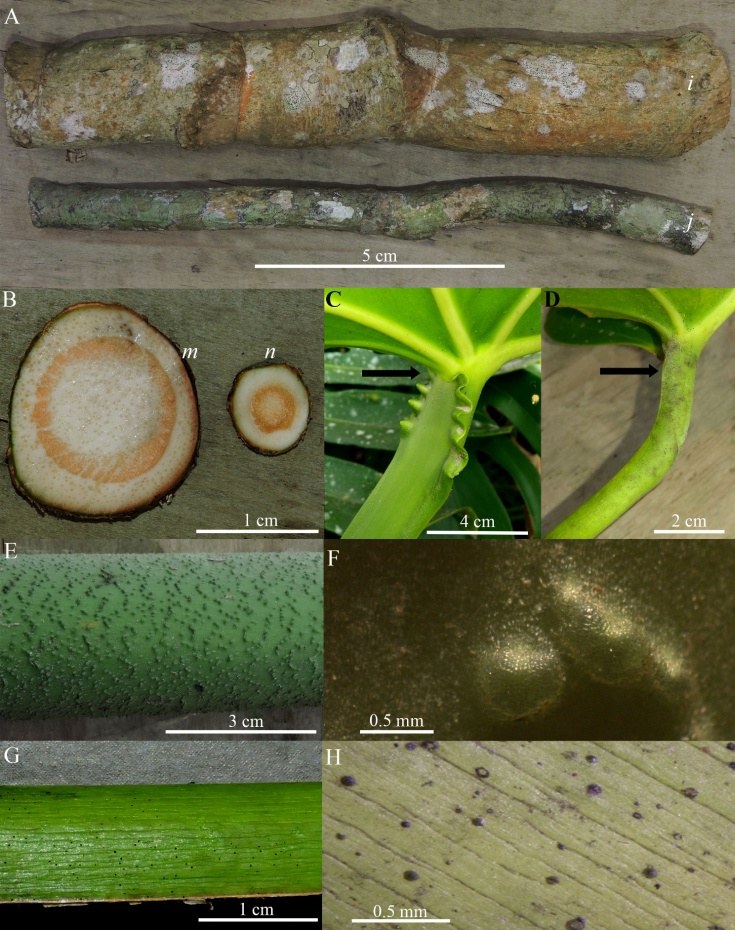
Width across the petiole, and how far the sheath runs toward the geniculum. Dull, quick, and repeatedly the character that carries a diagnosis in the modern treatments — as it does for Monstera obliqua3. It also has the advantage of being a number, which a photograph of a leaf never is.
-
Record the internodes and the leaf scars
How far apart the leaves sit along the stem, and the shape of the scar left behind. These are among the characters that held when the genus was examined across species, and they survive on a plant that is not flowering.
-
Only then, the blade
Outline, perforations, how the holes sit relative to the midrib. Useful for narrowing, poor for deciding — and worth photographing with something for scale, because absolute size is part of what a key asks and a photograph normally throws away.
If you have a juvenile, keep it, and photograph it
Madison divides the entire genus into sections on what the plant looked like in its earliest climbing phase — whether the leaves lay flat against the support or stood out from it1. Almost nobody has that plant any more. If you raised yours from seed, or bought it small, or have a cutting still shingling up a pole, you are holding the character the key most wants, and it will be gone in a year.
Photograph it. It costs nothing now and cannot be recovered later.
What is realistically reachable
| What you have | What can be settled |
|---|---|
| Wild-collected, locality recorded | A species determination, in the regional revision for that territory. |
| Cultivated, origin known to a country | Often a species, if a modern revision covers that country and the plant is an adult in good condition. |
| Cultivated adult, origin unknown | A section is unlikely without fruit or a juvenile. A species group is usually the honest ceiling. |
| Cultivated, still shingling | Better than the adult case — the sectional characters are present now1. |
| A variegated or named trade plant | The species behind it, at best. The cultivar name comes from the grower's records or it does not exist. |
Writing it down
The notation for a partial determination — cf., aff., and naming a rank above species — is set out in full in the Anthurium guide and works the same way here. The short version: write the rank you actually reached, say which treatment you used and its date, and record what you could not answer.
For this genus there is one addition worth making a habit. Record the stage. “Adult shoot, not flowering” or “still shingling” costs four words and tells the next person — quite possibly you, in three years — which half of the characters were even available when the name was assigned.
Given a genus where the revisers themselves name the juvenile-to-adult change as the first cause of confusion3, a determination that does not say which stage it was made on has left out the most important thing about it.
Sources
The papers behind this guide
Five sources. Three of them are revisions — one of the whole genus and two regional — and between them they are the working documents for anyone trying to name a Monstera. Where a modern revision covers your plant's origin, that revision is the answer, and this page exists mainly to say which one.
- Madison, M. (1977). A Revision of Monstera (Araceae). Contributions from the Gray Herbarium of Harvard University, No. 207. The only revision of the whole genus, and the source of nearly everything said about Monstera since. Recognizes 22 species and 3 varieties from Mexico to Brazil. Carries the keys quoted in Part I — including the key to sections, which divides the entire genus on the earliest climbing phase and on characters of fruit.
- Cedeño-Fonseca, M., Hay, A. & Blanco, M. A. (2022). A taxonomic revision of Monstera Adans. (Araceae: Monsteroideae) in Costa Rica. Aroideana 45(1). Thirty-five species in one country, ten of them described only very recently, one (Monstera deliciosa) introduced. A key and an illustration for each. Also fixes the types of several long-troublesome names, Monstera borsigiana among them.
- Croat, T. B., Cedeño-Fonseca, M. & Ortiz, O. O. (2024). Revision of Monstera (Araceae: Monsteroideae) of Central America. Phytotaxa 656(1): 1–197. doi:10.11646/phytotaxa.656.1.1 The current treatment, and the frankest thing written about this genus. Recognizes 52 native species. Its abstract states that Monstera is the taxonomically least understood genus in the Araceae in Mesoamerica, names the juvenile-to-adult change and precocious flowering as the reasons, and says the traditional characters were studied chiefly on dried specimens with their variation in living plants largely unknown. Built on 4,500 specimens and fieldwork photographing plants at different stages. Source of the Monstera obliqua diagnosis in Part III.
- Cedeño-Fonseca, M., Díaz Jiménez, P., Zuluaga, A. & Blanco, M. A. (2020). A comparison of Monstera deliciosa and M. tacanaensis, with comments on Monstera section Tornelia (Araceae). Aroideana 43(1&2). Settles borsigiana. The name is a synonym of Monstera deliciosa, representing one of its variations, and the paper walks the argument from Koch's 1862 description through Hemsley being unable to tell them apart and Birdsey's 1951 "suppressed juvenile state". Also restricts the natural range of Monstera deliciosa to southern Mexico and Guatemala, the Costa Rican and Panamanian plants belonging to Monstera tacanaensis.
- Phillips, C. (1987). Aroid Profile No. 12: Monstera obliqua, Featuring the "Laceleaf" Form — An Extreme Variant Within a Highly Variable Species. Aroideana 10(2). Worth reading for its title alone, which states the position on the lacy form nearly forty years before the question became a marketplace argument. A profile rather than a revision, with a long synonym list.