ALOCASIA
DESCRIPTION
Historical Synonyms: Colocasia (1832), Ensolenanthe (1861), Xenophya (1863), Schizocasia (1880), Panzhuyuia (1985)
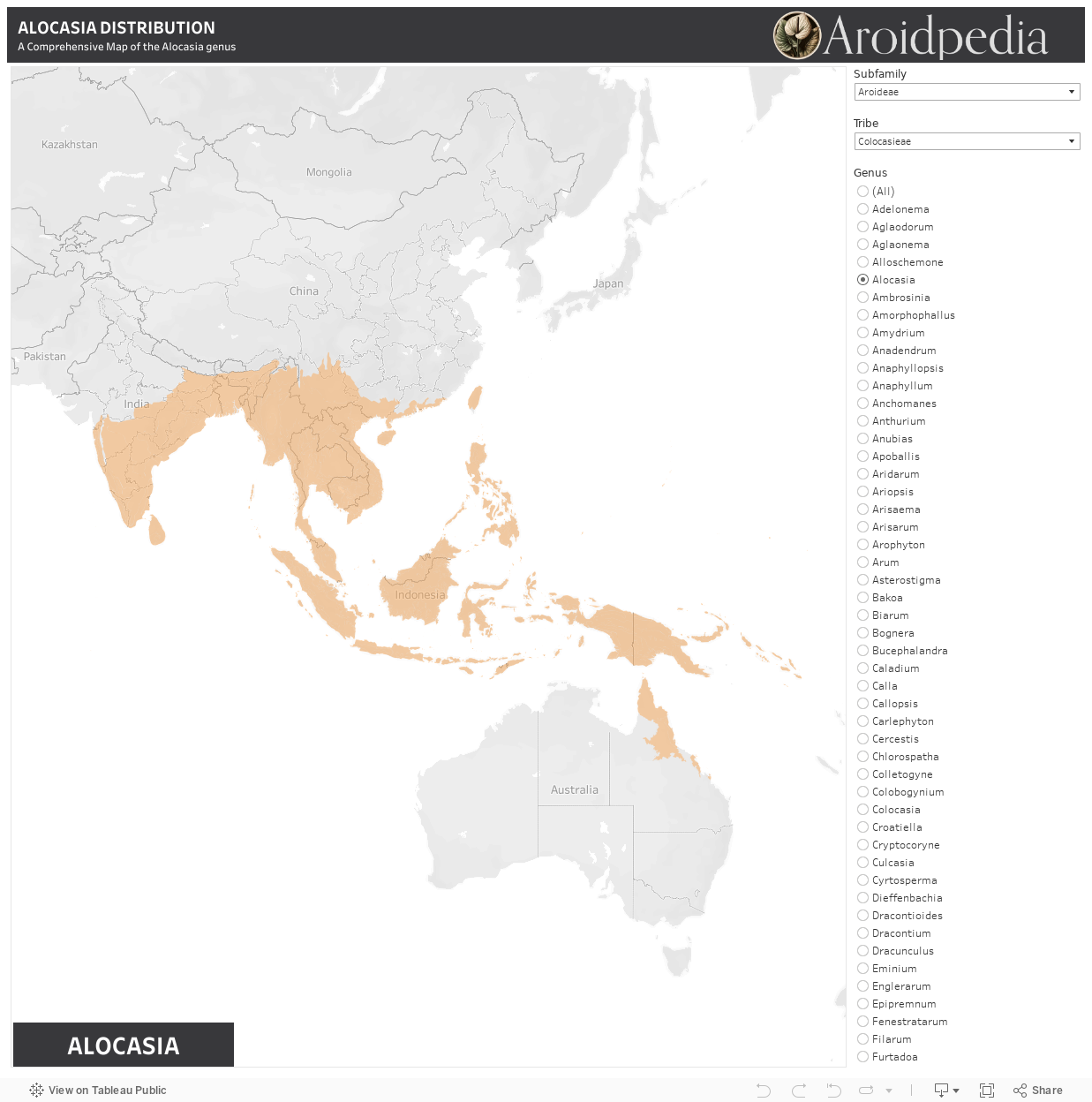
Alocasia is a genus of broad-leaved rhizomatous or tuberous perennial flowering plants from the family Araceae. There are 100+ species distributed from the subtropical eastern Himalayas throughout subtropical and tropical Asia into the tropical western pacific and eastern Australia
DISTRIBUTION
Tropical Asia, Australasia, Malay Archipelago, Melanesia
Australia (Queensland, New South Wales), Bangladesh, Brunei, Burma, Cambodia, China (incl. Taiwan), Fiji, India, Indonesia (Borneo, Irian Jaya, Java, Moluccas, Sulawesi, Sumatra), Japan (incl. Ryukyu Is.), Laos, Malaysia (Borneo, Peninsula), Nepal, Papua New Guinea, Philippines, Solomon Is., Sri Lanka, Thailand, Vietnam.
ECOLOGY
CLIMATE: Alocasia species generally thrive in tropical and subtropical regions characterized by high humidity and abundant rainfall. They are most commonly found in everwet to seasonally wet environments with average temperatures ranging from about 20°C to 35°C (68°F to 95°F). In many areas, annual precipitation exceeds 2,000 mm (79 in). Alocasias are well-adapted to consistent moisture, and while most prefer stable, warm temperatures, a few species can tolerate slightly cooler conditions at higher elevations. Their large, broad leaves also help them capture diffuse sunlight under the forest canopy.
HABITAT: Alocasia predominantly occupy niches in primary and secondary tropical forests, including transitional zones such as early regrowth and open swamp edges. They often establish themselves on the forest floor, nestled in layers of leaf litter, where nutrients are abundant and moisture levels remain high. Many species can also be found growing in humus deposits on rocks, taking advantage of nooks and crevices that accumulate organic matter. Their robust root systems allow them to anchor in steep or rocky terrain, especially in humid montane forests. Although Alocasia typically favor lowland habitats up to mid-elevation zones, certain exceptions can be found at higher elevations, particularly in regions where consistent cloud cover and humidity mimic lowland moisture conditions.
MORPHOLOGY
The genus Alocasia is celebrated for its unique morphological diversity, evident in species ranging from small herbs to massive arborescent plants which exhibit strikingly variable vegetative and reproductive structures that have evolved to adapt to diverse ecological niches.
-
One of the most remarkable aspects of Alocasia morphology is its leaf structure, which plays a crucial role in species identification. Alocasia leaves are generally large, often displaying a sagittate or hastate shape, with variations in color, texture, and venation that are essential for distinguishing species.
The leaf blade in Alocasia species is typically supported by three main veins which define the anterior and posterior lobes, respectively.
-
Alocasia stems range from short, rhizomatous structures in smaller species to robust, tall stems in arborescent varieties like Alocasia robusta. The stem produces foliage and flowers in a sequential growth pattern, creating a characteristic "crown" at the top of the plant. In some species, the stem or rhizome generates stolons that produce cormels—small underground tubers that serve as reproductive structures, allowing plants to colonize new spaces when conditions are favorable.
-
The inflorescence of Alocasia is another distinct morphological feature. Alocasia flowers are organized on a spadix surrounded by a protective spathe, divided into a persistent lower portion that encloses the female and sterile zones, and an upper, ephemeral limb that typically falls off post-anthesis. The female flowers mature before male flowers to reduce the likelihood of self-pollination.
The spadix may emit a scent to attract pollinators, ranging from a sweet fragrance to an odor reminiscent of decay. Some species even display thermogenic properties, where the spadix generates heat to help volatilize these scents, enhancing pollinator attraction in cooler environments
-
The remarkable morphological diversity among Alocasia species reflects various ecological adaptations. For example, species like Alocasia perakensis and Alocasia kerinciensis are adapted to montane habitats, while Alocasia puber and Alocasia princeps prefer swampy or well-drained sites, respectively. Additionally, certain species, such as Alocasia melo, are restricted to specific soil types like ultramafic substrates, while others like Alocasia cuprea exhibit flexibility, thriving on diverse substrates including limestone and sandstone.
CULTIVATION
ALOCASIA are a striking addition to any plant collection, offering some of the most distinctive ornamental foliage in the Araceae family.
They thrive under specific conditions, but are generally easy and rewarding to cultivate if those conditions are met.
-
Alocasia prefer a rich substrate that retains moisture while not getting excessively water-logged and anoxic:
A mix of peat moss/coco peat, perlite, pine fines or rice hulls, orchid bark and worm castings will work excellently for most growers. Advanced growers may see success with semi-hydroponic growing media as well (LECA, PON, etc.)
Additives like humic acid, systemic BONIDE granules or dolomitic lime can also benefit Alocasia, depending on species and individual growing conditions
-
Alocasia are heavy feeders and benefit from fertilization with every watering (the mantra weakly weekly works excellently). This can be done either:
externally with fertilizer added to watering solution (General Hydroponica Flora Series)
internally with slow-release forms of fertilizer added to the substrate (Nutricote, bone meal & blood meal)
-
TEMPERATURE: Like many other tropical genera, Alocasia prefer warm to hot temperatures, but substrate (root zone) temperatures are most critical for healthy growth: ideally you would sprout corms at 77-86°F (25-30°C) and switch to 72-79°F (22-26°C) for vegetative growth. Anything below 50°F (10°C) is detrimental, while temperatures below 40°F (4°C) are injurious and may cause irreversible damage
HUMIDITY: 60-80% RH is recommended for optimal growth and maintaining an acceptable VPD (Vapor Pressure Deficit), though many growers have reported Alocasia will adapt to ambient humidity as low as 30% if needed (this will result in very high VPDs and nutrient burn is possible, so lighter fertilization is recommended)
WATERING: Substrate should be kept consistently moist and should never be allowed to dry out
LIGHT: When grown outdoors, shade cloth blocking 70-80% of sunlight is recommended. For plants grown indoor under artificial lighting, this is equivalent to about 2000-3000 FC (400-600 µmol) and is ideal for growth and flowering.
A minimum of 200 FC (40 µmol) is required for maintenance, though no growth will take place at such low light densities. While still considered low light, Alocasia will grow, albeit slowly, starting at 400 FC (80 µmol)
POTTING: It is of the utmost importance to not use pots that are too large for Alocasia. While other Araceae genera prefer or tolerate over-potting, Alocasia will readily rot and die off if the roots and rhizome are surrounded by too much wet substrate. This has to do with the way Alocasia grow their roots: in the corm or bare rhizome state, roots will form horizontally to anchor the plant, and then will begin extending downwards, rather than filling the pot radially.
Many growers are misled by the size of the foliage and let it decide the size of the pot, but the rule of thumb for Alocasia is to use the smallest/tightest pot that can fit the rhizome and existing root system, and perhaps 20-30% substrate. A longer, narrower pot is preferable to a shorter, wider one.
-
Alocasia are easily propagated asexually. Healthy plants rapidly create offsets (also referred to as off-shoots or more colloquially pups), as well as propagative elements like terminal cormels (also referred to as corms). A larger rhizome can also be divided and propagated, similarly to how Monstera and Philodendron are propagated.
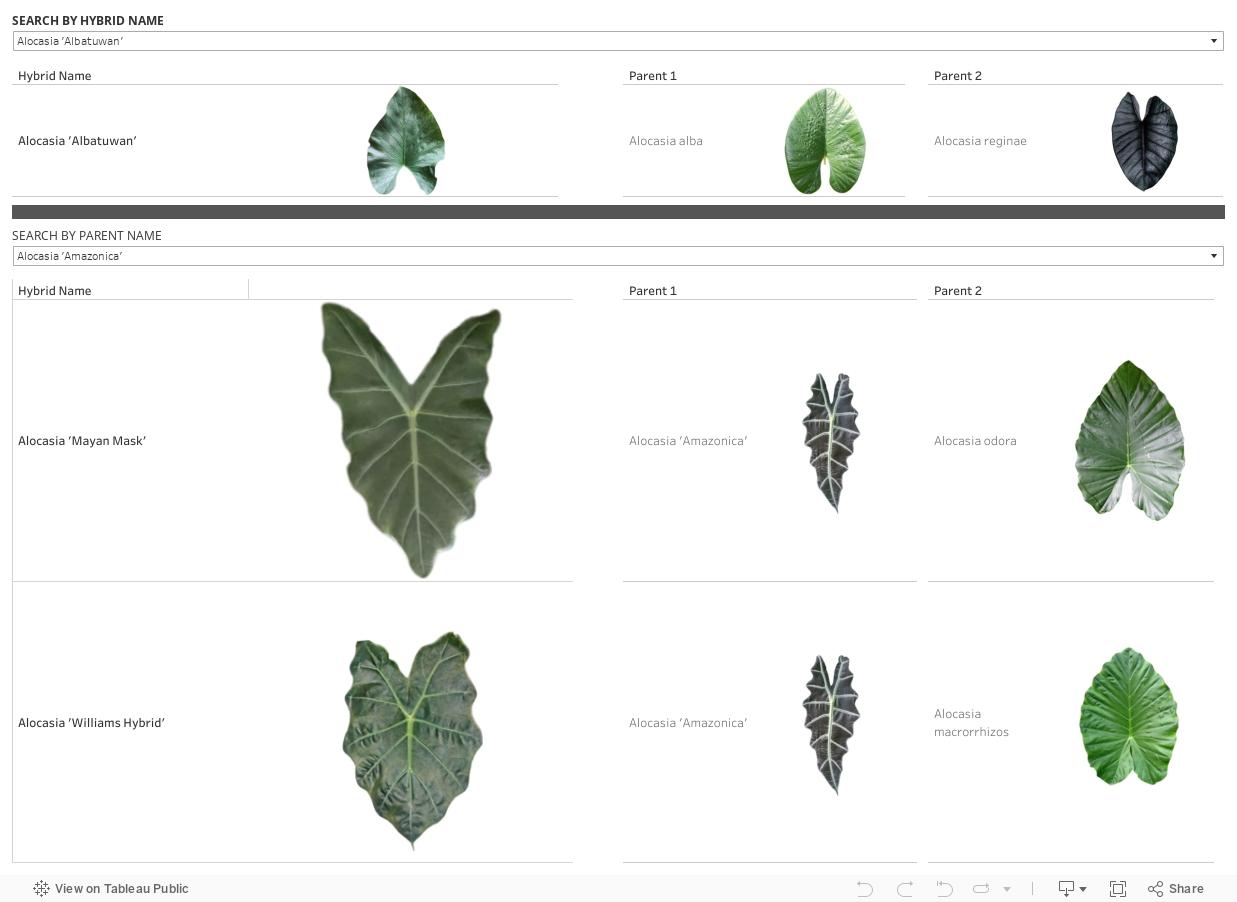
Sexual propagation (hybridization) in Alocasia has a rich history, dating as far back as the 1850s. While it takes a little more skill and luck to succesfully hybridize two Alocasia species or cultivars (intra-species hybridization is rarely worthwhile), it is a great way to select desirable qualities and create new and exciting plants. Please refer to the interactive dashboard at the bottom of this page for a complete list of existing hybrids.
-
As with most tropical plants, Alocasia are prone to infestations by a multitude of pests, particularly spider mites and thrips. For a complete list of pests and the recommended treatments please see the Pest Management GuideItem description
ALOCASIA TIMELINE
An interactive timeline showing the year each Alocasia species was first described as Alocasia (please note species may have previously been classified in other genera)
ALOCASIA SPECIES & CULTIVARS
Species marked with * are not yet fully described, or accepted
Species marked with ** are described, but not accepted
ALOCASIA HYBRIDS